

The pilot of a Cirrus received a TAWS (terrain awareness warning system) 'terrain, pull up' alert during a nighttime approach to land at Canberra Airport, an ATSB final report details.
The pilot of the single-engine Cirrus SR22T was conducting an instrument flight rules private flight with one passenger from Wangaratta, Victoria, to Canberra, ACT, on the evening of 2 October 2025, the investigation report details.
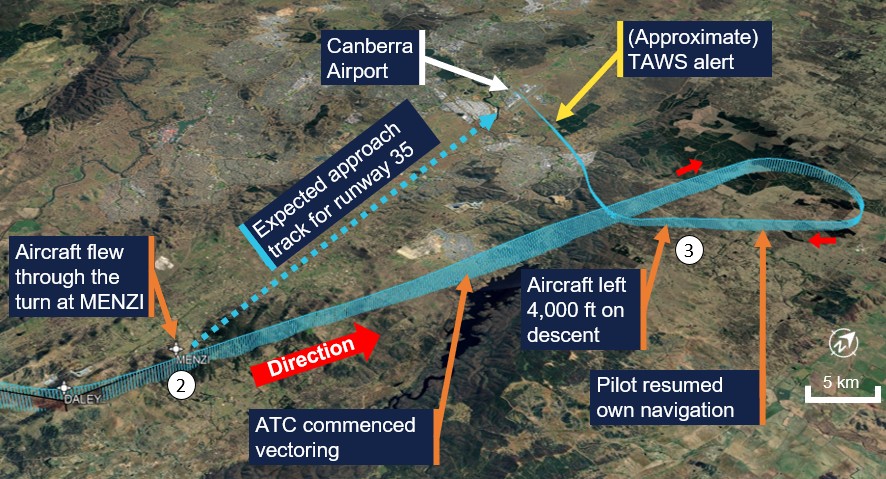
Arriving near Canberra shortly after sunset while in turbulence and initially in cloud, the pilot was cleared by the approach controller to commence a standard arrival route (STAR) to land on runway 35.
The investigation report details that the pilot mistakenly interpreted the clearance to “descend via STAR” as an instruction to descend immediately.
Consequently, the aircraft descended below the minimum STAR segment altitude of 9,000 ft, before the controller instructed the aircraft to climb back to 9,000 ft, and then began providing step descent instructions.
A short time later, as the aircraft neared the end of the STAR, the controller provided clearance for an instrument landing system (ILS) approach to land on runway 35.
“In the absence of a request for a different approach on the flight plan, the controller’s ILS clearance was in line with procedures for the assignment of an approach, but the pilot had been expecting to conduct, and had prepared for, a different type of approach,” ATSB Director of Transport Safety Dr Stuart Godley said.
The pilot was reprogramming their flight management system for the ILS approach when they inadvertently flew through the STAR’s final waypoint without making the prescribed turn onto the runway heading.
“Having only flown one approach into a major airport in the last 12 months, and given the weather conditions, the pilot reported experiencing a high workload,” Dr Godley said.
The controller then cancelled the ILS clearance and provided vectors for the pilot instead to line up to land on runway 30, and cleared the pilot for a visual approach once they had the runway in sight.
The approach controller, who was based in Melbourne Centre, was not aware that there had been a transition to nighttime procedures a few minutes before. As a result, the controller applied daytime procedures in issuing vectors when the aircraft was below the minimum vectoring altitude, and omitted the nighttime instruction to the pilot to maintain their assigned altitude until established on the precision approach path indicators (PAPI, a set of approach slope guidance lights).
During the approach to runway 30, the pilot descended below the cleared altitude without having established visual reference to the PAPI, and remained well below the correct vertical profile, resulting in the ‘terrain, pull up’ TAWS alert.
Flight data showed the aircraft levelling off about 500 ft above ground level – at the time of the alert the pilot recalled they could see the runway lights ahead and discern the horizon but could not see the ground below – before regaining the approach slope and landing without further incident.
“The approach and landing phases for single pilot instrument flight are typically high workload, particularly at night in turbulence, creating challenges in maintaining the correct approach profile,” Dr Godley said.
“If in a demanding, high-workload situation in controlled airspace, pilots can ask the controller for assistance, or conduct a missed approach to ensure continuing safety.”
Read the final report: Descent below lowest safe altitude and ground proximity alert involving Cirrus SR22T, VH-XXO, Canberra Airport, Australian Capital Territory, on 2 October 2025