

A Bell 412 helicopter entered an uncommanded descent while filling its bucket from a river during firebombing operations at the Canning Peak fireground about 55 km north-east of Strahan, in western Tasmania, an ATSB investigation final report details.
On 10 March 2025, the Coulson Aviation Australia operated and NSW Fire Service owned Bell 412EP was on a Tasmania Fire Service tasking conducting aerial firebombing using a longline and bucket.
The investigation report details that as the helicopter was filling its bucket while in the hover about 150 ft over a dip site in the Murchison River, it unexpectedly sank about 50 ft.
“Fortunately, although unable to jettison the longline, the pilot was able to recover the descent and establish a stable hover,” ATSB Chief Commissioner Angus Mitchell explained.
In attempting to jettison the longline, the pilot reported that they likely pressed the ring guard of the electrical release button rather than the centre of the button.
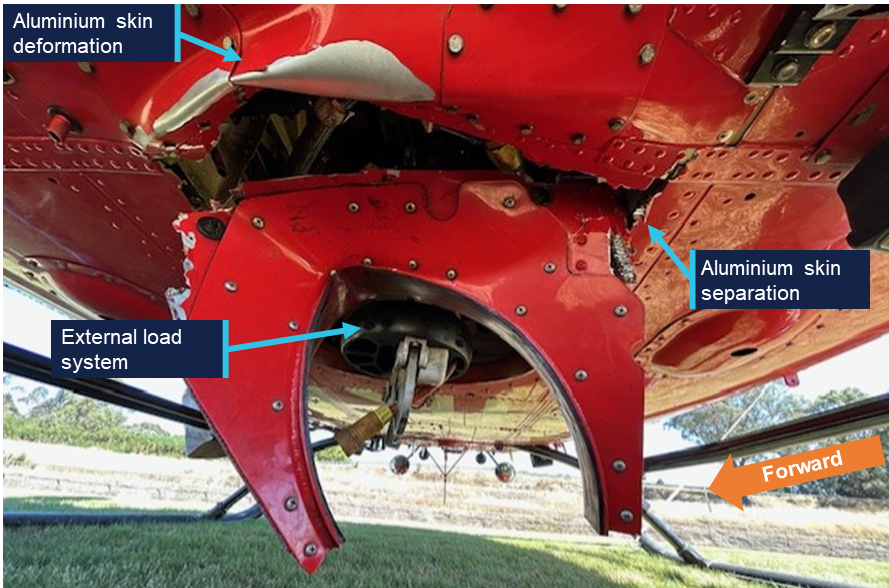
“The resulting loading of the longline from the submerged bucket led to contact between the longline and the helicopter, causing damage to the airframe and flight control systems,” Mr Mitchell continued.
The pilot initiated rearward flight to release the water and retrieve the bucket. Once the bucket and longline were recovered, the pilot climbed to clear the surrounding trees.
“Despite some flight control issues, the pilot was able to safely return and land at a refuelling base, where substantial damage to the helicopter’s underside and flight controls was identified.”
The ATSB’s investigation found that while approaching the dip site the pilot had commenced a steep descent at low forward airspeed and with power applied, likely conducive to the helicopter entering an incipient vortex ring state (VRS), or settling with power, or a combination of both, resulting in the uncommanded descent.
The investigation also found that the configuration of NSW RFS Bell 412s reduced pilot visibility of suspended loads during bucketing operations.
“Where fitted, external FLIR cameras and extended flight steps impeded pilot visibility of suspended loads,” Mr Mitchell explained.
“As a result, pilots reported adopting a steeper approach profile to compensate, which increased the helicopter’s susceptibility to aerodynamic conditions associated with VRS and settling with power.”
Coulson and NSW RFS have subsequently commenced a review to consider shortening of the flight steps, and have commenced a program to improve commonality of the helicopters’ systems, cockpit layouts, avionics and pilot operating interfaces.
In addition, the ATSB’s investigation identified that Coulson’s flight risk analysis tool (FRAT) did not adequately account for mission-specific and aircraft-specific risks associated with aerial firefighting operations.
The FRAT was used by pilots before the first flight of the day (and to be subsequently re-evaluated if weather changes or maintenance resulted in the stoppage of operations), to document and track operational risk.
“The ATSB identified problems in the design, application and oversight of the FRAT, and found the operator had limited effective mechanisms for improvement of the FRAT,” Mr Mitchell said.
“These factors reduced the FRAT’s effectiveness in identifying and managing operational risk.”
Coulson has since commenced a FRAT improvement program aimed at strengthening flight risk management through a redesign of the FRAT template to better capture the operational environment and associated operational risks.
“This investigation highlights that operators should ensure that appropriate risk assessment and operational decision‑making tools are available to assist pilots in identifying conditions that may increase exposure to VRS or settling with power during firefighting operations,” Mr Mitchell said.
In addition, pilots conducting firefighting operations should remain alert to the operational conditions associated with VRS and settling with power.
“Obstacles, reduced recovery options, low airspeeds, and elevated power settings can increase susceptibility to VRS and settling with power conditions, particularly during approaches to water sources in confined areas,” he concluded.
Read the final report: Loss of control and equipment contact with water involving Bell 412EP, VH-VJF, 57 km north-east of Strahan Airport, Tasmania, on 10 March 2025