

Preliminary report
Report release date: 30/09/2026
| The ATSB has released this preliminary report to provide a timely update on evidence gathered and investigation activities to date. It outlines areas of further investigation but does not contain analysis or findings, which will be detailed in a final report at the conclusion of the investigation. The information in this report is released in accordance with section 25 of the Transport Safety Investigation Act 2003. |
Summary video
The occurrence
On the morning of 18 August 2026, a Qantas Airways Airbus A321-271NY, registered VH-OGA, was operating flight Qantas 405 (QF405) from Sydney, New South Wales, to Melbourne, Victoria, with 3 flight crew, 5 cabin crew and 176 passengers on board. At around 0627 local time, the flight crew began to taxi the aircraft from the domestic terminal towards runway 34R1 for departure. Prior to reaching the runway, the flight crew observed an issue with the aircraft’s braking system and decided to return the aircraft to parking bay 3 at the domestic terminal in accordance with the airline’s procedures. Following rectification of the fault, the aircraft was pushed back from its parking position again at around 0757 to recommence the flight.
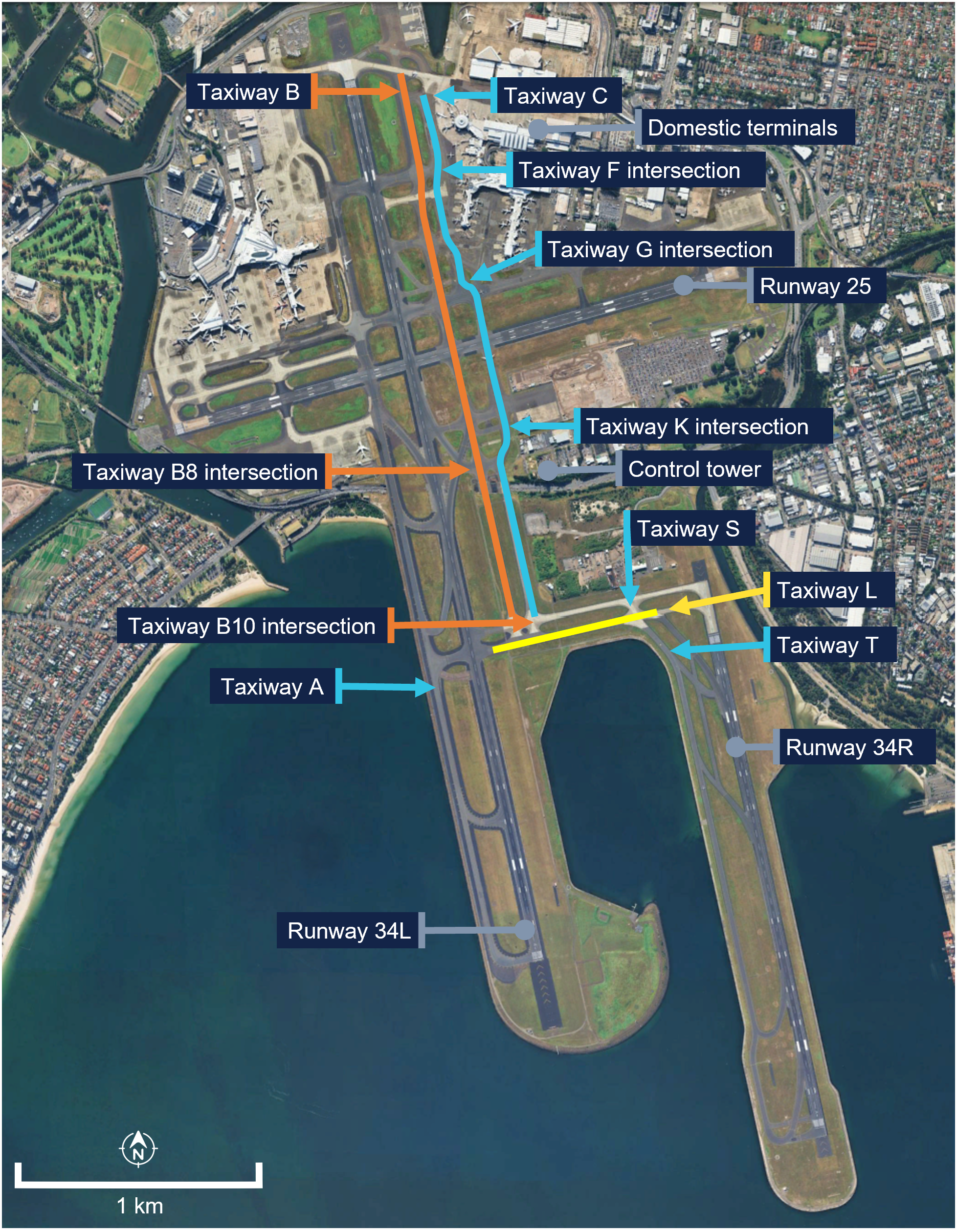
For the second departure, the flight crew decided to use the longer runway 34L. At around 0800, the flight crew contacted the surface movement controller (SMC) east, the air traffic controller responsible for ground movements in that part of the airport, and requested permission to taxi from the domestic terminal to runway 34L. The SMC east instructed the flight crew to follow the standard taxi route and initially to hold short of taxiway F (Figure 1).
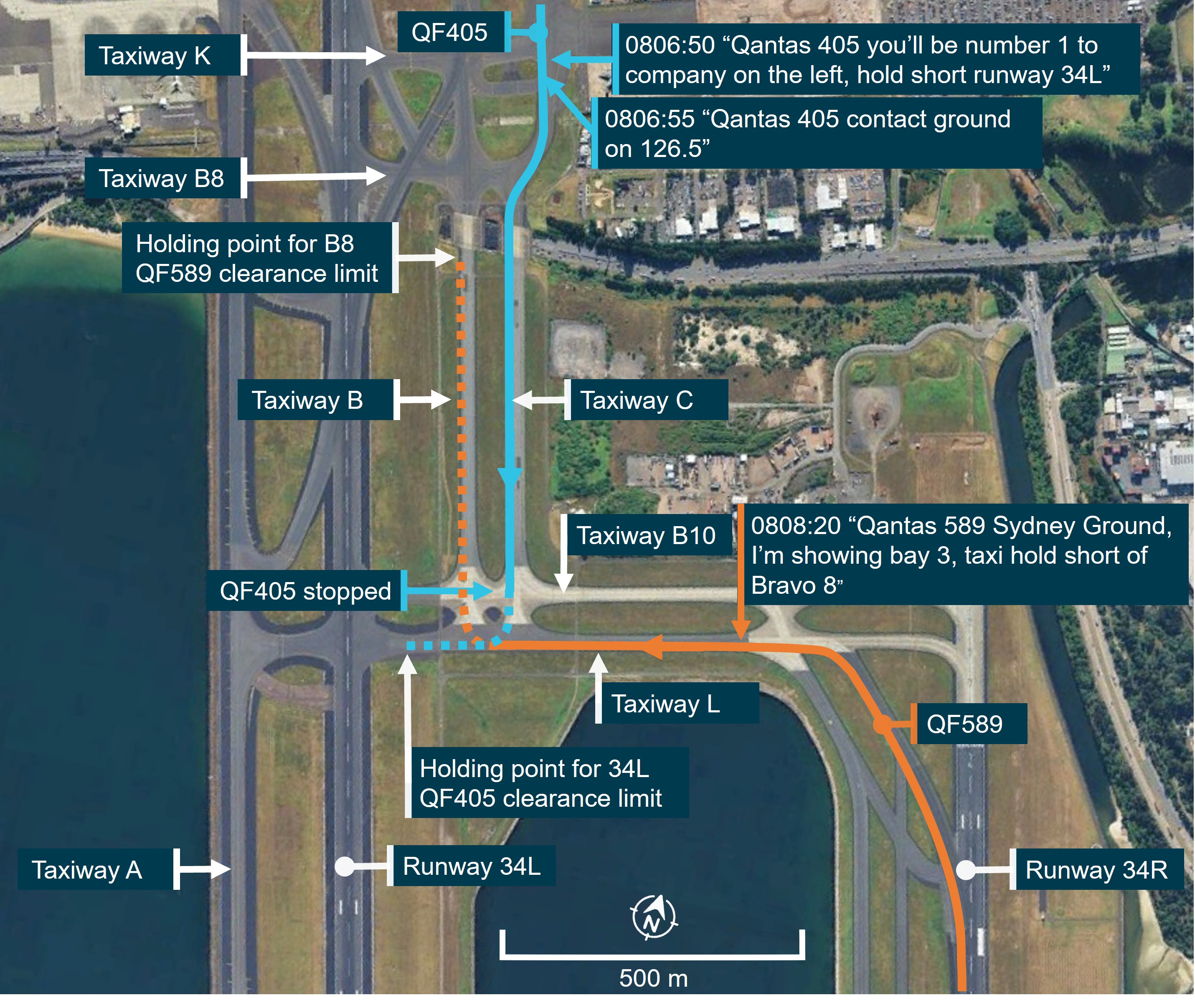
Sydney Airport’s standard taxi route from the domestic terminal to the threshold of runway 34L was along taxiways C, L and A, crossing runway 34L on taxiway L (Figure 2). As the aircraft moved south on taxiway C, the controller progressively extended the limit of its taxi clearance, first to hold short of taxiway G, and subsequently to cross runway 25 and hold short of taxiway B10.
At 0806, as the aircraft passed south of taxiway K, the SMC east informed the crew of QF405 that ‘… you’ll be number 1 to company on the left …’ meaning that they had priority in sequence2 over another taxiing Qantas aircraft that would approach them from their left (Figure 2).
During that radio exchange, the controller also further extended the aircraft’s taxi clearance limit, instructing QF405 to hold short of runway 34L. The clearance required the aircraft to continue along taxiway C, cross taxiway B10, then turn right onto taxiway L and follow it to the holding point for runway 34L. After confirming flight crew readback of this clearance and advice of company traffic, the SMC east instructed QF405 to change radio frequency and contact the SMC west, the air traffic controller responsible for coordinating the crossing of runway 34L and the remainder of the aircraft’s taxi. The flight crew changed radio frequency shortly after.
Figure 1: Sydney Airport with key taxiways and intersections
At about 0808, a Qantas Airways Boeing 737-800, registered VH-VXL, operating flight Qantas 589 (QF589) from Gold Coast, Queensland, exited runway 34R after landing at Sydney. The aircraft had 2 flight crew, 4 cabin crew, and 144 passengers on board. As the aircraft entered taxiway L (Figure 2), the flight crew contacted the SMC east and communicated that they wished to taxi to parking bay 7 at the domestic terminal. The SMC east informed them that there had been a change of bay and that parking bay 3 had been allocated to the aircraft, then cleared them to taxi and hold short of taxiway B8.
The published standard taxi route required the aircraft to continue along taxiway L then turn right onto taxiway B (Figure 2). After acknowledging the correct parking bay allocation, the crew readback the taxi clearance and the aircraft continued along taxiway L. The SMC east did not advise the flight crew of any sequence priority over other taxiing aircraft and did not mention QF405. The flight crew of QF405 did not recall hearing the communications between the SMC east and QF589, likely because they had already switched to the SMC west radio frequency.
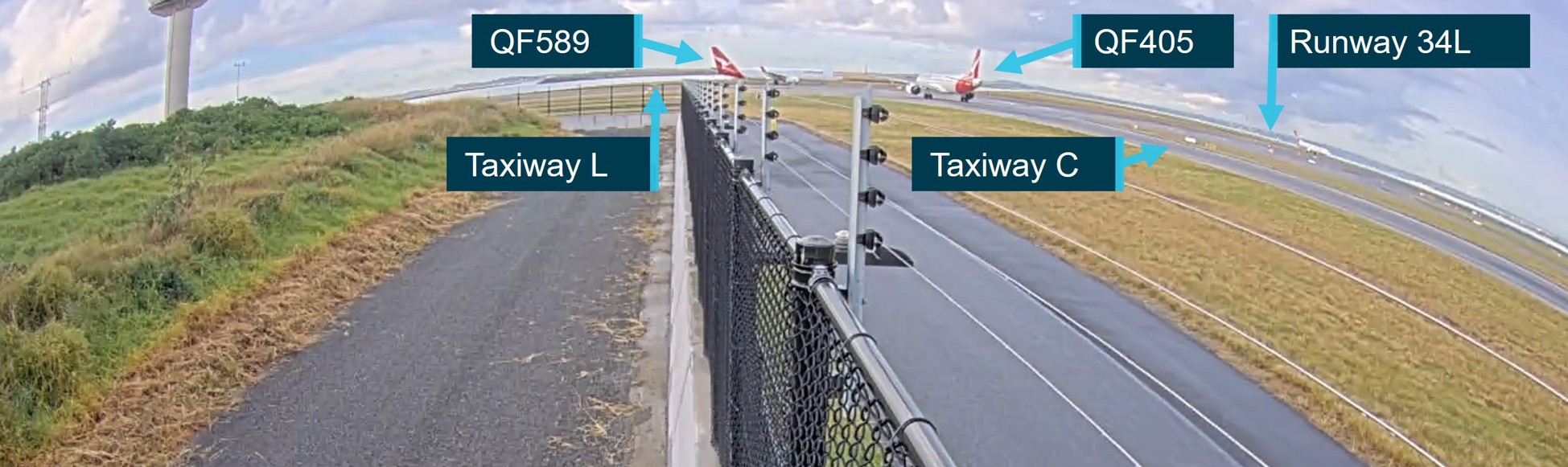
As the flight crew of QF405 approached taxiway L, they sighted QF589 moving from east to west on that taxiway and identified it as the aircraft over which they had been given priority. As the 2 aircraft converged, the flight crew of QF405 noted that QF589 did not appear to be slowing and assessed that it would not give way to them. Having already slowed to navigate the turn onto taxiway L, the captain of QF405 applied additional braking and brought the aircraft to a stop, just beyond the holding point for taxiway B10, but short of taxiway L. QF589 continued its taxi along L, passing in front of QF405 at around 0809, then turned north onto taxiway B.
Figure 2: Expanded view of aircraft taxi routes with key ATC communications
After QF589 had taxied past and was clear of their aircraft, the flight crew of QF405 continued onto taxiway L and to the holding point for runway 34L. The flight crew of QF589, having noted that QF405 appeared to stop more abruptly than normal and beyond the holding point for taxiway B10, contacted the SMC east to confirm they had been cleared to hold short of B8. By this time, a new controller had assumed the role of SMC east and they confirmed that the clearance was issued to taxiway B8. QF589 taxied to its parking bay and QF405 proceeded to depart, both without further issue.
Context
Personnel information
Surface movement controller east
The surface movement controller (SMC) east was appropriately endorsed for their role as SMC east and reported that they were also endorsed for the SMC west and clearance delivery control positions at Sydney Airport (see the section titled Air traffic services). The SMC east had been an air traffic controller for 16 years of which 1 year had been spent at Sydney Airport.
On the day of the occurrence, the controller began their shift at 0550 in the clearance delivery role and took a scheduled 30-minute break at around 0700. At 0730, the controller returned to work in the SMC east role and was on duty for around 39 minutes prior to the occurrence. Shortly after the occurrence, the controller was removed from duty for the rest of the day.
The controller reported that the traffic level was moderate at the time of the occurrence and typical for that time of the day at Sydney. The controller did not have an elevated predicted fatigue level based on their previous roster. Additionally, the controller reported feeling alert at the time of the occurrence and that they likely had around 8 hours of sleep the previous night. On the day before the occurrence, the controller had worked from 0730–1530 and had been on leave for the 2 days before that.
Qantas 405 captain
The captain held an Air Transport Pilot Licence (Aeroplane), a Class 1 aviation medical certificate, the appropriate type rating for the Airbus A321, and reported a total flying time of 14,256 hours, with 263 hours on type. The captain reported that they had been on duty for around 2.6 hours and awake for about 4 hours before the occurrence. They reported about 8 hours sleep the night before and reported feeling ‘fully alert’ at the time of the occurrence.
Qantas 589 captain
The captain held an Air Transport Pilot Licence (Aeroplane), a Class 1 aviation medical certificate, the appropriate type rating for the Boeing 737, and reported a total flying time of 19,016 hours, with around 4,148 hours on type. The captain reported they had been on duty for 2 hours and awake for about 3.5 hours before the occurrence. They reported about 7 hours sleep the night before and reported feeling ‘pretty good’.
Aircraft information
VH-OGA
VH-OGA was an Airbus A321-271NY, serial number 12323 and operated by Qantas Airways as flight QF405. The aircraft was manufactured in Germany in 2025 and first registered in Australia in March 2025.
VH-VXL
VH-VXL was a Boeing 737-838, serial number 33482 and operated by Qantas Airways as flight QF589. The aircraft was manufactured in the United States in 2002 and first registered in Australia in April 2002.
Airport information
Sydney Airport has 3 runways (Figure 1), a parallel pair – 16R/34L and 16L/34R, orientated approximately north-south – and an east-west runway, 25/07. On the morning of the occurrence, aircraft were arriving and departing Sydney Airport using runways 34L and 34R. When these runways were in use, jet aircraft departing from the domestic terminals generally used runway 34R to avoid crossing runway 34L during taxi. However, when required, domestic aircraft were permitted to nominate 34L as their departure runway.
Airservices Australia published standard taxi routes, which aircraft were expected to follow unless explicitly instructed otherwise by an air traffic controller. The standard taxi route for aircraft taxiing from the domestic terminal to runway 34R was via taxiways C, B10, S and T (Figure 1). Airservices Australia procedures required the SMC east to instruct all aircraft taxiing for departure on runway 34R to hold short of taxiway S and then hand them over to the aerodrome controller (ADC) responsible for that runway for further taxi instructions. The standard taxi route for aircraft arriving on runway 34R and taxiing to the domestic terminal was via taxiways L and B. Aircraft following these standard taxi routes to and from runway 34R were ordinarily separated from each other in the area controlled by the SMC east.
The standard taxi route for aircraft taxiing from the domestic terminal to runway 34L was via taxiways C, L, and A, crossing runway 34L on taxiway L. Aircraft needing to cross runway 34L for departure were handed over to the SMC west before reaching the holding point for that runway. It was the responsibility of the SMC west to coordinate the runway crossing with the appropriate ADC. Aircraft following this route to runway 34L would cross over the standard taxi route for inbound aircraft taxiing from runway 34R to the domestic terminal around the intersection of taxiway L with taxiways C and B.
Air traffic services
Overview
Air traffic services were provided by Airservices Australia (Airservices). Sydney control tower had 7 control positions:
- aerodrome controller (ADC) east and west
- surface movement controller (SMC) east and west
- clearance delivery
- coordinator
- tower shift manager (TSM).
These positions could be combined in various ways and operated by fewer controllers depending on traffic state and other factors.
The ADC east was responsible for movements on runway 34R/16L, and ADC west was responsible for movements on 34L/16R.
At the time of the occurrence, the SMC east and west positions were staffed by separate controllers. The SMC east was responsible for vehicles and aircraft using taxiways east of runway 16R/34L, except for certain taxiways controlled by the aerodrome controller (see the section titledAirport information). SMC west was responsible for vehicles and aircraft using taxiways west of runway 16R/34L.
The clearance delivery controller was responsible for obtaining and providing airways clearances3 to aircraft in preparation for their departure.
The coordinator (COORD) was responsible for keeping the Automatic Terminal Information Service (ATIS)4 updated and working with external stakeholders on departure times. The position helped control the flow of departures and keep aircraft ground running times to a minimum. The coordinator role supported the SMC by providing sequencing of ground movements and deconfliction of ground traffic.
The tower shift manager (TSM) role was to provide general supervision of operational staff to ensure a safe and efficient air traffic service and to provide overall responsibility for the provision of the tower’s air traffic service. At the time of the occurrence, the TSM and COORD roles were combined with a single appropriately-endorsed controller responsible for both roles. Under their supervision, a second controller undergoing position familiarisation was performing the duties of the COORD role.
Surface movement control
The Manual of Air Traffic Services (MATS) stated that the separation of aircraft taxiing on an airport manoeuvring area5 was a joint pilot and controller responsibility. It instructed that controllers should provide taxi instructions that:
a) give adequate information to assist pilots in determining correct taxi routes and avoid collision with other aircraft or obstructions; and
b) regulate entry to and movement on taxiways
Controllers regulated the entry and movement on taxiways by issuing limits to taxi clearances, such as an instruction to hold short of a particular taxiway intersection. Where the paths of taxiing aircraft were likely to conflict, controllers could also issue the aircraft with sequence priorities6 to assist them in self-separation.
For aircraft manoeuvring on the ground, the Aeronautical Information Publication Australia contained the following information about standard sequencing phraseology:
- Controller transmission: GIVE WAY TO (description and position of other aircraft)
- Pilot transmission: GIVING WAY TO (traffic)
Surveillance
The SMC and ADC positions were equipped with advanced surface movement guidance and control system (A-SMGCS) displays (Figure 3). The A-SMGCS displayed the positions of aircraft and ground vehicles on a screen in front of the controller in the tower.
Figure 3: A reconstruction of the A-SMGCS display around the time of the occurrence
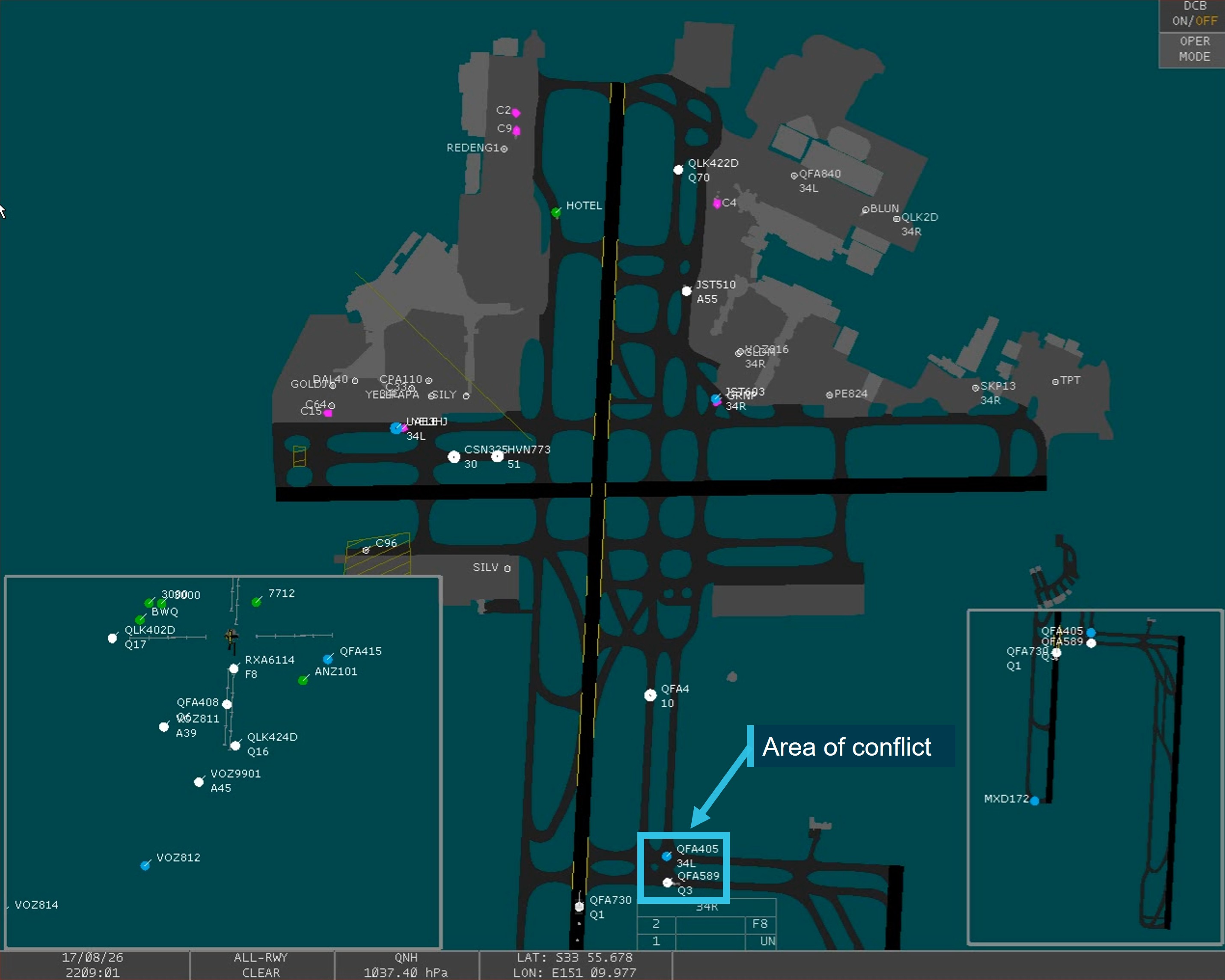
The SMC east reported that when seated at their control position in the tower, their view of taxiways B10, L and the southern parts of taxiways B and C was limited by the tower cab structure, equipment and people within it.
Flight progress strips
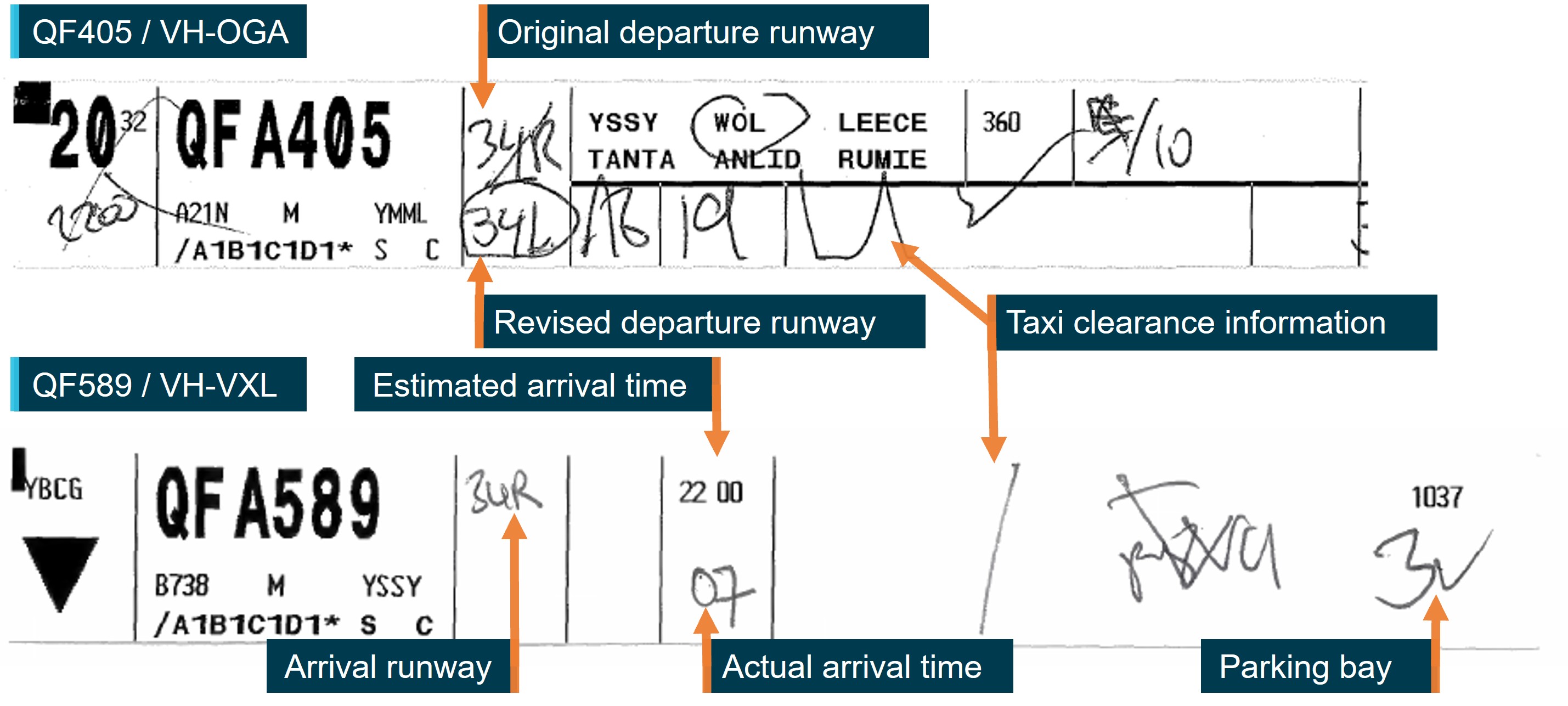
Controllers used physical flight progress strip (FPS) to keep track of aircraft details and positions (Figure 4). The FPS were moved between different controller positions as aircraft moved around the aerodrome and transferred between controller frequencies. Within control positions, controllers arranged the FPS on a flight progress board to indicate the aircraft sequence, and which aircraft were cleared to occupy a runway.
Controllers were able to mark the FPS to record specific information, such as the limit of an aircraft’s taxi clearance.
Figure 4: Flight progress strips for QF405 and QF589
Regulatory information
The Civil Aviation Safety Regulations Part 172 (Air Traffic Service Providers) Amendment (Fatigue Rules) Manual of Standards 2023 required Airservices Australia to have a fatigue risk management system (FRMS) that was approved by the Civil Aviation Safety Authority (CASA) for implementation by 1 September 2024. Airservices Australia had submitted a draft FRMS to CASA, however the FRMS had not yet been approved. Airservices Australia had been operating under a CASA exemption since 1 September 2024 which permitted operations without an approved FRMS.
CASA reported that, while the exemption was in place, Airservices continued to operate under existing fatigue risk management arrangements and was required to meet a number of additional conditions. This included providing CASA with regular reports on fatigue risk management and progress towards the development of an FRMS.
The current exemption commenced on 1 September 2026 and was due to expire on 28 February 2027. CASA expects Airservices to have an approved FRMS in place by the expiry of the exemption.
Fatigue risk management process
The Airservices fatigue risk management process focused on 2 controls: work scheduling, and education and awareness. Managing fatigue-related risk involved developing planned rosters/work cycles via a strategic roster planning process (which contained 12 strategic roster planning rules) and application of the tactical roster management process (risk identification, assessment and control) when changes to planned rosters/work cycles were required.
A controller could be allocated to a shift if their predicted fatigue level was ‘medium’ or ‘high’. However, a formal risk assessment was required. The risk assessment considered the expected operational situation for the shift (for example, the time of day and traffic volume) and applicable controls. The outcome of the risk assessment required acceptance by either a supervisor or manager, dependent on the risk level.
Predicted fatigue levels did not indicate that a controller was fatigued but that they were at risk of fatigue based on their roster. In addition to the organisational fatigue monitoring, Airservices required all controllers to advise their manager if they felt they were not fit for duty.
Airservices provided a list of risk controls that could be implemented to mitigate the impact of fatigue, which was managed by the tower shift manager. Some of those risk controls included:
- extra breaks
- change of duties during the shift
- releasing the controllers from their duties earlier than their scheduled finish time.
At the time of the occurrence, none of the controllers in the tower had a predicted fatigue level of medium or high that warranted additional risk assessment.
Meteorological information
At the time of the occurrence, the Bureau of Meteorology recorded that the visibility at Sydney Airport was in excess of 10 km. Cloud cover7 was observed to be ‘few’ at 3,900 ft and ‘scattered’ at 5,100 ft. The wind was about 5 kt from a north-westerly direction and the temperature was about 13°C.
Recorded information
Aircraft recorders
The operator provided recorded flight data for each aircraft. The flight data included multiple parameters, including position, heading and speed. Data from the aircrafts’ cockpit voice recorders (CVR) was not obtained.
Airservices data
Airservices provided recordings of VHF radio communications between the SMC positions and both aircraft, as well as recordings of phone calls between the tower shift manager and air traffic management director. Airservices also provided a recording of the A-SMGCS display.
Sydney Airport CCTV
Sydney Airport provided recordings of closed-circuit television (CCTV) footage covering the area around the intersection of taxiways C and L (Figure 5). This captured the movements of QF589 and QF405 at the time of the occurrence.
Figure 5: CCTV image of intersection of taxiways C and L
Further investigation
To date, the ATSB has received and begun analysis of:
- ground radar and air traffic control communications data from Airservices Australia
- operational documentation and procedures from Airservices Australia
- recorded flight data for both aircraft from Qantas Airways
- CCTV footage of the occurrence area from Sydney Airport.
Additionally, the ATSB has interviewed the pilots in command of both aircraft and the surface movement controller east.
The investigation is continuing and will include:
- analysis of recorded aircraft and air traffic control data and recordings
- review of operational procedures relating to aircraft taxi clearances
- review of similar occurrences.
Should a critical safety issue be identified during the course of the investigation, the ATSB will immediately notify relevant parties so appropriate and timely safety action can be taken.
A final report will be released at the conclusion of the investigation.
Purpose of safety investigationsThe objective of an ATSB safety investigation is to improve transport safety through:
In accordance with the TSI Act, the ATSB does not investigate for the purpose of taking administrative, regulatory or criminal action, and cannot apportion blame, assist in determining liability, or, as a general rule, assist in court proceedings. About ATSB reportsATSB safety investigation reports are developed in accordance with ATSB procedures and guidelines, and with regard to applicable international standards and instruments. Reports must include factual material of sufficient weight to support the investigation’s analysis and findings. At all times the ATSB endeavours to balance the use of material that could imply adverse comment with the need to properly explain what happened, and why, in a fair and unbiased manner. An explanation of terminology used in ATSB investigation reports is available here. Publishing informationReleased in accordance with section 25 of the Transport Safety Investigation Act 2003 Published by: Australian Transport Safety Bureau © Commonwealth of Australia 2026 Ownership of intellectual property rights in this publication Unless otherwise noted, copyright (and any other intellectual property rights, if any) in this report publication is owned by the Commonwealth of Australia. Creative Commons licence 
With the exception of the Commonwealth Coat of Arms, ATSB logo, and photos and graphics in which a third party holds copyright, this report is licensed under a Creative Commons Attribution 4.0 International licence. The CC BY 4.0 licence enables you to distribute, remix, adapt, and build upon our material in any medium or format, so long as attribution is given to the Australian Transport Safety Bureau. Copyright in material obtained from other agencies, private individuals or organisations, belongs to those agencies, individuals or organisations. Where you wish to use their material, you will need to contact them directly. |
- ^ Runway number: the number represents the magnetic heading of the runway (for example, runway 34 is oriented 340° magnetic). The runway identification may include L, R or C as required for left, right or centre.
- ^ Surface movement controllers sometimes issued sequence priority numbers to taxiing aircraft as a means of managing potential conflictions and avoiding collisions.
- ^ Airways clearance: in controlled airspace such as Sydney, aircraft are required to obtain a cleared route from air traffic control which they are required to follow.
- ^ Automatic terminal information service (ATIS): an automated pre-recorded transmission indicating the prevailing weather conditions at the aerodrome and other relevant operational information for arriving and departing aircraft.
- ^ Manoeuvring area: the part of an airport to be used for the take-off, landing and taxiing of aircraft, excluding aprons.
- ^ Sequence priority: control information issued to an aircraft to indicate what traffic they should give way to, and what traffic will give way to them.
- ^ Cloud cover: in aviation, cloud cover is reported using words that denote the extent of the cover – ‘few’ indicates that up to a quarter of the sky is covered, ‘scattered’ indicates that cloud is covering between a quarter and a half of the sky.
Occurrence summary
| Investigation number | AO-2026-091 |
|---|---|
| Occurrence date | 18/08/2026 |
| Occurrence time and timezone | 0809 Australian Eastern Standard Time |
| Location | Sydney Airport |
| State | New South Wales |
| Report release date | 30/09/2026 |
| Report status | Preliminary |
| Anticipated completion | Q1 2027 |
| Investigation level | Short |
| Investigation type | Occurrence Investigation |
| Investigation phase | Examination and analysis |
| Investigation status | Active |
| Mode of transport | Aviation |
| Aviation occurrence category | Failure to pass traffic, Information/procedural error |
| Occurrence class | Incident |
| Highest injury level | None |
Aircraft details
| Manufacturer | Airbus |
|---|---|
| Model | A321-271NY |
| Registration | VH-OGA |
| Serial number | 12323 |
| Aircraft operator | Qantas Airways Limited |
| Sector | Jet |
| Operation type | Part 121 Air transport operations - larger aeroplanes |
| Activity | Commercial air transport-Scheduled-Domestic |
| Departure point | Sydney Airport, New South Wales |
| Destination | Melbourne Airport, Victoria |
| Injuries | None |
| Damage | Nil |
Aircraft details
| Manufacturer | The Boeing Company |
|---|---|
| Model | 737-838 |
| Registration | VH-VXL |
| Serial number | 33482 |
| Aircraft operator | Qantas Airways Limited |
| Sector | Jet |
| Operation type | Part 121 Air transport operations - larger aeroplanes |
| Activity | Commercial air transport-Scheduled-Domestic |
| Departure point | Gold Coast Airport, Queensland |
| Destination | Sydney Airport, New South Wales |
| Injuries | None |
| Damage | Nil |