

Glideslope signal interference contributed to a Boeing 767 freighter’s descent below glideslope during a practice autoland instrument approach to Sydney Airport, an ATSB final report details.
On the afternoon of 10 September 2025, the Tasman Cargo Airlines Boeing 767‑300F with three flight crew on board (including a relief pilot in the jump seat) was conducting a practice autoland instrument landing system (ILS) approach to Sydney Airport at the end of a flight from Hong Kong.
While intercepting the glideslope for the ILS approach to runway 16R, the 767’s autopilot pitched the nose down, and the aircraft began to descend below and away from the glideslope. Shortly after the crew were presented with an autopilot caution and associated alerts.
The aircraft continued to descend away from the glideslope, maintaining an average descent rate of 1,650 feet per minute (ft/min) for approximately another minute. During this time the flight crew reported that, after receiving the alerts, they discussed switching to a localiser approach.
Then when the aircraft was about 10 NM (19 km) from the airport, air traffic control radar recorded it at 2,200 ft and descending at 1,731 ft/min, triggering a minimum safe altitude warning.
Prior to being notified by ATC, the flight crew disconnected the autopilot and levelled the aircraft out at 1,700 ft, approximately 1,000 ft below the glideslope. The aircraft then descended a further 150 ft, before the missed approach was commenced, as the approach controller gave the crew a low altitude alert, advising them to check their altitude.
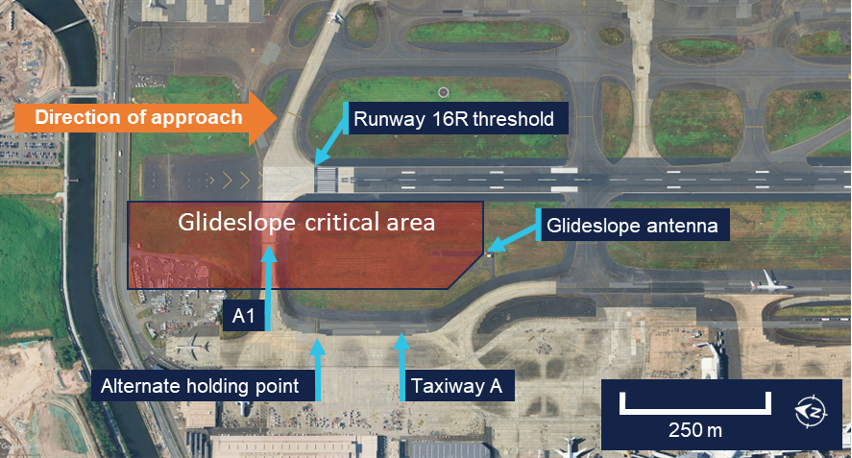
The ATSB’s investigation found that, during the 767’s approach, two Airbus A380s taxied into the instrument landing system critical area – an area in front of the ILS glideslope antenna that includes the A1 holding point for runway 16R.
“The 767 crew believed that their advice to ATC of their intent to conduct a practice autoland, as well as the weather conditions, meant ATC would prevent aircraft entering the ILS critical area, but this was not the case,” ATSB Director of Transport Safety Stuart Macleod said
The ATSB’s final report notes weather at the time of the incident was better than that which would require ATC to protect the ILS critical area.
In addition, while the tower controller was required to inform the 767 crew that the ILS was not being protected, they had not yet transferred to this controller, and so there was no opportunity for them to be given this advice.
“When the A380s taxied through the ILS critical area, interfering with the glideslope signal, the 767’s autopilot established it on a flight path that deviated away from the glideslope,” Mr Macleod said.
“The autopilot then notified the 767 crew that it was operating in a degraded mode, but the pilot flying continued the approach.”
Additionally, the investigation found the pilot monitoring did not effectively monitor the aircraft’s flight path, and did not call out deviations or advise the pilot flying to conduct a missed approach.
The final report notes Boeing plans to release a flight control software update for the 767 in 2027, with changes included to address this type of glideslope error.
“Not just 767 flight crews, but also those who operate Boeing’s 747-400, 747-8, 757, 777 and 787 aircraft, should familiarise themselves with their aircraft’s operating manual bulletin for ILS signal interference, and be prepared to conduct prescribed procedures when encountering cockpit indications and autoflight behaviour consistent with the issue,” Mr Macleod noted.
Tasman Cargo Airlines has since identified several proactive safety actions to prevent a future reoccurrence, the report details.
Mr Macleod said the incident is a reminder that automation, while designed to reduce pilot workload and enhance flight safety, still relies on flight crews maintaining a constant awareness of its performance.
“Flight crews should constantly monitor and verify that aircraft behaviour is consistent with the automation modes and parameters selected,” he said.
“And when a discrepancy is identified, automation should be disconnected, or the level of automation reduced, until control is adequately re-established.”
Read the final report: Descent below glidescope involving Boeing 767, VH-XQU, near Sydney Airport, New South Wales, on 10 September 2025