

Final report
Report release date: 10/07/2026
Investigation summary
What happened
On the afternoon of 10 September 2025, a Tasman Cargo Airlines Boeing 767-300 (B767), registered VH-XQU and operating as Tasman 22, was approaching Sydney Airport, New South Wales, at the conclusion of an air transport freight‑only flight from Hong Kong International Airport, Hong Kong. While intercepting the glideslope for the instrument landing system approach for runway 16R, the aircraft’s autopilot pitched the nose down. Subsequently, the approach was conducted with a high rate of descent while descending away from the glideslope.
The descent triggered an air traffic control minimum safe altitude warning (MSAW) before the autopilot was disconnected and the aircraft levelled out at 1,700 ft, approximately 1,000 ft below the glideslope. It then descended a further 150 ft before a missed approach was commenced. On the subsequent approach, the crew elected to conduct a localiser approach and the aircraft landed without further incident.
What the ATSB found
The ATSB found that 2 Airbus A380s on the ground at Sydney Airport taxied through the instrument landing system critical area and in front of the glideslope antenna, causing interference to the glideslope signal. As a result, after detecting the interference, the Boeing 767's autopilot established the aircraft on a flight path that deviated away from the glideslope, before alerting the crew that it was operating in a degraded mode.
It was also determined that the pilot flying continued the approach with the autopilot in a degraded mode. As a result, the aircraft’s high descent rate triggered an air traffic control minimum safe altitude warning. After disconnecting the autopilot, the pilot flying delayed the initiation of a missed approach and the aircraft descended below the localiser segment minimum safe altitude. In addition, the pilot monitoring did not effectively monitor the aircraft's flight path during the approach and did not call out deviations or advise the pilot flying to conduct a missed approach.
Furthermore, it was found that Tasman Cargo Airlines allowed the practice of flight crew exchanging flying and monitoring roles prior to 1,500 ft when conducting a practice autoland. It was also identified that Tasman Cargo's training did not inform flight crew of the conditions under which instrument landing system critical areas were protected. Consequently, the flight crew believed that the critical area was being protected, and the risk of glideslope interference had been mitigated.
What has been done as a result
Tasman Cargo Airlines has conducted the following proactive safety action:
- Removed the ‘glideslope out’ procedure from its policy and procedures manual (PPM), replacing it with the requirement to conduct a missed approach and notify air traffic control.
- Added a note in the PPM referencing the flight crew operating manual glideslope interference bulletin.
- Published an operational alert regarding Sydney Airport runway 16R glideslope interference with guidance information.
- Updated computer-based training materials to better highlight the ILS critical area and requirements during normal and low visibility operations.
- Introduced a requirement for the pilot flying to take control of the aircraft prior to the commencement of the approach when conducting an autoland.
In addition, while not in direct response to this occurrence, Boeing advised it is in the process of updating the flight control software for B767 aircraft. Planned for release in 2027, the update will include the following changes:
- The flight director pitch bar will remain biased out of view if the autopilot is disconnected while in attitude stabilising mode.
- Improved glideslope capture logic to reduce the occurrence of false captures leading to attitude stabilising mode.
- Limiting the flight path angle while in attitude stabilising mode to be between 0–3.25° of descent.
- Display of NO AUTOLAND after being in attitude stabilising mode for 15 seconds if the aircraft is still above alert height.
- Automatic autopilot disconnect 10 seconds after the display of NO AUTOLAND if the aircraft is still above 500 ft AGL.
Safety message
Flight crew of Boeing 747-400, 747-8, 757, 767, 777 and 787 aircraft should familiarise themselves with their aircraft’s flight crew operating manual bulletin for ILS signal interference and be prepared to conduct prescribed procedures when encountering cockpit indications and autoflight behaviour consistent with the issue.
Automation can reduce pilot workload and enhance flight safety. However, it is critical that flight crew maintain constant awareness of the performance of the autoflight system. When under the control of automation, flight crew should monitor the flight path and verify that aircraft behaviour is consistent with the automation modes and parameters selected. If a discrepancy is identified, automation should be disconnected or the level of automation reduced until control is re-established.
The occurrence
On the afternoon of 10 September 2025, a Tasman Cargo Airlines Boeing 767-3JHF (B767), registered VH-XQU and operating as Tasman 22, was approaching Sydney Airport, New South Wales, at the conclusion of an air transport freight-only flight from Hong Kong International Airport, Hong Kong. On board were 3 flight crew, consisting of a captain, who occupied the left seat and was the pilot monitoring,1 a first officer who occupied the right seat and was the pilot flying, and a relief pilot who occupied a jump seat.
The crew planned to conduct a practice autoland approach (see the section titled Practice autoland) to perform a scheduled check of the aircraft’s systems. As company procedures required that the captain was the pilot flying for an autoland approach, the crew had briefed that the captain and first officer would exchange flying and monitoring roles at 1,500 ft above ground level (AGL). The first officer also recalled that the approach briefing conducted by the crew included items specific to an autoland (see the section titled Instrument approach briefing).
At 1454, when the aircraft was at its cruising level of flight level 350,2 the crew advised air traffic control (ATC) of their intention to conduct a practice autoland at Sydney, which the controller acknowledged. Shortly afterwards, the aircraft commenced descent. At 1510, the crew were transferred to the approach controller, who issued a clearance to continue descent. The crew read back the clearance and confirmed that the controller was aware they were conducting a practice autoland.
The approach controller subsequently advised the tower controller at Sydney Airport that the aircraft would be conducting a practice autoland, before transferring them to a second approach controller. At 1516, the aircraft was cleared to descend to an altitude of 3,000 ft and conduct the instrument landing system (ILS) approach for runway 16R.3 Two minutes later, at an altitude of 5,300 ft, the aircraft intercepted the localiser course for the approach. At the time, the autopilot was controlling the aircraft’s flight path and the autothrottle was engaged in speed mode (see the section titled Autoflight system).
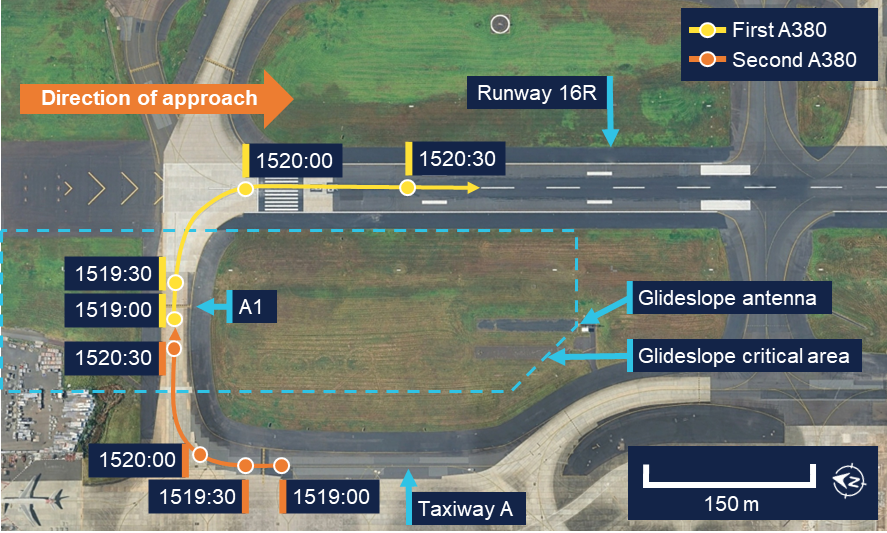
Concurrently, on the ground at Sydney Airport, an Airbus A380 was awaiting departure at holding point A1, adjacent to runway 16R (see the section titled Glideslope critical area). A second A380 was also waiting for departure in sequence on taxiway A. At 1519, the first A380 was cleared to line up on runway 16R and began moving onto the runway (Figure 1). The second A380 followed in sequence to hold at A1.
Figure 1: Ground movement of A380s
At 1519:18, when slightly below and flying to intercept the glideslope, the crew of VH‑XQU selected approach mode on the mode control panel and the autoflight system indicated that it had captured the glideslope (Figure 2). Two seconds later, the aircraft pitched down, adopting a nose down pitch of approximately 2°. As a result, the aircraft’s descent rate increased, and it began to diverge below the glideslope. At 1519:35, 15 seconds after the commencement of the pitch down and when the aircraft was descending through 3,730 ft, the crew were presented with several alerts in the cockpit:
- a line through the pitch (G/S) flight mode annunciation (FMA)
- removal of the flight director pitch bar from the primary flight display
- an autopilot caution message.
Figure 2: Flight path relative to runway 16R glideslope
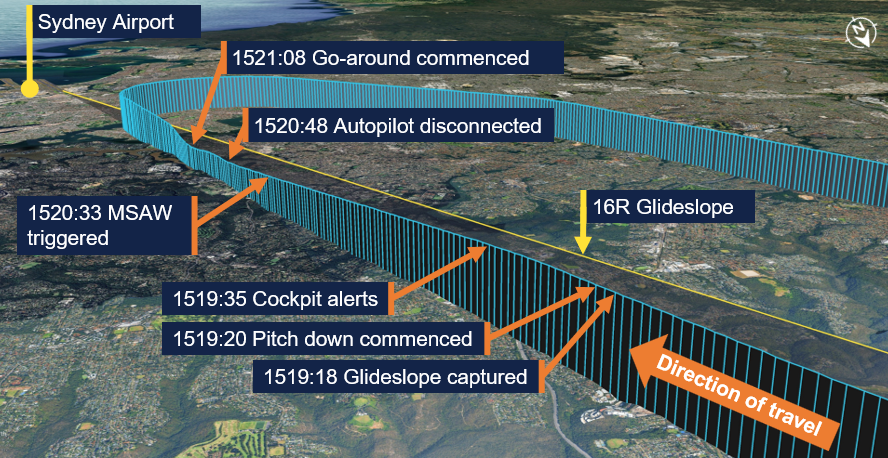
The first officer recalled seeing the autopilot caution and associated alerts. They also reported that they recognised that the aircraft’s descent rate had increased and that it was no longer following the glideslope. The captain also recalled identifying that the aircraft increased its descent rate, however they believed that this occurred later in the approach and that initially the aircraft followed the glideslope.
The aircraft continued to descend away from the glideslope, maintaining an average descent rate of 1,650 feet per minute (ft/min) for approximately another minute. During this time, the autopilot flight director system (AFDS) remained in approach mode with 3 autopilots engaged, and the alerts continued to be displayed to the crew. Both flight crew reported that, after being alerted, they discussed changing to conduct a localiser approach (see the section titled Instrument approach and landing chart). The first officer further recalled that, in addition, they began briefing and preparing for the change of approach. Both crew members advised that they considered they had time to have this discussion as the aircraft was still at a relatively high altitude and they had not yet passed the final approach point. The aircraft’s airspeed remained above the autothrottle selected airspeed, however the flight crew did not recall being required to manage excess airspeed during the approach.
The relief pilot, seated behind the captain and first officer, recalled that once the autopilot caution was observed, they assisted by calling out distances and required altitudes from the instrument approach chart (see the section titled Instrument approach and landing chart). The relief pilot further recalled that while doing this, they advised the other crew members that the aircraft was below the glideslope and called for them to slow the rate of descent.
At 1520:33, ATC radar recorded the aircraft at an altitude of 2,200 ft with a descent rate of 1,731 ft/min approximately 10 NM (19 km) from the airport. This descent rate and low altitude triggered an ATC minimum safe altitude warning (MSAW),4 which was presented on the approach controller’s display (Figure 3). The approach controller had just instructed the flight crew to change radio frequency and contact the tower controller, therefore they asked the tower controller to issue a safety alert to the crew. Given the frequency change instruction had just been issued, the approach controller also attempted to contact the flight crew directly on the approach frequency. The crew responded they were still on that frequency. The approach controller gave the crew a low altitude alert, advising them to check their altitude and the crew responded that they were going around.
Figure 3: Approach controller display at 1520:39
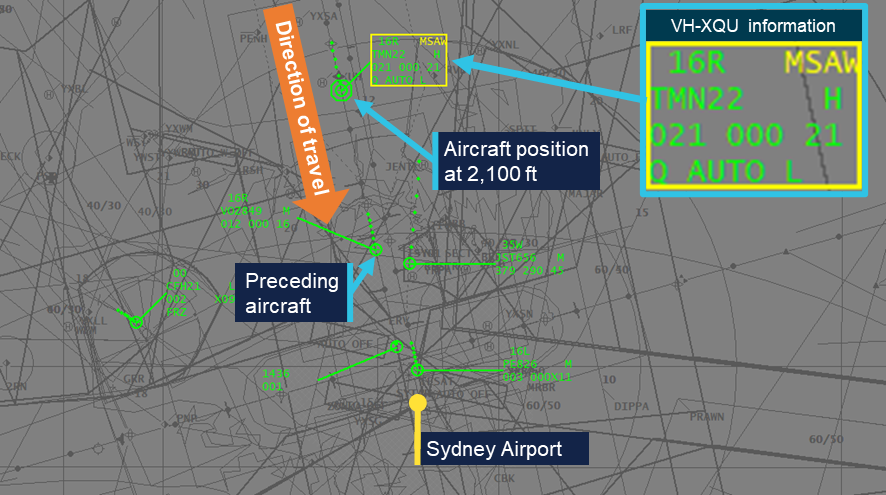
Just prior to the approach controller advising the crew of the low altitude warning, as the aircraft descended through 1,850 ft, the first officer disconnected the autopilot, re‑engaged the AFDS in vertical speed mode and raised the nose of the aircraft. As a result, the descent stopped at 1,700 ft, 8.6 NM (16 km) from the runway and approximately 1,000 ft below the glideslope. The aircraft then flew level for about 10 seconds before it began to descend again. At 1521:08, a go‑around was initiated from an altitude of 1,550 ft, as the low altitude alert was being given by ATC.
The aircraft climbed to 3,000 ft and was re-sequenced by ATC for another approach. This time, the crew elected to conduct a localiser approach, which they briefed while repositioning the aircraft to rejoin the approach. During this subsequent approach, the crew observed that the glideslope appeared to be functioning normally, and the aircraft landed without further incident.
After landing, the flight crew discussed the incident between themselves, and with the incoming crew for the next flight. They recalled that the B767 flight crew operations manual (FCOM) contained a bulletin that described the AFDS behaviour that was experienced (see the section titled Manufacturer signal interference bulletin) and concluded that glideslope interference had likely occurred.
Both the first officer and the relief pilot advised that they believed the glideslope critical area would have been protected because they were conducting an autoland; the captain also advised that they thought the glideslope critical area would have been protected, but due to the weather conditions at the time. The captain further reported that, after landing, they called ATC to enquire if there were any vehicles or aircraft that may have interfered with the glideslope signal and was advised that there were not. The aircraft’s ILS system was tested by maintenance personnel after landing and was assessed as serviceable.
Context
Pilot information
The captain held an Air Transport Pilot Licence (Aeroplane) and class 1 aviation medical certificate. They had 15,296 hours of flying experience, of which 2,567 were on the Boeing 767 (B767) aircraft type, with 102 hours accrued in the previous 90 days.
The first officer held a Commercial Pilot Licence (Aeroplane) and class 1 aviation medical certificate. They had 7,362 hours of flying experience, of which 440 were on the B767 aircraft type, with 84 hours accrued in the previous 90 days.
The relief pilot held an Air Transport Pilot Licence (Aeroplane) and class 1 aviation medical certificate. They had 20,599 hours of flying experience, of which 102 hours were on the B767 aircraft type, all accrued in the previous 90 days.
The flight crew had 2 days free of work prior to the flight and all pilots reported that they had slept adequately prior to, and had rested during, the flight.
Aircraft information
General information
VH-XQU was a Boeing 767-3JHF, manufactured in 2009 and first registered in Australia with the operator in 2022. The aircraft was fitted with 2 General Electric CF6‑80C2B7F turbofan engines and had accumulated 56,678 flight hours.
Autoflight system
Overview
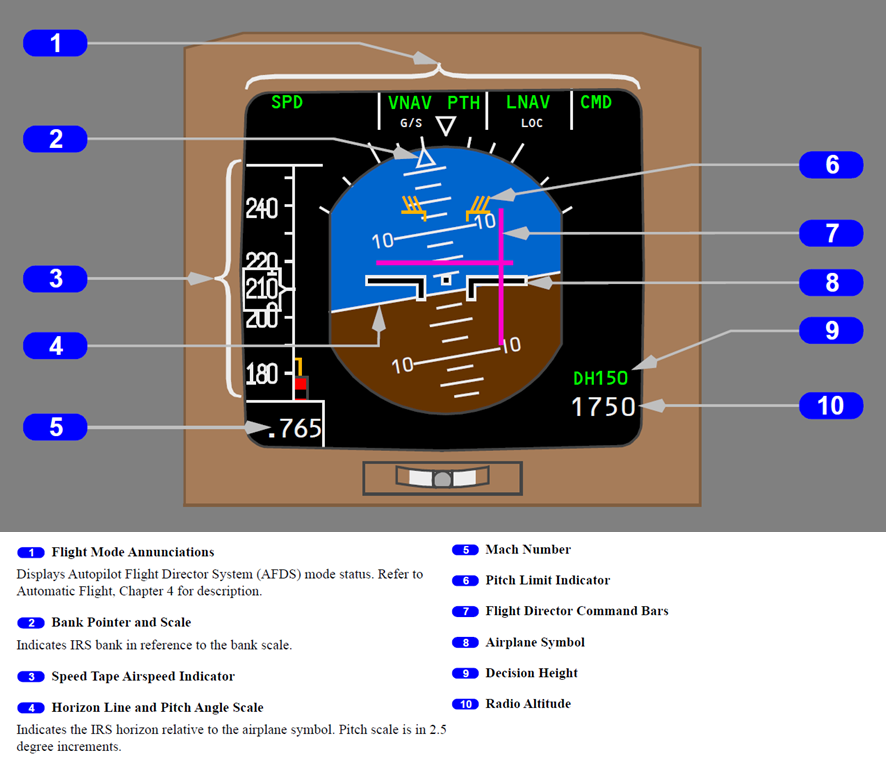
The aircraft’s automatic-flight system consists of an autopilot flight director system (AFDS), and an autothrottle system. The AFDS provides pitch (vertical) and roll (lateral) guidance via flight director command bars overlaid on the attitude direction indicator (ADI) display (Figure 4).
Figure 4: Attitude director indicator display
Flight crew controlled the mode and associated flight parameters of the AFDS via the mode control panel. Available modes included:
- Approach mode (APP): The flight director provided guidance to track the localiser laterally, and the glideslope vertically. This mode was used during an instrument landing system (ILS) approach.
- Vertical speed mode (V/S): The flight director pitch bar indicated the aircraft pitch required to maintain the selected vertical speed. This speed was adjusted by flight crew using the vertical speed selector.
The aircraft was equipped with 3 autopilots. When engaged, each autopilot activated flight controls required for the aircraft to follow the flight director command bars. Only one autopilot was required to be engaged to provide autoflight capability, however multiple autopilots could be engaged to provide redundancy. This was required when conducting certain operations such as an autoland. When no autopilot was engaged the pilot flying was required to manually control the aircraft to follow the flight director.
Automatic control of engine thrust was provided by the aircraft’s autothrottle system. This system was also controlled via the mode control panel. When speed mode (SPD) was active, the autothrottle would control engine thrust, between idle and maximum thrust, to achieve the selected airspeed.
The flight mode annunciations (FMA) displayed (green) active and (white) armed modes of the AFDS and the (green) active mode of the autothrottle system to the flight crew.
The flight crew operations manual (FCOM) contained information about engaging and disengaging the autoflight system and advised that:
After localizer and glideslope capture, the localizer and glideslope modes can only be deactivated by disengaging the autopilot and turning both flight directors off or by selecting GA [go-around] mode.
The FCOM also advised that:
If unwanted operation is noticed or when an autopilot failure is annunciated, the autopilot should be disconnected and the airplane flown manually.
Meteorology
The automatic terminal information service (ATIS)5 at Sydney Airport reported weather conditions at the time of the occurrence that included:
- cloud layers of few at 500 ft, scattered at 1,000 ft and broken at 3,000 ft6
- wind from 140° M at 15 kt
- visibility of 5,000 m in rain
- temperature of 16°C
- QNH7 of 1004
- advice that turbulence was expected in the circuit area
- an aerodrome warning that thunderstorms were expected from the west until 1845.
The flight crew advised that weather conditions were consistent with the ATIS, and that the aircraft was in instrument meteorological conditions8 throughout the approach and subsequent missed approach.
Recorded data
The ATSB was provided with data from the aircraft’s quick access recorder, which captured the incident flight. The data was also sent to the manufacturer for review (see the section titled Manufacturer review of recorded data). The cockpit voice recorder was not available due to the time that had elapsed since the occurrence.
A review of the data identified that at 1519:00, the aircraft, with 3 autopilots engaged, was at an altitude of 4,000 ft with the localiser captured (LOC) and descending slightly while intercepting the glideslope from below (Figure 5). At 1519:18, the AFDS changed to approach mode and the associated FMA indicated that the glideslope mode (G/S) was active.
Two seconds later, the aircraft pitch lowered from 4° nose up to approximately 2° nose down, and away from the flight director pitch command bar. The glideslope deviation then recorded a period of variations inconsistent with the aircraft’s position relative to the glideslope. The aircraft’s descent rate subsequently increased, and it began descending away from the glideslope.
Figure 5: Graphical representation of recorded flight modes and alerts
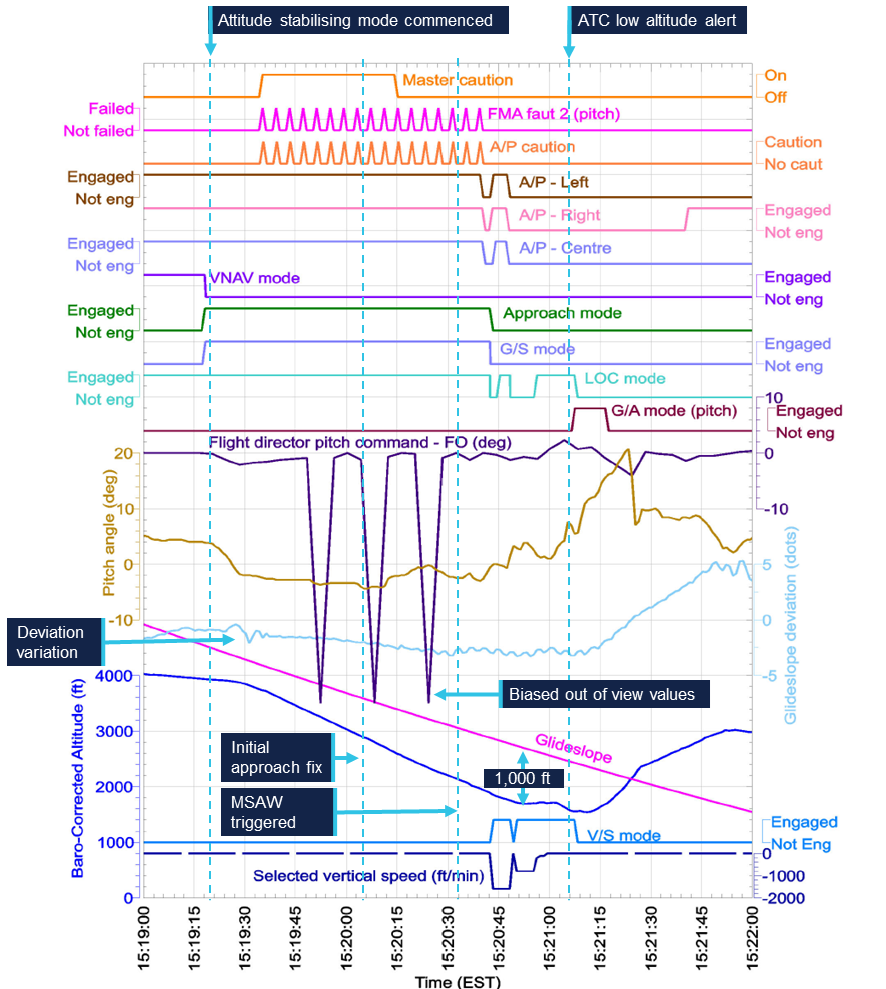
The data recorded the activation of a pitch fault FMA, an autopilot caution, and a master caution light at 1519:35. Approximately 15 seconds later, the flight director pitch command bar began showing values alternating between 0° and 45°, which the manufacturer advised was consistent with the flight director pitch bar being removed from the primary flight display (biased out of view).
Over the next minute, the aircraft maintained a descent rate of approximately 1,650 ft/min. During this time, the 3 autopilots remained engaged. Also during this time, the aircraft’s airspeed remained above the selected airspeed (Figure 6) while the engines remained at idle thrust. At 1520:05 the aircraft passed the initial approach fix at an altitude of approximately 2,900 ft, with the glideslope deviation at 2 dots, or full-scale deflection. From 1520:08, the speedbrake was deployed in varying positions, before being armed for landing at 1520:29.
Figure 6: Graphical representation of recorded airspeed and configuration
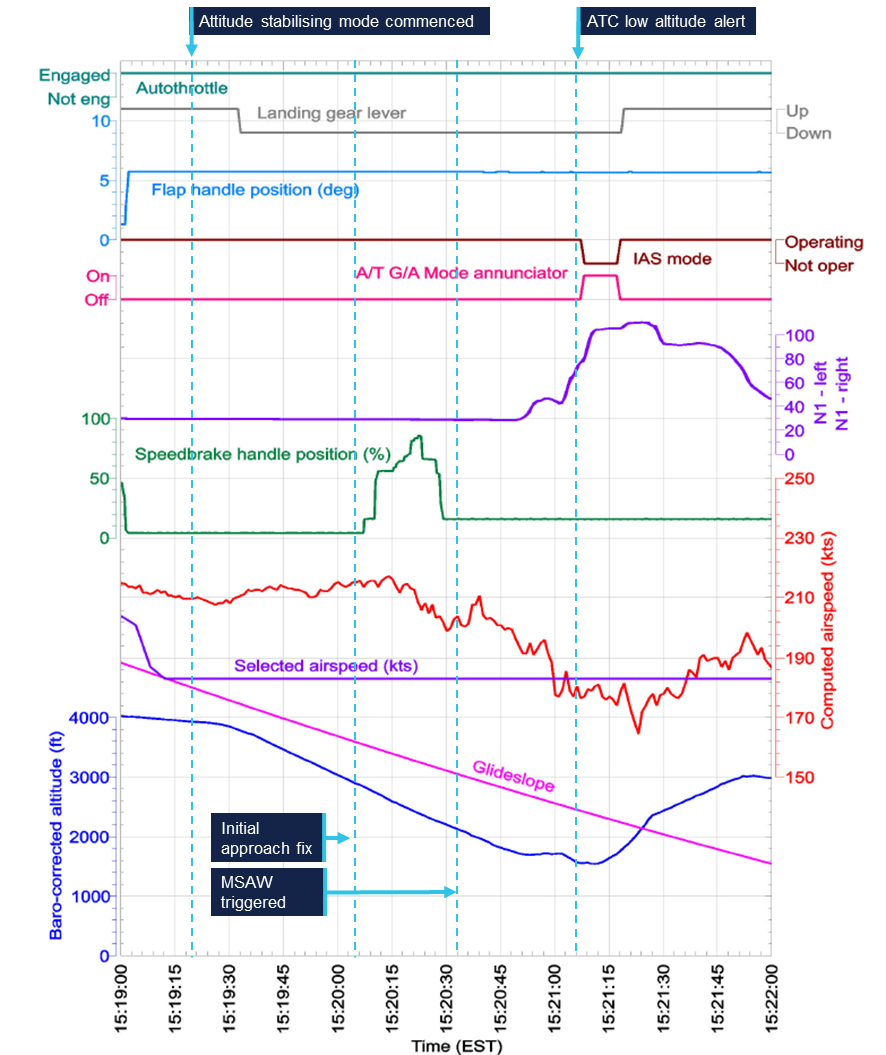
At 1520:42, the 3 autopilots were disconnected and the FMA fault indication and autopilot caution ceased. The data also recorded a change in AFDS mode from approach mode to vertical speed mode at this time, initially with a descent rate of 1,600 ft/min selected, consistent with the aircraft’s vertical speed at the time.9 At 1520:50, the aircraft’s altitude stabilised at 1,700 ft as the aircraft’s pitch raised to 5° nose up. The vertical speed selected was then reduced to −800 ft/min, then to 0.
At 1520:59, the flight director pitch command bar progressively raised over 7 seconds. The aircraft pitch also increased over this time. Also during this period, the airspeed decreased to the selected airspeed of 183 kt and engine thrust increased above idle. At 1521:08 go‑around mode was selected and the aircraft commenced a climb to 3,000 ft.
Instrument landing system
Overview
An instrument landing system (ILS) is an instrument approach that uses lateral (localiser) and vertical (glideslope) position information, using angular deviation signals from the localiser antennas (located past the upwind end of the runway) and the glideslope antennas (located to the side of the runway). Aircraft systems detect these radio signals and provide instrument indications that enable an aircraft to be manoeuvred along a precise final approach path.
Instrument approach and landing chart
The flight crew used a Jeppesen instrument approach and landing (IAL) chart to brief and conduct the approach (Figure 7). The chart contained information required to conduct either an ILS approach, with the glideslope providing vertical guidance, or a localiser approach that provided distance and altitude information for the flight crew to manage the vertical path, when vertical guidance from the glideslope was not available.
Figure 7: Instrument approach and landing chart runway 16R ILS/LOC
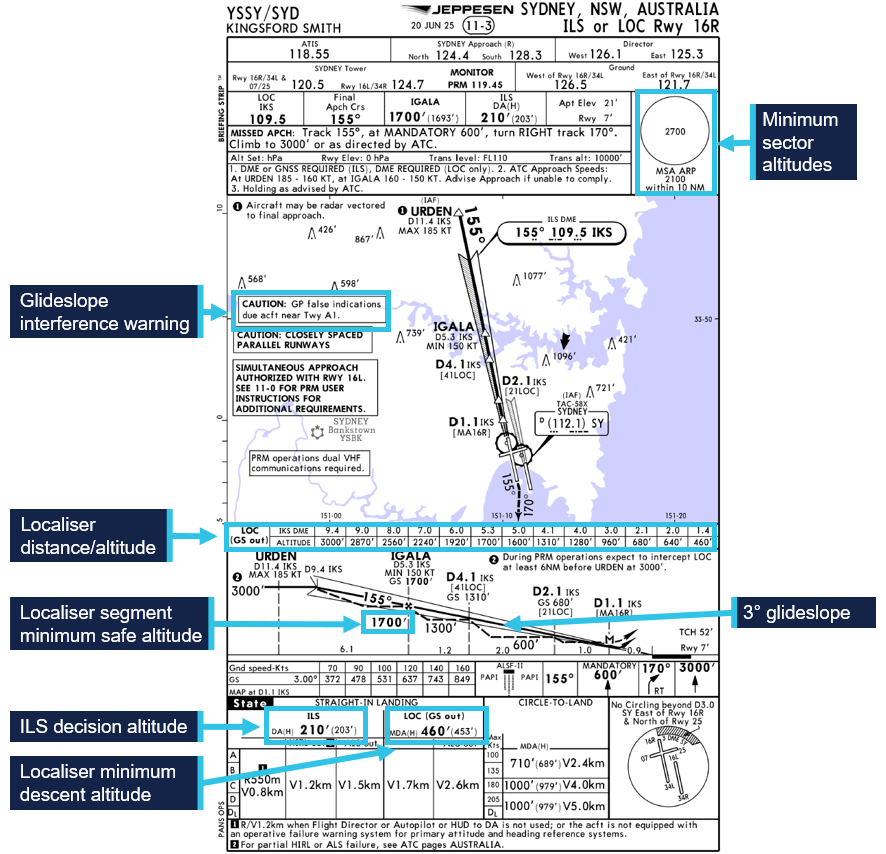
The chart specified the 25 NM (46 km) minimum sector altitude as 2,700 ft. This was the minimum altitude an aircraft could descend to while maintaining terrain and obstacle clearance when between 10–25 NM (19–46 km) of the airport and not in visual conditions or conducting an instrument approach. The minimum sector altitude reduced to 2,100 ft when within 10 NM (19 km) of the airport.
The chart also included a caution message that advised of the risk of glideslope interference (see the section titled Glideslope interference) stating that:
GP [glidepath] false indications due acft [aircraft] near Twy [taxiway] A1.
Information on the chart specific to conducting the localiser approach included a segment minimum safe altitude associated with each segment of the approach. Flight crew were required to ensure the aircraft remained at or above these altitudes when within the corresponding segment to maintain minimum obstacle and terrain clearance. The chart also included table of distance/altitude relationships to assist in maintaining a 3° descent profile when glideslope guidance was not available.
Missed approach requirements
The Aeronautical Information Package (AIP) stated that when conducting an ILS approach, a missed approach was required to be executed under certain conditions, including:
During an instrument approach and below MSA (as specified on the IAL chart) the performance of the radio aid becomes suspect, or the radio aid fails.
Glideslope interference
Glideslope critical area
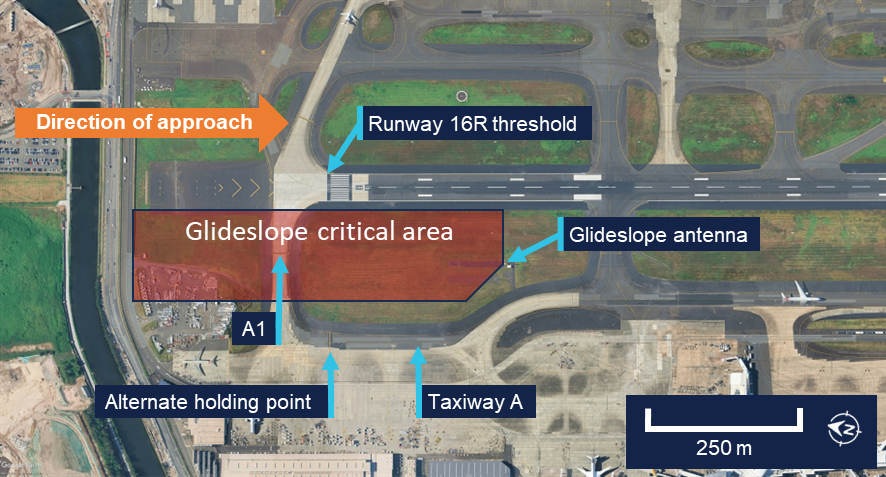
Disturbances to the ILS glideslope signal may occur when vehicles or aircraft are operated near the antenna. For this reason, an ILS critical area is defined around the glideslope antenna location, within which aircraft and vehicle movement is restricted under certain conditions.
The glideslope critical area for runway 16R at Sydney Airport was an area 600 m long and 145 m wide and included the A1 holding point (Figure 8). When protection of this critical area was required, air traffic control (ATC) directed aircraft to hold at an alternate holding point on taxiway A, instead of A1.
Figure 8: Glideslope critical area for runway 16R
The conditions under which the ILS critical areas were required to be protected were defined in the Manual of Air Traffic Standards (MATS), which stated:
When the ceiling10 is at or below 600 ft or the visibility is 2000 m or less, ensure no aircraft enter the glide path or localiser critical areas when an arriving aircraft is within:
a) the outer marker; or
b) 4 NM from the threshold if no outer marker exists.
Manufacturer signal interference bulletin
The FCOM contained a bulletin, issued in November 2021 and titled Erroneous Autopilot Flight Director System (AFDS) Guidance when Instrument Landing System (ILS) Signal Interference Occurs. The bulletin stated that:
Boeing has received several reports of unexpected pitch guidance when capturing or tracking the glideslope during an instrument landing system (ILS) approach. In each event for which data was provided, Boeing has determined that glideslope signal interference occurred at the time of the unexpected pitch guidance and, in most of these events, the unexpected pitch guidance occurred during glideslope capture. ILS signal interference can occur when vehicles, aircraft, or other factors affect the localizer or glideslope signal.
The bulletin further stated that:
The AFDS can detect the degradation or instability of radio signals that support specific autopilot modes. When the AFDS detects a degraded or unstable signal during an ILS approach with the autopilot engaged, the affected AFDS mode changes to an attitude stabilizing mode based on inertial data at the time of the signal degradation or instability. The purpose of the attitude stabilizing mode is to prevent large and abrupt pitch and roll changes during short periods of localizer or glideslope signal interference. When the localizer or glideslope signal stabilizes and the airplane is within parameters for capture, the AFDS returns to tracking the localizer or glideslope. Alternatively, if the localizer or glideslope signal does not stabilize or the airplane is not within parameters for capture, the attitude stabilizing mode remains active. In this case, the AFDS continues to provide guidance in the attitude stabilizing mode, with possible high rates of descent and significant deviation from the localizer or glideslope.
The bulletin also advised that:
There is no direct indication to the pilot that the attitude stabilizing mode is active if the airplane is above 200 feet radio altitude and either:
• the localizer attitude stabilizing mode is active for less than 20 seconds or
• the glideslope attitude stabilizing mode is active for less than 15 seconds
If the airplane is above 200 feet radio altitude and the attitude stabilizing mode remains active for 20 seconds or more (for localizer) or 15 seconds or more (for glideslope):
• the AUTOPILOT message shows (if autopilot is engaged) (Figure 9) and
• the flight director roll or pitch bar is removed (if flight director is on) and
• an amber line shows through the affected flight mode annunciation (FMA)
Figure 9: Indications following extended time in attitude stabilising mode
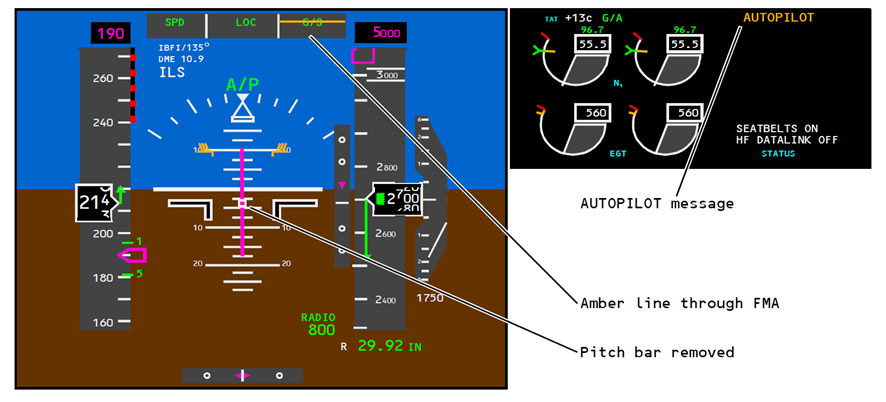
Operating instructions were given for flight crew conducting an ILS approach, which advised that:
While on an ILS approach, monitor localizer and glideslope raw data and call out any significant deviations. Perform an immediate go-around if not within the criteria to continue the approach.
It is essential to crosscheck altitude at the FAF [final approach fix] and monitor pitch attitude and descent rate throughout the approach.
If a glideslope anomaly is suspected, an abnormal altitude range-distance relationship may exist. This can be identified by crosschecking distance to the runway with altitude or crosschecking the airplane position with waypoints indicated on the navigation display. The altitude should be approximately 300 feet height above touchdown per NM of distance to the runway for a 3° glideslope.
Manufacturer review of recorded data
At the request of the ATSB, the manufacturer reviewed the recorded data from the occurrence flight. The review included analysis of glideslope beam variation at the time of glideslope capture and throughout the approach. It identified that:
At a longitudinal distance of approximately 15.5 nautical miles [29 km] prior to the runway threshold, the observed glideslope beam began to diverge from the ideal beam, moving below the ideal beam. This deviation between the ideal and observed beam is characteristic of a beam anomaly.
The observed glideslope beam reached approximately 300 feet below the ideal beam. The divergence then began to decrease as the observed beam began to converge towards the ideal beam.
The observed glideslope beam diverged from the ideal beam again, varying by up to 350 feet below and then 400 feet above the ideal beam over the next 1.5 nautical miles.
A second period of divergence between the ideal and observed glideslope commenced at approximately the same time as the second A380 entered the critical area.
Based on this analysis, the manufacturer concluded that:
The airplane experienced a beam anomaly while attempting to capture the glideslope from below the beam. The observed glideslope beam diverged below the ideal 3-degree beam by a vertical offset of 300 feet, causing the airplane to attempt glideslope capture prematurely.
The review also referred to the FCOM bulletin for glideslope interference and advised that:
In this event, the airplane behaviour was consistent with a glideslope beam anomaly, causing the AFDS to enter attitude stabilizing mode. The airplane encountered a beam anomaly while intercepting the glideslope in G/S mode before entering into a steady descent with an average calculated vertical speed of approximately -1,700 feet per minute. The AFDS did not return to tracking the glideslope after the glideslope signal stabilized, probably because the glideslope deviation was no longer within the parameters for capture. For approximately the first 15 seconds, there were no indications in the QAR [quick access recorder] data that attitude stabilizing mode was active until the Autopilot Caution and FMA Pitch Fault activated. An additional 15 seconds passed before the flight director pitch guidance became BOV [biased out of view], consistent with the removal of the flight director pitch bar. This state remained until the flight crew switched the pitch mode to V/S.
Noting the operational guidance in the bulletin, the review concluded that:
Earlier recognition of the airplane state and degraded autopilot performance may have reduced the magnitude of the deviation below the glideslope.
The manufacturer also advised that there was no evidence to show whether the glideslope deviation pointer would have been displayed during the period that the alerts were active.
Practice autoland
Overview
An autoland approach is an approach during which the aircraft is fully controlled by the autoflight system through to landing. During an autoland, pilots assume a monitoring role and intervene only in the event of a system failure or other abnormal event. The procedure is primarily intended to be used in low-visibility conditions, however an autoland can also be conducted in better conditions to meet aircraft or flight crew recency and currency requirements. An autoland conducted under these conditions is termed a practice autoland.
Regulatory requirements and guidance
Flight crew were required to advise ATC of an intention to conduct a practice autoland when arriving at an aerodrome and the AIP stated that:
In weather conditions where the ceiling and/or visibility are above CAT I minima, pilots should inform ATC about any intention to conduct:
a. an approach with minima less than standard CAT I; or
b. an autoland procedure.
This information must not be taken as a request for or expectation of the protection of the ILS but to enable ATC to inform the flight crew of any known or anticipated disturbance.
The AIP also stated that when receiving this advice, and the ILS critical area was not protected, the controller was required to report ‘ILS critical area not protected’. Airservices Australia advised that only a tower controller provided advice of any known or anticipated disturbances. They also confirmed that an intention to conduct a practice autoland procedure did not change ATC’s requirements with regards to protecting the ILS critical areas.
The Civil Aviation Safety Authority published Advisory Circular (AC) 91‑12 Conduct of practice autoland operations. The AC described the problems and potential risks when conducting an autoland and stated:
Multiple factors may influence the accuracy of the ILS signal when the ILS autoland system is to be used:
• in conditions where ATC is not protecting ILS critical and/or sensitive areas.
These factors include:
• interference of the ILS signal due to an intrusion within the ILS critical and sensitive areas by:
- taxiing aircraft
- ground vehicles
- over-flight of the ILS localiser.
The AC also identified a number of considerations, procedures and instructions when conducting practice autoland operations, which included:
ATC should be informed about the crew’s intention to conduct an autoland. Pilots should not expect the protection of the ILS, but on receiving advice from the crew of their intention to conduct a practice autoland, ATC may inform the flight crew of any known or anticipated disturbance.
Operator procedures and training
Flight crew roles and responsibilities
The operator’s policy and procedures manual (PPM) defined the roles of the pilot flying and the pilot monitoring as:
The PF [pilot flying] will control and monitor the aircraft, regardless of the level of automation being used. The duties of the PF are:
• flight control:
- flight path and airspeed control
- navigation
- aircraft configuration
• conducting normal procedures in compliance with company manuals
• monitoring flight status and condition.
The PM [pilot monitoring] will monitor the aircraft and action of the PF. The duties of the PM are:
• general monitoring and crosschecking the procedures for all flight phases including take-off, cruise, approach and landing, aircraft system status, and condition
• make callouts to PF for any deviation from the flight path or system malfunction or failure
• give advice to the PF to execute a missed approach when the approach becomes unstable or unable to continue the approach safely
• ATC communications, checklist reading, FMS [flight management system] CDU [control display unit] operation
• complete the PF directions.
A callout must be made by the PM for the other crew if a deviation occurs from the normal procedures, or intended flight path (attitude, speed, altitude, and direction). If there is a failure for the PF to respond to callouts of the PM, appropriate corrective action shall be made for the safety of the flight including taking over the aircraft control.
The PPM defined tolerances for certain flight parameters, including a tolerance of one dot when tracking the glideslope, and advised that:
These parameters are to be observed and sustained flight should not be allowed to continue without corrective action by the flight crew. Any deviation outside of approach tolerances in IMC must result in a GA [go-around].
Use of automation
The PPM contained an automation policy which advised:
Automation is provided to enhance safety, reduce pilot workload and improve operational capabilities.
Automation can be as beneficial as mentioned above for flight operations, if automation is used appropriately. However, at the same time, if flight crew members fail to maintain proficiency in the use of automation or to properly correspond to recognised degradation of automation performance, it could be an obstruction for the flight safety.
In addition, over-reliance on automation system may lead to flight crews accepting whatever the aircraft was doing without proper monitoring or may result in deterioration of flight crew members’ manual flying skills. Therefore, for safe flight operation, proper use of automation system, maintaining manual flying skills, and practical use of CRM [crew resource management] skills are required.
Following elements are imperative to use automation at the most appropriate level:
• full understanding and knowledge of automation system
• proficiency in the use of all levels of automation
• monitoring and cross-check of automation
• skills to recognize degraded performance of automation system
• skills to shift between all levels of automation including manual flying.
The PPM also contained guidelines for flight crew when using automation, which included that:
• The flight crew must compare the performance of autoflight system (operation status) with the flight path of the aircraft.
• It is the responsibility of the flight crew to maintain flight mode awareness and control to ensure the flight director provides the guidance required.
• If any autoflight system is not operating as expected or any doubt exists, disengage it.
Instrument approach briefing
The PPM required flight crew to conduct a briefing of the threats, plans and considerations of the expected approach after the approach had been loaded. Considerations to be included in the brief were:
• approach title and chart effective date
• manual or AUTOLAND Landing
• nomination of required navigation aids
• approach entry/holding pattern
i• nitial approach altitude
• approach track(s)
• limiting and check altitudes
• CAT I, CAT II, CAT III MDA/DH [minimum descent altitude / decision height] and visibility minimum
• aerodrome elevation
• circling procedures (if applicable)
• significant terrain
• missed approach procedure
• monitoring of approach aids.
In addition, the crew were required to brief specific items prior to commencing an autoland approach which included the following non-normal situations:
• persistent localiser or glideslope deviation alert between 500 ft RA [radio altimeter] & 200 ft RA or any deviation alert below 200 ft RA
• ASA [autoland status annunciator] changes to NO AUTOLAND
• ILS Localiser and/or Glideslope Transmitter Failure
• autopilot disconnect.
Glideslope out procedure
The PPM contained procedures for when the glideslope failed during an ILS approach. The procedures stated that when in IMC:
If the glideslope fails when the aircraft is established on the ILS procedure (or being radar vectored) after the IAF [initial approach fix] ATC must be notified immediately.
An approach may be continued if the following items can be completed prior to FAF [final approach fix]:
• complete briefing for a LOC [localiser] (GS [glideslope] out) approach
• mode change and operation for LOC approach
• set the next fix altitude or MDA on altitude window
• barometric altimeter bug set
• completion of landing configuration and landing checklist
A missed approach must be conducted for the following situations
• failure to complete the steps above, prior to the FAF
• failure of situational awareness for the LOC (GS out) procedure
• when directed by ATC.
Low visibility operations
Autoland procedures
The PPM defined procedures for taxi, take-off and landing in conditions where visual reference was limited by weather. This included procedures for conducting a low visibility operations (LVO) approach and landing including an autoland. It was stated that:
LVO approach and landings shall be carried out using the highest level of automation available to an autoland.
The left seat pilot is PF and the right seat pilot is PM for the approach, landing or missed approach.
In addition, crew responsibilities during an LVO landing were stated as:
Pilot Flying Duties
The PF shall guard the control column, rudder pedals and thrust levers throughout the approach, landing, or missed approach, make standard callouts and responses as per the LVO landing standard callouts and actions, and take manual control in the event of autopilot disconnect.
Pilot Monitoring Duties
The PM must monitor the aircraft flight path and flight instruments throughout the approach, landing and rollout, or missed approach. They are to remain ‘heads down’ and make no attempt to seek visual reference. Any deviation or system failure must be called to alert the PF.
Additionally, specific standard callouts (by the PM) and responses (by the PF) were required to be used when conducting an LVO landing. These specific callouts began at 1,500 ft AGL.
The PPM did not contain procedures specific to conducting a practice autoland. The operator later advised that when conducting LVO operations, the left seat pilot was required to be the pilot flying for the entire approach however, when conducting a practice autoland, the pilots could switch roles so long as the left seat pilot was the pilot flying prior to 1,500 ft AGL.
The PPM contained information about ILS critical areas that was relevant to the conduct of an autoland and advised that:
When the weather ceiling is above 600 ft and 2,000 m visibility the ILS critical and sensitive areas are not protected by ATC and a number of factors may influence the accuracy of the ILS signal.
These include intrusions of the ILS critical and sensitive areas by the following factors:
• taxiing aircraft
• ground vehicles
• over-flight of the ILS localiser.
The flight crew shall therefore notify ATC at the commencement of an autoland approach when the ceiling and visibility are above the parameters listed above. e.g. ‘We are conducting an autoland approach’.
When an approach condition develops where the glide slope or the localizer becomes unreliable, due to signal interference, the aircraft departs from the approach path, or for other causes where manual flying is required, the flight crew must transition to manual flying immediately.
Flight crew training
The operator provided training to flight crew for LVO via a combination of online computer-based training (CBT), in-person training and training and assessment in a flight simulator.
The CBT included information about the purpose of an ILS critical area, and of alternate holding point requirements when protection was in force. Presentation materials used during in-person training identified the loss of glideslope or localiser signal as a possible non-normal situation. The indications expected in this situation were:
• pointer disappears
• line through associated FMA
• FD [flight director] bar for failed mode is removed
• autopilot EICAS [Engine indicating and crew alerting system]
The operator advised that simulator training during both induction and ongoing training covered failures during approaches, including the glideslope. In addition, they advised this training covered the cockpit indications during a glideslope out scenario. They also advised that the FCOM signal interference bulletin was discussed during training with focus on the potential high rates of descent associated with the issue.
Reviewed training materials did not contain information about the conditions under which the ILS critical area would be protected.
Related occurrences
ATSB investigation AO-2015-144
The ATSB investigated a flight below minimum altitude of a Boeing 787 conducting an ILS approach to Perth Airport on 4 December 2015. It was found that interference to the glideslope signal likely occurred due to a Boeing 737 aircraft taxiing from the holding point to the runway at the time.
ATSB investigation AO-2017-023
The ATSB also investigated a descent below lowest safe altitude of a Boeing 747‑400 aircraft conducting an ILS approach to Sydney Airport’s runway 16R on 12 February 2017. It was found that glideslope interference likely occurred due to a Boeing 787 aircraft holding at A1 during the approach. The report also identified 2 similar occurrences in March 2017 of Boeing 747 aircraft experiencing high descent rates during an ILS approach. In both instances an Airbus A380 was occupying taxiway A1 at the time.
Other occurrences
The ATSB occurrence database did not contain any additional occurrences after 2017 that could be identified as glideslope interference. However, as glideslope interference is not a reportable matter under the Transport Safety Investigation Regulations, it is likely an occurrence would only be reported to the ATSB if a consequential event required it and may not include detail to identify glideslope interference.
Following a notice to flight crew to report instances of glideslope interference, the operator was subsequently made aware of 9 additional instances of suspected glideslope interference when approaching runway 16R at Sydney Airport. For each, the ATSB reviewed publicly available flight data and identified an aircraft positioned either at holding point A1 or moving from the holding point onto the runway at the time of the reported interference.
Table 1: Subsequent occurrences of glideslope interference reported to operator
| Date | Aircraft | Aircraft type at A1 |
| 1 November 2025 | VH-FKX (B767) | Boeing 787 |
| 2 November 2025 | VH-FKX (B767) | Boeing 777 |
| 9 November 2025 | VH-EXZ (B767) | Airbus A350 |
| 22 November 2025 | VH-EXZ (B767) | Airbus A350 |
| 27 November 2025 | VH-XQU (B767) | Boeing 787 |
| 28 December 2025 | VH-XQU (B767) | Airbus A350 |
| 2 January 2026 | VH-EXZ (B767) | Airbus A380 |
| 23 February 2026 | VH-XQU (B767) | Boeing 787 |
| 13 March 2026 | VH-XQU (B767) | Airbus A380 |
In response to a request for reports of glideslope interference at Sydney Airport, Airservices Australia advised that several of the subsequent events listed by the operator were received and reviewed by technical surveillance specialists. All events were determined to be due to aircraft in the glideslope critical area with the effect on the approaching aircraft as expected. No reports of glideslope interference were received from other operators between January 2025 and January 2026.
Safety analysis
Introduction
This analysis will discuss the factors leading to the performance of the autoflight system and the protection requirements of the instrument landing system critical area. In addition, it will examine the actions of the flight crew in response. Finally, the analysis will consider the operator’s procedures and training for conducting precision approaches, low visibility operations and practice autoland approaches.
Glideslope interference
As the aircraft was intercepting the glideslope prior to the commencement of a practice autoland approach, an A380 aircraft holding at A1, within the ILS critical area, began moving onto the runway. A second A380 then entered the critical area as the first vacated. The movements of both aircraft coincided with anomalies observed in the glideslope signal received by the aircraft.
The weather conditions at Sydney Airport at the time were better than those for which protection of the ILS critical area was required. Therefore, ATC was not required to protect the area for a practice autoland. Furthermore, while the tower controller was required to inform the flight crew that the ILS was not being protected, the flight crew had not yet transferred to this controller. Therefore, there was no opportunity for the flight crew to be given this advice.
After initially attempting to capture the glideslope from below, the aircraft's descent rate increased away from the flight director pitch guidance, and it began deviating away from the glideslope. As described in the flight crew operations manual (FCOM) bulletin for ILS signal interference, when the autopilot flight director system (AFDS) detected an unstable glideslope signal it changed to an attitude stabilising mode. Cockpit alerts were subsequently displayed to alert the flight crew to the degraded performance of the autopilot. These alerts were consistent with those expected when the AFDS had been in attitude stabilising mode for 15 seconds. Therefore, the movement of the first A380 through the ILS critical area caused an interference to the glideslope signal, which was subsequently detected by the AFDS. As a result, after attempting to capture the glideslope prematurely, the AFDS entered and remained in an attitude stabilising mode before alerting the crew.
Contributing factor Two Airbus A380s on the ground at Sydney Airport taxied through the instrument landing system critical area and in front of the glideslope antenna, causing interference to the glideslope signal. As a result, after detecting the interference, the Boeing 767's autopilot established the aircraft on a flight path that deviated away from the glideslope, before alerting the crew that it was operating in a degraded mode. |
Descent below glideslope
Pilot flying
After the interference stopped, it is likely that the flight path deviation had increased beyond the threshold at which the AFDS could re-capture the glideslope. Therefore, the AFDS remained in attitude stabilising mode while the annunciations indicating the degraded performance of the autopilot continued to be displayed to the flight crew.
The pilot flying recognised that the autopilot was no longer following the glideslope, and that the aircraft was descending at a high rate. However, believing that they had sufficient time and altitude, they did not disengage the autopilot and commenced discussion and preparation for a change to a localiser approach. Both operator and manufacturer procedures required that if automation was not operating as expected then it should be disengaged and the aircraft flown manually. However, the pilot flying allowed flight below the glideslope to continue beyond the initial approach fix and below the approach commencement altitude.
After the aircraft’s flight path triggered a minimum safe altitude warning (MSAW), but prior to receiving the corresponding low altitude alert from ATC, the pilot flying did disconnect the autopilot. By this time, the aircraft’s position was significantly below the minimum sector altitude, below which a missed approach was required to be conducted when experiencing a failure of the glideslope. Furthermore, the manufacturer’s procedure specific to glideslope interference required a missed approach to be conducted when corresponding failure annunciations were displayed. These annunciations were continuously displayed throughout the approach. Following the disconnection of the autopilot, the pilot further delayed the initiation of a missed approach. During this period of manual flight, the aircraft descended a further 150 ft and below the localiser segment minimum safe altitude before a missed approach was commenced.
The ATSB considered the extended time between the MSAW being triggered and the flight crew receiving a low altitude alert. As the MSAW coincided with an instruction to the crew to contact the tower controller, the low altitude alert could not be given immediately because the approach controller was required to establish which frequency the crew were listening on. However, as the crew had already disconnected the autopilot and arrested the initial descent, this was not considered to be contributory.
Contributing factor The pilot flying continued the approach with the autopilot in a degraded mode. As a result, the aircraft’s high descent rate triggered an air traffic control minimum safe altitude warning. After disconnecting the autopilot, the pilot flying delayed the initiation of a missed approach and the aircraft descended below the localiser segment minimum safe altitude. |
Pilot monitoring
During the approach, the pilot monitoring was required to monitor the aircraft’s flight path and advise the pilot flying of any deviations. Specifically, when conducting an ILS approach, they were required to monitor the glideslope for deviation. If glideslope tracking deviated beyond one dot, a callout was required, and the flight path was required to be corrected by the pilot flying. When in instrument meteorological conditions (IMC) further deviation outside of this required a missed approach. At the commencement of the approach, the glideslope deviation was recorded as already at 2 dots (full scale) and remained so throughout the approach. However, both the pilot flying and the pilot monitoring could not recall that the glideslope deviation pointer was displayed after the autopilot alerts activated. Furthermore, the manufacturer could not determine whether the pointer was displayed to the flight crew after the AFDS entered attitude stabilising mode.
Notwithstanding this, other flight instruments were available to monitor the aircraft’s flight path. The aircraft’s pitch attitude was more nose down than expected during an ILS approach. In addition, the vertical speed indicator would have been indicating a descent rate greater than expected. The FCOM bulletin advised flight crew to monitor both pitch attitude and descent rate during an ILS approach. Furthermore, the relief pilot called out required altitudes and distances during the approach, providing additional information regarding the aircraft’s position below the glideslope. As no deviation calls or requests to conduct a missed approach were reported as being made by the pilot monitoring, it is likely that they were not effectively monitoring the aircraft’s flight path throughout the approach.
Contributing factor The pilot monitoring did not effectively monitor the aircraft's flight path during the approach and did not call out deviations or advise the pilot flying to conduct a missed approach. |
Operator procedures and training
Glideslope out procedure
The operator had a ‘glideslope out’ procedure that allowed the crew the flexibility to transition to localiser approach provided specific preparatory actions were able to be completed prior to the final approach fix. Recognising that on this occasion the crew experienced glideslope interference rather than glideslope out, the cockpit indications were similar. As such, consideration of transitioning to a localiser approach was understandable.
However, given the significant deviation from the expected flightpath due to the aircraft’s sustained high rate of descent, safe transition to a localiser approach was considered highly unlikely on this occasion. This was ultimately recognised by the crew and a missed approach initiated.
The operator advised that the procedure allowing the transition from an instrument landing system approach to a localiser approach was withdrawn following this occurrence.
Practice autoland procedure
As approved by the operator, the flight crew briefed that while the first officer was initially the pilot flying, they would exchange flying and monitoring roles at 1,500 ft above ground level (AGL), after which point the captain would be the pilot flying. However, the operator’s procedures did not differentiate between a practice autoland and one conducted in low visibility conditions. Therefore, the captain was required to be the pilot flying from the commencement of the approach.
In addition, while callouts required for an autoland did not commence until 1,500 ft AGL, there were specific responsibilities assigned to the flying and monitoring roles during an autoland approach that applied to the entire approach.
A practice autoland offered an opportunity to develop familiarity with, and proficiency in, those roles. Furthermore, the Civil Aviation Safety Authority guidance material highlighted the importance of flight crew responsibilities during transition to visual conditions, in deteriorating visibility or when failures occur. As such, exchanging roles introduced the potential for confusion or ambiguity as to the roles and responsibilities of each crew member during the approach, particularly if the handover coincided with a transition to visual conditions, or the need to respond to an abnormal event.
Other factor that increased risk Tasman Cargo Airlines allowed the practice of flight crew exchanging flying and monitoring roles prior to 1,500 ft when conducting a practice autoland. This increased the risk of role confusion or ambiguity during a high workload activity. |
Low visibility operations training
The operator provided training to flight crew for low visibility operations, which included information about the ILS critical area. However, the training did not include information about the conditions under which the critical area would be protected. In addition, while the operator's procedures informed flight crew that they should notify ATC of their intent to conduct a practice autoland, they did not specify that this notification did not change ATC protection requirements, implying that the notification would result in the critical area being protected.
The captain reported that they considered that the weather conditions would necessitate protection of the critical area. Additionally, both the first officer and the relief pilot reported that they thought the ILS was being protected as they had advised ATC of their intention to conduct an autoland. Therefore, while it likely did not influence the flight crew’s response to the glideslope interference, they mistakenly believed that the risk of such an event had been mitigated.
Other factor that increased risk Tasman Cargo Airlines’ training did not inform flight crew of the conditions under which instrument landing system critical areas were protected. Consequently, the flight crew believed that the critical area was being protected, and the risk of glideslope interference had been mitigated. |
Findings
ATSB investigation report findings focus on safety factors (that is, events and conditions that increase risk). Safety factors include ‘contributing factors’ and ‘other factors that increased risk’ (that is, factors that did not meet the definition of a contributing factor for this occurrence but were still considered important to include in the report for the purpose of increasing awareness and enhancing safety). In addition ‘other findings’ may be included to provide important information about topics other than safety factors. Safety issues are highlighted in bold to emphasise their importance. A safety issue is a safety factor that (a) can reasonably be regarded as having the potential to adversely affect the safety of future operations, and (b) is a characteristic of an organisation or a system, rather than a characteristic of a specific individual, or characteristic of an operating environment at a specific point in time. These findings should not be read as apportioning blame or liability to any particular organisation or individual. |
From the evidence available, the following findings are made with respect to the descent below glideslope involving Boeing 767, VH-XQU, near Sydney Airport, New South Wales, on 10 September 2025.
Contributing factors
- Two Airbus A380s on the ground at Sydney Airport taxied through the instrument landing system critical area and in front of the glideslope antenna, causing interference to the glideslope signal. As a result, after detecting the interference, the Boeing 767's autopilot established the aircraft on a flight path that deviated away from the glideslope, before alerting the crew that it was operating in a degraded mode.
- The pilot flying continued the approach with the autopilot in a degraded mode. As a result, the aircraft’s high descent rate triggered an air traffic control minimum safe altitude warning. After disconnecting the autopilot, the pilot flying delayed the initiation of a missed approach and the aircraft descended below the localiser segment minimum safe altitude.
- The pilot monitoring did not effectively monitor the aircraft's flight path during the approach and did not call out deviations or advise the pilot flying to conduct a missed approach.
Other factors that increased risk
- Tasman Cargo Airlines allowed the practice of flight crew exchanging flying and monitoring roles prior to 1,500 ft when conducting a practice autoland. This increased the risk of role confusion or ambiguity during a high workload activity.
- Tasman Cargo Airlines’ training did not inform flight crew of the conditions under which instrument landing system critical areas were protected. Consequently, the flight crew believed that the critical area was being protected, and the risk of glideslope interference had been mitigated.
Safety actions
Safety action not associated with an identified safety issue
Safety action by Tasman Cargo Airlines
Tasman Cargo Airlines has taken the following proactive safety action:
- Removed the ‘glideslope out’ procedure from its policy and procedures manual (PPM), replacing it with the requirement to conduct a missed approach and notify air traffic control.
- Added a note in the PPM referencing the glideslope interference bulletin from the flight crew operating manual.
- Published an operational alert regarding Sydney Airport runway 16R glideslope interference with guidance information.
- Updated computer-based training materials to better highlight the ILS critical area and requirements during normal and low visibility operations.
- Introduced a requirement for the pilot flying to take control of the aircraft prior to the commencement of the approach when conducting an autoland.
Safety action by Boeing
While not in direct response to this occurrence, Boeing is in the process of updating the flight control software for B767 aircraft. Planned for release in 2027, the update will include the following changes:
- The flight director pitch bar will remain biased out of view if the autopilot is disconnected while in attitude stabilising mode.
- Improved glideslope capture logic to reduce the occurrence of false captures leading to attitude stabilising mode.
- Limiting the flight path angle while in attitude stabilising mode to be between 0–3.25° of descent.
- Display of NO AUTOLAND after being in attitude stabilising mode for 15 seconds if the aircraft is still above alert height.
- Automatic autopilot disconnect 10 seconds after the display of NO AUTOLAND if the aircraft is still above 500 ft AGL.
Glossary
| AC | Advisory circular |
| ADI | Attitude direction indicator |
| AFDS | Autopilot flight director system |
| AGL | Above ground level |
| AIP | Aeronautical Information Package |
| ATC | Air traffic control |
| ATIS | Automatic terminal information service |
| BOV | Biased out of view |
| CBT | Computer-based training |
| CDU | Control display unit |
| DH | Decision height |
| EICAS | Engine indicating and crew alerting system |
| FAF | Final approach fix |
| FCOM | Flight crew operations manual |
| FL | Flight level |
| FMA | Flight mode annunciation |
| FMS | Flight management system |
| GS | Glideslope |
| IAF | Initial approach fix |
| IAL | Instrument approach and landing |
| ILS | Instrument landing system |
| IMC | Instrument meteorological conditions |
| LOC | Localiser |
| LVO | Low visibility operations |
| MATS | Manual of Air Traffic Standards |
| MDA | Minimum descent altitude |
| MSA | Minimum sector altitude |
| MSAW | Minimum safe altitude warning |
| PF | Pilot flying |
| PM | Pilot monitoring |
| PPM | Policy and procedures manual |
| QAR | Quick access recorder |
| RA | Radio altimeter |
Sources and submissions
Sources of information
The sources of information during the investigation included:
- the flight crew
- the operator
- The Boeing Company
- Airservices Australia
- recorded data from the aircraft quick access recorder.
References
Civil Aviation Safety Authority (2024). Conduct of practice autoland operations (advisory circular AC 91-12 v1.1), https://www.casa.gov.au/sites/default/files/2021-12/advisory-circular-91-12-conduct-of-practice-autoland-operations.pdf, CASA, accessed 1 December 2025.
Submissions
Under section 26 of the Transport Safety Investigation Act 2003, the ATSB may provide a draft report, on a confidential basis, to any person whom the ATSB considers appropriate. That section allows a person receiving a draft report to make submissions to the ATSB about the draft report.
A draft of this report was provided to the following directly involved parties:
- the flight crew
- the operator
- The Boeing Company
- Airservices Australia
- Civil Aviation Safety Authority
- United States National Transportation Safety Board.
Submissions were received from:
- the operator
- The Boeing Company
- Civil Aviation Safety Authority.
The submissions were reviewed and, where considered appropriate, the text of the report was amended accordingly.
Purpose of safety investigationsThe objective of a safety investigation is to enhance transport safety. This is done through:
It is not a function of the ATSB to apportion blame or provide a means for determining liability. At the same time, an investigation report must include factual material of sufficient weight to support the analysis and findings. At all times the ATSB endeavours to balance the use of material that could imply adverse comment with the need to properly explain what happened, and why, in a fair and unbiased manner. The ATSB does not investigate for the purpose of taking administrative, regulatory or criminal action. About ATSB reportsATSB investigation reports are organised with regard to international standards or instruments, as applicable, and with ATSB procedures and guidelines. Reports must include factual material of sufficient weight to support the analysis and findings. At all times the ATSB endeavours to balance the use of material that could imply adverse comment with the need to properly explain what happened, and why, in a fair and unbiased manner. An explanation of terminology used in ATSB investigation reports is available here. This includes terms such as occurrence, contributing factor, other factor that increased risk, and safety issue. Publishing informationReleased in accordance with section 25 of the Transport Safety Investigation Act 2003 Published by: Australian Transport Safety Bureau © Commonwealth of Australia 2026 
Ownership of intellectual property rights in this publication Unless otherwise noted, copyright (and any other intellectual property rights, if any) in this report publication is owned by the Commonwealth of Australia. Creative Commons licence With the exception of the Commonwealth Coat of Arms, ATSB logo, and photos and graphics in which a third party holds copyright, this report is licensed under a Creative Commons Attribution 4.0 International licence. The CC BY 4.0 licence enables you to distribute, remix, adapt, and build upon our material in any medium or format, so long as attribution is given to the Australian Transport Safety Bureau. Copyright in material obtained from other agencies, private individuals or organisations, belongs to those agencies, individuals or organisations. Where you wish to use their material, you will need to contact them directly. |
- ^ Pilot flying (PF) and pilot monitoring (PM): procedurally assigned roles with specifically assigned duties at specific stages of a flight. The PF does most of the flying, except in defined circumstances, such as planning for descent, approach and landing. The PM carries out support duties and monitors the PF’s actions and the aircraft’s flight path.
- ^ Flight level: at altitudes above 10,000 ft in Australia, an aircraft’s height above mean sea level is referred to as a flight level (FL). FL 350 equates to 35,000 ft pressure altitude.
- ^ Runway number: the number represents the magnetic heading of the runway. The runway identification may include L, or R as required for left or right when there are parallel runways.
- ^ Minimum safe altitude warning (MSAW): an automated warning for air traffic controllers to draw attention to an aircraft that at its current descent rate is projected to conflict with terrain.
- ^ Automatic terminal information service: the provision of current, routine information to arriving and departing aircraft by means of continuous and repetitive broadcasts. ATIS information is prefixed with a unique letter identifier and is updated either routinely or when there is a significant change to weather and/or operations.
- ^ Cloud cover: in aviation, cloud cover is reported using words that denote the extent of the cover – ‘few’ indicates that up to a quarter of the sky is covered, ‘scattered’ indicates that cloud is covering between a quarter and a half of the sky, ‘broken’ indicates that more than half to almost all the sky is covered, and ‘overcast’ indicates that all the sky is covered.
- ^ QNH: the altimeter barometric pressure subscale setting used to indicate the height above mean sea level.
- ^ Instrument meteorological conditions (IMC): weather conditions that require pilots to fly primarily by reference to instruments, and therefore under instrument flight rules (IFR), rather than by outside visual reference. Typically, this means flying in cloud or limited visibility.
- ^ When vertical speed mode is engaged, it will initially target the vertical speed current at the time of engagement.
- ^ Cloud ceiling: The height above the ground of the base of the lowest layer of cloud covering more than one-half the sky.
Occurrence summary
| Investigation number | AO-2025-055 |
|---|---|
| Occurrence date | 10/09/2025 |
| Occurrence time and timezone | 15:20 Australian Eastern Standard Time |
| Location | Near Sydney Airport |
| State | New South Wales |
| Report release date | 10/07/2026 |
| Report status | Final |
| Investigation level | Defined |
| Investigation type | Occurrence Investigation |
| Investigation phase | Final report: Dissemination |
| Investigation status | Completed |
| Mode of transport | Aviation |
| Aviation occurrence category | Flight below minimum altitude, Missed approach, Unstable approach, Warning devices |
| Occurrence class | Serious Incident |
| Highest injury level | None |
Aircraft details
| Manufacturer | The Boeing Company |
|---|---|
| Model | 767-3JHF |
| Registration | VH-XQU |
| Serial number | 37806 |
| Aircraft operator | Tasman Cargo Airlines Pty Ltd |
| Sector | Jet |
| Operation type | Part 121 Air transport operations - larger aeroplanes |
| Activity | Commercial air transport-Scheduled-Scheduled freight only |
| Departure point | Hong Kong International Airport, Hong Kong |
| Destination | Sydney Airport, New South Wales |
| Injuries | None |
| Damage | Nil |