

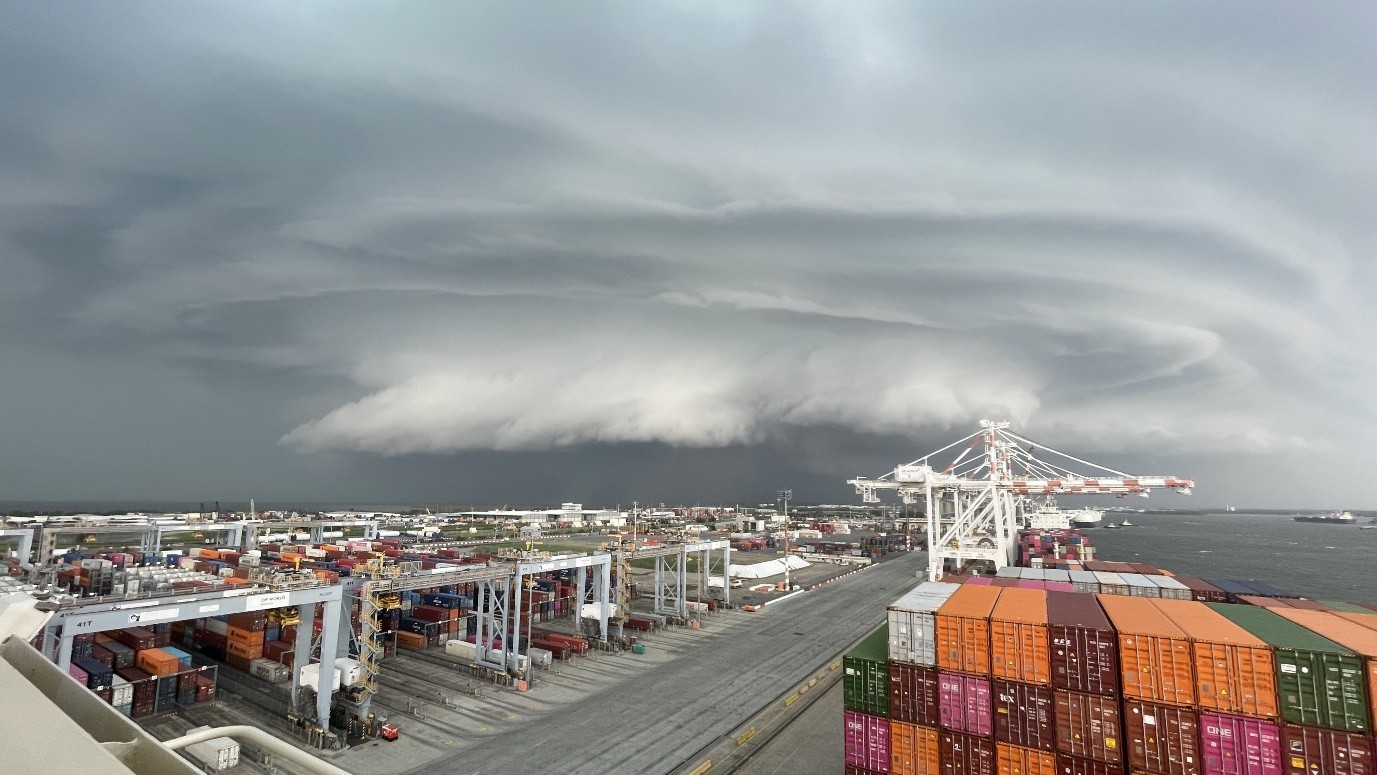
The ATSB has published an interim report from its ongoing investigation into the breakaway of four ships during a storm at the Port of Brisbane last year.
Three large container ships broke their moorings, and one subsequently grounded, when Brisbane was hit by a fast‑moving, severe thunderstorm on the afternoon of 24 November 2025.
A car carrier, which was in the process of mooring as the storm approached, was also pushed off the berth, but kept under control by its attending tugs.
An interim report summarises the evidence gathered so far in the ATSB’s ongoing investigation, and outlines the order of events, but does not include analysis or findings.
It notes on the morning of the incident, the Brisbane harbour master received weather briefings indicating potential severe thunderstorms that afternoon and evening.
This information was distributed by Brisbane vessel traffic service to port stakeholders, and high windage ships moored in the port were directed to lower their outboard anchors, and add extra mooring lines where possible.
Operations in the port then proceeded as normal, with the three container ships Volans, Wide India and MSC Barbara continuing loading and unloading at their respective berths at the Fisherman Islands terminals, having completed the required precautions.
The car carrier, the Viking Passama, also continued its inbound transit of Moreton Bay, with its pilot and master agreeing on the use of a second tug and extra mooring lines.
At 12:43 pm, the Bureau of Meteorology issued the first severe thunderstorm warning for South East Queensland. Updates showed storms tracking north‑east over the Gold Coast, until 2:07 pm and 2:27 pm, when updated warnings indicated a track closer to the port.
“A new warning issued at 2:46 pm indicated that very dangerous thunderstorms would affect the area at about 3 pm,” said ATSB Chief Commissioner Angus Mitchell.
“This warning resulted in all stevedores working on the container ships stopping work and disembarking, and led to the pilot of a gas tanker following Viking Passama into the port to abort their approach.”
However, by this time, Viking Passama was in the narrow entrance channel, and could not turn around.
“Data recorded by Maritime Safety Queensland then showed increasing winds from just prior to 3 pm, with a rapid increase in windspeed and a roughly 180-degree change in direction about 20 minutes later, with gusts peaking at 71 knots – over 130 km/h.”
During the storm, all four aforementioned ships broke mooring lines along the Fisherman Islands berths.
- Viking Passama was being assisted by two tugs into its assigned berth at about 3 pm. The ship had just come to rest on the fenders and the crew were passing mooring lines ashore, when the pilot recognised the imminent change in wind direction, and ordered the tugs to push the ship against the berth.
The rapidly increasing wind then started blowing the ship away from the berth, while heavy rain and large hail required the pilot and master to seek shelter.
A short time later, the mooring party on the aft mooring station noticed extreme tension on the spring lines and moved to a safe position, before both lines parted, damaging hydraulic pipes and disabling the winches.
Despite the two tugs pushing at full power, the ship was slowly blown further from the berth, and the remaining lines parted about two minutes later.
Viking Passama drifted into the channel, about 120 m off its berth, before the wind abated sufficiently for the tugs to bring it under control and push it back to the berth.
After securing its forward lines one tug was released at about 4 pm, but the other tug had to stay longer with the ship due to the damage to the ship’s aft winches.
- Meanwhile, the rapidly increasing wind acting on the stern of the berthed container ship Volans caused its aft mooring lines to part at about 3.15 pm, and the stern pushed away from the berth.
The ship’s master subsequently requested urgent tug and pilot assistance, but none was available.
The ship swung around its bow, still held by its anchor and two remaining headlines, until it was heading into the wind and its stern was impinging into the adjacent channel.
- The container ship Wide India, which was berthed adjacent to Volans, broke free at about 3:19 pm. The ship’s master used its main engine to prevent it from drifting astern into the container feeder Medkon Ten, which remained fast alongside at the next berth.
After being informed by vessel traffic service that tug assistance was not available, Wide India’s master then manoeuvred their ship slowly upriver, maintaining the minimum speed required for steering to keep the ship under control.
While still exposed to high wind speeds and in poor visibility, the ship passed through the narrow opening between the channel bank and the stern of Volans, eventually coming to a stop at the south end of Fisherman Islands when the wind subsided.
A pilot boarded Wide India after 4 pm and, with the assistance of a tug released from Viking Passama, turned the ship and departed the port to anchorage.
- At about 3:20 pm, the increasing wind force impacting container ship MSC Barbara, berthed further to the north along the wharf, led to its winch brakes rendering.
The wind pushed the ship off its berth, with most of its mooring lines running off their winch drums and the remainder parting under the load.
The ship’s main engine was not ready to manoeuvre, leaving the ship without propulsion as it drifted north, eventually grounding at about 3:36 pm on the opposite side of the channel.
Pilots boarded MSC Barbara, which was heeled over slightly to port, at 4:24 pm. It was refloated, with the assistance of three tugs, soon after 5 pm, and departed to the anchorage.
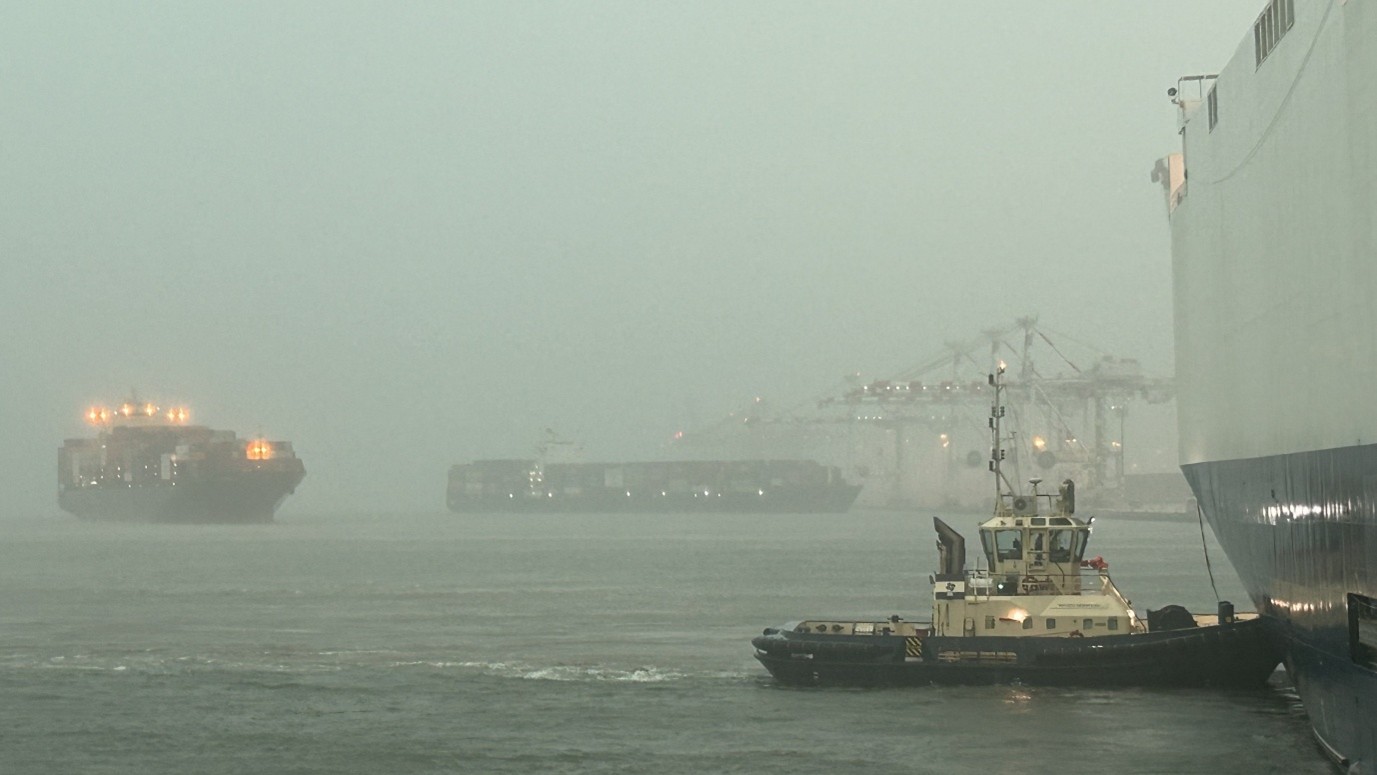
The breakaways of Wide India (left) and Volans (centre), with Viking Passama in the right foreground.
Fortunately, no injuries were reported during the events. Viking Passama and MSC Barbara sustained minor damage.
“The interim report notes as the storm passed over the port, vessel traffic service operators contacted both harbour towage operators and the pilotage provider to request emergency assistance, but this was delayed due to the need for crews and pilots to make their way through road traffic congestion caused by the storm,” Mr Mitchell said.
The first available pilot arrived at Fisherman Islands on board a police boat just after 4 pm, shortly followed by three more pilots on a pilot launch. The first emergency tug departed its base at 4:22 pm.
Following the incident ATSB investigators deployed to the Port of Brisbane to collect relevant evidence and interview relevant personnel.
Investigators also attended Wide India and MSC Barbara in Brisbane, and Viking Passama in Melbourne, to collect evidence and interview masters and relevant crew.
Voyage data recorder (VDR) data was received from Volans, and recovered by the ATSB from Viking Passama and MSC Barbara.
Mr Mitchell said that as the investigation progressed, it would consider the evidence detailed in the interim report, with a particular focus on the information, procedures and planning in place, both at the port and on board each ship, prior to the occurrence.
“This was a severe weather event, resulting in a complex situation involving several ships and harbour vessels,” he said.
“The investigation will include a thorough review of the available meteorological and climatological data, as well as shipboard and shore-side mooring arrangements, harbour towage, emergency arrangements, and the effectiveness of the port’s procedures and operational guidance.”
Mr Mitchell said a final report will be released, detailing analysis and findings, at the conclusion of the investigation.
“In the meantime, should a critical safety issue be identified, the ATSB will notify relevant parties immediately, so appropriate and timely safety action can be taken,” he concluded.
Read the interim report: Breakaways involving Wide India, Volans, Viking Passama and MSC Barbara, Port of Brisbane, Queensland, on 24 November 2025