

| Occurrence Briefs are concise reports that detail the facts surrounding a transport safety occurrence, as received in the initial notification and any follow-up enquiries. They provide an opportunity to share safety messages in the absence of an investigation. Because occurrence briefs are not investigations under the Transport Safety Investigation Act 2003, the information in them is de-identified. |
What happened
On 12 April 2026, a student pilot, the sole occupant of a Cessna 172R, was conducting solo circuits at Archerfield Airport, Queensland. Prior to this, dual training (with an instructor) was conducted for about half an hour. The flight was the third time the student had flown solo, and an instructor was responsible for supervising their flight. There was a quartering headwind at about 8 kt.
The solo circuits were initially conducted on runway 28L prior to the pilot requesting a ‘full-stop landing’1 to complete the flight. At this point the air traffic controller (tower) changed the runway assignment to runway 28R.
The pilot then conducted three unsuccessful landing attempts to runway 28R. Each of these attempts resulting in the aircraft either ‘bouncing’2 or ‘porpoising’3 followed by the student conducting a go-around. The student pilot reported that during one of the attempted landings a significant ‘bounce’ occurred.
The controller reported to the operator that the second landing attempt involved the aircraft porpoising, resulting in a tail strike and what appeared to be a possible propeller strike.
The supervising instructor reported observing that the third landing was a hard landing. noting the nose wheel came into contact with the runway first. The earlier landing attempts were not fully visible by the instructor due to them not having a clear line of sight.
After the third attempt to land, the supervising instructor contacted the air traffic control tower and communicated directly with the student, via the tower frequency, to provide the student verbal assistance, helping to facilitate a safe landing on the fourth attempt.
A post-flight inspection of the aircraft by the operator revealed the tail tie-down hook was missing, with evidence of a tail strike and firewall deformation (Figure 1).
Figure 1: Damage to aircraft
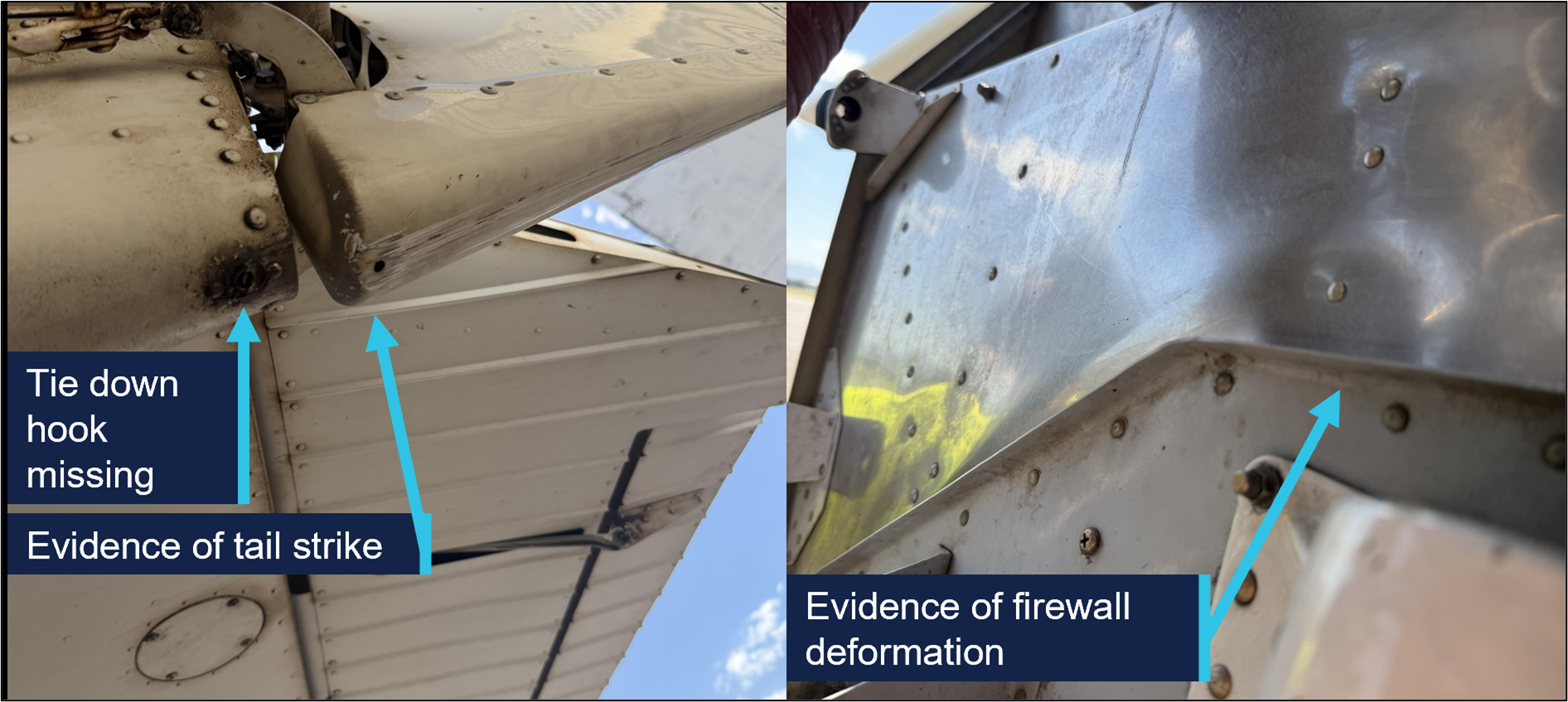
Source: Operator, annotated by the ATSB
Safety message
While conducting training flights, students can experience a high workload, particularly during solo flights and landing. Maintaining a calm mindset is important in order to adjust the aircraft’s profile and airspeed accordingly and determine if a go‑around is necessary.
All pilots, regardless of their experience levels, should be prepared to undertake a go‑around rather than continuing if they are not confident that a successful landing can be achieved. This occurrence also serves as a reminder that after any hard landing or other related incident where the integrity of the airframe or structure may be compromised, an engineering inspection can detect damage that may not be immediately apparent.
About this report
Decisions regarding whether to conduct an investigation, and the scope of an investigation, are based on many factors, including the level of safety benefit likely to be obtained from an investigation. For this occurrence, no investigation has been conducted and the ATSB did not verify the accuracy of the information. A brief description has been written using information supplied in the notification and any follow-up information in order to produce a short summary report, and allow for greater industry awareness of potential safety issues and possible safety actions.
- ^ A ‘full-stop landing’ in pilot training means the pilot does not intend to take off again immediately.
- ^ A bounced landing is a condition where the aircraft lands on the runway, but instead of rolling on the surface after touchdown, it rebounds/bounces off the ground.
- ^ ‘Porpoising’ refers to the manoeuvre that can occur after a bounced landing that is improperly recovered, in which the aeroplane comes in nose first setting off a series of cyclic vertical motions.
Occurrence summary
| Mode of transport | Aviation |
|---|---|
| Occurrence ID | AB-2026-024 |
| Occurrence date | 12/04/2026 |
| Location | Archerfield Airport |
| State | Queensland |
| Occurrence class | Accident |
| Aviation occurrence category | Control issues, Hard landing, Missed approach |
| Highest injury level | None |
| Brief release date | 22/05/2026 |
Aircraft details
| Manufacturer | Cessna Aircraft Company |
|---|---|
| Model | 172R |
| Sector | Piston |
| Operation type | Part 141 Recreational, private and commercial pilot flight training |
| Activity | General aviation / Recreational-Instructional flying-Instructional flying - solo |
| Departure point | Archerfield Airport, Queensland |
| Destination | Archerfield Airport, Queensland |
| Injuries | None |
| Damage | Substantial |