

Final report
Report release date: 06/08/2026
Investigation summary
What happened
On the morning of 1 May 2026, a Piper PA-32R-301 Saratoga, registered VH-LPW, departed Essendon for a flight to Stawell, Victoria, with a pilot and 2 allied health clinician passengers on board.
The aircraft flew to Stawell, Victoria, disembarked a clinician, then flew to Horsham, Victoria, where the second clinician disembarked. The pilot operated the flights to Horsham using the left wing fuel tank and intended to change to the right tank to operate the return flights. Later in the day, after the clinician had attended to their appointments, the aircraft departed Horsham before collecting the second clinician from Stawell and departing with both on board for the return to Essendon.
At 1616, as the aircraft was cruising at 7,000 ft above mean sea level, the engine began to run rough. In response, the pilot commenced the engine power loss in flight actions which included selecting the right fuel tank. After switching to the right fuel tank, normal engine power did not immediately return, and the pilot assessed that the rough running was not fuel‑related. The pilot then shut the engine down and completed a power-off landing at the nearby Bacchus Marsh Aerodrome.
What the ATSB found
The ATSB found that the planned fuel tank change at Horsham before the return flights was inadvertently omitted. This omission was not detected prior to the contents of the left fuel tank being exhausted and the engine began running rough.
In response to the rough running, the appropriate emergency actions were not fully completed, and the engine was shut down before those actions could take effect. This resulted in an unnecessary increase in safety risk associated with the power-off forced landing.
Safety message
Accidents involving fuel mismanagement are an ongoing aviation safety concern and are a reminder of the importance of monitoring fuel levels prior to, and during, flight. Adhering to procedures, maintaining an accurate fuel record, and ensuring appropriate tank selections are made for the phase of flight will lessen the likelihood of fuel starvation and/or fuel exhaustion.
Fuel management related accident investigations have been published by the ATSB in Avoidable Accidents No. 5 - Starved and exhausted: Fuel management aviation accidents (AR‑2011-112) which outlines strategies and key messages for fuel management.
This incident also highlights the importance of careful and methodical emergency response actions. In this case the engine failure response actions were not fully completed, resulting in power not being restored to an otherwise serviceable engine.
The investigation
| The ATSB scopes its investigations based on many factors, including the level of safety benefit likely to be obtained from an investigation and the associated resources required. For this occurrence, the ATSB conducted a limited-scope investigation in order to produce a short investigation report, and allow for greater industry awareness of findings that affect safety and potential learning opportunities. |
The occurrence
At 0657 local time on the morning of 1 May 2026, a Piper PA-32R-301 Saratoga, registered VH-LPW, departed Moorabbin Airport for a flight to Essendon Airport, Victoria, with the pilot on board. The aircraft was loaded with a total of 323 litres (L) of usable fuel with the left tank full (193 L), while the right tank held 130 L. The flight departed with the left fuel tank selected and landed at Essendon 18 minutes later, where 2 allied health clinicians boarded the aircraft.
From Essendon, the plan was to fly to Stawell, Victoria, to disembark a clinician, then fly on to Horsham, Victoria, where the second clinician would disembark. Later in the day, after the clinician had attended to their appointments, the aircraft would depart Horsham with the pilot and clinician on board before collecting the second clinician from Stawell and returning both to Essendon. Following this, the pilot would return to Moorabbin to conclude the day.
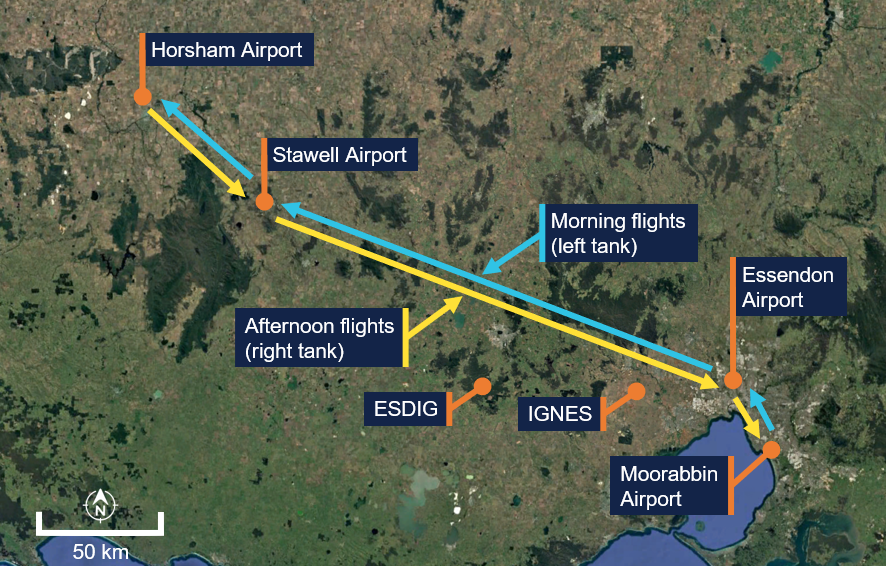
The flights were operated as private flights (see the section titled Operation) under the instrument flight rules.1 The pilot intended to operate the flights to Horsham using the fuel contained in the left tank and then change to the right tank to operate the return flights (Figure 1).
Figure 1: Planned flights
After completing the morning’s flights, the aircraft landed at Horsham at 0913 with about 74 L in the left tank and 130 L in the right. In the afternoon, the pilot prepared for the return flight to Stawell but inadvertently omitted to select the right tank and, at 1429, the aircraft departed Horsham with the left tank still selected.
The pilot reported that their practice was to use the crossing of en route waypoints as a cue to check the fuel state of the aircraft, but for the short flight to Stawell, the aircraft did not cross any en route waypoints and, at 1446, landed with the left tank still selected. At 1534, the aircraft departed Stawell with the left tank still selected and tracked toward the first en route waypoint, ESDIG. However, prior to crossing ESDIG, air traffic control instructed the pilot to track direct to waypoint IGNES.
At 1616, the aircraft was continuing toward IGNES at 7,000 ft above mean sea level and passed through a patch of cloud. At that time, the engine began to run rough. Before commencing emergency procedures (see the section titled Emergency procedures) the pilot visually identified Bacchus Marsh Aerodrome, which was about 4 NM (7.4 km) north of the aircraft, as a suitable location for a forced landing (Figure 2). The engine continued to run rough and, in response, the pilot commenced the engine power loss in flight actions and selected the right fuel tank.
After switching fuel tanks, normal engine power did not immediately return, and the pilot assessed that the rough running was not fuel‑related. The pilot then shut the engine down by moving the mixture control to the idle cut-off position and the fuel selector to the off position.
Figure 2: Rough running and forced landing
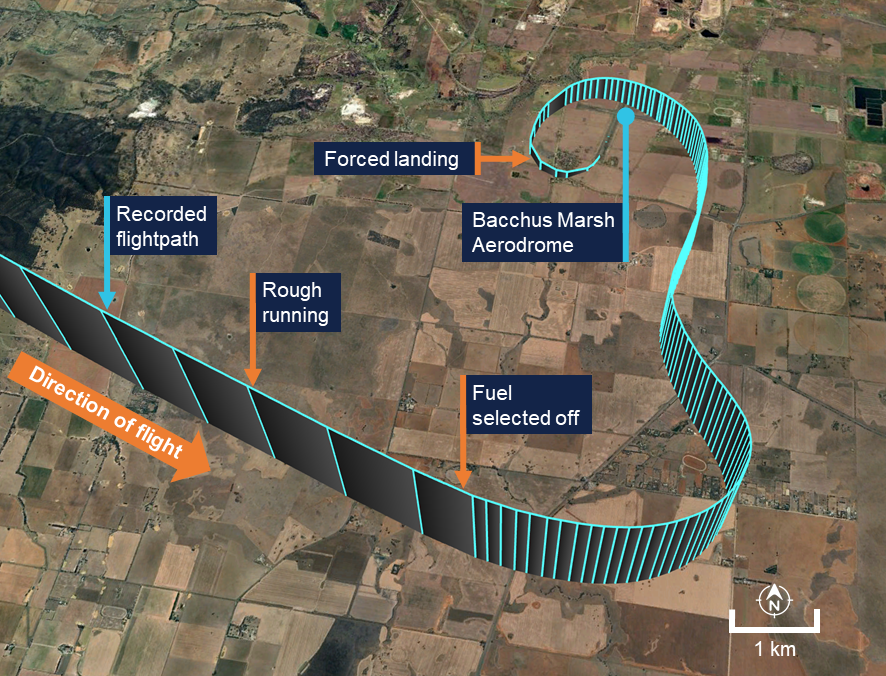
The pilot then completed a power-off landing at Bacchus Marsh without incident. After landing, the engine was started with the right fuel tank selected and ran without issue.
Context
Pilot details
The pilot held a Commercial Pilot Licence (Aeroplane), an instrument rating and a class 1 aviation medical certificate. The pilot had about 1,360 hours of aeronautical experience (105 in the Saratoga) of which 54 hours (29 in the Saratoga) were in the 90 days before the incident.
The ATSB found no indicators that the pilot was experiencing a level of fatigue known to adversely affect performance.
Aircraft details
General
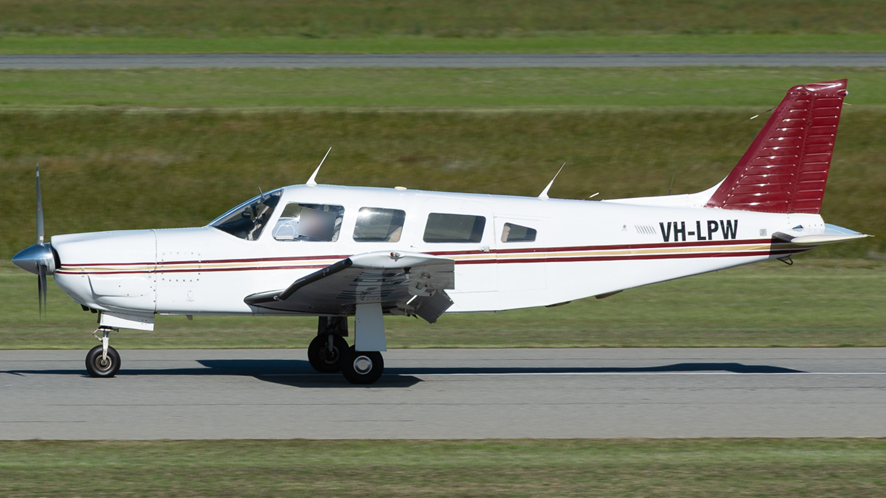
The Piper PA-32R-301 Saratoga is a single-engine, low-wing, retractable-tricycle landing gear aircraft. The Saratoga is powered by a Lycoming IO‑540 fuel‑injected, horizontally‑opposed piston engine driving a 3‑blade, variable‑pitch propeller. VH‑LPW (Figure 3), serial number 32R‑8113095, was manufactured in the United States in 1981 and first registered in Australia in 1982.
Figure 3: VH-LPW
Fuel information
The Saratoga was fitted with 2 fuel tanks in each wing. The total fuel capacity was 405 L, of which 386 L was usable (193 L in each wing). The 2 fuel tanks in each wing were interconnected and acted as one tank and the fuel selector had 3 positions: left, right and off. Fuel was fed to the engine cylinders via a mechanical fuel pump and a pilot‑selectable electric fuel pump (Figure 4).
Figure 4: Fuel system schematic
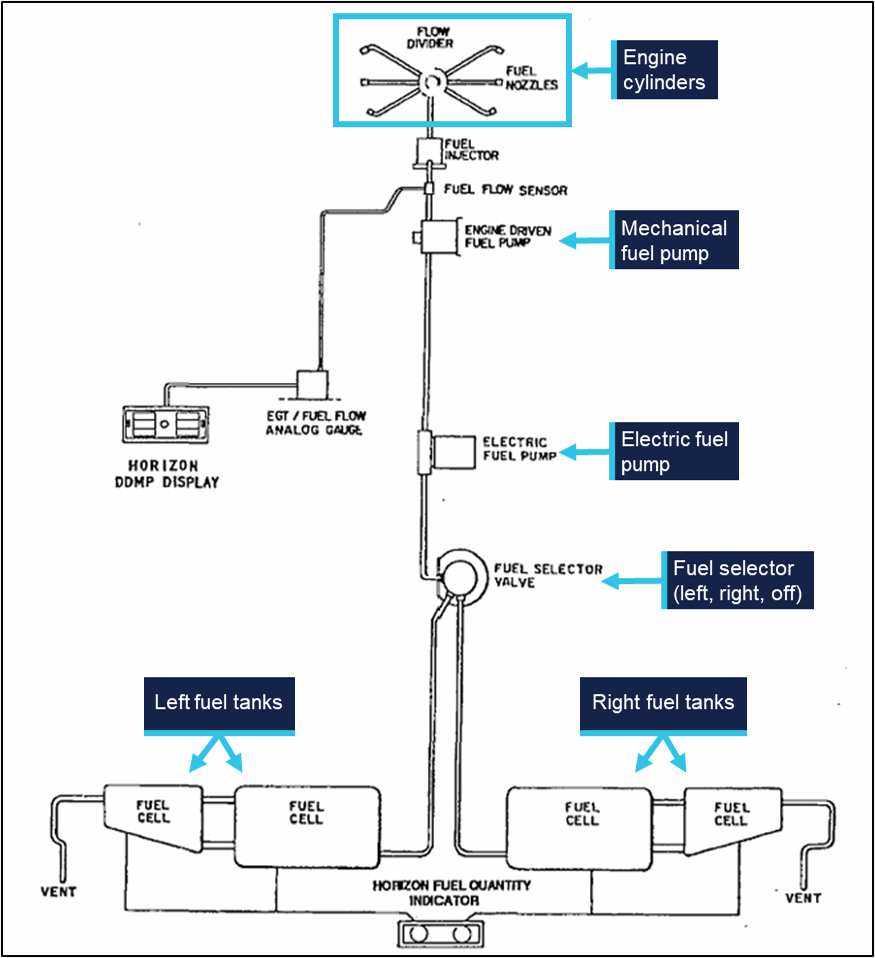
Source: Piper, annotated by the ATSB
For normal operations, the pilot’s operating handbook (POH) required the following fuel tank selections when operating the aircraft:
• Before starting engine – Select desired tank
• Before take-off – Select the proper (fullest) tank
• For approach and landing – Select the proper (fullest) tank
For flight planning purposes, the pilot used an estimated en route fuel burn rate of 60 L per hour (consistent with POH information) and an allowance of 5 L for ground operations. The ATSB calculated that the aircraft departed Stawell for the return flight to Essendon with about 45 L in the selected left tank and 130 L in the right tank.
Emergency procedures
The POH instructed the following actions to be taken in response to an engine power loss in flight:
• Fuel selector – switch to tank containing fuel
• Electric fuel pump – select on
• Mixture rich – rich
• Alternate air – open
• Engine gauges – check for indication of cause of power loss
If no fuel flow is indicated, check tank selector position to be sure it is on a tank containing fuel.
The POH also noted that if the engine failure was caused by fuel starvation, engine power would not be restored after switching fuel tanks until the empty fuel lines were filled. The handbook stated that this could take up to 10 seconds.
Operation
The aircraft operator was an allied health services provider that serviced regional areas. The operator used small aircraft (and other means) to transport employees from major centres to the regional areas for appointments.
The operator’s flights were conducted in accordance with Civil Aviation Safety Regulation (CASR) instrument EX68/24 (section 7AA). This instrument provided an exemption to the requirements of CASR Part 119 (Australian air transport operations), permitting the flights to be operated under CASR Part 91 (General operating and flight rules) as private flights.
In addition to the exemption, the Civil Aviation Safety Authority (CASA) had also issued a direction applicable to flights conducted by the operator with the following additional requirements:
• In addition to meeting other CASR Part 61 (Flight crew licencing) requirements for the aircraft and the flight, each flight must be operated by a pilot in command holding a:
- Class 1 or Class 2 medical certificate
- Commercial Pilot Licence or Air Transport Pilot Licence.
• The aircraft must be operated in accordance with the performance rules specified in CASR Subpart 135.F, as if the flight were conducted as a Part 135 (air transport – smaller aeroplanes) operation.
• The aircraft must be compliant with the equipment rules in CASR Subpart 135.K, as if the flight were a Part 135 operation.
• Any aircraft used must be within the maximum take-off weight limits and maximum operational passenger seating capacity limits specified in regulation 135.005 of the CASR.
• The operator must ensure that all passengers carried are informed that the flight is being conducted as a private flight and that the flight is therefore not subject to all of the same safety standards as a commercial operation.
Meteorological information
At the time the engine began running rough, the aircraft was flying through broken2 clouds, although the forced landing was conducted in visual meteorological conditions.3
At 1600, 16 minutes before the incident, the Bureau of Meteorology automatic weather station at Avalon Airport, 26 km south of the aircraft, recorded the temperature as 27°C and the wind as 12 kt from 358° magnetic. Broken cloud was recorded at 8,935 ft above mean seal level, and visibility was recorded as greater than 10 km.
Similar occurrences
The ATSB has investigated multiple fuel management/fuel starvation incidents and accidents involving both single and twin‑engine aircraft. Examples include:
- Fuel starvation event involving Cessna 310, VH-JQK, near Sunshine Coast Airport, Queensland, on 18 August 2022 (AO‑2022‑040).
- Fuel starvation and forced landing involving Pilatus Britten-Norman Islander BN2A, VH‑WQA, Moa Island, Queensland, on 3 October 2022 (AO‑2022‑046)
- Fuel starvation and forced landing involving Piper PA-31-350, VH-HJE, 11 km south of Archerfield Airport, Queensland, on 7 April 2023 (AO‑2023‑017).
- Fuel starvation and ditching involving Piper PA-28, VH-FEY, 15 km north-west of Jandakot Airport, Western Australia, on 20 April 2023 (AO‑2023‑021).
- Fuel starvation and forced landing involving Cessna 310R, VH-DAW, about 5 km south-east of Derby Airport, Western Australia, on 20 June 2023 (AO‑2023‑029).
- Fuel starvation involving Cessna T210M, VH-MYW, 4 km north‑west of Bankstown Airport, New South Wales, on 26 May 2024 (AO‑2024‑033).
- Fuel starvation involving Cessna T210M, VH-LLM, near Darwin Airport, Northern Territory, on 8 September 2025 (AO‑2025‑054).
Safety analysis
The aircraft departed Moorabbin with sufficient fuel to conduct the day’s planned flying and the pilot planned to operate the legs to Horsham on the left tank and return on the right. While this plan provided adequate fuel supply to the engine for the day, it was not consistent with the pilot operating handbook’s (POH) requirement to select the fullest tank for the arrival into Horsham (when fuel level in the left tank had reduced below that of the right tank).
At Horsham, the pilot inadvertently omitted the planned selection of the right tank for the return flights and then, prior to departure, the fullest (right) tank was not identified and selected as required by the POH. During the return flight to Stawell, the aircraft did not cross an en route waypoint. As a result, the pilot was not prompted by their usual processes to review the aircraft’s fuel state and identify the omission.
The pilot’s plan for the day’s flying did not include further tank selections and therefore the pilot was likely not primed to make any further selections. Nevertheless, for the landing and departure from Stawell, the pilot did not select the fullest (right) tank as was required, nor did they identify that the left tank remained selected. Therefore, the aircraft departed Stawell with about 45 L available in the selected tank. This was insufficient fuel to complete the flight.
After the departure from Stawell, air traffic control instructions resulted in a change to en route tracking prior to the aircraft crossing the waypoint ESDIG. As the pilot’s practice of reviewing the fuel state was linked to crossing waypoints, the change in tracking resulted in the pilot not being prompted to identify the fuel tank selection omission before the fuel in the left tank was exhausted. As a result, at 1616, the contents of the left tank were exhausted, and the engine began to run rough.
Contributing factor On a previous flight leg, a planned fuel tank change was inadvertently omitted. The omission was not detected prior to the contents of the left fuel tank being exhausted and the engine began running rough. |
In response to the rough running, the pilot commenced the emergency actions and changed to the right fuel tank. After taking this action, the POH instructed that it could take up to 10 seconds for the empty fuel lines to be filled before the engine would restart. However, the pilot almost certainly did not allow this time to elapse before assessing that the engine failure was not fuel‑related and shutting off fuel to the engine.
After shutting off the fuel, the pilot then successfully completed a forced landing at Bacchus Marsh. After landing, the serviceability of the engine was confirmed when a start was attempted and, after sufficient time was allowed for the empty fuel lines to be filled, the engine started and ran without issue.
Shutting off the fuel to the engine before sufficient time had elapsed for it to restart resulted in an unnecessary forced landing that increased risk to the flight.
Contributing factor In response to the rough running, the appropriate emergency actions were not fully completed, and the engine was shut down before those actions could take effect. A landing was then completed without engine power. |
Findings
ATSB investigation report findings focus on safety factors (that is, events and conditions that increase risk). Safety factors include ‘contributing factors’ and ‘other factors that increased risk’ (that is, factors that did not meet the definition of a contributing factor for this occurrence but were still considered important to include in the report for the purpose of increasing awareness and enhancing safety). In addition ‘other findings’ may be included to provide important information about topics other than safety factors. These findings should not be read as apportioning blame or liability to any particular organisation or individual. |
From the evidence available, the following findings are made with respect to the fuel starvation involving Piper PA-32R-301, VH-LPW, 9 km south of Bacchus Marsh Aerodrome, Victoria, on 1 May 2026.
Contributing factors
- On a previous flight leg, a planned fuel tank change was inadvertently omitted. The omission was not detected prior to the contents of the left fuel tank being exhausted and the engine began running rough.
- In response to the rough running, the appropriate emergency actions were not fully completed, and the engine was shut down before those actions could take effect. A landing was then completed without engine power.
Sources and submissions
Sources of information
The sources of information during the investigation included:
- Airservices Australia
- Civil Aviation Safety Authority
- Piper Aircraft
- the Bureau of Meteorology
- the operator
- the pilot.
Submissions
Under section 26 of the Transport Safety Investigation Act 2003, the ATSB may provide a draft report, on a confidential basis, to any person whom the ATSB considers appropriate. That section allows a person receiving a draft report to make submissions to the ATSB about the draft report.
A draft of this report was provided to the following directly involved parties:
- Civil Aviation Safety Authority
- Piper Aircraft
- the operator
- the pilot
- United States National Transportation Safety Board.
Submissions were received from:
- Civil Aviation Safety Authority
- the operator.
The submissions were reviewed and, where considered appropriate, the text of the report was amended accordingly.
Purpose of safety investigationsThe objective of an ATSB safety investigation is to improve transport safety through:
In accordance with the TSI Act, the ATSB does not investigate for the purpose of taking administrative, regulatory or criminal action, and cannot apportion blame, assist in determining liability, or, as a general rule, assist in court proceedings. About ATSB reportsATSB safety investigation reports are developed in accordance with ATSB procedures and guidelines, and with regard to applicable international standards and instruments. Reports must include factual material of sufficient weight to support the investigation’s analysis and findings. At all times the ATSB endeavours to balance the use of material that could imply adverse comment with the need to properly explain what happened, and why, in a fair and unbiased manner. An explanation of terminology used in ATSB investigation reports is available here. Publishing informationReleased in accordance with section 25 of the Transport Safety Investigation Act 2003 Published by: Australian Transport Safety Bureau © Commonwealth of Australia 2026 Ownership of intellectual property rights in this publication Unless otherwise noted, copyright (and any other intellectual property rights, if any) in this report publication is owned by the Commonwealth of Australia. Creative Commons licence 
With the exception of the Commonwealth Coat of Arms, ATSB logo, and photos and graphics in which a third party holds copyright, this report is licensed under a Creative Commons Attribution 4.0 International licence. The CC BY 4.0 licence enables you to distribute, remix, adapt, and build upon our material in any medium or format, so long as attribution is given to the Australian Transport Safety Bureau. Copyright in material obtained from other agencies, private individuals or organisations, belongs to those agencies, individuals or organisations. Where you wish to use their material, you will need to contact them directly. |
- ^ Instrument flight rules (IFR): a set of regulations that permit the pilot to operate an aircraft in instrument meteorological conditions (IMC), which have much lower weather minimums than visual flight rules (VFR).
- ^ In aviation, cloud cover is reported using words that denote the extent of the cover – ‘broken’ indicates that more than half to almost all the sky is covered.
- ^ Visual meteorological conditions (VMC): an aviation flight category in which visual flight rules (VFR) flight is permitted – that is, conditions in which pilots have sufficient visibility to fly the aircraft while maintaining visual separation from terrain and other aircraft.
Occurrence summary
| Investigation number | AO-2026-076 |
|---|---|
| Occurrence date | 01/05/2026 |
| Occurrence time and timezone | 1616 Australian Eastern Standard Time |
| Location | 9 km south of Bacchus Marsh Aerodrome |
| State | Victoria |
| Report release date | 06/08/2026 |
| Report status | Final |
| Investigation level | Short |
| Investigation type | Occurrence Investigation |
| Investigation phase | Final report: Dissemination |
| Investigation status | Completed |
| Mode of transport | Aviation |
| Aviation occurrence category | Engine failure or malfunction, Fuel starvation |
| Occurrence class | Incident |
| Highest injury level | None |
Aircraft details
| Manufacturer | Piper Aircraft Corp |
|---|---|
| Model | PA-32R-301 |
| Registration | VH-LPW |
| Serial number | 32R-8113095 |
| Sector | Piston |
| Operation type | Part 91 General operating and flight rules |
| Activity | Own business travel |
| Departure point | Stawell Airport, Victoria |
| Destination | Essendon Airport, Victoria |
| Injuries | None |
| Damage | Nil |