

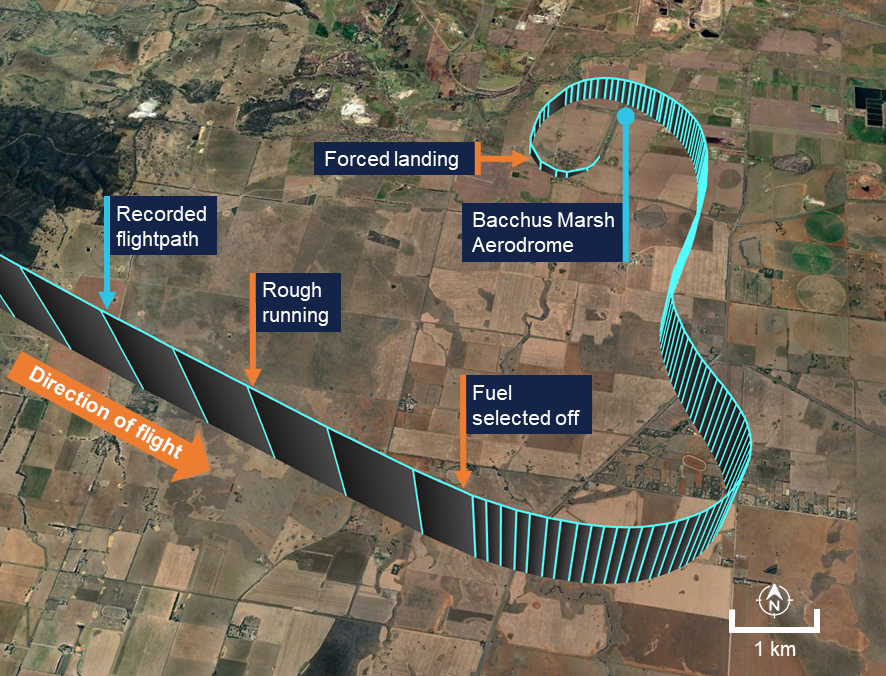
A Piper Saratoga light aircraft conducted a power-off forced landing at Bacchus Marsh, Victoria, when the engine was starved of fuel, an ATSB investigation report details.
On the morning of 1 May 2026, the single-engine Piper PA-32R-301 departed Essendon, in north‑west Melbourne, with a pilot and two allied health clinicians on board.
The plan for the day was for the pilot to transport the two passengers to appointments in Stawell and Horsham, in western Victoria, before returning them to Essendon.
The pilot planned to select the aircraft’s left fuel tank for the outbound journey, and then switch over to the right tank on the ground at Horsham, before the return trip to Essendon.
ATSB Director of Transport Safety Stuart Macleod noted this fuel management plan was not in line with the pilot operating handbook (POH) requirement to select the fullest tank prior to each approach and landing.
“The aircraft had sufficient fuel for all planned flights,” Mr Macleod noted.
“However, the pilot used the left tank for all outbound flights, and then inadvertently omitted the fuel tank changeover on the ground in Horsham.
“The left tank then remained selected for the return trip, and the engine was starved of fuel about 45 km from Essendon.”
Consequently, the engine began running rough while the aircraft was cruising at about 7,000 ft.
In response, the pilot commenced the engine power loss in flight actions, which included selecting the right fuel tank.
“The pilot operating handbook details it can take up to 10 seconds for the empty fuel lines to be filled before the engine restarts, however the pilot almost certainly did not allow this time to elapse before assessing that the engine failure was not fuel‑related,” Mr Macleod said.
“The pilot subsequently shut the engine down, and successfully conducted a power‑off landing at Bacchus Marsh.”
After landing, the engine was started with the right fuel tank selected and ran without issue.
Mr Macleod noted the ATSB has investigated multiple fuel management/starvation accidents and incidents, involving both single and twin‑engine aircraft.
“These investigations highlight that adhering to procedures, maintaining an accurate fuel record, and ensuring appropriate tank selections are made for the phase of flight will lessen the likelihood of fuel starvation and exhaustion events,” he said.
The ATSB’s Avoidable Accidents publication on fuel management accidents outlines strategies and key messages for fuel management.
“In addition, this incident also highlights the importance of careful and methodical emergency response actions,” Mr Macleod concluded.
“In this case the engine failure response actions were not fully completed, resulting in power not being restored to an otherwise serviceable engine.”
Read the final report: Fuel starvation involving Piper PA-32R, VH-LPW, about 9 km south of Bacchus Marsh Aerodrome, Victoria, on 1 May 2026