

Summary
The ATSB is investigating an inadvertent engine shutdown and forced landing involving a Cessna 441, VH-LBZ, 3.6 km from Broome Airport, Western Australia, on 19 March 2026.
During initial climb from runway 10, both engines were inadvertently shutdown. The pilots maintained heading and conducted a forced landing in mangroves. One passenger was seriously injured and 4 passengers and 2 pilots received minor injuries.
To date, the ATSB has examined the aircraft wreckage, interviewed pilots and passengers, obtained maintenance records, examined recorded data, and collected other relevant information.
- examined the wreckage and accident site
- examined recorded data from the Garmin G600 TXi, GI 275 and GTN 650 devices
- interviewed the pilots and passengers
- collected radio communication, aircraft traffic surveillance data, and navigational application data
- collected aircraft, pilot, crew and operator documentation.
The investigation is continuing and will include further review and examination of:
- operational procedures and training
- aircraft maintenance and MEL practices
- crashworthiness and survivability aspects
- aircraft design features (including the START/STOP buttons).
A final report will be released at the conclusion of the investigation. Should a critical safety issue be identified during the course of the investigation, the ATSB will immediately notify relevant parties, so that appropriate safety action can be taken.
Last updated:
Preliminary report
Report release date: 02/06/2026
| This preliminary report details factual information established in the investigation’s early evidence collection phase, and has been prepared to provide timely information to the industry and public. Preliminary reports contain no analysis or findings, which will be detailed in the investigation’s final report. The information contained in this preliminary report is released in accordance with section 25 of the Transport Safety Investigation Act 2003. |
Summary video
The occurrence
On 19 March 2026, a Cessna 441 Conquest aircraft, registered VH-LBZ and operated by Skippers Aviation, was being utilised for a non-scheduled passenger air transport flight from Broome Airport to Mungalalu‑Truscott aerodrome, Western Australia. The flight was being operated by 2 pilots – a pilot in command under supervision1 (pilot flying), seated in the left seat and a training captain in the right seat. There were 5 passengers on board.
The aircraft had a permissible unserviceability, under the minimum equipment list (MEL)2 applied for the right engine fuel control computer. The MEL deferred defect log stipulated that both engines be operated in manual mode for take-off, using a specific procedure. The training captain, in consultation with the pilot flying, requested that they be assigned VH‑LBZ for training purposes, to cover the manual mode procedure. In preparation, the pilot flying reviewed the manual mode procedure both the night before and on the morning of the flight. This was in addition to having talked through and observed the training captain perform the procedure about 2 weeks prior.
The pilot flying arrived at the airport at about 0900 local time, about 40 minutes prior to the scheduled sign-on time, to prepare for the flight and to participate in a briefing with the training captain. The briefing was reported to be normal except that it included the procedure to operate the aircraft’s engines in manual mode, with the pilots referencing the flight manual.
The flight was scheduled to depart at 1030. Both pilots prepared the aircraft for departure and at about 1035 all 5 passengers had checked in and were escorted to the aircraft. The passengers received a safety briefing from the training captain at the aircraft.
The aircraft start was as per the manual mode procedure and, at 1058, Broome tower air traffic control (ATC) provided a clearance and the aircraft taxi was commenced. During the taxi to the runway holding point, the pilots completed their take-off brief, where they again discussed differences related to operating in manual mode. This included an earlier decision speed3 of 105 kt, setting an engine torque limit of 1,500 ft-lbs per side and that manual fuel enrichment using the START buttons may be required during the take‑off roll.
At about 1115, after waiting for traffic, VH-LBZ was cleared for take-off. The aircraft was lined up on runway 10 and the pilot flying moved the power levers up for a normal take‑off. The pilot flying noted that the engine torque increased to about 650 ft-lbs per side, below the target of 1,500 ft-lbs. In response, the pilot flying pressed the START buttons as per the procedure, alternating between left and right to enrich with fuel, reaching 1,450 ft-lbs engine torque before rotation.4
After take-off, both pilots recalled that, just after they had completed the after-take-off checks and at about 500 ft above mean sea level, with the autopilot engaged, the pilot flying verbalised their intention to enrich again as the torque was at 1,450 ft-lbs, and they wanted to increase it to 1,500 ft‑lbs. The pilot flying pressed what they believed to be the left and right START buttons (without looking at the panel).
At about 1117, immediately following the enrichment, the pilot flying recalled a change in engine sound, feeling the aircraft yaw slightly and an absence of thrust. The training captain also reported an immediate sound change and seeing the engine torque reduce asked the pilot flying if they had pressed the STOP buttons. The pilot flying was unsure, however, immediately lowered the nose to maintain airspeed.
The training captain called for an ‘air start’ and instructed the pilot flying to press the START buttons again. The training captain pulled the power levers back to where they believed the air start zone was, however, with limited time available to restart the engines, they decided to conduct a forced landing. At 1117:12, a MAYDAY5 call was made, and the pilot flying handed over control to the training captain. Broome tower ATC activated the crash alarm at 1117:18.
The decision was made by the training captain to land in the mangroves, relatively straight ahead of the aircraft track. The landing gear was extended as instructed by the training captain, and the pilot flying called for the flaps down, which the training captain actioned. The passengers were instructed to brace for impact.
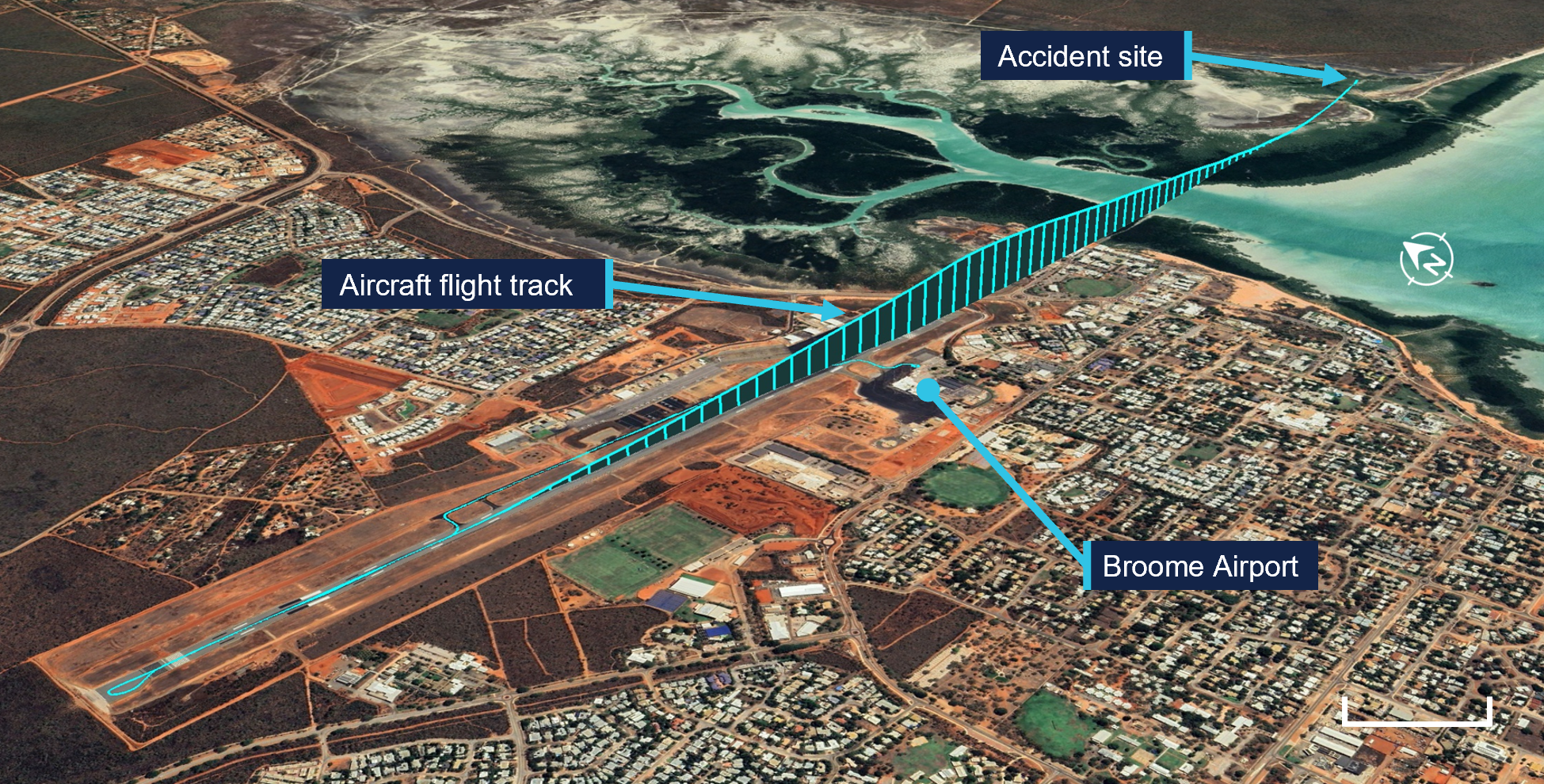
The training captain conducted a controlled descent and moved the condition levers to shut-off just before the aircraft impacted terrain at 1117:54, at a ground speed of 76 kt (141 km/h) (Figure 1). As a result of the impact, one passenger was seriously injured and the 2 pilots and 4 passengers received minor injuries. The aircraft was substantially damaged.
Figure 1: Flight track and location of accident site
Source: ATSB
The aircraft emergency locator transmitter activated on impact and the training captain attempted to contact Broome tower ATC via radio, however, was unsure if the radio was working, as they did not receive a response.
Broome tower ATC attempted to contact the aircraft operator to confirm the number of people on board, and if there were any dangerous goods, but was unable to do so. This information was instead obtained through contact with the training captain on their mobile phone.
The occupants commenced exiting the aircraft and the training captain was the last to egress, taking the fire extinguisher. The pilot flying applied first aid to the seriously injured passenger.
A search and rescue helicopter was dispatched at about 1141, arriving on site at 1210. Western Australia police arrived at about 1213. The seriously injured passenger was airlifted from the accident site and transported to hospital by ambulance. The flight crew and remaining passengers were assisted by police and the Department of Fire and Emergency Services to walk from the accident site and were met by ambulances.
Context
Personnel information
Pilot in command under supervision
The pilot in command under supervision held a Commercial Pilot Licence (Aeroplane), issued in 2018 and with class ratings for multi- and single-engine aeroplanes. They had accumulated 1,256.8 total flight hours, with 56.6 hours on the Cessna 441 aircraft type. The pilot held a current instrument rating, with their last proficiency check completed in January 2026, and a current class 1 aviation medical certificate (valid until April 2026) with no conditions. The pilot reported being well rested and fit to fly.
Training captain
The training captain held a Commercial Pilot Licence (Aeroplane) issued in 2022 and with class ratings for multi- and single-engine aeroplanes. They had accumulated 1,764.7 total flight hours, with 1,080.9 hours on the Cessna aircraft 441 type. They held a current instrument flight rating, with their last proficiency check completed in November 2025, and a current class 1 aviation medical certificate (valid until November 2026) with no conditions. The training captain reported being well rested and fit to fly.
In addition to their position as training captain, they also held the roles of Broome senior base pilot and the Cessna 441 fleet manager for the operator.
Aircraft information
General
The Cessna 441 Conquest is a pressurised, low‑wing aircraft, with seating for up to 2 pilots and 10 passengers. However, the Skippers Aviation operations manual limited the number of passengers that could be carried to 9.
VH-LBZ was powered by 2 Honeywell International Inc TPE331-10N-531S turboprop engines, fitted with Hartzell HC-B3TN-5 propellers. Both pilot seats were equipped with flight controls, however, single‑pilot line operations were flown from the left seat. The right pilot seat would normally only be occupied by a second pilot for training and checking, although for this flight the operator’s client had stipulated via policy that 2 crew would be carried.
The accident aircraft, serial number 4410038, was manufactured in the United States by the Cessna Aircraft Company in 1978 and registered in Australia as VH-LBZ in July 1984. At the time of take-off, the aircraft had a total time-in-service of 29,267.9 flight hours. The aircraft was operating under a Civil Aviation Safety Authority supplemental type certificate that, with specific maintenance requirements, permitted operators to continue operating the Cessna 441 past its service life of 22,500 flight hours to 40,000 flight hours.
Aircraft maintenance
The aircraft was maintained in accordance with the Skippers Aviation Cessna 441 maintenance program, which incorporated the requirements of the life extension program, permitted by the supplemental type certificate.
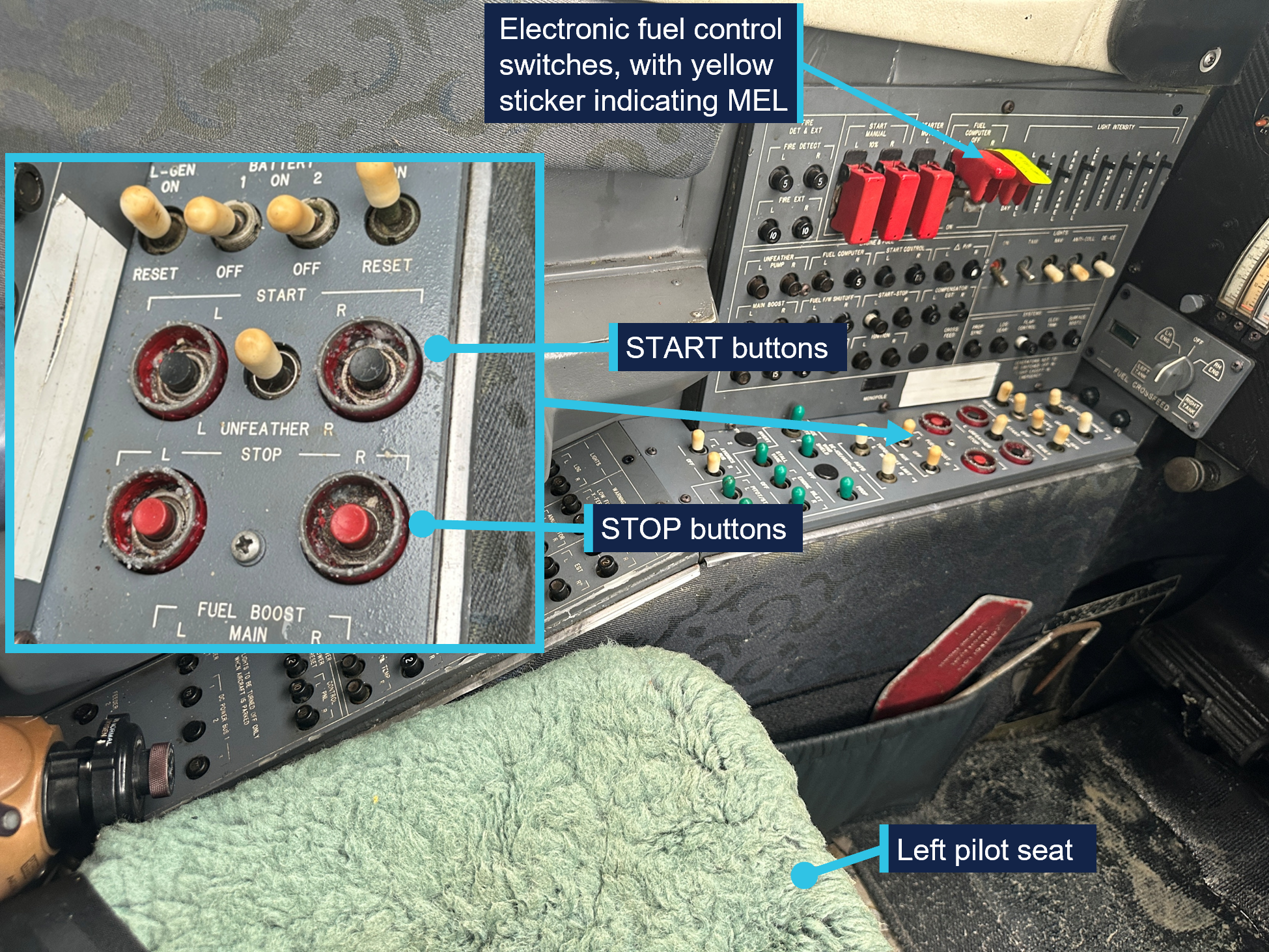
The aircraft had a deferred defect log6 entry dated 16 March 2026, which showed that the right engine fuel control computer was unserviceable. A yellow sticker was affixed to the right fuel control computer switch located on the left vertical panel inside the aircraft to identify the unserviceability (see START and STOP buttons). This was a permissible unserviceability in accordance with the aircraft’s MEL. As this was a category C defect,7 the aircraft was permitted to operate for a maximum of 10 days, with one or both fuel computers unserviceable, provided certain limitations were adhered to. Those limitations were:
- manual mode (see Engine fuel control system) procedures in the airplane flight manual were followed
- manual mode performance charts in the airplane flight manual were used
- propeller reversing was not to be used for the engine operating in manual mode
- propeller synchrophasing8 was inoperative.
The airplane flight manual procedures recommended that, where one fuel computer was inoperative, both engines were to be in manual mode for take-off. The operator’s deferred defect log included the MEL requirements and added that both engines were to be in manual mode for take-off and landing. Further, the operator required that the abovementioned specific MEL requirements be covered in line training for take-off and landing.
Engine fuel control system
Normal mode operation
Each engine was equipped with an electronic fuel control system (normal mode operation), which included an electronic fuel computer for regulating fuel flow and engine speed. The system automatic functions included:
- automatic engine starting
- fuel enrichment and optimum fuel scheduling
- calculating a single red line exhaust gas temperature to assist the pilot with managing engine power
- limiting engine torque and temperatures to prevent exceedance
- the engine revolutions per minute (RPM) automatically changed with the condition lever selection9
- electronic underspeed governing of the propeller.10
Manual mode operation
The electronic fuel control system was also fitted with a manual backup system (manual mode operation), which was to be used when the electronic fuel computer became inoperative for any reason. When operating in manual mode, among other reductions in certain system functions:
- fuel enrichment required for take-off and engine acceleration was achieved by pressing the engine START button
- the engine starting functions were to be performed manually by the pilot
- the condition lever did not control the engine speed
- the propeller synchroniser was inoperative
- engine torque and temperature were to be monitored and manually adjusted by the pilot to prevent engine damage as the limiting functioning was inoperative
- engine response to power lever advances was slower
- aircraft performance was changed
- propeller reversing was not permitted.
START and STOP buttons
The aircraft was fitted with START (black) and STOP (red) buttons for the left (L) and right (R) engines. Slightly recessed, the buttons were located in proximity on a horizontal switches panel to left of the left pilot seat (Figure 2). The START button was pressed momentarily to initiate the start sequence, in normal and manual modes.
When the STOP buttons were pressed, this activated the electrical fuel shutoff valve initiating an immediate cessation of fuel flow. When using the STOP buttons for a normal shutdown, the airplane flight manual advised that the buttons were to be pressed and held for 5 seconds to allow for any remaining fuel in the system to be purged.
Figure 2: Location of START and STOP buttons and electronic fuel control switches
Source: ATSB
Use of the START button for fuel enrichment
The fuel enrichment valve, part of the fuel control assembly,11 permitted fuel enrichment during engine start, primarily to accelerate the engine smoothly to operating speed. The electronic fuel computer controlled the fuel enrichment for acceleration while simultaneously ensuring that the exhaust gas temperature remained within limits. In manual mode, the pilot provided fuel enrichment by pressing and holding the START button, after fuel flow had been established. The procedure for manual mode starting included the START button could be pushed ‘as required for fuel enrichments to assist engine acceleration to 85% RPM’. The pilot must monitor exhaust gas temperature to remain within limitations.
The airplane flight manual further stated that the START button could be used as required to aid engine acceleration to 100% RPM, with brakes applied prior to the commencement of the take-off roll. However, it did not mention the use of the START button for enrichment during any other phases of flight.
Meteorological information
The aerodrome forecast for Broome Airport, valid from 1000 on 19 March 2026, indicated the wind was 100° at 14 kt, and CAVOK12 conditions. The forecast temperature was 34°C.
Wreckage and impact information
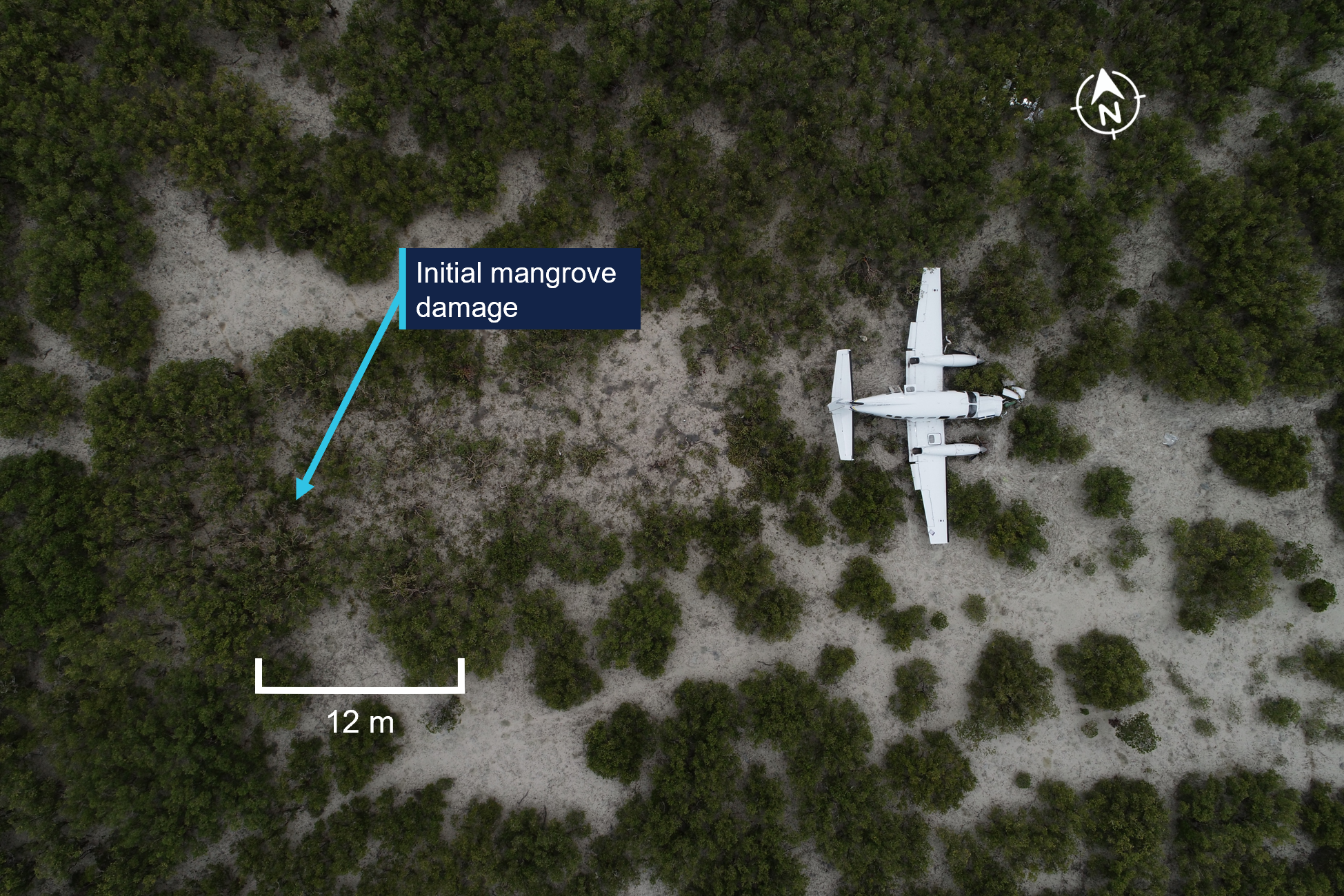
The forced landing area was in mangrove swampland about 3.6 km east of Broome Airport, in-line with the aircraft’s approximate take-off track. The flight path angle was about 9° nose down and the distance between the initial contact with mangrove trees and the wreckage was about 30 m (Figure 3).
Figure 3: Overhead view of aircraft accident site
Source: ATSB
The ATSB’s onsite examination identified that:
- The aircraft was relatively intact with the landing gear down and the flaps partially extended. The aircraft rapidly decelerated once the landing gear had contacted the muddy terrain.
- There was fuel in the left and right wing tanks and clean fuel in the left and right engine‑driven fuel pump filter bowls.
- Examination of the left and right engine turbines viewed through the exit ducts did not show any observable damage.
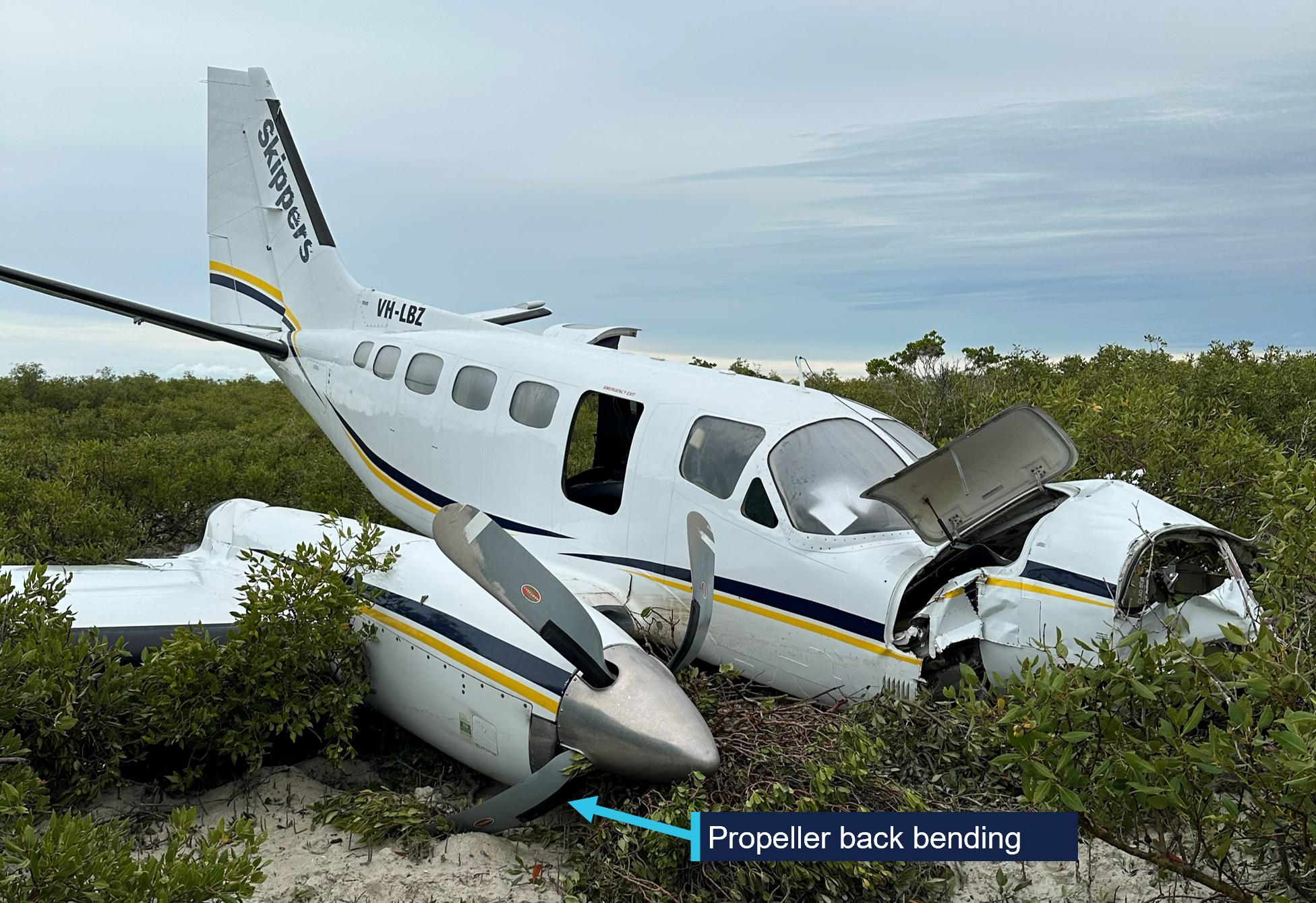
- Damage to the left and right propeller showed back bending and limited rotational abrasion damage, which indicated the engines were not driving the propellers at the time of the impact (Figure 4).
Figure 4: Aircraft wreckage showing propeller back bend
Source: ATSB
Recorded information
The ATSB recovered 3 Garmin electronic recording devices from the aircraft:
- G600 TXi flight display
- GI 275 attitude indicator
- GTN 650Xi GPS, navigation, communications and multifunction display.
While there were no parameters on the devices recovered that directly pertained to the engines, the GI 275 recorded the system voltage (aircraft power). The data retrieved from this unit showed a drop in the system voltage beginning at 1116:59, from 27.7 volts direct current (VDC) to 26.8 VDC within 1 second, then slowly decreased to 24.5 VDC over the next 17 seconds. The base system voltage was nominally 24 VDC, however, would be about 28 VDC when the generators13 were on. Therefore, a drop in voltage was consistent with the generator speed reducing as the engines shut down. In addition, there was also a rapid decrease in longitudinal acceleration at the same time.
The data retrieved also indicated that, at 1116:59, the aircraft (Figure 5):
- was at an altitude of 490 ft above mean sea level
- had an indicated airspeed of 141 kt (261 km/h)
- was climbing at 1,225 ft/min
- had about 9° nose-up attitude and 4° left roll
- was on a heading of about 107°.
At 1117:54, the impact occurred at an indicated airspeed of about 82 kt (152 km/h) and a ground speed of 76 kt (141 km/h) coming to a stop by 1117:58.
Figure 5: Location of aircraft engine shutdown
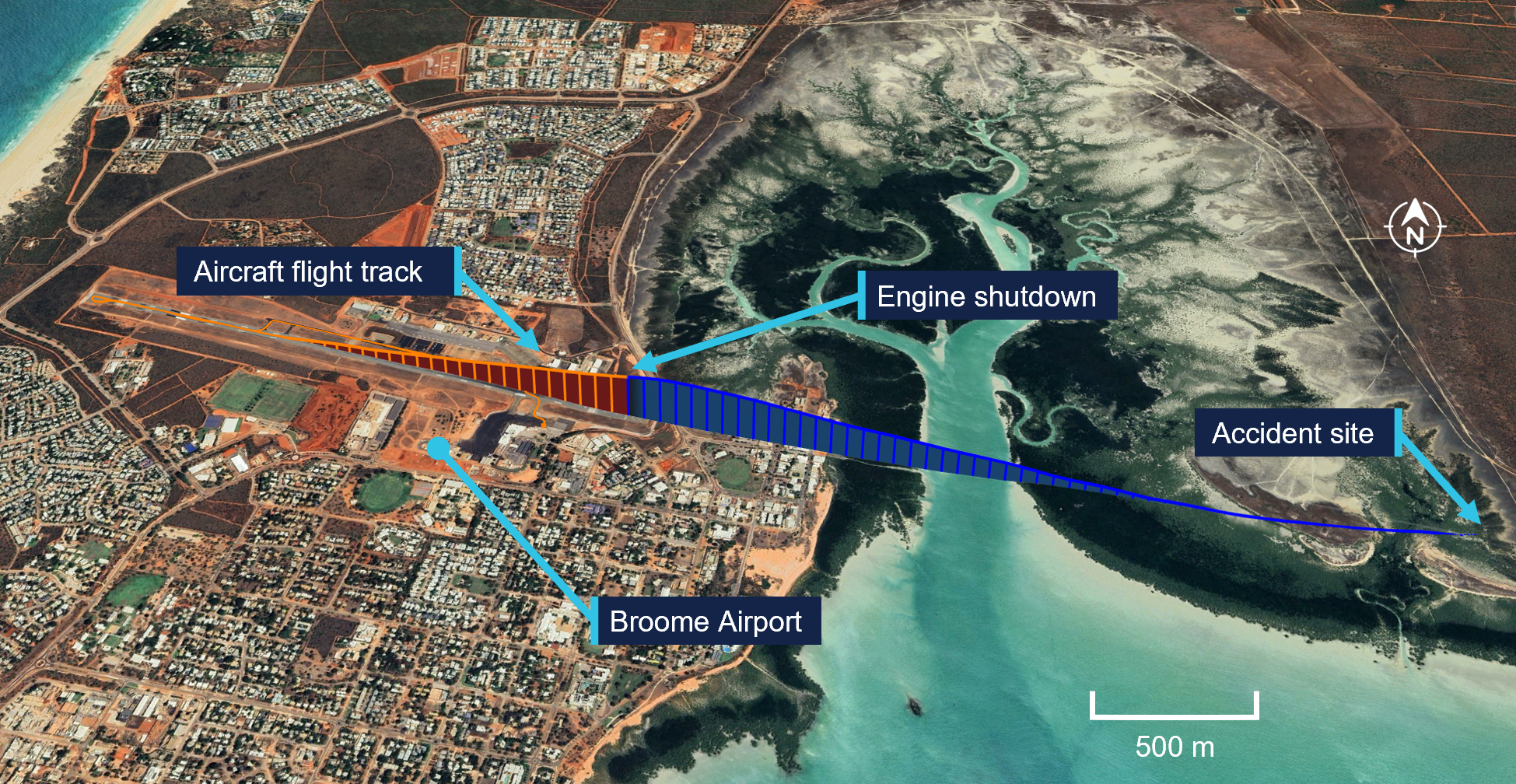
Orange section is with power available, blue section is following the engine shutdown.Source: ATSB
Survival aspects
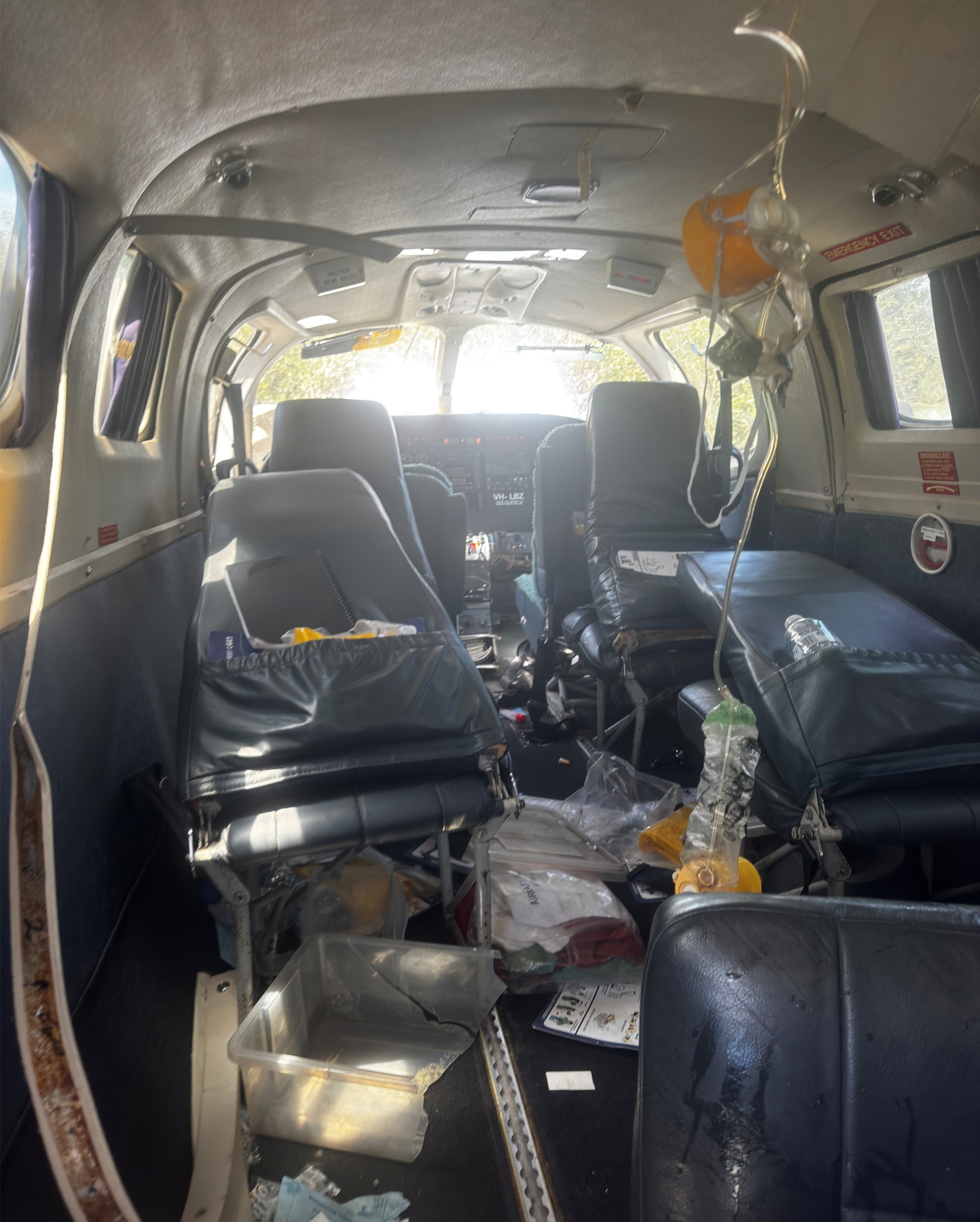
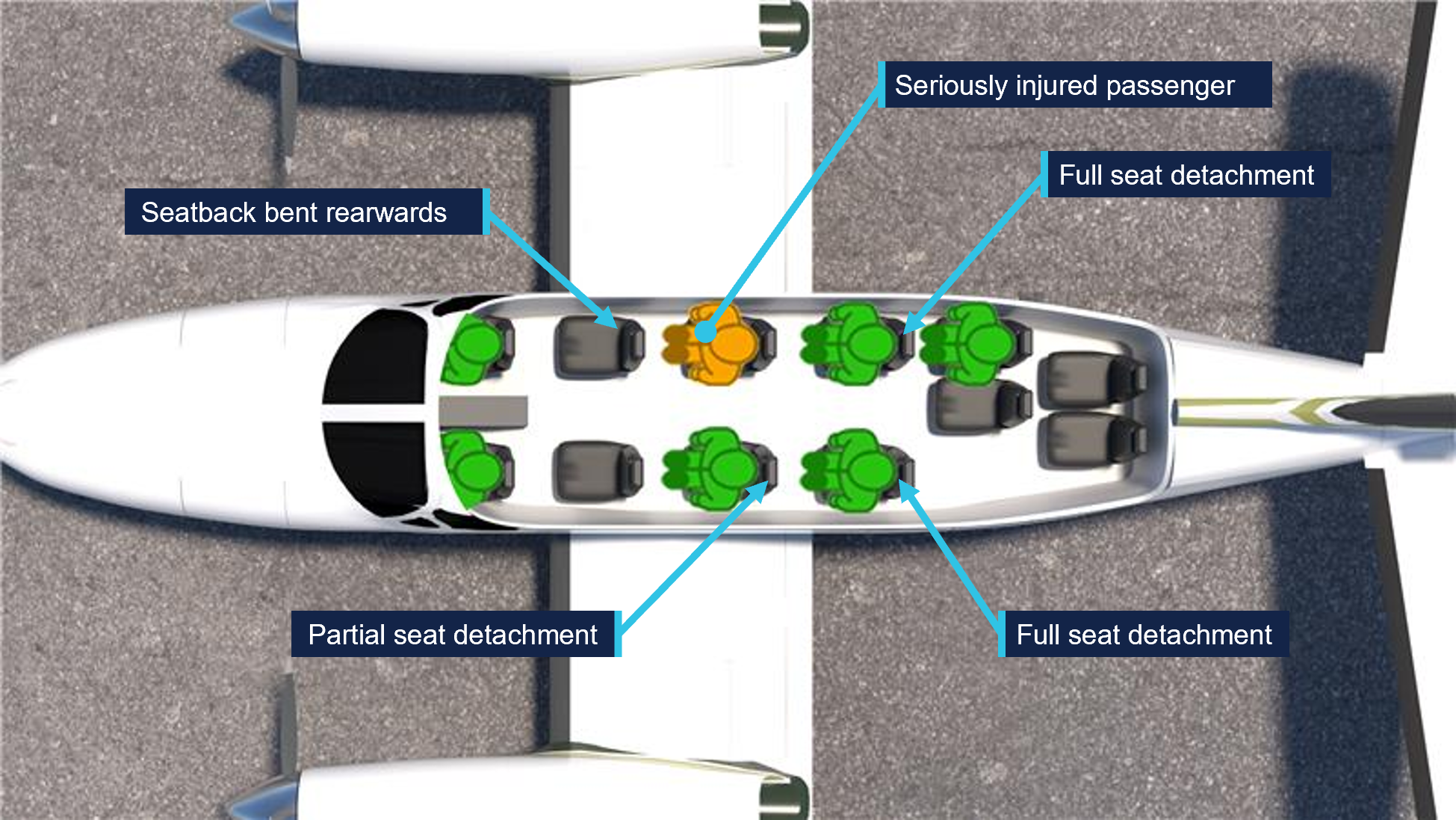
The liveable space within the aircraft cabin was maintained, and the exits were tested by the ATSB and found to function correctly. However, there was significant disruption to the cabin interior including displaced equipment, deployed oxygen masks and the complete detachment of 2 passenger seats from their seat tracks, with some of the floor structure lifting. An additional seat had partially detached and the seat behind the right pilot was significantly distorted, with a backward bend of almost 45° (Figure 6).
Figure 6: Aircraft cabin immediately after the accident
Source: Pilot of VH-LBZ
In addition, a passenger seated on the right side of the second row of passenger seats reported that their seatbelt failed during the impact, throwing them forward into the back of the seat ahead before coming to rest between the 2 pilots. This passenger received serious injuries. Figure 7 shows the location of the full and partially failed seats, and where the seriously injured passenger was seated. All other passengers and the pilots received minor injuries.
Figure 7: Location of seat failures and seriously injured passenger
Source: ATSB
Related occurrence
A previous ATSB investigation (200601053) involving a Cessna 441 Conquest, VH-LBA, 40 km north-west of Callion, Western Australia, on 27 February 2006, found that the pilot in command inadvertently shut down the left engine in-flight by pressing the STOP button. The investigation noted that:
…Prior to the event, the flight crew were discussing the use of the Start Button Guard Plate which was in place over the engine START buttons. In the course of explaining to the second pilot the use of the Start Button Guard Plate, the PIC inadvertently depressed the left engine STOP button...
Safety action
The Civil Aviation Safety Authority (CASA) issued a safety alert to Skippers Aviation Pty Ltd to prevent the use of Cessna 441 Conquest aircraft that have an MEL applied that requires the use of manual mode. The safety alert advised:
Skippers must not dispatch a flight where an MEL involving the use of manual mode is in force in any C441 Conquest operated by them until CASA has approved amendments to the Exposition and the Training and Checking manual that detail the use of manual mode and Skippers has conducted the appropriate training and checking of the flight crew assigned to the flight.
Skippers Aviation Pty Ltd advised that it has taken the following safety action, which addressed the safety alert issued by CASA and included additional actions:
- Immediate grounding of the Cessna 441 Conquest fleet.
- Issuance of a companywide ‘Memorandum to All Staff – The use of MEL 76-00-01 Fuel computers is Prohibited’.
- Completion of a risk review of Cessna 441 Conquest operations which encompassed procedures, training, maintenance, workload, safety and staffing. The review determined that, while the operator considered all controls were compliant, multiple challenges existed and a decision was made to cease all Cessna 441 Conquest revenue operations permanently.
- A cost benefit analysis was completed, and Broome operations were considered no longer feasible.
- A review of companywide procedures and training is in progress, including all procedures related to the management of MELs.
Further investigation
To date, the ATSB has:
- examined the wreckage and accident site
- examined recorded data from the Garmin G600 TXi, GI 275 and GTN 650 devices
- interviewed the pilots and passengers
- collected radio communication, aircraft traffic surveillance data, and navigational application data
- collected aircraft, pilot, crew and operator documentation.
The investigation is continuing and will include further review and examination of:
- operational procedures and training
- aircraft maintenance and MEL practices
- crashworthiness and survivability aspects
- aircraft design features (including the START/STOP buttons).
A final report will be released at the conclusion of the investigation. Should a critical safety issue be identified during the course of the investigation, the ATSB will immediately notify relevant parties so appropriate and timely safety action can be taken.

The ATSB SafetyWatch highlights the broad safety concerns that come out of our investigation findings and from the occurrence data reported to us by industry. One of the safety concerns is reducing the severity of injuries in accidents involving small aircraft.
Acknowledgements
The ATSB would like to thank the Department of Biodiversity, Conservation and Attractions for its assistance in facilitating access to the aircraft accident site.
Purpose of safety investigationsThe objective of a safety investigation is to enhance transport safety. This is done through:
It is not a function of the ATSB to apportion blame or provide a means for determining liability. At the same time, an investigation report must include factual material of sufficient weight to support the analysis and findings. At all times the ATSB endeavours to balance the use of material that could imply adverse comment with the need to properly explain what happened, and why, in a fair and unbiased manner. The ATSB does not investigate for the purpose of taking administrative, regulatory or criminal action. About ATSB reportsATSB investigation reports are organised with regard to international standards or instruments, as applicable, and with ATSB procedures and guidelines. Reports must include factual material of sufficient weight to support the analysis and findings. At all times the ATSB endeavours to balance the use of material that could imply adverse comment with the need to properly explain what happened, and why, in a fair and unbiased manner. An explanation of terminology used in ATSB investigation reports is available here. This includes terms such as occurrence, contributing factor, other factor that increased risk, and safety issue. Publishing informationReleased in accordance with section 25 of the Transport Safety Investigation Act 2003 Published by: Australian Transport Safety Bureau © Commonwealth of Australia 2026 
Ownership of intellectual property rights in this publication Unless otherwise noted, copyright (and any other intellectual property rights, if any) in this report publication is owned by the Commonwealth of Australia. Creative Commons licence With the exception of the Commonwealth Coat of Arms, ATSB logo, and photos and graphics in which a third party holds copyright, this report is licensed under a Creative Commons Attribution 4.0 International licence. The CC BY 4.0 licence enables you to distribute, remix, adapt, and build upon our material in any medium or format, so long as attribution is given to the Australian Transport Safety Bureau. Copyright in material obtained from other agencies, private individuals or organisations, belongs to those agencies, individuals or organisations. Where you wish to use their material, you will need to contact them directly. |
- ^ In-command under supervision allows a pilot to perform all duties and functions as a pilot in command under the supervision of a pilot in command appointed for that purpose.
- ^ Minimum equipment list (MEL) is a list that provides for the operation of aircraft, subject to specified conditions, with particular equipment inoperative.
- ^ An engine failure below the decision speed should result in a rejected take off; above this speed the take-off should be continued.
- ^ Rotation: the positive, nose-up, movement of an aircraft about the lateral (pitch) axis immediately before becoming airborne.
- ^ MAYDAY is an internationally recognised radio call announcing a distress condition where an aircraft or its occupants are being threatened by serious and/or imminent danger and the flight crew require immediate assistance.
- ^ The deferred defect log identified the system affected, date and aircraft hours when logged, any limitations and deferral expiry date, a copy of which was in the flight log available to the pilots.
- ^ Minimum equipment lists and repair categories are explained in Civil Aviation Advisory Publication (CAAP) 37-01 v5.1.
- ^ Propeller synchronising and synchrophasing provide a means to match the RPM of both engines and establish a blade phase relationship between the left and right propellers to reduce vibration and cabin noise.
- ^ The condition lever controlled engine speed (RPM) and fuel flow while the power lever adjusted the engine torque and propeller speed.
- ^ The electronic underspeed governor is primarily to control fuel flow to maintain engine RPM during ground operations. It differs in operation to the propeller governor that directs oil to, or from, the propeller to maintain selected propeller/engine RPM.
- ^ The fuel control assembly regulates fuel flow to the engine and contains a mechanical fuel shutoff valve and an electrical fuel shutoff valve.
- ^ Ceiling and visibility okay (CAVOK): visibility, cloud and present weather are better than prescribed conditions. For an aerodrome weather report, those conditions are visibility 10 km or more, no significant cloud below 5,000 ft, no cumulonimbus cloud and no other significant weather.
- ^ A combination starter-generator was mounted on each engine. The units operated as a starter during ground starts and were the aircraft’s primary power source.
Occurrence summary
| Investigation number | AO-2026-068 |
|---|---|
| Occurrence date | 19/03/2026 |
| Occurrence time and timezone | 1117 Australian Western Standard Time |
| Location | 3.6 km from Broome Airport |
| State | Western Australia |
| Report release date | 02/06/2026 |
| Report status | Preliminary |
| Anticipated completion | Q2 2027 |
| Investigation level | Defined |
| Investigation type | Occurrence Investigation |
| Investigation phase | Examination and analysis |
| Investigation status | Active |
| Mode of transport | Aviation |
| Aviation occurrence category | Collision with terrain, Forced/precautionary landing |
| Occurrence class | Accident |
| Highest injury level | Serious |
Aircraft details
| Manufacturer | Cessna Aircraft Company |
|---|---|
| Model | 441 Conquest |
| Registration | VH-LBZ |
| Serial number | 4410038 |
| Aircraft operator | Skippers Aviation Pty Ltd |
| Sector | Turboprop |
| Operation type | Part 135 Air transport operations - smaller aeroplanes |
| Activity | Non-scheduled passenger air transport |
| Departure point | Broome Airport, Western Australia |
| Destination | Truscott-Mungalalu aerodrome, Western Australia |
| Injuries | Crew - 2 (Minor), Passengers - 1 (Serious) 4 (Minor) |
| Damage | Substantial |