

Final report
Report release date: 14/05/2026
Investigation summary
What happened
On 25 January 2026, at 0917 local time, the pilot and only occupant of a Robinson R44 Raven I helicopter, registered VH-8HR and operated by Whitsunday Air Services, departed Whitsunday Airport (Shute Harbour), Queensland, for nearby Daydream Island.
After departing, the helicopter climbed to an altitude of about 1,000 ft above sea level and shortly after crossing the coast, the pilot reported that the low rotor RPM horn sounded. The pilot recalled that they immediately reacted by increasing the throttle and lowering the collective lever which returned the engine and rotor RPM to within the normal operating range.
About 10 seconds later, the engine RPM briefly reduced a second time before a rapid increase of engine and rotor RPM which activated the high rotor RPM alert. The pilot recalled then switching off the engine governor to manually control the throttle inputs and maintain a constant engine RPM. They were able to stabilise the engine and rotor RPM for about 10 seconds, during this time they observed the engine was running rough with a significant increase in manifold pressure and the helicopter had begun an uncommanded descent.
The pilot reported that they began to slow the helicopter to the best rate of climb speed of 55 kt. While over water and beyond gliding distance from land they observed another engine RPM reduction, and elected to enter an autorotation, activated the emergency pop-out floats and ditched the helicopter onto the ocean. After ditching, the helicopter remained upright and the pilot reported they were uninjured. They were subsequently rescued by water police about 20 minutes later.
What the ATSB found
The right magneto distributor gear jammed when an internal rotating electrode became loose. This led to a mechanical failure of the gear teeth that affected the engine timing and subsequently reduced the helicopter power output.
The altered engine timing likely resulted in the number one cylinder exhaust valve being damaged. This resulted in a loss of compression in the cylinder and a further loss of power.
As a result of the power loss, the pilot was unable to maintain altitude, entered autorotation, and activated the emergency pop-out floats before conducting a successful forced landing onto the water.
The damaged magneto likely caused erroneous engine governor inputs which caused an engine and rotor RPM overspeed.
Safety message
The occurrence highlights the importance of pilot training and understanding of governor‑off throttle control and engine RPM management. The pilot’s decision to switch the engine governor off, and manually control the throttle, likely eliminated erroneous throttle inputs from the governor that caused the fluctuations in engine RPM.
Pilots are required to demonstrate competency in governor-off control during their biennial single engine helicopter flight reviews. Operators of Robinson R44 and R22 helicopters with engine governors should ensure that pilots have good understanding of the situations that could require manual throttle control and the techniques and precautions to manage those abnormal situations.
The investigation
| The ATSB scopes its investigations based on many factors, including the level of safety benefit likely to be obtained from an investigation and the associated resources required. For this occurrence, the ATSB conducted a limited-scope investigation in order to produce a short investigation report, and allow for greater industry awareness of findings that affect safety and potential learning opportunities. |
The occurrence
On 25 January 2026, at 0917 local time, the pilot of a Robinson R44 Raven I helicopter, registered VH-8HR and operated by Whitsunday Air Services, departed Whitsunday Airport (Shute Harbour), Queensland, for nearby Daydream Island, where the pilot was to board 2 passengers for a scheduled scenic flight at 0930.
On departure from Shute Harbour, the helicopter climbed to an altitude of about 1,000 ft above sea level. However, shortly after crossing the coast, the pilot reported that the low rotor RPM horn sounded. The pilot recalled that they immediately reacted by increasing the throttle and lowering the collective1 which returned the engine and rotor RPM to within the normal operating range.
About 10 seconds later the engine RPM briefly reduced a second time before a rapid engine RPM increase, reaching 115.9% engine RPM and 114.2% rotor RPM, activating the high rotor RPM alert. The pilot recalled then switching the engine governor off to manually control the throttle inputs which maintained a constant engine RPM for about 10 seconds. The pilot observed the engine was running rough with a significant increase in manifold pressure and that the helicopter had begun an uncommanded descent the pilot was unable to arrest.
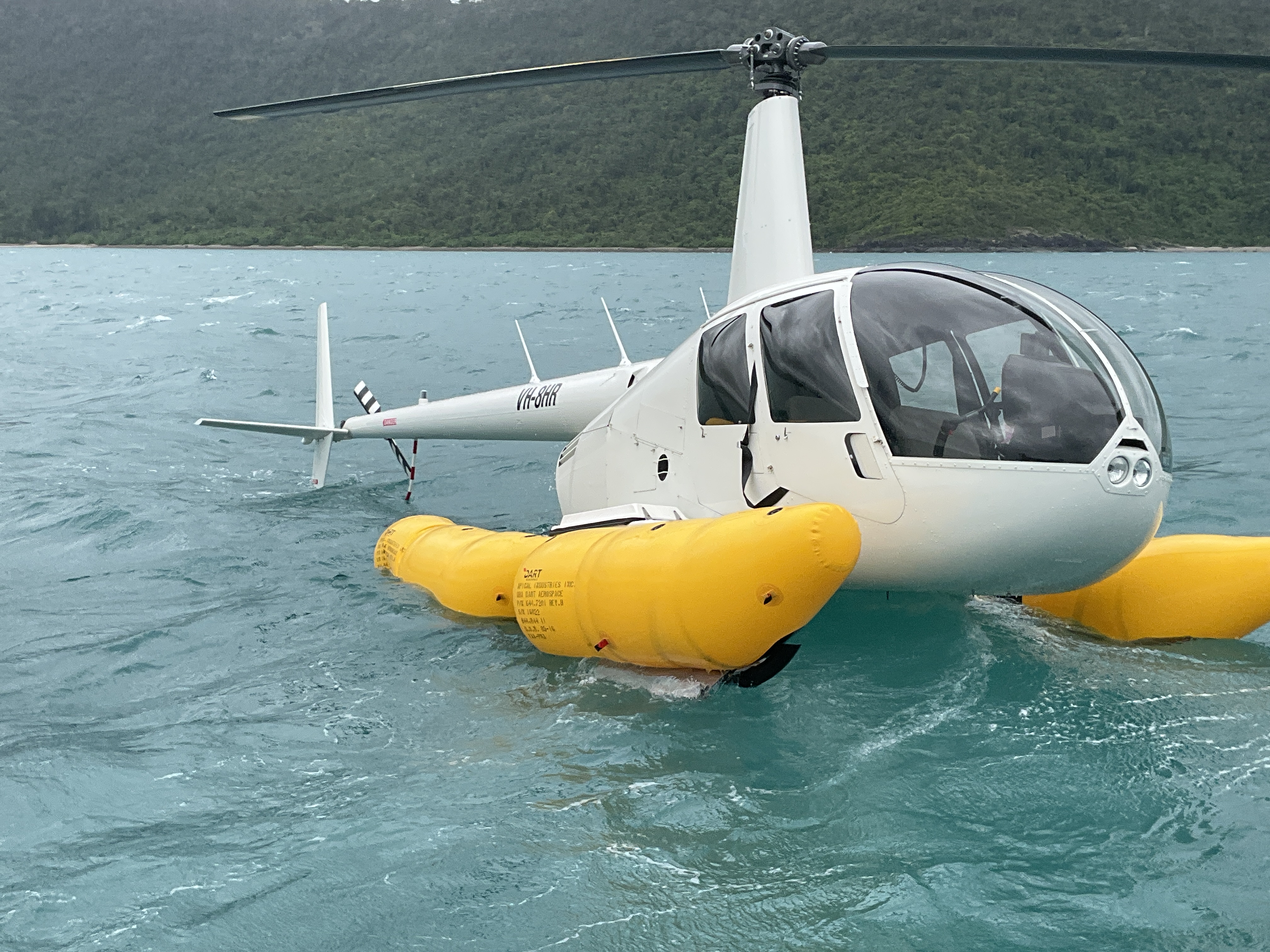
The pilot attempted to slow the helicopter to the best rate of climb speed of 55 kt. As the helicopter airspeed slowed to about 60 kt it was still descending and they were still unable to maintain altitude. The pilot reported that the engine RPM again reduced while over water and they elected to enter an autorotation. The helicopter was beyond gliding distance from land, and the pilot activated the emergency pop-out floats and conducted a ditching onto the ocean (Figure 1).
Figure 1: VH-8HR shortly after pilot was met by local water police
Source: Queensland Police
The helicopter landed and remained upright on the water without further damage. The pilot then transmitted a MAYDAY call which was received by a nearby fixed-wing aircraft that relayed the distress call to Brisbane Centre air traffic control. The pilot observed a knocking sound which they suspected was coming from the engine and shut the helicopter down.
The pilot remained in the helicopter and recalled that, about 20 minutes after the ditching, they were met by the local water police and transferred from the helicopter onto the police vessel.
The pilot was uninjured during the ditching and the helicopter was towed back to land upright on its floats before being transported to the operator’s maintenance provider.
Context
Personnel information
The pilot held a Commercial Pilot Licence (Helicopter) issued on 6 April 2023 having previously completed their initial flight training and a commercial licence in New Zealand. They had also successfully completed a gas turbine engine endorsement on 29 January 2024 and a low-level rating on 12 May 2025. They also held a class one medical certificate that was valid until 4 October 2026 with no restrictions.
The pilot had accumulated about 1,600 total hours flying helicopters including 835 hours flying the Robinson R44.
They had last completed a proficiency check flight with the operator on 12 June 2025 that included autorotation landings and governor malfunctions and was found competent by the operator.
The pilot had last completed helicopter underwater escape training on 4 June 2025, which was valid for 3 years.
Fatigue
The pilot reported they felt fully alert at the time of the occurrence having slept 9 hours in the previous 24 hours and 17 hours in the past 48 hours.
The ATSB considered that it was very unlikely that fatigue affected the pilot’s performance on the day of the occurrence.
Aircraft information
The Robinson Helicopter Company (RHC) R44, Raven I is a 4‑place, light helicopter, powered by a Lycoming O-540-F1B5, 6-cylinder, horizontally-opposed piston engine. It has a 2‑bladed main rotor system and a conventional 2‑bladed tail rotor. The R44 pilot operating handbook (POH) stated that at maximum continuous power, the engine operated at 2,718 RPM, which indicated as 102% on the engine tachometer display in the cockpit and also advised a transient limit of 105% RPM with a warning:
Intentional operation above maximum continuous speed (engine RPM) prohibited.
Engine power is displayed to the pilot via the manifold pressure gauge in inches of mercury. A placard on the pilot’s cyclic2 control displayed the maximum continuous power limit adjusted for pressure altitude3 and outside air temperature. It also included a transient 5-minute limit of an additional 1.6 inches of manifold pressure above the continuous power limit for maximum take-off power. Conditions on the day indicated a maximum continuous power limit of about 24.1 inches and a 5-minute maximum take-off limit of 25.7 inches.
The POH also stated the safe operational rotor RPM range is between 90 and 108%, which is marked with a green arc on the rotor RPM tachometer.
The R44 helicopter is equipped with a low rotor RPM horn and caution light which both activated when the rotor RPM dropped below 97%. VH-8HR was also equipped with a high rotor RPM alert that sounded through the pilot’s headset and activated when the rotor RPM was approaching 108%.
VH-8HR was manufactured in the United States as serial number 2751 in 2023 and had flown a total of 1,116.8 hours prior to the occurrence flight. The operator had been the registration holder since July 2023.
VH-8HR was equipped with emergency pop-out floats manufactured by DART Aerospace. A helium‑filled cylinder was located under the front left seat that provided the means for float inflation. The pop-out floats are activated when the inflation lever on the pilot’s collective control is squeezed (9 kg of force required).
Engine
At the time of the occurrence, the Lycoming engine was fitted with 2 magnetos (part number 10-6006-46-201), manufactured by Continental Aerospace Technologies (CAT), that produced high voltage for the 12 spark plugs. Fitted to the distributor gear of each magneto (Figure 2) was a rotating electrode that provided the timing of the electrical energy to the distributor block4 and then to the relevant spark plug via a high-tension lead.
Figure 2: Sectioned view of an exemplar magneto
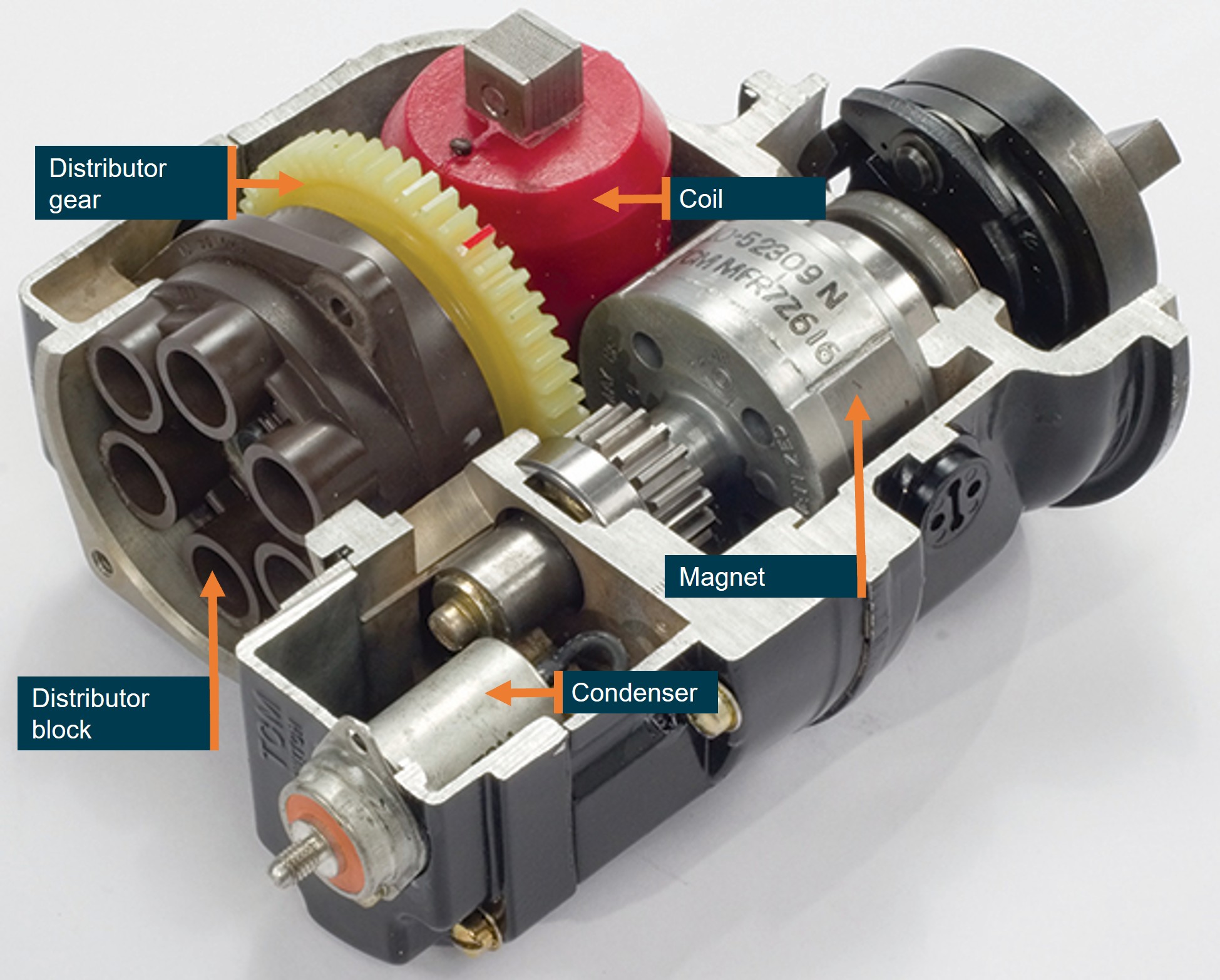
This magneto is similar to the one that was fitted to VH-8HR. Source: Aviation Safety Magazine, annotated by the ATSB
The R44 helicopter is equipped with an automatic throttle governor designed to assist pilots in controlling RPM under normal flight conditions.
The POH provided a description of the governor operation.
The governor maintains engine RPM by sensing changes and applying corrective throttle inputs through a friction clutch which can be easily overridden by the pilot. The governor is active only above 80% engine RPM and can be switched on or off using the toggle switch on the end of the right seat collective.
The R44 throttle governor takes its signal source from the tachometer breaker contact (points) assembly within the engine-right5 magneto and provides throttle inputs to maintain the engine RPM at 102%. Above 112% RPM, the governor is inactive.
R44 magneto changes
Prior to January 2021 all piston-engined RHC helicopters were fitted with dual magnetos. In 2020 RHC received United States Federal Aviation Administration (FAA) approval to replace the engine-left magneto with an electronic ignition system (EIS) manufactured by Lycoming. The July 2020 Robinson newsletter described the new EIS:
The EIS installation replaces the left starting magneto. The remaining right magneto provides redundant ignition and eliminates the need for a backup power supply. EIS has very high spark-energy for easy engine starts and eliminates internal moving parts for increased reliability.
On 13 February 2024, Lycoming issued mandatory service bulletin 656 (revised to 656A in April 2025) that stated:
Lycoming has identified an internal wear issue with some EIS units used on 6-cylinder engines in rotary wing applications. This internal wear progresses over time and can lead to engine power fluctuations. This bulletin requires the replacement of EIS units in 6-cylinder helicopter applications. Affected 6-cylinder EIS part numbers are 66K6D3SN-03, 66K6D3SN-02, and 66K6D3SN-01.
The service bulletin required the replacement of the EIS every 50 flight hours in helicopters with 6-cylinder engines due to the wear issues.
On 24 February 2024 RHC released kit instructions KI-272-5 for the installation of Bendix Style magnetos that replaced the EIS and avoided the required 50‑hour EIS replacement.
Maintenance history
On 31 May 2024, the operator’s maintenance provider replaced the EIS (engine-left) on VH-8HR using the RHC KI 272-5 magneto conversion kit. At that time the helicopter had flown 389.7 hours flight time.
On 8 November 2024, and 585.4 hours flight time, the maintenance records showed the engine-left magneto was unable to be timed to the engine and was replaced.
On 7 April 2025, the helicopter had accumulated 781.2 hours and underwent scheduled maintenance that included a 500-hour inspection of the distributor gear within the magnetos. The maintenance organisation reported nil defects with the distributor gear during this inspection.
On 17 December 2025, the helicopter had accumulated 1,066.5 hours, and maintenance records showed a pilot had reported that the engine ran rough on the engine-left magneto. One high-tension lead was found to be unserviceable and the lead was repaired and a subsequent engine run found the engine operated normally.
The magnetos had been inspected every 100 hours as per CAT service bulletin SB 643C part 1 and magneto timing had also been completed as per Lycoming service bulletin SB 183A during the last five 100‑hourly inspections.
Following the occurrence, the operator’s maintenance provider inspected the engine‑right magneto and identified that the rotating electrode on the distributor gear had come loose and subsequently contacted the distributor block, jamming the gear which resulted in numerous gear teeth being stripped (Figure 3).
Figure 3: VH-8HR engine-right magneto distributor gear
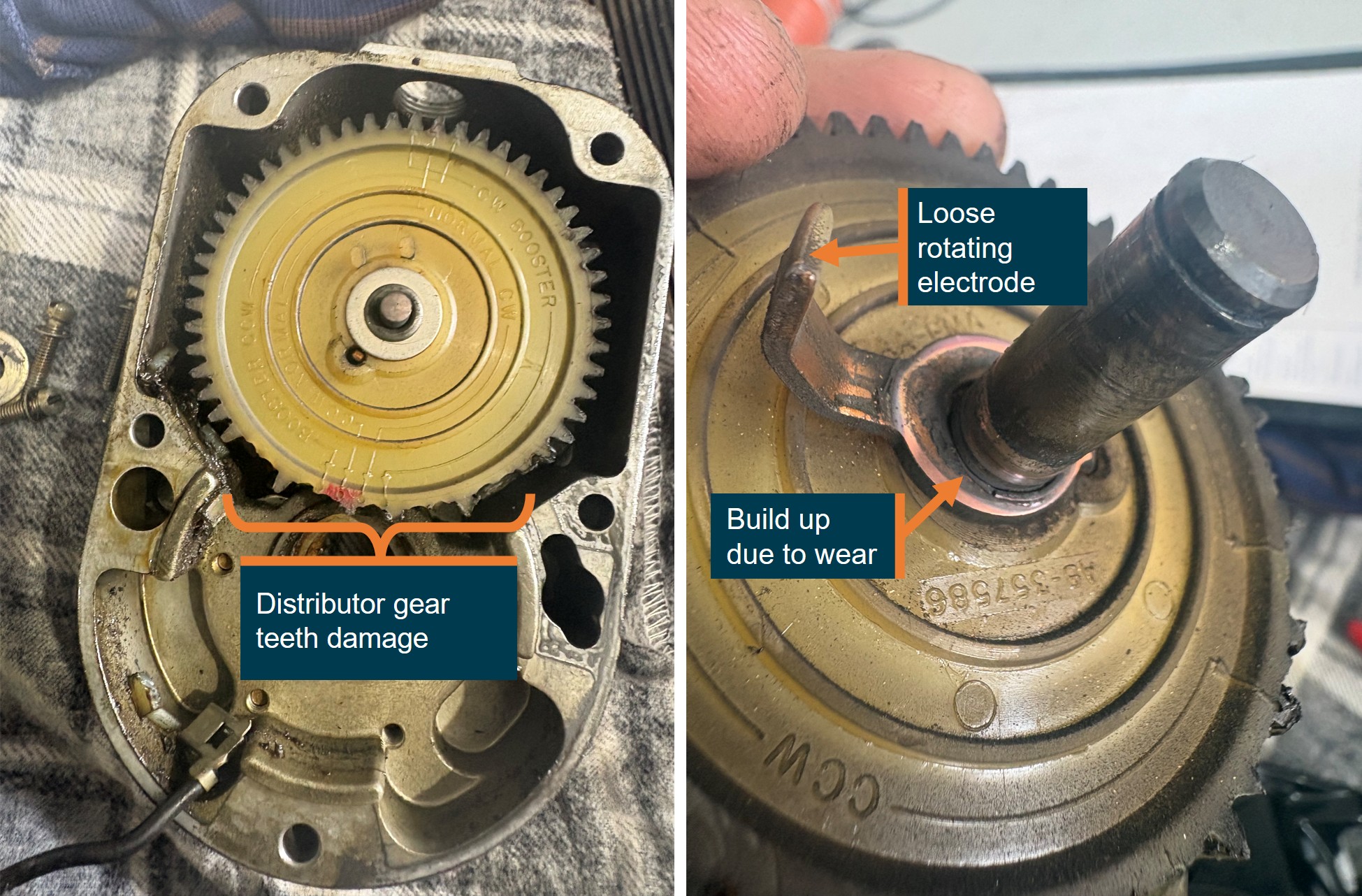
Source: Whitsunday Air Services, annotated by the ATSB
The engine-right magneto had been fitted to the helicopter for about 18 months and 727 flying hours. The magneto distributor gear was last inspected on 7 April 2025. After that inspection, the helicopter operated a further 335.6 hours before the magneto failed. At the time of the occurrence, the 500-hour magneto distributor gear inspection was due in 164.4 hours flying time.
Maintenance records also indicated that individual cylinder compression checks had been completed at 100-hourly service intervals with nil defects reported.
The post‑occurrence engine inspection also identified damage to the exhaust valve on the number one engine cylinder, with a compression test indicating nil compression. The maintenance organisation reported the erosion damage was likely from environmental conditions, fuel and exhaust deposits. The maintenance organisation identified that the combination of a magneto failure and lack of compression in the cylinder would have resulted in a substantial power loss.
CAT reviewed the supplied images and a summary of the occurrence and advised that the distributor gear rotating electrode could detach due to:
• Mechanical fatigue or vibration: High cyclic loading and torsional vibration in the O‑540 engine can weaken the electrode attachment over time.
• Improper staking or attachment during a prior overhaul: If the rotor assembly was not correctly staked, riveted, or assembled during the last 500‑hour inspection, the electrode can loosen prematurely.
• Internal contamination or sudden rotor binding: Foreign material or gear debris can momentarily jam the rotor, placing abnormal shear loads on the electrode.
• Heat distortion: Excessive magneto temperature (due to lean running, under‑cowl heat, or advanced timing) can warp the rotor plate or insulator, stressing the electrode until it separates.
CAT also provided an assessment of the exhaust valve damage (Figure 4) stating that it was entirely consistent with late, weak or erratic ignition timing and provided the following explanation:
A jammed magneto or slipping distributor gear causes late or erratic ignition timing. When ignition occurs too late:
• Combustion continues as the exhaust valve opens, exposing the valve face to extremely hot combustion gases.
• This leads to localized overheating, erosion, and burning of the valve edge, matching the borescope damage observed on No. 1 cylinder.
• Intermittent or weak ignition can also cause backfiring or detonation, further overstressing the exhaust valve and increasing temperature spikes.
Late timing = combustion into exhaust stroke → valve overheating → valve burning.
Figure 4: VH-8HR cylinder one exhaust valve
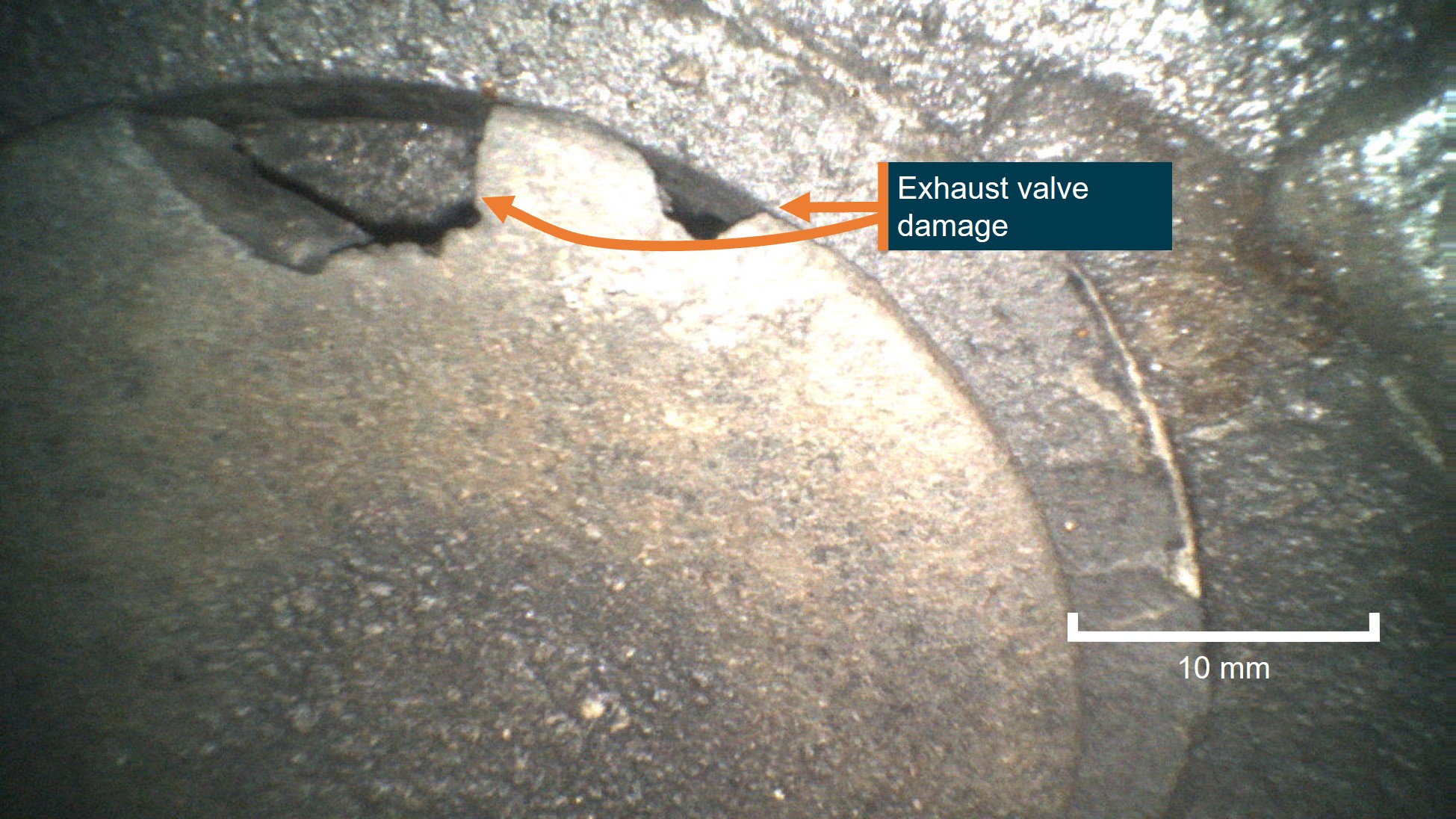
Source: Whitsunday Air Services, annotated by the ATSB
Meteorological information
Meteorological information recorded at 0900 local time at Hamilton Island Airport, 19 km south-east of the ditching location showed:
- wind from 110° at 20 kt
- visibility greater than 10 km
- cloud broken6 at 2,200 ft and overcast at 2,700 ft
- temperature was 27° C and dew point 24° C
- QNH7 of 1,010 hectopascals.
The pilot estimated that the wind strength on the day was 10–15 kt from the south-east and recalled the sea state was about 0.5 m of swell when they landed on the water.
Recorded data
The helicopter was equipped with an RHC installed engine monitoring unit (EMU). The user guide for the EMU stated:
The EMU monitors engine speed, rotor speed, engine oil temperature, cylinder head temperature, manifold pressure, ambient pressure, and outside air temperature. Data is stored once per second. If the EMU detects an engine or rotor parameter outside of operating limits, an exceedance record is created and data is stored at a higher rate of 15 times per second during the exceedance event.
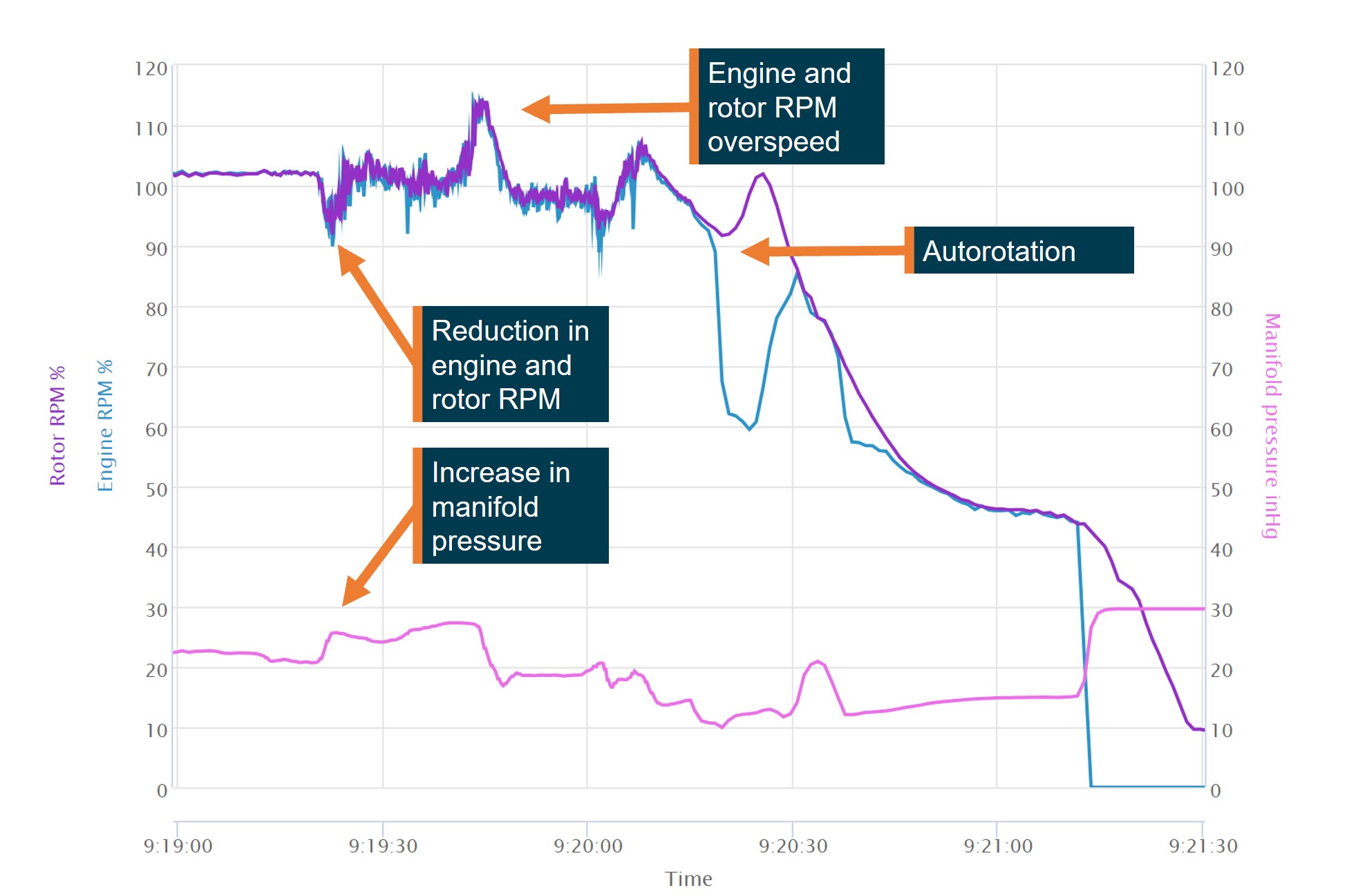
The EMU data (Figure 5) recorded at 0919:208 showed an engine RPM reduction from the normal 101–102% RPM operating range reducing to about 94% RPM before increasing again. A further momentary reduction in engine RPM was recorded about 10 seconds later and then returned to within the normal operating range before then rapidly increasing, peaking at 115.9% engine RPM. The increase in engine RPM also resulted in a rotor RPM overspeed, peaking at 114.2%. The pilot reported after the overspeed that they switched the governor off and manually controlled the throttle.
The engine RPM then reduced and stabilised at about 98% for about 10 seconds. At about 0920 the engine RPM again dropped below 90% and then increased to about 104%.
At about 0920:20 the engine RPM reduced to about 62%, while the rotor RPM remained above 90% and increased to 100%, consistent with the pilot closing the throttle and conducting an autorotation before flaring to land on the water.
Engine manifold pressure recorded by the EMU on departure indicated pressure within normal operating range. At about 0919:20, at a similar time to the first engine RPM reduction, the manifold pressure increased above 25 inches before it momentarily reduced to about 24 inches, then increased and peaked at about 27.5 inches.
Figure 5: VH-8HR engine monitoring unit data
Source: ATSB
The helicopter was also equipped with a cockpit video recording camera, as optional equipment from the RHC factory. The camera featured both internal and external storage, however no external storage was fitted for the occurrence flight. The internal storage recorded continuously and was sufficient for 3 hours of recordings before being overwritten. During the subsequent post‑occurrence inspection it was identified that the internal camera battery had failed and the last recorded data stored was from June 2025. It was reported that previous internal battery failures had been identified by RHC, and a requirement for battery replacement to be carried out yearly had been added to the maintenance schedule in August 2025. The battery on this device had not reached the required replacement date.
It was also identified during the inspection that the internal camera mountings had failed, with the potential to impact the data quality and footage available.
Survivability
MAYDAY transmission
Following the successful forced landing, the pilot reported that they broadcast a MAYDAY transmission on the local area common traffic advisory frequency (CTAF). A nearby fixed‑wing aircraft heard the transmission and relayed the details of the MAYDAY to Brisbane Centre air traffic control. The pilot recalled that their workload during the management of the event prevented an earlier MAYDAY call being made.
Lifejackets and emergency locator transmitters
The pilot wore a constant-wear vest style lifejacket and felt no need to inflate the lifejacket at any point. The lifejacket was equipped with pockets and was where the pilot kept a personal survival emergency locator transmitter (ELT) that was an operator requirement to be carried. The onboard automatic ELT fitted to the helicopter was not activated during the occurrence.
Communication
The pilot reported they were able to communicate with the operator’s base on Hamilton Island via VHF radio while awaiting rescue and made several phone calls to assist with the coordination of the retrieval of the helicopter.
Rescue
The pilot reported about 20 minutes after the ditching, local police arrived by boat and they transferred to the police boat. They remained on station to monitor the helicopter until a larger vessel arrived that towed the helicopter to shore.
Similar occurrences
Partial engine power loss and ditching involving Robinson R44, VH-WRR (AO‑2017‑110)
On 8 November 2017, the pilot of a Robinson R44 ditched about 49 km north of Hamilton Island Airport, Queensland. In addition to the pilot, there were 3 passengers on board.
When about 40 minutes into the flight, on return to Hamilton Island, the pilot heard the engine sound decrease and noted that the helicopter was unable to maintain the cruise altitude of 1,000 ft. The pilot reported that the indicated main rotor revolutions per minute (RPM) decreased and the low rotor RPM horn activated. The engine RPM indication was also oscillating throughout the range. In response to the low RPM horn, the pilot increased throttle and again raised the collective. The rotor RPM initially spiked and then decreased with associated re-activation of the low rotor RPM horn. The engine RPM gauge continued to oscillate and the helicopter could not maintain altitude. The pilot noticed the engine noise was changing with the fluctuations in the indications. While there appeared to be no observable damage sustained to the helicopter, it later sank and was unable to be recovered.
A maintenance logbook entry around 2 weeks prior to the accident noted that the helicopter had intermittent tachometer/governor fluctuations. The right magneto points were found to be out-of-tolerance and adjusted. A ground run to test the adjusted magneto was completed satisfactorily.
Post-accident discussions between the manufacturer, operator and maintenance provider resulted in a consensus of opinion that the power reduction was associated with either a governor control failure and/or a compromised engine RPM signal from poor tachometer points.
Engine RPM governor failure involving Robinson R44, abeam Brisbane, Queensland (AB-2018-082)
On 15 June 2018, at 1050 local time, a Robinson R44 conducting a charter flight experienced an engine RPM governor failure.
The pilot was not certain of the cause of the drop in RPM. Rather than turning off the governor as the flight manual instructs for governor failure, the pilot elected to manually control engine RPM by overriding the clutch in the governor.
The aircraft’s magnetos had undergone a 500-hour service immediately prior to the scenic charter flight. An engineering inspection following the incident flight found that a problem with the tachometer points of the magneto caused the governor to read a higher RPM than existed and wind down the throttle, subsequently slowing the rotor system.
Safety analysis
Magneto damage
Since the magneto distributor gear was last inspected, VH-8HR had flown 335.6 hours and it was due to be re-inspected in 164.4 hours flying time.
The reason for the loose electrode on the distributor gear was not able to be determined, however the magneto manufacturer indicated that the rotating electrode could become loose due to fatigue, vibration, incorrect installation, or heat damage.
The loose electrode likely caused the distributor gear to jam, damaging the gear. Either due to this damage or a result of the jamming, the timing of the electrical supply to the spark plugs was affected and caused the engine to misfire.
Exhaust valve damage
The helicopter had accumulated 1,116.8 total flying hours and had mostly been operated throughout the Whitsunday Islands and Great Barrier Reef, exposing the helicopter to a corrosive salt air environment. The helicopter’s maintainer reported erosion damage to the valve sealing face following the occurrence, likely due to the corrosive operational environment, fuel or exhaust deposits.
The magneto manufacturer, Continental Aerospace Technologies (CAT), stated the damage to the valves was consistent with late ignition timing due to the damaged magneto. The late timing of the ignition resulted in combustion during the exhaust stroke and therefore overheated the exhaust valve resulting in burning, increasing the likelihood of premature failure.
The damage to the exhaust valve prevented adequate compression during the combustion cycle in the cylinder, leading to a reduction of power.
Forced landing
As a result of the damaged magneto and damaged exhaust valve, the power available was insufficient for the pilot to maintain altitude.
Without sufficient power to maintain altitude, the pilot’s decision to close the throttle and enter autorotation removed the threat of further engine RPM fluctuations during the landing. During the autorotation the rotor RPM increased from about 92% to more than 100% RPM, therefore, the increased inertia in the rotor system likely assisted the pilot to conduct a controlled ditching without further damage to the helicopter or emergency pop‑out floats.
The pilot activated the emergency pop-out floats during the autorotation which allowed the aircraft to remain upright on landing and remain buoyant. They were then able to take refuge in the helicopter until first responders arrived.
Erratic governor control
The Robinson R44 engine-right magneto provided electrical signal to the engine tachometer in the cockpit. The engine governor applied throttle inputs to maintain a constant engine RPM.
The damaged right magneto likely caused the engine tachometer to incorrectly read the engine RPM and therefore throttle inputs made by the governor were not accurate and resulted in engine RPM fluctuations. The fluctuations resulted in several reductions in engine RPM and one significant engine RPM increase which increased both the engine and rotor RPM over the manufacturer’s limits, increasing the likelihood of damage to the helicopter.
The pilot reported that following the overspeed, they elected to switch the governor control off and fly the aircraft using manual throttle control. The engine monitoring unit (EMU) data showed a 10‑second period where the engine and rotor remained at about 98% RPM, consistent with the pilot manually controlling the throttle. The data then showed a further, momentary engine RPM reduction. The governor switch position was not a parameter recorded by the onboard EMU and therefore the ATSB was unable to determine if the cause of the further reduction was caused by inputs from the governor.
Findings
ATSB investigation report findings focus on safety factors (that is, events and conditions that increase risk). Safety factors include ‘contributing factors’ and ‘other factors that increased risk’ (that is, factors that did not meet the definition of a contributing factor for this occurrence but were still considered important to include in the report for the purpose of increasing awareness and enhancing safety). In addition ‘other findings’ may be included to provide important information about topics other than safety factors. These findings should not be read as apportioning blame or liability to any particular organisation or individual. |
From the evidence available, the following findings are made with respect to the power loss and ditching involving Robinson R44, VH-8HR, 19 km north-west of Hamilton Island, Queensland, on 25 January 2026.
Contributing factors
- The right magneto distributor gear was jammed by a loose electrode. This led to a mechanical failure of the gear teeth affecting the engine timing and subsequently the helicopter lost power.
- The altered engine timing likely resulted in the number one cylinder exhaust valve being damaged. This resulted in a loss of compression and a further loss of power.
- The pilot was unable to maintain altitude and entered autorotation, activated the emergency pop-out floats and conducted a successful forced landing onto the water.
Other factors that increased risk
- The damaged magneto likely caused erroneous governor inputs and therefore an engine and rotor RPM overspeed.
Sources and submissions
Sources of information
The sources of information during the investigation included the:
- pilot of the accident flight
- operator
- Civil Aviation Safety Authority
- Queensland Police Service
- aircraft manufacturer
- magneto manufacturer
- recorded data from the engine monitoring unit on the aircraft.
Submissions
Under section 26 of the Transport Safety Investigation Act 2003, the ATSB may provide a draft report, on a confidential basis, to any person whom the ATSB considers appropriate. That section allows a person receiving a draft report to make submissions to the ATSB about the draft report.
A draft of this report was provided to the following directly involved parties:
- the pilot of the accident flight
- Whitsunday Air Services
- Heli Biz
- United States National Transportation Safety Board
- Robinson Helicopter Company
- Continental Aerospace Technologies
- Bureau of Meteorology
- Civil Aviation Safety Authority.
Submissions were received from:
- Whitsunday Air Services
- Heli Biz.
The submissions were reviewed and, where considered appropriate, the text of the report was amended accordingly.
Purpose of safety investigationsThe objective of a safety investigation is to enhance transport safety. This is done through:
It is not a function of the ATSB to apportion blame or provide a means for determining liability. At the same time, an investigation report must include factual material of sufficient weight to support the analysis and findings. At all times the ATSB endeavours to balance the use of material that could imply adverse comment with the need to properly explain what happened, and why, in a fair and unbiased manner. The ATSB does not investigate for the purpose of taking administrative, regulatory or criminal action. About ATSB reportsATSB investigation reports are organised with regard to international standards or instruments, as applicable, and with ATSB procedures and guidelines. Reports must include factual material of sufficient weight to support the analysis and findings. At all times the ATSB endeavours to balance the use of material that could imply adverse comment with the need to properly explain what happened, and why, in a fair and unbiased manner. An explanation of terminology used in ATSB investigation reports is available here. This includes terms such as occurrence, contributing factor, other factor that increased risk, and safety issue. Publishing informationReleased in accordance with section 25 of the Transport Safety Investigation Act 2003 Published by: Australian Transport Safety Bureau © Commonwealth of Australia 2026 
Ownership of intellectual property rights in this publication Unless otherwise noted, copyright (and any other intellectual property rights, if any) in this report publication is owned by the Commonwealth of Australia. Creative Commons licence With the exception of the Commonwealth Coat of Arms, ATSB logo, and photos and graphics in which a third party holds copyright, this report is licensed under a Creative Commons Attribution 4.0 International licence. The CC BY 4.0 licence enables you to distribute, remix, adapt, and build upon our material in any medium or format, so long as attribution is given to the Australian Transport Safety Bureau. Copyright in material obtained from other agencies, private individuals or organisations, belongs to those agencies, individuals or organisations. Where you wish to use their material, you will need to contact them directly. |
Footnotes
| 1 | ^ A primary flight control that collectively adjusts the pitch on the main rotor blades. |
| 2 | ^ Cyclic: a primary helicopter flight control that is similar to an aircraft control column. Cyclic input tilts the main rotor disc, varying the attitude of the helicopter and hence the lateral direction. |
| 3 | ^ Pressure altitude is the altitude corrected for atmospheric pressure. |
| 4 | ^ A distribution block is a device used to consolidate and distribute electrical power from a single source. |
| 5 | ^ This term is derived from the way the engine is fitted in fixed-wing aircraft with a front‑mounted propeller. The engine is fitted facing aft in the R44, therefore engine-right is on the left side of the helicopter. |
| 6 | ^ Broken: 5–7 okta of cloud cover. An okta is a unit of measurement used to describe the extent of cloud cover (1–8). |
| 7 | ^ QNH: the altimeter barometric pressure subscale setting used to indicate the height above mean sea level. |
| 8 | ^ A timing correction was made to align with ADS-B data. Timing is initially set by a technician and is not linked to GPS or other sources. Additionally, while there is an internal clock, this can drift over time. |
Occurrence summary
| Investigation number | AO-2026-009 |
|---|---|
| Occurrence date | 25/01/2026 |
| Occurrence time and timezone | 09:22 Australian Eastern Standard Time |
| Location | 19 km north-west of Hamilton Island |
| State | Queensland |
| Report release date | 14/05/2026 |
| Report status | Final |
| Investigation level | Short |
| Investigation type | Occurrence Investigation |
| Investigation status | Completed |
| Mode of transport | Aviation |
| Aviation occurrence category | Abnormal engine indications, Ditching, Engine failure or malfunction |
| Occurrence class | Serious Incident |
| Highest injury level | None |
Aircraft details
| Manufacturer | Robinson Helicopter Co |
|---|---|
| Model | R44 |
| Registration | VH-8HR |
| Serial number | 2751 |
| Aircraft operator | Whitsunday Air Services Pty Ltd |
| Sector | Helicopter |
| Operation type | Part 91 General operating and flight rules |
| Activity | General aviation / Recreational-Other general aviation flying-Ferry flights |
| Departure point | Whitsunday Airport (Shute Harbour), Queensland |
| Destination | Daydream Island Helicopter Landing Site, Queensland |
| Injuries | None |
| Damage | Minor |