

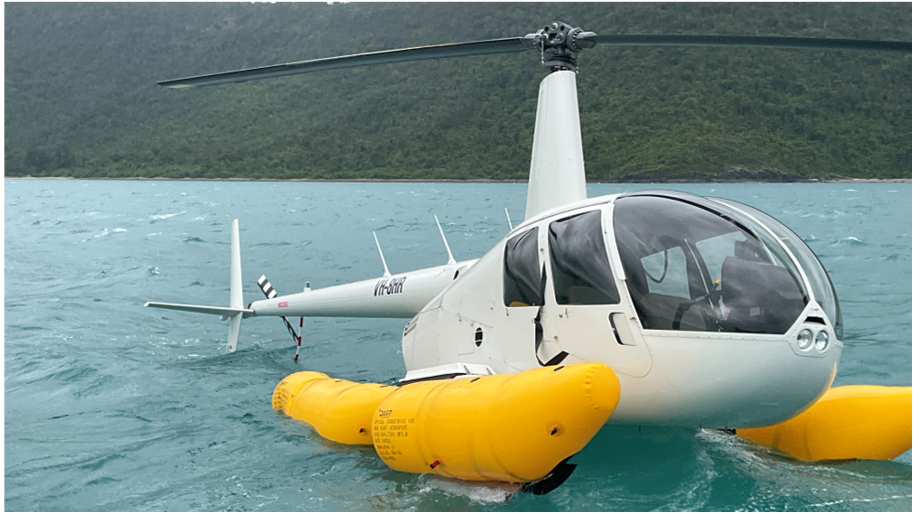
An R44 helicopter pilot’s management of a power loss and ditching in Queensland’s Whitsunday Region has demonstrated the importance of pilot training and the understanding of governor-off throttle control and engine RPM management, an ATSB final report concludes.
On 25 January 2026 the pilot and only occupant of the Robinson R44 helicopter took off from Whitsunday Airport (Shute Harbour) for a short flight to Daydream Island.
After climbing to 1,000 ft and crossing the coast, the pilot heard the low rotor RPM horn, and immediately increased the throttle and lowered the collective, returning engine and rotor RPM to within the normal range.
About 10 seconds later, the engine RPM briefly reduced again, before both it and rotor RPM rapidly increased, activating another alert.
“The pilot recalled then switching off the engine governor, so they could manually control the throttle inputs and maintain a constant engine RPM,” ATSB Director of Transport Safety Dr Stuart Godley explained.
The pilot was able to keep the engine and rotor RPM stable for about 10 seconds, during which time they observed the engine was running rough, and that there had been a significant increase in manifold pressure, while the aircraft commenced an uncommanded descent.
“The pilot began to slow the helicopter to the best rate of climb speed of 55 kt, but the descent continued, with the helicopter beyond gliding distance from land,” Dr Godley said.
“Unable to maintain altitude and observing another engine RPM reduction, the pilot elected to enter an autorotation, activated the emergency pop-out floats, and ditched the helicopter onto the ocean.”
The helicopter remained upright, and the pilot was uninjured. The pilot then transmitted a MAYDAY call which was received by a nearby fixed-wing aircraft that relayed the distress call to Brisbane Centre air traffic control. After a 20-minute wait in the helicopter, the pilot was rescued by water police.
The ATSB’s final report notes the pilot had last completed a proficiency check flight with the operator about six months prior to the incident. The check flight included autorotation landings and governor malfunctions.
The investigation found the source of the engine issues to be the right magneto distributor gear, which jammed when an internal rotating electrode became loose. The reason for the loose electrode could not be determined.
“The jammed magneto affected the timing of the electrical supply to the spark plugs, causing the engine to misfire” Dr Godley explained.
“This in turn likely resulted in the number one cylinder’s exhaust valve being damaged, resulting in a loss of compression and further loss of engine power.”
The final report notes the damaged magneto also likely caused the engine tachometer to incorrectly read the engine RPM, and therefore throttle inputs made by the governor were not accurate, resulting in engine RPM fluctuations.
“The pilot’s decision to switch off the engine governor control and manually control the throttle likely eliminated erroneous throttle inputs, and helped them manage the safe ditching,” Dr Godley said.
“This highlights the importance of pilot training, and an adequate understanding of governor-off throttle control and engine RPM management.”
Read the final report: Power loss and ditching involving Robinson R44, VH-8HR, 19 km north-west of Hamilton Island, Queensland, on 25 January 2026