

Final report
Report release date: 08/12/2025
Investigation summary
What happened
On the evening of 2 July 2025, a Virgin Australia Airlines Boeing 737‑800 aircraft, registered VH-YFZ, operated a scheduled passenger flight from Sydney, New South Wales, to Melbourne, Victoria.
During the arrival into Melbourne, the aircraft exceeded 2 speed limitations on the standard terminal arrival route, and air traffic control issued 2 speed reduction instructions, likely to maintain separation from traffic.
Perceiving the ATC instructions to be urgent, the crew hastened the conduct of the approach actions and missed arming the speedbrake and performing the landing checks. As the aircraft descended below 1,000 ft above airfield elevation the crew assessed the approach to be stable and continued, resulting in the aircraft landing with the speedbrake not armed, which resulted in it not automatically deploying. Noticing this, the captain moved their hand to the lever to raise it manually. However, the speedbrake simultaneously automatically deployed as the first officer selected reverse thrust. Thereafter the aircraft’s deceleration was sufficient, and the flight concluded without further incident.
What the ATSB found
The ATSB found that the flight crew allowed the aircraft to exceed speed limitations on the arrival, resulting in air traffic control requiring them to reduce speed. The crew were slow to take positive steps to reduce speed requiring ATC to instruct them to slow further. The crew’s attention became focused on achieving the requested speed reductions, which likely resulted in them omitting to arm the speedbrake and conduct the landing checks.
As the aircraft passed 1,000 ft above airfield elevation, neither flight crew recognised that the speedbrake was not armed and the landing checklist had not been completed, resulting in the approach continuing despite the stabilised approach criteria not being met.
Safety message
Threat and error management (TEM) principles state that flight crews' proactive management of workload throughout the flight is a key defence against capacity and attention-related errors.
Checklists are a vital defence against human error and are integral to maintaining flight safety. This occurrence highlights the importance of adhering to standard operating procedures and ensuring checklists are conducted at the appropriate times.
Many of the speed limitations built into approach procedures are designed to facilitate predictable traffic flows and manage both controller and flight crew workloads. Exceeding the published approach speeds without clearance compromises this risk control and introduces the threat of additional workload and demands on attentional resources.
Many transport jets, such as the 737-800, have a limited capacity to simultaneously descend and decelerate when in a clean configuration. In some modes and flight conditions the aircraft’s autopilot system will be unable to meet altitude and airspeed constraints contained in arrival and approach procedures. The flight crew must therefore be vigilant in monitoring and managing the aircraft’s descent profile and energy condition and be ready to intervene as necessary.
Correct management of the aircraft’s profile and energy during the descent is an effective countermeasure against approach and landing accidents. The Flight Safety Foundation (2000) provides guidance to flight crew on this matter (FSF ALAR Briefing Note 4.1 – Descent-and-approach Profile Management) as part of its broader approach and landing accident reduction (ALAR) toolkit.
The investigation
The occurrence
On 2 July 2025, a Virgin Australia Airlines Boeing 737-800 aircraft, registered VH-YFZ, was operating a scheduled passenger flight,[1] VA882, from Sydney, New South Wales, to Melbourne, Victoria. On board were the captain as pilot monitoring (PM),[2] first officer as pilot flying (PF), 4 cabin crew and 170 passengers.
At 2040 local time the aircraft commenced an initial descent from its cruising altitude with a clearance from the Melbourne centre air traffic controller (ATC) to track via the BOOIN ONE ALPHA standard terminal arrival route (STAR) (Figure 1). ATC did not remove any of the speed restrictions associated with the arrival.
Seven minutes later, descending through flight level 140,[3] the aircraft was transferred to the Melbourne approach ATC, who cleared the flight for further descent via the STAR, initially to 5,000 ft, and soon after to 3,000 ft. ATC also issued a clearance for the ground based augmentation system (GBAS) landing system (GLS)[4] approach to runway 16, but again did not remove any speed restrictions.
With the autopilot engaged in VNAV PTH pitch mode (see the section titled Automatic flight modes), the aircraft’s descent was momentarily arrested at 10,000 ft, to decelerate to less than the maximum speed constraint of 250 kt below that altitude. However, as the airspeed decreased to about 260 kt, the autopilot recommenced the descent, and the aircraft’s deceleration ceased. Subsequently, the aircraft crossed the ENSEG waypoint,[5] located approximately 21 track miles from the runway threshold at 263 kt, 33 kt above the speed required at that waypoint by the arrival procedure.
When the aircraft was approximately 15 track miles from the runway threshold, around 4 NM from initial approach fix BELTA and descending through 5,250 ft above mean sea level (AMSL), ATC instructed the flight crew to reduce their speed to 180 kt. At this stage, the aircraft was in a clean configuration[6] and slowly decelerating through 240 kt. Shortly thereafter the flight crew began to extend the initial stages of flap and deployed the speedbrake.
Figure 1: BOOIN ONE ALFA standard instrument arrival procedure chart
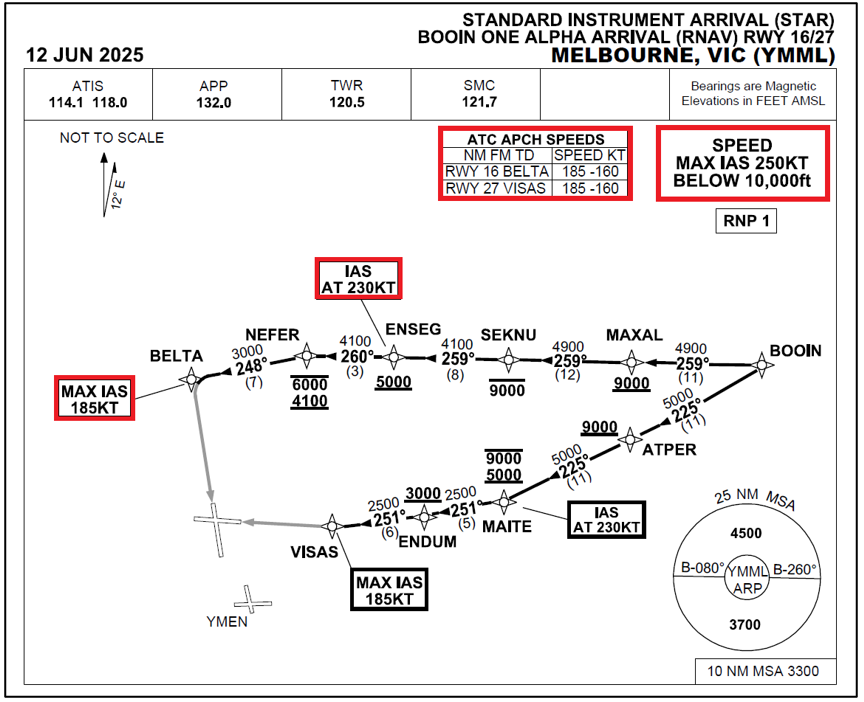
The chart shows graphical section of the STAR with the applicable speed restrictions highlighted in red by the ATSB. Source: Airservices Australia
Just over one minute later, as the aircraft was abeam BELTA and midway through the turn to the final approach course, ATC requested a further reduction in speed to 160 kt, likely for traffic separation. The crew perceived the ATC request to be urgent and began selecting flaps earlier than normal to arrest the aircraft’s speed. The aircraft passed abeam BELTA, with the speedbrakes still deployed, decelerating through 206 kt and descending through an altitude of 4,000 ft AMSL.
Shortly after passing BELTA at 199 kt, flap 10 was selected, and then the speedbrake was stowed. Twenty seconds later, at approximately 9.5 NM from the runway threshold and descending through 3,650 ft AMSL, flap 15 was selected and the landing gear was extended. While the operator’s standard procedures call for the speedbrake lever to be placed into the armed position after the selection of flap 15, it remained in the stowed position for the remainder of the approach.
The flight crew selected the landing flap configuration of 30, approximately 8.5 NM from the runway threshold at 3,330 ft AMSL, but did not action the landing checks, as called for in the operator’s standard procedures.
Figure 2: Aircraft flight path and key events during the transition from the arrival to the approach procedure
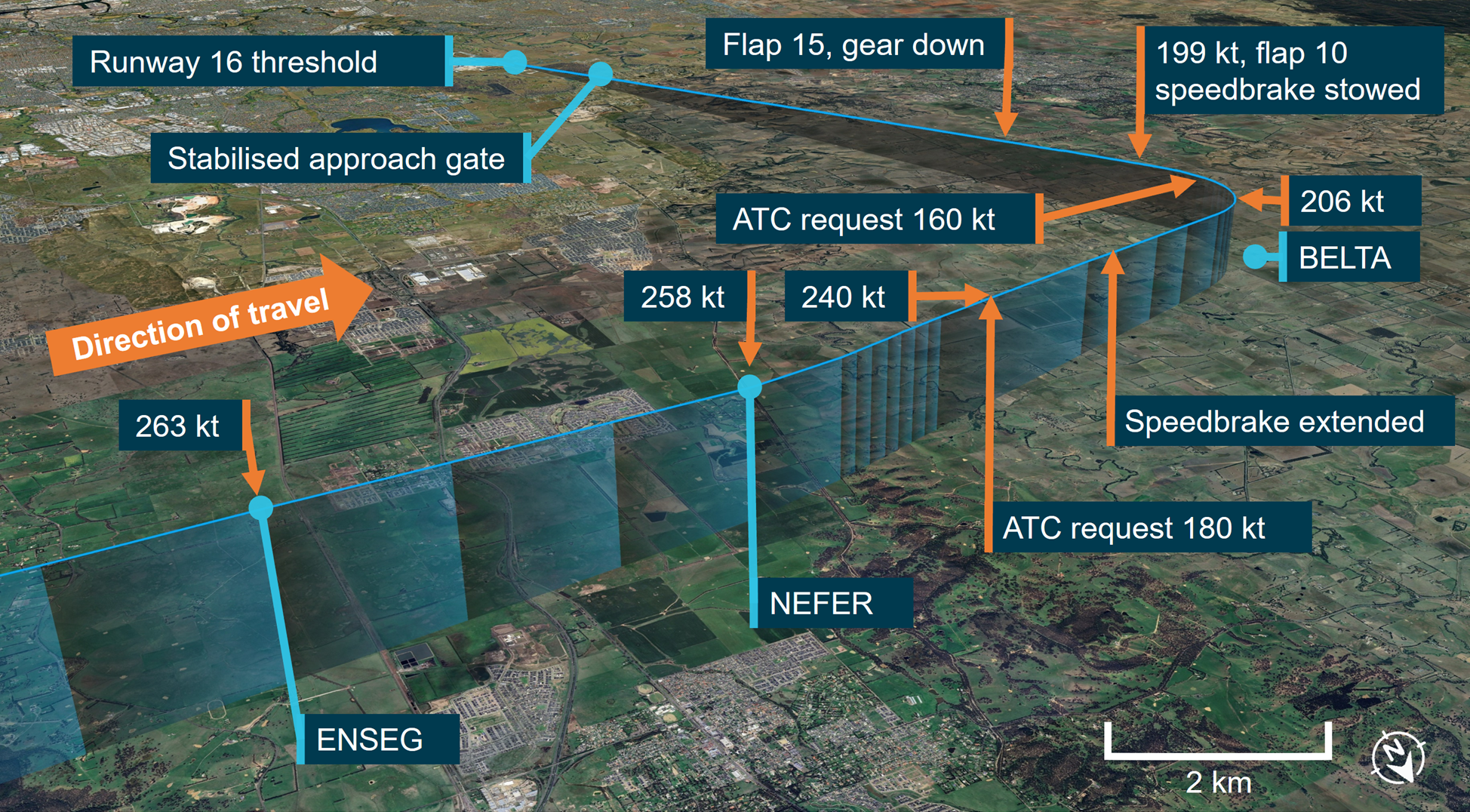
Source: Google Earth and Flightradar24, annotated by the ATSB
The aircraft descended through the 1,000 ft above airfield elevation stabilised approach gate (see the section titled Stabilised approach requirements) on the GLS course and glideslope, with the airspeed stable at 150 kt, but with the speedbrake lever still in the stowed position and the landing checks incomplete. The crew advised the ATSB that the stabilised approach criteria were assessed, but neither crewmember recognised that they had not been met. As a result, they continued the approach.
Upon touchdown, the captain sighted the speedbrake lever and noted that it had not automatically moved to the deployed position. As they moved their hand to the lever with the intention of manually extending the speedbrakes, the lever began to automatically deploy, coincident with the first officer selecting reverse thrust.
The aircraft decelerated normally and exited the runway. As the flight crew began their post‑landing actions, the captain noted that the line pointers on both yoke‑mounted checklists had not been moved below the bottom of the approach checks, signalling that the landing checks had not been completed. After manoeuvring the aircraft onto the stand and shutting down the engines, the flight crew discussed what they thought had probably happened. The first officer was unaware that the speedbrake had not been armed prior to landing, nor that the landing checks had not been performed.
Context
Flight crew background
The captain and first officer both held an air transport pilot licence (aeroplane) and a class 1 aviation medical certificate. The captain had around 13,600 total flight hours (5,500 on the 737), and the first officer had just over a total of 3,000 hours at the time of the incident. The flight was the captain’s first in almost a month, having been away from work on annual leave. They advised that although they were comfortable with the flight, they felt slightly below their normal performance capability.
Aircraft information
VH-YFZ was a Boeing 737-800, serial number 41005, manufactured in the United States in 2017. The 176-seat aircraft was fitted with 2 CFM International CFM56-7B24E turbofan engines.
Speedbrake system
The Boeing 737-800 speedbrake system is comprised of 6 hydraulically-actuated spoiler panels on the upper surface of each wing, 4 flight spoilers and 2 ground spoilers. In flight, only the flight spoilers may be extended, and are used symmetrically across the wings to increase drag. On the ground, both flight and ground spoilers may be extended to assist with deceleration.
The 737 NG Flight crew training manual stated that:
The use of speedbrakes with flaps extended should be avoided, if possible. With flaps 15 or greater, the speedbrakes should be retracted. If circumstances dictate the use of speedbrakes with flaps extended, high sink rates during the approach should be avoided. Speedbrakes should be retracted before reaching 1,000 feet AGL [above ground level].
Operation of the speedbrakes is achieved via the speedbrake lever. This lever can also be set in the ARMED position. In flight this will not result in speedbrake extension, however after landing, when the conditions are met, all spoiler panels will automatically raise to their maximum extent.
Normally, for the speedbrake system to operate automatically during landing, the following set of conditions must be met:
- speedbrake lever in the armed position and the light illuminated
- radio altitude less than 10 ft
- landing gear strut compressed
- both thrust levers retarded to idle
- main landing gear wheels spun up (more than 60 kt).
However, if the speedbrake lever is not in the armed position during landing, the speedbrake system will also automatically operate when the following conditions are met:
- main landing gear wheels spun up (more than 60 kt)
- both thrust levers retarded to idle
- reverse thrust levers positioned for reverse thrust.
Automatic flight modes
The aircraft’s automatic flight system consisted of the autopilot flight director system (AFDS) and autothrottle (A/T). They could be used together in a number of distinct modes to achieve lateral and vertical navigation, and speed management. For descents, a vertical navigation mode could be selected via the VNAV switch on the mode control panel (MCP). The aircraft’s flight management computer (FMC) would command the AFDS pitch and A/T to fly a pre‑programmed vertical profile, attempting to accommodate waypoint altitude and airspeed constraints.
In most scenarios, selecting VNAV engaged the VNAV PTH mode, where maintenance of vertical flightpath was prioritised over airspeed. In certain situations, such as steep descent profiles in clean configuration, the aircraft may be unable to decelerate or maintain airspeed limits, even with idle thrust. In these situations, VNAV PTH mode would seek to achieve the programmed descent path, including altitude constraints, and may allow the airspeed to increase within broad limits, before reverting to a speed prioritised mode (VNAV SPD).
Standard operating procedures
Approach configuration sequence
The operator’s 737 NG Flight Crew Operations Manual (FCOM) specified a normal sequence of flight crew actions for a GLS approach, as well as the areas of the flight deck for which each flight crew member was responsible.
When the first officer was operating as the pilot flying, it was their responsibility to move the speedbrake lever to the ARM position and verify the status of the corresponding annunciator, prior to landing. At around 2,000 ft above airfield elevation, the normal procedure specified that the speedbrake arming action should occur, immediately after the pilot flying called for ‘Gear Down’ and ‘Flaps 15’.
The normal procedure also specified that it was the pilot flying’s responsibility to call for the landing checklist to be completed at around 1,500 ft above airfield elevation. This should normally occur as part of a second block of configuration actions, immediately after the pilot flying called for the landing flap to be set and the threshold target speed to be bugged.
The Quick Reference Handbook (QRH) section of the FCOM specified the normal landing checklist, and contained the following items, all to be confirmed by the pilot flying:
Engine start switches………………………..CONT
Speedbrake………………………………......ARMED
Landing gear………………………………….Down
Flaps……………………………………..……Green light
A checklist and movable position marker were mounted to each of the aircraft’s control yokes. The occurrence happened at night in a darkened cockpit and the checklists did not have backlighting.
Stabilised approach requirements
The operator’s normal procedures for a GLS approach called for the flight crew to assess the approach against stabilisation criteria at 1,000 ft above airfield elevation and initiate a missed approach if the conditions were not met. The criteria were specified under the operator’s stabilised approach policy, contained within their general operating policies and procedures manual. They were as follows:
- briefings and normal checklists completed
- aircraft in the correct landing configuration
- aircraft on the correct lateral and vertical flight path
- sink rate, no greater than 1,000 fpm
- thrust setting appropriate for the aircraft configuration and trajectory
- speed within -5 kt to +10 kt of the speed target.
Instrument arrival procedure speed restrictions
The STAR contained several speed limitations (Figure 1). Airservices Australia’s Aeronautical Information Publication (AIP) Enroute 1.5 - 47 included the following requirements:
10.2.1 Unless explicitly cancelled or amended by ATC, the pilot must follow the vertical and lateral profile of the STAR and comply with any published speed restrictions.
On this occasion ATC did not cancel the speed restrictions when clearing the flight to conduct the STAR.
Safety analysis
The flight crew used the autopilot’s vertical navigation path (VNAV PTH) mode and auto throttle to manage the aircraft’s descent profile and airspeed for the arrival.
On this occasion, and as per expected system performance, in a clean configuration, the autopilot was unable to sufficiently reduce speed such that it could simultaneously meet the descent profile and airspeed requirements of the arrival procedure. With no additional drag added by the flight crew, the aircraft continued to maintain an airspeed around 30 kt higher than the speed restrictions in the STAR, until the air traffic controller issued a speed reduction instruction and the flight crew modified the aircraft’s configuration.
The crew perceived the ATC instruction to be urgent and advised that this increased their workload. It is likely the crew focused their attention on monitoring the airspeed and ensuring the flaps were extended promptly, but within their operational limits. Wickens (2021) describes attentional narrowing as a focus on a limited set of information at the expense of other sources. This focus can cause steps in the linear sequence of a procedure to be skipped.
As the aircraft was decelerated to final approach speed and configured for landing earlier than normal, it is probable that the crew omitted to arm the speedbrake and call for the landing checks because their attention was focused on achieving the ATC‑requested airspeed reduction. Compounding this, the captain perceived that their monitoring performance was modestly degraded due to a lack of recent flying experience.
During the final segment of the approach, while the aircraft was on the approach path and the speed had reduced to the required approach speed, the aircraft did not meet all the stabilised approach criteria since the landing checklist had not been completed, and the speedbrake was not in the armed position.
Findings
ATSB investigation report findings focus on safety factors (that is, events and conditions that increase risk). Safety factors include ‘contributing factors’ and ‘other factors that increased risk’ (that is, factors that did not meet the definition of a contributing factor for this occurrence but were still considered important to include in the report for the purpose of increasing awareness and enhancing safety). In addition ‘other findings’ may be included to provide important information about topics other than safety factors. These findings should not be read as apportioning blame or liability to any particular organisation or individual. |
From the evidence available, the following findings are made with respect to the incorrect landing configuration involving Boeing 737, VH-YFZ, near Melbourne Airport, Victoria, on 2 July 2025.
Contributing factors
- The aircraft exceeded speed restrictions during the arrival and the crew did not take appropriate action to slow the aircraft in a timely manner. This resulted in the air traffic controller issuing instructions to reduce speed further and the crew subsequently not arming the speedbrake and performing the landing checks.
- As the aircraft passed 1,000 ft above airfield elevation, neither flight crew recognised that the speedbrake was not armed and the landing checklist had not been completed, resulting in the approach continuing despite the stabilised approach criteria not being met.
Sources and submissions
Sources of information
The sources of information during the investigation included:
- the pilots of the incident flight
- operational documentation from Virgin Australia Airlines
- Airservices Australia
- ADS-B data from Flightradar24
- recorded data from the aircraft Quick Access Recorder.
References
- Flight Safety Foundation. (2000). ALAR briefing note 4.1: Descent-and-approach profile management. In Approach and landing accident reduction (ALAR) toolkit. Flight Safety Foundation. https://flightsafety.org/wp-content/uploads/2016/09/alar_bn4-1-profilemgmt.pdf
- Wickens, C. (2021). Attention: Theory, principles, models and applications. International Journal of Human–Computer Interaction, 37(5), 403-417.
Submissions
Under section 26 of the Transport Safety Investigation Act 2003, the ATSB may provide a draft report, on a confidential basis, to any person whom the ATSB considers appropriate. That section allows a person receiving a draft report to make submissions to the ATSB about the draft report.
A draft of this report was provided to the following directly involved parties:
- the pilots of the incident flight
- Virgin Australia Airlines
- Civil Aviation Safety Authority.
Submissions were received from:
- the pilots of the incident flight
- Virgin Australia Airlines.
The submissions were reviewed and, where considered appropriate, the text of the report was amended accordingly.
Purpose of safety investigationsThe objective of a safety investigation is to enhance transport safety. This is done through:
It is not a function of the ATSB to apportion blame or provide a means for determining liability. At the same time, an investigation report must include factual material of sufficient weight to support the analysis and findings. At all times the ATSB endeavours to balance the use of material that could imply adverse comment with the need to properly explain what happened, and why, in a fair and unbiased manner. The ATSB does not investigate for the purpose of taking administrative, regulatory or criminal action. About ATSB reportsATSB investigation reports are organised with regard to international standards or instruments, as applicable, and with ATSB procedures and guidelines. Reports must include factual material of sufficient weight to support the analysis and findings. At all times the ATSB endeavours to balance the use of material that could imply adverse comment with the need to properly explain what happened, and why, in a fair and unbiased manner. An explanation of terminology used in ATSB investigation reports is available here. This includes terms such as occurrence, contributing factor, other factor that increased risk, and safety issue. Publishing informationReleased in accordance with section 25 of the Transport Safety Investigation Act 2003 Published by: Australian Transport Safety Bureau © Commonwealth of Australia 2025 
Ownership of intellectual property rights in this publication Unless otherwise noted, copyright (and any other intellectual property rights, if any) in this report publication is owned by the Commonwealth of Australia. Creative Commons licence With the exception of the Commonwealth Coat of Arms, ATSB logo, and photos and graphics in which a third party holds copyright, this report is licensed under a Creative Commons Attribution 4.0 International licence. The CC BY 4.0 licence enables you to distribute, remix, adapt, and build upon our material in any medium or format, so long as attribution is given to the Australian Transport Safety Bureau. Copyright in material obtained from other agencies, private individuals or organisations, belongs to those agencies, individuals or organisations. Where you wish to use their material, you will need to contact them directly. |
[1] The flight departed Sydney at 1935 local time, 35 minutes later than the scheduled departure time, after weather conditions in the Sydney area had caused disruptions and delays to traffic movements.
[2] Pilot Flying (PF) and Pilot Monitoring (PM): procedurally assigned roles with specifically assigned duties at specific stages of a flight. The PF does most of the flying, except in defined circumstances; such as planning for descent, approach and landing. The PM carries out support duties and monitors the PF’s actions and the aircraft’s flight path.
[3] Flight level: at altitudes above 10,000 ft in Australia, an aircraft’s height above mean sea level is referred to as a flight level (FL). FL 140 equates to 14,000 ft.
[4] GLS: a GBAS Landing System (GLS) is an alternative to the Instrument Landing System and uses the Global Navigation Satellite System (GNSS), augmented by an airport ground station, to provided suitably equipped aircraft with precision approach guidance.
[5] Waypoint: a specific geographical location, defined by latitude and longitude coordinates, that is used to define an aircraft’s flight path
[6] Clean configuration: an aircraft is in a clean configuration when all external drag‑inducing equipment, such as landing gear, flaps and spoilers, are retracted.
Occurrence summary
| Investigation number | AO-2025-038 |
|---|---|
| Occurrence date | 02/07/2025 |
| Location | Melbourne Airport |
| State | Victoria |
| Report release date | 08/12/2025 |
| Report status | Final |
| Investigation level | Short |
| Investigation type | Occurrence Investigation |
| Investigation status | Completed |
| Mode of transport | Aviation |
| Aviation occurrence category | Flight Preparation / Navigation, Incorrect configuration |
| Occurrence class | Incident |
| Highest injury level | None |
Aircraft details
| Manufacturer | The Boeing Company |
|---|---|
| Model | 737-800 |
| Registration | VH-YFZ |
| Serial number | 41005 |
| Aircraft operator | Virgin Australia Airlines Pty Ltd |
| Sector | Jet |
| Operation type | Part 121 Air transport operations - larger aeroplanes |
| Departure point | Sydney Airport, New South Wales |
| Destination | Melbourne Airport, Victoria |
| Damage | Nil |