

Final report
Report release date: 13/04/2016
What happened
On 14 February 2016, the pilot of a Robinson R44 helicopter, registered VH-HXY, conducted a local private flight from a property about 90 km north of Hughenden, Queensland.
After operating for about 1 hour, the pilot landed near a water trough to check a float. During the approach and landing, the pilot sighted powerlines strung across the trough, and manoeuvred to remain clear of them.
While the helicopter was on the ground, the wind veered from a south-west to a southerly direction, so that to take off into wind, the helicopter would track perpendicular to the powerlines. After completing the pre-take-off checks, the pilot turned his attention to a mob of cattle, to ensure the noise of the helicopter would not send them through a fence.
The helicopter lifted off initially parallel to the powerlines, and the pilot then turned the helicopter to manoeuvre around a tree and climbed to about 20 ft above ground level. The tree momentarily obscured the powerlines and the pilot’s attention was on the cattle.
As the helicopter rounded the tree, at an airspeed of about 50 kt, the skids struck the powerlines. The pilot heard the wires contact the helicopter and it decelerated rapidly. The pilot lowered the collective[1] and pulled back on the cyclic[2] control, but the helicopter rolled forwards over the wires, descended rapidly, and collided with the ground left side down in a nose-down attitude.
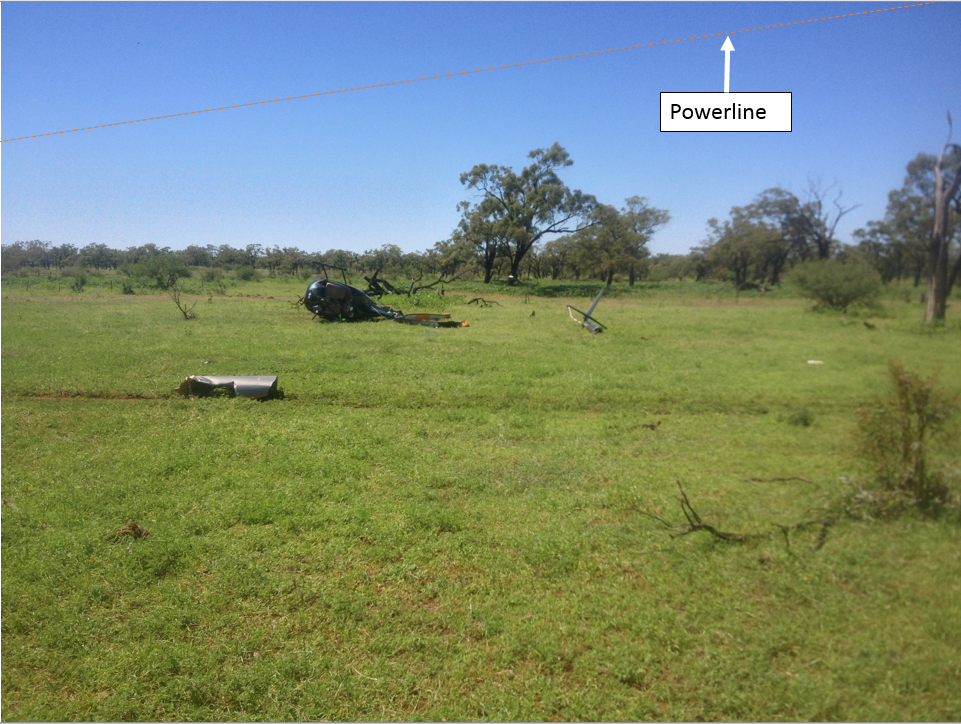
The wire was hooked on the helicopter’s right skid, with electrical power still running through it. After the blades stopped turning, the pilot exited the helicopter. The pilot was not injured and the helicopter was destroyed (Figure 1).
Figure 1: Accident site of Robinson R44 helicopter, registered VH-HXY
Source: Helicopter owner
Safety message
ATSB research indicates that in 63 per cent of reported wirestrike incidents, pilots were aware of the position of the wire before they struck it. In this instance, the pilot was aware of the powerline however, they were unable to see the wires from the helicopter’s position on the ground due to a tree. The pilot’s attention was then diverted to the cattle and did not maintain awareness of the wires.
The Aerial Agricultural Association of Australia suggests a way to keep focus is to ask yourself:
- Where is the wire now?
- What do I do about it?
- Where am I in the paddock?
For further risk management strategies for agricultural operations, refer to the Aerial Application Pilots Manual.
The ATSB publication Avoidable Accidents No. 2 – Wirestrikes involving known wires: A manageable aerial agricultural hazard, explains strategies to help minimise the risk of striking wires while flying. Pilots are reminded to avoid unnecessary distractions and to refocus when distracted. Distraction, combined with difficulty in seeing wires makes them extremely hard to avoid at the last minute.
Aviation Short Investigations Bulletin - Issue 47
About this reportDecisions regarding whether to conduct an investigation, and the scope of an investigation, are based on many factors, including the level of safety benefit likely to be obtained from an investigation. For this occurrence, a limited-scope, fact-gathering investigation was conducted in order to produce a short summary report, and allow for greater industry awareness of potential safety issues and possible safety actions. Publishing informationReleased in accordance with section 25 of the Transport Safety Investigation Act 2003 Published by: Australian Transport Safety Bureau © Commonwealth of Australia 2016 
Ownership of intellectual property rights in this publication Unless otherwise noted, copyright (and any other intellectual property rights, if any) in this report publication is owned by the Commonwealth of Australia. Creative Commons licence With the exception of the Coat of Arms, ATSB logo, and photos and graphics in which a third party holds copyright, this publication is licensed under a Creative Commons Attribution 3.0 Australia licence. Creative Commons Attribution 3.0 Australia Licence is a standard form licence agreement that allows you to copy, distribute, transmit and adapt this publication provided that you attribute the work. The ATSB’s preference is that you attribute this publication (and any material sourced from it) using the following wording: Source: Australian Transport Safety Bureau Copyright in material obtained from other agencies, private individuals or organisations, belongs to those agencies, individuals or organisations. Where you wish to use their material, you will need to contact them directly. |
__________
- A primary helicopter flight control that simultaneously affects the pitch of all blades of a lifting rotor. Collective input is the main control for vertical velocity.
- A primary helicopter flight control that is similar to an aircraft control column. Cyclic input tilts the main rotor disc varying the attitude of the helicopter and hence the lateral direction.
Occurrence summary
| Investigation number | AO-2016-010 |
|---|---|
| Occurrence date | 14/02/2016 |
| Location | Near Hughenden |
| State | Queensland |
| Report release date | 13/04/2016 |
| Report status | Final |
| Investigation level | Short |
| Investigation type | Occurrence Investigation |
| Investigation status | Completed |
| Mode of transport | Aviation |
| Aviation occurrence category | Wirestrike |
| Occurrence class | Accident |
| Highest injury level | None |
Aircraft details
| Manufacturer | Robinson Helicopter Co |
|---|---|
| Model | R44 |
| Registration | VH-HXY |
| Serial number | 0350 |
| Sector | Helicopter |
| Operation type | Private |
| Departure point | Boonacarbaroo Station, Queensland |
| Damage | Destroyed |