

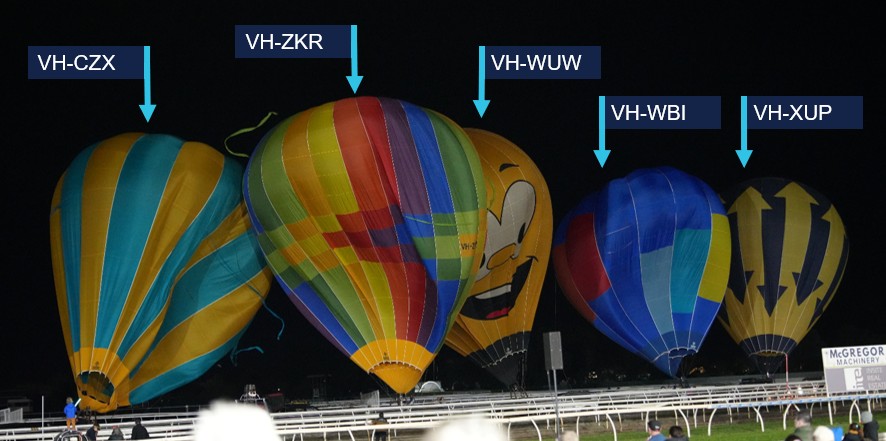
Hot air balloon event organisers are encouraged to obtain and properly consider all available weather information prior to each event, after two people were injured during a static balloon glow display at Wangaratta, Victoria, earlier this year.
An ATSB investigation report details the circumstances of the 11 April 2026 incident at Wangaratta Racecourse, where 21 balloons were taking part in a night display as part of the Art of Flight Festival.
The balloons, which were tethered to vehicles on the ground, were affected by a rapid and significant increase in wind speed, and several temporarily became airborne.
Two people on the ground were injured when the balloons they were holding onto became airborne, with the restraint securing one of those balloons failing. That balloon was dragged across the ground before its enveloped was deflated.
The ATSB investigation found the event director had not requested the involvement of the event meteorologist when preparing for the static display.
“Consequently, the pre-event briefing did not include discussion of the forecast weather, nor were conditions actively monitored once the event commenced,” ATSB Director of Transport Safety Investigations Graham Drummond said.
“As this occurrence highlights, while static displays are typically short, and no flight is intended, the balloons are still subject to the same types of adverse weather conditions which are a known common contributor to accidents and incidents in this sector.”
The investigation also noted the event did not have defined conditions for weather which would trigger a discontinuation.
The ATSB further concluded the risk of the launch restraint as a single point of failure was not effectively managed.
“It was found that the launch restraint that failed likely had insufficient breaking strain, and periodic inspections had not identified that it should have been retired due to damage, and an extended time in service,” Mr Drummond said.
In response to the incident, the Australian Ballooning Federation has advised it is developing a balloon glow procedures document to provide guidance for organisers and participants of future events.
Mr Drummond encouraged all balloon operators to review the ATSB’s report, and the Federation’s guidance, once published.
“A comprehensive pre-event briefing is also an opportunity to re-enforce to balloon crew members the importance of using the recommended hands-on / hands-off technique to reduce the risk of injury, should a balloon suddenly become airborne,” he added.
Read the final report: Loss of control on the ground involving Kavanagh Balloons D-77, VH-CZX, and amateur‑built GUS-69, VH-XUP, Wangaratta Racecourse, Victoria, on 11 April 2026