

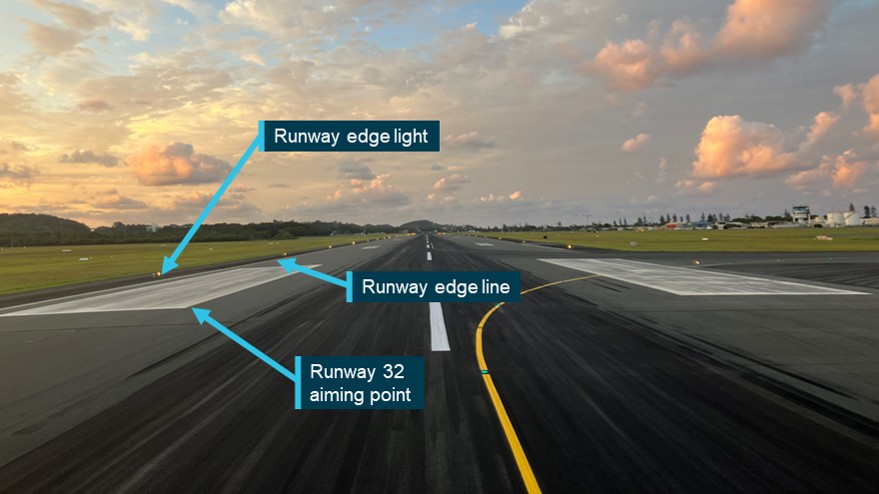
The ATSB has issued an advisory to airport operators to consider international guidance for reflective runway markings, after a Virgin Australia 737 landed beyond the touchdown zone during a thunderstorm at Gold Coast Airport.
An ATSB investigation of the 24 January 2023 incident found a sequence of factors contributed to the Boeing 737 landing long at about 1839 local time in reported heavy rain and dark conditions.
When the aircraft touched down more than halfway down the runway, the captain, who was pilot monitoring, likely identified there was insufficient distance to stop using the autobrake setting.
The captain immediately took control and applied maximum manual braking and reverse thrust, and the aircraft slowed within the confines of the runway.
The flight crew reported that they suspected they had landed long, but had not seen any runway markings indicating they had passed the latest point of touchdown during the landing.
“In the dark thunderstorm conditions, and with water on the runway, the visibility of the painted markings was likely diminished to the extent the flight crew could not see them,” ATSB Chief Commissioner Angus Mitchell said.
“Had the flight crew recognised they had passed the touchdown zone, the operator’s procedures would have been to conduct a go‑around.
“Instead, the landing was continued, and the aircraft touched down with a significantly reduced stopping distance available – with a runway overrun likely avoided by the captain’s prompt response.”
Mr Mitchell noted Australia’s Civil Aviation Safety Authority guidance differs from the International Civil Aviation Organization’s recommended practice for reflective markings on airports that include night operations.
“While the use of reflective markings is not a mandatory part of complying with international guidance, other significant aviation authorities have encouraged the use of reflective markings,” he said.
The ATSB is subsequently issuing a Safety Advisory Notice encouraging all aerodrome operators to consider reflective materials in visual aid markings on runways that are used for night operations, particularly those where there is a reasonable likelihood of the runway also becoming wet.
“Runway markings play a critical role in the safe completion of a landing, particularly in adverse weather conditions,” Mr Mitchell said.
“Given the significant risk of runway overruns, flight crews should maintain a ‘go-around mindset’, but it is crucial for visual cues to be available to inform a correct decision.”
QNH not updated
The ATSB’s final report notes several other factors contributed to the long landing.
The barometric pressure at Gold Coast Airport changed 11 minutes before the long landing, but the aircraft’s instruments were not updated because the flight crew were not notified of the change.
This was in part because the 1 hPa change in pressure was below the 2 hPa threshold for the airport’s tower controller to be automatically alerted so the automatic terminal information service (ATIS) could be updated and flight crew informed.
“With the pressure change below the threshold for an automated notification, it was reliant on the tower controller to identify the change in pressure and update the ATIS,” Mr Mitchell observed.
The QNH discrepancy meant, in this case, the aircraft was about 35 ft higher than its instruments indicated during the approach.
While the ground-based precision approach path indicator (PAPI) lights next to the runway were likely indicating to the flight crew the aircraft was above the glidepath, both pilots were very likely looking at the glidepath as presented on the aircraft instruments near the decision altitude.
The aircraft subsequently passed over the runway threshold about 37 ft above the PAPI indicated flightpath (90 ft above ground level), adding about 215 m to the distance travelled before touchdown.
Then, the first officer initiated the flare at 44 ft, above the recommended height of 20 ft above ground level.
The aircraft subsequently floated for an extended distance before touching down, adding another 635 m to the distance travelled before landing.
In combination, these factors meant the aircraft touched down 550 m beyond the touchdown zone.
Mr Mitchell noted the flight crew were also influenced by a combination of conditions on this and earlier flights, resulting in a prolonged high workload that likely had an adverse effect on their performance.
This was compounded for the captain who was also likely experiencing fatigue.
“This incident should be a reminder to flight crews to take advantage of all the information that is available to them, particularly those that are providing the most accurate information for the phase of flight,” he said.
“And while it wouldn’t have resulted in a long landing by itself, this incident highlights the importance of flight crews being provided with, and using, accurate QNH data when conducting this type of approach.
“In this case, the error was such that the aircraft was high, but a similar discrepancy in the other direction could potentially have resulted in the aircraft being low, reducing terrain clearance.”
Read the final report: Long landing involving Boeing 737-8FE, VH-YQM, at Gold Coast Airport, Queensland, on 24 January 2023