

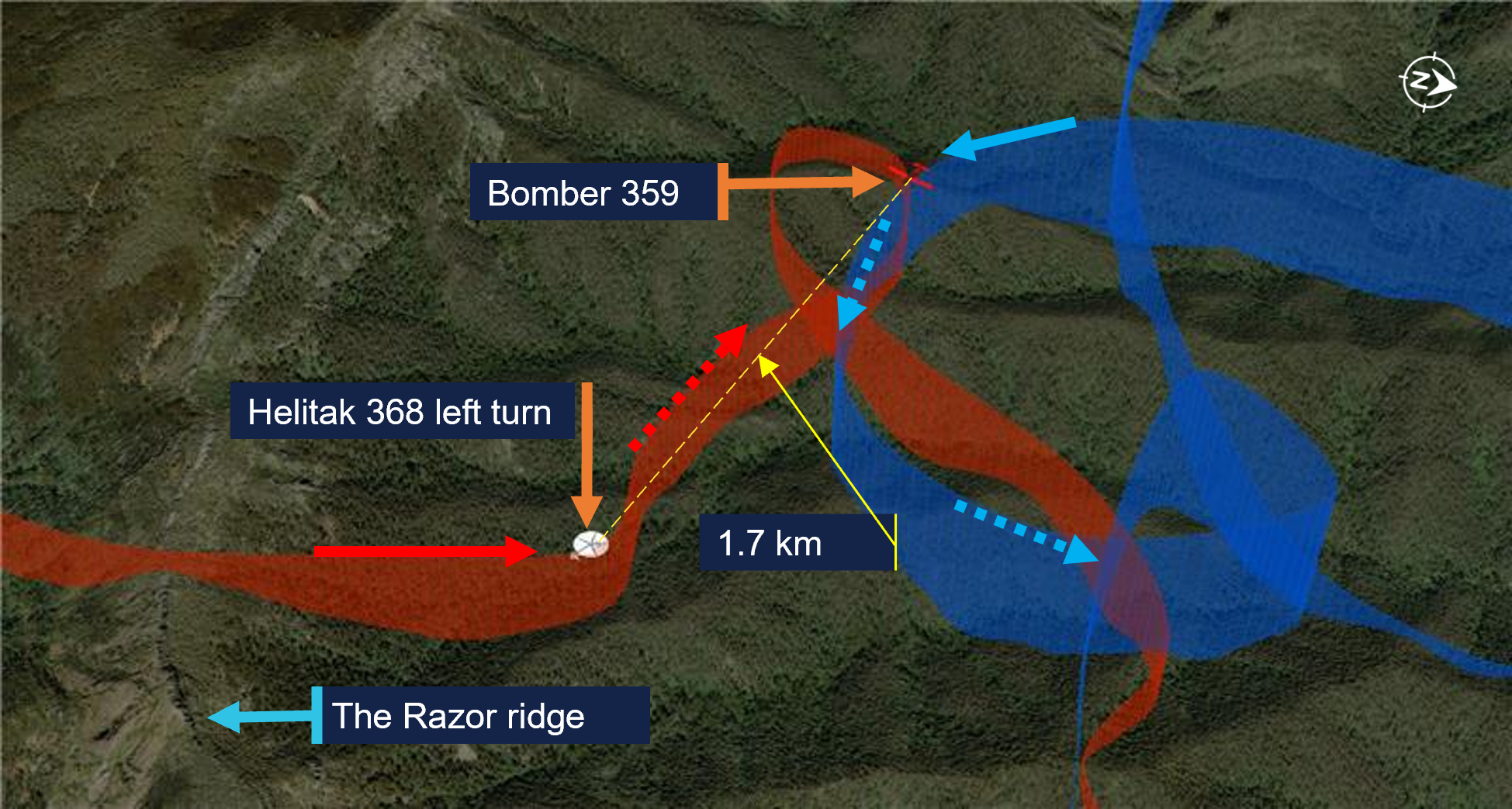
An operational misunderstanding and inadequate situational awareness contributed to a helicopter and a firebombing aircraft coming into close proximity over a fireground in the Victorian High Country earlier this year.
The incident occurred on 18 January 2026, when a Bell 212, callsign Helitak 368, was flown into a fireground west of Mount Hotham, Victoria, to perform rappelling operations.
After entering the fireground, the pilot of the helicopter sighted a PZL M18B single engine air tanker, callsign Bomber 359, ahead on a conflicting track, and conducted a left descending turn to increase separation. At about the same time, Bomber 359 commenced a fire retardant drop, then climbed and departed the area.
The two aircraft passed within about 500 m horizontally and 400 ft vertically of one another. The pilot of Bomber 359 was unaware of the incident, while the pilot of Helitak 368 elected to continue tracking northwards through the fireground.
ATSB Director of Transport Safety Stuart Macleod said a misunderstanding between the Helitak pilot and the air attack supervisor, who was overseeing the fireground from another helicopter, contributed to the separation issue.
“The pilot of Helitak 368 had not yet been to the fireground on the day, and was not aware that all other aircraft were holding north of the fireground and entering from there,” Mr Macleod explained.
“When the air attack supervisor cleared Helitak 368 to enter the fireground, they expected the helicopter to first track east of the fireground, so they too could enter the fireground from the north.
“But the air attack supervisor did not specifically instruct Helitak 368 to enter the fireground this way, and the Helitak pilot instead entered the fireground from the south, believing they had separation assurance and were clear to conduct rappelling operations.”
The pilots of both Helitak 368 and Bomber 359 reported having communicated their intentions on the local fire common traffic advisory frequency, but were unaware they were on a conflicting track until the Helitak pilot sighted Bomber 359.
“While the reason for the pilots being unaware of one another could not be conclusively determined, there were several potential factors which may have limited the crew’s ability to identify each other’s presence,” Mr Macleod said.
“The effectiveness of radio communications can be limited by factors such as the number of aircraft operating on the frequency, and by terrain shielding. Ultimately, see-and-avoid was effective in ensuring separation between the aircraft was maintained.”
While it did not contribute to the occurrence itself, the ATSB noted the Helitak pilot did not alert the air attack supervisor to the conflict incident when it occurred, instead continuing to track through the fireground without assurance of positive separation with other aircraft.
Among several safety actions detailed in the final report, the Victorian Department of Energy, Environment and Climate Action has advised it will focus learnings on mandatory escalation of separation issues, and supervisory control recovery, following airspace conflicts.
“Aerial firefighting, a critical capability for the management and suppression of bushfires in Australia, often sees multiple aircraft flown at low heights above the ground at varying airspeeds in challenging environmental conditions,” Mr Macleod noted.
“As such it is vital that pilots involved in firefighting operations understand where other aircraft are operating and immediately communicate any issues so that all have a common mental model of the fireground.”
Read the final report: Separation issue involving Bell 212, VH-KHO, and PZL M18B, VH-VWF, 58 km west of Mount Hotham Airport, Victoria, on 18 January 2026