

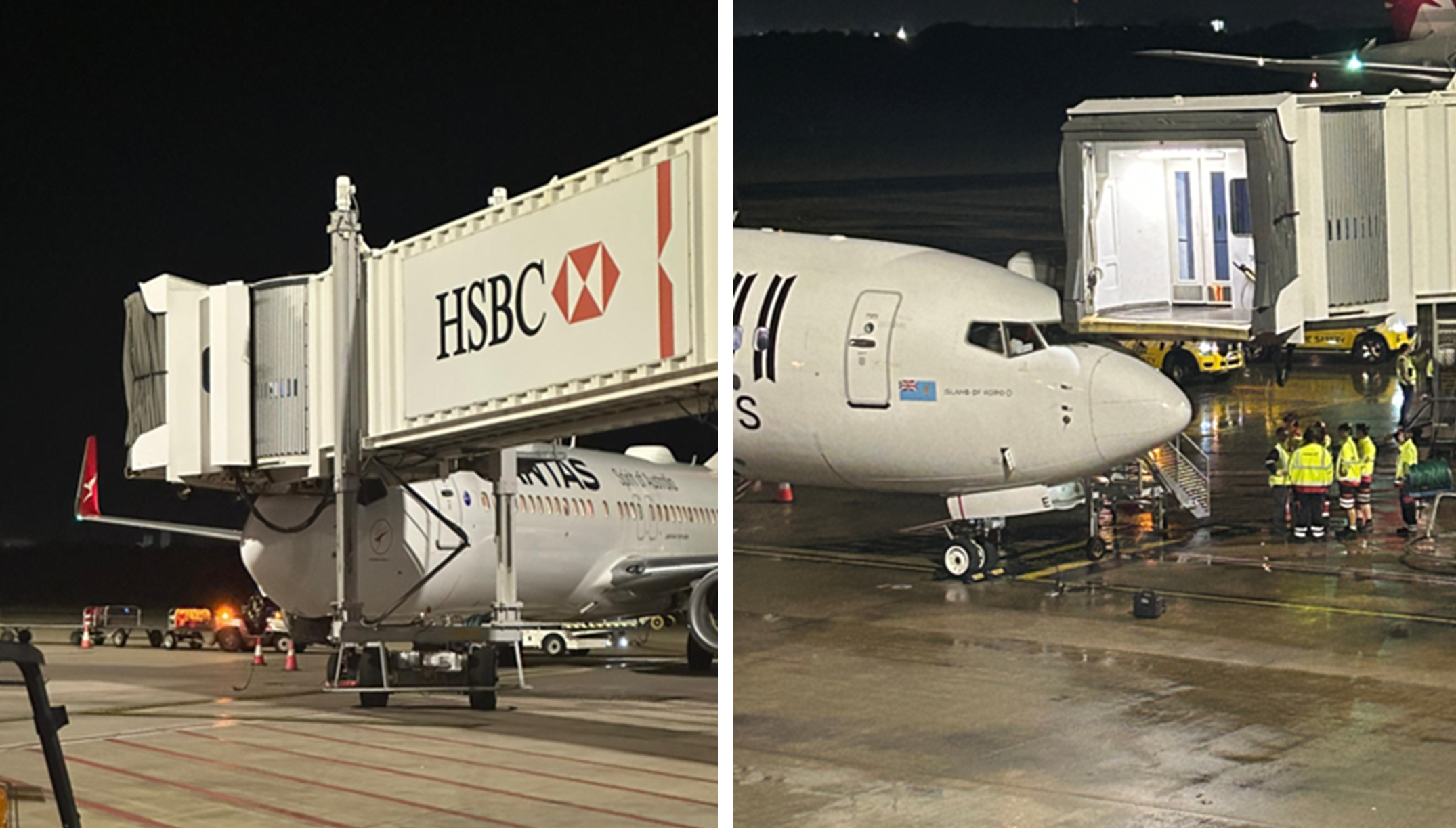
An aerobridge at Brisbane Airport’s international terminal collided with parked Boeing 737s on two occasions last year, an ATSB investigation final report details.
In the first incident, on 18 June 2025, the Gate 82 aerobridge shattered the right windshield of a Qantas 737-800. Glass fragments landed on the first officer, but there were no injuries.
Just over a month later, on 26 July, the same aerobridge also shattered the left windshield of a Fiji Airways 737-8 MAX. Glass and the corner of the aerobridge entered the cockpit, but the captain was able to move out of their seat before impact, and there were no injuries.
In each incident the aircraft was correctly positioned at the gate, and the aerobridge operator was an employee of the respective airline.
“The ATSB’s investigation identified safety factors common to both occurrences, finding that both aerobridge operators could not see the parked aircraft when they began to extend the aerobridge,” ATSB Chief Commissioner Angus Mitchell said.
The investigation report notes Gate 82 catered for both wide-body and narrow-body aircraft, and that the parking position for a 737 was to the far right of the aerobridge home position, meaning the aerobridge operator had restricted visibility of the aircraft from the aerobridge home position.
“Narrow-body aircraft, such as the 737, sit lower to the ground than wide-body aircraft,” Mr Mitchell explained.
“As a result, to minimise the slope of the passenger tunnel, at Gate 82 they park further from the aerobridge home position than would be the case for wide-body aircraft, or at a gate designed only for narrow-body aircraft, such as many domestic terminal gates.”
This meant the Gate 82 aerobridge had to extend much further, and almost parallel to a narrow-body aircraft, in order to attach to it.
“In addition, this aerobridge lacked side viewing windows, as installed in some other aerobridges at the airport, limiting the visibility of narrow‑body aircraft along the docking path,” he said.
The investigation found it was accepted practice for operators to extend the aerobridge without first being able to see the aircraft, with an expectation it would come into view during the extension.
“This expectation was reinforced by successful operations in the past,” Mr Mitchell noted.
“But during the collision events, each aerobridge operator moved the joystick to a 3 o’clock position after rotating the cab left, unaware that this orientation would change the aerobridge’s direction of travel.”
Consequently, as it extended, the aerobridge moved diagonally towards the aircraft, rather than parallel to it, while the aerobridge operator did not have visual reference.
The ATSB identified aerobridge training and in-cab instructions did not direct operators to gain and maintain visibility of the aircraft before moving the aerobridge.
Brisbane Airport Corporation has subsequently disseminated information to all operators emphasising the requirement to rotate the cab towards the aircraft, and to maintain positive line-of-sight during aerobridge operations.
It has also reviewed operator training manuals and identified gaps and opportunities to be more specific in the process to safely attach aerobridges to aircraft.
The airport has also created a new quality assurance role focused on airside performance of assets and operators.
“Aerobridges should be designed with visibility of aircraft in mind, and training should reinforce the importance of maintaining visual reference while operating an aerobridge,” Mr Mitchell said.
Brisbane Airport says a program to replace eight aerobridges, including Gate 82, will include a review of safety features and narrow-body aircraft visibility.
Read the final report: Aerobridge collision with parked aircraft events, Brisbane Airport, Queensland, on 18 June and 26 July 2025