

Discontinuation notice
Report release date: 11/09/2025
| Section 21 (2) of the Transport Safety Investigation Act 2003 (TSI Act) empowers the ATSB to discontinue an investigation into a transport safety matter at any time. Section 21 (3) of the TSI Act requires the ATSB to publish a statement setting out the reasons for discontinuing an investigation. The statement is published as a report in accordance with section 25 of the TSI Act, capturing information from the investigation up to the time of discontinuance. |
Overview of the investigation
The ATSB commenced an investigation into a collision between freight train Y375 and an unoccupied excavator that occurred at Fairfield station, Queensland, on 15 July 2023. The serious incident occurred during completion of a major construction project at Fairfield station that included the demolition of the existing railway station and timber pedestrian overpass, construction of a new railway station, pedestrian overpass bridge and supporting non‑rail and rail infrastructure, dual gauge line lowering, equipment removal and replacement, signalling works, and rail shutdown periods.
Workers had earlier departed the Fairfield work site leaving it unoccupied at the time of the collision. There were no injuries to the train crew and freight train Y375 sustained minor damage.
The occurrence
Construction at Fairfield station
Work preparations commenced around 0200 local time for the inner‑city scheduled corridor access system (SCAS)[1] shutdown between Dutton Park and Rocklea stations on the Queensland Rail (QR) network. This shutdown was separated into zones, with Fairfield station specifically falling under local possession authority permit E on the up and down suburban lines, and track authority number 2 (TA2) on the dual gauge rail line.[2] All of the possessions for the shutdown were managed by a possession protection officer based at the QR Yeerongpilly depot.
A workgroup supervisor, employed by UNITY Alliance (UNITY), arrived at Fairfield station at 0530 to prepare for planned work between 0600–1800. Following a pre‑work brief with about 50 participants, activities outside of the danger zone began.
At 0837, worksite permit E became active, covering both the up and down suburban lines at Fairfield station, under which multiple workgroups operated. Between 0910 and 1122, 9 workgroups formally signed onto the multiple workgroup register at Yeerongpilly depot for tasks on the suburban lines. The Fairfield station workgroup supervisor signed on at 1030.
Concurrently, at 0858, TA2 was issued by the network control officer (NCO) for the dual gauge line passing through Fairfield station, with 7 workgroups signing on to its register between 0900 and 1343 at Yeerongpilly depot. The Fairfield station workgroup supervisor signed on at 1343, and following staff locking onto local lockboxes,[3] planned work proceeded on both the suburban and dual gauge lines.
At approximately 1647, a decision was made to leave machinery, including an excavator, on the dual gauge line and danger zone, due in combination to access challenges and in preparation for work the following day.
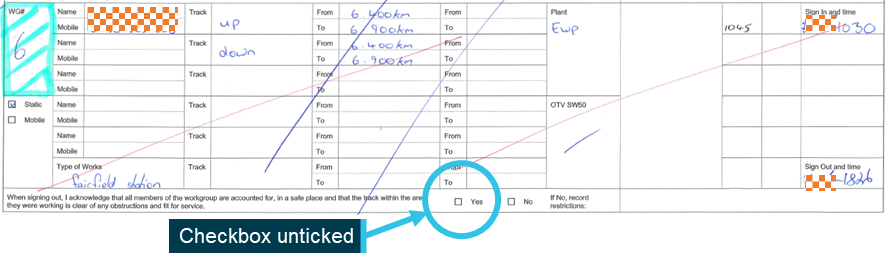
From about 1730, construction at Fairfield station began to close down for the day with workers locking off from the local lock box and departing the site. At about 1745, the work group was clear of both the suburban and dual gauge lines with the local lock boxes free of padlocks. The workgroup supervisor remained at Fairfield station to finalise the day. At about 1815, the workgroup supervisor left Fairfield station and drove to the Yeerongpilly depot, and at 1826 they signed out from permit E on the up and down suburban line leaving the checkbox (declaring the track was clear) unticked, see Figure 1.
Figure 1: Sign in and out permit E from the suburban line
Source: Queensland Rail, annotated by the ATSB
Immediately following, the workgroup supervisor signed out from TA2 (Figure 2) at 1828 and ticked the checkbox denoting:
When signing out, I acknowledge that all members of the workgroup are accounted for, in a safe place and that the track within the area they were working is clear of any obstructions and fit for service.
The possession protection officer recalled that they had confirmed twice with the workgroup supervisor that the track was clear. The workgroup supervisor then left the depot and completed their shift.
Figure 2: Sign in and out of track authority number 2 from the dual gauge
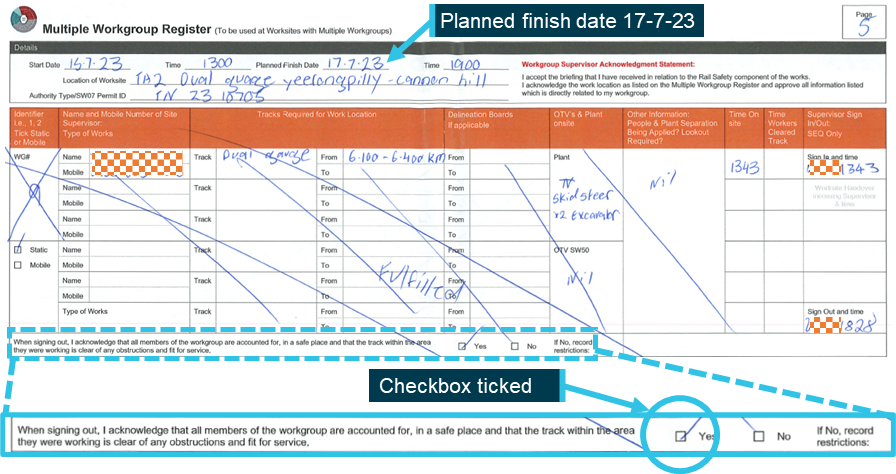
Note: The planned finish date of 17-7-23 was incorrectly shown on the multiple work group register, instead, it should have shown 15‑7‑23. Source: Queensland Rail, annotated by the ATSB
Freight operations
Concurrent to ceasing the daily work at Fairfield, at about 1750, rail traffic crew (one driver) signed on for duty at Fisherman Island to operate Aurizon freight train Y375 from Fisherman Island to Maryborough, Queensland. The train departed Fisherman Island at about 1806. When performing a radio check, the QR NCO informed the rail traffic crew that their train would be held at signal CH7, located at Cannon Hill, until the dual gauge line was opened. The train arrived at signal CH7 at about 1829 and waited for the signal to show a proceed indication.
At about 1936, the stop boards protecting the dual gauge line were removed. At 1939, TA2 protection was removed by network control and at 1941 the dual gauge line opened for rail traffic.
Train Y375 received a green proceed indication from signal CH7 and departed at 1945. It then travelled south towards Fairfield station on the dual gauge line. Train Y375 gradually increased speed to a maximum speed of 51 km/h, then the speed gradually decreased approaching Fairfield station.
Train Y375 approached the station at about 23 km/h, below the posted limit of 60 km/h, with main headlights off (as is usual practice in suburban areas), ditch lights on and the throttle controller set to notch 3.
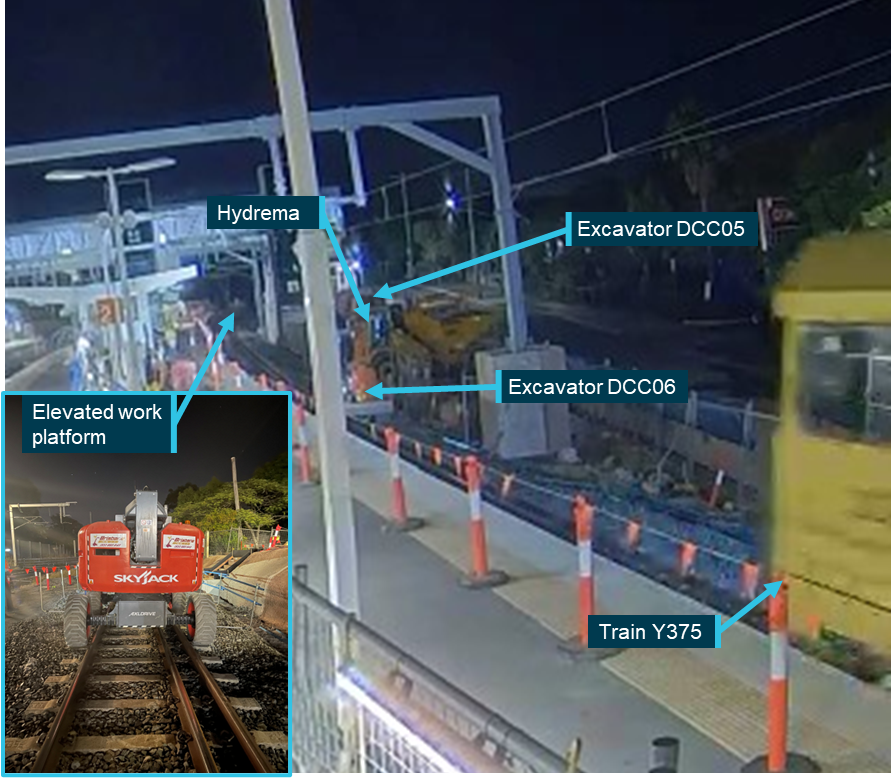
Just prior to Fairfield platform, the driver noticed a dark shadow on the track ahead. At 2001:53, the driver switched on the main headlight, applied the brakes, throttle controller to idle, and sounded the train horn. The train was travelling at about 20 km/h when at 2002:00 it collided with an excavator (DCC006) on the dual gauge line (Figure 3). The train had initially impacted the excavator blade, with the boom arm facing the other direction.
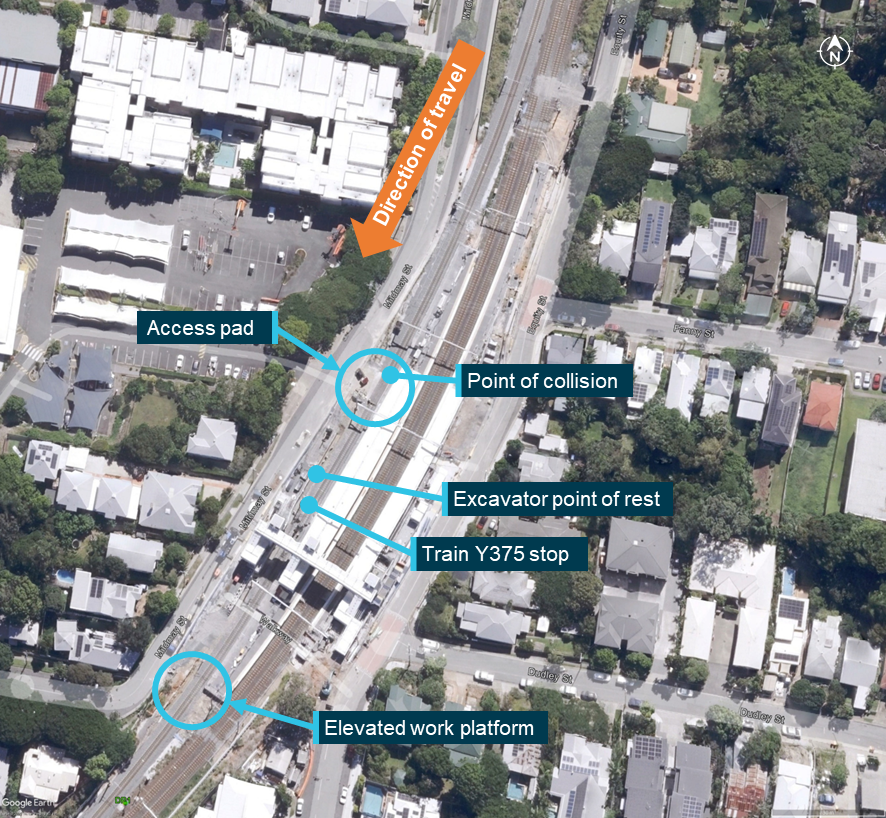
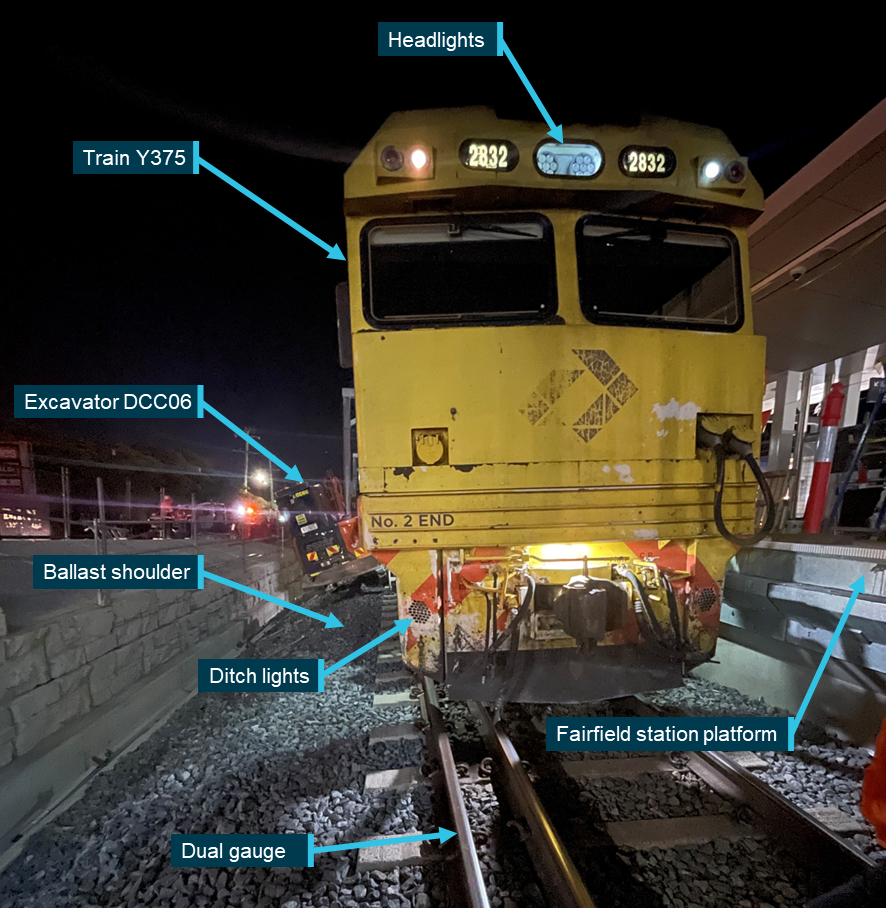
The impacted excavator was pushed into adjacent machinery that was parked on an adjacent vehicle access pad located between the dual gauge line and corridor boundary fence. The excavator impacted a Hydrema dump truck and another excavator (DCC05), then was pushed alongside the track by the passage of the train, before coming to rest between a retaining wall and the leading locomotive. The train stopped at 2002:16, about 55 m from the initial collision point (Figure 4 and Figure 5). No workers were on the machinery or track at the time of the collision, and the driver was uninjured.
At 2002:21, the driver of train Y375 transmitted ‘emergency emergency emergency’ over the train radio. The NCO responded to the driver and confirmed details of the collision, occupancy of the excavator, and location. In a following communication with the NCO, at 2005:38, the driver advised that another item (elevated work platform) was on the track ahead of the train (Figure 3).
Figure 3: Fairfield station closed circuit television footage at 2001:56 showing train Y375 just prior to it impacting the construction equipment
Source: Queensland Rail, annotated by the ATSB
Figure 4: Collision site at Fairfield station
Source: Google Earth, annotated by the ATSB
After the incident, the damaged machinery was cleared and about 0730 the following day, train Y375 departed the site following minor repairs. The dual gauge line was again closed at about 1110 through a track authority for continuation of the construction work at Fairfield station.
Site information
Fairfield station has platforms for the up and down suburban line and a platform for the dual gauge line. The 5 t excavator (DCC06) that was parked on the dual gauge line was pushed about 15 m by the leading locomotive, in the process colliding with a 10 t articulated rear dump truck that was parked on the vehicle access pad. Alongside the dump truck on the pad, was a Hitachi 5 t excavator (DCC05), which was also impacted.
Excavator DCC06 came to rest on the ballast shoulder between the locomotive and a retaining wall, spun around 180° from the original position. Train Y375 stopped about 5 m further from excavator DCC06 (Figure 5), but short of another item of machinery, a mobile elevated work platform Skyjack SJ60AJ+, parked on the track at the end of the station platform. The locomotive front cowling contacted the excavator blade in the first instance.
Figure 5: Train Y375 following the impact at Fairfield station
Source: Queensland Rail, annotated by the ATSB
The work at Fairfield station
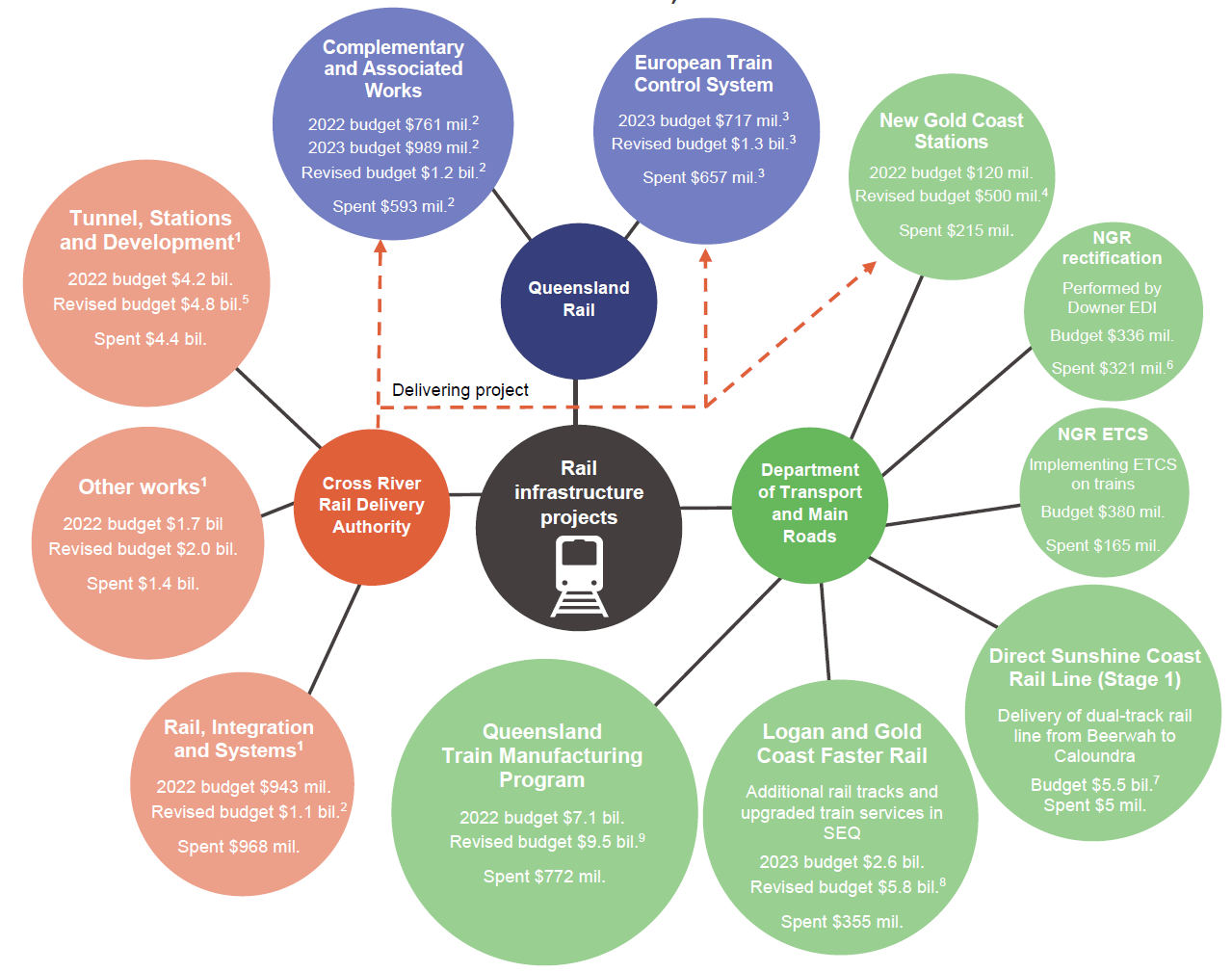
The construction work at Fairfield station was part of the Cross River Rail project. The Cross River Rail project was being delivered through 3 major works packages:
- The Rail, Integration and Systems (RIS) package – delivered by UNITY.
- The Tunnel, Stations and Development package – delivered by PULSE.
- The European Train Control System package – delivered by Sequence Alliance.
The work at Fairfield station was being delivered through the RIS package. The client for that package was the Cross River Rail Delivery Authority. The RIS package alliance consisted of non‑owner construction participants operating as the UNITY comprising 4 non‑owner participants:
- CPB Contractors
- UGL Engineering
- AECOM Australia
- Jacobs Group (Australia).
The participants had entered into a project agreement with QR and the Cross River Rail Delivery Authority (acting as owners on behalf of the State of Queensland). UNITY was contracted to deliver the RIS package, which is depicted in Figure 6.
Figure 6: Major rail and associated infrastructure projects
Source: Queensland Audit Office, Audit Brief 20 January 2025, Major Projects 2024, Report 9: 2024-25, Figure 4B Major rail and associated infrastructure projects (estimated expenditure as of 30 June 2024), page 24
Proactive safety actions
CPB Contractors
Following a post‑incident investigation, CPB Contractors made the following recommendations:
- UNITY to develop an agreed track clearance process that requires secondary evidence to confirm that a site walk has occurred as required, and that this has been verified by a second UNITY worker or QR personnel. As part of this process, an inspection checklist and associated guidance document will be developed and implemented. Checklist to be completed by the worksite supervisors prior to any track being handed back to the QR protection officer.
- UNITY should impose a clear requirement that UNITY construction supervisors clear track of all plant and equipment at the conclusion of the shift and this should be recorded by UNITY with photographic evidence that the track is clear.
- Senior management provision of guidelines on the priorities of attending the T-1 meetings[4] and familiarity with the content of the UNITY possession summary document prior to SCAS occurring and additional guidance on the use of the track protection and access board. The provision of resources as needed to achieve those goals.
- UNITY to develop a process for accountability for personnel attendance requirements in T-1 meetings and providing required information to those who do not attend.
- Pending agreement by QR to a new safety supervisor process, as an interim measure UNITY’s construction supervisor to be accompanied by either the UNITY superintendent or QR supervisor during physical inspection of track before confirming to protection officer that all workers have been accounted for, are clear of the worksite and the line is clear and fit for use.
- QR subject matter expert to provide UNITY supervisors with additional training beyond mandatory training that clarifies the roles and responsibilities of the possession protection officer, protection officer and worksite supervisors when working in the danger zone under the worksite protection, as a means of increasing competency and understanding of those supervisors particularly while performing roles under MD‑14‑166.[5]
Queensland Rail
Following the collision, QR initiated several safety actions, including:
- QR and UNITY stopped work on sites until all works could be confirmed safe.
- A meeting was held between the group executive, Major Projects Integration, the program director of UNITY and head of south‑east Queensland to confirm an action plan to ensure track access safety.
- Reviewing the UNITY investigation report and proposed corrective actions to determine suitability against QR’s requirements as the rail infrastructure manager.
- Schedule and complete a 2nd line compliance and assurance activity to review the implementation of identified UNITY corrective actions.
- QR and UNITY to facilitate appropriate change management regarding any changes to established ways of working to ensure QR is satisfied with the proposed changes.
- Reviewing the existing network pre‑start briefing (documented in MD‑15‑43) requirements throughout the safety and environment management system to implement consistent requirements for the application and acknowledgment of the network pre‑start briefing.
- Reviewing existing requirements regarding rail safety responsibilities of workgroup supervisor/worksite supervisors/person in charge of the workgroup and consider the development of role specific training/qualification requirements.
- Developing rail safety/safeworking assurance program/tools in consultation with relevant business areas to monitor and report compliance with QR’s safety management system requirements.
- Reviewing the multiple workgroup register form increasing the prominence of the sign off declaration.
- Reinforcing the CPB Contractors track clearance process.
Reasons for the discontinuation
The ATSB strives to use its limited resources for maximum safety benefit, and considers that in this case, based on a review of the available evidence, it was unlikely that further investigation would identify any systemic safety issues or important safety lessons. Consequently, the ATSB has discontinued this investigation. The subsequent proactive safety actions undertaken by the involved parties have been published for the interests of transport safety.
The evidence collected during this investigation remains available to be used in future investigations or safety studies. The ATSB will also monitor for any similar occurrences that may indicate a need to undertake a further safety investigation.
[1] An SCAS is a system that is utilised to plan and execute all scheduled shutdowns to below rail and facility assets with the south‑east QR corridors. Following detailed development, a finalised SCAS work pack is issued to stakeholders.
[2] Track that is constructed with a mixture of both standard gauge (1,435 mm) and narrow gauge (1,067 mm) widths utilising a common rail.
[3] Network lockout processes involve each worker personally locking onto a lockbox. This isolation control is designed to prevent the unintentional release of track protection, while workers are still on track.
[4] T-minus countdown meetings were used by UNITY/CPB to plan and consolidate planned SCAS works within a defined safe working boundary. The T‑1 meeting was the final meeting before the planned work.
[5] MD-14-166 Managing multiple workgroups instruction.
Occurrence summary
| Investigation number | RO-2023-007 |
|---|---|
| Occurrence date | 15/07/2023 |
| Location | Fairfield Station |
| State | Queensland |
| Report release date | 11/09/2025 |
| Report status | Discontinued |
| Investigation level | Short |
| Investigation type | Occurrence Investigation |
| Investigation status | Discontinued |
| Mode of transport | Rail |
| Rail occurrence category | Collision |
| Occurrence class | Serious Incident |
| Highest injury level | None |
Train details
| Train operator | Aurizon |
|---|---|
| Train number | Y375 |
| Rail vehicle sector | Freight |
| Departure point | Fisherman’s Island, Queensland |
| Destination | Rockhampton, Queensland |
| Train damage | Minor |