

Final report
Report release date: 03/11/2025
Investigation summary
What happened
On the morning of 30 August 2024, the Maersk Shekou was navigated into Fremantle Port by 2 pilots. As the ship was inbound, it experienced strong winds including a south‑westerly squall of about 50 knots in the inner harbour entry channel.
As the ship passed the wheel over point for the inner harbour, it did not turn. Instead, the ship travelled in the direction of Victoria Quay, where it subsequently collided with the STS Leeuwin II and the wharf edge.
While the Maersk Shekou sustained minor damage in the accident, the STS Leeuwin II sustained substantial damage and 2 of its crew sustained minor injuries.
What the ATSB found
The ATSB found that as the Maersk Shekou was approaching the charted wheel over point at South Mole, the pilot did not provide the helmsman with a course alteration instruction. While the pilot used a combination of the 4 available tugs and the ship's main engine to turn the ship, the helmsman’s attempts to maintain the ship on the previously instructed heading prevented the turn into the inner harbour.
It was also identified that monitoring required of the entire bridge team was inadequately implemented, with improper oversight maintained during the pilotage. Further, the secondary (monitoring) pilot was occupied in non-essential phone activity at the critical stage of the passage.
Finally, the ATSB found that several risk controls established by Fremantle Ports for the safe operation of ships had not been adequately implemented.
What has been done as a result
As a result of this occurrence, Fremantle Ports has taken the following action:
- Updated its procedures to clarify the daylight entry requirements for large container vessels (LCVs) ‘turning on arrival’ manoeuvres into port. In addition, it is in the process of conducting validation trials for nighttime ‘turning on arrival’ manoeuvres, following the installation of an additional aid to navigation and simulation training of the pilots.
- At the time of writing, it is in the process of implementing a passage monitoring and auditing software to assist with identification of non-compliances.
- The secondary pilot’s role during a 2-pilot operation shall be reiterated through a Harbour Master's Instruction (HMI), after consultation with Fremantle Pilots.
- Updated its procedures relating to the usage, attachment and release of tugs.
- Implemented several improvements to weather monitoring, such as:
- the inclusion of squall alerts from Fremantle Ports’ weather service provider
- proposed installation of additional wind monitoring equipment in port waters to improve decision-making capability
- Focused training of vessel traffic service operators, in relation to monitoring and ‘challenge and response’ activity.
In addition, Fremantle Pilots has taken the following proactive safety action:
- LCV in/outbound procedures have been updated to include the fourth tug to align with LCV overview procedure
- LCV procedures were reiterated to the pilot group (highlighting use of mobile phones, wheel over point, speed management, tug placement, daylight definition)
- Fremantle Pilots has also worked with the Fremantle Ports harbour master to implement a revised HMI for mobile phone usage during towage and pilotage
- utilised the Maersk Shekou event during emergency simulations conducted in October 2024
- added the Maersk Shekou event to emergency simulation exercise matrix for all pilots
- worked with Fremantle Ports to revise the definition of daylight
- the tug rendezvous point for all 3 and 4-tug inner harbour inbound jobs (includes all LCVs) was revised and amended to a position adjacent to Gage Roads N4 anchorage (in collaboration with Svitzer and Fremantle Ports).
Safety message
A properly functioning bridge team requires that all its members maintain a shared mental model to actively monitor the ship’s progress. To ensure this is effective, where deviations from the passage plan are required, this information should be conveyed to all members of the team. Similarly, actions that are incorrect or missed should be immediately identified, communicated and rectified.
Distractions on the bridge should be minimised, especially during critical stages of a passage. Several maritime accident investigations, both in Australia and overseas, have highlighted the use of mobile phones during critical phases of the passage as possible contributing factors. In 2020, the Australian Maritime Safety Authority released an advisory notice to say pilots should have their phones turned off or in silent mode when conducting a pilotage. This will minimise the potential distraction for the bridge team and the pilot.
Further, due regard should be given to the risk controls that ensure safe port operations. The dynamic nature of marine operations often results in actual conditions varying from those expected. It is essential that any associated risks and consequences, particularly those affecting pre-defined limits, are carefully reassessed and communicated between all concerned parties so that safety is not compromised.
The occurrence
Background
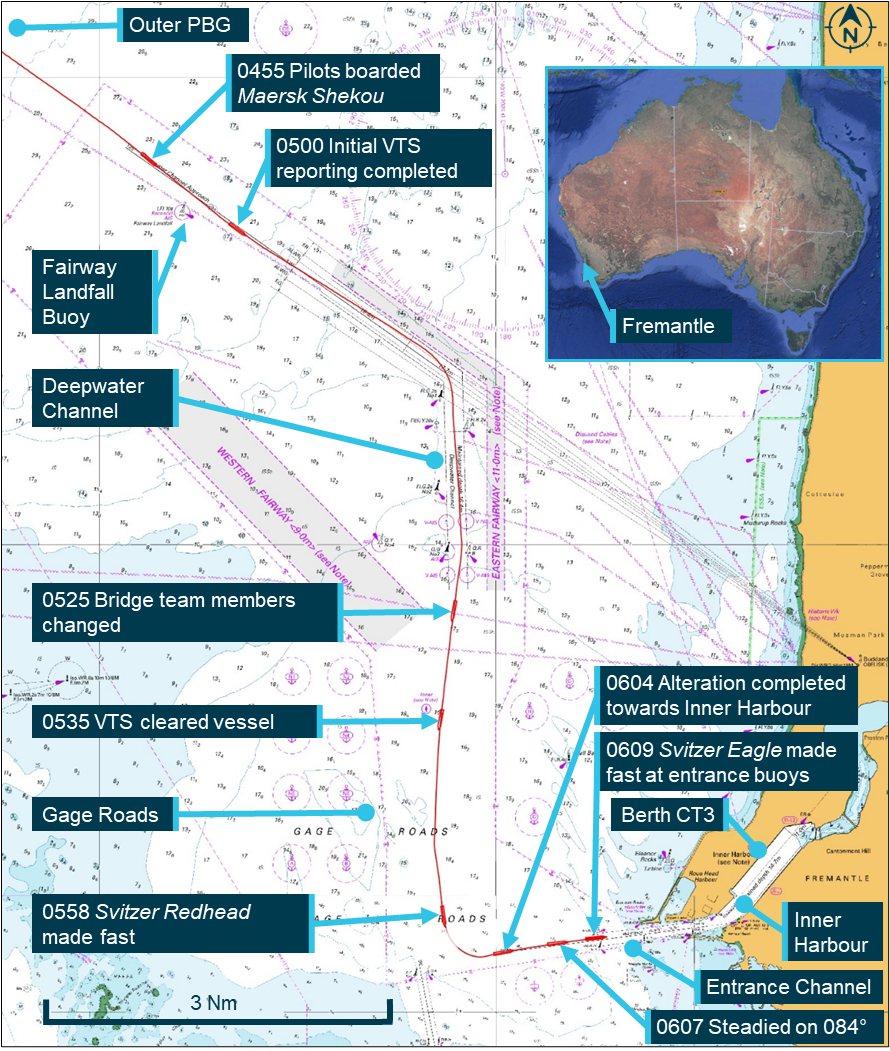
At 1100 local time on 22 August 2024, container ship Maersk Shekou arrived off the Port of Fremantle, Western Australia following a voyage from Adelaide, South Australia, and commenced drifting off the coast while awaiting entry into the port. The ship was loaded with 4,164 containers and was intending to proceed to berth CT3 (Figure 1).
The previous day, the Fremantle harbour master advised Maersk Shekou’s master (via the ship’s agent) that, due to industrial action taking place in the port, the ship’s scheduled 22 August berthing time had been postponed to 25 August.
Thereafter, Fremantle Port was evacuated of all vessel traffic due to unfavourable weather conditions, and Maersk Shekou’s pilot boarding time was rescheduled to 0700 on 30 August as per the harbour master’s instructions. At the request of the terminal operations manager, Maersk Shekou’s pilot boarding time was revised to 0500 on 30 August, so that the ship could be alongside by 0700.
At 0300 on 30 August, the second mate, who was the officer of the watch (OOW) recorded commencing navigational checks, and operation of the steering gear as per SOLAS regulations.[1] At 0321, the OOW engaged the engines, and the Maersk Shekou commenced slowly making its way towards the outer pilot boarding ground.
By 0333, the wind speed had increased, with speeds recorded on the ship’s anemometer[2] of about 30 knots. At 0345, the Maersk Shekou’s crew had unlashed both anchors in preparation for the inbound passage and at 0400, the second mate gave the ship’s master and duty engineer one hour’s notice for pilot boarding. At around the same time, the third mate[3] relieved the second mate on the bridge.
The master arrived on the bridge and at 0436, took over conduct (con) of the ship from the third mate. The ship continued to encounter wind speeds above 20 knots, with occasional gusts up to 25 knots. At 0455, 2 harbour pilots boarded the Maersk Shekou in the vicinity of the outer pilot boarding ground while it was making good about 11.6 knots. Both pilots made their way to the bridge where they met the master and others from the ship’s bridge team.
The primary pilot (pilot) immediately commenced the master-pilot exchange of information (MPX)[4] with the master for the intended pilotage transit.[5] The pilot briefed the master that they had 4 tugs available, and intended on making them fast, one on each shoulder, and one at each quarter.[6] The pilot informed the master they would keep the ship’s speed unchanged at about 11.6 knots,[7] transit the deepwater channel (DWC)[8] and wait at the harbour entrance, to maintain an estimated time of arrival (ETA) of 0600 for daylight arrival into the port.
Figure 1: Section of navigational chart Aus112 showing Maersk Shekou's inbound track
Source: Australian Hydrographic Office, annotated by the ATSB
At 0500, the pilot made VHF radio contact with Fremantle vessel traffic service (VTS)[9] and advised the vessel traffic services operator (VTSO) that Maersk Shekou had just passed the Fairway Landfall buoy (Figure 1). The VTSO acknowledged the pilot’s message and confirmed that the route for the ship into the port via the DWC was clear. During this time, the second (secondary) pilot set up their portable pilot unit (PPU)[10] aerials on the bridge wing.
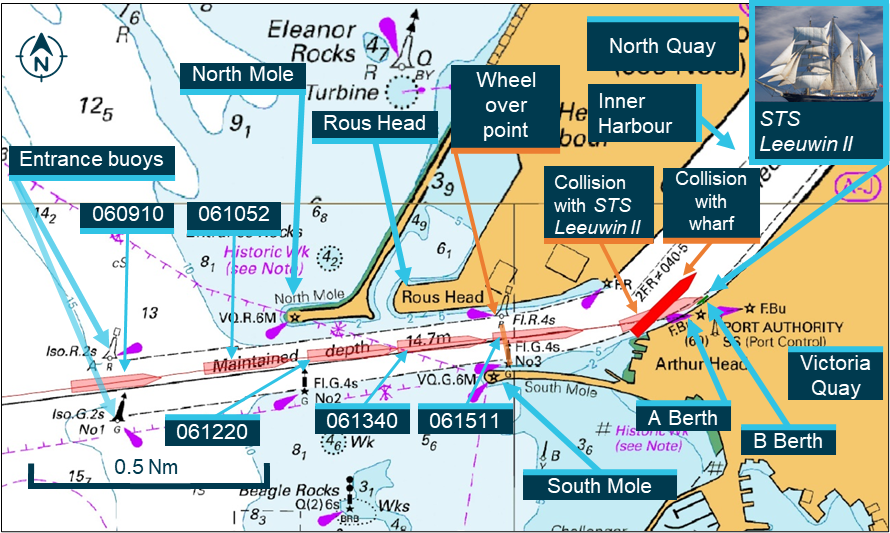
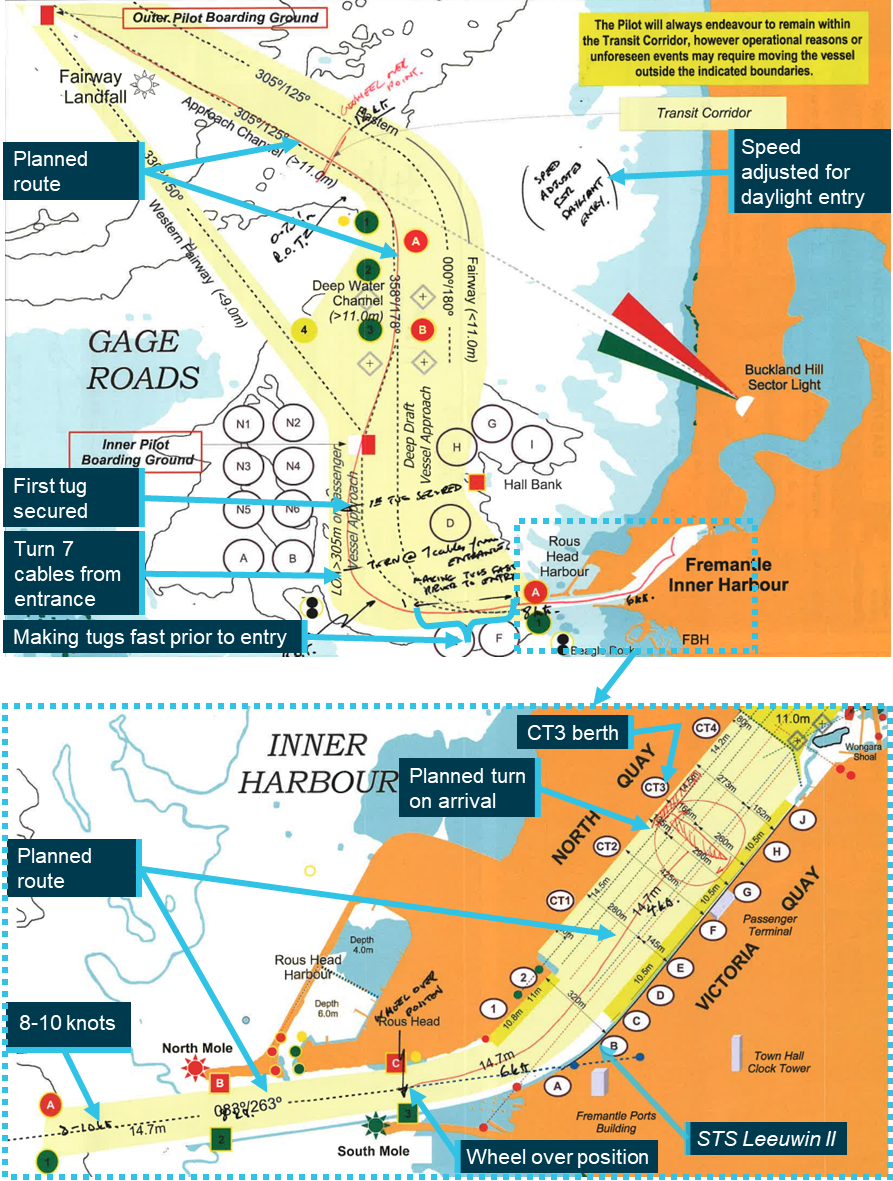
The pilot and master continued discussing pertinent information provided on Fremantle Pilots’ MPX form (Figure 8). This included the route to be followed and an inner harbour manoeuvre involving a 180° turn, so that the ship could be berthed heading outwards with starboard side alongside at berth CT3 (Figure 9).[11] In the pilotage passage plan, the wheel over point[12] for the turn into the inner harbour entrance channel (IHEC) was marked abeam[13] buoys No 3 and C, near South Mole (Figure 2).
During the exchange, the pilot informed the master that a 20–25 knot westerly breeze had been forecast throughout the day, the tide was flooding, with high water expected at 0706.
The ship continued its inbound transit with the bridge team comprising the 2 pilots, master, third mate, and an ordinary seafarer at the helm. The third mate was relieved by the chief mate at about 0525, and the helmsman was also relieved by an able seafarer a few minutes later. During the transit, the pilots engaged in various social and work‑related discussions, including different aspects of the pilotage. The ship’s bridge team was also engaged in separate conversations in a non-English language.
During the inbound transit through the DWC, the Maersk Shekou experienced sustained strong winds, and the master later advised it was cloudy with passing rain showers and squalls. By 0518, while on a southerly heading, the relative wind gusts peaked at 54 knots from about 4 points[14] on the starboard bow.
At about 0535, while passing Hall Bank beacon, the pilot contacted Fremantle VTS advising they were proceeding very slowly and awaiting daylight to enter the port. The VTSO confirmed the ship was clear to proceed into the Inner Harbour on that basis. The wind speed had abated slightly but remained in the vicinity of 25–30 knots.
Between 0531 and 0543, the pilot contacted the masters of the 4 tugs and advised them of their intended placement around the Maersk Shekou. At 0558, the escort tug,[15]Svitzer Redhead was made fast on the port quarter. Continuing on a southerly heading at approximately 6.8 knots with its main engine on slow ahead, the ship was experiencing relative wind speeds of about 30–35 knots from approximately 5 points on the starboard bow. The pilot then ordered an increase to half ahead on the engine and port helm to facilitate a course alteration through an approximately 96° port turn to line up with the inner harbour entrance channel.
At 0604, on completing the turn, the wind speed had decreased to below 20 knots. Maersk Shekou was proceeding at 9.4 knots and slow ahead was ordered on the main engine. At 0607, the pilot instructed the helmsman to steady the ship on a heading of 084°.[16] About a minute later, the ship’s speed had increased to 9.9 knots and the pilot ordered dead slow ahead on the main engine.
Inner harbour entrance channel transit
At 0609, as the ship passed the IHEC entrance buoys, A and No 1,the Svitzer Eagle tug was made fast on the starboard quarter (Figure 2). Between helm and engine orders, the pilots continued to engage in various marine and social discussions. About a minute later, the Svitzer Emma tug was secured at the Maersk Shekou’s port shoulder. At this stage, the ship’sspeed had reduced to 9.3 knots.
At 0610:52, the ship was heading 084°, with its bow approximately abeam North Mole. The pilot ordered 085° which was immediately acknowledged and actioned by the helmsman. As the ship proceeded along the IHEC, the south-westerly winds increased and, by 0612:05, the relative wind speed had increased to upwards of 30 knots from the starboard quarter. At about that time, as the Maersk Shekou was at 8.6 knots with its bow in line with Rous Head, the pilot ordered both stern tugs to pull back at quarter power to reduce the ship’s speed.
At about 0611, the secondary pilot stood at the rear of the wheelhouse, behind the helmsman, and made a telephone call to the duty pilot (see the section titled Fremantle Pilots).
Figure 2: Maersk Shekou key times of port entry
Source: Australian Hydrographic Office, annotated by the ATSB
At around 0612:36, the ship developed a slight starboard rate of turn. To maintain the 085° heading ordered by the pilot, the helmsman put the helm[17] over to port 25° and then port 30°. The wind speed was steadily increasing and by 0612:50, the ship was encountering a persistent relative wind speed of 40 knots on the starboard quarter. Despite the port 30° helm, the ship continued to swing slowly to starboard and was heading approximately 086°.
At 0613:26, the ship’s speed had slowed to about 8.0 knots, and the pilot ordered the tug Svitzer Redhead (already pulling back at quarter power) to increase engine speed to half power. At 0613:40, as the Maersk Shekou’s bow was abeam South Mole, the pilot ordered the helmsman to steer 083°. The helmsman apparently did not hear the order completely and responded by saying ‘08…’. The pilot immediately repeated the 083° order, which was then correctly acknowledged by the helmsman without delay at 0613:45.
Around that time, the tug Svitzer Falcon was made fast at the Maersk Shekou’s starboard shoulder, with the tug master advising the pilot they were standing by to slow the ship. In the following 15 seconds, several verbal exchanges of information occurred between the ship’s crew on forward stations and the bridge team on UHF radio, between the pilot and Svitzer Falcon’s tug master on VHF radio, and between the master and pilot (in person on the bridge). Shortly after, at 0614:10, the pilot instructed the Svitzer Eagle to stop pulling back. Despite the helm being maintained nearly at hard port, the ship was heading almost 087°, making good 7.5 knots, with a 1°/min rate of turn to starboard.
As the primary pilot was conning the ship from the front of the wheelhouse, the secondary pilot, stationed at the rear, continued to be engaged in their phone call. At 0614:24, the pilot instructed Svitzer Emma on the port shoulder to pull back with half power. The helmsman then reported aloud that the wheel was on hard port, but the ship was swinging to starboard. The master immediately reiterated this to the pilot and suggested increasing the engine to full ahead[18] to facilitate a quicker turn. The pilot agreed and at 0614:34, the master ordered full ahead on the main engine.
At 0614:40, the pilot ordered Svitzer Eagle to ‘come out square, standby to lift off[19] on the starboard quarter’ and a few seconds later, the master of Svitzer Eagle confirmed that it was square on the starboard quarter. With the helmsman continuing to maintain the helm nearly at hard port, the ship’s bow started slowing swinging to port. It was around this time that the ship crossed the wheel over point marked on the MPX passage plan.
At 0614:56, the pilot then stated on the VHF radio ‘we need to take the stern to starboard please’. The Svitzer Eagle’s skipper later advised that, based on their assessment, they were unable to assist in the direct towing mode and altered to indirect towage[20] to generate more force with the manoeuvre.
The engine RPM was steadily increasing to full ahead and by 0615:03, it had increased to 68 RPM. At 0615:10, the master advised the pilot that the (relative) wind speed had increased to 45 knots, which the pilot acknowledged.
By 0615:11, the ship was making good 7.1 knots and continued to swing to port, achieving a maximum rate of turn of 9°/min. However, as the heading came around to 086°, the helmsman brought the helm to midship[21] and then to starboard 33° for a brief period before returning it to midship. The helmsman’s actions resulted in the ship’s port swing being arrested, and the ship being steadied on a heading of approximately 083°, into the path of Aand B berths at Victoria Quay.
With neither pilot nor the ship’s bridge team observing the actions of the helmsman, the primary pilot informed the secondary pilot that they were in trouble, resulting in the latter then concluding their phone call at 0615:33. The secondary pilot questioned, ‘not turning?’, but did not receive any verbal response from the primary pilot.
As it became apparent that the Maersk Shekou was headed towards Victoria Quay, both pilots then coordinated their efforts in directing the tugs to assist with the ship’s port turn. The primary pilot continued to communicate with the tugs, with the secondary pilot providing advice. The pilot instructed Svitzer Emma on the port shoulder to ‘come out square, lift off as much as you can’.
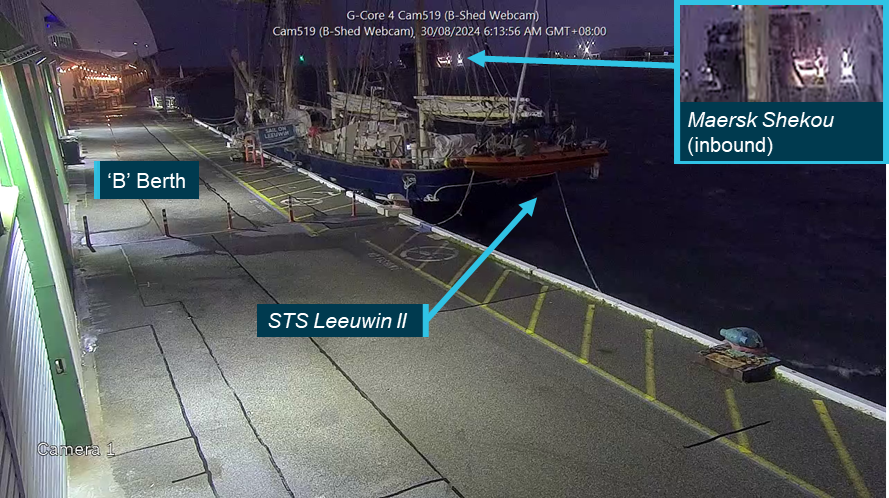
At 0615:47, the Maersk Shekou’s engine achieved its full ahead potential of 76 RPM, and the helmsman maintained the rudder in the midship position. The ship was proceeding at 7.2 knots on a steady 083.5° heading, into the path of STS Leeuwin II, which was less than a ship’s length away, and moored port side alongside B berth at Victoria Quay (Figure 3).
Figure 3: CCTV footage of STS Leeuwin II at its mooring with Maersk Shekou inbound
Source: Fremantle Port Authority, annotated by the ATSB
In a continued effort to maintain a steady heading of 083°, the helmsman turned the helm briefly to port 20° for about 6 seconds, before returning it to midship. It then started to rain heavily.
Noting that collision was imminent, and as the primary pilot was engaged in controlling and communicating with the 4 tugs, the secondary pilot rendered assistance by taking control of the ship’s engines, thrusters and anchors to stop the ship as quickly as possible. While an official handover of the con did not occur between the pilots, the primary pilot later reported that the situation was beyond the control of a single pilot, and confirmed that the secondary pilot was aware of their intentions and provided adequate support by controlling the ship’s equipment. The secondary pilot later confirmed that their role was to support the primary pilot and so they were concentrating on providing assistance as required.
At 0615:54, on the secondary pilot’s orders, the master put the bow thrusters full power to port and at 0616:05, the Svitzer Falcon tug pushed with full power on the starboard shoulder following the pilot’s instructions. Five seconds later, the secondary pilot ordered stop engines and 5 seconds after that, full astern. The master instructed the crew at forward stations to standby to release the port anchor.
With the Maersk Shekou proceeding at 7.0 knots and bow thrusters at full power to port, the ship was heading 082° and commenced swinging to port at a rate of approximately 5°/min.
At 0616:21, the helmsman gave further starboard helm of 12–20° for about 10 seconds, followed by starboard 24–29° for 46 seconds before returning the wheel to the midship position. At 0616:49, the ship achieved its full astern potential of 76 RPM and its speed had reduced to 5.7 knots.
At 0616:54, the secondary pilot ordered the port anchor to be released, and the master immediately conveyed this instruction to the crew at forward stations. On instruction from the secondary pilot, the bridge team then sounded a long blast on the ship’s whistle to caution any crewmembers onboard STS Leeuwin II of an impending collision.
The relative wind speed recorded on the Maersk Shekou’s anemometer remained at approximately 40–45 knots from the starboard quarter with heavy, driving rain. At 0617:29, the tug master of Svitzer Falcon informed the pilot that they needed to abandon position due to the danger of being crushed between Victoria Quay and the closing in hull of the Maersk Shekou. The crew of the Svitzer Falcon readied the gangway in case it was required for their emergency evacuation onto the wharf, but the tug was manoeuvred clear in time and the crew remained on board.
At 0617:33, on the secondary pilot's suggestion, the lead pilot instructed Svitzer Eagle to push on the starboard quarter. This command was not acknowledged by the tug, however, a few seconds later, the pilot instructed Svitzer Eagle to pull back with full power, which was then duly acknowledged. The Maersk Shekou still had headway with a ground speed of just over 3 knots and decreasing.
The collision
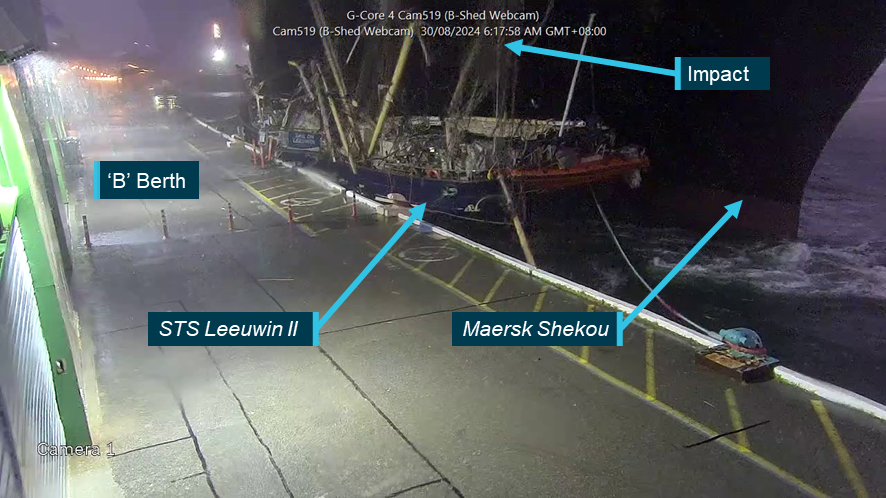
Due to the action of the tugs and bow thrusters, the Maersk Shekou continued to maintain a port swing of about 10°/min, away from the direct path of the STS Leeuwin II. However, Maersk Shekou did notmake a clear turn, and moments later, its starboard bow flare collided with the STS Leeuwin II, dismasting the latter (Figure 4). Two crew members, on board the tall ship at the time, escaped via its gangway just as the collision occurred.
Figure 4: CCTV footage showing collision between Maersk Shekou and STS Leeuwin II
Source: Fremantle Port Authority, annotated by the ATSB
Maersk Shekou’s bow kept swinging to port and in the seconds after the collision, its port anchor was dropped. Unable to visually sight the STS Leeuwin II and ascertain the safety of its crew, either the secondary pilot or the Maersk Shekou’s master sounded another long blast.
By 0618:35, the Maersk Shekou had lost almost all speed, however, its bow was still swinging to port at about 7°/min, and its stern moving to starboard in the direction of the WA Maritime Museum located at the western edge of Victoria Quay. To push the ship’s stern away from the wharf, the pilot instructed Svitzer Falcon to push on the Maersk Shekou wherever it was possible and at 0618:45, ordered the master to stop engines.
At 0619:01, the pilot instructed Svitzer Redhead on the port quarter to lift off with full power and a few seconds later, ordered Svitzer Emma to stop pulling back on the port shoulder. With the Maersk Shekou swinging to port at about 13°/min, the pilot ordered the helm hard to starboard and then dead slow ahead at 0619:23. The pilot again requested Svitzer Eagle to push on the starboard quarter, but the tug master advised they were unable to comply due to limited access between the ship’s hull and the wharf. Instead, it assisted by pulling astern with full power.
The primary pilot remained in the wheelhouse while the secondary pilot moved between the wheelhouse and starboard bridge wing, checking the tugs’ positions and overside clearances. At 0619:30, the pilot ordered slow ahead and, subsequently, ordered the wheel hard to starboard. Twenty seconds later, half ahead was ordered. The Maersk Shekou’s bow kept swinging to port at about 12°/min, with its stern closing in to the edge of the wharf. As the ship continued to come around to a north-easterly heading, it experienced 20–40 knot winds from astern.
At 0619:52, the master alerted the pilots that the bow thrusters were still running with full power to port. The secondary pilot immediately instructed the master to stop the thrusters to keep the stern away from the wharf. By 0620:04, the thrusters had stopped, and the rate of turn had decreased rapidly to about 6°/min. Having been advised by the aft station’s crew that the ship’s stern was about 3 m away from the wharf and closing in, the master suggested going full ahead on the engine, which was agreed to by the pilots.
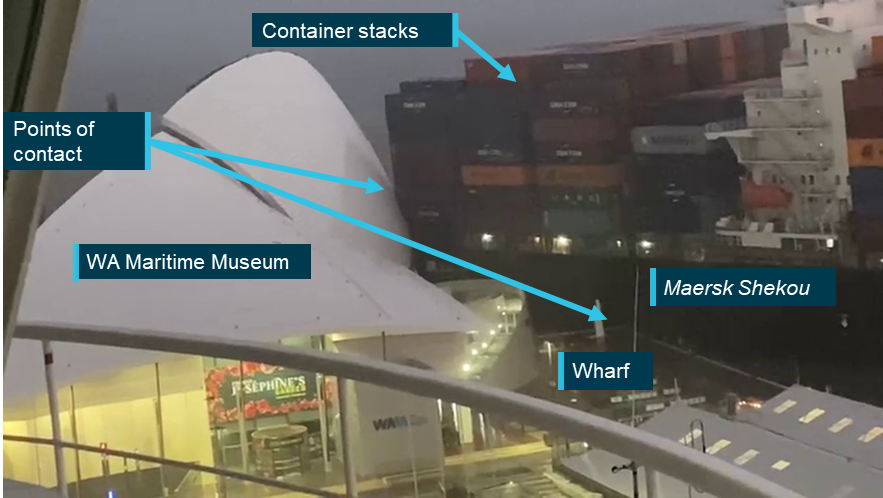
At 0620:09, the helm was brought to midship. The ship’s rate of turn continued to decrease to nearly zero, but its stern continued to drift towards the wharf. At 0620:23, the pilot ordered the bow thrusters to be put full to starboard, however, the outermost stack of containers on the Maersk Shekou’s poop deck collided with the roof of the museum, and the ship’s starboard quarter contacted the wharf (Figure 5).
Figure 5: Footage showing contact of Maersk Shekou with the shore
Source: Fremantle Port Authority, annotated by the ATSB
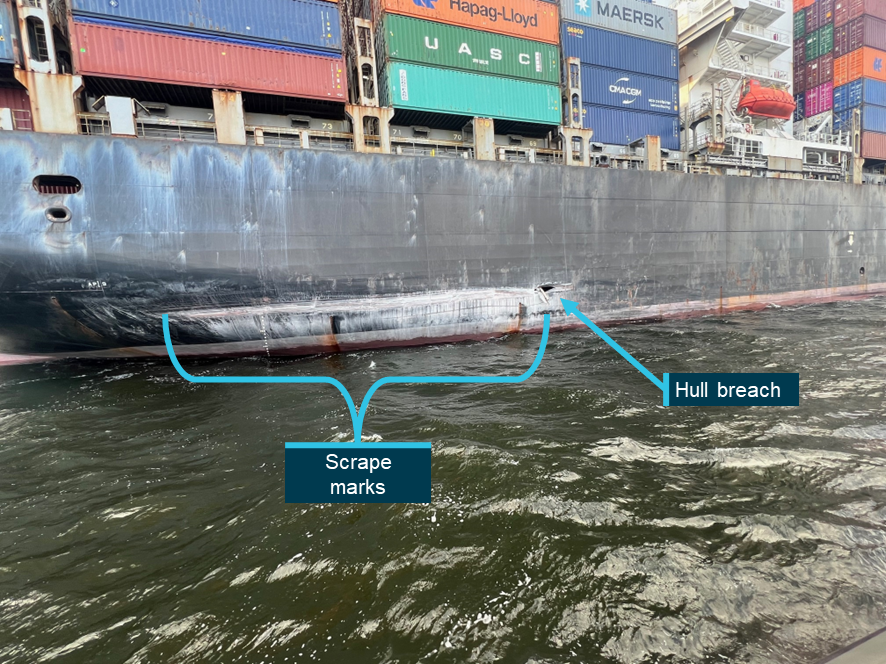
Thereafter, the ship developed a slight forward motion and starboard swing, resulting in the edge of the wharf scraping against and rupturing the ship’s hull by approximately 1.8 m x 0.5 m. The breach was situated above the waterline, and no ingress or egress resulted. Concrete and timber debris from the wharf lodged within the breached section of the hull as the ship pulled away from the wharf (Figure 6).
Figure 6: Contact damage to Maersk Shekou’s hull
Source: Maersk Shekou’s P&I representative, annotated by the ATSB
At 0620:48, the pilot ordered the bow thrusters to be stopped and once the ship’s stern had moved clear of the wharf, stopped the main engine. Subsequently, the pilots utilised the tugs, bow thrusters and the main engine to navigate the Maersk Shekou towards the centre of the channel. The secondary pilot checked on the wellbeing of the primary pilot and offered to take over con if required, however, the primary pilot confirmed they were fine to continue. Meanwhile, the secondary pilot made phone calls to the VTSO and duty pilot to confirm the next course of action. After the integrity of the ship had been assessed and with instructions from the harbour master, the VTSO directed the Maersk Shekou to continue to its intended berth. It was also decided that 2 additional pilots would board the ship to relieve the initial pilots of their duties for the berthing manoeuvre.
At 0631, the Maersk Shekou’s crew commenced retrieving the port anchor following the pilot’s instructions, and the 2 relief pilots boarded the ship at 0713. Following a handover, the initial 2 pilots disembarked at 0810 and the port anchor was fully aweigh at 0812. The ship was then navigated into the inner harbour and safely made fast to its berth by 0930.
The Maersk Shekou sustained minor damage. The STS Leeuwin II sustained substantial damage and 2 of its crew members sustained minor physical injuries during the accident. At the time of writing, major repair works were underway on the STS Leeuwin II.
Context
Maersk Shekou
General details
Maersk Shekou was a 333 m container ship built in 2010 by Daewoo Shipbuilding and Marine Engineering, Korea. It was registered in Singapore and classed with Lloyds Register Asia. At the time of the occurrence, the ship was owned by A.P. Moller Singapore Pte Ltd, managed by V. Ships (Hamburg) GmbH & Co. KG of Germany (V Ships) and operated by Maersk A/S of Denmark.
Maersk Shekou had a moulded breadth of 43.20 m and a depth of 24.50 m. At its summer draught of 14.52 m, the ship had a deadweight of 108,622 t and had a cargo capacity of 8,814 20-foot equivalent (TEU)[22] containers. Upon its arrival at Fremantle, the ship had a maximum declared draft of 13.3 m, and displacement of 141,076 t.
Propulsive power was provided by a single Doosan-MAN B&W 2‑stroke, single‑acting diesel engine that developed 57,100 kW at 104 RPM. The main engine drove a single, right-handed fixed-pitch propeller, which gave the ship a service speed of 24 knots. The ship was also equipped with an electrically‑driven controllable pitch propeller bow thruster producing 3,000 kW.
Crew
Maersk Shekou had a crew of 26 Ukrainian, Lithuanian, Burmese and Romanian nationals. This included 4 mates, with an additional third mate on board to assist in maintaining the rest hour requirements of the Standards of Training, Certification and Watchkeeping for Seafarers (STCW) Code.[23]
The master had 35 years’ experience at sea and held a Ukrainian master mariner’s certificate of competency. They had sailed as master for 22 years and served in command of the Maersk Shekou for the last 12 years on a 3-monthly on-off rotation. During the current rotation, the master had joined the ship 1 month prior to the accident.
The chief mate held a Ukrainian master mariner’s certificate of competency, first obtained in 2021. They had been serving as an officer for 21 years. They had sailed as chief mate on the Maersk Shekou on a rotational basis for the last 12 years and had worked with the master for that time. The chief mate kept the 1600–1800 bridge watch at sea and usually formed part of the bridge team during port arrival and departure manoeuvring. At the time of the accident, the chief mate had been on board for a little over 3 months.
The helmsman at the time of the accident obtained their Burmese certificate of proficiency as an able seafarer in 2022 and had been with the operator for the last 10 years. They had joined Maersk Shekou 3 months before the accident and reported that they had visited the port of Fremantle once before. This was their first contract as an able seafarer.
There was no evidence to indicate that the master, chief mate or helmsman were experiencing a level of fatigue known to have a demonstrated effect on performance.
Safety management system
The ship manager, V Ships, had implemented a safety management system (SMS) in accordance with the International Safety Management (ISM) Code.[24] The SMS contained bridge procedures, including instructions to ensure the safe operation of the ship during pilotage operations, along with emergency procedures.
The documented bridge procedures detailed the roles and responsibilities of the master, the watchkeeping officers, lookouts, and helmsman, with and without a pilot on board. Of relevance to this accident and pilotage in general, the procedures specified the following requirements:
- that the bridge team monitored the pilots’ advice
- in accordance with IMO Resolution A.285 (VIII),[25] the OOW should immediately alert the pilot if the ship’s position was in doubt
- there should be no distractions or non-essential activity on the bridge, such as electronic entertainment equipment or mobile phones
- the master should courteously request the pilot to terminate a mobile phone conversation if it posed a distraction to the passage execution
- only experienced qualified helmsmen were to be employed in restricted waters
- in addition to the helmsman on the bridge, a dedicated lookout was to be posted.
The procedures also stated that the bridge team’s responsibilities included:
- checking and confirming correctness of the pilot’s orders
- monitoring the rate of turn and rudder angle indicator when helm orders were given.
Error management
Within their SMS, the ship manager had provided guidance about ‘error chain’ formation. The guidance cautioned about disruptions in the bridge team following the introduction of a pilot due to a variety of reasons, such as distraction, loss of situational awareness, poor communication, lack of understanding of the pilot’s intentions, among others.
Bridge equipment
Maersk Shekou was fitted with navigational equipment required for a ship of its size under SOLAS. The navigation equipment included 2 electronic chart display and information system (ECDIS), and 2 radars with automatic radar plotting aid (ARPA) and other target tracking functions. Both radars had data inputs from the ship’s automatic identification system (AIS) transceiver, global positioning system (GPS) receiver unit and anemometer. The radars displayed the calculated true wind speed and direction.
In accordance with IMO Resolution A.861(20) and MSC.333(90),[26] the ship was fitted with a voyage data recorder (VDR), from which parametric information and bridge audio recordings were recovered. Pertinent information, including audio transcripts obtained from the VDR, have been included and referenced throughout this report.
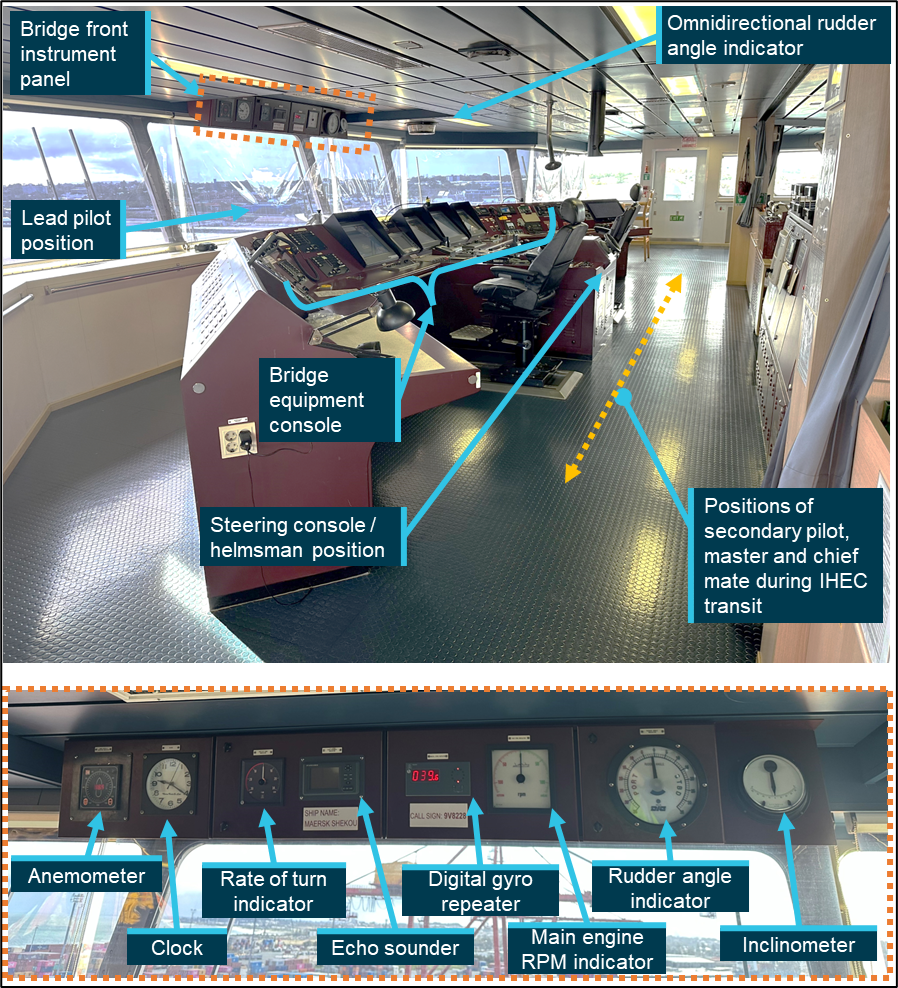
Among other equipment displays, the bridge front instrument panel was fitted with:
- an analogue rudder angle indicator
- a main engine RPM indicator
- a digital gyro repeater
- rate of turn indicator
- an anemometer display.
An omni-directional indicator was also fitted on the wheelhouse deckhead above the manoeuvring console. Based on their reported positioning inside the wheelhouse during the accident transit, the bridge front instrument display panel would have been visible to both pilots and the ship’s bridge team members (Figure 7).
Figure 7: View of Maersk Shekou’s wheelhouse and bridge front indicator panel (inset)
Source: ATSB
There were no equipment defects reported prior to the ship’s arrival in Fremantle on 30 August 2024. On the day of the accident, the second mate recorded that the steering gear was tested at 0300 as part of the pre-arrival checks. On review of the VDR data, there was no evidence of the steering gear being operated at that time. Notwithstanding, no operational deficiencies were identified with the ship’s bridge equipment or steering gear in relation to the accident.
STS Leeuwin II
STS Leeuwin II was Australia’s largest sail-training tall ship. It was a 3-masted 1850’s‑style barquentine[27] built, owned and operated in Western Australia by the Leeuwin Ocean Adventure Foundation Limited (LOAF), a registered Western Australian charity run by staff and volunteers. The ship was launched in 1986. It had a length overall of 55 m, 9 m beam and stood 33 m tall at its main mast. Its hull was constructed from welded steel, with a teak deck and 16 canvas sails.
The tall ship was equipped to accommodate a full complement of 15 crew and 40 trainees. It was typically moored at B Berth in Victoria Quay, Fremantle Port. It arrived at its berth on 25 August 2024 for maintenance and survey works, with its next intended sail on 1 September 2024. As required by LOAF’s Harbour Watchkeeping SMS procedures and the master’s standing orders, 2 crewmembers were residing on board the STS Leeuwin II at the time of accident.
STS Leeuwin II was used to run youth training programs, as part of the Leeuwin Ocean Adventure Foundation. In addition, the tall ship offered sailing tours to members of the public.
Port of Fremantle
Fremantle is the principal commercial port that handled almost all of the container trade for Western Australia and is situated adjacent to the mouth of Swan River. The Port of Fremantle is operated through 2 harbours: the Inner Harbour within the estuary of Swan River, and an Outer Harbour about 22 km to the south at Kwinana, with 3 open roadsteads[28] of Gage Roads, Owen Anchorage and Cockburn Sound.
The Fremantle Port Authority, operating under the name Fremantle Ports, was the port’s strategic manager. The port included a mix of facilities and services managed by Fremantle Ports and private operators. Fremantle Ports provided and maintained shipping channels, navigation aids, port infrastructure and amenities whereas services such as towage, line boats and bunkering were provided by the private sector. Pilotage service was provided by Fremantle Ports through a contract with Fremantle Pilots.
Policies and procedures
Operational parameters
The Fremantle Ports Navigational Policy provided for the establishment of operational parameters for the safe operation of vessels within the Port of Fremantle waters and while alongside. The operational parameters captured the scheduling, pilotage, environmental, towage and berthing requirements of the port. Among other stakeholders, they applied to:
- Fremantle Port Authority Harbour Master Office
- Fremantle Pilots
- Fremantle Ports towage service providers
- Fremantle Ports vessel traffic services (VTS) personnel.
The operational parameters were reviewed annually with Edition 16.0, authorised by the harbour master on 14 March 2024, in force at the time of accident. Between annual reviews, any mandatory directives or important changes were promulgated via Shipping Agent Memos, and Harbour Master’s Instructions (HMI).
The operational parameters addressed towage, weather, daylight manoeuvring, pilotage and other operational considerations for large container vessels (LCV), such as the Maersk Shekou, having a length overall (LOA) greater than 310 m or beam exceeding 43 m.
Pilotage was compulsory within the port limits for vessels with LOA exceeding 35 m, and LCV with length 310 m or greater required a 2-pilot operation.
The operational parameters also set out the requirements in respect of other related aspects of LCV pilotage, such as:
- minimum visibility of 1.0 NM
- weather limits (see the section titled Weather)
- towage (see the section titled Towage).
To ensure safe navigation and pilotage in Fremantle port, it was mandatory that all stakeholders complied with the operational parameters. Harbour master approval was required for any deviation from compliance with these parameters.
Sunrise entry
The operational parameters specified that vessels between 310 m and 347 m LOA being turned around on arrival inside the Inner Harbour, were to be daylight-only manoeuvres. The parameters further specified that during the approach:
Sunrise or sunset is to coincide with the vessel’s position at the entrance [emphasis added] of the Inner Harbour Channel.
The sunrise entry requirement had been in place for about 5 months prior to the accident. Prior to this, the earliest channel entrance timing was civil twilight.[29] On the day of the accident, sunrise was at 0636, and civil twilight was at 0611.
A review of data since the changed requirement identified that prior to the Maersk Shekou’s transit, LCVs were piloted into the entrance channel prior to sunrise on at least 4 occasions. While the earliest ship’s entry was about 10 minutes prior to sunrise, Fremantle Ports was not aware of any violations to the sunrise entry rule. It was also reported that Fremantle VTS did not provide any oversight for the early arrivals.
The secondary pilot reported that as the Maersk Shekou’s pilotage was undertaken in darkness, it limited their visual ability to identify any squall activity. After sunrise, incoming squalls were clearly visible.
Navigation policy
Fremantle Ports and Fremantle Pilots jointly maintained the Navigation Policy Committee, which provided the forum for the discussion, implementation and amendment of the operational parameters. Any amendments were subject to harbour master approval.
The Navigation Policy Committee met quarterly and included representatives of:
- Fremantle Port Authority Harbour Master Office
- Fremantle Pilots
- Fremantle VTS
- towage services providers
- other parties concerned with the navigation, assets and infrastructure at Fremantle Port.
Routine and non-routine operations
Fremantle Ports’ nomenclature deemed vessels and operations that were compliant with the operational parameters as ‘routine’, whereas those that did not were considered ‘non-routine’.
A non-routine operation included a situation where a pilot had boarded a vessel, and defined parameters were exceeded (e.g. wind speed exceeded forecast). In such a case, the following applied:
- If the pilot and master decided it was unsafe to continue the movement, it was to be postponed or aborted and harbour master contacted through the VTS when safe to do so. If the movement was beyond safely aborting, the pilot was permitted to continue the movement to best ensure the safety of the port, environment, and vessel.
- Alternatively, where the pilot and master decided it was safe to continue the movement, the harbour master was to be contacted through the VTS seeking authorisation to proceed. If unsafe to contact the harbour master, the pilot was permitted to continue the required movement to best ensure the safety of all aspects.
Vessel traffic services
Fremantle VTS, operated by Fremantle Ports under the authority of the harbour master, provided ‘continuous monitoring of vessel movements within the VTS areas of Fremantle and Cockburn Sound.’ The service provided navigational advice using information from radar, vessels' AIS and VHF radio, while also documenting all communications and relevant data.
The defined objectives of VTS included:
- providing ability to respond quickly in the event of any safety or pollution incident
- enhancing navigational safety by providing information on inclement weather
- reducing the risk of maritime accidents and pollution.
It was mandatory for all vessels with LOA greater than 35 m and all commercial vessels regardless of LOA, operating within the Fremantle VTS coverage area, to comply with reporting requirements.
Vessel Traffic Services Operators
There were 2 vessel traffic services operators (VTSOs) on duty at the time of accident. Both VTSOs were experienced, having worked at Fremantle Ports for over 10 years. They worked a 4 days on/off roster, in 12-hour shifts.
On 30 August 2024, the VTSOs were scheduled to complete their shift at 0630. Therefore, they were on duty for the entirety of the Maersk Shekou’s inbound transit, with the accident occurring towards the end of their shift.
Large Container Vessel project
Between 2020 and 2023, Fremantle Ports, Fremantle Pilots and Svitzer conducted various simulation manoeuvres at the Fremantle Maritime Simulation Centre (FMSC) with the aim of improving port efficiency. Specifically, they explored the viability of inbound LCV being turned around in the inner harbour prior to berthing, during daylight hours. This project, initiated by Fremantle Ports, would enable these LCV to depart port during hours of darkness without restriction.
Simulation trials
A project report released by FMSC in March 2021[30] detailed a 3-phase study encompassing a series of simulation manoeuvres with LCV models. While the simulations primarily related to the viability of inbound container ships undertaking a static turn within the inner harbour, the transit through the inner harbour entrance channel (IHEC) and the subsequent turn into the inner harbour were also simulated. They were undertaken across various environmental conditions, including in south-westerly 25 knot winds with 0.3 knot flood and ebb tides.
Following the simulations, FMSC compiled feedback from the participating pilots, tug masters and Fremantle Ports’ operations staff. It was documented that the prevalent wind force produced a turning moment, which induced the ship to turn to the wind when moving ahead.
Other pertinent feedback from the pilots for the passage segment comprising the turn into the inner harbour (IH) included the following:
- A maximum of 20 knots south westerly [wind] for turning the ship into the harbour.
- Concern was expressed regarding the speed of the ship entering the IH. It is better to slow the ship sufficiently to ensure it can maintain the recommended track in all weather conditions set as the operational parameters.
- The appropriate use of tugs to ensure a safe speed is maintained and to facilitate the turn into the IH.
Fremantle Ports then conducted a risk assessment before conducting a series of 8 ‘live’ trials involving LCV being turned around while inbound into port.
Fremantle Pilots
Fremantle Pilots (FP) was a privately owned company[31] that had provided continuous contracted pilotage services within the Port of Fremantle since 1994. FP was reported to pilot about 3,500 vessels annually. Prior to the accident, FP had been involved in approximately 400 LCV movements at the Port of Fremantle since February 2022 (when turning on arrival was mandated).
FP operated a roster of 5 pilots with 2 available at any given time, plus an additional duty pilot who also completed pilotages for 12 hours between 0500 and 2000. The duty pilot was also responsible for conducting operational liaison between FP and Fremantle Ports. If the rostered-on pilots were unable to manage the work demands, an additional standby pilot could be requested from those pilots on their break.
Both pilots assigned to Maersk Shekou on 30 August 2024 held an unrestricted licence as a port pilot with a LCV endorsement, issued by Fremantle Ports, and a master mariner’s certificate of competency, issued by the Australian Maritime Safety Authority (AMSA).
Primary pilot
The primary pilot had 36 years of pilotage experience overseas and in various Australian ports, and had worked for FP since 1997. They had experience piloting various classes of vessels. The day of the accident was their second rostered day on duty. They were designated as the second pilot on the roster, scheduled for duty between 0200 and 1400. On the first day of their roster, they did not pilot any ships, but engaged in 2 hours of other work activity in the morning.
The pilot reported having 6–7 hours of reasonable quality sleep before they were contacted by VTS at about 0315 that morning. The pilot self-assessed feeling ‘a little tired, less than fresh’ on commencement of work.
Secondary pilot
The secondary pilot had been a pilot for 25 years, of which 20 had been with FP. They were also experienced across various vessel types. This was also their second rostered day on duty, scheduled for duty between 0000 and 1200. They had worked 4.5 hours on day one. Prior to the accident transit, the secondary pilot had commenced work at 0015 and piloted 2 previous vessels. They reported experiencing passing showers, but no squall activity during those transits.
The secondary pilot reported having slept for 4 hours on the morning of 29 August 2024, and a further 3–4 hours that night, prior to waking for duty at about 2315.
Fatigue
During the master-pilot exchange of information (MPX), the primary pilot advised the master that they were originally rostered as the secondary pilot but had taken on the primary pilot’s role as the other pilot, who was originally scheduled to be primary, ‘was tired’.
While the secondary pilot reported they had experienced good sleep quality and felt ‘okay, somewhat fresh’ at the time of boarding the Maersk Shekou, the primary pilot reported to the ATSB they were requested to take on the lead role as the secondary pilot was tired and had reportedly not slept well the night before. In contrast, the secondary pilot reported that they asked the other pilot to take on the role as the primary pilot as:
- they (the secondary pilot) would not have time to return to the office prior to boarding the ship
- the primary pilot was conducting his first job of the day and could plan the passage at the office
- the primary pilot had not performed any piloting duties on his first rostered day on shift and was in a better position to prepare for the trip.
The ATSB conducted an analysis of the potential for pilot fatigue to have contributed to this accident. While there were some fatigue indicators such as:
- contemporaneous statements made during their bridge discussions
- attention lapses
- omissions
- time of day
there was insufficient evidence to establish that either pilot was impaired to the point where they were likely experiencing a level of fatigue known to have an effect on performance. In addition, both pilots were operating within the requirements of the FP fatigue management requirements.
Pilotage procedures
FP had documented procedures for pilot rostering and scheduling, fatigue management, passage planning and execution, which included the roles and responsibilities of pilots. Its SMS stated that the passage execution was to be continuously monitored by the pilots on board. A shared mental model was to be established with the bridge team from the commencement of the pilotage, with due consideration to various navigational aspects, including turn execution.
The procedures stated that in cases where 2 pilots were scheduled for a pilotage movement:
- The primary pilot was responsible for preparing the passage plan, reviewing and agreeing to the same with the secondary pilot prior to joining the vessel. They were also responsible for:
- completing the MPX with the master
- the overall conduct of the vessel[32]
- maintaining and monitoring radio communications.
- The secondary pilot was to assist in pilotage and passage planning as instructed by the primary pilot. In addition, the secondary pilot was required to:
- set up the PPU
- participate in the MPX
- monitor all aspects of passage execution including turn execution
- practice and engage in bridge resource management (BRM) principles
- support the primary pilot with communication and reporting
- maintain a log of events
- pack up the PPU on completion of the movement.
- The secondary pilot was also to remain prepared to take conduct of the vessel should the primary pilot become incapacitated at any time.
FP also had specific procedures in place in respect of passage planning, execution and overall management of the full pilotage of LCV at Fremantle Port. The procedures included the following:
- recommendations for the vessel’s speed during the various legs of the passage
- the required information exchange with the vessel’s bridge team
- dynamic under keel clearance considerations
- wheel over and abort points.
The recommended turn radius at the various wheel over points, including the turn into the inner harbour, was 0.75 NM.
The wheel over point identified in FP’s procedures for LCVs turning into the inner harbour was when the vessel’s bow was abeam South Mole. During the incident passage, this coincided with the time the pilot instructed the helmsman to steer 083°.
Towage
While the FP procedures specified locations to rendezvous with and make fast tugs, considerations were only made in respect of 3 tugs. For the approach into the IH, the FP procedures stated the following:
- tug No 1, as a dedicated escort tug, was to be made fast to the piloted vessel’s aft centre lead[33] at a minimum of 7 cables from the inner harbour buoys.
- tug No 2, to be made fast on the piloted vessel’s starboard shoulder.
- tug No 3, as a passive escort[34] on the port quarter of the piloted vessel.
Tugs No 2 and 3 were to be in position before the piloted vessel arrived at North Mole. There was no procedure detailed for the fourth tug that was required for LCV operations by the Port of Fremantle procedures.
Mobile phone usage
In respect of mobile phone usage, the FP SMS stated that:
The principles of BRM are particularly critical when managing change and emergency response. The use of mobile telephones by Pilots is to be limited to critical calls relating to the pilotage being undertaken with the Harbour Master, Duty Pilot and Managing Director. Telephone calls are only to be taken when considered safe to do so by the Pilot and for a minimum period of time.
The secondary pilot later reported that while the vessel was transiting the IHEC, they initiated a mobile phone call to the duty pilot to discuss disembarking arrangements. They reported having elected to use their mobile phone rather than the VHF, located at wheelhouse front, to avoid distracting the primary pilot. However, the secondary pilot also acknowledged the following:
- the inappropriate timing of the call
- that it included additional discussions, such as scheduling of the pilotage
- that it was not a brief conversation as anticipated.
Pilotage
Within pilotage waters, licensed pilots offer ships’ masters and crew valuable advice with their skills and local area knowledge. While pilots are a vital addition to a ship’s bridge team, they are not a substitute for any of the ship’s bridge team members. The master and the ship’s bridge team are always responsible for its safe navigation.
Equipment
FP utilised PPU equipment supplied by Fremantle Ports to aid their navigation in pilotage waters. The PPU equipment comprised the following:
- Class A[35] AD Navigation XR2 antenna pods
- a display unit or tablet, such as an iPad
- software such as Qastor Connect Server or SeaIQ.
Fremantle Ports Operational Parameters mandated that pilots carried one independent PPU for the pilotage of LCVs.
On the contrary, FP’s internal procedures required that each pilot carried an independent PPU to ensure redundancy. It was also FP’s requirement that both PPUs were to be set up by the pilots on board, with one to be operated and the other maintained on standby for use in case of primary PPU failure.
It was reported that, while each pilot carried their own display unit on board, the antenna pods of the secondary PPU were not carried during Maersk Shekou’s pilotage. Therefore, FP’s procedural requirement in terms of PPU redundancy was not maintained.
Additionally, except for a one-degree heading difference between the ship’s gyrocompass and the pilot’s PPU, the ATSB’s post-accident review did not find any appreciable difference of other parametric data between the pilot’s PPU and the ship’s equipment. The pilots stated the error was minor, and that they had allowed for this during manoeuvring.
Scheduling considerations
On 29 August 2024, the duty pilot discussed scheduling arrangements for the following day’s pilotage movements with Fremantle VTS. After questioning if a later boarding time was available, and being advised this was the latest they could do, the duty pilot confirmed a 0500-pilot boarding time for the Maersk Shekou.
The duty pilot reported reviewing the weather forecast, which was at the higher end of Fremantle Ports’ limits, but within operational parameters. Further, as the forecast winds were from the south-westerly direction, they were not concerned about squalls.
The duty pilot also requested the VTSO to note down the civil twilight timing of 0611 on the scheduling roster, which was available to all concerned. They reported doing so to alert the rostered pilots that the Maersk Shekou’s arrival speed was to be adjusted to make a daylight entry time.
On the day of accident, as the Maersk Shekou was inbound, the duty pilot and the VTSO had a telephone discussion about the vessel’s entry. During that call, the VTSO corrected the duty pilot’s understanding of the earliest arrival time. That is, the VTSO advised that the entry time had been revised to ‘sunrise’ from civil twilight, pursuant to the previous harbour master directive.[36]
Master-pilot exchange
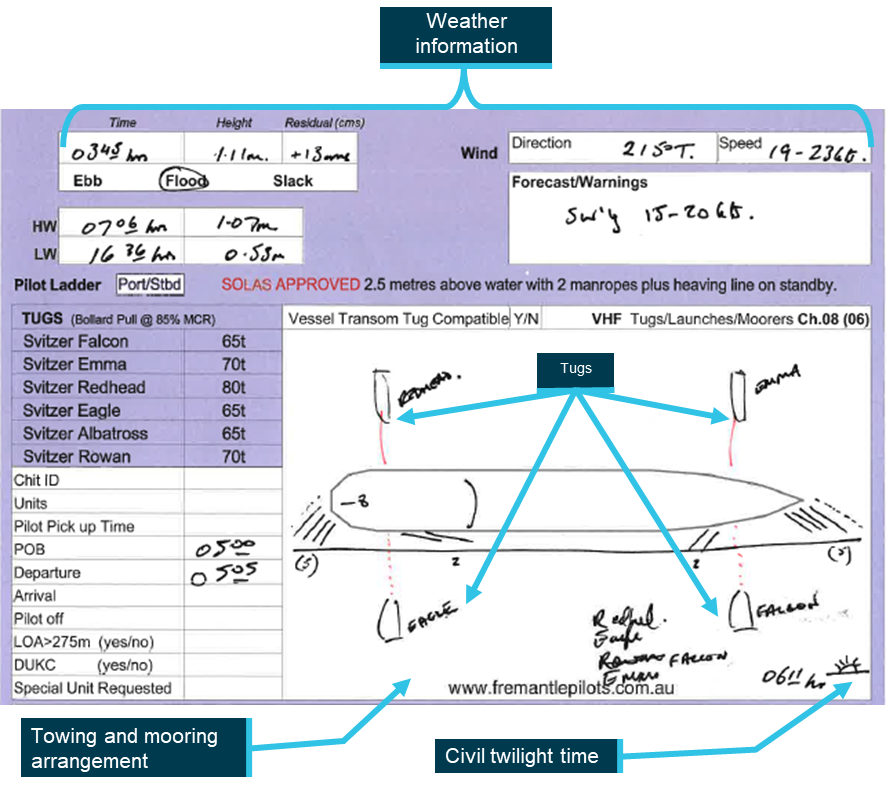
The MPX form that was completed by the pilot, contained the passage plan from the outer pilot boarding ground up to CT3 berth, with the charted courses and speeds, mooring and towing arrangements, weather information and confirmation of the ship’s equipment status. The plan also included a symbolic representation of the 0611 civil twilight time (Figure 8).
Figure 8: Master-pilot exchange plan
Source: Fremantle Pilots, annotated by the ATSB
During the initial southbound segment of the transit, the plan noted ‘speed adjusted for daylight entry’, with the pilot verbally advising the master of a 0600 daylight time. The plan also included wheel over points, the turn radii and the locations where the tugs were to be made fast. The plan detailed that the tugs were to be made fast prior to the IHEC entrance buoys. However, the plan was not marked with the abort point, as per industry requirements.[37] It was later reported that the abort point was about one mile before the IHEC.
The charted entry course in the IHEC was 083°, at a planned speed of 8–10 knots. Following the wheel over point near South Mole, the vessel’s next course leading into the IH was approximately 040°.
Figure 9: Master-pilot exchange plan
Source: Fremantle Pilots, annotated by the ATSB
Towage
Requirements
The towage requirements for ships entering the Port of Fremantle were set by the harbour master and outlined in the Port Information Guide and operational parameters. All tugs in the Port of Fremantle were privately owned and operated, and available 24 hours.
For LCV between 310 m and 336 m turning on arrival, the Fremantle Ports Operational Parameters mandated that 4 A-Class[38] tugs were required for the inbound ‘turning on arrival’ manoeuvre. While 3 tugs were used in the initial simulation trial exercises, a 4-tug requirement was introduced at the outset of the ‘live’ trials in 2021 and was mandated in HMI 01-2022 in March of that year.
The operational parameters also mandated the following towage arrangements in respect of inbound LCV:
- The towing arrangement would comprise one escort tug and 3 other tugs.
- The escort tug and the other tugs were required to be ‘on station’ at distances of 1.5 NM and 1.0 NM respectively from the inner harbour entrance.[39]
- The escort tug was required to be made fast to the inbound ship by 1.0 NM from the inner harbour entrance.
- The 3 other tugs were to be made fast by the inner harbour entrance buoys.
Historical transit data pertaining to the securing times of the tugs to inbound LCVs was limited; however, it was reported that the tugs were not always made fast as required.
Svitzer Australia
Towage services were provided by Svitzer. Azimuth stern drive (ASD) tugs were by far the largest group of tugs within the Svitzer fleet. This type of tug was equipped with 2 azimuth thrusters in nozzles at the stern. The thrusters could be turned around 360°, enabling the propeller thrust to be in any direction. ASD tugs mainly towed over the bow with the towing winch and towing staple forward, but some were fitted with an aft winch and staple or a towing hook, with the aft towing point aft of amidships.
Positioning
There were 4 tugs allocated to the Maersk Shekou for its inbound transit. The Class-certified escort tug, Svitzer Redhead, with a bollard pull of 80 tonnes was made fast at the vessel’s port quarter mooring bitt rated at 74 tonnes. The remaining tugs included:
- Svitzer Emma, with a bollard pull of 70 tonnes, made fast to the Maersk Shekou’s port shoulder mooring bitt rated at 60 tonnes
- Svitzer Falcon, with a bollard pull of 65 tonnes, made fast at the vessel’s starboard shoulder mooring bitt rated at 90 tonnes
- Svitzer Eagle, with a bollard pull of 65 tonnes, made fast at the vessel’s starboard quarter mooring bitt rated at 74 tonnes.
Svitzer Redhead and Svitzer Emma were limited by the strength of their respective mooring bitts.
During the pilot’s initial briefing with the tug masters over the VHF, the pilot instructed that Svitzer Redhead would be made fast on the port quarter, rather than via the aft centre lead. This decision was based on the pilot’s experience with limited sea room if the escort tug was required to perform indirect towage from the aft centre lead position, as well as their preference to have one tug secured on each quarter of the Maersk Shekou. This was discussed between both pilots during the transit.
It was documented that on at least one previous occasion, other pilots had encountered issues with sea room availability with the escort tug positioned at centre lead aft. As such, FP stated that its procedures with the tug positioning were not prescriptive, and that the pilots could use their discretion to best configure the same.
Weather
Port limits
Pursuant to the operational parameters, Fremantle Ports had stipulated the weather parameters for inbound LCV. For ships turning on arrival, such as the Maersk Shekou, these were:
- maximum wind: 20 knots with maximum gusts not above 30 knots[40]
- maximum current: 0.3 knots at swing circle (inner harbour) / 1.0 knots at railway bridge.
The harbour master later advised the ATSB that the operational parameters gust limit was incorrectly published, and that the previous limit of 25 knots still applied at the time of the accident transit. Based on information gathered by the ATSB during interviews, Fremantle Ports and the pilots were still operating to the lower limit of 25 knots.
Forecasts and observations
Bureau of Meteorology
In the days leading up to 30 August, the Bureau of Meteorology (BoM) had issued strong wind and gale warnings, with winds predicted to reach 35 knots at times.[41] Fremantle Ports had issued Shipping Agents’ Memos for the forecast adverse weather, advising of cessation of shipping movements within the port for this period. Accordingly, the Port of Fremantle was evacuated, and vessel movements were stopped during that time.
The BoM forecast issued during the late hours of 29 August predicted that ‘a vigorous west to south-westerly flow’ would ease that night, with 15–20 knot winds from the south‑westerly direction forecast for Friday 30 August.
The BoM forecast, issued at 0400 on 30 August, maintained an unchanged wind prediction, partly cloudy skies with a chance of showers, seas of 1.5 m, westerly to south-westerly swell of 2.5–4.0 m.
All BoM forecasts contained the following cautionary advice:
Wind and wave forecasts are averages. Wind gusts can be 40 per cent stronger than the forecast, and stronger still in squalls and thunderstorms.
Fremantle Ports
Weatherzone
Fremantle Ports subscribed to a private weather service, Weatherzone, which provided forecasting and monitoring capability of various weather parameters, including but not limited to:
- the average[42] and gusting wind direction and speed
- currents
- predicted and actual tides
- air and sea temperatures
- barometric pressure.
The Weatherzone service was made available to both the VTS as well as FP. In the VTS control tower the weather information was displayed on a dedicated screen, where the on‑duty personnel could monitor prevalent conditions.
Online access of this information was also provided to FP, to aid in the preparation of the pilotage plan and passage execution. Access to the Weatherzone webpage was possible via computer and on a mobile device using an application.
Wind
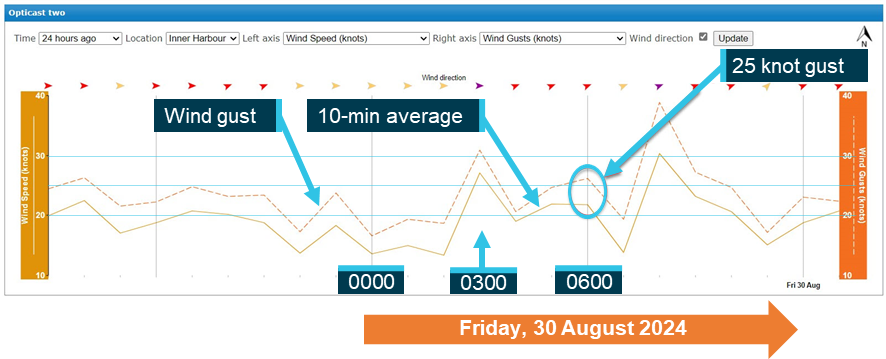
The Weatherzone forecast for 30 August 2024 (Figure 10) contained evidence of strong wind conditions, including squall activity.[43] The following considerations were relevant to the timing of the Maersk Shekou’s transit:
- the 10-minute average wind was above the 20-knot maximum limit
- an approximately 25-knot wind gust was expected at 0600, which coincided with Maersk Shekou approaching the IHEC entrance.
Figure 10: Weatherzone forecast for 30 August 2024
Source: Fremantle Port Authority, annotated by the ATSB
Fremantle Ports later advised that the conditions were only marginally higher than the operational parameters, and within the acceptable variance of a dynamic marine weather risk assessment. Therefore, they did not believe it would impact the safe inbound passage of the Maersk Shekou.
Monitoring of weather parameters was facilitated by wind measuring instruments at:
- the Fremantle Ports Building
- North Mole
- Success, Parmelia and Stirling Channels.
Additionally, current meters were installed in the inner harbour at the small craft finger jetty and at Corkhill Landing. The port was also equipped with tide gauges and wave sensors, including waverider buoys and digi-quartz sensors across various locations. Fremantle Ports was not equipped with any fixed wind measuring installations between the pilot boarding ground and the IHEC.
A record of wind observations from 30 August 2024, from the ‘Inner Harbour’ sensor at the Fremantle Ports Building (close to the accident location) is depicted in Figure 11. Annotations along the bottom of the graph denote the representative position of the Maersk Shekou on its inbound voyage.
Figure 11: Actual wind observations from Inner Harbour sensor
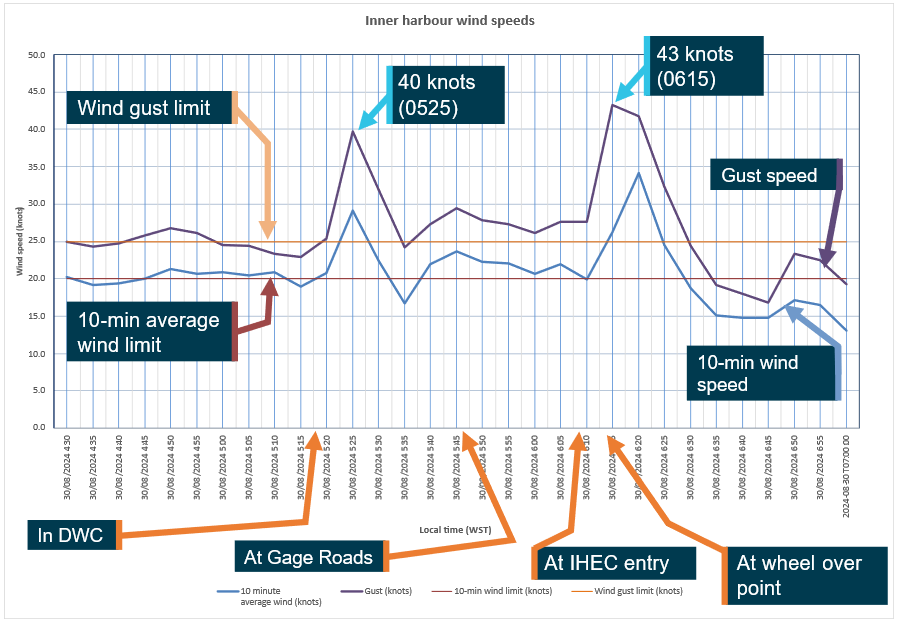
The ATSB has identified when the Maersk Shekou passed the main passage points. Source: Fremantle Port Authority, annotated by the ATSB
Current
The Weatherzone current meter at Corkhill Landing was situated closest to where STS Leeuwin II was moored. Observations from the Corkhill Landing current meter for the Maersk Shekou’s approach and transit within the IHEC are presented in Table 1 below.
Table 1: Corkhill Landing current meter observations
| Date | Local Time | Mean Velocity | Direction |
| 30 August 2024 | 0600 | 0.08 | 069 |
| 0605 | 0.12 | 068 | |
| 0610 | 0.13 | 073 | |
| 0615 | 0.72 | 041 | |
| 0620 | 0.22 | 049 |
There was an increase in current flow at 0615, which was coincident with time of the squall activity. Further current meter data obtained after the accident showed a 30‑minute average of 0.28 knots and a peak current of 1.99 knots.
Discussions surrounding weather
In relation to the weather conditions, the following discussions took place during the Maersk Shekou’s inbound passage, and immediately after the accident:
- At 0536 on 30 August 2024 (shortly after the initial 0525 squall had passed), the VTSO received a phone call from the port’s mooring team leader who enquired about the Maersk Shekou’s arrival in the strong wind conditions. While the VTSO acknowledged the recent squall, they confirmed the movement was likely to proceed as there were no concerns raised by the pilot in their recent report (on passing Hall Bank beacon).
- At about 0600, the VTSO and duty pilot (ashore) engaged in a telephone conversation about the Maersk Shekou’s arrival. By then the wind speed had briefly subsided, but the VTSO noted that the Maersk Shekou would be entering port as a squall was passing over. This was acknowledged by the duty pilot, but the information was not conveyed to the pilots on board.
- After the Maersk Shekou’s collision with STS Leeuwin II and the wharf, the VTSO notified the harbour master of the accident. It was reported that the Maersk Shekou was hit by a squall (referring to the subsequent 0615 squall).
Shipboard systems
Maersk Shekou’s operator had subscribed to a private weather forecasting and routing service, Weathernews Inc. (WNI). While weather forecasts were available on board the ship, this was not discussed during the passage.
The Maersk Shekou was fitted with an ultrasound anemometer to measure wind speed and direction. The anemometer sensor was located approximately 46.2 m above sea level and was noted to be installed clear of any surface obstructions. The anemometer wind speeds were referenced several times in conversation between the pilots and the master during pilotage. The wind observations on the Maersk Shekou’s anemometer recorded similar values to the Weatherzone data.[44]
Bridge resource management
Bridge resource management (BRM) is defined as the use and coordination of all the skills and resources (people, procedures and equipment) available to the entire bridge team to achieve the established goal of optimum safety and efficiency.[45] All individuals make errors, and BRM aims to minimise the occurrence and outcome of errors through the best possible use of resources. All ship’s navigators must have training, and demonstrate competence, in BRM techniques.
BRM is a broad topic which covers many inter-related subjects, including but not limited to:
- shared mental model
- situation awareness
- error management
- contingency planning
- challenge and response
- distractions and interruptions.
The ship’s master and the pilots are responsible for taking steps to actively engage and include other members of the ship’s bridge team in the pilotage. Through effective BRM, all personnel involved in the navigation of the ship should have a clear understanding of, and expectations for, the pilotage. Navigational, operational and general safety priorities should be set and constantly reviewed in the context of the prevailing circumstances and conditions. Non-essential activity and distractions should be avoided, suppressed or removed.
Although section 326(3) of the Navigation Act 2012 provides that masters are not relieved of responsibility for the conduct and safe navigation of a vessel when the vessel is under pilotage, it is essential that coastal pilots work closely with masters and bridge teams to ensure that errors are detected and corrected as early as possible.[46]
Pilot’s actions
The primary pilot advised that after boarding the Maersk Shekou, they adjusted the ship’s speed to enter port at 0611 to coincide with civil twilight. They also advised that based on the ship’s handling during the inbound passage, including the turn into the IHEC, they did not anticipate any steerage issues while approaching the wheel over point near South Mole.
When approaching the charted wheel over point, they had intended for the ship to be making good about 7.5 knots. However, the ship was reportedly taking longer than expected to slow down, which the pilot thought was due to the prevalent wind and tidal effects. Consequently, to remain on the planned turning arc, as the ship approached South Mole, the pilot reported pulling back with the stern tugs and commencing the turn into the IH earlier than the charted wheel over point. However, they did not advise the crew that this was their intention. The primary pilot recalled initially providing the helmsman a port 10° helm order where they considered the turn should have been commenced. The pilot further reported that there was a slight indication that the ship’s bow turned to port, and then a few seconds later, started turning to starboard.
Post-accident simulations
Following the accident, Fremantle Ports commissioned simulations at the Fremantle Maritime Simulation Centre to recreate the conditions during Maersk Shekou’s arrival into Fremantle on 30 August 2024. Specifically, 4 simulation manoeuvres were undertaken by a team from Fremantle Pilots using 4 tugs of similar capacity as the accident day. The weather conditions simulated included a following current on flood tide, south-westerly 1.5 m wave height with a 7 s period, and a 20 knot south-westerly wind which increased to 45 knots on the onset of the squall near South Mole. One simulation involved squalls of up to 55 knots.
It was reported that the ship behaved sluggishly and had a slight starboard rate of turn because of the squall. However, the outcomes of all 4 simulations were successful, with the pilots utilising a combination of the tugs, the ship’s main engine and rudder action to facilitate the turn into the IH at the wheel over point.
In addition, the ATSB analysed 4 previous LCV transits (including the Maersk Shekou’s previous arrival) to determine if the accident voyage was significantly different. The results showed that, although faster than the average, the Maersk Shekou’s speed during the accident transit was not significantly higher than the others.
Safety analysis
Introduction
While transiting the inbound passage from the pilot boarding ground, the Maersk Shekou encountered unforecast strong south-westerly winds, including squall activity. These conditions continued as the ship transited the inner harbour entrance channel (IHEC) before sunrise, where the strong winds affected manoeuvrability.
As the ship approached the wheel over point for the inner harbour, the pilot instructed the helmsman to maintain 083°, just prior to the last of the 4 tugs being made fast. At the time, the secondary pilot was occupied in a telephone call. The helmsman’s efforts were concentrated on maintaining 083° and each time the ship began to turn, they attempted to return to the 083° heading. Despite the pilots’ subsequent actions to alter course, the Maersk Shekou did not make the turn and collided with STS Leeuwin II and Victoria Quay.
This analysis will consider the contributing factors to the collision, including the:
- manoeuvring of the ship and monitoring of its progress
- resources available to the pilots, including tugs and real time weather monitoring
- role of Fremantle vessel traffic services during pilotage transits
- operational compliance with the implemented risk controls at the port of Fremantle.
Helm orders
Pilot’s actions
Verbal communications between the pilot and helmsman, as well as the pilot and other members of the bridge team, were audible on the Maersk Shekou’s VDR recording that was obtained by the ATSB as part of the post‑accident evidence. The pilot’s orders were loud, distinct and clear throughout the pilotage, as were the helmsman’s confirmations of the orders. It was also noted that on one occasion when the helmsman had not correctly heard the pilot’s instruction, they immediately clarified this with the pilot.
As the Maersk Shekou’s bow was abeam South Mole, approximately a ship’s length away from the charted wheel over point, the pilot had intended to commence the turn into the inner harbour with a port 10° helm order. However, a 083° course instruction (and helmsman acknowledgment) was the only instruction recorded at that time.
As the Maersk Shekou approached and passed the wheel over point for the turn into the inner harbour, there were no further helm instructions (or acknowledgments) audible on the bridge audio recording.
Contributing factor As Maersk Shekou approached the wheel over point in the entrance channel, the pilot did not provide the helmsman with an order to execute the turn into the inner harbour. Consequently, the helmsman did not alter course to negotiate the planned turn, and the ship continued towards the STS Leeuwin II. |
Helmsman behaviour
While the Maersk Shekou was transiting the IHEC, the ship developed a starboard rate of turn. To maintain course, the helmsman adjusted the helm to port. However, this had little effect in restricting the gradually increasing starboard swing. Despite the ship not responding, the helmsman did not report this to the pilot for almost 2 minutes after the initial application of port helm.
While this did not contribute to the development of the accident, it is crucial that in restricted or confined waters, the pilot is kept informed of the ship’s delayed (or lack of) response to both steering and engine movements. This is due to the limited margin of error available with the ship, the time required to evaluate the situation, apply countermeasures and for these measures to take effect.
Other factor that increased risk Maersk Shekou's helmsman did not promptly notify the bridge team of their inability to maintain course and that the ship was turning to starboard despite the application of significant port helm. |
Passage monitoring
Bridge resource management
The pilot reported that as the ship approached the wheel over point, it was faster than they intended. Consequently, they planned to commence the turn prior to the nominated point to maintain the desired turning arc. However, the pilot did not advise the bridge team of their intention to alter course earlier than the charted wheel over point. Therefore, the bridge team lacked a shared mental model of the ship’s passage plan, and the master and chief mate had limited appreciation of the pilot's anticipated actions. Further, the helmsman (and master) provided delayed feedback of the ship’s steering response to the pilot.
Communicating and monitoring deviations from the passage plan or the ship’s expected behaviour were necessary to ensure its safe navigation. This required that each member of the bridge team verified each other’s actions, provided early feedback if the ship behaved unexpectedly, and maintained a proactive ‘challenge and response’ mindset. This did not occur, most notably with respect to monitoring the actions of the helmsman. The absence of a dedicated lookout on the bridge was also noted, however, was not deemed contributory to the inadequate monitoring by the bridge team.
Contributing factor As the Maersk Shekou proceeded along the inner harbour entrance channel, the resource management required of the ship’s bridge team was ineffectively implemented. In particular, the following aspects were not practiced:
|
Mobile phone usage
The VDR audio showed that the secondary pilot was engaged in a conversation on their mobile phone during a critical phase of the passage. While they later reported that they used their mobile phone as they did not want to distract the primary pilot by speaking on the VHF radio, the phone call was not a brief conversation as intended but instead included an unrelated discussion.
Cautionary advice about mobile phone usage was highlighted in both the Fremantle Pilots’ (FP) and the ship manager’s Safety Management System (SMS). However, none of the ship’s bridge team members intervened or objected to the secondary pilot speaking on the phone. Despite this, there was no evidence that the phone call was a significant distraction to others on the bridge. However, it was apparent that the timing of the phone call shifted the secondary pilot’s focus from their monitoring role. Consequently, they did not identify that:
- in the approach to the wheel over point, maintaining the ship’s heading and turning to port by helm action alone was difficult in the prevalent conditions
- the primary pilot had not provided the next course instruction to the helmsman
- once the vessel had commenced its turn to port at the wheel over point, the helmsman engaged starboard helm to steady the vessel on the previously ordered 083° course.
Contributing factor The secondary pilot was engaged in a phone conversation at the time the ship was transiting the inner harbour entrance channel. Therefore, they were distracted from their monitoring role and did not identify that the lead pilot had not altered course, and that the helmsman's actions opposed the ship’s planned turn. |
Engagement of tugs during the pilotage
Delayed attachment of tugs
The escort tug, Svitzer Redhead, was secured to the Maersk Shekou’s port quarter as it was heading southbound through Gage Roads. The remaining 3 tugs arrived alongside the Maersk Shekou when the vessel was 0.6 NM from the entrance of the channel, which was 0.4 NM later than the rendezvous point stipulated in the procedures. Further, of the 3 remaining tugs, only the Svitzer Eagle on the starboard quarter was made fast before the ship entered the IHEC, as required. The final tug, Svitzer Falcon, was made fast as the pilot instructed the helmsman to steer 083°. This delay resulted in the bridge team, including the pilot, being engaged with the Svitzer Falcon’s attachment activity just as they approached the wheel over point. This increased the bridge team workload at the most critical stage of the passage.
Contributing factor As the ship approached the wheel over point, the fourth tug was being made fast, which increased the entire bridge team's workload at the critical stage of the passage and reduced the effective resources available to the pilot to safely manoeuvre the ship into the inner harbour. |
Procedural inconsistencies
With respect to the inbound large container vessels (LCVs), the towage procedures documented by Fremantle Ports and Fremantle Pilots were inconsistent. However, as the pilots always intended to use 4 tugs and were experienced in the manoeuvre involving the turning of LCVs on arrival, this was not considered a contributing factor on the day.
Weather activity
Forecast conditions
Prior to the ship’s passage, the forecast winds were within the acceptable limits for a dynamic forecast. However, the actual conditions experienced on the day were more severe with strong winds experienced during the inbound transit. Between 0515 and 0530, (true) wind speeds of up to 47 knots were recorded on the ship in the deepwater channel, with similar conditions experienced within the inner harbour. These squally conditions had not been forecast, and the winds were above the maximum for the inbound transit. However, when the pilot contacted the vessel traffic services operator (VTSO) at 0535, this was not discussed.
About a minute later, the VTSO received a phone call from the mooring team leader enquiring about the ship’s arrival in the strong winds, however, their concerns were dismissed as the pilot had not raised any concerns. In another phone call at 0600, the VTSO discussed the increased winds with the duty pilot, and again no concerns were raised with the pilots on board. Thereafter, the Maersk Shekou encountered a squall with winds of up to 43 knots from its starboard quarter, affecting its steerage in the IHEC.
Despite the available resources to monitor conditions and the opportunities to communicate their concerns, there was a limited appreciation of the prevalent weather conditions by all concerned parties. Consequently, the following were not considered prior to the abort point on the passage:
- ensuring that all existing risk controls were comprehensively implemented
- any additional measures required to mitigate the weather associated risks
- the effect of weather on the vessel’s manoeuvrability
- Fremantle Ports’ non-routine process, which specifically referenced such situations.
Other factor that increased risk During Maersk Shekou's inbound pilotage, wind speeds exceeded forecast conditions as well as the port's operational parameters for large container vessels. However, the risks introduced by these changed conditions were not formally reassessed or communicated between vessel traffic services and the pilots. Subsequently, the ship was subjected to a severe squall at a critical phase in the pilotage. While not contributory to the accident, it very likely increased the pilot's workload at the time. |
Daylight entry into port
On 30 August 2024, Maersk Shekou entered the IHEC at 0609, 27 minutes prior to sunrise, in contravention of the operational parameters. During the passage, the pilots had adjusted the ship’s approach speed to arrive at the channel entrance, based on the 0611 civil twilight time.
As the Maersk Shekou arrived at the IHEC entrance it was still dark, possibly exacerbated by the cloudy sky. While navigating in darkness may have an impact on situation awareness, there was no evidence to indicate this adversely influenced the bridge team’s behaviour or resulted in the subsequent collision.
Audio and documentary evidence indicated that both the pilots on board as well as the duty pilot were mistaken about the earliest time the vessel could arrive at the channel entrance. On the other hand, the duty VTSO appeared to be clear in their understanding. However, in discussions between the pilot and VTS during the inbound passage, when the pilot advised they would adjust the ship’s speed to make a ‘daylight’ arrival neither party specifically referenced the sunrise timing, and the difference in expectation was not discussed.
For LCVs, daylight entry facilitates better awareness and visual navigation within the confined channel waters, including judgment of clearances during the subsequent turn in the inner harbour. Despite being a documented risk control for at least the past 5 months, the parties involved in the Maersk Shekou’s transit did not comply with this requirement, and effective enforcement by Fremantle Ports was not carried out on this occasion.
Other factor that increased risk Maersk Shekou entered the port prior to sunrise, which was inconsistent with the procedures set out in the Fremantle Ports operational parameters. While this did not directly impact the ship’s navigation in this instance, the risk controls in place to safely navigate the ship into port were not adhered to. |
Risk controls
The operational parameters established by Fremantle Ports provided a series of risk controls to ensure safe navigation within port limits. These control measures were based on the outcome of strategic assessments by Fremantle Ports with other concerned stakeholders, including Fremantle Pilots and Svitzer.
However, during the accident pilotage, several of the risk controls were either overlooked, misinterpreted, or bypassed. These included:
- the ship entering the IHEC before sunrise
- tugs not being made fast on time
- the secondary pilot being on the mobile phone
- wind speeds above set limits
- no challenge by the VTSO of the pilots when the limits were exceeded.
While their contribution to the accident could not be quantified, in combination they increased the workload and risks of safe navigation at a critical time of the passage.
Additionally, during the course of the investigation, the ATSB identified other instances where the underlying risk controls were ineffective.
Other factor that increased risk A number of the risk controls established by Fremantle Ports to ensure the safe entry of large container vessels were ineffective. These included:
While not all contributory, the above factors collectively reduced the effectiveness of the port’s risk control measures and increased the likelihood of a safety occurrence. (Safety issue) |
Findings
ATSB investigation report findings focus on safety factors (that is, events and conditions that increase risk). Safety factors include ‘contributing factors’ and ‘other factors that increased risk’ (that is, factors that did not meet the definition of a contributing factor for this occurrence but were still considered important to include in the report for the purpose of increasing awareness and enhancing safety). In addition ‘other findings’ may be included to provide important information about topics other than safety factors. Safety issues are highlighted in bold to emphasise their importance. A safety issue is a safety factor that (a) can reasonably be regarded as having the potential to adversely affect the safety of future operations, and (b) is a characteristic of an organisation or a system, rather than a characteristic of a specific individual, or characteristic of an operating environment at a specific point in time. These findings should not be read as apportioning blame or liability to any particular organisation or individual. |
From the evidence available, the following findings are made with respect to the collision between container ship Maersk Shekou and tall ship STS Leeuwin II, Fremantle, Western Australia, on 30 August 2024.
Contributing factors
- As Maersk Shekou approached the wheel over point in the entrance channel, the pilot did not provide the helmsman with an order to execute the turn into the inner harbour. Consequently, the helmsman did not alter course to negotiate the planned turn, and the ship continued towards the STS Leeuwin II.
- As the Maersk Shekou proceeded along the inner harbour entrance channel, the resource management required of the ship’s bridge team was ineffectively implemented. In particular, the following aspects were not practiced:
- active monitoring of the rate of turn and helm with regard to the ship’s position in the channel
- early challenge and response, and error management
- a shared mental model between all members of the team.
- The secondary pilot was engaged in a phone conversation at the time the ship was transiting the inner harbour entrance channel. Therefore, they were distracted from their monitoring role and did not identify that the lead pilot had not altered course, and that the helmsman's actions opposed the ship’s planned turn.
- As the ship approached the wheel over point, the fourth tug was being made fast which increased the entire bridge team's workload at the critical stage of the passage and reduced the effective resources available to the pilot to safely manoeuvre the ship into the inner harbour.
Other factors that increased risk
- Maersk Shekou's helmsman did not promptly notify the bridge team of their inability to maintain course and that the ship was turning to starboard despite the application of significant port helm.
- During Maersk Shekou's inbound pilotage, wind speeds exceeded forecast conditions as well as the port's operational parameters for large container vessels. However, the risks introduced by these changed conditions were not formally reassessed or communicated between vessel traffic services and the pilots. Subsequently, the ship was subjected to a severe squall at a critical phase in the pilotage. While not contributory to the accident, it very likely increased the pilot's workload at the time.
- Maersk Shekou entered the port prior to sunrise, which was inconsistent with the procedures set out in the Fremantle Ports operational parameters. While this did not directly impact the ship’s navigation in this instance, the risk controls in place to safely navigate the ship into port were not adhered to.
A number of the risk controls established by Fremantle Ports to ensure the safe entry of large container vessels were ineffective. These included:
- Inconsistent compliance with designated daylight entry requirements
- Ineffectiveness of the second pilot’s role in monitoring the progress of the pilotage
- Inconsistent procedural documentation and application regarding tug usage
- Inadequate compliance with operational wind limits and non-routine task protocols
- Inadequate information exchange between the VTS and pilots.
While not all contributory, the above factors collectively reduced the effectiveness of the port’s risk control measures and increased the likelihood of a safety occurrence. (Safety issue)
Safety issues and actions
Risk controls not observed
Safety issue number: MO-2024-001-SI-01
Safety issue description: A number of the risk controls established by Fremantle Ports to ensure the safe entry of large container vessels were ineffective. These included:
- Inconsistent compliance with designated daylight entry requirements
- Ineffectiveness of the second pilot’s role in monitoring the progress of the pilotage
- Inconsistent procedural documentation and application regarding tug usage
- Inadequate compliance with operational wind limits and non-routine task protocols
- Inadequate information exchange between the VTS and pilots.
While not all contributory, the above factors collectively reduced the effectiveness of the port’s risk control measures and increased the likelihood of a safety occurrence.
Safety action not associated with an identified safety issue
| Whether or not the ATSB identifies safety issues in the course of an investigation, relevant organisations may proactively initiate safety action in order to reduce their safety risk. The ATSB has been advised of the following proactive safety action in response to this occurrence. |
Additional safety action by Fremantle Pilots
Fremantle Pilots has taken the following proactive safety action:
- LCV in/outbound procedures have been updated to include the fourth tug to align with LCV overview procedure
- LCV procedures were reiterated to the pilot group (highlighting use of mobile phones, wheel over point, speed management, tug placement, daylight definition)
- Fremantle Pilots has also worked with the Fremantle Ports harbour master to implement a revised HMI for mobile phone usage during towage and pilotage
- utilised the Maersk Shekou event during emergency simulations conducted in October 2024
- added the Maersk Shekou event to emergency simulation exercise matrix for all pilots
- worked with Fremantle Ports to revise the definition of daylight
- the tug rendezvous point for all 3 and 4-tug inner harbour inbound jobs (includes all LCVs) was revised and amended to a position adjacent to Gage Roads N4 anchorage (in collaboration with Svitzer and Fremantle Ports).
Glossary
| AIS | Automatic identification system |
| AMSA | Australian Maritime Safety Authority |
| ARPA | Automatic radar plotting aid |
| ASD | Azimuth stern drive |
| BoM | Bureau of Meteorology |
| BRM | Bridge resource management |
| DWC | Deepwater channel |
| ECDIS | Electronic chart display and information system |
| ETA | Estimated time of arrival |
| FMSC | Fremantle Maritime Simulation Centre |
| FP | Fremantle Pilots |
| GPS | Global positioning system |
| HMI | Harbour Master’s Instructions |
| IH | Inner harbour |
| IHEC | Inner harbour entrance channel |
| ISM | International Management Code for the Safe Operation of Ships and for Pollution Prevention, 1995, as amended |
| LCV | Large container vessel |
| LOA | Length overall |
| LOAF | Leeuwin Ocean Adventure Foundation Limited |
| MPX | Master-pilot exchange of information |
| OOW | Officer of the watch |
| PPU | Portable pilot unit |
| SMS | Safety management system |
| SOLAS | The International Convention for the Safety of Life at Sea, 1974, as amended |
| STCW | The International Convention on Standards of Training, Certification and Watchkeeping for Seafarers, 1978, as amended |
| STS | Sail training ship |
| UHF | Ultra high frequency |
| VDR | Voyage data recorder |
| VHF | Very high frequency |
| VTS | Vessel traffic services |
| VTSO | Vessel traffic services operator |
| WNI | Weathernews Inc. |
Sources and submissions
Sources of information
The sources of information during the investigation included:
- the master, chief mate and helmsman on board Maersk Shekou
- V. Ships (Hamburg) GmbH & Co. KG
- the Maersk Shekou’s P&I representative
- the master and crew of STS Leeuwin II
- Leeuwin Ocean Adventure Foundation
- Fremantle Ports
- Fremantle Pilots
- Australian Maritime Safety Authority
- Svitzer Australia
- Bureau of Meteorology
- video footage of the accident voyage and other photographs and videos taken on the day of the accident.
References
Australian Maritime Safety Authority, 2020, Bridge resource management and the reduction of single person errors—advisory note, AMSA, Canberra.
Fremantle Maritime Simulation Centre, 2021, A simulation report on turning large containerships on arrival in the Fremantle Inner Harbour, Fremantle.
International Maritime Organisation, 1978, International Convention on Standards of Training Certification and Watchkeeping for Seafarers, (STCW), 1978, as amended, IMO, London.
International Maritime Organization, 2018, International Management Code for the Safe Operation of ships and for Pollution Prevention (ISM Code) as amended, IMO, London.
International Maritime Organization, 1973, Recommendation of basic principles and operational guidance relating to navigational watchkeeping, IMO, London.
Nijjer, R, 2000, Bridge Resource Management: The Missing Link, Sea Australia 2000, Sydney.
Submissions
Under section 26 of the Transport Safety Investigation Act 2003, the ATSB may provide a draft report, on a confidential basis, to any person whom the ATSB considers appropriate. That section allows a person receiving a draft report to make submissions to the ATSB about the draft report.
A draft of this report was provided to the following directly involved parties:
- the master, chief mate and helmsman on board Maersk Shekou
- V. Ships (Hamburg) GmbH & Co. KG
- the master of STS Leeuwin II
- Leeuwin Ocean Adventure Foundation
- Fremantle Ports
- Fremantle Pilots
- Australian Maritime Safety Authority
- Svitzer Australia
- the Maersk Shekou’s flag state administration, Singapore.
Submissions were received from:
- Leeuwin Ocean Adventure Foundation
- Fremantle Ports
- Fremantle Pilots
- Svitzer Australia
The submissions were reviewed and, where considered appropriate, the text of the report was amended accordingly.
Purpose of safety investigationsThe objective of a safety investigation is to enhance transport safety. This is done through:
It is not a function of the ATSB to apportion blame or provide a means for determining liability. At the same time, an investigation report must include factual material of sufficient weight to support the analysis and findings. At all times the ATSB endeavours to balance the use of material that could imply adverse comment with the need to properly explain what happened, and why, in a fair and unbiased manner. The ATSB does not investigate for the purpose of taking administrative, regulatory or criminal action. About ATSB reportsATSB investigation reports are organised with regard to international standards or instruments, as applicable, and with ATSB procedures and guidelines. Reports must include factual material of sufficient weight to support the analysis and findings. At all times the ATSB endeavours to balance the use of material that could imply adverse comment with the need to properly explain what happened, and why, in a fair and unbiased manner. An explanation of terminology used in ATSB investigation reports is available here. This includes terms such as occurrence, contributing factor, other factor that increased risk, and safety issue. Publishing informationReleased in accordance with section 25 of the Transport Safety Investigation Act 2003 Published by: Australian Transport Safety Bureau © Commonwealth of Australia 2025 
Ownership of intellectual property rights in this publication Unless otherwise noted, copyright (and any other intellectual property rights, if any) in this report publication is owned by the Commonwealth of Australia. Creative Commons licence With the exception of the Commonwealth Coat of Arms, ATSB logo, and photos and graphics in which a third party holds copyright, this report is licensed under a Creative Commons Attribution 4.0 International licence. The CC BY 4.0 licence enables you to distribute, remix, adapt, and build upon our material in any medium or format, so long as attribution is given to the Australian Transport Safety Bureau. Copyright in material obtained from other agencies, private individuals or organisations, belongs to those agencies, individuals or organisations. Where you wish to use their material, you will need to contact them directly. |
[1] The International Convention for the Safety of Life at Sea (SOLAS) Regulation V/26 provides the requirements with respect to testing and drills for steering and emergency steering.
[2] The vessel’s anemometer could display either true or relative wind speed, with the relative wind speed mode selected. Relative wind is the speed of the wind as experienced on the moving ship. Unless otherwise specified, wind speeds in this report are true wind speed.
[3] Maersk Shekou carried 2 third mates, one keeping the 4–8 watch and the other the 8–12 watch.
[4] The Master-Pilot exchange is a formal exchange of information between the master and pilots on matters such as the ship’s characteristics, operational parameters and the pilots’ intended passage.
[5] The activity carried out by a pilot assisting the master of a ship in navigation, mainly while entering or leaving a port.
[6] The shoulder is the area where a ship’s hull form changes from the bow shape to the parallel mid body, and the quarter is located at the stern of the ship.
[7] One knot, or one nautical mile per hour, equals 1.852 kilometres per hour. All ship speeds referred to in this report are ‘made good/over the ground’.
[8] The DWC is for vessels under pilotage from the Outer Pilotage Boarding Ground to berth, referred to as a 'full pilotage'.
[9] The Fremantle Port Authority operates a 24-hour Vessel Traffic Service (VTS), with the call sign 'Fremantle VTS'.
[10] A Portable Pilot Unit is a specialised navigation device used by marine pilots to assist with navigation.
[11] Turning large container vessels on arrival ensured they were able to depart the berth at any time.
[12] The wheel over point is the point on the initial course at which the ship’s steering wheel is to be turned over to initiate a turn onto the next course.
[13] The bearing of an object 90° from the centreline of a ship.
[14] One point refers to an angle of 11.25° on a compass.
[15] A tug that follows a ship to assist in manoeuvrability if required.
[16] All ship’s headings in this report are in degrees by gyro compass.
[17] Helm refers to the steering wheel used to control the ship’s rudder movement.
[18] Full ahead is rated at 76 RPM on the Maersk Shekou.
[19] A ‘lift off’ instruction requires the tug to pull at a 90° angle to the ship’s fore and aft line.
[20] Indirect towage is a specialised towing technique effective at speeds between 6 to 10 knots where the tug uses its own thrust and drag effect to generate high towline assistance forces.
[21] Zero (0) degree mark on the rudder angle indicator.
[22] Twenty-foot Equivalent Unit, a standard shipping container. The nominal size of a ship in TEU refers to the number of standard containers that it can carry.
[23] International Maritime Organisation 1978, International Convention on Standards of Training, Certification and Watchkeeping for Seafarers (STCW), 1978, as amended, IMO, London.
[24] International Maritime Organization, 2018, International Management Code for the Safe Operation of ships and for Pollution Prevention (ISM Code) as amended, IMO, London.
[25] International Maritime Organization, 1973, Recommendation of basic principles and operational guidance relating to navigational watchkeeping, IMO, London.
[26] The Maersk Shekou’s VDR was installed in 2020, and was therefore required to conform to the performance standards specified in the annex to MSC.333(90).
[27] A barquentine is a sailing vessel with 3 or more masts, with a square‑rigged foremast and fore-and-aft rigged main, mizzen and any other masts.
[28] Roadsteads are sheltered stretches of water near the shore where ships can reasonably safely remain anchored.
[29] Civil twilight is defined as the period after sunset or before sunrise ending or beginning when the sun is about 6° below the horizon and during which on clear days there is enough light for ordinary outdoor occupations.
[30] Fremantle Maritime Simulation Centre, 2021, A simulation report on turning large containerships on arrival in the Fremantle Inner Harbour, Fremantle.
[32] The master always remained in command of the vessel.
[33] Aft centre lead or centre lead aft is a fairlead located along the vessel’s centreline at the stern, through which towing or mooring lines are passed.
[34] Passive escorting refers to where a tug remains close to a vessel without making fast, ready to assist if required.
[35] Very high accuracy independent heading berthing systems, operating in ‘triple mode’ with 3 antenna pods.
[36] VTS Memo 05/2024 issued 9 April 2024 was referred to in the conversation, which addressed changes in Fremantle Ports Operational Parameters including earliest arrival times.
[37] The abort point is the point beyond which the vessel is committed to follow its passage, mainly due to confined sea room.
[38] Azimuth Stern Drive tug with a bollard pull of > 60T @ 85% Maximum Continuous Rating (MCR) over the bow.
[39] The inner harbour entrance was defined as the channel position abeam Buoys No 1 and A.
[40] Wind speed is the 10-minute average.
[41] Local waters forecast for Perth Waters.
[42] 10-minute average wind speed as recorded at the closest port anemometer at an elevation of 10 m above sea level. The data was updated at 5-minute intervals.
[43] Squalls are a sudden large increase in wind speed (usually accompanied by a change in wind direction) that lasts several minutes and then suddenly dies.
[44] Wind speed usually increases with height above the sea-surface. A small variation may exist between shipboard and shore-based measurements due to the respective sensor height and locations.
[45] Nijjer, R, 2000, Bridge Resource Management: The Missing Link, Sea Australia 2000, Sydney.
[46] Australian Maritime Safety Authority, 2020, Bridge resource management and the reduction of single person errors—advisory note, AMSA, Canberra.
Interim report
Report release date: 17/04/2025
| This interim report details factual information established in the investigation’s early evidence collection phase, and has been prepared to provide timely information to the industry and public. Interim reports contain no analysis or findings, which will be detailed in the investigation’s final report. The information contained in this interim report is released in accordance with section 25 of the Transport Safety Investigation Act 2003. |
Summary video
The occurrence
At 1100 local time on 22 August 2024, container ship Maersk Shekou arrived off the Port of Fremantle, Western Australia following a voyage from Adelaide, South Australia and commenced drifting off the coast while awaiting entry into the port. The ship was loaded with 4,164 containers and was intending to proceed to berth CT3 (Figure 1).
The previous day, the Fremantle harbour master advised Maersk Shekou’s master (via the ship’s agent) that, due to industrial action taking place in the port, the ship’s scheduled 22 August berthing time had been postponed to 25 August.
Thereafter, Fremantle Port was evacuated of all vessel traffic due to unfavourable weather conditions, and Maersk Shekou’s pilot boarding time was rescheduled to 0700 on 30 August as per the harbour master’s instructions. At the request of the terminal operations manager, Maersk Shekou’s pilot boarding time was revised to 0500 on 30 August, so that the vessel could be alongside by 0700.
At 0300 on 30 August, the second mate, who was the officer of the watch (OOW) recorded commencing navigational checks, and operation of the steering gear as per SOLAS regulations.[1] At 0321, the OOW engaged the engines, and the Maersk Shekou commenced slowly making its way towards the outer pilot boarding ground.
By 0333, the wind speed had increased, with speeds recorded on the vessel’s anemometer[2] of about 30 knots. At 0345, the Maersk Shekou’s crew had unlashed both anchors in preparation for the inbound passage and at 0400, the second mate gave the vessel’s master and duty engineer one hour’s notice for pilot boarding. At around the same time, the third mate[3] relieved the second mate on the bridge.
The master arrived on the bridge and at 0436, took over conduct (con) of the ship from the third mate. The vessel continued to encounter wind speeds above 20 knots, with occasional gusts up to 25 knots. At 0455, 2 harbour pilots boarded the Maersk Shekou in the vicinity of the outer pilot boarding ground while it was making good about 11.6 knots. Both pilots made their way to the bridge where they met the master and others from the vessel’s bridge team.
The primary pilot (pilot) immediately commenced the exchange of information with the master for the intended pilotage transit. The pilot briefed the master that they had 4 tugs available, and intended on making them fast, one on each shoulder, and one at each quarter.[4] The pilot informed the master they would keep the vessel’s speed unchanged at about 11.6 knots,[5] transit the deepwater channel (DWC)[6] and wait at the harbour entrance, to maintain an estimated time of arrival (ETA) of 0600 for daylight arrival into the port.
Figure 1: Section of navigational chart Aus112 showing Maersk Shekou's inbound track
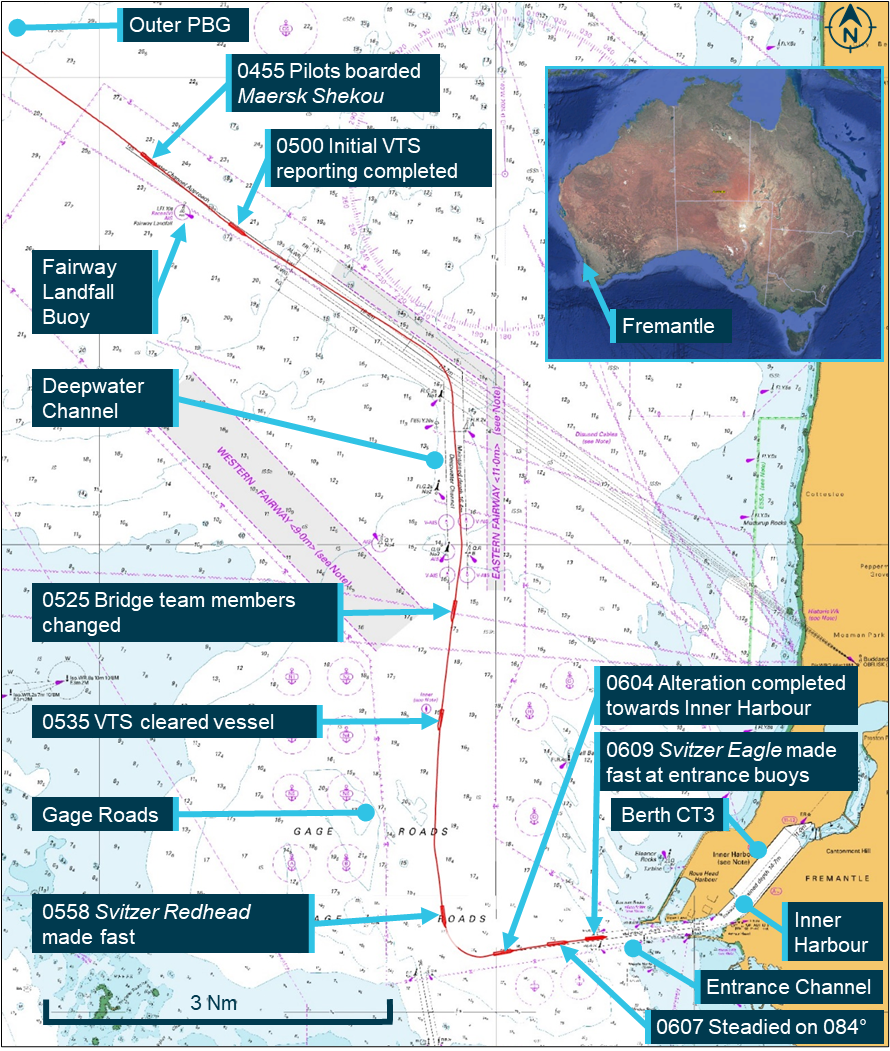
Source: Australian Hydrographic Office, annotated by the ATSB
At 0500, the pilot made VHF radio contact with Fremantle vessel traffic service (VTS)[7] and advised the duty vessel traffic service officer (VTSO) that Maersk Shekou had just passed the Fairway Landfall buoy. The VTSO acknowledged the pilot’s message and confirmed that the route for the ship into the port via the DWC was clear. During this time, the second (secondary) pilot set up their portable pilot unit (PPU)[8] aerials on the bridge wing.
Meanwhile, the pilot and master continued discussing pertinent information provided on Fremantle Pilots’ ‘master/pilot exchange of information’ (MPX) form. This included the route to be followed and an inner harbour manoeuvre involving a 180° turn, so that the vessel could be berthed heading outwards and starboard side alongside at berth CT3. During the exchange, the pilot advised the master that they were the backup/substitute pilot but had taken on the primary pilot’s role as the secondary pilot, who was originally scheduled to be in charge, ‘was tired’. The pilot also informed the master that a 20–25 knot westerly breeze had been forecast throughout the day and the tide was flooding, with high water expected at 0706.
The vessel continued its inbound transit with the bridge team comprising the 2 pilots, master, third mate, and an ordinary seafarer at the helm. The third mate was relieved by the chief mate at about 0525, and the helmsman was also relieved by an able seafarer a few minutes later. The pilots engaged in various work-related and social discussions during the transit. The vessel’s bridge team was also engaged in separate conversations in a non-English language.
During the inbound transit through the DWC, the Maersk Shekou experienced sustained strong winds. By 0518, while on a southerly heading, the relative wind gusts peaked at 54 knots from about 4 points[9] on the starboard bow.
At about 0535, while passing Hall Bank beacon, the pilot contacted Fremantle VTS advising they were proceeding very slowly and awaiting daylight to enter the port. The duty VTSO confirmed the vessel was clear to proceed into the Inner Harbour on that basis. The wind speed had abated slightly but remained in the vicinity of 25–30 knots.
Between 0531 and 0543, the pilot contacted the masters of the 4 tugs and advised them of their intended placement around the Maersk Shekou. At 0558, the escort tug, Svitzer Redhead was made fast on the port quarter. Continuing on a southerly heading at approximately 6.8 knots with its main engine on slow ahead, the vessel was experiencing relative wind speeds of about 30–35 knots from approximately 5 points on the starboard bow. The pilot then ordered an increase to half ahead on the engine and port helm to facilitate a course alteration through an approximately 96° port turn to line up with the inner harbour entrance channel (IHEC).
At 0604, on completing the turn, the wind speed had decreased to below 20 knots. Maersk Shekou was proceeding at 9.4 knots and slow ahead was ordered on the main engine. At 0607, the pilot instructed the helmsman to steady the vessel on a heading[10] of 084°. About a minute later, the vessel’s speed had increased to 9.9 knots and the pilot ordered dead slow ahead on the main engine.
At 0609, as the vessel passed the IHEC entrance buoys, A and No1, the Svitzer Eagle tug was made fast on the starboard quarter (Figure 2). Between helm and engine orders, the pilots continued to engage in various marine and social discussions. About a minute later, the Svitzer Emma tug was secured at the Maersk Shekou’s port shoulder. At this stage, the vessel’s speed had reduced to 9.3 knots. At 0610:52, the vessel was heading 084°, with its bow approximately in line with North Mole. The pilot ordered 085° which was immediately acknowledged and actioned by the helmsman.
As the vessel proceeded along the IHEC, the south-westerly winds escalated and, by 0612:05, the relative wind speed had increased to upwards of 30 knots from the starboard quarter. At about that time, as the Maersk Shekou was at 8.6 knots with its bow in line with Rous Head, the pilot ordered both stern tugs to pull back at quarter power to reduce the vessel’s speed.
Figure 2: Maersk Shekou key times of port entry
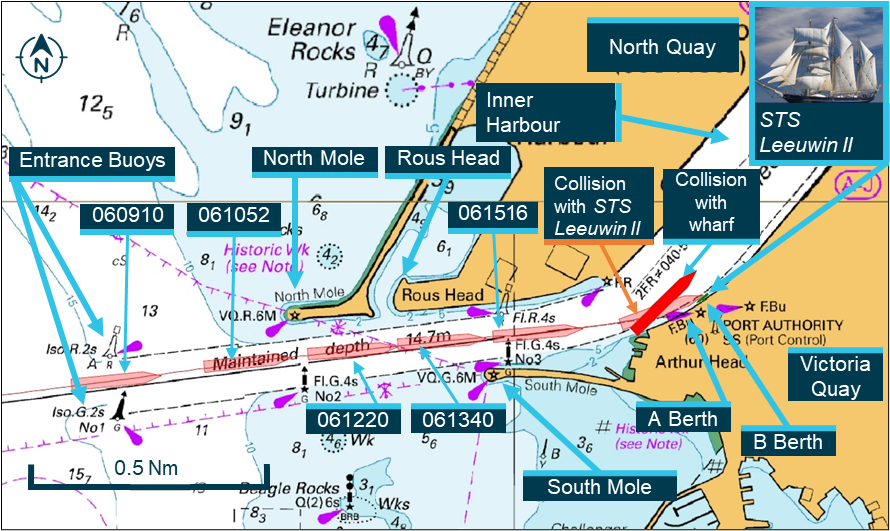
Source: Australian Hydrographic Office, annotated by the ATSB
At around 0612:36, the vessel developed a slight starboard rate of turn. To maintain the 085° heading ordered by the pilot, the helmsman put the helm over to port 25° and then port 30°. The wind speed was steadily increasing and by 0612:50, the vessel was encountering a persistent relative wind speed of 40 knots on the starboard quarter. Despite the port 30° helm, the vessel continued to swing slowly to starboard and was heading approximately 086°.
About then, as the vessel was passing the entrance to Rous Head Harbour (Figure 2), the secondary pilot stood at the rear of the wheelhouse, behind the helmsman, and made a telephone call to the duty pilot (see the section titled Fremantle pilots).
At 0613:26, the vessel’s speed had slowed to about 8.0 knots, and the pilot ordered the tug Svitzer Redhead (already pulling back at quarter power) to increase engine speed to half power. At 0613:40, as the Maersk Shekou’s bow was in line with South Mole, the pilot ordered the helmsman to steer 083°. The helmsman apparently did not hear the order completely and responded by saying ‘08…’. The pilot immediately repeated the 083° order, which was then correctly acknowledged by the helmsman without delay at 0613:45.
Around that time, the Svitzer Falcon tug was made fast at the Maersk Shekou’s starboard shoulder. In the following 15 seconds, several verbal exchanges of information occurred between the vessel’s crew on forward stations and the bridge team on UHF radio, between the pilot and Svitzer Falcon’s tug master on VHF radio, and between the master and pilot (in person on the bridge). Shortly after, at 0614:10, the pilot instructed the Svitzer Eagle to stop pulling back. Despite the helm being maintained nearly at hard port, the vessel was heading almost 087°, making good 7.5 knots, with a 1°/min rate of turn to starboard.
As the primary pilot was conning the vessel from the front of the wheelhouse, the secondary pilot was stationed at the rear and continued to be engaged in their phone call. At 0614:24, the pilot instructed Svitzer Emma on the port shoulder to pull back with half power. The helmsman then reported aloud that the wheel was on hard port, but the vessel was swinging to starboard. The master immediately reiterated this to the pilot and suggested increasing the engine to full ahead[11] to facilitate a quicker turn. The pilot agreed and at 0614:34, the master ordered full ahead on the main engine.
At 0614:40, the pilot ordered Svitzer Eagle to ‘come out square, standby to lift off[12] on the starboard quarter’ and a few seconds later, the master of Svitzer Eagle confirmed that it was square on the starboard quarter. With the helmsman continuing to maintain the helm nearly at hard port, the Maersk Shekou’s bow started slowing swinging to port.
At 0614:56, the pilot then stated on the VHF radio ‘we need to take the stern to starboard please’. The Svitzer Eagle’s skipper later advised that based on their assessment, they were unable to assist in the direct towing mode and altered to indirect towage[13] to generate more force with the manoeuvre.
The engine RPM was steadily increasing to full ahead and by 0615:03, it had increased to 68 RPM. At 0615:10, the master advised the pilot that the (relative) wind speed had increased to 45 knots, which the pilot acknowledged.
By 0615:16, the vessel was making good 7.1 knots and continued to swing to port, achieving a maximum rate of turn of 9°/min. However, as the heading came around to 086°, the helmsman brought the helm to midship and then to starboard 33° for a brief period before returning it to midship. The helmsman’s actions resulted in the vessel’s port swing being arrested, and the vessel being steadied on a heading of approximately 083°, into the path of A and B berths at Victoria Quay.
With neither pilot nor the ship’s bridge team observing the actions of the helmsman, the primary pilot informed the secondary pilot that they were in trouble, resulting in the latter then concluding their phone call at 0615:33. At the time, the rate of turn was almost nil, however, the rudder position was still at starboard 31° and returning to midship following the helmsman’s actions. The secondary pilot questioned, ‘not turning?’, but did not receive any verbal response from the primary pilot.
Both pilots then coordinated their efforts in directing the tugs to assist with the vessel’s port turn. The primary pilot continued to communicate with the tugs, with the secondary pilot providing advice. The pilot instructed Svitzer Emma on the port shoulder to ‘come out square, lift off as much as you can’.
At 0615:47, the Maersk Shekou’s engine achieved its full ahead potential of 76 RPM and the helmsman maintained the rudder in the amidships[14] position. The ship was proceeding at 7.2 knots on a steady 083.5° heading, into the path of STS Leeuwin II, which was less than a ship’s length away, and moored port side alongside B berth at Victoria Quay (Figure 3).
Figure 3: CCTV footage of STS Leeuwin II at its mooring with Maersk Shekou inbound
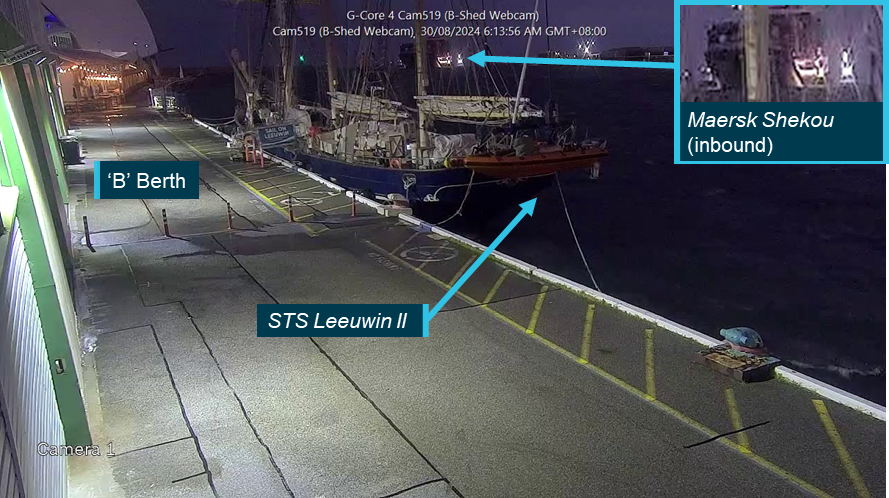
Source: Fremantle Port Authority, annotated by the ATSB
In a continued effort to maintain a steady heading of 083°, the helmsman turned the helm briefly to port 20° for about 6 seconds, before returning it to midship. It also started to rain heavily around this time.
At 0615:54, on the secondary pilot’s orders, the master put the bow thrusters full power to port and at 0616:05, the Svitzer Falcon tug pushed with full power on the starboard shoulder following the pilot’s instructions. At 0616:10, the secondary pilot ordered stop engines and 5 seconds later, full astern. The master instructed the crew at forward stations to standby to release the port anchor.
With the Maersk Shekou proceeding at 7.0 knots and bow thrusters at full power to port, the vessel was heading 082° and commenced swinging to port at a rate of approximately 5°/min.
At 0616:21, the helmsman gave further starboard helm of 12–20° for about 10 seconds, followed by starboard 24–29° for 46 seconds before returning the wheel to the midship position. At 0616:49, the vessel achieved its full astern potential of 76 RPM and its speed had reduced to 5.7 knots.
At 0616:54, one of the pilots ordered the port anchor to be released, and the master immediately conveyed this instruction to the crew at forward stations. The bridge team then sounded a long blast on the ship’s whistle to caution other craft of an impending collision.
The relative wind speed recorded on the Maersk Shekou’s anemometer remained at approximately 40–45 knots from the starboard quarter with heavy driving rain. At 0617:29, the tug master of Svitzer Falcon informed the pilot that they needed to abandon position due to the danger of being crushed between Victoria Quay and the closing in hull of the Maersk Shekou. The crew of the Svitzer Falcon readied the gangway in case it was required for their emergency evacuation onto the wharf, but the tug was manoeuvred clear in time and the crew remained on board.
At 0617:33, on the secondary pilot's suggestion, the lead pilot instructed Svitzer Eagle to push on the starboard quarter. This command was not acknowledged by the tug, however, a few seconds later, the pilot instructed Svitzer Eagle to pull back with full power, which was then duly acknowledged. The Maersk Shekou still had headway with a ground speed of just over 3 knots and decreasing.
Due to the action of the tugs and bow thrusters, the Maersk Shekou continued to maintain a port swing of about 10°/min, away from the direct path of the STS Leeuwin II. However, Maersk Shekou did not make a clear turn, and moments later, its starboard bow flare collided with the STS Leeuwin II, dismasting the latter (Figure 4). Two crew members, on board the sailing vessel at the time, escaped via its gangway just as the collision occurred.
Figure 4: CCTV footage showing collision between Maersk Shekou and STS Leeuwin II
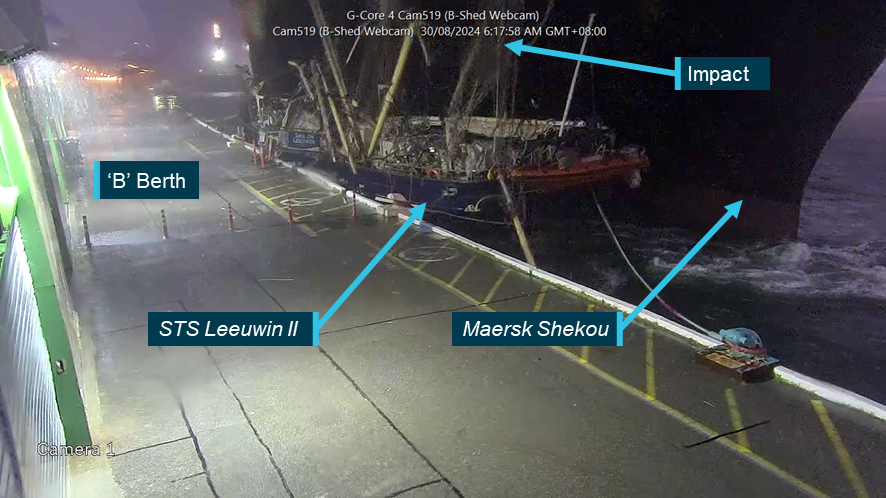
Source: Fremantle Port Authority, annotated by the ATSB
Maersk Shekou’s bow kept swinging to port and in the seconds after the collision, its port anchor was dropped. Unable to visually sight the STS Leeuwin II and ascertain the safety of its crew, either the secondary pilot or the Maersk Shekou’s master sounded another long blast.
By 0618:35, the Maersk Shekou had lost almost all speed, however, its bow was still swinging to port at about 7°/min, and its stern moving to starboard in the direction of the WA Maritime Museum located at the western edge of Victoria Quay. To push the vessel’s stern away from the wharf, the pilot instructed Svitzer Falcon to push on the Maersk Shekou wherever it was possible and at 0618:45, ordered the master to stop engines.
At 0619:01, the pilot instructed Svitzer Redhead on the port quarter to lift off with full power and a few seconds later, ordered Svitzer Emma to stop pulling back on the port shoulder. With the Maersk Shekou swinging to port at about 13°/min, the pilot ordered the helm hard to starboard and then dead slow ahead at 0619:23. The pilot again requested Svitzer Eagle to push on the starboard quarter, but the tug master advised they were unable to comply due to limited access between the vessel’s hull and the wharf. Instead, it assisted by pulling astern with full power.
The primary pilot remained in the wheelhouse while the secondary pilot moved between the wheelhouse and starboard bridge wing, checking the tugs’ positions and overside clearances. At 0619:30, the pilot ordered slow ahead and, subsequently, ordered the wheel hard to starboard. 20 seconds later, half ahead was ordered. The Maersk Shekou’s bow kept swinging to port at about 12°/min, with its stern closing in to the edge of the wharf. As the vessel continued to come around to a north-easterly heading, it experienced 20–40 knot winds from astern.
At 0619:52, the master alerted the pilots that the bow thrusters were still running with full power to port. The secondary pilot immediately instructed the master to stop the thrusters to keep the stern away from the wharf. By 0620:04, the thrusters had stopped, and the rate of turn had decreased rapidly to about 6°/min. Having been advised by the aft station’s crew that the vessel’s stern was about 3 m away from the wharf and closing in, the master suggested going full ahead on the engine, which was agreed to by the pilots.
At 0620:09 the helm was brought to midship, but the rudder momentarily moved to about port 12° for a few seconds before returning to amidships. This movement was later reported to have been due to a fouled towline from the Svitzer Eagle. The vessel’s rate of turn continued to decrease to nearly zero, but its stern continued to drift towards the wharf. At 0620:23, the pilot ordered the bow thrusters to be put full to starboard, however, the outermost stack of containers on the Maersk Shekou’s poop deck collided with the roof of the museum, and the vessel’s starboard quarter contacted the wharf (Figure 5).
Figure 5: Footage showing contact of Maersk Shekou with the shore
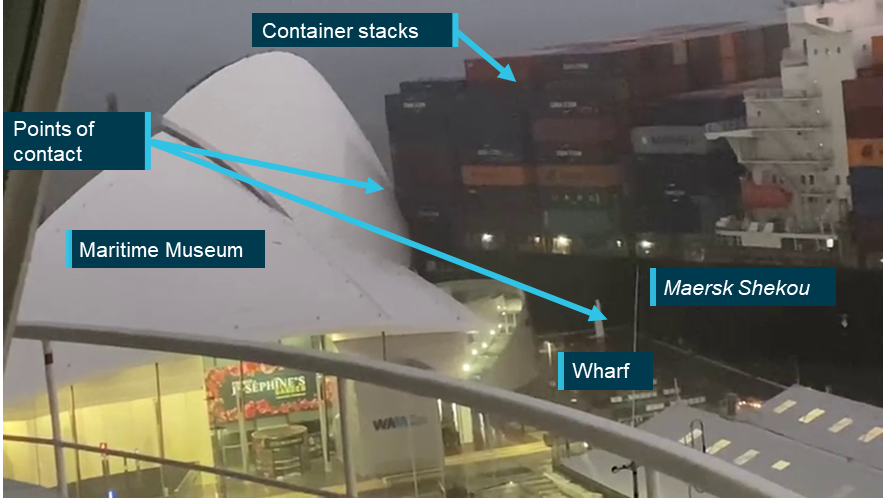
Source: Fremantle Port Authority, annotated by the ATSB
Thereafter, the vessel developed a slight forward motion and starboard swing, resulting in the edge of the wharf scraping against and rupturing the vessel’s hull by approximately 1.84 m x 0.51 m. The breach was situated above the waterline, and no ingress or egress resulted. Concrete and timber debris from the wharf lodged within the breached section of the hull as the vessel pulled away from the wharf (Figure 6).
Figure 6: Contact damage to Maersk Shekou’s hull
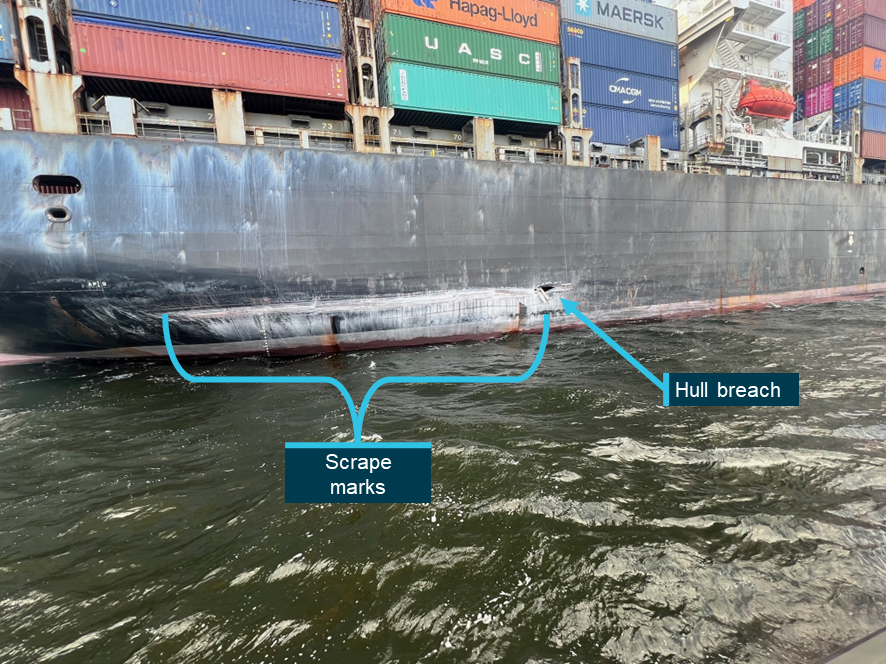
Source: Maersk Shekou’s P&I representative, annotated by the ATSB
At 0620:48, the pilot ordered the bow thrusters to be stopped and once the vessel’s stern had moved clear of the wharf, stopped the main engine. Subsequently, the pilots utilised the tugs, bow thrusters and the main engine to navigate the Maersk Shekou towards the centre of the channel. Meanwhile, the secondary pilot made phone calls to the VTSO and duty pilot to confirm the next course of action. On the harbour master’s instructions, the VTSO directed the Maersk Shekou to continue to its intended berth. It was also decided that 2 additional pilots would board the vessel to relieve the initial pilots of their duties for the berthing manoeuvre.
At 0631, the Maersk Shekou’s crew commenced retrieving the port anchor following the pilot’s instructions, and the 2 relief pilots boarded the vessel at 0713. Following a handover, the initial 2 pilots disembarked at 0810 and the port anchor was fully aweigh at 0812. The Maersk Shekou was then navigated into the inner harbour and safely made fast to its berth by 0930.
The Maersk Shekou sustained minor damage. The STS Leeuwin II sustained substantial damage and 2 of its crew members sustained minor injuries during the incident.
Context
Maersk Shekou
Maersk Shekou was a 333 m container ship built in 2010 by Daewoo Shipbuilding and Marine Engineering, Korea. It was registered in Singapore and classed with Lloyds Register Asia. At the time of the occurrence, the ship was owned by A.P. Moller Singapore Pte Ltd, managed by V Ships (Hamburg) GmbH & Co KG of Germany and operated by Maersk A/S of Denmark.
Maersk Shekou had a moulded breadth of 43.20 m and a depth of 24.50 m. At its summer draught of 14.52 m, the ship had a deadweight of 108,622 t and had a cargo capacity of 8,814 20‑foot equivalent (TEU)[15] containers. Propulsive power was provided by a single Doosan-MAN B&W 2‑stroke, single‑acting diesel engine that developed 57,100 kW at 104 RPM. The main engine drove a single, right-handed fixed-pitch propeller, which gave the ship a service speed of 24 knots. The ship was also equipped with an electrically‑driven controllable pitch propeller bow thruster producing 3,000 kW. Upon its arrival at Fremantle, the vessel had a maximum declared draft of 13.3 m, and displacement of 141,076 t.
Maersk Shekou had a crew of 26 Ukrainian, Lithuanian, Burmese and Romanian nationals. This included 4 mates with an additional third mate on board to assist in maintaining the rest hour requirements of the Standards of Training Certification and Watchkeeping for Seafarers (STCW) Code.[16]
The master had 35 years’ experience at sea and held a Ukrainian master mariner’s certificate of competency. They had sailed as master for 22 years and served in command of the Maersk Shekou for the last 12 years on a 3‑monthly on‑off rotation.
The chief mate held a Ukrainian master mariner’s certificate of competency, first obtained in 2021. They had been serving as an officer for 21 years. They had sailed as chief mate on the Maersk Shekou on a rotational basis for the last 12 years and had worked with the master for that time. The chief mate kept the 1600–1800 bridge watch at sea and usually formed part of the bridge team during port arrival and departure manoeuvring.
The helmsman at the time of the incident obtained their Burmese certificate of proficiency as an able seafarer in 2022 and had been with the operator for the last 10 years. They had joined Maersk Shekou 3 months before the incident and reported that they had visited the port of Fremantle once before. This was their first contract as an able seafarer.
STS Leeuwin II
STS Leeuwin II was Australia’s largest sail-training tall ship. It was a 3-masted 1850’s-style barquentine[17] built, owned and operated in Western Australia by the Leeuwin Ocean Adventure Foundation Limited, a registered Western Australian charity run by staff and volunteers. The ship was launched in 1986. It had a length overall of 55 m, 9 m beam and stood 33 m tall at its main mast. The tall ship was moored at B Shed in Victoria Quay, Fremantle Port.
The hull was constructed from welded steel, with a teak deck and 16 canvas sails. It was equipped to accommodate a full complement of 15 crew and 40 trainees.
STS Leeuwin II was used to run youth training programs, as part of the Leeuwin Ocean Adventure Foundation. In addition, the tall ship offered sailing tours to members of the public.
Port of Fremantle
The Port of Fremantle operated through 2 harbours: the Inner Harbour in Fremantle, at the entrance to the Swan River, and the Outer Harbour, about 22 km to the south at Kwinana.
The Inner Harbour handled almost all the container trade for Western Australia and also provided facilities for livestock exports, motor vehicle imports, other general cargo trades, cruise ships and visiting naval vessels.
The Fremantle Port Authority, operating under the name Fremantle Ports, was the port’s strategic manager. The port included a mix of facilities and services managed by Fremantle Ports and private operators. Fremantle Ports provided and maintained shipping channels, navigation aids, port infrastructure and amenities whereas services such as towage, line boats and bunkering were provided by the private sector. Pilotage service is provided by Fremantle Ports through a contract with Fremantle Pilots.
Fremantle vessel traffic services (VTS), operated by Fremantle Ports, provided ‘continuous monitoring of vessel movements within the VTS areas of Fremantle and Cockburn Sound.’ The service provided navigational advice using information from radar, vessels' own Automatic Identification System (AIS), and VHF radio, while also documenting all communications and relevant data.
To ensure the safe and efficient operation of vessels within port limits, Fremantle Ports issued mandatory directives by way of Harbour Master’s Instructions (HMI) which applied to commercial vessels operating within these limits. The HMI covered a range of operational, safety and procedural aspects.
HMI 03-2023 referred to Revised Operational Parameters for Large Container Vessels (LCV)[18] for their safe berthing and unberthing within the Port of Fremantle Inner Harbour. The instruction addressed towage, weather, daylight manoeuvring, pilotage and other operational considerations for large ships such as the Maersk Shekou, having a length overall greater than 310 m or beam exceeding 43 m.
Pilotage was compulsory within the port limits for vessels with LOA[19] exceeding 35 m. As noted in the Fremantle Ports operational parameters, LCV with length 310 m or greater required a 2-pilot operation.
LCV project
Between 2020 and 2023, Fremantle Ports worked in conjunction with Fremantle Pilots and Svitzer across various simulation manoeuvres at the Fremantle Maritime Simulation Centre (FMSC). This included a series of ‘live’ trials involving LCV being turned around while inbound into port. This process was adopted to improve port efficiency and enable vessels to depart port during hours of darkness. These operational trails and simulations culminated in the harbour master setting out the relevant revised parameters in HMI 03-2023.
Accordingly, Fremantle Pilots provided 2 pilots for the full pilotage of LCV and arranged for vessels between 310 m and 347 m LOA to be turned around on arrival inside the Inner Harbour, in a daylight-only manoeuvre.
In conjunction with HMI 03-2023, the Fremantle Ports operational parameters specified that for the daylight-only turning on arrival berthing manoeuvre:
Sunrise or Sunset is to coincide with the vessel’s position at the entrance [emphasis added] of the Inner Harbour Channel.
Fremantle pilots
Fremantle Pilots (FP) was a privately owned company[20] that provided continuous contracted pilotage services within the Port of Fremantle since 1994. FP was reported to pilot about 3,500 vessel movements annually. Pilot bookings were managed through the Port of Fremantle via the vessel’s contracted shipping agent. Prior to the incident, FP had been involved in approximately 400 LCV movements at the Port of Fremantle since February 2022 (when turning on arrival was mandated).
The pilot roster allocated a team of 5 pilots working on a 4‑day on/off rotational basis. While rostered on, 4 pilots worked a fixed 12‑hour shift each day and overlapped duties such that there were at least 2 pilots available at any given time. The remaining pilot assumed the duty pilot role and supplemented the 4 pilots on roster by arranging their transportation, reviewing HMI and marine notices and providing relevant feedback. If the rostered-on pilots were unable to manage the work demands, an additional standby pilot could be requested from those pilots on their break.
Both pilots assigned to Maersk Shekou on 30 August 2024 held an unrestricted licence as a port pilot issued by Fremantle Ports and a master mariner’s certificate of competency issued by the Australian Maritime Safety Authority (AMSA). The primary pilot had 36 years of pilotage experience overseas and in various Australian ports, and had worked for FP since 1997. The secondary pilot had been a pilot for 25 years, of which 20 had been with FP.
Towage
The towage requirements for ships entering the Port of Fremantle were set by the harbour master and outlined in the Port Information Guide. All tugs in the Port of Fremantle were privately owned and operated, and available 24 hours.
For LCV between 310 m and 336 m turning on arrival, the towage requirements prescribed in HMI 03-2023 mandated that 4 A‑Class[21] tugs were required for the inbound manoeuvre.
The latest revision of the Fremantle Ports operational parameters, as authorised by the harbour master on 14 March 2024, mandated that in respect of the LCV, the towing arrangement would comprise one escort tug and 3 other tugs.
The escort tug and the other tugs were required to be ‘on station’ at distances of 1.5 NM and 1.0 NM respectively from the inner harbour entrance.[22] Further, the escort tug was required to be made fast to the inbound ship by 1.0 NM from the inner harbour entrance, and the 3 other tugs were to be made fast by the inner harbour entrance buoys.
Towage services of the A-Class tugs were provided by Svitzer. Azimuth stern drive (ASD) tugs were by far the largest group of tugs within the Svitzer fleet, and the most popular tug type worldwide. This type of tug is equipped with 2 azimuth thrusters in nozzles at the stern. Some are also fitted with bow thrusters. The thrusters can be turned around 360°, enabling the propeller thrust to be in any direction. ASD tugs mainly tow over the bow with the towing winch and towing staple forward, but some are fitted with an aft winch and staple or a towing hook with the aft towing point aft of amidships. The bollard pull of the tugs used for the Maersk Shekou’s inbound manoeuvre varied between 65 tonnes and 80 tonnes.
Pilotage procedures
FP had documented procedures for pilot rostering and scheduling, fatigue management, passage planning and execution, which included the roles and responsibilities of pilots.
The procedures stated that in cases where a second pilot was scheduled as a secondary pilot for a pilotage movement:
- The primary pilot was responsible for preparing the passage plan, reviewing and agreeing to the same with the secondary pilot prior to joining the vessel. They were also responsible for completing the MPX with the master, the overall conduct of the vessel,[23] and maintaining and monitoring radio communications.
- The secondary pilot was to assist in pilotage and passage planning as instructed by the primary pilot. In addition, the secondary pilot was required to:
- set up the PPU
- participate in the MPX
- monitor all aspects of passage execution including turn execution
- support the primary pilot with communication and reporting
- maintain a log of events
- pack up the PPU on completion of the movement.
- The secondary pilot was also to remain prepared to take conduct of the vessel should the primary pilot become incapacitated at any time.
FP also had specific passage planning procedures in place for the full pilotage of LCV at Fremantle Port. The procedures included recommendations for the vessel’s speed during the various legs of the passage, wheel over and abort points, dynamic under keel clearance considerations, and the required information exchange with the vessel’s bridge team. The recommended turn radius at the various wheel over points, including the turn into the inner harbour, was 0.75 NM.
While the FP procedures specified locations to rendezvous with and make fast tugs, considerations were only made in respect of 3 tugs. There was no procedure detailed for the fourth tug that was required for LCV operations by the Port of Fremantle procedures.
For the approach into the inner harbour, the FP procedures stated that the dedicated escort tug was to be made fast to the vessel’s aft centre lead at a minimum of 7 cables from the inner harbour buoys, and the remaining 2 tugs were to be in position before the vessel arrived at North Mole.
Bridge resource management
Bridge resource management (BRM) is defined as the use and coordination of all the skills and resources (people, procedures and equipment) available to the entire bridge team to achieve the established goal of optimum safety and efficiency.[24] All individuals make errors, and BRM aims to minimise the occurrence and outcome of errors through the best possible use of resources. All ship’s navigators must have training, and demonstrate competence, in BRM techniques.
In areas of increased risk to safe navigation, one or more pilots are often added to the ship’s navigation team. The pilots’ local knowledge and practised piloting techniques are intended to reduce risks to an acceptable level. In the case of LCV operations at Fremantle port, the addition of a secondary pilot was deemed necessary.
Bridge resource management is a broad topic which covers many inter-related subjects, including but not limited to:
- shared mental model
- situational awareness
- error management
- contingency planning
- challenge and response
- distractions and interruptions.
The ship’s master and the pilots are responsible for taking steps to actively engage and include other members of the ship’s bridge team in the pilotage. Through effective BRM, all personnel involved in the navigation of the ship should have a clear understanding of, and expectations for, the pilotage. A clear understanding of the agreed passage plan and the establishment of a ‘shared mental model’ by the entire bridge team forms the basis of a safe voyage under coastal pilotage conditions.[25]
Navigational, operational and general safety priorities should be set and constantly reviewed in the context of the prevailing circumstances and conditions. Non-essential activity and distractions should be avoided, suppressed or removed.
Although section 326(3) of the Navigation Act 2012 provides that masters are not relieved of responsibility for the conduct and safe navigation of a vessel when the vessel is under pilotage, it is essential that coastal pilots work closely with masters and bridge teams to ensure that errors are detected and corrected as early as possible.
Weather
Pursuant to HMI 03-2023, Fremantle Ports had stipulated the maximum weather criteria for inbound LCV. For ships turning on arrival, such as the Maersk Shekou, the relevant parameters were:
- maximum wind: 20 knots[26]
- maximum current: 0.3 knots at swing circle (inner harbour) / 1.0 knots at railway bridge.
In the days leading up to 30 August, the Bureau of Meteorology (BOM)[27] had issued strong wind and gale warnings, with winds predicted to reach 35 knots at times. Accordingly, the Port of Fremantle was evacuated, and vessel movements were stopped during that time.
The BOM forecast issued during the late hours of 29 August predicted that ‘a vigorous west to south-westerly flow’ would ease that night, with 15–20 knot winds from the south-westerly direction forecast for Friday, 30 August. There was no strong wind or gale warning forecast for 30 August.
Fremantle Ports had also issued Shipping Agents’ Memos for the forecast adverse weather, advising of cessation of shipping movements within the port for this period.
The BOM forecast, issued at 0400 on 30 August, maintained an unchanged wind prediction, partly cloudy skies with a chance of showers, seas of 1.5 m, westerly to south-westerly swell of 2.5–4.0 m.
All BOM forecasts contain the following cautionary advice:
Wind and wave forecasts are averages. Wind gusts can be 40 per cent stronger than the forecast, and stronger still in squalls and thunderstorms.
Further investigation
To date, the ATSB has:
- interviewed the vessel’s master and crew, both pilots, tug skippers and VTSOs
- reviewed:
- recordings of relevant communications and written communications between various parties
- bridge recordings
- Fremantle Pilots and Fremantle Ports procedures
- Bureau of Meteorology data
- the vessel’s logs and records
The investigation is continuing and will include further review and examination of:
- pilots and crew actions including bridge resource management
- shipboard SMS, port and pilotage procedures for inbound vessels.
A final report will be released at the conclusion of the investigation. Should a critical safety issue be identified during the course of the investigation, the ATSB will immediately notify relevant parties so appropriate and timely safety action can be taken.
[1] The International Convention for the Safety of Life at Sea (SOLAS) Regulation V/26 provides the requirements with respect to testing and drills for steering and emergency steering.
[2] The vessel’s anemometer could display either true or relative wind speed, with the relative wind speed mode selected. Relative wind is the speed of the wind as experienced on the moving ship. Unless otherwise specified, wind speeds in this report are true wind speed, calculated using the ship’s anemometer values.
[3] Maersk Shekou carried 2 third mates, one keeping the 4–8 watch and the other the 8–12 watch.
[4] The shoulder is the area where a ship’s hull form changes from the bow shape to the parallel mid body, and the quarter is located at the stern of the ship.
[5] One knot, or one nautical mile per hour, equals 1.852 kilometres per hour. All ship speeds referred to in this report are ‘made good/over the ground’.
[6] The DWC is for vessels under pilotage from the Outer Pilotage Boarding Ground to berth, referred to as a 'full pilotage'.
[7] The Fremantle Port Authority operates a 24‑hour Vessel Traffic Service (VTS), with the call sign 'Fremantle VTS'.
[8] A Portable Pilot Unit is a specialised navigation device used by marine pilots to assist with navigation.
[9] One point refers to an angle of 11.25° on a compass.
[10] All ship’s headings in this report are in degrees by gyro compass.
[11] Full ahead is rated at 76 RPM on the Maersk Shekou.
[12] A ‘lift off’ instruction requires the tug to pull at a 90° angle to the ship’s fore and aft line.
[13] Indirect towage is a specialised towing technique effective at speeds between 6 to 10 knots where the tug uses its own thrust and drag effect to generate high towline assistance forces.
[14] Zero (0) degree mark on the rudder angle indicator.
[15] Twenty-foot Equivalent Unit, a standard shipping container. The nominal size of a ship in TEU refers to the number of standard containers that it can carry.
[16] International Maritime Organisation (IMO) 1978, International Convention on Standards of Training Certification and Watchkeeping for Seafarers, 1978, as amended (STCW Code), IMO, London.
[17] A barquentine is a sailing vessel with 3 or more masts, with a square rigged foremast and fore-and-aft rigged main, mizzen and any other masts.
[19] Length Overall
[21] Azimuth Stern Drive tug with a bollard pull of > 60T @ 85% Maximum Continuous Rating (MCR) over the bow.
[22] The inner harbour entrance is defined as the channel position abeam Buoys No. 1 and A.
[23] The master always remained in command of the vessel.
[24] Nijjer, R 2000 Bridge Resource Management: The Missing Link, Sea Australia 2000, Sydney.
[26] Wind speed is the 10‑minute average with maximum gusts not exceeding 10 knots above the 10-minute average parameter stated.
[27] Local Waters Forecast for Perth Waters
Occurrence summary
| Investigation number | MO-2024-001 |
|---|---|
| Occurrence date | 30/08/2024 |
| Location | Fremantle |
| State | Western Australia |
| Report release date | 03/11/2025 |
| Report status | Final |
| Investigation level | Defined |
| Investigation type | Occurrence Investigation |
| Investigation status | Completed |
| Mode of transport | Marine |
| Marine occurrence category | Collision |
| Occurrence class | Accident |
| Highest injury level | None |
Ship details
| Name | Maersk Shekou |
|---|---|
| IMO number | 9466984 |
| Ship type | Container Ship |
| Flag | Singapore |
| Departure point | Adelaide, South Australia |
| Destination | Fremantle, Western Australia |
Ship details
| Name | Leeuwin II |
|---|---|
| IMO number | 8510855 |
| Ship type | Sail Training Ship |
| Flag | Australia |