

Final report
Report release date: 28/05/2026
Investigation summary
What happened
On 29 January 2026, a Saab 340 aircraft, registered VH‑VEZ, was operating a scheduled passenger service from Canberra Airport, Australian Capital Territory, to Newcastle Airport, New South Wales, with 3 crew members and 19 passengers on board. During take-off, the left inboard main landing gear wheel separated from the aircraft.
After coordinating with air traffic control (ATC) the crew returned the aircraft to Canberra where it landed without incident. The crew shut down both engines on the runway, and the aircraft was towed to the apron, where passengers later disembarked. The main wheel was subsequently located against an internal airport fence.
What the ATSB found
Examination of the components found that the left inboard wheel separated due to failure of the wheel bearings. Due to the degree of damage sustained by the bearing components, it was not possible to determine the cause of the bearing failure.
What has been done as a result
As a result of this occurrence, the aircraft operator conducted a fleet‑wide inspection of main wheel assemblies and nose wheel assemblies for any defects. No faults were found on any aircraft at the time of inspection.
In addition, the operator implemented a proactive change to its wheel bearing maintenance schedule.
Safety message
This occurrence highlights the importance of effective communication and decision‑making in managing unexpected aircraft malfunctions. After being advised by ATC that a wheel had separated from the aircraft, the crew initially focused on climbing the aircraft to the minimum safe altitude, before taking time to apply standard operating procedures to plan a return to Canberra Airport.
Communication and coordination with ATC enabled confirmation of the specific missing wheel and emergency services preparation. In combination, these actions maintained safety margins and resulted in a safe landing.
The investigation
| The ATSB scopes its investigations based on many factors, including the level of safety benefit likely to be obtained from an investigation and the associated resources required. For this occurrence, the ATSB conducted a limited-scope investigation in order to produce a short investigation report, and allow for greater industry awareness of findings that affect safety and potential learning opportunities. |
The occurrence
On 29 January 2026, a Saab 340 aircraft, registered VH‑VEZ, was operating a scheduled passenger service from Canberra Airport, Australian Capital Territory, to Newcastle Airport, New South Wales, as flight FC201, with 3 crewmembers and 19 passengers on board. At 1548 local time, the aircraft taxied from the apron and conducted a take-off from runway 35.1
During the initial climb, air traffic control (ATC) advised the flight crew that a wheel had separated from the aircraft. In response, the crew requested and received clearance to maintain runway heading and climbed to the minimum safe altitude. They reviewed the quick reference handbook (QRH) for checklist items applicable to the event, however none were identified.
As the aircraft approached the limit of the Canberra Airport control area, the crew made the decision to return to the airport. They advised the cabin manager and ground staff of the decision. In coordination with ATC, the crew conducted a fly‑by of the control tower to allow for a visual inspection of the landing gear. Tower personnel confirmed that the left inboard main landing gear wheel was missing. The crew then commenced orbits on the eastern side of the airport to allow time for landing preparation, ensuring the landing performance calculations and briefing tasks were completed. They assessed that a normal landing configuration was most appropriate for the situation, and advised the cabin manager and passengers accordingly.
The crew notified ATC of their intention to return to land and emergency services were placed on standby. The captain declared a PAN2 while the first officer coordinated with company operations staff. The aircraft was subsequently positioned on an extended final approach to runway 35.
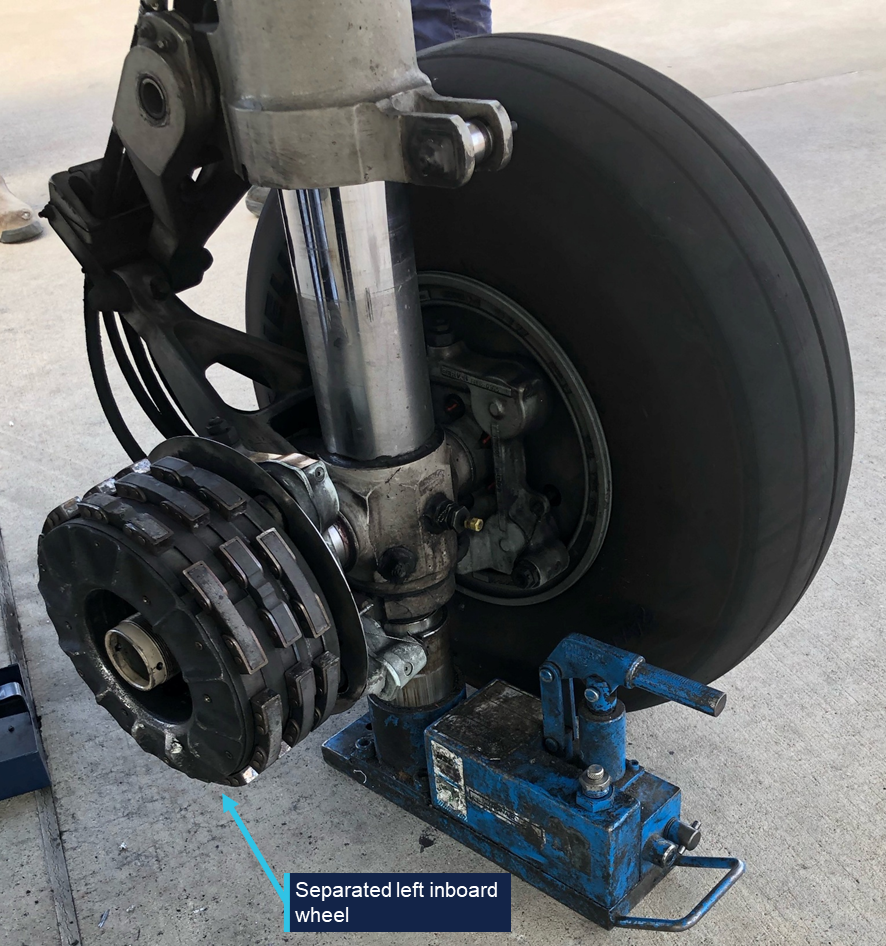
At 1611, the aircraft landed safely and was brought to a stop at the end of the runway (Figure 1). Airport emergency services reported no fire, smoke, or fluid leaks from the landing gear. The crew shut down both engines on the runway, and the aircraft was towed to the apron, where passengers were disembarked. Canberra Airport safety personnel located the main wheel against an internal airport fence on the eastern side of runway 35.
Figure 1: VH-VEZ left main landing gear with separated inboard wheel
Source: Aircraft operator
Context
Aircraft information
VH-VEZ was a Saab 340B, serial number 340B‑450. It was manufactured in Sweden in 1998 and was first registered in Australia on 18 November 2022. The aircraft was powered by 2 General Electric CT7‑9B turboprop engines, equipped with Dowty Aerospace R390/4‑123‑F propellers.
Main wheel assembly information
The Saab 340B main landing gear has an inboard and outboard main wheel, both with a brake assembly, attached to the main landing gear leg axle.
Main wheel assembly
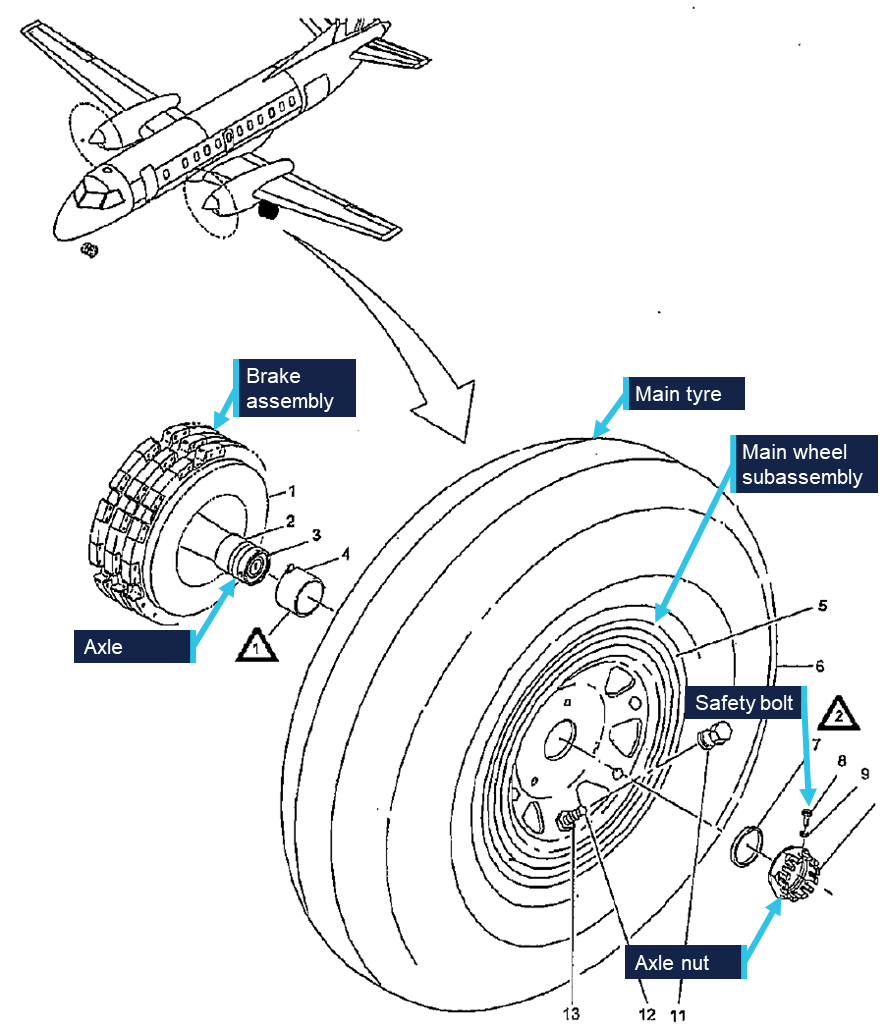
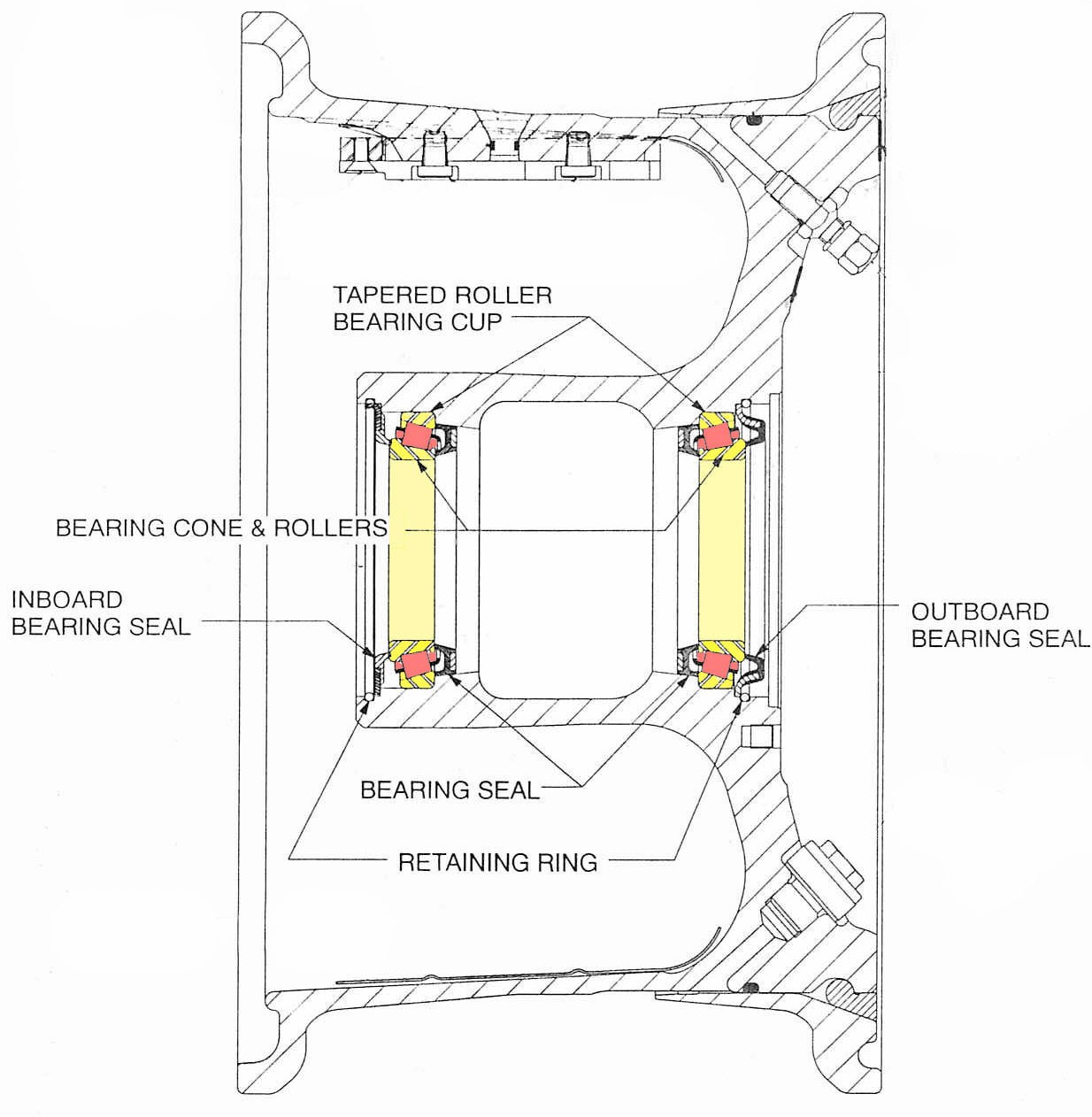
An overview of a main wheel is shown in Figure 2. The main wheel assembly consists primarily of the tyre and the wheel subassembly; also referred to as the wheel hub. The main wheel assembly connects to the axle via an inboard and outboard tapered roller bearing, installed in the wheel subassembly as shown in Figure 2. The main wheel assembly is held onto the axle via a single axle nut and safety bolt.
Figure 2: Saab 340 main wheel assembly
Source: Saab Aircraft Maintenance Manual, annotated by the ATSB
Figure 3: Wheel subassembly cross section with inner and outer bearings highlighted
Source: Meggitt Aircraft Braking Systems Component Maintenance Manual, amended by the ATSB
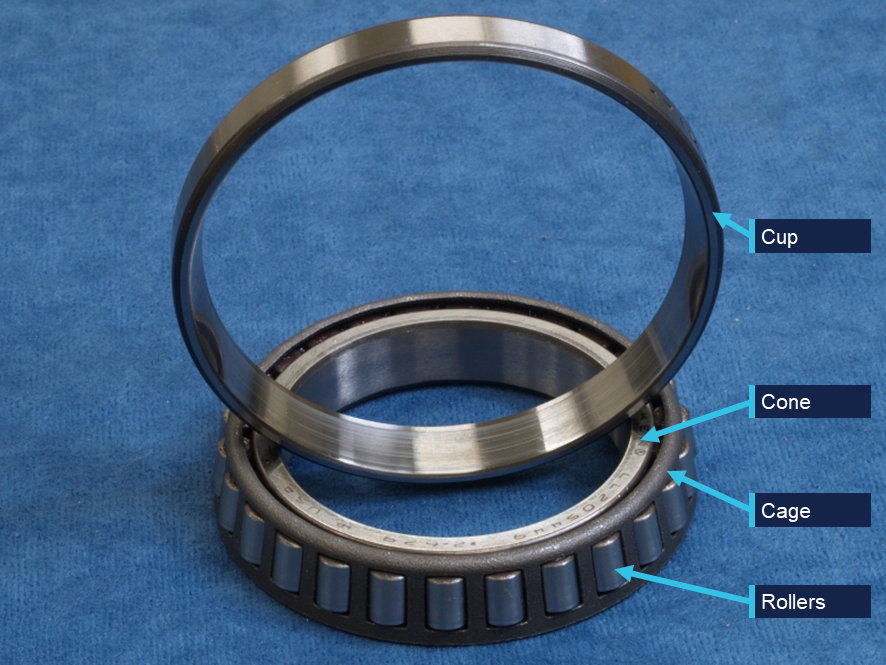
Each wheel subassembly bearing is comprised of a cup (outer race), cone (inner race), cage, and rolling elements (rollers) (Figure 4), held in place with a retaining ring. The bearing cups are shrink fitted into the wheel subassembly. Each bearing then has an inner and outer seal to protect it from contamination while preserving the grease lubrication. The cup or the cone-and-rollers can be replaced independently without changing the entire bearing.
Figure 4: Example bearing
Source: ATSB
Main wheel assembly examination
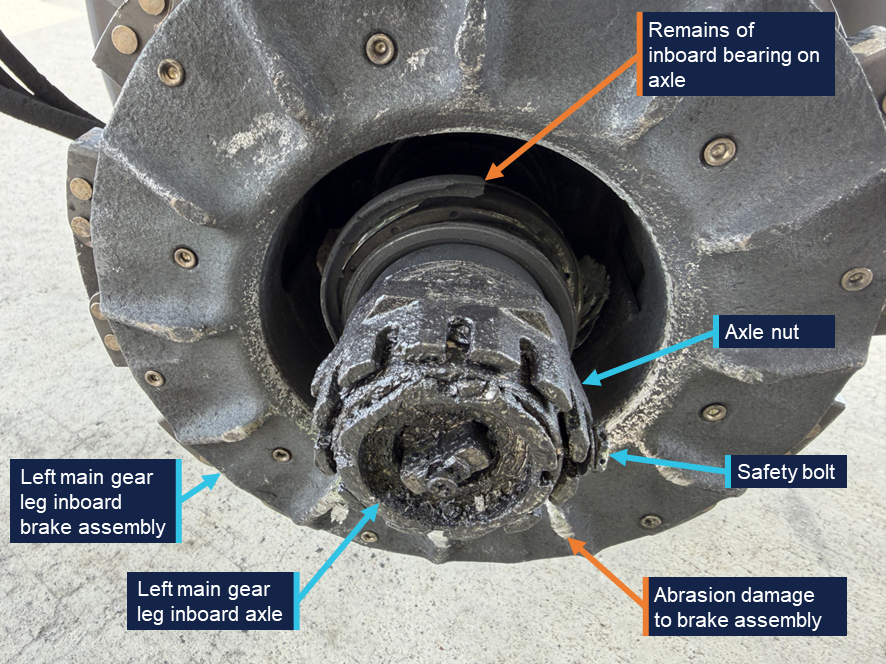
A post-incident inspection of the left main landing gear wheel and the main landing gear axle identified significant damage to both components. The axle nut and safety bolt remained in place on the axle (Figure 5). Remains of the inboard bearing were also identified on the axle, and there was visible abrasion to the brake assembly.
Figure 5: Left main gear leg inboard axle
Source: Aircraft operator, annotated by the ATSB
The tyre on the main wheel remained inflated and the fusible plug3 had not activated. The wheel face had sustained minor damage and the hub cap remained installed and was secured with safety wire. Grease residue was observed around the hub cap.
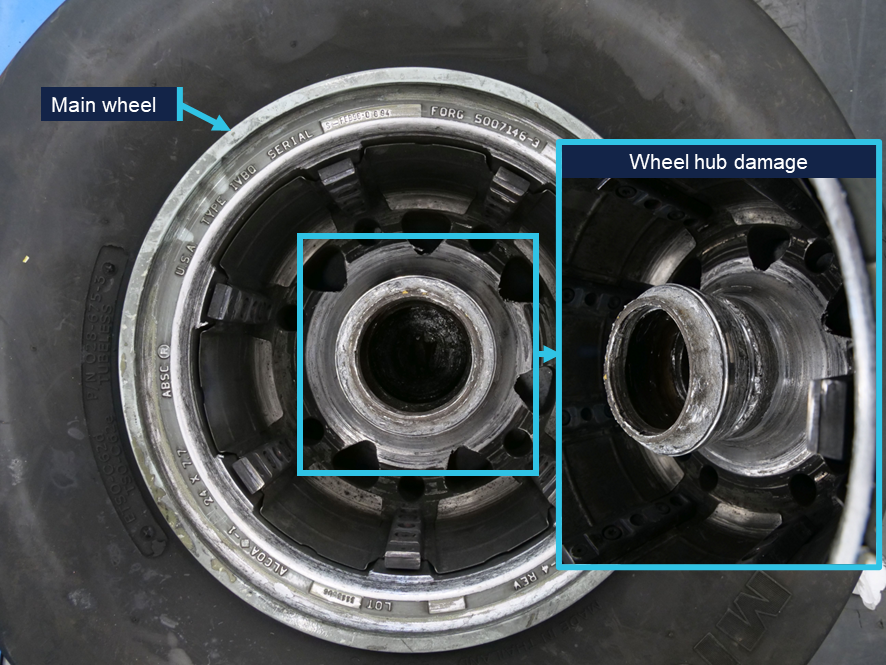
The inboard side of the wheel sustained significant damage (Figure 6). A circumferential fracture surface was visible on the inboard region of the hub encompassing the inboard bearing cone seat. The hub surfaces in proximity to the brake assembly when the wheel is installed exhibited deep rotational gouging and scoring.
Figure 6: Main wheel hub damage
Source: ATSB
Pieces of bearing material were found with the wheel, including 13 roller elements, fragments of the roller cages and bearing seals. The outboard cup remained installed in the wheel. All of the bearing races exhibited significant damage and smearing,4 including deformation from impact with loose rollers. Both cones had heat colouration as evidence of exposure to high temperatures.
The fractured sections of wheel hub also had evidence of heat damage. To the extent that could be established,5 the ATSB did not identify any evidence of progressive cracking or pre-existing defect that might have contributed to the fracture.
Main wheel assembly history
The main wheel assembly part number 5010488-2 and serial number APR93‑1167, was manufactured by the Aircraft Braking Systems Corporation (ABSC), now Meggitt Aircraft Braking Systems (MABS), in April 1993. The wheel was installed on VH‑VEZ on 11 December 2025 following an overhaul on 26 November 2025. Maintenance records documented the history of work on the wheel assembly in accordance with maintenance instructions. During those workshop visits, bearing cups and/or cone‑and‑rollers were replaced, however, the records did not specify whether the replaced components were installed in the inboard or outboard positions.
Component maintenance procedures
Service letter (SL) SL-GS-366 and component maintenance manual (CMM) 32-41-167 outlined the wheel inspection and overhaul schedules, and maintenance procedures for this type of wheel. The CMM stated that wheels are an ‘on condition’ part, meaning there was no defined service life and that inspections, tests and checks were used to determine the condition of the wheel and subcomponents with regard to continued serviceability.
Two key procedures given in the CMM include tyre change and overhaul.
Tyre change
The tyre change procedure was carried out when a tyre was worn to its tread limit. This involved removing the worn tyre, conducting a detailed visual inspection of the whole wheel assembly and non-destructive (eddy current or ultrasonic) inspection of specific areas. At each tyre change, the bearing cones, cups and rollers were cleaned, inspected and regreased prior to install. Parts were replaced when they failed to meet the inspection criteria within the CMM.
Overhaul
At an overhaul, wheels had to undergo a full tyre change inspection plus eddy current, ultrasonic or fluorescent penetrant inspection of the whole wheel. The SL stated that overhauls for fixed wing commercial aircraft wheels should be performed at maximum intervals of 5 tyre changes, or 1,500 cycles,8 whichever occurred first.
Operator’s maintenance process
The operator contracted an external maintenance organisation to conduct wheel tyre changes and overhauls for its Saab fleet. The operator advised the ATSB that the average cycles between tyre changes is 260, meaning that the wheel and bearings are inspected approximately every 260 cycles.
Previous occurrences
The aircraft manufacturer provided the ATSB with data on similar reported occurrences from global Saab 340B operators. Since 1997 there have been 14 reported occurrences relating to a main landing gear wheel departing the aircraft, one of which (AO-2008-046) was investigated by the ATSB, and 2 occurrences of bearing failures where the wheel did not depart the aircraft.
The aircraft manufacturer advised the ATSB that it had not identified any trends or variations related to loss of wheel or main wheel bearing failure occurrences. In 2008, the aircraft manufacturer released a service newsletter highlighting the importance of rotating the wheel while torquing the wheel axle nut to prevent axial play, which can result in bearing failures.
AO-2008-046
On 6 July 2008, a Saab 340B aircraft departed Orange for a scheduled flight to Sydney, New South Wales.
During take-off, the right outboard main wheel detached from the aircraft. The crew continued to Sydney where the aircraft landed without further incident.
Examination of the components identified that the wheel detachment occurred due to a failed wheel bearing. It was possible that the failure was related to a lubrication or setting (installation) issue, however the degree of damage sustained by the bearing components prevented a determination of the specific failure mechanism.
As a result of that occurrence, the aircraft operator implemented a range of safety actions, including a review of wheel bearing maintenance procedures, and an audit of main wheel axle nut torques across the fleet.
Safety analysis
As the aircraft rotated, the left inboard main landing gear wheel separated from the aircraft. Post-flight inspection of the aircraft identified that the axle nut remained secured on the end of the axle. As such, the potential mechanisms for wheel detachment were limited to a fracture of the wheel or bearing failure.
The level of damage to both bearings, and the absence of any identified pre-existing cracking or defect on the fractured hub pieces supported failure of the bearings as the initiating event. The hub fracture was assessed as secondary, the result of abnormal loading during continued wheel rotation with collapsed bearings.
The bearing failure allowed the wheel to move axially outward, pass over the axle nut, and separate once it was no longer restrained on the landing gear axle.
A bearing failure may have resulted from various initiating factors including:
- material or manufacturing defect
- improper installation
- insufficient lubrication
- corrosion
- material fatigue
- contamination by foreign material.
The condition of the bearing races and the other retained bearing fragments did not provide clear evidence as to an initiating event for the failure. Maintenance records indicated that the wheel was installed and maintained in accordance with the relevant maintenance instructions, and there was a history of replacement of the bearing components.
Additionally, all components were inspected during the overhaul on 26 November 2025 prior to being installed on VH-VEZ, and the wheel had subsequently completed 271 cycles on VH-VEZ. Taken together, they opposed failure being the result of an installation or maintenance error.
Findings
ATSB investigation report findings focus on safety factors (that is, events and conditions that increase risk). Safety factors include ‘contributing factors’ and ‘other factors that increased risk’ (that is, factors that did not meet the definition of a contributing factor for this occurrence but were still considered important to include in the report for the purpose of increasing awareness and enhancing safety). In addition ‘other findings’ may be included to provide important information about topics other than safety factors. These findings should not be read as apportioning blame or liability to any particular organisation or individual. |
From the evidence available, the following finding is made with respect to the main landing gear wheel separation involving Saab 340, VH-VEZ, Canberra Airport, Australian Capital Territory, on 29 January 2026.
Contributing factors
- During take-off, the left main landing gear inboard wheel bearings failed, resulting in the wheel separating from the aircraft. The cause of the bearing failure could not be determined.
Safety actions
| Whether or not the ATSB identifies safety issues in the course of an investigation, relevant organisations may proactively initiate safety action in order to reduce their safety risk. The ATSB has been advised of the following proactive safety action in response to this occurrence. |
Aircraft operator
In response to the occurrence, the operator conducted a fleet‑wide inspection of main wheel assemblies and nose wheel assemblies for any defects. No faults were found on any aircraft at the time of inspection.
In addition, the operator has elected to replace wheel bearings on-condition or at every second wheel overhaul, whichever occurs first.
Sources and submissions
Sources of information
The sources of information during the investigation included the:
- first officer
- operator
- aircraft manufacturer
- aircraft component manufacturer.
Submissions
Under section 26 of the Transport Safety Investigation Act 2003, the ATSB may provide a draft report, on a confidential basis, to any person whom the ATSB considers appropriate. That section allows a person receiving a draft report to make submissions to the ATSB about the draft report.
A draft of this report was provided to the following directly involved parties:
- flight crew
- operator
- aircraft manufacturer
- aircraft component manufacturer
- Civil Aviation Safety Authority
- Airservices Australia.
A submission was received from the operator.
The submission was reviewed and, where considered appropriate, the text of the report was amended accordingly.
Purpose of safety investigationsThe objective of a safety investigation is to enhance transport safety. This is done through:
It is not a function of the ATSB to apportion blame or provide a means for determining liability. At the same time, an investigation report must include factual material of sufficient weight to support the analysis and findings. At all times the ATSB endeavours to balance the use of material that could imply adverse comment with the need to properly explain what happened, and why, in a fair and unbiased manner. The ATSB does not investigate for the purpose of taking administrative, regulatory or criminal action. About ATSB reportsATSB investigation reports are organised with regard to international standards or instruments, as applicable, and with ATSB procedures and guidelines. Reports must include factual material of sufficient weight to support the analysis and findings. At all times the ATSB endeavours to balance the use of material that could imply adverse comment with the need to properly explain what happened, and why, in a fair and unbiased manner. An explanation of terminology used in ATSB investigation reports is available here. This includes terms such as occurrence, contributing factor, other factor that increased risk, and safety issue. Publishing informationReleased in accordance with section 25 of the Transport Safety Investigation Act 2003 Published by: Australian Transport Safety Bureau © Commonwealth of Australia 2026 
Ownership of intellectual property rights in this publication Unless otherwise noted, copyright (and any other intellectual property rights, if any) in this report publication is owned by the Commonwealth of Australia. Creative Commons licence With the exception of the Commonwealth Coat of Arms, ATSB logo, and photos and graphics in which a third party holds copyright, this report is licensed under a Creative Commons Attribution 4.0 International licence. The CC BY 4.0 licence enables you to distribute, remix, adapt, and build upon our material in any medium or format, so long as attribution is given to the Australian Transport Safety Bureau. Copyright in material obtained from other agencies, private individuals or organisations, belongs to those agencies, individuals or organisations. Where you wish to use their material, you will need to contact them directly. |
- ^ Runway number: the number represents the magnetic heading of the runway. The runway identification may include L, R or C as required for left, right or centre.
- ^ PAN PAN: an internationally recognised radio call announcing an urgency condition which concerns the safety of an aircraft or its occupants but where the flight crew does not require immediate assistance.
- ^ The fusible plug is a safety device to prevent tyre explosion by deflating the tyre when a specific temperature is reached.
- ^ Deformation of metal associated with shear loading.
- ^ Not all of the separated wheel hub sections were recovered and there was limited deformation of the fracture surface.
- ^ SL-GS-36 was first issued in July 1993. The most recent revision, version 7, was issued in January 2006.
- ^ CMM 32-41-16 was first issued in April 1992. The most recent revision, revision 6, was issued in April 2014.
- ^ A cycle is a completed take-off and landing sequence.
Occurrence summary
| Investigation number | AO-2026-008 |
|---|---|
| Occurrence date | 29/01/2026 |
| Occurrence time and timezone | 1609 Eastern Daylight-saving Time |
| Location | Canberra Airport |
| State | Australian Capital Territory |
| Report release date | 28/05/2026 |
| Report status | Final |
| Investigation level | Short |
| Investigation type | Occurrence Investigation |
| Investigation status | Completed |
| Mode of transport | Aviation |
| Aviation occurrence category | Diversion/return, Landing gear/indication, Objects falling from aircraft |
| Occurrence class | Incident |
| Highest injury level | None |
Aircraft details
| Manufacturer | Saab Aircraft Co. |
|---|---|
| Model | 340B |
| Registration | VH-VEZ |
| Serial number | 340B-450 |
| Aircraft operator | Vee H Aviation Pty Ltd |
| Sector | Turboprop |
| Operation type | Part 121 Air transport operations - larger aeroplanes |
| Activity | Commercial air transport-Scheduled-Domestic |
| Departure point | Canberra Airport, Australian Capital Territory |
| Destination | Williamtown Airport, New South Wales |
| Injuries | None |
| Damage | Minor |