

Summary
The ATSB is investigating a collision with terrain involving a Van's RV-8A, registered VH-MKX, near Heck Field aircraft landing area, Queensland, on 27 January 2026.
The pilot had planned to conduct a private flight from Heck Field to Barraba, New South Wales, with one passenger on board. Shortly after becoming airborne off runway 28, the aircraft collided with terrain. The pilot and passenger were fatally injured, and the aircraft was destroyed.
To date, the ATSB investigation has:
- evaluated the accident site and aircraft wreckage
- interviewed witnesses and other parties
- collected closed circuit television footage
- analysed aircraft weight and balance
- recovered of the engine from the accident site for more detailed examination
- collected of maintenance and pilot records.
The continuing investigation will include:
- detailed inspection of components recovered from the accident site
- analysis of video and audio recordings
- examination of pilot and maintenance records
- assessment of related occurrences.
The ATSB released a preliminary report, which details factual information established in the investigation’s early evidence collection phase, on 31 March 2026. See below.
A final report will be released at the conclusion of the investigation. Should a critical safety issue be identified during the course of the investigation, the ATSB will immediately notify relevant parties, so that appropriate safety action can be taken.
Last updated:
Preliminary report
Report release date: 31/03/2026
This preliminary report details factual information established in the investigation’s early evidence collection phase, and has been prepared to provide timely information to the industry and public. Preliminary reports contain no analysis or findings, which will be detailed in the investigation’s final report. The information contained in this preliminary report is released in accordance with section 25 of the Transport Safety Investigation Act 2003.
The occurrence
Accident flight details
Early on the morning of 27 January 2026, the pilot of a Van’s Aircraft RV-8A, registered VH‑MKX, commenced preparation for a private flight from the Heck Field aeroplane landing area, Queensland, to Barraba, New South Wales. At 0328 local time, the pilot submitted a location briefing request to the National Aeronautical Information Processing System[1] through OzRunways.[2] At 0450, the pilot and their passenger were observed arriving at Heck Field by security. The pilot later lodged a flight plan with Airservices Australia at 0528 to depart at 0600 and land at Barraba at 0900. At 0538, closed circuit television (CCTV) footage recorded the pilot and passenger boarding the aircraft, with the pilot sitting in the front seat and the passenger in the rear seat.
The pilot taxied the aircraft to the start of runway 28[3] and commenced the take-off roll. At 0550:14, the aircraft entered the view of the CCTV around 100 m from the runway threshold and was observed accelerating (Figure 1). Fifteen seconds later, the aircraft had travelled around 350 m whereupon it lifted off, flying just above and along the runway surface. At 0550:32, the aircraft began to sink, after which it pitched up and began to climb with wings level. The climb ceased at 0550:41, then the aircraft started to descend. The footage showed that the right wing dropped and the aircraft subsequently collided with terrain at 0550:43. Both occupants sustained fatal injuries and the aircraft was destroyed.
Figure 1: Montage of frames from CCTV showing the accident flight path
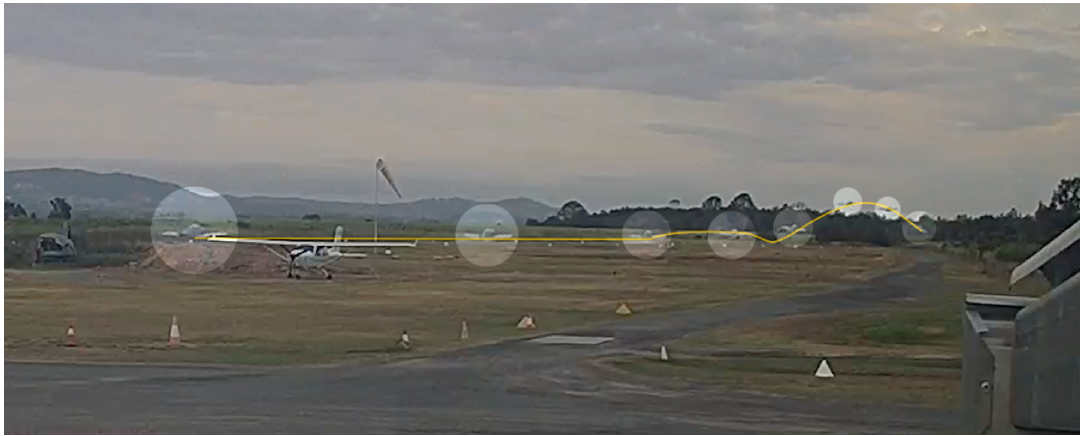
The image has been cropped to show the later portion of the flight. The yellow line shows the indicative path of travel for the aircraft. Source: Heck Field airfield CCTV, annotated by the ATSB
Witness observation
An earwitness located at Heck Field reported that their attention was drawn to the sound of the aircraft due to what they described as abnormal engine noises that developed during the take‑off.
Context
Pilot information
The pilot held a Private Pilot Licence (Aeroplane), issued in 1975, and a Private Pilot Licence (Helicopter), issued in 1993. Their total aeronautical experience was reported to be about 5,500 hours. The available flight records indicated they had flown about 60 hours in the last 6 months. The pilot held a valid class 5 aviation medical certificate[4] through self‑declaration of fitness to fly on 15 December 2025.
Aircraft information
General
The Van’s Aircraft RV-8A is a low-wing, all-metal, amateur-built aircraft. It is supplied in kit form and is designed to be constructed for the education and recreation of the owner. The RV-8A has 2 seats in tandem configuration, has a fixed, tricycle landing gear, and is suitable for cross-country flying or for flying aerobatic manoeuvres.
Construction of VH-MKX, serial number 82025, was completed in 2015.[5] It was fitted with a 4-cylinder, horizontally opposed Subaru EJ25 engine modified for aircraft use driving a MT Propellor 3-blade electric constant speed propeller.
A special certificate of airworthiness in the experimental category[6] was issued in 2024. The aircraft was sold to the pilot of the accident flight in January 2025. The most recent maintenance record available to the investigation, dated 8 January 2025, indicated that the aircraft had accrued 614.5 hours time since new.
Meteorological information
There was no Bureau of Meteorology weather monitoring station for Heck Field, however, the graphical area forecast valid for the time and area did not indicate any significant weather phenomena. The airfield CCTV recorded the windsock movements during the take‑off and indicated a south-easterly wind (between 100º to 160º) at around 5 to 10 kt. Geoscience Australia recorded sunrise at the airfield to be 0515.
Recorded information
The aircraft was not fitted with, nor was it required to have, a flight data recorder or cockpit voice recorder. The aircraft was fitted with an electronic flight instrument system that had the capacity to record flight and engine parameters. This device was damaged beyond the ability to recover data.
Automatic dependent surveillance broadcast (ADS-B)[7] flight tracking data was obtained from ADS-B Exchange, which identified 3 data points for the accident flight (Figure 2). The final data point identified an aircraft ground speed of 68 kt.
CCTV (no audio available) of the take-off was recorded by the Gold Coast Sport Flying Club. Another camera at a nearby industrial property recorded audio of the accident flight in which the sounds of the aircraft engine were apparent. The engine was audible for around 40 seconds and the engine revolutions per minute fluctuated periodically for that time.
Figure 2: Flight tracking data and location of closed-circuit television cameras

Source: Google Earth and ADS-B Exchange flight tracking data, annotated by the ATSB
Wreckage and impact information
The accident site was about 360 m from the end of runway 28, on the same heading, in an area of lightly timbered bushland with some felled trees. The distribution of the wreckage indicated that the aircraft collided with terrain right-wing low, at a high angle of entry, and at a relatively slow speed. The aircraft came to rest inverted and facing in the opposite direction to its flightpath. An immediate fuel-fed, post‑impact fire developed into a bushfire in the surrounding area that required a firefighting helicopter to contain.
The fire destroyed the aircraft, limiting the extent to which it could be examined (Figure 3). However, all major aircraft components were accounted for at the accident site. Examination of the flap actuator indicated that the flaps were at or near the fully extended position. Damage to the propeller blades showed that the engine was operating at impact. The engine was recovered from the accident site and taken to a facility for detailed inspection by Queensland Police Service vehicle inspection officers under the supervision of the ATSB. The engine was extensively damaged by the fire, which limited the examination. However, based on the available evidence, no obvious malfunction was identified.
Figure 3: Aircraft at the accident site destroyed by the post-impact fire
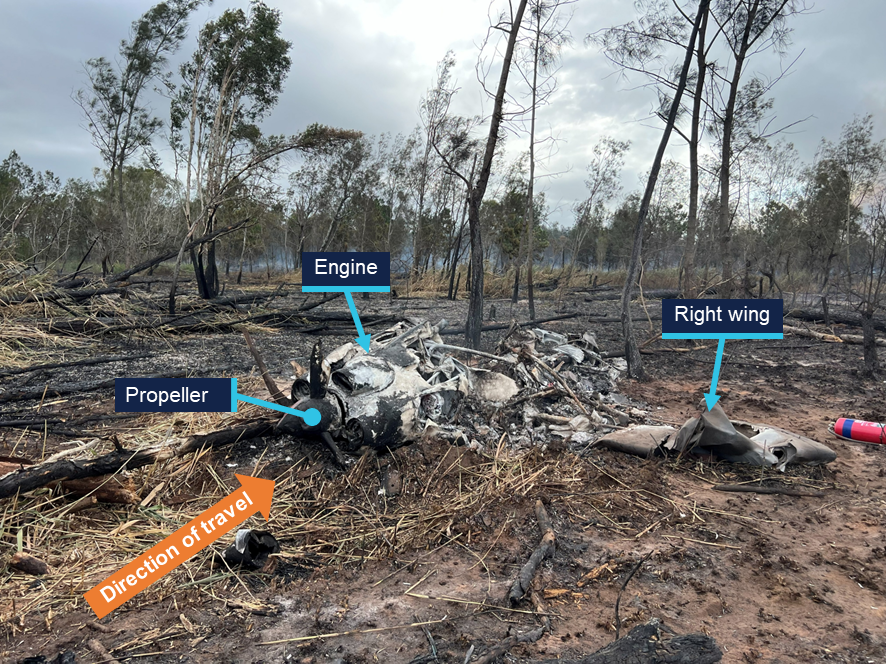
Source: Queensland Police Service, annotated by the ATSB
Further investigation
To date, the ATSB has:
- examined the wreckage and accident site
- recovered and examined the engine
- recovered and examined avionics components
- interviewed involved parties with knowledge of the pilot, passenger, and the aircraft
- collected aircraft and pilot documentation.
The investigation is continuing and will include:
- review of aircraft maintenance and pilot documentation
- further analysis of the take-off sequence using the CCTV recordings and other recorded data
- review of the post-mortem information and survivability factors.
A final report will be released at the conclusion of the investigation. Should a critical safety issue be identified during the course of the investigation, the ATSB will immediately notify relevant parties so appropriate and timely safety action can be taken.
Acknowledgements
The ATSB acknowledges the assistance provided by the Queensland Police Service, the Queensland State Emergency Services, and the Gold Coast Sport Flying Club during the onsite phase of the investigation and additional examination of the engine.
Purpose of safety investigationsThe objective of a safety investigation is to enhance transport safety. This is done through:
It is not a function of the ATSB to apportion blame or provide a means for determining liability. At the same time, an investigation report must include factual material of sufficient weight to support the analysis and findings. At all times the ATSB endeavours to balance the use of material that could imply adverse comment with the need to properly explain what happened, and why, in a fair and unbiased manner. The ATSB does not investigate for the purpose of taking administrative, regulatory or criminal action. About ATSB reportsATSB investigation reports are organised with regard to international standards or instruments, as applicable, and with ATSB procedures and guidelines. Reports must include factual material of sufficient weight to support the analysis and findings. At all times the ATSB endeavours to balance the use of material that could imply adverse comment with the need to properly explain what happened, and why, in a fair and unbiased manner. An explanation of terminology used in ATSB investigation reports is available here. This includes terms such as occurrence, contributing factor, other factor that increased risk, and safety issue. Publishing informationReleased in accordance with section 25 of the Transport Safety Investigation Act 2003 Published by: Australian Transport Safety Bureau © Commonwealth of Australia 2026 
Ownership of intellectual property rights in this publication Unless otherwise noted, copyright (and any other intellectual property rights, if any) in this report publication is owned by the Commonwealth of Australia. Creative Commons licence With the exception of the Commonwealth Coat of Arms, ATSB logo, and photos and graphics in which a third party holds copyright, this report is licensed under a Creative Commons Attribution 4.0 International licence. The CC BY 4.0 licence enables you to distribute, remix, adapt, and build upon our material in any medium or format, so long as attribution is given to the Australian Transport Safety Bureau. Copyright in material obtained from other agencies, private individuals or organisations, belongs to those agencies, individuals or organisations. Where you wish to use their material, you will need to contact them directly. |
[1] The National Aeronautical Information Processing System is a multi-function, computerised, aeronautical information system that allows users, such as pilots, to obtain weather information and submit flight plans into the air traffic system.
[2] OzRunways is an electronic flight bag application that provides navigation, weather, area briefings and other flight information. It provides the option for live flight tracking by transmitting the device’s position and altitude.
[3] Runway number: the number represents the magnetic heading closest to the runway orientation. In this case 280º.
[4] The class 5 medical self-declaration allows recreational and private pilots to self-assess and self-declare without requiring a medical assessment. Eligibility and operational limitations apply.
[5] This registration and serial number had been previously used for a Van’s RV-8A that was involved in an accident on 1 October 2010. Some components, such as the avionics and electrical system, from the original aircraft were fitted to the accident aircraft.
[6] Experimental category: the Civil Aviation Safety Authority can issue experimental certificates to allow specific operations of aircraft, which are not by their nature type certificated or have modifications incorporated that are not yet approved. Pilots and passengers of experimental aircraft in Australia accept the risk that the aircraft may not meet the same airworthiness safety standards as certified aircraft and, therefore, operate on the basis of informed participation. Informed participation relies on the premise that before the participant takes part, or pays for an activity, they are fully aware of the potential risks and consequences.
[7] Automatic dependent surveillance-broadcast is a surveillance technology in which an aircraft determines its position via satellite navigation and periodically broadcasts it, enabling it to be tracked.
Occurrence summary
| Investigation number | AO-2026-005 |
|---|---|
| Occurrence date | 27/01/2026 |
| Occurrence time and timezone | 0551 Australian Eastern Standard Time |
| Location | Near Heck Field aeroplane landing area |
| State | Queensland |
| Report release date | 31/03/2026 |
| Report status | Preliminary |
| Anticipated completion | Q1 2027 |
| Investigation level | Defined |
| Investigation type | Occurrence Investigation |
| Investigation phase | Examination and analysis |
| Investigation status | Active |
| Mode of transport | Aviation |
| Aviation occurrence category | Collision with terrain |
| Occurrence class | Accident |
| Highest injury level | Fatal |
Aircraft details
| Manufacturer | Amateur Built Aircraft |
|---|---|
| Model | RV-8A |
| Registration | VH-MKX |
| Serial number | 82025 |
| Sector | Piston |
| Operation type | Part 91 General operating and flight rules |
| Activity | General aviation / Recreational-Sport and pleasure flying-Pleasure and personal transport |
| Departure point | Heck Field aeroplane landing area, Queensland |
| Destination | Barraba aeroplane landing area, New South Wales |
| Injuries | Crew - 1 (fatal), Passengers - 1 (fatal) |
| Damage | Destroyed |