

Final report
Report release date: 05/02/2026
Investigation summary
What happened
On 18 October 2025, a Go Ballooning Gold Coast balloon pilot and a ground crew member were preparing for a scheduled sunrise sightseeing flight near Beaudesert, Queensland. Weather forecasts indicated light winds and some clearing rain. The operator’s tour manager arrived at the launch site at about 0500 local time with 24 passengers booked for the flight. As the crew began the envelope cold inflation, a change in wind direction pushed the partially inflated balloon envelope across the field, striking 2 light posts near the road. After the crew recovered the balloon from the light posts, it was relocated with the help of the passengers. An inspection by the pilot identified a tear in one of the upper envelope panels.
The pilot, who was also the maintainer, estimated the tear to be about 45 cm and conducted a field repair using specialised adhesive tape. After checking the weather conditions were suitable for launch, the pilot assessed the repair was sufficient to continue with the proposed flight. The crew boarded the passengers, and the balloon departed the Beaudesert launch site.
During the latter part of the flight, the repair degraded, allowing air to escape from the balloon’s envelope. The pilot continued the flight to the chosen landing site as planned and landed the balloon without further incident.
What the ATSB found
The ATSB found that the position selected within the launch site did not provide sufficient clearance from nearby obstacles, which resulted in damage to the balloon’s envelope after being moved by an unexpected wind gust.
The envelope repair using adhesive tape was not conducted in accordance with the manufacturer’s requirements, and the pilot did not fully understand the manufacturer’s limits for field repairs for the tear location and did not review the manufacturer’s written requirements before proceeding with the repair.
The pilot’s decision to continue with the intended flight was likely influenced by the pilot’s perception of the expectations of the waiting passengers, along with the improvement in weather conditions and the pilot’s confidence in the repair. Subsequent in‑flight deterioration of the repair emphasised the potential risk of the tear propagating which increased the risk to occupants on board. However, the pilot continued for the remaining 5–10 minutes of the flight rather than landing immediately.
Safety message
Balloon repairs must be conducted in accordance with the manufacturer’s instructions.
Non-approved repairs that appear to work without consequence can normalise unsafe practices over time and represent a significant risk to all occupants on board. Operators and maintainers should be familiar with the approved maintenance standards and practices before commencing any repair work.
Pilots and maintainers should also be aware of external and internal commercial pressures to continue a flight without fully researching and conducting an appropriate repair.

The ATSB SafetyWatch highlights the broad safety concerns that come out of our investigation findings and from the occurrence data reported to us by industry. One of the safety concerns is Reducing passenger injuries in commercial ballooning operations.
The investigation
The occurrence
On 18 October 2025, a Kubíček BB142P hot-air balloon, registered VH-RRP, was being operated by Go Ballooning Gold Coast on a sightseeing flight from Beaudesert, Queensland.
The pilot, who was also the operator and maintenance controller, obtained relevant weather information from the Bureau of Meteorology and via a phone‑based weather application, Rain Parrot, to assess the weather conditions and plan the proposed flight.
The pilot picked a familiar launch site location in a large open field adjacent to a supermarket car park, which they had operated from numerous times previously.
The pilot and a ground crew member arrived at the launch site (Figure 1) at about 0300 to unload and prepare the balloon for launch. The balloon basket was positioned close to the public road bordering the launch area. This position was within 10 m of a public road and about 20 m from nearby light posts bordering the shopping centre car park.
Figure 1: Location of balloon launch site

Source: Google Earth, annotated by the ATSB
As per Go Ballooning Gold Coast’s operational procedure the pilot released several helium pibal[1] balloons to observe wind conditions at different levels for the intended flight and confirmed the launch site suitability for the planned flight.
The pilot and ground crew member were preparing the balloon by cold inflation,[2] when the pilot described that the wind speed increased to about 6 kt and changed direction. At a time that could not be determined, the partially inflated balloon envelope moved from a north-east to a south-west position around the basket that was secured to the front of a 4-wheel drive car. The crew attempted to restrain the balloon by pulling on the crown line,[3] but were unable to stop the movement of the envelope. The balloon envelope continued to travel across the public road and struck 2 light posts (Figure 2) in the shopping centre car park. During recovery from one of the light posts, it sustained a tear to the upper section of the envelope.
Figure 2: Photograph of balloon after striking light posts

Source: Supplied, annotated by the ATSB
At about 0500 local time, the tour manager and 24 passengers, booked for the scheduled sunrise flight, arrived at the launch site on the operator’s bus.
After the crew retrieved the balloon envelope it was deflated and packed up with the assistance of some of the passengers.
The balloon was then repositioned away from the obstacles and laid out for the pilot to inspect for any damage. The pilot identified a tear in the upper section of the envelope, above the balloon equator.[4] The pilot estimated the tear to be about 45 cm in length (Figure 3), and no other damage was identified.
The pilot reported that they had previously carried out field repairs on balloons and was confident that the specialised adhesive tape provided from the manufacturer would temporarily fix the tear to allow the flight to proceed as planned.
After the pilot applied the tape, the balloon was fully inflated with hot air and was visually inspected. The pilot reported that they believed the repair was sufficient to continue with the flight. About 20 minutes after completing the repair and following an assessment that the wind speed was within the allowable limits for launch, the pilot decided to continue with the flight as scheduled. A safety briefing was given to the passengers before boarding, and the flight proceeded at about 0550.
Figure 3: Photograph of damage to balloon envelope

Source: Supplied, annotated by the ATSB
The pilot reported that after take-off, the balloon tracked in a southerly direction, opposite to the intended direction of flight for about 30 minutes. The pilot reported that about 5–10 minutes before arriving at a newly planned landing site, heat at the top of the balloon likely caused the adhesive repair tape to weaken, partially re-opening the tear and allowing a small, uncontrolled venting of air. The pilot reported not being concerned and continued to the planned landing site. The balloon landed safely at 0620 at Kerry, Queensland, about 17 km south of Beaudesert.
Context
Pilot information
The pilot was the owner and operator of Go Ballooning, operating sightseeing balloon flights and private charters in south-east Queensland, since 2015.
They held a Civil Aviation Safety Authority (CASA) Commercial Pilot (Balloon) Licence and had over 20 years of experience with 2,299 total flying hours at the time of the incident. In the previous 2 weeks the pilot had flown about 6.5 hours in VH-RRP. The pilot held a current CASA class 2 aviation medical certificate, a valid CASA maintenance authority (MA) for balloons and a valid Kubíček maintenance certificate.
The pilot reported having slept their normal 7–8 hours prior to the incident and self‑assessed as ‘1’ on a fatigue scale of 1–7 where 1 is fully alert and 7 is completely exhausted.
Balloon information
VH-RRP was manufactured in 2022 by the Kubíček factory in Czechia and could operate with a maximum of 24 passengers and 1 pilot. The balloon was registered to Go Ballooning Australia on 9 December 2022.
The BB142P balloon envelope had a volume of 14,158 m2 and was about 30 m in diameter and almost 34 m in height which supported a maximum take-off weight of 4,500 kg (Figure 4). The balloon envelope was constructed of 32 gores[5] and was inflated by hot air from 4 burners connected to 4 independent fuel systems.
Figure 4: Schematic of a Kubíček balloon
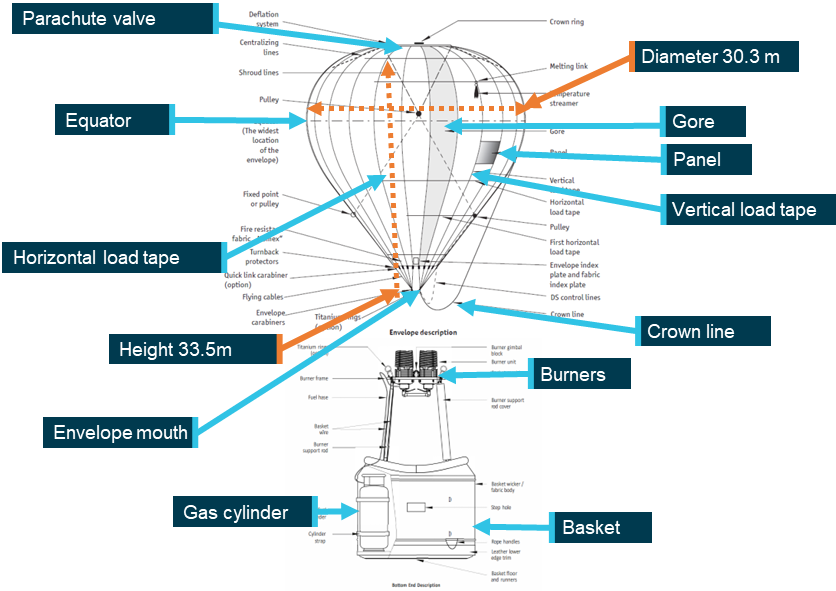
Envelope and basket not to scale. Source: Adapted from the Kubíček hot air balloon flight manual (section 1), annotated by the ATSB
A manned free balloon certificate of airworthiness was issued on 16 February 2023, and the balloon had accumulated a total time of 369.6 hours in service and the basket 942 hours at the time of the event.
Meteorological information
The ATSB obtained relevant weather data from the Bureau of Meteorology. For Beaudesert, observations for wind were recorded at 1-minute intervals at ground level about 3 km to the north-west of the launch site. Between 0448 and 0515, surface winds were reported as west to north-westerly at approximately 3 kt, shifting through the west to a southerly, then south‑easterly at approximately 2 kt from 0516 through to the launch time of 0550. The forecast temperature for Amberly, (about 50 km to the north-west of the launch site) at the time of the launch was around 16°C.
The pilot recalled that, at the time of preparation, forecast conditions for the time of the launch were:
- light and variable winds
- unrestricted visibility
- no low cloud, a few scattered high-level clouds.
Regulatory oversight
Operators require a Civil Aviation Safety Authority (CASA) Air Operator’s Certificate (AOC) to conduct balloon transport operations under Part 131 of the Civil Aviation Safety Regulations (CASR).
The Part 131 Manual of Standards (MOS) sets out the specific requirements for these operations. The MOS does not specify size requirements for balloon launch sites, however an operator is required to keep records of launch and landing sites. This includes a description of each launch and landing site with maps, diagrams, and records of any hazards associated with the site and any limitations or restrictions. The documented information is required to form part of the operator’s exposition.[6]
CASA Advisory Circular (AC) 131-02 v4.0 specifies in section 8.2 Ground Handling:
Operators and PIC [pilot in command] are recommended to consider the hazards or risks to persons or property that might arise during any of the following activities:
• laying out, inflation and preparation for launch
• take-off and climb
• landing, normal deflation and pack up
• relocation of inflated balloon on the ground
• use of the handling line for hot air balloons
• use of the trail rope for gas balloons.
Pre-flight damage assessment and repair
After contact with the light posts and inspection of the envelope, the pilot identified an estimated 45 cm tear, located above the equator of the balloon in gore 22, panel 26 (Figure 5) and no other damage. The pilot, who was also a maintenance authority, applied specialised adhesive tape to the tear as they had reportedly done on previous occasions for temporary field repairs on minor fabric damage.
Figure 5: Location of tear in balloon envelope VH-RRP

Source: Photograph supplied; diagram from Kubicek maintenance manual, annotated by the ATSB
Manufacturer instructions for envelope repair
The operator’s exposition outlined the pre-flight procedures with a list of pre-flight inspections and checks for the balloon which included verifying the envelope integrity in accordance with damage limitation in the Kubíček Hot Air Balloon Flight Manual (BFM).
The BFM provides information on the damage limits applicable to various sections of the balloon. Different sections of the balloon envelope are subject to varying thermal loads, internal pressures and fabric tensions during operation. Therefore, the structural consequences of damage will differ depending on where the damage is located on the envelope. The hottest and highest structurally loaded area of the balloon envelope is above the equator.
The operator accessed the BFM and the Kubíček Maintenance Manual(BMM) for the BB142P model.
The BFM stated that repairs above the first horizontal load tape are limited to:
…small holes or tears of no more than 5 mm (1/4 in) in any direction. The integrity of the panel must not be affected by the holes or tears.
Any damage exceeding the above limits must be repaired prior the next flight according to the instructions given by the Kubicek Maintenance Manual
For damage limitation the BFM warning states:
Any damage to the fabric weakens the fabrics resistance to tear and causes localized heating of the fabric around that damage. Damage exceeding those listed above increase the potential of propagating a tear or hole and is unacceptable for flight.
The BMM (section 3.21) repair guidance for using an adhesive patch above the equator, stated:
Adhesive Patch without Overstitching:
If the damage is not more than 2.5 cm (1") in any dimension. There must be minimum of 10 cm (4") between any two damaged locations on a single panel.
Adhesive Patch with Overstitching:
If the damage is not more than 10 cm (4“) in any dimension. May not be used if the damage extends to within 2.5 cm (1“) of a load tape. There must be a minimum of 10 cm (4“) between any two adhesive patches on a single panel.
A further note also stated that:
Always check adhesion of the patch as the adhesive may adhere differently on different materials (polyester vs. polyamide, ripstop, etc.) and its adhesion may also be affected by outside temperature, age and dustyness of the fabric, and other factors. When in doubt, use sewn patch.
Balloon envelope damage
The size (45 cm) and location (above the equator) of the tear significantly exceeded the limit to use adhesive tape for repair. The BMM stated that a sewn partial panel or panel with the same material as used in the original panel was required for a tear of this size. The panel repair is designated as a category B repair which covers the common maintenance tasks that may be carried out by individuals who have undertaken a manufacturer maintenance course and hold a valid manufacturer maintenance certificate. The approved method to repair the damage, as detailed in the BMM, required the affected panel to be repaired in accordance with the manufacturer's directions before further flight.
Operational information
Launch site selection and preparation
The pilot reported that between 40 and 50 sites were used for launching and landing balloons, with agreements in place with landowners to access several private properties on the Gold Coast. The operator’s exposition included documented information for each site, including the Beaudesert launch site. The balloon basket was positioned close to the public road bordering the launch area. While this suited the southerly wind at the time for the balloon layout, it left little clearance from other obstacles in the circumstances of a wind shift.
Passenger briefings
The pilot reported that the passenger briefing was given prior to boarding the passengers. It was described as the operator’s standard briefing and included details on the brace position for landing, that passengers should not enter or exit the balloon until the pilot has given permission and that smoking was strictly prohibited.
Balloon envelope damage in-flight
The operator’s exposition referred to the manufacturer’s flight manual for emergency procedures. The Kubíček BFM stated that in the event of damage to the envelope in‑flight the balloon should be kept flying at a low altitude to avoid a hard landing and landed as soon as possible.
Safety risk
ATSB investigation 198900820 illustrated that damage to the envelope of a balloon that propagates to the point where it rapidly deflates can have disastrous implications for flight safety.
On 13 August 1988, 2 hot air balloons, VH-NMS and VH-WMS, were operating tourist flights near Alice Springs Airport. VH-WMS departed about 2 minutes ahead of VH-NMS and climbed to about 4,000 ft AMSL (2,000 ft AGL) and drifted in a westerly direction. After reaching 4,000 ft, VH-WMS commenced descending as VH-NMS climbed towards it. VH‑NMS continued climbing until its envelope collided with the basket of VH-WMS, tearing a large hole in the envelope fabric. The disruption to the envelope of VH-NMS prevented the balloon maintaining inflation and it descended uncontrolled until it collided with terrain. The pilot and 12 passengers were fatally injured.
Safety analysis
During the envelope pre-inflation for a scheduled sunrise sightseeing balloon flight, the wind suddenly increased and changed direction pushing the balloon envelope into contact with 2 nearby light posts. This caused a tear in a panel above the equator of the envelope greater than the manufacturer’s allowable limit. The pilot applied adhesive tape to repair the damage while passengers waited. After hot inflation and inspection of the repair, the pilot then decided to operate the flight as scheduled. The repair subsequently degraded in‑flight however a safe landing was made.
This analysis will explore the assessment of the launch location, damage assessment and repair, as well as factors relating to the continuation of the flight.
Launch site
The pilot selected a regular launch site and although the site had been used previously, the positioning of the basket and envelope layout for the flight did not provide sufficient available space to ensure clearance of surrounding obstacles at all times during the balloon’s preparation for flight, increasing the risk of envelope damage.
A wind change occurred at a critical part of envelope inflation, causing the envelope to contact nearby light poles. During recovery from the light pole, the envelope sustained damage.
Repair
The onsite repair did not comply with the operator’s exposition which required repairs to be conducted in accordance with balloon manufacturer’s instructions.
Although adhesive tape was allowed for smaller tears up to 10 cm in that area of the envelope, this tear was at least 45 cm. The decision to apply adhesive tape for the repair indicated that the pilot, who was also the maintainer, did not fully understand the manufacturer’s requirements relating to envelope damage limits and did not review the manufacturer’s written requirements before proceeding with the repair.
The absence of any other obvious deformation of the envelope, or further tearing after the tape was applied, was interpreted that the repair was sufficient. Previous experience repairing minor damage with the adhesive tape likely reinforced the perception that this was an adequate method for this repair, even though 45 cm was beyond admissible damage where such repair was permitted.
Had the pilot consulted the hot air balloon flight manual, a sewn panel repair would have necessitated the postponement or cancellation of the flight. The pilot’s decision to repair the tear to enable the planned flight to continue without consulting the manufacturer’s envelope repair requirements increased the risk of further in-flight envelope tear propagation, potentially leading to catastrophic envelope failure and a subsequent uncontrolled descent.
Flight continuation
Research has shown that many aviation accidents involve a ‘plan continuation bias’ or ‘plan continuation error’.[7] That is, pilots decide to continue with the original plan of action despite the presence of cues or information that suggests changing the course of action would be the safer option (Orasanu and others 2001; Orasanu 2010). Plan continuation bias is often associated with situations involving dynamically changing risk and pilots underestimating the risk level (Orasanu and others 2001; Wiegmann and others 2002).
The absence of any immediate deterioration in the tape repair after hot inflation likely reinforced the pilot's belief that the envelope was airworthy. The pilot’s expectation that the balloon was serviceable, supported the pilot’s desire to continue the flight. Improving stability in the surface wind direction and strength then provided an opportunity to launch the balloon.
With the 24 passengers already arrived and waiting, it was likely the pilot perception of the passengers’ expectations was also a strong motivator to continue and influenced the pilot’s decision to conduct the flight. The weight of the perceived passenger expectation would likely have the pilot searching for solutions to enable the flight to proceed, rather than cancelling and rescheduling the flight to conduct repairs.
The manufacturer’s flight manual instructions were to land as soon as possible following in‑flight envelope damage. While the pilot reported awareness of the tape repair degrading in flight, they did not assess the need to land earlier.
Findings
ATSB investigation report findings focus on safety factors (that is, events and conditions that increase risk). Safety factors include ‘contributing factors’ and ‘other factors that increased risk’ (that is, factors that did not meet the definition of a contributing factor for this occurrence but were still considered important to include in the report for the purpose of increasing awareness and enhancing safety). In addition, ‘other findings’ may be included to provide important information about topics other than safety factors. These findings should not be read as apportioning blame or liability to any particular organisation or individual. |
From the evidence available, the following findings are made with respect to the flight with damaged envelope involving Kubíček BB142P, VH‑RRP, near Beaudesert, Queensland, on 18 October 2025.
Contributing factors
- The location in the launch area did not provide adequate clearance from obstacles during inflation.
- A change in the wind direction caused the partially inflated balloon envelope to move and strike 2 light posts, resulting in significant envelope damage.
- The pilot identified the tear and conducted a repair not in accordance with the balloon manufacturer’s requirements, increasing the risk of in‑flight envelope failure.
- The pilot continued with the intended flight, likely due to their confidence in the repair, improvement in the weather conditions and perceived passenger expectations. When the repair failed, the pilot continued for the remaining 5-10 minutes of the flight rather than landing immediately.
Sources and submissions
Sources of information
The sources of information during the investigation included:
- the pilot of the incident flight
- Civil Aviation Safety Authority
- Bureau of Meteorology
- balloon manufacturer
- witness
- video footage of the accident flight and other photographs taken on the day of the accident.
References
ATSB (1989) Kavanagh Hot Air Balloon E-260, VH-NMS, 14 km SSE of Alice Springs Airport NT, 13 August 1989 198900820
Kubíček Balloons, Flight manual B3102 3rd edition, revision 19, 2017.
Kubíček Balloons, Maintenance manual B3202 3rd edition, revision 10, 2017.
Orasanu, J., Martin, L., & Davison, J. (2001). Cognitive and contextual factors in aviation accidents: Decision errors. In Linking expertise and naturalistic decision making (pp. 209-225). Psychology Press.
Orasanu, J. M. (2010). Flight crew decision-making. In Crew resource management (pp. 147-179). Academic Press.
Wiegmann, D. A., Goh, J., & O'Hare, D. (2002). The role of situation assessment and flight experience in pilots' decisions to continue visual flight rules flight into adverse weather. Human factors, 44(2), 189-197.
Submissions
Submissions were received from:
- the pilot of the incident flight
- Civil Aviation Safety Authority
- Bureau of Meteorology.
The submissions were reviewed and, where considered appropriate, the text of the report was amended accordingly.
Purpose of safety investigationsThe objective of a safety investigation is to enhance transport safety. This is done through:
It is not a function of the ATSB to apportion blame or provide a means for determining liability. At the same time, an investigation report must include factual material of sufficient weight to support the analysis and findings. At all times the ATSB endeavours to balance the use of material that could imply adverse comment with the need to properly explain what happened, and why, in a fair and unbiased manner. The ATSB does not investigate for the purpose of taking administrative, regulatory or criminal action. About ATSB reportsATSB investigation reports are organised with regard to international standards or instruments, as applicable, and with ATSB procedures and guidelines. Reports must include factual material of sufficient weight to support the analysis and findings. At all times the ATSB endeavours to balance the use of material that could imply adverse comment with the need to properly explain what happened, and why, in a fair and unbiased manner. An explanation of terminology used in ATSB investigation reports is available here. This includes terms such as occurrence, contributing factor, other factor that increased risk, and safety issue. Publishing informationReleased in accordance with section 25 of the Transport Safety Investigation Act 2003 Published by: Australian Transport Safety Bureau © Commonwealth of Australia 2026 
Ownership of intellectual property rights in this publication Unless otherwise noted, copyright (and any other intellectual property rights, if any) in this report publication is owned by the Commonwealth of Australia. Creative Commons licence With the exception of the Commonwealth Coat of Arms, ATSB logo, and photos and graphics in which a third party holds copyright, this report is licensed under a Creative Commons Attribution 4.0 International licence. The CC BY 4.0 licence enables you to distribute, remix, adapt, and build upon our material in any medium or format, so long as attribution is given to the Australian Transport Safety Bureau. Copyright in material obtained from other agencies, private individuals or organisations, belongs to those agencies, individuals or organisations. Where you wish to use their material, you will need to contact them directly. |
[1] Pibal: a lighter-than-air gas‑filled small rubber balloon used to estimate wind speed and direction at the launch (take-off) site and in the first few hundred feet above the surface.
[2] Cold inflation is the initial stage of inflating a hot air balloon. Cold air is forced into the envelope prior to using the burners.
[3] Crown line: a rope connected to the top of the balloon envelope used to control the balloon’s position during inflation.
[4] The equator of the balloon is the widest part of the balloon envelope in diameter. The loss of hot air from a same size tear would be greater when the tear was higher in the balloon.
[5] A gore is a section of fabric running from the top to the bottom of the envelope.
[6] An exposition is a Part 131 document detailing an organisation's policies and processes, specific to each operator.
[7] In terms of continuing a flight to the original destination, plan-continuous bias is often known as ‘mission‑itis’, ‘get‑home‑itis’ and ‘press‑on‑itis’.
Occurrence summary
| Investigation number | AO-2025-065 |
|---|---|
| Occurrence date | 18/10/2025 |
| Occurrence time and timezone | 04:45 Australian Eastern Standard Time |
| Location | Near Beaudesert |
| State | Queensland |
| Report release date | 05/02/2026 |
| Report status | Final |
| Investigation level | Short |
| Investigation type | Occurrence Investigation |
| Investigation status | Completed |
| Mode of transport | Aviation |
| Aviation occurrence category | Aircraft preparation, Airframe - Other, Collision |
| Occurrence class | Serious Incident |
| Highest injury level | None |
Aircraft details
| Manufacturer | Kubicek Factory |
|---|---|
| Model | BB142P |
| Registration | VH-RRP |
| Serial number | 2052 |
| Aircraft operator | Go Ballooning Gold Coast Pty Ltd |
| Sector | Balloon |
| Operation type | Part 131 Balloons and hot air airships |
| Activity | Commercial air transport-Non-scheduled-Joyflights / sightseeing charters |
| Departure point | Near Beaudesert, Queensland |
| Destination | Near Beaudesert, Queensland |
| Injuries | None |
| Damage | Minor |