

Final report
Report release date: 07/05/2026
Investigation summary
What happened
On 8 October 2025 at about 0719 local time, a Robinson R44 Raven I helicopter, registered VH-XSO and operated by GBR Helicopters, departed Thursday Island, Queensland, with 2 passengers on board to conduct work related to their employment on Coconut Island (Poruma), 55 NM (102 km) north-east of Horn Island.
While en route at about 600 ft above sea level, the low rotor RPM horn sounded, and the pilot reacted by immediately lowering the collective lever and entered autorotation. The pilot suspected a total engine power loss and transmitted a MAYDAY call, deployed the emergency pop-out floats and instructed the passengers to brace.
The helicopter landed on the water and immediately began to roll onto its left side as the left side float detached from the helicopter’s skid tube. The pilot instructed the passengers to evacuate, with the rear seat passenger and pilot egressing on the right side and the front left passenger egressing from their left door, under water.
The 3 occupants were able to inflate their lifejackets and climb on board the partially submerged helicopter.
An emergency locator transmitter activation was received by the Joint Rescue Coordination Centre who initiated a rescue. The pilot’s MAYDAY call was also heard by the pilot of another helicopter in the area that diverted to the accident location and provided updated information on the welfare of the occupants.
The rescue helicopter arrived about 50 minutes after the ditching and winched the 3 people on board before transferring them to Thursday Island Hospital. During the winching operation, one of the people being rescued impacted the submerged wreckage, fracturing a rib.
The pilot and passengers received serious injuries from chemical burns from exposure to aviation gasoline in the water while waiting to be rescued. Subsequently, the helicopter sank and was not able to be located or recovered.
What the ATSB found
During the cruise at about 600 ft while operating over the ocean, the helicopter engine had a total power loss, forcing the pilot to conduct a forced landing onto the ocean surface.
The pilot transmitted an effective MAYDAY call, activated the pop-out floats and instructed the passengers to brace prior to ditching. This improved the occupants' survivability during and after the ditching. Further, the operator’s use of constant wear lifejackets likely increased the ease and speed of use by the occupants (compared to pouch-worn lifejackets), enhancing their survivability post-accident.
Although the passengers flew regularly as part of their employment, on this occasion the pilot did not provide the passengers with information on the appropriate brace position during the pre-flight safety briefing. Subsequently, when the pilot instructed them to brace for impact, both passengers adopted inappropriate brace positions that increased the risk of injury.
During the ditching, the left pop-out float detached causing the helicopter to roll in the water. This reduced the likelihood of timely emergency egress and exposed the occupants to fuel in the water that resulted in chemical burns.
GBR Helicopters did not provide company pilots with a survival emergency locator transmitter for all overwater flights. Although it did not influence the outcome on this occasion, it had the potential to reduce the post‑impact survivability of a ditching event by relying on the onboard automatic emergency locator transmitter.
Queensland Department of Education employees who regularly flew over water in helicopters as passengers were not provided with helicopter underwater escape training (HUET) which increased the risk of drowning in the event of a ditching.
One of the occupants of the ditched helicopter likely sustained an additional serious injury after impacting the wreckage while being winched during their rescue.
Safety message
Passengers, who regularly fly in helicopters for their employment, are not always provided with aviation‑specific training including helicopter underwater escape training (HUET).
Research has shown that disorientation, entanglement with debris, unfamiliarity with seat belt release mechanisms and difficulty locating or opening exits, are commonly cited as hazards when attempting to escape from a helicopter following an in-water accident. HUET provides participants with familiarity with the crash environment and improves occupant confidence in their ability to manage an in-water emergency egress situation. Individuals and organisations whose employees regularly travel in helicopters over water are encouraged to consider the potential life-saving benefits of HUET for their employees in otherwise survivable helicopter accidents.
The accident highlighted the importance of an effective MAYDAY transmission. With limited time before landing on the water, the pilot’s broadcast alerted other aircraft to their identity and approximate location, resulting in another helicopter arriving at the accident site about 11 minutes after the ditching. Situations requiring a MAYDAY call are often intense and time‑limited, and calculation of an accurate position may not always be possible. The ATSB reminds pilots that, as in this situation, an accurate location, transmitted effectively during an emergency, will likely reduce response time during a rescue and increase the survivability of occupants.
Summary video
The occurrence
Departure and cruise
On the 8 October 2025, at about 0705 local time, the pilot of a Robinson R44 Raven I helicopter, registered VH-XSO, operated by GBR Helicopters Pty Ltd, ferried the helicopter from Horn Island Airport, Queensland, to Sadie’s Helipad on the south-eastern side of Thursday Island, Queensland, about 4 NM north-west of Horn Island Airport.
On arrival at Sadie’s Helipad the pilot shut down the helicopter and commenced a safety briefing for 2 passengers employed by the Queensland Department of Education. Both passengers were familiar with the R44 helicopter, having flown in the model numerous times as part of their employment. The pilot assisted the passengers to board the helicopter, seating one passenger in the rear right seat, behind the pilot and the other in the front left seat.
The non-scheduled air transport passenger flight was planned from Thursday Island (Figure 1) direct to Coconut Island (Poruma), about 55 NM (102 km) north-east of Horn Island Airport, where the passengers were to conduct duties related to their employment before the flight continued to Warraber Island and then return to Thursday Island.
At 0719, the helicopter became airborne from Sadie’s Helipad and climbed to an altitude of about 600 ft above sea level. Once they had passed over Wednesday Island, the pilot recalled they conducted a ‘CLEAR-OFF’1 check to assess the helicopter’s performance and position, the check indicated the helicopter was operating normally and on track for its destination.
Figure 1: VH-XSO flight track
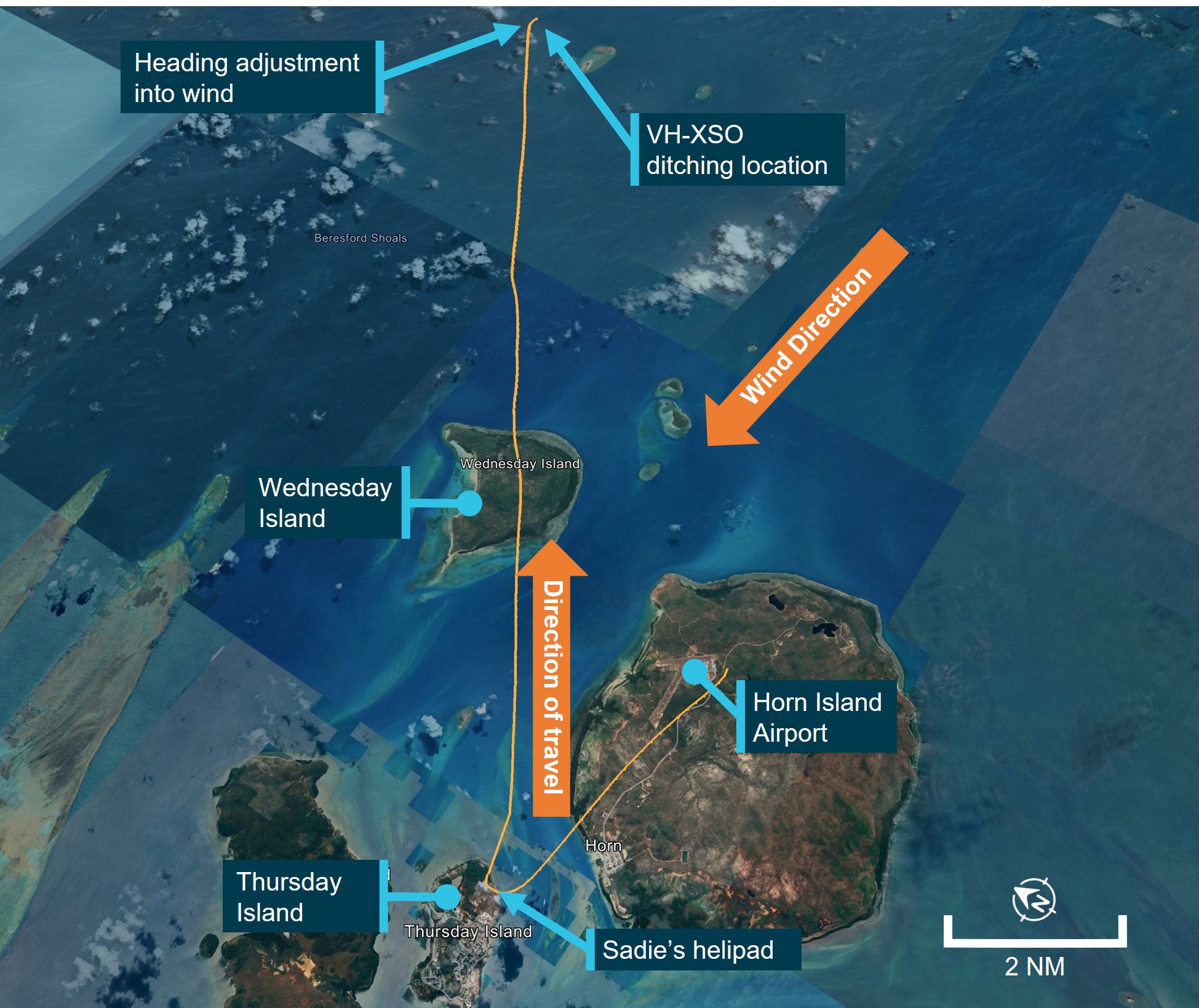
Source: Google Earth, annotated by the ATSB
Ditching
After the completion of the check, the pilot considered that they had reached a sufficient distance that would no longer impede traffic approaching to land at Horn Island Airport and they planned to commence a further climb. The pilot reported at this time the low rotor RPM horn activated. They rapidly lowered the collective2 to preserve the rotor RPM and entered autorotation.3 They then observed the engine RPM reducing through about 50% before the engine then completely stopped.
Preparing for a ditching,4 the pilot broadcast a MAYDAY5 call on the local common traffic advisory frequency (CTAF). The transmission included the helicopter’s position relative to Horn Island and that they were ditching into the ocean. The pilot inflated the emergency pop-out floats and instructed the passengers to brace. Prior to contact with the water, the pilot adjusted the helicopter’s heading to the right to align the helicopter more into wind.
Recorded data showed that at 0730:15, the helicopter’s altitude was at sea level. The pilot described the contact with the water as ‘upright’ between an airspeed of 5–10 kt. One passenger described the landing as ‘pretty hard’ and that the water covered the windscreen on impact. The pilot then instructed both passengers to evacuate and recalled that the helicopter rolled immediately on its left side. The pilot and rear right passenger were able to egress via their doors to the right side of the helicopter, which was not submerged, and inflated their lifejackets. The front left passenger, positioned on the lower side (left side) of the rolled helicopter egressed using their low side (left) door, reporting that they struggled to open the door due to the pressure of the water. Once the door was opened, the passenger exited and surfaced near the main rotor blades. While attempting to return to the cabin, they struck their head twice on the helicopter’s main rotor blade. They reported feeling heavy in the water and had difficulty maintaining buoyancy until the other passenger instructed them to inflate their lifejacket.
All the occupants were subsequently able to climb onto the partially submerged helicopter (Figure 2). The pilot observed that the left float, still inflated, had detached from the skid tube and had become entangled around the helicopter’s rotor hub.
Figure 2: VH-XSO shortly after ditching

Source: GBR Helicopters, annotated by the ATSB
Unsure if other aircraft had heard the pilot’s MAYDAY transmission, the occupants attempted to call for help using their phones, however due to water ingress were unable to place any calls. Assisted by the passengers, the pilot entered into the submerged cabin of the helicopter to ensure the emergency locator transmitter (ELT) had been activated. They entered the cabin a second time, shortly after, to retrieve the helicopter’s survival kit and satellite phone. The satellite phone, which had also been submerged, did not work.
All 3 occupants later reported that after a period of time on the submerged helicopter, they noticed a burning sensation, mostly on their legs as they were submerged and presumed this was from fuel in the water. The occupants were individually swept off the helicopter on several occasions as a result of the sea state6 conditions and were assisted by the others to climb back onto the helicopter.
Rescue
The Joint Rescue Coordination Centre (JRCC) received an ELT activation detection in the Torres Strait at 0731.
The pilot of a second R44, operated by another helicopter company based in the Torres Strait, heard a broken transmission of the pilot’s MAYDAY call including the registration and that they were ditching. The second pilot was able to contact the operator of VH‑XSO’s base manager who advised the last known position of the aircraft using company aircraft tracking software. The airborne R44 pilot was then able to track to the location, alerting other airborne fixed wing traffic, who also diverted to the location. About 11 minutes after the ditching, the R44 pilot located the ditched helicopter and relayed, via a fixed wing aircraft that also began orbiting above the site, the ditching location and state of the occupants to Brisbane Centre air traffic control. The helicopter pilot flew above VH-XSO to ensure the occupants were not separated from the ditched helicopter until remaining fuel required them to continue their flight to Horn Island. A company helicopter arrived at the location shortly after and continued monitoring the occupants in the water.
The Horn Island rescue helicopter crew, operating a Leonardo Helicopters AW139, received notification of the task at 0741 and after a reconfiguration for water winching, started engines at 0758 and were airborne at 0804. On board were the aircraft captain, air crew officer (winch operator) and rescue crew officer. The rescue helicopter arrived at the location of the ditched helicopter at 0819, about 50 minutes after the ditching.
A rescue crew officer descended into the water via the winch about 20 m from the wreckage to reduce the effects of the rescue helicopter’s downwash. They approached the wreckage toward the tail of the helicopter and recalled being about 2–5 m from the wreckage when, due to debris and the potential to snag the winch cable on the wreckage, they requested the 3 people to be rescued to enter the water. The rescue crew officer individually winched each person using a rescue strop7 and accompanied each person during the winch.
One rescued person later recalled that once in the winch rescue strop, as the winch cable tightened, they were immersed underwater and impacted the tail of the partially submerged wreckage on the right side of their chest. Neither the rescue crew officer who accompanied the person on the winch, nor the aircrew officer operating the winch, observed the impact with the wreckage nor did the person advise the crew of the impact following the winching.
Once all 3 people had been winched from the water, the rescue helicopter tracked to Thursday Island Hospital and arrived there at 0841. The rescue crew officer recalled during the flight, the survivors advised they were suffering from a burning sensation on their legs and they assisted to rinse the affected areas with water.
Injuries and damage
Medical records indicated all 3 occupants of the ditched helicopter received chemical burns due to their exposure to aviation gasoline. Two of the occupants suffered chemical burns to 14% of their total body surface area (TBSA) while the third suffered burns to 21% of their TBSA. One occupant also suffered a minor head injury, likely from impact with the wreckage following their egress.
The third occupant also received a fracture to a right-side rib. This was reported to medical staff and the ATSB as being a result of the rescue operation where after being attached to the rescue strop, they impacted the tail of the partially submerged wreckage.
Occupants were treated for chemical burns and kept under observation for about 6 hours at Thursday Island Hospital before being discharged later the same day.
In addition to the occupants of the ditched helicopter, the rescue crew officer was kept under observation at the hospital for chemical burns, however reported they were uninjured and also released the same day.
VH-XSO was later reported to have sunk and was not able to be located or recovered.
Context
Personnel information
Pilot experience
The pilot held a commercial helicopter pilot’s licence issued on 22 April 2025 and a current low-level rating valid until 30 March 2027. They had accumulated about 210 hours total time flying helicopters.
They also held an unrestricted Class 1 aviation medical that was valid until 1 November 2026.
Training
The pilot had last completed an operator proficiency check on 20 June 2025 which included emergency autorotations and they were deemed competent by the operator.
The pilot had completed helicopter underwater escape training (HUET) and survival on 20 July 2023 that was valid for 3 years. The pilot later stated that they felt their HUET training was ‘instrumental’ in their efficient egress from the helicopter.
Fatigue
The pilot recalled they had slept well and felt rested and that the early flight did not require a change to their usual sleep pattern. They were rostered the day prior to the occurrence for an 8‑hour duty period, however were not required to fly and had last flown 5 days earlier on 3 October 2025.
The ATSB considered that it was unlikely that fatigue affected the pilot’s performance on the day of the occurrence.
Aircraft information
General information
The Robinson Helicopter Company R44, Raven I is a 4‑place, light helicopter, powered by a Lycoming O-540-F1B5, 6-cylinder, horizontally-opposed piston engine. It has a 2‑bladed main rotor system and a conventional 2‑bladed tail rotor.
The manufacturer advised that the most recent calculation for R44 helicopter engine power loss events indicated a failure rate of 0.37 events per 100,000 flight hours.
VH-XSO was manufactured in the United States as serial number 0817 in 2000 and had flown a total of 3,253.7 hours prior to the occurrence flight. Nautilus Aviation had been the registration holder since January 2024 and cross-hired the helicopter to GBR Helicopters.
Emergency pop-out floats
VH-XSO was fitted with emergency pop-out floats (Robinson Helicopter Company part number C-950). The pilot operating handbook (POH) pop-out float supplement stated that they were ‘intended for safety during overwater flight’ and that the ‘pop-out floats were not certified for ditching’. The supplement did however provide a procedure for practise autorotations onto water, directing pilots to conduct autorotations as per the basic manual with the addition of ensuring a slight nose high attitude.
Following inflation, the POH supplement indicated the emergency pop-out floats would remain inflated for at least one hour and typically maintained shape for several hours.
The R44 type certificate data sheet (H11NM) provided the certification basis for the helicopter and included certification of ‘emergency pop-out floats’ under US Federal Aviation Administration (FAA) Title 14 Code of Federal Regulations (CFR) Part 27. The emergency pop-out floats were certified under Part 27.521 - float landing conditions.
CASR Part 133 Manual of Standards Division 12, section 11.51 stated:
(2) Subject to subsection (3), the rotorcraft must be fitted with emergency flotation equipment if one or more of the following applies to the flight:
(a) the flight:
(i) is to, or from, a helideck on a vessel or other offshore facility; and
(ii) will have an approach and landing or baulked landing stage, or a take‑off and initial climb stage, over water;
(b) the rotorcraft will be flown further over water from land than the distance in which, with 1 engine inoperative, the rotorcraft could reach a suitable forced landing area, for the flight, on land.
(3) Despite paragraph (2)(b), the flight over water is permitted without having to fit emergency flotation equipment if:
(a) it is in a rotorcraft access lane mentioned in the AIP; or
(b) both:
(i) it is to comply with an ATC instruction; and
(ii) it is for no longer than 2 minutes at normal cruising speed in still air.
The R44’s pop-out floats are bolted to the helicopter skid tubes and featured 6 individual chambers per float, the R44 POH described the system:
The pop-out float system consists of inflatable floats stowed in protective covers along the skid tubes, a pressure cylinder located in the compartment under the left front seat, flexible hoses from the cylinder to the floats, an inflation lever located on the pilot’s collective, and an additional stabilizer installed at the base of the lower vertical stabilizer.
The cylinder was filled with helium, with the required operating pressure indicated on a placard on the cylinder and actual pressure was displayed on a gauge at the top of the cylinder.
Squeezing the inflation lever (required about 9 kg of force) caused a spring-loaded pin to puncture a metal sealing disk and allowed the helium to fill the floats.
The POH provided a caution to pilots:
Do not inflate floats above 80 KIAS [knots indicated airspeed]. Do not exceed 80 KIAS with floats inflated.
During the autorotation the pilot reported they reduced the helicopter’s airspeed below the 80 kt limit and then inflated the floats. The pilot also suspected that the left float may have detached or partially detached while the helicopter was descending as they recalled hearing a flapping noise from the left side of the helicopter. However, the R44 POH also contained a note to state:
Some flapping of float covers during flight with floats inflated is normal……
Images of the helicopter in the water showed the left float completely detached from the skid tube and caught on the hub of the main rotor (Figure 3) which prevented the helicopter rolling fully inverted.
Figure 3: VH-XSO ditched

Source: GBR Helicopters, annotated by the ATSB
The manufacturer advised that the floats may be susceptible to damage if:
- deployed above the 80 kt airspeed limit
- there is a higher than normal vertical impact
- there is high forward airspeed
- allowing the nose to drop when contacting the water, which could cause the float to separate from the skid and may start as a partial separation before fully detaching.
The manufacturer conducted tests using a 1/7 scale model of the Robinson R66 model equipped with identical floats as used on the R44. These tests were conducted in conditions that simulated uniform waves per the sea state 48 definition and demonstrated that the R66 would remain upright.
Robinson Helicopter Company advised that additional unofficial testing of the R66 in irregular wave conditions peaking at sea state 4 levels, also demonstrated it would remain upright. Although model testing was limited to the R66 configuration, the manufacturer advised that the results extended to the R44 6‑chamber floats by analysis to substantiate European Union Aviation Safety Agency (EASA) requirements for overwater commercial operations. The R44 emergency pop-out float supplement contained a limitation saying the following for normal operations on water:
Safe operation on water has been demonstrated in waves up to 1 foot (0.3 M) (trough to crest) Maximum recommended water taxi speed is 5 kt. Some application of collective is required.
However, the R44 POH did not contain any limitations on the maximum sea state stability of the helicopter to remain upright.
Recent maintenance
The operator advised that prior to the ditching, recent maintenance was completed on VH-XSO following identification of an unserviceable main rotor gearbox pinion and swashplate,9 which was found to be ‘noisy, rough and rusty’. The operator replaced the main rotor gearbox assembly and swashplate. At the completion of the maintenance on 24 September 2025, 2 maintenance test flights were conducted that totalled about 36 minutes and the aircraft was then released into service.
After release to service, a company pilot further reported that the left skid tube on VH‑XSO was cracked. The skid was replaced with one from another R44 helicopter undergoing maintenance at the time. This included the removal of the left side emergency pop-out floats and reattachment to the replacement skid tube, which was completed on 30 September 2025.
VH-XSO then operated on 1 and 2 October 2025 which totalled 4.8 hours of flying over the 2 days and was not flown again prior to the occurrence flight on 8 October.
As VH-XSO sank and was not recovered, the ATSB was unable to determine if recent maintenance may have contributed to either the total loss of power or the left emergency pop-out float separation from the skid tubes.
Fuel
The pilot stated that they departed Horn Island with about 150 L of fuel on board. The R44 helicopter uses about 60 L per hour during normal flying operations and had flown for about 12 minutes before the low rotor RPM warning, including the ferry flight to Thursday Island.
As a result of the helicopter rolling 90° on its left side and the swell of the ocean causing movement, it was likely that this caused fuel to leak from a vent located in the R44’s mast fairing.
Due to the presence of fuel in the ocean following the ditching, the ATSB concluded it was unlikely that fuel exhaustion was a factor.
Carburettor heat
The R44 Raven I is equipped with a carburettor that delivers a fuel air mixture to the engine. A gauge in the helicopter’s cockpit displays the air temperature inside the carburettor and features a yellow caution arc between −17°C and 3°C.
The Robinson Helicopter Company safety notice 25 warns:
Pressure drops and fuel evaporation inside the carburetor cause significant cooling. Therefore, carburetor ice can occur at OATs [outside air temperatures] as high as 30˚C. Even in generally dry air, local conditions such as a nearby body of water can be conducive to carburetor ice and apply carb heat as required.
The pilot reported that they observed low cloud during the flight and that they had mostly flown fuel‑injected variants of the R44 previously, so were particularly conscious to regularly check the carburettor temperature gauge in VH-XSO. The pilot recalled the carburettor temperature was about 10° before they applied about half carburettor heat early in the flight, while abeam Horn Island, to increase the temperature and reduce the possibility of carburettor ice build-up.
Meteorological information
One minute recorded meteorological data from Thursday Island indicated that the outside air temperature had been a consistent 28°C from 0700 local time with a mean sea level pressure of 1010 hectopascals. One minute meteorological data from Horn Island Airport, about 13 NM (24 km) south-west of the accident location, from 0700 until the time of the occurrence showed wind strengths of 10–19 kt from a consistent east‑south‑east direction.
The ATSB was unable to obtain data from a nearby Queensland Government wave measuring device, however the European Centre for Medium-Range Weather Forecasts (ECMWF) forecast the following ocean conditions in the area:
- wave height: 0.82 m (steady)
- sea temperature: 27.3°C (steady)
- wave period: 3.55 seconds (steady)
- wave direction: 115°(ESE)
- swell height: 0–0.2 m (steady).
The passengers described windy conditions and being ‘smashed’ by the swell and on several occasions were washed off VH-XSO and were required to assist each other to get back onto the partially submerged helicopter.
Operational information
Overwater flights
The operator’s rotorcraft exposition for both their Civil Aviation Safety Regulation (CASR) Part 133 (air transport operations - rotorcraft) and Part 138 (aerial work operations) for flights over water, detailed that the rotorcraft must be fitted with emergency pop-out floats and that one or more suitable forced landing areas must be available at all times during flight.
The exposition detailed the requirements of a suitable forced landing area in relation to ditching as:
the rotorcraft must be able to ditch in the area of water with a reasonable expectation that there would be no injuries to persons in the rotorcraft or on the water. Company policy is that this is only viable in sea states of less than 2 metres.
CASR Part 133.010 provided the definition of a suitable forced landing area:
Areas of ground
(1) An area of ground is a suitable forced landing area for a flight of a rotorcraft if the rotorcraft could make a forced landing in the area with a reasonable expectation that there would be no injuries to persons in the rotorcraft or on the ground.
Areas of water
(2) An area of water that meets the requirements mentioned in subregulation
(3) is a suitable forced landing area for a flight of a rotorcraft if the rotorcraft:
(a) is equipped with emergency flotation equipment; or
(b) has a type certificate or supplemental type certificate for landing on water.
(3) For the purposes of subregulation (2), the requirements are the following:
(a) the rotorcraft must be able to ditch in the area of water with a reasonable expectation that there would be no injuries to persons in the rotorcraft or on the water;
(b) there must be a reasonable expectation that persons in the rotorcraft would survive in the area of water for the time that it would take to rescue the persons;
(c) if the flight is a passenger transport operation or a medical transport operation—the area of water must be:
(i) adjacent to land; or
(ii) adjacent to an offshore installation with search and rescue capabilities; or
(iii) in a location, set out in the rotorcraft operator’s exposition, that has search and rescue capabilities.
(4) Factors that affect whether there is a reasonable expectation about the matters mentioned in paragraphs (3)(a) and (b) include the following:
(a) the surface condition of the area of water, including the wave height, wind conditions and swell;
(b) the limits of the capability of the rotorcraft’s emergency flotation system to stay upright and floating in certain sea states.
Survivability
Operator’s procedures
For overwater flights, the pilot was required to leave a search and rescue time (SARTIME) with company operations that detailed the commencement and completion times of the intended flight. The pilot reported that they left SARTIME details with company operations and that the flight was also being monitored by aviation tracking software that recorded the helicopter’s position, altitude and performance every 2 minutes.
Helicopter underwater escape training
Fear, anxiety, panic and inaction are the common behavioural responses experienced by occupants during a helicopter ditching. The initial impact, in-rushing water, disorientation, entanglement with debris, unfamiliarity with seatbelt release mechanisms and an inability to reach or open exits have all been cited as problems experienced when attempting to escape from a helicopter following an in-water accident (Rice and Greear, 1973).
Helicopter underwater escape training (HUET) involves a replica of a helicopter cabin and fuselage being lowered into a swimming pool to simulate the ditching of a helicopter. The cabin can rotate upside down and focuses participants on bracing for impact, identifying primary and secondary exit points, opening an exit, releasing harness, egressing the wreckage and surfacing. HUET is normally part of a program of graduated training that builds in complexity, with occupants utilising different seating locations, exits and visibility. This training is conducted in a controlled environment with safety divers in the water.
The CASR Manual of Standards (MOS) Part 133, Chapter 12, section 12.04 discusses the requirements for flight crew general emergency training. The section included that training must cover ditching procedures, including in-water practical training, underwater escape and the use of lifejackets when lifejackets were required to be carried on the flight.
The operator’s risk assessment for an aircraft emergency while over water included a mitigating control that all pilots conducting overwater flight had currency in HUET. The pilot recalled that the techniques learnt during HUET assisted with their efficient egress.
Neither passenger had ever completed HUET, nor was there any regulatory requirement for them to do so.
The passenger in the rear right seat stated they initially attempted to egress the helicopter while wearing their seatbelt. They stated they were panicked and took 2 attempts to then unbuckle their seatbelt.
The front left passenger described ‘fumbling’ during their egress and stated they had difficulty opening their door due to the force of the water, and similar to the other passenger, they also attempted to egress with their seatbelt still fastened.
An ATSB safety advisory notice AO-2018-022-SAN-001 stated that:
The Australian Transport Safety Bureau advises helicopter operators involved in overwater operations of the importance of undertaking regular HUET for all crew and regular passengers to increase their survivability in the event of an in-water accident or ditching.
The ATSB contacted 2 large organisations with employees who regularly flew as passengers in light helicopters over water as part of their employment. One of the organisations required that employees who flew 2 or more return flights per year underwent HUET, the other required HUET when employees flew 3 or more return flights per year. As part of a separate ATSB investigation, passengers from a third organisation with employees who regularly flew in the Torres Strait reported they were also provided HUET by their employer.
The Queensland Department of Education stated they did not provide any aviation training to their employees, nor was there a regulatory requirement for the passengers to conduct HUET.
Survival emergency locator transmitter
For all air transport flights, the operator required their aircraft to be fitted with a serviceable automatic emergency locator transmitter (ELT).10 The operator’s exposition also stated:
For any flights where a safe landing may not be possible in the event of an emergency, the PIC [pilot in command] should also carry a survival ELT.
The operator did not require nor did they provide a survival ELT11 to the pilot for the occurrence flight.
ATSB aviation research AR-2012-128 A review of the effectiveness of emergency locator transmitters in aviation accidents(2013) found that automatic ELTs functioned as intended in about 40 to 60% of accidents in which their activation was expected and that automatic ELT activation accounted for the first notification in only about 15% of incidents. The research report safety message stated:
Pilots and operators of general aviation and low-capacity aircraft need to be aware that a fixed fuselage mounted ELT cannot be relied upon to function in the types of accidents in which they were intended to be useful. The effectiveness of ELTs in increasing occupant safety and assisting SAR efforts may be enhanced by using a GPS-enabled ELT, using an ELT with a newer 3-axis g-switch, ensuring it is installed correctly, ensuring your beacon is registered with AMSA and pre-emptively activating the beacon if a forced landing or ditching is imminent. Additionally, carrying a personal locator beacon in place of or as well as a fixed ELT will most likely only be beneficial to safety if it is carried on the person, rather than being fixed or stowed elsewhere in the aircraft.
CASA Part 133 MOS Chapter 11.50 required that a life raft fitted with a survival ELT be carried in single-engined rotorcraft if flights were conducted over water at a distance greater than 25 NM (46 km) from a suitable forced landing situated on land.
GBR Helicopters’ operations manual advised that flights were not conducted at distances over water where a life raft was required to be carried.
During the course of other ATSB investigations, it was identified that at least 2 other helicopter operators that conducted regular overwater flights with multiple helicopters, required their pilots to carry a survival ELT in addition to the helicopter’s automatic ELT.
Lifejackets
The operator’s exposition required occupants to wear lifejackets during overwater flight. For Torres Strait operations, passengers were provided with aviation‑approved constant wear vest style lifejackets with a single inflation cord that activated 2 gas cylinders that inflated the jacket. The lifejacket was worn over the head with a single strap fastened across the lower back (Figure 4).
The pilot wore a similar style lifejacket that was fastened at the front with a buckle and zip and featured pockets and dual toggles that individually inflated the 2 gas cylinders separately.
Both the pilot and passengers did not report any difficulty using or inflating the lifejackets.
Figure 4: Lifejackets provided for the occupants by the operator
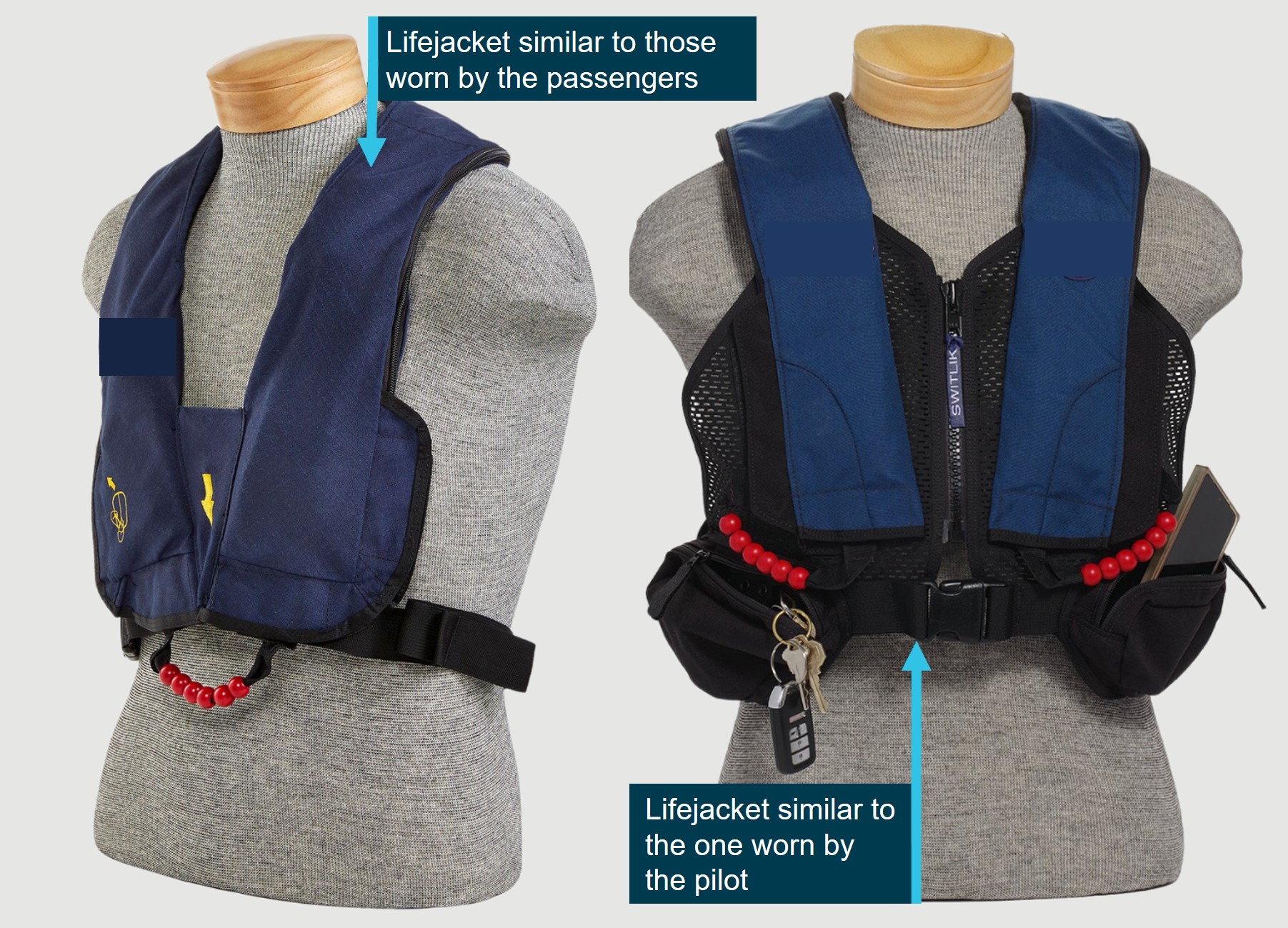
Source: Red Barron ALSE, annotated by the ATSB
These lifejackets allow the wearer to inflate with a single movement. In comparison, pouch style lifejackets, common in overwater helicopter passenger operations and worn around the waist, required the lifejacket to be pulled from the pouch and then physically placed over the head prior to inflation. They are designed to be donned using one arm to allow the other arm to assist with buoyancy.
Survival kit
The operator advised that survival kits were located in all helicopters operating from its Horn Island base, serviced annually and stowed in an area where they were easily accessible but would not affect the operation of the helicopter. The operator’s exposition stated the minimum contents for their survival kits:
• survival manual
• 2 rations barley sugar
• 13 m light rope
• 2 water purifier tablets
• 1 knife
• 1 box of waterproof matches
• 2 space blankets
• 1 orange plastic sheet
• 1 compass
• 2 containers of water
• 1 signalling mirror
• 1 can opener.
One passenger stated the kit was also equipped with a small torch, however it was not bright enough to attract the attention of the pilot of the R44 helicopter who located the ditched helicopter.
The pilot reported that flares and sea dye were also available at the Horn Island base, however, were not part of the survival kit, were not required to be carried under the regulations or the operator’s exposition and that the pilot had not carried them on the flight.
Brace position
As of 1 December 2022, CASR Part 133 MOS chapter 7 section 7.01– Safety briefing card required that an operator supply a safety briefing card to all passengers specific to the helicopter type and model, which should include detail on how to assume the emergency brace position.
Section 7.02 –Safety briefings, instructions, or demonstrations, before take-off (9)(p) required that a safety briefing addresses when, and how, to assume the brace position.
Both passengers received a safety briefing from the pilot prior to their departure. The pilot recalled they had shown the passenger the operation of the doors, alternative exits and discussed the operation of the lifejackets. During interview the passengers were asked to recall the details of the safety briefing. Neither passenger reported receiving instruction of the brace position.
The operator had produced a specific briefing card for R44 helicopters. The card was available for each passenger in the helicopter, as required. The operator’s briefing card advised passengers the brace position was leaning back into the forward-facing seat while gripping the upper part of the harness for both the lap and sash style seatbelt fitted in VH-XSO and double shoulder harness as pictured (Figure 5). One of the passengers stated they were not aware of the safety briefing card in the helicopter.
Figure 5: GBR Helicopters R44 helicopter emergency brace position
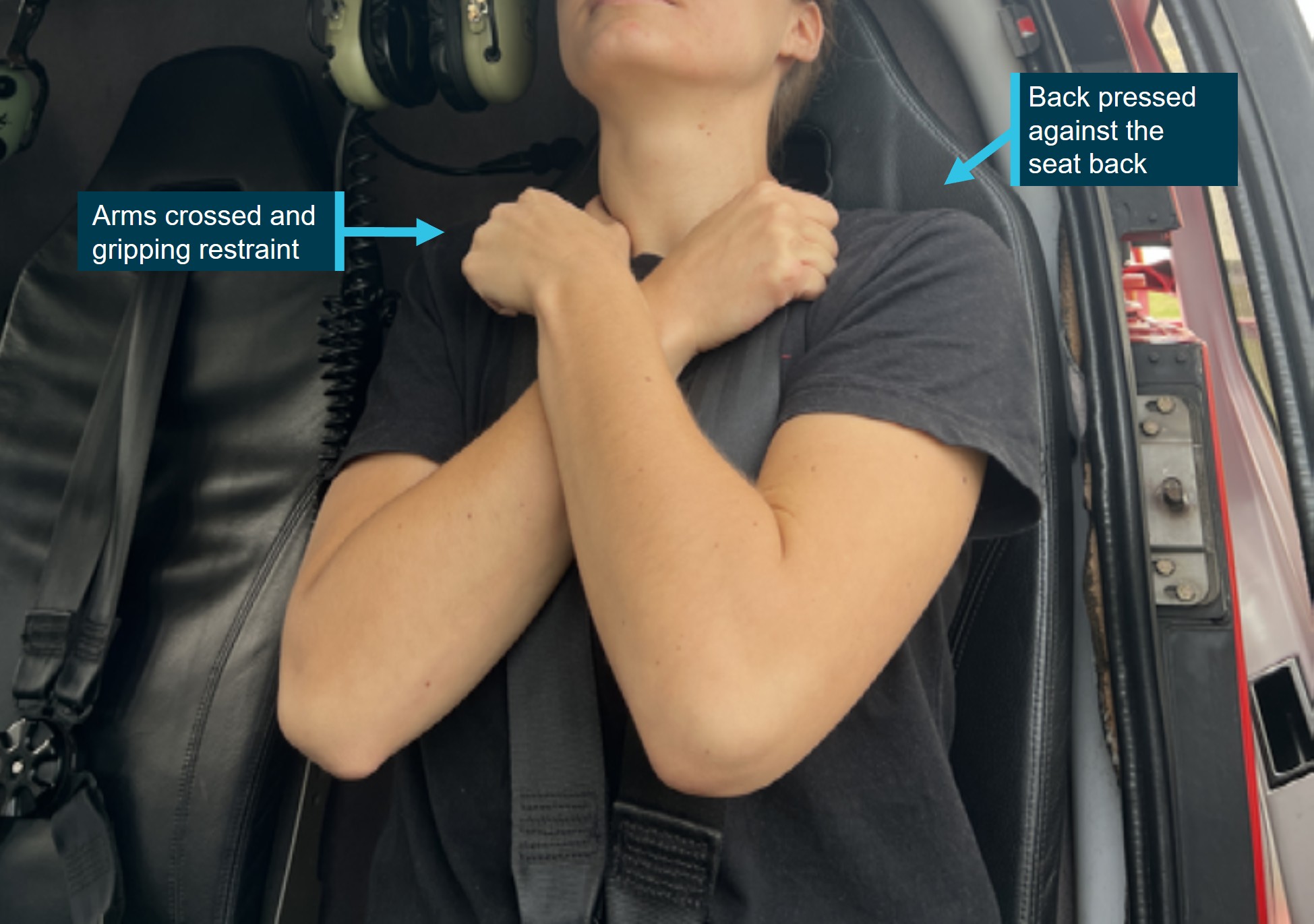
Source: GBR Helicopters, annotated by the ATSB
During the emergency, when the pilot instructed the passengers to brace, the front left passenger stated that they sat upright in their seat and placed one hand on the pilot’s arm, the second passenger reported they gripped the crossbar on the back of the pilot’s seat and held the position until water impact.
Recorded information
Aviation planning software from the pilot’s electronic flight bag (EFB) recorded data every 5 seconds in increments of 100 ft altitude. The recorded data identified that the helicopter became airborne from Sadie’s Helipad, Thursday Island, at about 0719:50 and initially climbed to about 500 ft above sea level. At 0729:45 the helicopter was recorded at 600 ft and 83 kt ground speed. The data then showed a rapid descent (Table 1).
Table 1: VH-XSO last 5 recorded data points
| Local time | Height above sea level (ft) | Ground speed (kt) | Heading (Magnetic) |
| 0729:45 | 600 | 83 | 060˚ |
| 0729:50 | 500 | 75 | 059˚ |
| 0729:55 | 300 | 65 | 061˚ |
| 0730:00 | 200 | 56 | 082˚ |
| 0730:05 | 100 | 49 | 088˚ |
Separate aircraft tracking software, used by the operator to monitor aircraft position, recorded the helicopter’s last known position at about 600 ft and 90 kt ground speed and identified that the engine was ‘off’.
Related occurrences
A search of the ATSB occurrence database showed 7 other Australian registered helicopters had ditched into the ocean since 2011. The pilots of 6 of those occurrences had sufficient time to deploy the emergency pop-out floats, and 3 of the 6 helicopters involved rolled shortly after landing on the water.
Engine flame-out and ditching involving Bell LongRanger, VH-RHF, Cone Bay, approximately 98 km north of Derby, Western Australia (AO-2013-097)
On 8 June 2013 VH-RHF, was conducting an aerial survey flight with 4 passengers in the Buccaneer Archipelago area north of Derby, Western Australia. The helicopter was being flown at about 1,000 ft to a planned fuel stop on an island in Cone Bay and was over water when the engine flamed out.
The pilot entered autorotation to glide towards land but was unable to reach it. During the glide the pilot deployed the helicopter’s pop-out floats in preparation for an emergency ditching. Shortly after touchdown the helicopter rolled inverted. The pilot and the 4 passengers exited without injury.
Ditching – Robinson R44, VH-HOT, 2 km east of Cairns, Queensland (AO-2011-001)
On 3 January 2011, VH-HOT departed Cairns Airport, Queensland, for a 30-minute charter flight. On board the helicopter was the pilot and 3 non-English speaking passengers. About 25 minutes into the flight, at about 400 ft above sea level, the engine failed and the rotor low rpm horn sounded. The pilot broadcast a MAYDAY and entered autorotation. During the descent he deployed the inflatable floats, however the right float did not fully inflate. The pilot assisted the passengers to egress the helicopter and inflated their life preservers. They were rescued from the water by fishermen in a small boat.
Abnormal engine indications and ditching involving Bell 206L-3, VH-LMW, 6.5 km west of Horn Island Airport, Queensland (AO-2026-003)
On 6 January 2026 during climb, the pilot and only occupant observed uncommanded yaw and fluctuating torque indications. The pilot received a low rotor alert and conducted an autorotation before activating the floats and ditching the helicopter which subsequently inverted. The pilot escaped the wreckage uninjured.
At the time of publication of this report this investigation was ongoing.
Safety analysis
Introduction
On 8 October 2025 a Robinson R44 Raven I, registered VH-XSO and operated by GBR Helicopters, departed Thursday Island, Queensland, with the pilot and 2 passengers on board. During cruise at about 600 ft above sea level the low rotor RPM horn activated and the pilot entered an autorotation. The pilot conducted a ditching and the helicopter immediately rolled onto its left side resulting in the front left seat passenger egressing the helicopter underwater. The 3 occupants were seriously injured from chemical burns from the fuel in the water while waiting for rescue, and one was additionally injured from an impact with the wreckage during the rescue winching.
This analysis will explore the operational considerations related to factors that affected the survivability of the occupants during an overwater emergency.
Total power loss
The pilot reported while in the cruise at about 600 ft, that the low rotor RPM horn activated and the helicopter engine RPM reduced before the engine completely stopped prior to ditching into the ocean. The last recorded data point from the operator’s flight tracking software for VH-XSO also indicated ‘engine off’.
The helicopter subsequently sank and was not able to be located or recovered. Consequently, the ATSB was unable to determine the likely cause of the engine power loss.
Contributing factor For reasons undetermined, the helicopter engine had a total power loss during the cruise at 600 ft while operating over water, requiring the pilot to conduct a ditching. |
Briefing of the brace position
Although the passengers had flown in helicopters in the Torres Strait regularly, and were familiar with the R44, the pilot of VH-XSO provided a pre-flight safety briefing which included operation of the doors as an emergency exit and alternative exits if a door was blocked, and the use of the lifejackets.
However, on this occasion, the pilot did not brief the passengers on how to adopt the correct brace position as required by the operator’s manual and the regulations. Although the pilot advised both passengers to brace during the autorotation, the front left passenger grabbed the pilot’s arm and sat back in their seat, while the rear seat passenger braced themselves using the cross bar on the back of the pilot’s seat. Both brace positions increased the risk of injury to the passengers and had the potential to interfere with the pilot’s ability to control the helicopter during the emergency.
The operator advised that VH-XSO contained safety briefing cards that depicted the brace position for the lap and sash harness fitted to VH-XSO. However, one passenger was not aware of the location of the safety briefing card.
Not being briefed on adopting the appropriate brace position increased the risk of injury to both occupants which may have further hindered emergency egress from the helicopter or affected the pilot’s ability to control the helicopter during the emergency.
Other factor that increased risk The pilot did not provide the passengers with information on the appropriate brace position during the pre-flight safety briefing. |
MAYDAY transmission and emergency response
Realising they were forced to ditch the helicopter, the pilot transmitted a MAYDAY call that alerted another helicopter that they intended to ditch in the ocean. The second helicopter diverted to the ditched helicopter, and in conjunction with a nearby fixed wing aircraft, were able to communicate the emergency to Brisbane Centre air traffic control, providing their location, which reduced the response time of the search and rescue aircraft in locating the occupants, and additional information on the survivor’s welfare.
Although the automatic emergency locator transmitter (ELT) had alerted the Joint Rescue Coordination Centre (JRCC) to the aircraft’s last known position, past studies have shown that the activation and transmission of ELTs is not always certain. Had the ELT not been activated, the pilot’s MAYDAY call was likely to have been the initiation of the emergency response.
Following their MAYDAY call, the pilot was able to deploy the emergency pop-out floats in preparation for the water landing; this very likely prevented the helicopter from rapidly sinking and allowed the occupants time to egress. Although the helicopter rolled shortly after ditching, the partially submerged helicopter provided some refuge from the ocean conditions and made visual identification for first responders easier. The helicopter’s ELT had also been activated, alerting rescuers to its location. However, had the helicopter sunk, ocean currents and wind would have carried the occupants away from their last known position.
The pilot also advised the passengers to brace prior to the water impact, and even though they had not been advised of the appropriate brace position, it is likely that this gave the passengers additional time to prepare and consider possible egress options.
Other finding The pilot transmitted an effective MAYDAY call, activated the pop-out floats and instructed the passengers to brace prior to ditching. This improved the occupants’ survivability during and after the ditching. |
Emergency pop-out floats
On landing, the left side emergency pop-out float detached from the skid and the helicopter rolled onto its left side. The detached float then became entangled in the rotor assembly, providing some buoyancy to the mast and preventing the helicopter from becoming inverted. The manufacturer advised that the floats may be susceptible to damage as a result of high forward airspeeds or impact forces.
The helicopter’s left skid had also recently been replaced due to an identified crack. The replacement of the skid meant that the emergency pop-out floats were reattached to the replacement skids. The operator advised that the skid replacement and emergency pop‑out float attachment was completed in accordance with the manufacturer’s maintenance manual.
The helicopter’s roll to the left resulted in the front left passenger egressing through their door while under water. Had the emergency pop-out float not lodged around the helicopter’s main rotor hub it is likely that all 3 occupants would have been required to egress from an inverted helicopter, increasing the risk of disorientation during escape.
The Robinson Helicopter Company advised that the R44 would likely remain stable in sea states of up to 2.4 m, which was above the forecast wave heights of about 0.8 m on the day of the accident. Following the egress, the 3 occupants then sought refuge on board the partially submerged helicopter. However, their legs were mostly submerged and they were often swept off the helicopter entirely. This exposed them to the leaked aviation gasoline and resulted in serious injuries to all 3 occupants. Without the detachment of the emergency pop-out float it was likely the helicopter would have remained upright and the occupants could have remained on board until their rescue with significantly less time exposed to the leaked fuel in the water.
Both the helicopter and the detached left emergency pop-out float were not recovered, and the cause of the detachment could not be accurately determined.
Contributing factor For reasons that were undetermined, during the ditching, the left float detached causing the helicopter to roll in the water. This reduced the likelihood of a successful emergency egress and exposed the survivors to fuel in the water leading to chemical burn injuries. |
Survival emergency locator transmitter on overwater flights
GBR Helicopters did not provide company pilots with a survival ELT for all overwater flights, nor were they required to unless the flight involved a distance from a suitable forced landing area that required the carriage of a life raft.
The single-engined Robinson R44 helicopter VH-XSO was fitted with emergency pop-out floats, certified for water landing, however they were not certified for ditching, resulting in a greater risk of float damage and therefore capsize during a ditching event.
The ATSB considered that during the ditching, the attached remaining emergency pop‑out float could have been damaged or detached, which may have resulted in the helicopter sinking immediately after impact. In such circumstances, had the occupants successfully egressed they would have been subject to wind and current and likely drifted from the last known position, increasing the search area, reducing the likelihood of timely detection and increasing the occupants’ exposure time in the water.
Carriage of a survival ELT by the pilot would have provided an additional layer of safety, if carried on their person, via timely and accurate location for search and rescue focus, increasing post‑impact survivability.
Other factor that increased risk GBR Helicopters did not provide company pilots with a survival ELT for all overwater flights. This reduced the post‑impact survivability of a ditching event. (Safety Issue) |
Helicopter underwater escape training
It is a regulatory requirement for pilots conducting overwater flight to conduct helicopter underwater escape training (HUET) every 3 years, although there is no regulatory requirement for passengers who travel regularly in helicopters over water to conduct the training.
Both passengers had flown regularly in helicopters over water as part of their employment with the Queensland Department of Education during the 12 months preceding the occurrence flight and had never undertaken HUET.
HUET is considered to provide individuals with familiarity with the crash environment and confidence in their ability to cope with the emergency situation (Ryack et al., 1986). Interviews with survivors from helicopter accidents requiring underwater escape frequently mention that they considered that HUET was very important in their survival. Training assists by providing reflex conditioning, a behaviour pattern to follow and reducing confusion and panic (Hytten, 1989).
Passengers stated they fumbled and felt panicked, both attempting to egress while still wearing their seatbelts. Therefore, it was likely the passengers’ egress would have been more efficient and reduced the risk of drowning had they completed HUET.
Other organisations whose employees travelled numerous times per year in helicopters over water arranged HUET for these employees. However, Queensland Department of Education employees were not provided with any aviation‑specific training. HUET training provides the opportunity to develop a behavioural pattern for underwater emergency helicopter egress and has been shown to increase post‑impact survivability and decrease the risk of drowning.
Other factor that increased risk Queensland Department of Education employees who regularly fly over water in helicopters were not provided with Helicopter Underwater Escape Training which increased the risk of drowning. (Safety Issue) |
Lifejackets
GBR Helicopter’s Horn Island operation provided passengers with constant wear, vest style, lifejackets and required that they be worn at all times for overwater flights.
The front seat passenger described ‘feeling heavy’ in the water and had difficulty staying buoyant, compounded by the constant swell, until they were instructed to inflate their lifejacket. The wearable vest style life jacket was able to be immediately inflated post‑accident, without requiring it to be donned while attempting to remain afloat in the water.
Had any of the occupants lost consciousness while awaiting a rescue, a first responder need only inflate the passenger’s lifejacket, removing the additional step of donning the jacket from a pouch for a person requiring assistance.
The quick inflation of the lifejacket provided rapid buoyancy and increased their post‑accident survivability.
Other finding The use of constant wear, vest style lifejackets likely increased the ease and speed of use, enhancing the survivability of occupants. |
Rescue
Following the arrival of the rescue helicopter on site, the rescue crew officer was winched into the water to retrieve the people one-by-one via the winch with themselves also attached. During one winch recovery, the person being rescued reported they impacted the wreckage of the helicopter while being dragged through the water, likely resulting in the fracture to their rib. Environmental conditions on the day likely increased the difficulty for the rescue, with the wind and sea state moving the rolled and partially submerged wreckage. This likely increased the difficulty of identifying their proximity to the wreckage, especially sections of the helicopter that were submerged, and increased the risk of impact and therefore injury.
Neither the rescue crew officer or the aircrew officer observed the impact with the wreckage and were not advised by the injured person during the transfer to Thursday Island Hospital.
Although it was considered possible that the rib injury was sustained during the ditching sequence or subsequent egress, the elapsed time between the ditching and rescue was likely sufficient for the injured individual to have recognised the presence of a fracture injury. In the absence of any reported awareness of such an injury before the rescue, it is therefore more likely that the fractured rib was sustained during the winch recovery.
Contributing factor One of the people being rescued likely sustained an additional serious injury after impacting the wreckage while being winched. |
Findings
ATSB investigation report findings focus on safety factors (that is, events and conditions that increase risk). Safety factors include ‘contributing factors’ and ‘other factors that increased risk’ (that is, factors that did not meet the definition of a contributing factor for this occurrence but were still considered important to include in the report for the purpose of increasing awareness and enhancing safety). In addition ‘other findings’ may be included to provide important information about topics other than safety factors. Safety issues are highlighted in bold to emphasise their importance. A safety issue is a safety factor that (a) can reasonably be regarded as having the potential to adversely affect the safety of future operations, and (b) is a characteristic of an organisation or a system, rather than a characteristic of a specific individual, or characteristic of an operating environment at a specific point in time. These findings should not be read as apportioning blame or liability to any particular organisation or individual. |
From the evidence available, the following findings are made with respect to the power loss and ditching involving Robinson R44, VH-XSO, 24 km north-east of Horn Island Airport, Queensland, on 8 October 2025.
Contributing factors
- For reasons undetermined, the helicopter engine had a total power loss during the cruise at 600 ft while operating over water, requiring the pilot to conduct a ditching.
- For reasons that were undetermined, during the ditching, the left float detached causing the helicopter to roll in the water. This reduced the likelihood of a successful emergency egress and exposed the survivors to fuel in the water leading to chemical burn injuries.
- One of the people being rescued likely sustained an additional serious injury after impacting the wreckage while being winched.
Other factors that increased risk
- The pilot did not provide the passengers with information on the appropriate brace position during the pre-flight safety briefing.
- GBR Helicopters did not provide company pilots with a survival emergency locator transmitter for overwater flights. This reduced the post‑impact survivability of a ditching event. (Safety Issue)
- Queensland Department of Education employees who regularly fly over water in helicopters were not provided with Helicopter Underwater Escape Training which increased the risk of drowning. (Safety Issue)
Other findings
- The pilot transmitted an effective MAYDAY call, activated the pop-out floats and instructed the passenger to brace prior to ditching. This improved the occupants' survivability during and after the ditching.
- The use of constant wear, vest style lifejackets likely increased the ease and speed of use, enhancing the survivability of occupants.
Safety issues and actions
Central to the ATSB’s investigation of transport safety matters is the early identification of safety issues. The ATSB expects relevant organisations will address all safety issues an investigation identifies. Depending on the level of risk of a safety issue, the extent of corrective action taken by the relevant organisation(s), or the desirability of directing a broad safety message to the aviation industry, the ATSB may issue a formal safety recommendation or safety advisory notice as part of the final report. All of the directly involved parties were provided with a draft report and invited to provide submissions. As part of that process, each organisation was asked to communicate what safety actions, if any, they had carried out or were planning to carry out in relation to each safety issue relevant to their organisation. Descriptions of each safety issue, and any associated safety recommendations, are detailed below. Click the link to read the full safety issue description, including the issue status and any safety action/s taken. Safety issues and actions are updated on this website when safety issue owners provide further information concerning the implementation of safety action.comes to hand. |
Helicopter underwater escape training for regular passengers
Safety issue number: AO-2025-062-SI-01
Safety issue description: Queensland Department of Education employees who regularly fly over water in helicopters were not provided with Helicopter Underwater Escape Training which increased the risk of drowning.
Carriage of survival emergency locator transmitter
Safety issue number: AO-2025-062-SI-02
Safety issue description: GBR Helicopters did not provide company pilots with a personal locator beacon for overwater flights. This reduced the post‑impact survivability of a ditching event.
Glossary
| ATC | Air Traffic Control |
| CASA | Civil Aviation Safety Authority |
| CASR | Civil Aviation Safety Regulations |
| CTAF | Common terminal area frequency |
| EASA | European Union Aviation Safety Agency |
| ECMWF | European centre for medium-range weather forecasts |
| ELT | Emergency locator transmitter |
| EPIRB | Emergency position-indicating radio beacon |
| FAA | Federal Aviation Administration |
| HUET | Helicopter underwater escape training |
| JRCC | Joint Rescue Coordination Centre |
| KIAS | Knots of indicated airspeed |
| kt | Knots |
| NM | Nautical mile |
| SAR | Search and rescue |
| PLB | Personal locator beacon |
| POH | Pilot operating handbook |
| RPM | Revolutions per minute |
Sources and submissions
Sources of information
The sources of information during the investigation included:
- the pilot of the accident flight
- passengers of the accident flight
- the pilot of VH-WTT
- recorded data from EFB and satellite tracking device
- images provided by the operator
- maintenance records of the occurrence aircraft
- the rescue crew officer
- Queensland Department of Education
- Civil Aviation Safety Authority
- Robinson Helicopter Company
- Bureau of Meteorology.
References
Rice, E. a. (1973). Underwater escape from helicopters. In proceedings of the eleventh annual symposium, Cited in Brooks C. (1989)The human factors relating to escape and survival from helicopters ditching in water (pp. 59-60). Phoenix AZ: AGRAD.
Ryack, B. L. (1986). Surviving Helicopter crashes at sea,. Aviation Space and Environment Medicine, 57(6), 603-609.
Submissions
Under section 26 of the Transport Safety Investigation Act 2003, the ATSB may provide a draft report, on a confidential basis, to any person whom the ATSB considers appropriate. That section allows a person receiving a draft report to make submissions to the ATSB about the draft report.
A draft of this report was provided to the following directly involved parties:
- the pilot of VH-XSO
- the passengers on board VH-XSO
- GBR Helicopters
- the rescue helicopter operator
- CASA
- Bureau of Meteorology
- Robinson Helicopter Company
- Queensland Department of Education
- Australian Maritime Safety Authority
- United States National Transport Safety Board (NTSB)
Submissions were received from:
- the pilot of VH-XSO
- the passengers on board VH-XSO
- GBR Helicopters
- the rescue helicopter operator
- CASA
- Bureau of Meteorology
- Robinson Helicopter Company
- Queensland Department of Education
The submissions were reviewed and, where considered appropriate, the text of the report was amended accordingly.
Purpose of safety investigationsThe objective of a safety investigation is to enhance transport safety. This is done through:
It is not a function of the ATSB to apportion blame or provide a means for determining liability. At the same time, an investigation report must include factual material of sufficient weight to support the analysis and findings. At all times the ATSB endeavours to balance the use of material that could imply adverse comment with the need to properly explain what happened, and why, in a fair and unbiased manner. The ATSB does not investigate for the purpose of taking administrative, regulatory or criminal action. About ATSB reportsATSB investigation reports are organised with regard to international standards or instruments, as applicable, and with ATSB procedures and guidelines. Reports must include factual material of sufficient weight to support the analysis and findings. At all times the ATSB endeavours to balance the use of material that could imply adverse comment with the need to properly explain what happened, and why, in a fair and unbiased manner. An explanation of terminology used in ATSB investigation reports is available here. This includes terms such as occurrence, contributing factor, other factor that increased risk, and safety issue. Publishing informationReleased in accordance with section 25 of the Transport Safety Investigation Act 2003 Published by: Australian Transport Safety Bureau © Commonwealth of Australia 2026 
Ownership of intellectual property rights in this publication Unless otherwise noted, copyright (and any other intellectual property rights, if any) in this report publication is owned by the Commonwealth of Australia. Creative Commons licence With the exception of the Commonwealth Coat of Arms, ATSB logo, and photos and graphics in which a third party holds copyright, this report is licensed under a Creative Commons Attribution 4.0 International licence. The CC BY 4.0 licence enables you to distribute, remix, adapt, and build upon our material in any medium or format, so long as attribution is given to the Australian Transport Safety Bureau. Copyright in material obtained from other agencies, private individuals or organisations, belongs to those agencies, individuals or organisations. Where you wish to use their material, you will need to contact them directly. |
Footnotes
| 1 | A precautionary check of the aircraft’s performance and position - compass, log, engine, altitude, radio, orientation, fuel and forced landing areas. |
| 2 | A primary flight control that collectively adjusts the pitch on the main rotor blades. |
| 3 | Autorotation is a condition of descending flight where, following an engine failure or deliberate disengagement, the rotor blades are driven solely by aerodynamic forces resulting from rate of descent airflow through the rotor. The rate of descent is driven mainly by airspeed. |
| 4 | A ditching is a controlled emergency landing of an aircraft on water. |
| 5 | MAYDAY: an internationally recognised radio call announcing a distress condition where an aircraft or its occupants are being threatened by serious and/or imminent danger and the flight crew require immediate assistance. |
| 6 | Sea state is the general condition of the free surface on a large body of water. |
| 7 | Rescue strop is designed for hoisting personnel from ships, shore and sea during helicopter operations. |
| 8 | World Meteorological Organization - Sea State 4 wave heights of between 1.25 and 2.5 metres. |
| 9 | A helicopter swash plate transmits flight control inputs to the main rotor blades allowing vertical and rotational movement. |
| 10 | Automatic emergency locator transmitter (ELT): a radio beacon that transmits an emergency signal that may include the position of a crashed aircraft, activated either manually or due to the forces of an accident. |
| 11 | A survival ELT refers to approved emergency position-indicating radio beacons (EPIRB) and personal locator beacons (PLB). They are removable from an aircraft or carried on the person, and require manual activation. |
Occurrence summary
| Investigation number | AO-2025-062 |
|---|---|
| Occurrence date | 08/10/2025 |
| Occurrence time and timezone | 07:20 Australian Eastern Standard Time |
| Location | 24 km north-east of Horn Island Airport |
| State | Queensland |
| Report release date | 07/05/2026 |
| Report status | Final |
| Investigation level | Defined |
| Investigation type | Occurrence Investigation |
| Investigation status | Completed |
| Mode of transport | Aviation |
| Aviation occurrence category | Ditching, Engine failure or malfunction |
| Occurrence class | Accident |
| Highest injury level | Serious |
Aircraft details
| Manufacturer | Robinson Helicopter Co |
|---|---|
| Model | R44 |
| Registration | VH-XSO |
| Serial number | 817 |
| Aircraft operator | GBR Helicopters Pty Ltd |
| Sector | Helicopter |
| Operation type | Part 133 Air transport operations - rotorcraft |
| Activity | Commercial air transport-Non-scheduled-Passenger transport charters |
| Departure point | Sadie's Beach Helipad Helicopter Landing Site, Queensland |
| Destination | Coconut Island Aircraft Landing Area, Queensland |
| Injuries | Crew - 1 (serious), Passengers - 2 (serious) |
| Damage | Destroyed |
Aircraft details
| Manufacturer | Leonardo Helicopters |
|---|---|
| Model | AW 139 |
| Registration | VH-8HD |
| Serial number | 32070 |
| Aircraft operator | Babcock International Group |
| Sector | Helicopter |
| Operation type | Part 138 Aerial work operations |
| Activity | Aerial work – Search and rescue |
| Departure point | Horn Island Airport, Queensland |
| Destination | Thursday Island Hospital, Queensland |
| Injuries | Passengers - 1 (serious) |
| Damage | Nil |