

Final report
Report release date: 22/01/2026
Investigation summary
What happened
On 17 August 2025, a Piper PA-28, registration VH-BUN, was undertaking a navigation training exercise under the visual flight rules from Wollongong (Shellharbour) Airport, New South Wales, with a student pilot and instructor on board.
While flying south along the coast north of Sydney, at around 1,600 ft above mean sea level, the crew heard unusual engine noises and observed a rapid drop in engine RPM. This was accompanied by a period of heavy engine vibration and a smell of oil. As they continued south, the engine RPM progressively reduced. Approximately 6 minutes after the first abnormal engine indications, the instructor determined that the safest option would be to conduct a landing on the Mona Vale golf course.
However, during the final stages of the approach to the golf course, the pilot slowed the aircraft to around 50 kt indicated airspeed before they realised they could not safely land straight ahead, and made a right turn to avoid the club house facilities. The aircraft subsequently landed heavily in a right-wing low attitude. All 3 undercarriage legs detached, and the aircraft slid approximately 45 m before coming to rest. The student pilot received minor injuries while the instructor was uninjured. The aircraft suffered substantial damage.
What the ATSB found
The ATSB found that the exhaust valve of the engine’s number 3 cylinder broke away from its stem and caused extensive damage to the internal surfaces of the cylinder, its piston, and spark plugs. This resulted in a rapid loss of power from the engine, such that the aircraft was unable to maintain level flight. The specific failure sequence of the exhaust valve could not be determined.
The instructor was proactive in maintaining an awareness of potential landing sites throughout the flight. Consequently, they were able to promptly identify a suitable area to conduct a precautionary landing and avoid a more adverse outcome.
What has been done as a result
Following the accident, the operator undertook several safety actions, including:
- Revision of the emergency briefing content, and formal re-statement of the requirement for pre-impact and evacuation procedures to be briefed by the instructor, and confirmed by the student, before every flight.
- Completion of a review of competency in conducting engine failure procedures for all flight instructors, and implementation of additional training and enhanced supervision where required.
- Commencement of a process to check students’ post‑engine failure competencies, including glide path judgement, execution of post‑failure actions, and engine securing checks.
Safety message
This investigation highlights the importance of effective contingency management and decision-making skills in emergency situations.
In a single engine aircraft, a partial engine failure can present more options and decision‑making challenges than a total loss of power. Greater uncertainty of the aircraft’s performance over time makes it more difficult to choose the lowest risk course of action and potentially requires decisions to be revisited and revised. However, certain traits of human cognition, such as confirmation bias, may resist changing decisions which have already been made.
The instructor in this investigation reported they had an awareness of several contingency landing locations along their route prior to the engine malfunction occurring. This subsequently helped them to decide a suitable course of action when the malfunction did occur. Furthermore, as the situation evolved, they recognised the need to re‑evaluate their original choice of landing site. Their timely selection of a different landing site likely minimised the adverse consequences of the occurrence. A previous ATSB investigation (AO-2024-010) highlighted how a delayed decision to land following an engine malfunction in a single engine aircraft led to a more challenging forced landing.
In this case the cause of the exhaust valve failure could not be determined. However, in 1988 Textron Lycoming, the manufacturer of the aircraft’s engine, provided guidance on maintenance practices to reduce the possibility of valve sticking (Service Instruction No. 1425 A Suggested Maintenance Procedures to Reduce the Possibility of Valve Sticking). The guidance noted that engine oil contamination increases the possibility of valve sticking and advised preventative actions, including:
- regular changing of oil and oil filters
- cleaning of air filters
- proper sealing of the air induction system.
The risk of valve sticking is increased for engines operating in hot ambient conditions, and where engines are regularly shut down before they have cooled sufficiently.
Summary video
The investigation
The occurrence
On 17 August 2025, a Piper PA-28-140, registration VH-BUN, was undertaking a navigation training exercise under the visual flight rules (VFR)[1] from Wollongong (Shellharbour) Airport, New South Wales, with a student pilot and flight instructor on board.
The aircraft departed Wollongong at 1222 local time, initially flying north to Camden Airport. The student flew 3 circuits at Camden before landing and shutting down the aircraft for a brief stop. Departing Camden at 1331, the aircraft continued north to Wisemans Ferry, before turning south-east at Barrenjoey Head. From there the crew had planned to follow the coast south before returning to Wollongong (Figure 1).
At 1413, shortly after the aircraft passed overhead Barrenjoey Head at an altitude of 1,600 ft, the aircraft’s engine suddenly started to produce an unusual noise, accompanied by a brief period of heavy vibration and a smell of oil in the cockpit. The instructor observed the engine RPM indication drop rapidly from the cruise setting of 2,450 to around 2,100. Indications of oil temperature, oil pressure and fuel pressure all remained in the normal range.
The instructor assumed control of the aircraft from the student. The student then followed the instructor’s directive to turn on the fuel pump and switch the fuel selector valve from the right tank to the left tank. The instructor advised they did not select the carburettor heat to ON as they assessed it would further reduce the engine RPM by about 100 and, as they had been flying at cruise power for about an hour, it was unlikely they were experiencing carburettor icing.
The instructor communicated the nature of the engine problems to Sydney terminal air traffic control (ATC) and was informed that the nearest airport to them was Sydney, directly to the south. Shortly after, the instructor reported that they would continue tracking south, but that the engine RPM had fallen further to 1,900. ATC advised that Long Reef golf course was 4 NM (7 km) ahead of the aircraft. The instructor assessed that the engine’s performance was deteriorating, and the aircraft could not maintain level flight. They therefore decided to make a landing at Long Reef golf course, noting that although Mona Vale golf course was closer, its abundance of trees would make landing more challenging.
Shortly after, with the aircraft approximately 1 NM (1.9 km) south-east of the Mona Vale golf course the instructor detected that the engine RPM had reduced further to 1,500. They determined that the aircraft would no longer be able to reach Long Reef and decided that Mona Vale golf course was now the best available option for a landing. The instructor advised ATC of their intention to land at Mona Vale and turned the aircraft north towards it.
Once the instructor felt assured that the aircraft was able to reach the golf course, they began to progressively extend the aircraft’s flaps and reduce the airspeed from the best glide speed, which based on the aircraft’s weight they assessed to be 70 kt, aiming for approximately 55 kt, reducing to 50 kt on touchdown. However, as the aircraft neared the ground, travelling in a north-east direction, the instructor judged that there was insufficient clear area ahead of them to land safely. Consequently, they made a right turn of approximately 90 degrees to avoid the club house facilities and re-aligned the aircraft to land in a south-east, downslope direction. The instructor did not identify the extent of the downslope.
During the turn, the right wing dropped, and the aircraft impacted the golf course heavily. All 3 undercarriage legs detached on impact and the aircraft slid approximately 45 m before coming to rest upright on a section of fairway.
Figure 1: Flightpath of VH-BUN

The image shows the point at which abnormal engine indications were first noticed and the location of the precautionary landing on Mona Vale golf course. Source: Google Earth and Flightradar24, annotated by the ATSB
Fuel began leaking from the underside of the aircraft but there was no fire. Both occupants were able to exit the aircraft soon after, assisted by first responders from the golf club. The aircraft received substantial damage. The student suffered minor injuries during the impact, while the instructor was uninjured. Both were subsequently taken by ambulance to a local hospital for assessment, where the student remained overnight, but the instructor discharged themselves later in the evening.
Context
Flight crew background
The flight instructor held a Commercial Pilot Licence (Aeroplane) and a CASA class 1 aviation medical certificate. At the time of the occurrence, they had accumulated 1,392 flying hours, 305 of which were in the Piper PA-28. The instructor had flown 75 hours in the past 90 days, 31 of which were in the PA-28.
The instructor reported that they had flown the same navigational route many times prior to the occurrence flight. They had developed knowledge of various sites along the route, which could serve as contingency landing locations in the event of an emergency.
The student pilot was undertaking training towards their Private Pilot Licence (Aeroplane) and held a CASA class 2 aviation medical certificate. At the time of the occurrence, they had accumulated a total of 91 hours flying time, 3 of which were in the PA-28.
Aircraft information
General
The aircraft was a Piper PA-28-140 (serial number 28-23228) manufactured in the United States in 1967. The aircraft was fitted with a Textron Lycoming O-320-E2A piston engine and Sensenich fixed pitch propeller. The aircraft was being maintained under the Civil Aviation Safety Authority Schedule 5. The most recent periodic maintenance was a 100‑hour inspection completed on 26 May 2025. At that time the aircraft had accumulated 8,478 hours in service. The next periodic inspection was due on 26 May 2026, or 8,578 hours, whichever occurred first. The aircraft’s total time in service at the time of the occurrence was around 8,509 hours.
A review of the maintenance documentation indicated that the aircraft’s engine was last overhauled in November 1993 and was maintained under Civil Aviation Regulation 42B CASA maintenance schedule using Airworthiness Directive AD/ENG/4 during every periodic inspection. During the last periodic inspection in May 2025, there were no engine discrepancies identified. At the time of the occurrence, the engine had accrued approximately 1,680 hours since overhaul.
Fuel system
The aircraft was equipped with 2 fuel tanks, one in each wing, referred to as the left and right tanks. Each tank had a maximum capacity of 95 litres, providing a total capacity of 190 litres.[2] A fuel tank selector valve in the cockpit could be positioned to control which tank provided fuel to the engine. The selector valve could be positioned to feed fuel from either the left tank or the right tank, or to an off position, where neither tank would provide fuel. It was not possible to supply fuel to the engine from both tanks simultaneously. After the selector valve, fuel passed through a strainer, 2 fuel pumps, and a carburettor before reaching the engine.
Pre-flight inspection
On the morning of the flight, both the instructor and the student pilot conducted independent pre‑flight inspections. This included inspection of the engine compartment where there was no evidence of oil leaks. They checked the oil levels and observed that there was sufficient oil, and it was a normal colour.
Both of the aircraft’s fuel tanks were filled to their maximum capacity shortly before departing Wollongong. The crew started up and taxied out using fuel from the left tank, before switching to the right tank just before take-off. The first flight to Camden was 41 minutes in duration and was flown entirely using the right tank. After landing at Camden, the student pilot inspected the quantity of fuel in each tank using a dipstick. The amount of fuel consumed during the first flight was as expected and there was sufficient fuel on board to perform the second flight as planned, with significant reserves.
Approximately the first 30 minutes of the second flight were flown using the left tank, before the crew switched to using the right tank again, at around 1404, just after passing Wisemans Ferry. The right tank remained selected until the engine began to malfunction. The crew switched back to the left tank as part of their efforts to rectify the engine problems, and the fuel selector valve remained in this position for the rest of the flight.
Post-flight fuel inspection
A post-accident inspection of the aircraft’s fuel system determined that approximately 58 litres of fuel remained in the right tank, but only around 2.5 litres remained in the left tank. The fuel selector valve was positioned to feed fuel from the left tank.
However, the fuel strainer, located on the lower edge of the engine firewall, was ruptured during the impact and a significant quantity of fuel was observed draining from it after the accident. With the fuel selector valve positioned to the left tank, it is therefore likely that the low quantity of fuel observed in the left tank was a result of fuel draining away via the damaged fuel strainer post-accident. The ATSB determined that fuel starvation was not a contributing factor.
Post-flight engine inspection
The ATSB undertook a detailed engineering inspection of the aircraft’s engine following the occurrence. Each of the engine’s 4 cylinders was subject to a compression check, external visual inspection, and internal borescope inspection. Cylinders 1, 2 and 4 exhibited no major defects. However, cylinder 3 showed signs of significant damage.
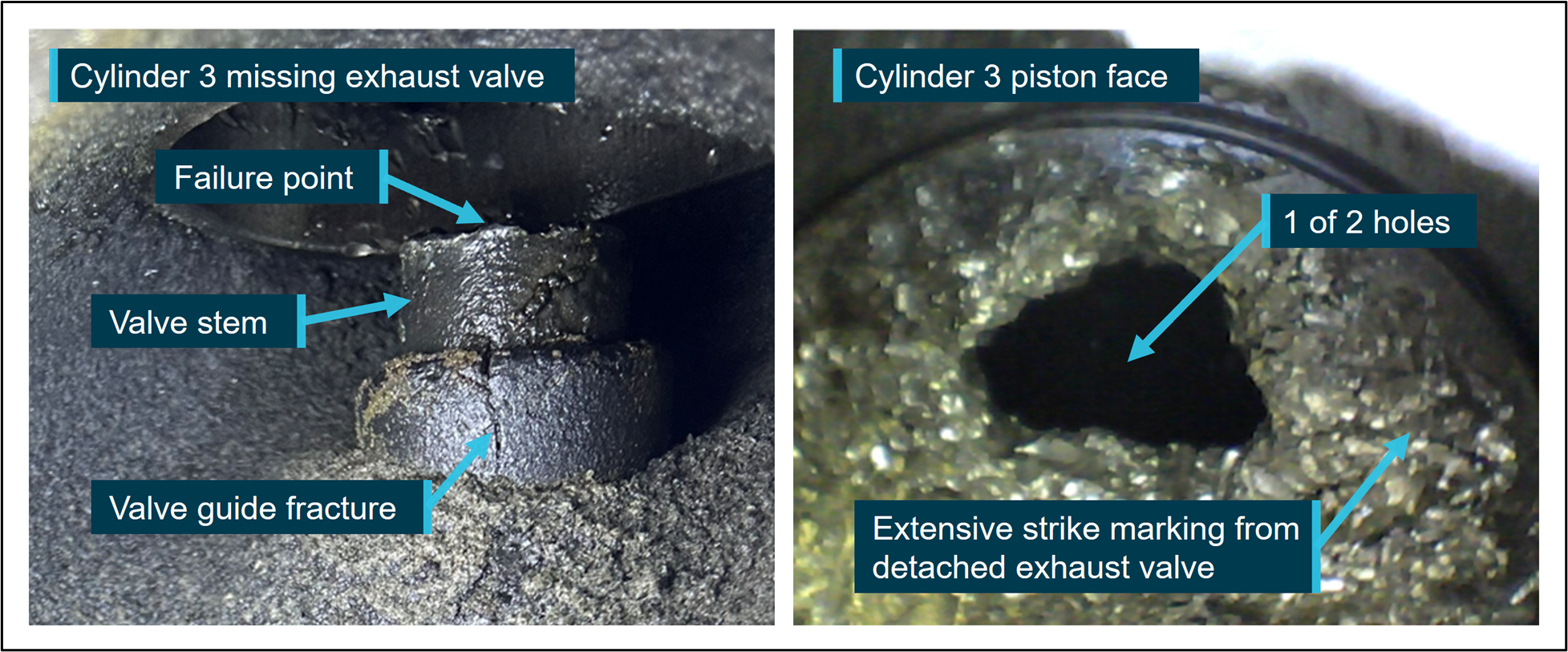
The exhaust manifold of cylinder 3 was heavily soaked with oil and its valve train components showed signs of exposure to combustion gases. Cylinder 3 provided no compression, and an internal inspection showed its upper surface and piston face to be heavily damaged with multiple strike marks and 2 large holes (Figure 2). The exhaust valve had broken off at its stem and was missing, while the valve guide exhibited a small fracture line. Both of the cylinder’s spark plugs had sustained impact damage to their electrodes.
Figure 2: Borescope images of cylinder 3 showing the missing exhaust valve and damage to the piston face
Source: ATSB
Meteorological information
The Bureau of Meteorology reported the visibility at the time of the occurrence as greater than 10 km. The temperature was around 16°C, with a dew point of around 1°C, and an atmospheric pressure adjusted to mean sea level of 1,017 hectopascals.
Both the instructor and student pilot reported that the weather conditions were favourable for VFR flying, with extensive visibility, little turbulence, and only light southerly winds.
Safety analysis
The ATSB determined that the exhaust valve of cylinder 3 impacted the piston surface multiple times, causing damage to the piston, cylinder and spark plugs. This resulted in a sudden loss of compression and subsequent loss of engine power. It could not be determined if the valve had stuck open, resulting in the piston impact and valve fracture, or if the valve fractured prior to impacting the piston.
Following the loss of power, the instructor identified that an off-airport landing was required. The instructor’s prior knowledge of the area and proactive contingency planning helped them identify possible locations. Furthermore, as the engine’s performance continued to deteriorate, they re-evaluated their decision and changed the plan, including shortly before touchdown when it was assessed that there was insufficient clear area ahead.
While the turn away from obstacles prevented a potentially significant frontal impact, it also led to the aircraft contacting the ground with substantial vertical force due to the low remaining airspeed limiting the instructor’s ability to flare the aircraft. Fortunately, the aircraft absorbed the vertical impact, preventing significant injury to the occupants.
Findings
ATSB investigation report findings focus on safety factors (that is, events and conditions that increase risk). Safety factors include ‘contributing factors’ and ‘other factors that increased risk’ (that is, factors that did not meet the definition of a contributing factor for this occurrence but were still considered important to include in the report for the purpose of increasing awareness and enhancing safety). In addition ‘other findings’ may be included to provide important information about topics other than safety factors. These findings should not be read as apportioning blame or liability to any particular organisation or individual. |
From the evidence available, the following finding is made with respect to the loss of power and forced landing involving Piper PA-28, VH-BUN, 32 km north-north-east of Sydney Airport, New South Wales, on 17 August 2025.
Contributing factor
- An exhaust valve in the aircraft's engine failed, resulting in a significant reduction of power and aircraft performance. Subsequently, the pilot in command conducted a forced landing on a golf course.
Safety actions
| Whether or not the ATSB identifies safety issues in the course of an investigation, relevant organisations may proactively initiate safety action in order to reduce their safety risk. The ATSB has been advised of the following proactive safety action in response to this occurrence. |
Safety actions by operator
The operator undertook the following safety actions after this accident:
- Revised the emergency briefing content and formally re-stated the requirement for pre‑impact and evacuation procedures to be briefed by the instructor and confirmed by the student before every flight.
- Completed a review of competency in conducting engine failure procedures for all flight instructors and implemented remedial training and enhanced supervision where required.
- Commenced a process to check students’ post‑engine failure competencies, including glide path judgement, execution of post‑failure actions, and engine securing checks.
- Implemented Drugs and Alcohol Management Plan (DAMP) policy refresher training and increased the frequency of random Alcohol and Other Drugs (AOD) testing across all employees undertaking safety sensitive aviation activities.
- Introduced carburettor icing probability assessment as part of the standard pre-flight preparation activities and provided education on the precautionary use of carburettor heat.
- Reviewed the on-boarding process for cross-hired aircraft and is consulting with other industry participants to create internal guidance around the use of aircraft with older engines.
Sources and submissions
Sources of information
The sources of information during the investigation included:
- pilots of the accident flight
- the aircraft operator
- the aircraft owner
- the maintenance organisation
- the aircraft insurer
- Airservices Australia
- Civil Aviation Safety Authority
- New South Wales Fire and Rescue
- the Bureau of Meteorology
- video footage of the accident flight and other photographs and videos taken on the day of the accident
- ADS-B data from Flightradar24.
Submissions
Under section 26 of the Transport Safety Investigation Act 2003, the ATSB may provide a draft report, on a confidential basis, to any person whom the ATSB considers appropriate. That section allows a person receiving a draft report to make submissions to the ATSB about the draft report.
A draft of this report was provided to the following directly involved parties:
- pilots of the accident flight
- operator of the accident aircraft
- owner of the accident aircraft
- Civil Aviation Safety Authority.
Submissions were received from:
- one of the accident flight pilots
- the operator of the accident aircraft
- the owner of the accident aircraft.
The submissions were reviewed and, where considered appropriate, the text of the report was amended accordingly.
Purpose of safety investigationsThe objective of a safety investigation is to enhance transport safety. This is done through:
It is not a function of the ATSB to apportion blame or provide a means for determining liability. At the same time, an investigation report must include factual material of sufficient weight to support the analysis and findings. At all times the ATSB endeavours to balance the use of material that could imply adverse comment with the need to properly explain what happened, and why, in a fair and unbiased manner. The ATSB does not investigate for the purpose of taking administrative, regulatory or criminal action. About ATSB reportsATSB investigation reports are organised with regard to international standards or instruments, as applicable, and with ATSB procedures and guidelines. Reports must include factual material of sufficient weight to support the analysis and findings. At all times the ATSB endeavours to balance the use of material that could imply adverse comment with the need to properly explain what happened, and why, in a fair and unbiased manner. An explanation of terminology used in ATSB investigation reports is available here. This includes terms such as occurrence, contributing factor, other factor that increased risk, and safety issue. Publishing informationReleased in accordance with section 25 of the Transport Safety Investigation Act 2003 Published by: Australian Transport Safety Bureau © Commonwealth of Australia 202 
Ownership of intellectual property rights in this publication Unless otherwise noted, copyright (and any other intellectual property rights, if any) in this report publication is owned by the Commonwealth of Australia. Creative Commons licence With the exception of the Commonwealth Coat of Arms, ATSB logo, and photos and graphics in which a third party holds copyright, this report is licensed under a Creative Commons Attribution 4.0 International licence. The CC BY 4.0 licence enables you to distribute, remix, adapt, and build upon our material in any medium or format, so long as attribution is given to the Australian Transport Safety Bureau. Copyright in material obtained from other agencies, private individuals or organisations, belongs to those agencies, individuals or organisations. Where you wish to use their material, you will need to contact them directly. |
[1] Visual flight rules (VFR): a set of regulations that permit a pilot to operate an aircraft only in weather conditions generally clear enough to allow the pilot to see where the aircraft is going.
[2] The operator’s documentation noted that of the total 190 litre fuel capacity, only 187 litres were usable.
Occurrence summary
| Investigation number | AO-2025-049 |
|---|---|
| Occurrence date | 17/08/2025 |
| Occurrence time and timezone | 14:00 Australian Eastern Standard Time |
| Location | 32 km north-north-east of Sydney Airport |
| State | New South Wales |
| Report release date | 22/01/2026 |
| Report status | Final |
| Investigation level | Short |
| Investigation type | Occurrence Investigation |
| Investigation status | Completed |
| Mode of transport | Aviation |
| Aviation occurrence category | Engine failure or malfunction, Forced/precautionary landing |
| Occurrence class | Accident |
| Highest injury level | Minor |
Aircraft details
| Manufacturer | Piper Aircraft Corp |
|---|---|
| Model | PA-28-140 |
| Registration | VH-BUN |
| Serial number | 28-23228 |
| Aircraft operator | Airspeed Aviation |
| Sector | Piston |
| Operation type | Part 141 Recreational, private and commercial pilot flight training |
| Departure point | Wollongong (Shellharbour) Airport, New South Wales |
| Destination | Wollongong (Shellharbour) Airport, New South Wales |
| Damage | Substantial |