

Final report
Report release date: 24/04/2026
Investigation summary
What happened
At 1851 local time on 24 July 2025, the crew of an Alliance Airlines Embraer ERJ 190, registered VH‑A2T, departed Cairns, Queensland, for a passenger transport flight to Brisbane. For the departure, the crew took off from runway 15 with a clearance to follow the AKROM 1 standard instrument departure (SID).
As the aircraft became airborne in darkness, the captain, acting as pilot monitoring, announced ‘pitch rate’ to alert the first officer, who was pilot flying, that the aircraft’s rotation had slowed. Both crewmembers then focused on the aircraft flight path, and the retraction of the landing gear was inadvertently omitted.
As the aircraft continued climbing and turning left to follow the SID, the flight crew received 2 radio altimeter annunciations and observed the flight director unexpectedly command a right turn. After completing the left turn to follow the SID, the first officer engaged the autopilot, and the aircraft started a right turn toward terrain. The captain identified the turn and instructed the first officer to turn left back to the required track.
As the aircraft then continued along the SID, the captain recognised that the landing gear was still extended and quickly retracted it. The landing gear completed retracting when the aircraft had reached a speed of 252 kt, 17 kt above the maximum landing gear retraction speed.
The flight continued and the aircraft landed at Brisbane without further incident at 2044. Following the flight, the aircraft was inspected and found to be undamaged.
What the ATSB found
The ATSB found that the 'pitch rate' announcement was made at a time when a ‘positive rate’ announcement would normally be expected. This resulted in both flight crewmembers focusing on the pitch angle and the first officer was not prompted to call for landing gear retraction.
As the aircraft turned left to follow the SID, the crew were presented with radio altimeter alerts and unexpected flight director indications. These distractions increased the flight crew's workload and delayed their identification of the extended landing gear. Upon recognising the still extended landing gear, the captain reflexively retracted it without first checking the aircraft speed.
What has been done as a result
Alliance Airlines accelerated its program to upgrade E190 aircraft from load 25 avionics to load 27 and at the time of the release of this report, all E190s in the Alliance Airlines fleet have been upgraded. This should prevent recurrence of the unexpected flight management system indications presented to the crew during this incident.
In addition, the load 27 avionics upgrade incorporated electronic checklists that require associated actions to be undertaken before the electronic checklist is completed.
Safety message
This incident highlights the impact a combination of omitted actions and distractions can have on aircraft operations, during what is often a high workload period. Such situations can create challenges in responding to the unexpected with potential for a reduction in safety when pilots act rapidly and reflexively. In these situations, pilots may not be able to effectively process information or consider all relevant factors, which reduces the ability to make good decisions.
Crews of Embraer ERJ 190 aircraft equipped with load 25 avionics should also be aware that, on occasion, these systems may provide unexpected indications. This has been observed on multiple occasions on the Cairns AKROM 1 SID. When faced with unexpected indications, crews should use primary instruments to ensure that flight path requirements are adhered to.
The investigation
The occurrence
On the evening of 24 July 2025, the crew of an Alliance Airlines Embraer ERJ 190, registered VH‑A2T, prepared to operate a passenger transport flight from Cairns to Brisbane, Queensland. For the flight, the captain acted as pilot monitoring (PM), and the first officer as pilot flying (PF).[1] For the departure, the crew were provided with clearance to follow the AKROM 1 standard instrument departure (SID) (see the section titled Cairns runway 15 AKROM 1 standard instrument departure). While preparing for the flight, the captain advised the first officer that on previous flights, the first officer’s rotation[2] rate was slower than required and, as adherence to the SID climb requirements was essential for terrain avoidance, the rotation rate would be a point of focus for the departure.
In darkness at 1851 local time, the aircraft commenced a take-off from runway 15 with the lateral navigation flight guidance mode selected. After passing the rotation speed of 143 kt, the first officer commenced the rotation to the target pitch attitude of about 15° nose up. The aircraft became airborne, and the captain assessed that as the aircraft passed 10° pitch angle, the rotation rate slowed. To alert the first officer, the captain announced, ‘pitch rate’.
This announcement came at about the same time that the PM would normally announce ‘positive rate’ after checking that a positive rate of climb was indicated on the aircraft instrumentation. This ‘positive rate’ announcement would then trigger the PF to request the retraction of landing gear. On this occasion, the lateral navigation mode activated and, after the captain announced ‘pitch rate’, both crewmembers then focused on the aircraft flight path and the retraction of the landing gear was inadvertently omitted.
The aircraft continued climbing and turning left to follow the SID. As the aircraft climbed through about 840 ft above mean sea level (AMSL), the primary flight displays presented 2 radio altimeter alerts in quick succession and the engine indicating and crew alerting system (EICAS) presented ‘RADALT MISCOMPARE’ and ‘APPR 2 NOT AVAIL’ messages (see the section titled Radio altimeter). The crew noted these indications and determined that they were not relevant to that phase of flight and therefore took no action.
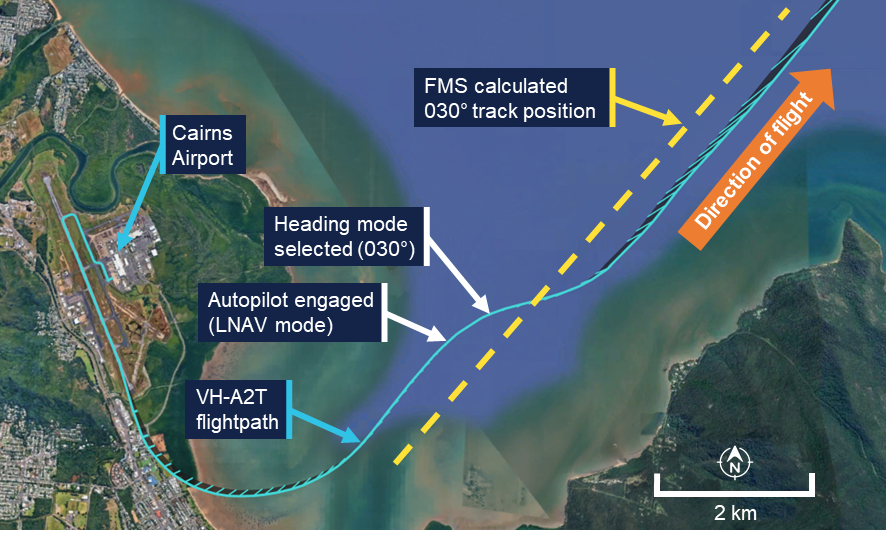
As the first officer manually turned the aircraft left to follow the SID, the aircraft followed a turn radius smaller than the flight management system’s (FMS) precalculated turn (see the section titled Flight instrumentation) and turned onto the SID 030° track[3] to the left of the FMS calculated track position (Figure 1). As the turn continued, the FMS targeted the wider track and the crew observed the flight director indications on the primary flight display unexpectedly command a right turn. The first officer briefly followed the right turn command by reducing the angle of bank from 24° left to 10° left before then increasing the angle back to 20° left to complete the turn.
Once the first officer established the aircraft on a 030° track, the autopilot was engaged while the flight director continued to indicate a right turn. The autopilot then started a right turn to intercept the FMS calculated 030° track position. At about the same time, air traffic control instructed the crew to change radio frequency. As the aircraft commenced the right turn, the captain identified the turn away from the SID track toward the high terrain and instructed the first officer to turn left to follow the 030° track. The first officer then engaged the autopilot heading mode and selected 030° and the aircraft turned left to a heading of 030° and continued climbing.
Figure 1: Departure flight path (initial)
Source: Recorded data from VH-A2T and Google Earth, annotated by the ATSB
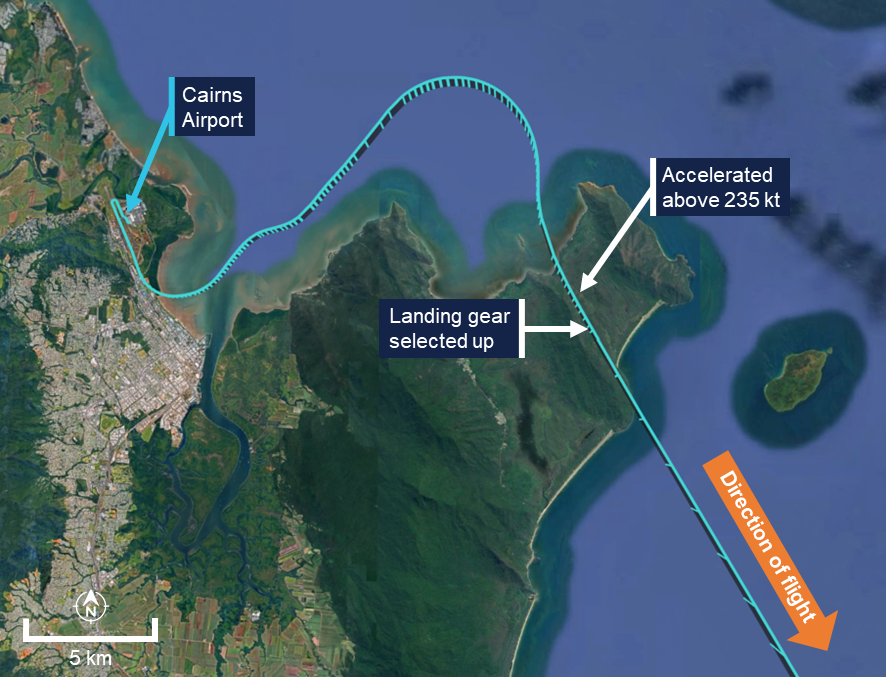
The aircraft then continued along the SID and after climbing above 4,000 ft AMSL, turned right toward the waypoint AKROM. As the aircraft continued climbing toward AKROM, the captain, whose headset was not noise-cancelling, noted that the ambient noise was louder than expected and recognised that the landing gear was still extended. At about the same time, the first officer noted the landing gear extended indication on the EICAS. In response, while the aircraft was accelerating through 243 kt – 8 kt above the maximum landing gear retraction speed of 235 kt – the captain retracted the landing gear without first checking the indicated airspeed. The landing gear completed retracting when the aircraft had reached a speed of 252 kt, 17 kt above the maximum retraction speed (Figure 2).
Figure 2: Departure flight path
Source: Recorded data from VH-A2T and Google Earth, annotated by the ATSB
The flight continued and, at 2044, the aircraft landed at Brisbane without further incident. Following the flight, the aircraft was inspected and found to be undamaged.
Context
Flight crew details
The captain held an Air Transport Pilot Licence (Aeroplane) and a class 1 aviation medical certificate. The captain had 15,192 hours of flying experience, of which 1,680 hours were on the Embraer 190 aircraft type, with 137 hours accrued in the previous 90 days.
The first officer held an Air Transport Pilot Licence (Aeroplane) and a class 1 aviation medical certificate. The first officer had 6,131 hours of flying experience, of which about 1,353 hours were on the Embraer 190 aircraft type, with 213 hours accrued in the previous 90 days.
The ATSB found no indicators that the flight crew were experiencing a level of fatigue known to adversely affect performance.
Operational information
Cairns Airport runway 15 AKROM 1 standard instrument departure
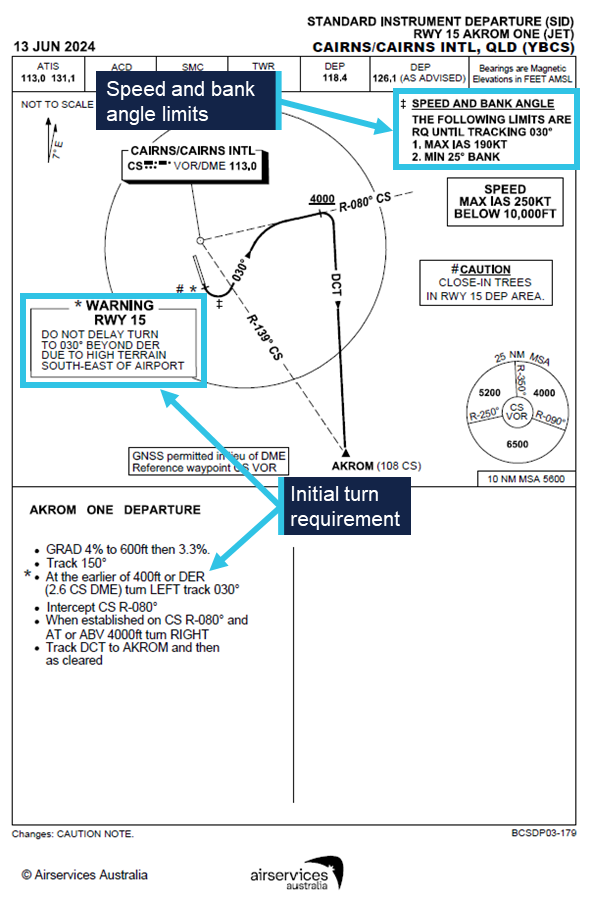
High terrain partly encircles Cairns Airport from the north-west through south-west and to the south-east. To avoid the high terrain, the AKROM 1 standard instrument departure (SID) required aircraft departing runway 15 to make a left turn at the earlier of either reaching 400 ft AMSL or passing the departure end of the runway (DER) (Figure 3). During the turn, flight crew needed to maintain a bank angle of at least 25° and a speed of no more than 190 kt until the aircraft was established on a track of 030°. The location of the 030° track was dependent upon both the position that the left turn was commenced and the radius of the turn. The departure required maintenance of the 030° track until intercepting the 080° radial of the Cairns very high frequency omni range navigation aid (VOR) and then followed that track until the aircraft climbed above 4,000 ft AMSL. The departure then turned to the waypoint AKROM.
Figure 3: Runway 15 AKROM 1 standard instrument departure
Source: Airservices Australia, annotated by the ATSB
Take-off standard operating procedures
The operator’s standard operating procedures manual (SOPM) required the pilot monitoring (PM) to verify a positive rate of climb immediately after take-off and then announce ‘positive rate’. After that announcement, the pilot flying (PF) confirmed the positive rate of climb and called for the landing gear to be retracted, and the PM then selected the landing gear ‘up’.
The SOPM also specified a normal rotation rate of 3° of pitch angle per second.
Aircraft information
The aircraft was an Embraer ERJ 190‑100 IGW, manufactured in Brazil in 2008 and issued serial number 19000179. It was registered in Australia as VH-A2T on 19 July 2024. The aircraft was fitted with 2 General Electric Company CF34-10E5 turbofan engines.
The maximum indicated airspeed at which the landing gear could be retracted or extended was 235 kt and the maximum airspeed with the landing gear in the extended position was 265 kt.
Flight instrumentation
The ERJ 190 was equipped with an integrated avionics system. VH-A2T was equipped with a ‘load 25’ version of the avionics. At the time of the incident, Alliance Airlines operated ERJ 190 aircraft equipped with both ‘load 25’ and upgraded ‘load 27’ avionics.
The flight management system (FMS) in ‘load 25’ equipped aircraft was designed to dynamically calculate the location of down path tracks, but only when these paths were inactive. Once the path became active, their location was fixed. The system should have predicted the 030° track leg of the AKROM 1 SID relative to where the system sequenced the 400 ft altitude crossing or departure end of the runway point. The avionics manufacturer, Honeywell, advised that in this case, the FMS sequenced the termination of the 400 ft altitude leg early and appeared to fix the location of the 030° track leg before it could be updated based on the position of the commencement of the left turn.
Subsequently, and as intended by design, the FMS did not recalculate the location of the 030° track during the turn. As a result, when the crew turned to the 030° track to the left of the FMS precalculated track, the FMS, still targeting the wider track, commanded a right turn to intercept that track (Figure 4).
Figure 4: Representation of primary flight and navigation displays during the left turn
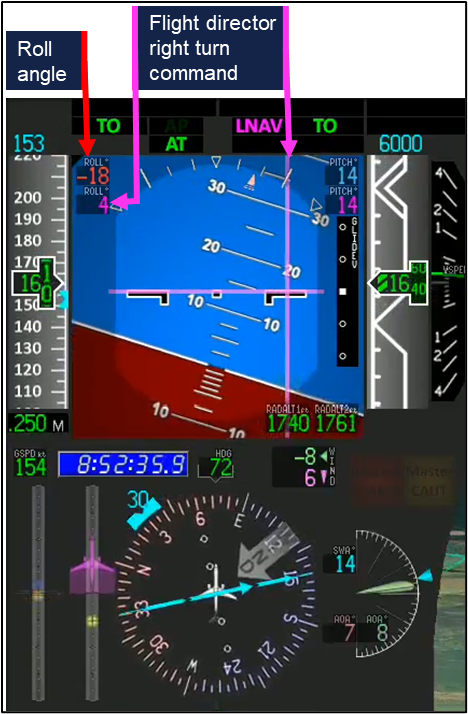
Note: The figure is based on an animation of the incident. The flight director representation is different to actual aircraft, and indications are included that are not presented in the actual aircraft. Negative roll values indicated a left turn, positive a right turn. Source: Embraer, annotated by the ATSB
Recorded automatic dependent surveillance broadcast (ADS-B) data from previous AKROM 1 departures flown by VH-A2T identified 2 additional flights where the FMS had precalculated the 030° track at a wider location. On those occasions, the ADS-B data indicated that the flight crews followed the flight director commands and intercepted the wider track (Figure 5).
Figure 5: Departures of VH-A2T equipped with ‘load 25’ avionics
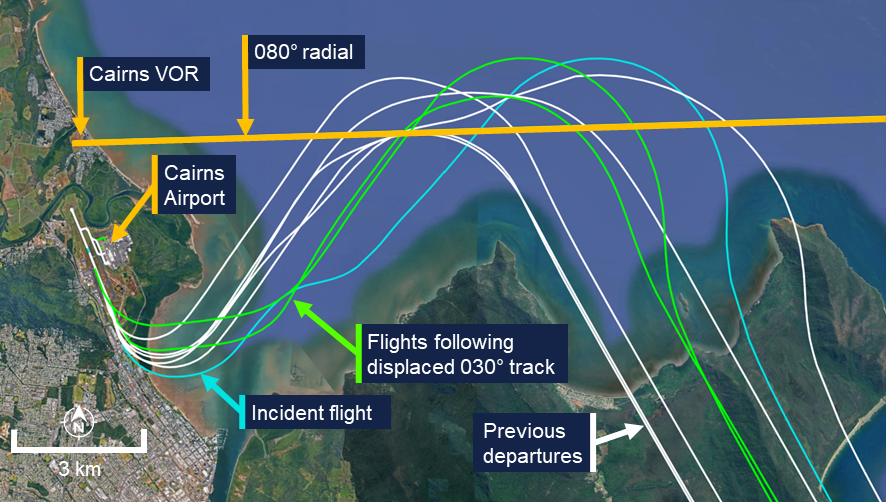
Source: Recorded data from VH-A2T and Google Earth, annotated by the ATSB
For ‘load 27’ equipped aircraft, the flight path was continuously updated as FMS track legs were flown and while in transition between them. This resulted in more accurate tracking of departure paths (Figure 6).
Figure 6: Departure paths of an E190 equipped with ‘load 27’ avionics
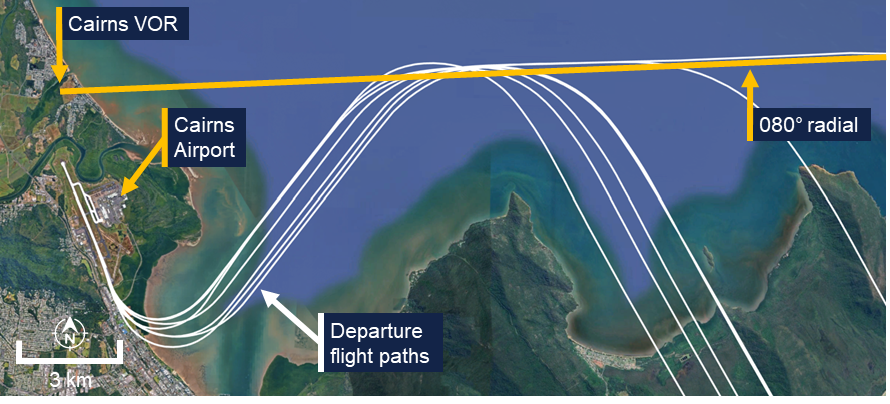
Source: Recorded data from VH-UYY and Google Earth, annotated by the ATSB
Radio altimeter
The Embraer ERJ 190 was fitted with 2 radio altimeters. These provided each crewmember with an indication of the height of the aircraft above underlying terrain measured using radio waves. When a difference in the height measured by the 2 radio altimeters exceeded a dynamic threshold, an ‘RA’ alert was presented on the primary flight display (Figure 7) and the RADALT MISCOMPARE alert was presented on the EICAS. Whenever this condition was detected, the associated EICAS message APPR 2 NOT AVAIL was also displayed.
Figure 7: Radio altimeter alert
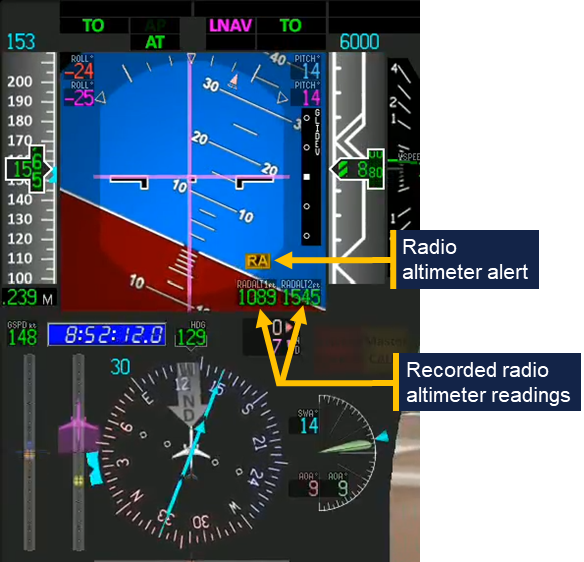
Note: The figure is based on an animation of the incident and indications (such as the radio altimeter readings) are included that are not presented in the actual aircraft. Source: Embraer, annotated by the ATSB
United States Federal Aviation Administration Advisory Circular AC 25-7D Flight Test Guide for Certification of Transport Category Airplanes stated the following guidance and measurement conditions for radio altimeter certification:
32.1.5.5 Radio Altimeter System.
32.1.5.5.1 The radio altimeter system should display to the flightcrew, clearly and positively, the altitude information that indicates the airplane main landing gear wheel height above terrain.
32.1.5.5.2 Verify that the altimeters display altitude without loss of signal indications or excessive fluctuations, under the following measurement conditions:
• Pitch angle ±5° about the mean approach attitude.
• Roll angle zero to ±20°.
On departure from Cairns, the alerts were generated while the aircraft was operating over relatively flat terrain and when the aircraft’s pitch angle was about 14° nose up and the roll angle about 23° left. While the investigation did not determine the reason for the different radio altimeter readings that led to the radio altimeter alerts, the aircraft’s pitch and roll values at the time exceeded the guidance and measurement conditions specified in the FAA circular.
Light and meteorology
The departure was conducted in night visual meteorological conditions. The sun had set at 1802, 49 minutes before the departure, and the moon was below the horizon.
At the time of the departure, the Bureau of Meteorology automatic weather station at Cairns Airport recorded the temperature as 23°C and the wind as 9 kt from 161° magnetic. There was no recorded cloud, and visibility was recorded as 58 km.
Recorded data
Analysis of flight data from the flight data recorder fitted to VH‑A2T showed that the rotation rate during the take‑off was 1.49 degrees per second until the aircraft was pitched 9.7° nose up and then 1.73 degrees per second until 14.9° nose up. The pitch attitude stabilised at about 16° nose up during the turn.
As the aircraft turned left through a heading of 080°, the flight director began commanding a right turn (Figure 8). At 1853:08, the autopilot was engaged in the lateral navigation mode and while the flight director continued to command a right turn. The aircraft then rolled right, following that command. At 1853:20, while flying a heading of 058° the autopilot mode changed from lateral navigation mode to heading mode with 030° selected. The aircraft then began rolling left to turn to that heading.
At 1856:35, the landing gear was selected up at a speed of 243 kt. The landing gear completed the retraction sequence at 1856:47 as the aircraft accelerated to 252 kt.
Cockpit voice recorder data capturing the incident was not available as it had been overwritten.
Figure 8: Recorded flight data
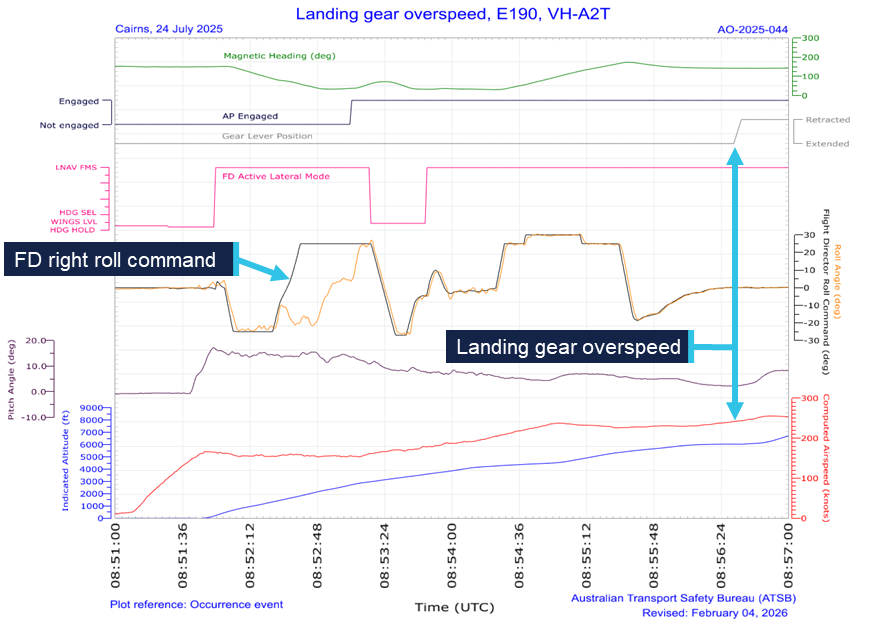
Source: ATSB
Safety analysis
Non-retraction of landing gear
During the take-off, the first officer rotated the aircraft slower than required, prompting the captain to call for an increase in pitch rate. The captain’s attention then remained focused on monitoring the pitch attitude of the aircraft throughout the rotation manoeuvre to ensure the required pitch attitude targets were being achieved. Because of this, the captain likely did not have sufficient opportunity to move onto the next task, verifying the aircraft’s positive rate of climb, before it passed through 400 ft – the point at which the terrain avoidance turn was to be initiated. Consequently, the task step of verifying and announcing positive climb performance was not fully completed and the captain did not make the ‘positive rate’ announcement.
In the absence of the captain’s announcement, the first officer was not prompted to request landing gear retraction, and the landing gear remained extended. The captain’s announcement of ‘pitch rate’ at about the same time that the acoustically and semantically similar ‘positive rate’ announcement would normally be made, potentially caused interference in working memory (Lentoor 2023) and possibly gave both flight crew a false sense that the latter action had been successfully performed.
Delayed identification and overspeed
During the initial climb, which was a high workload phase of the flight, abnormal radio altimeter alerts and unexpected flight director indications further increased the flight crew’s workload. In particular, when the autopilot was engaged, it commenced a right turn toward high terrain in response to an unexpected flight director indication. This prompted the captain’s intervention and the crew’s attention then narrowed to focus on parameters which would enable them to verify the aircraft’s lateral tracking performance. Wickens (2009, 2021) notes that attentional tunnelling occurs under conditions of elevated stress and deliberate task focus and can cause other task-relevant stimuli to be ignored.
Consequently, increasing flight deck wind noise and abnormal engine indicating and crew alerting system (EICAS) indications, both of which provided an indication of the landing gear’s extended state, were not initially detected. Furthermore, the turn and speed restrictions of the departure also likely masked the performance degradation due to the extended landing gear, further reducing the likelihood of identifying that it was still extended.
As the flight crew’s workload decreased in the latter portion of the departure, the effects of attentional tunnelling reduced, and the noise from the landing gear increased as the aircraft accelerated. The captain (whose headset was not noise-cancelling) then detected the increased cockpit wind noise and was alerted to the misconfiguration of the landing gear. At about the same time, the first officer identified the landing gear extended indication on the EICAS.
As the aircraft had travelled well beyond the normal gear retraction point and was accelerating, the captain likely perceived some urgency to act upon noticing that the landing gear was still extended and experienced associated increased stress. Under such conditions research has shown that people often do not make optimal decisions and may act more reflexively (Dismukes and others, 2007).
Under time pressure and stress, experts may revert to a recognition primed decision mode (Klein, 2014), making rapid and intuitive interpretations of a situation and selecting actions based on their most familiar experiences.
The landing gear was normally retracted well below the retraction limiting speed, and this speed was not normally checked by the other crew member. Therefore, the captain reverted to their most familiar experience and initiated gear retraction without first confirming the action with the first officer and did not check the gear retraction limiting speed. Consequently, the landing gear retraction was initiated 8 kt above the 235 kt retraction limit speed and the retraction completed 17 kt above that speed.
Findings
ATSB investigation report findings focus on safety factors (that is, events and conditions that increase risk). Safety factors include ‘contributing factors’ and ‘other factors that increased risk’ (that is, factors that did not meet the definition of a contributing factor for this occurrence but were still considered important to include in the report for the purpose of increasing awareness and enhancing safety). In addition ‘other findings’ may be included to provide important information about topics other than safety factors. These findings should not be read as apportioning blame or liability to any particular organisation or individual. |
From the evidence available, the following findings are made with respect to the landing gear overspeed involving Embraer E190, VH-A2T on 24 July 2025.
Contributing factors
- After take-off, the pilot monitoring made a 'pitch rate' announcement at a time when a 'positive rate' announcement would normally be expected. This resulted in both flight crewmembers focusing on the pitch angle and the pilot flying was not prompted to call for gear retraction. Subsequently the crew's attention was focused on following the departure flight path and the landing gear was not retracted.
- As the aircraft turned left to follow the standard instrument departure, abnormal radio altimeter indications were presented, and the flight management system unexpectedly commanded a right turn. When the autopilot was engaged, the aircraft briefly followed the commanded turn before the captain intervened. These distractions increased the flight crew's workload and delayed their identification of the extended landing gear.
- After recognising that the landing gear was still extended, the captain reflexively retracted the landing gear at a speed above the maximum landing gear retraction speed.
Safety actions
Safety action by Alliance Airlines
Alliance Airlines has accelerated its program to upgrade E190 aircraft from load 25 avionics to load 27 and at the time of the release of this report, all E190s in the Alliance Airlines fleet have been upgraded. This should prevent recurrence of the unexpected flight management system indications presented to the crew during this incident.
In addition, the load 27 avionics upgrade incorporated electronic checklists that require associated actions to be undertaken before the electronic checklist is completed.
Sources and submissions
Sources of information
The sources of information during the investigation included:
- the flight crew
- Alliance Airlines
- the aircraft and avionics manufacturers
- Bureau of Meteorology
- recorded data from VH-A2T.
References
Dismukes, R., Goldsmith, T. E., & Kochan, J. A. (2015). Effects of acute stress on aircrew performance: literature review and analysis of operational aspects. National Aeronautics and Space Administration Technical Memorandum, NASA/TM-2015-218930.
Klein, G. (2014). The recognition-primed decision (RPD) model: Looking back, looking forward. In Naturalistic decision making (pp. 285-292). Psychology Press.
Lentoor, A. G. (2023). Cognitive and neural mechanisms underlying false memories: misinformation, distortion or erroneous configuration? AIMS neuroscience, 10(3), 255.
Wickens, C. D., & Alexander, A. L. (2009). Attentional tunnelling and task management in synthetic vision displays. The international journal of aviation psychology, 19(2), 182-199.
Wickens, C. D., & Carswell, C. M. (2021). Information processing. In Handbook of human factors and ergonomics (pp. 114-158). John Wiley & Sons.
Submissions
Under section 26 of the Transport Safety Investigation Act 2003, the ATSB may provide a draft report, on a confidential basis, to any person whom the ATSB considers appropriate. That section allows a person receiving a draft report to make submissions to the ATSB about the draft report.
A draft of this report was provided to the following directly involved parties:
- the flight crew
- Alliance Airlines
- the aircraft manufacturer
- the avionics manufacturer
- Civil Aviation Safety Authority
- the United States National Transportation Safety Board.
Submissions were received from:
- the flight crew
- Alliance Airlines
- the aircraft manufacturer
- Civil Aviation Safety Authority.
The submissions were reviewed and, where considered appropriate, the text of the report was amended accordingly.
Purpose of safety investigationsThe objective of a safety investigation is to enhance transport safety. This is done through:
It is not a function of the ATSB to apportion blame or provide a means for determining liability. At the same time, an investigation report must include factual material of sufficient weight to support the analysis and findings. At all times the ATSB endeavours to balance the use of material that could imply adverse comment with the need to properly explain what happened, and why, in a fair and unbiased manner. The ATSB does not investigate for the purpose of taking administrative, regulatory or criminal action. About ATSB reportsATSB investigation reports are organised with regard to international standards or instruments, as applicable, and with ATSB procedures and guidelines. Reports must include factual material of sufficient weight to support the analysis and findings. At all times the ATSB endeavours to balance the use of material that could imply adverse comment with the need to properly explain what happened, and why, in a fair and unbiased manner. An explanation of terminology used in ATSB investigation reports is available here. This includes terms such as occurrence, contributing factor, other factor that increased risk, and safety issue. Publishing informationReleased in accordance with section 25 of the Transport Safety Investigation Act 2003 Published by: Australian Transport Safety Bureau © Commonwealth of Australia 2026 
Ownership of intellectual property rights in this publication Unless otherwise noted, copyright (and any other intellectual property rights, if any) in this report publication is owned by the Commonwealth of Australia. Creative Commons licence With the exception of the Commonwealth Coat of Arms, ATSB logo, and photos and graphics in which a third party holds copyright, this report is licensed under a Creative Commons Attribution 4.0 International licence. The CC BY 4.0 licence enables you to distribute, remix, adapt, and build upon our material in any medium or format, so long as attribution is given to the Australian Transport Safety Bureau. Copyright in material obtained from other agencies, private individuals or organisations, belongs to those agencies, individuals or organisations. Where you wish to use their material, you will need to contact them directly. |
[1] Pilot flying (PF) and pilot monitoring (PM): procedurally assigned roles with specifically assigned duties at specific stages of a flight. The PF does most of the flying, except in defined circumstances, such as planning for descent, approach and landing. The PM carries out support duties and monitors the PF’s actions and the aircraft’s flight path.
[2] Rotation: the positive, nose-up, movement of an aircraft about the lateral (pitch) axis immediately before becoming airborne.
[3] All tracks and headings mentioned in the report are magnetic.
Occurrence summary
| Investigation number | AO-2025-044 |
|---|---|
| Occurrence date | 24/07/2025 |
| Location | 19 km east of Cairns Airport |
| State | Queensland |
| Report release date | 24/04/2026 |
| Report status | Final |
| Investigation level | Short |
| Investigation type | Occurrence Investigation |
| Investigation status | Completed |
| Mode of transport | Aviation |
| Aviation occurrence category | Airframe overspeed, Incorrect configuration, Inter-crew communications |
| Occurrence class | Incident |
| Highest injury level | None |
Aircraft details
| Manufacturer | Embraer-Empresa Brasileira De Aeronautica |
|---|---|
| Model | 190LR |
| Registration | VH-A2T |
| Serial number | 19000179 |
| Aircraft operator | Alliance Airlines Pty Limited |
| Sector | Jet |
| Operation type | Part 121 Air transport operations - larger aeroplanes |
| Departure point | Cairns Airport, Queensland |
| Destination | Brisbane Airport, Queensland |
| Injuries | Crew - Nil, Passengers - Nil |
| Damage | Nil |