

Final report
Report release date: 21/11/2025
Investigation summary
What happened
On 1 July 2025, at about 1430, the pilot was the sole occupant of a Robinson R22 Beta II helicopter, being operated by North Australian Helicopters to conduct aerial mustering operations for a cattle station about 58 km north-west of Anthony Lagoon, Northern Territory.
Two R22’s provided by the operator were contracted by the cattle station owner and were assisted by stockmen on the ground.
While working an animal towards a holding yard, the animal baulked when about 4 m from the aircraft and turned away from the mustered direction. The pilot flared the helicopter as a reaction to the animal’s movement to prevent the animal from escaping, but at the time was about 6 ft above the ground with a quartering tailwind. The helicopter descended tail-low during the flare and the tail rotor struck the ground. Subsequently, the helicopter began to rotate, completing 2 or 3 rotations before the pilot conducted the emergency procedure for a tail rotor failure. As the helicopter descended, still rotating, during the recovery the right skid impacted the ground and caused the helicopter to roll to the right. The main rotor blades then impacted the ground, and the helicopter came to a stop on its right side.
The uninjured pilot freed themselves from the wreckage, however the helicopter was substantially damaged.
What the ATSB found
After a successful day mustering prior to the accident, the pilot’s attention became increasingly focused on moving the last remaining animal through to the holding paddock while flying in close proximity to the ground.
The last animal baulked before the gate and the pilot attempted to stop it changing direction. With limited time to react due to their close proximity to the animal, they did not anticipate the additional power required to flare the helicopter with a tailwind. The helicopter descended during the flare and the tail rotor impacted terrain, and the damaged helicopter began rotating uncontrollably.
The pilot had conducted a recent proficiency check with the operator that included simulated tail rotor failures. The recency of this training likely allowed the pilot to react quickly with the correct emergency technique, helping prevent a more serious accident and injury.
What has been done as a result
The operator advised that following the occurrence, a check flight was completed with all company pilots.
The operator also updated its collision with obstacles safe work method statement to include that pilots should prioritise flying the aircraft and if animals are unresponsive to the helicopter they should let the animal go.
Safety message
Mustering operations are a high-risk aviation activity, sometimes involving low flying in close proximity to terrain, obstacles, powerlines and stock. Any external distraction presents an increased risk of collision, especially when the aircraft is operated at low level, further reducing the margin of error. Operators are encouraged to identify and discuss the hazards involved in their low-level operations, including the risks of divided attention, with company pilots.
The accident highlights the benefit of recent training, with the pilot able to execute the correct emergency procedure, reducing the severity of the helicopter’s rotation and likely preventing a more serious accident and injury. Operators are encouraged to review the cycle of their recency training and the benefit it may have during an emergency situation.
Furthermore, the operator required pilots to wear helmets when conducting mustering operations. The use of flight helmets as well as seatbelts can prevent and reduce injuries.
The investigation
The occurrence
On 1 July 2025, the pilot and sole occupant of a Robinson R22 Beta II helicopter, registered VH-HGE and operated by North Australian Helicopters, was conducting contracted aerial cattle mustering operations about 58 km north-west of Anthony Lagoon, Northern Territory.
The muster commenced about 0730 local time to move stock to a cattle yarding area. North Australian Helicopters provided 2 Robinson R22 helicopters to assist the stockmen on the ground.
At about 1430, while being mustered into a holding paddock, a mob of 10–15 cattle broke away from the main group. The helicopters were sent to herd the stock back toward the holding paddock. Five animals[1] from the group again broke away and the helicopters successfully mustered 4 of the 5 back to the holding paddock.
At about 1510, the pilot of VH-HGE was working the one remaining animal along a fence line (Figure 1) towards the gate of the holding paddock at about 6 ft above the ground. The pilot described that the animal baulked when approaching the gate about 4 m from the helicopter and attempted to run behind the helicopter. The pilot reported that they were highly motivated to complete the mustering operation and became increasingly focused on moving the animal.
Figure 1: VH-HGE accident location and cattle yards
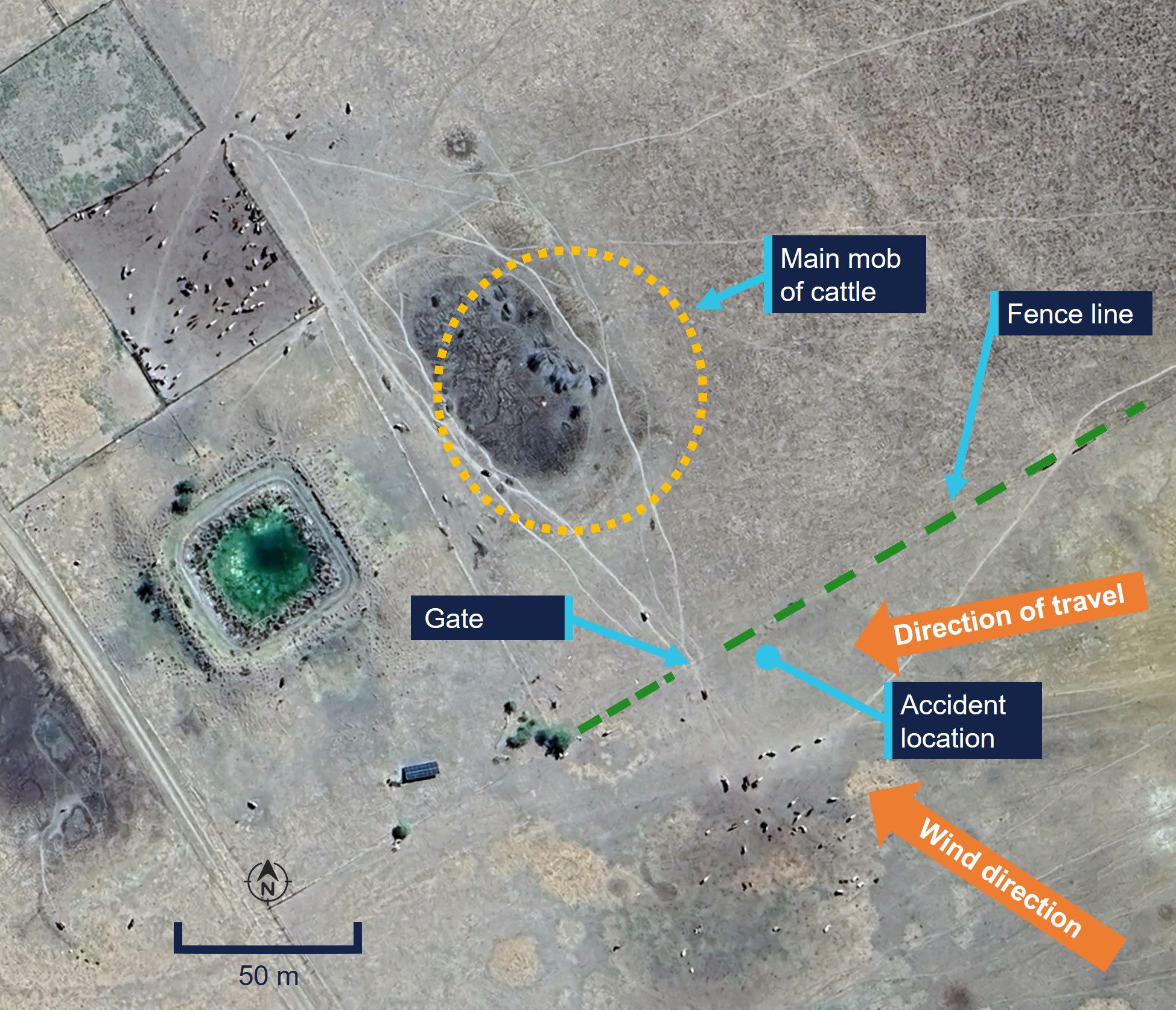
Source: Google Earth, annotated by the ATSB
Reacting to the animal’s movement, the pilot flared[2] the helicopter while travelling downwind in close proximity to the ground. During the flare, the pilot felt the helicopter sink more than expected and the tail rotor impacted the ground. This resulted in the tail rotor becoming ineffective. Without yaw[3] control, the helicopter rotated quickly to the right and the pilot assessed there was a tail rotor failure. The pilot reduced the throttle to decrease the torque and raised the collective to cushion the aircraft onto the ground. The pilot estimated that the helicopter had completed 2 or 3 full rotations, and still had some rotation when the right skid made contact with the ground, causing the helicopter to roll over to the right. The main rotor blades then impacted the ground and the helicopter came to a stop on its right side, resulting in substantial damage (Figure 2).
The pilot was restrained by their seatbelt and uninjured. They were able to free themselves from the wreckage, later stating that their use of a flight helmet had prevented a head impact during the accident sequence.
Figure 2: VH-HGE accident site
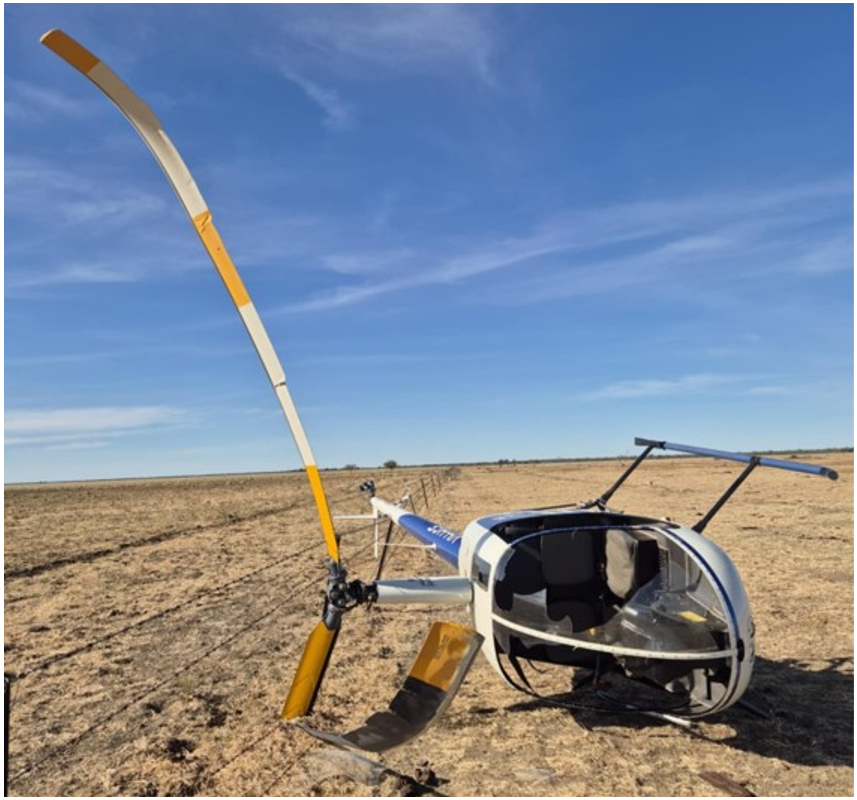
Source: North Australian Helicopters
Context
Personnel information
The pilot held a commercial pilot licence (helicopter) issued on 7 August 2023 and had held a private pilot licence (helicopter) since 3 June 2020, with a class rating for single‑engine helicopters. They had held an aerial mustering rating since 9 March 2022 and a low-level operations rating that was valid until 7 May 2027. The pilot had accumulated about 1,970 total hours flying time.
They also held a class 1 medical certificate, valid until 20 August 2025 with no restrictions.
Training
The pilot completed their last helicopter flight review and operator proficiency check flight on 7 May 2025. An operator’s proficiency check was required every 12 months and included low-level operations and simulated emergency procedures relevant to mustering operations, such as managing the loss of tail rotor control in forward flight and during hover. The pilot recalled that about 30 minutes of the check flight was focused on tail rotor failures and jammed flight controls.
Additionally, about 2 weeks earlier, the pilot conducted a check flight with the operator’s chief pilot. The flight included mustering procedures and general flying. The chief pilot recorded that the pilot showed above satisfactory techniques during the check flight.
Following the tail rotor impact with the ground, the pilot recalled there was limited time to assess what had happened before the helicopter began to rapidly rotate and indicated that the recent training allowed them to quickly apply the correct recovery technique.
Fatigue
The pilot reported starting work at 0700 on the day of the occurrence, having obtained about 8 hours of sleep and recalled feeling alert at the time of the occurrence.
Aircraft information
General information
The Robinson R22 is a single-engine, light utility and training helicopter with a semi-rigid, 2-bladed main rotor, a 2-bladed tail rotor and skid type landing gear. It has an enclosed cabin with 2 seats. The pilot sat on the right side, and extensive windows at the front of the helicopter generally afforded unrestricted visibility ahead. The accident helicopter was being flown without doors fitted, as is common in mustering operations.
The R22 Beta II is powered by a Lycoming O-360 4-cylinder piston engine that is derated to 131 hp (96 kW) for take-off and 124 hp (91 kW) for cruise at 2,652 RPM.
VH-HGE was manufactured in the United States in 1996 as serial number 2574. North Australian Helicopters held the registration since July 2009. Its maintenance release was current until June 2026 and did not record any outstanding maintenance or defects.
Helicopter performance
The pilot described a south-easterly wind at about 15 kt; at the time of the accident it was a quartering tailwind from the left.
The New Zealand Civil Aviation Authority Good Aviation Practice: Helicopter Performance publication (2025) stated that:
Only a few knots of wind on the tail can make a big difference to the power required to satisfactorily control the rate of descent during an approach.
In a helicopter, translational lift occurs when clear, undisturbed air flows through the rotor system, either from wind or directional flight improving rotor efficiency. As a helicopter’s airspeed increases the power required to maintain level flight decreases. (Wagtendonk, 2011).
To initiate a flare, the pilot is required to tilt the main rotor system of the helicopter rearwards, raising the nose so the downwash is angled in front of the helicopter, causing a reduction in forward airspeed. However, as the pilot tilts the rotor system, the thrust direction may no longer be vertical and therefore may require additional power to produce additional lift to maintain height.
Tail rotor failure
A helicopter’s tail rotor provides anti-torque control, which counteracts the torque of the main rotor system. A tail rotor failure at low airspeed will result in the helicopter rotating immediately in the opposite direction to the rotation of the main rotor system. The severity of the rotation is directly proportional to the power being applied.
A potentially damaging situation exists when total tail rotor loss occurs unexpectedly at lower than cruising speeds. The fuselage will begin to rotate immediately and it will be difficult to regain directional control. (Wagtendonk, 2011)
The Robinson R22 pilot operating handbook (POH) detailed the procedure for a loss of tail rotor thrust during a hover, stating:
Failure is usually indicated by nose right yaw which cannot be stopped by applying left pedal.
- Immediately roll throttle off into the overtravel spring and allow the aircraft to settle
- Raise collective just before touchdown to cushion landing.
Meteorological information
The graphical area forecast for the Northern Territory, valid between 0830 and 1430 local time, indicated expected visibility in the area greater than 10 km, isolated areas of fumes (smoke) below 5,000 ft, moderate turbulence from the surface to 10,000 ft expected from dust devils[4] and thermals; neither pilot reported any concerns with visibility or other localised weather phenomena. The grid point wind temperature forecast for the Northern Territory, valid from 1230, indicated expected winds at 1,000 ft were about 130° at 15 kt and a forecast temperature of 19°C.
The pilot recalled conditions on the day as fine and sunny and estimated the temperature between 18–20°C with a south-easterly wind of about 15 kt. They reported no issues with visibility while operating at low level. The pilot of the second helicopter also recalled similar conditions at the time of the occurrence.
Aerial mustering guidance
Civil Aviation Safety Authority (CASA) sector risk profile for agricultural flying, published in 2025, indicated for the 10‑year period between 2014 and 2023 a total of 90 accidents and incidents while conducting aerial mustering. Of these occurrences, 71 were categorised as accidents including 7 fatalities.
The sector risk profile also showed that collisions with terrain were the most common fatal and non-fatal accidents in the agricultural flying sector.
The mustering sector risk profile published in 2014 (now superseded by the current agricultural sector risk profile) advised:
The aerial mustering sector is hazard rich due to the inherent characteristics of the operation, such as very low flying, high workload, negative effects from weather, obstacles such as power lines, trees and terrain, pilot distraction, small power margins, and extended time operating within the height/velocity diagram (‘deadmans curve’)….. Pilot training, supervision and mentoring play an important role in developing pilot skills to manage aerial mustering manoeuvres.
North Australian Helicopters’ operations manual stated that the 4 main causes of accidents when conducting mustering operations are:
- turning downwind whilst reducing airspeed and then trying to arrest descent with more collective pitch rather than regaining airspeed
- tail rotor/main rotor strike
- poor recovery from partial power loss (e.g. stuck valve, magneto issues)
- lack of situational awareness due to focussing too much on the animals/job, and/or fatigue.
The operator’s safe work method statements highlighted inadvertent ground impact during low-level flying as a hazard during mustering operations. The assessment indicated a high risk level and the operator’s control for the hazard was instructing pilots that when tracking with a tailwind component to avoid bringing the aircraft into a hover (flaring).
Further resources and guidance material for both pilots and operators within the aerial mustering industry include.
- Agricultural flying sector safety risk profile
- CASA Flight Safety Australia – The challenge for aerial mustering
ATSB Safety Advisory Notice
AO-2020-040-SAN-01 (204.84 KB)Correctly fitted, secured and maintained flight helmets can save lives.
Divided attention
Humans attend selectively to information due to finite cognitive capacity, making it impossible to process all of the information in our environment at once. Conscious attention is also influenced by tasks that are prioritised (Wickens & McCarley, 2007). Attention directed to a primary task (flying), can quickly shift to a secondary task (mustering stock), at the expense of the primary task (Australian Transport Safety Bureau, 2005).
Task prioritisation is further influenced by motivation to complete a goal, such as an operational goal (Harris, Fein, & Machin, 2002), and pilots can be influenced to prioritise secondary goals (Bearman, Paletz, & Orasanu, 2009) intentionally or unintentionally.
Recency training
The Federal Aviation Authority (FAA) aviation instructor’s handbook details the benefit of recent training:
The principle of recency states that things most recently learned are best remembered. Conversely, the further a learner is removed in time from a new fact or understanding, the more difficult it is to remember. For example, it is easy for a learner to recall a torque value used a few minutes earlier, but it is more difficult or even impossible to remember a value last studied or used further back in time [.…..] In SBT (skills based training), the closer the training or learning time is to the time of the actual scenario, the more apt the learner is to perform successfully. This law is most effectively addressed by making the training experience as much like the scenario as possible.
Survivability
The helicopter was fitted with a lap and sash style seat belt which the pilot wore during the mustering operation.
The operator’s safe work method statements required pilots to wear helmets while conducting mustering operations. The pilot reported that they suspected their helmet probably prevented a head knock during the accident sequence.
The Civil Aviation Safety Regulations did not require pilots to wear flight helmets at the time of the accident. However, the wearing of flight helmets was often required by aircraft operators for pilots engaged in aerial work and mustering operations, and was necessary to meet federal and state legislated workplace, health and safety requirements.
Related occurrences
A search of the ATSB Aviation Occurrence Database showed that in the 5 years since 2020 there have been 7 occurrences that involved commercial mustering helicopters impacting the tail rotor with terrain or obstacles:
- Collision with terrain involving a Robinson R22, 202 km south-west of Winton, Qld, June 2022 (AB-2022-003): During low‑level mustering operations, the helicopter struck a motorcyclist while in the hover. The pilot lost directional control and the helicopter subsequently collided with terrain and was destroyed. The motorcycle rider sustained serious injuries.
- Collision with terrain involving Robinson R22, 13 km south‑south-east of Fitzroy Crossing, WA, June 2023: During low‑level mustering operations, the pilot applied excessive pitch to manoeuvre clear of trees resulting in the tail rotor striking the ground. The helicopter subsequently collided with terrain and sustained substantial damage.
- Collision with terrain involving a Robinson R22, 76 km west‑south-west of Halls Creek, WA, September 2023: During aerial mustering operations, the helicopter’s tail rotor struck a tree and subsequently collided with terrain. The pilot received serious injuries and the helicopter was destroyed by post-impact fire.
- Collision with terrain involving Robinson R22, 26 km east of Broome, WA, April 2024: During aerial mustering operations at 6 ft, the pilot detected a jolt through the tail rotor pedals followed by severe vibration. The helicopter collided with terrain and was substantially damaged. The pilot received minor injuries.
- Collision with terrain involving Robinson R22, near Mount Valley, NT, May 2024: During aerial mustering operations at 6 ft, the tail rotor struck the ground and the helicopter collided with terrain resulting in substantial damage.
- Collision with terrain involving Robinson R22, 139 km south of Kununurra, WA, June 2024: During approach, the tail struck the ground resulting in minor damage to the tail boom.
- Collision with terrain involving Robinson R22, at Rockhampton Downs, NT, June 2025: During aerial mustering operations, the helicopter's tail struck the ground and the helicopter collided with terrain, resulting in substantial damage.
Safety analysis
Introduction
In the final stages of the muster, one remaining animal baulked when approaching a gate. To prevent the animal from escaping, the pilot flared the helicopter while low to the ground with a quartering tailwind. During the flare, the helicopter descended, resulting in the tail rotor impacting the ground. The pilot lost yaw control and the right skid contacted the ground, causing the helicopter to roll over.
Divided attention
Having returned 4 out of the 5 stock to the yard, the pilot was highly motivated to complete the mustering operation and their attention became increasingly focused on moving the last remaining animal through to the holding paddock while flying in close proximity to the ground. Associated with this divided attention, the pilot likely had reduced awareness of the helicopter’s proximity to the last animal, the ground and the potential effect of the prevailing wind on the performance of the helicopter.
The helicopter’s proximity to the animal and forward momentum reduced the pilot’s reaction time and options for recovery.
Pilot reaction to baulking animal
The pilot estimated the helicopter was moving forward about 4 m behind the animal at about 6 ft above ground level when it baulked. The pilot likely judged their airspeed by visual reference to ground features and the tailwind likely gave them a sensation of a higher airspeed. With limited time to respond, the pilot likely flared the aircraft as an automatic reaction to the animal’s movement while in close proximity to the ground.
This resulted in the pilot not anticipating the additional power required during the flare, leading to the helicopter descending. This, combined with the change in pitch attitude, lowered the tail rotor closer to the ground. With minimal clearance between the helicopter and the ground, there was likely insufficient opportunity for the pilot to apply additional power to climb or arrest the descent before the tail rotor impacted the ground.
Pilot response to ground impact
Following the tail rotor impacting terrain the helicopter began to rapidly rotate to the right. The pilot assessed there was a tail rotor failure and reduced the throttle to decrease the torque and then increased the collective prior to impact to manage the rate of descent. This likely helped prevent a more serious accident and possible injury.
The operator had conducted a proficiency check flight with the pilot less than 2 months prior to the accident and included tail rotor failure simulations which were recognised by the operator as a common accident during mustering operations.
The recent emergency training likely helped the pilot to react to the tail rotor failure with the correct technique before the helicopter became uncontrollable.
Findings
ATSB investigation report findings focus on safety factors (that is, events and conditions that increase risk). Safety factors include ‘contributing factors’ and ‘other factors that increased risk’ (that is, factors that did not meet the definition of a contributing factor for this occurrence but were still considered important to include in the report for the purpose of increasing awareness and enhancing safety). In addition ‘other findings’ may be included to provide important information about topics other than safety factors. These findings should not be read as apportioning blame or liability to any particular organisation or individual. |
From the evidence available, the following findings are made with respect to the tail rotor strike involving Robinson R22 Beta II, VH-HGE, 58 km north-west of Anthony Lagoon, Northern Territory on 1 July 2025.
Contributing factors
- Focusing their attention on moving stock during mustering operations, the pilot flew the helicopter in close proximity to the ground and one of the animals.
- The pilot flared the helicopter in response to the animal baulking at a gate. The combination of the tail wind component and flare at low level led to the helicopter descending and the tail rotor impacting the ground. This resulted in the helicopter uncontrollably yawing to the right.
Other findings
- Recent tail rotor failure training during an operator proficiency check ensured the pilot reacted to the emergency with the correct technique, which likely helped prevent injury and minimised damage.
Safety actions
North Australian Helicopters advised following the occurrence a check flight was conducted with each company pilot.
North Australian Helicopters also advised the safe work method statements had been updated for collision with obstacles adding that pilots were to prioritise flying the aircraft over the movement of stock and if an animal was unresponsive to the helicopter, pilots were advised to let the animal go.
Sources and submissions
Sources of information
The sources of information during the investigation included the:
- pilot of the accident flight and another pilot who conducted flights for the operator
- Bureau of Meteorology
- operator’s manuals
- pilot logbooks and training history
- Civil Aviation Safety Authority
- aircraft maintenance release.
References
Australian Transport Safety Bureau. (2005). Dangerous Distraction An examination of accidents and incidents involving pilot distraction in Australia between 1997 and 2004.
Bearman, C., Paletz, S. B., & Orasanu, J. (2009). Situational pressures on aviation decision making. Goal seduction and situation aversion. Aviation, Space, and Environmental Medicine, 80 (6), 556-560.
Harris, M. R., Fein, E. C., & Machin, M. A. (2002). A Systematic Review of Multilevel Influenced Risk-Taking in Helicopter and Small Airplane Normal Operations. Frontiers in Public Health.
New Zealand Civil Aviation Authority . (2025). Good aviation practise, Helicopter Performance.
Robinson Helicopter Co. (June, 1994). Safety Notice 9.
Wagtendonk, W. J. (2011). Principles of Helicopter flight. Newcastle, Washington: Aviation Supplies and Academics, Inc.
Wickens, C. D., & McCarley, J. S. (2007). Executive Control: Attention Switching, Interruptions and Task Management. In Applied Attention Theory. Chapman and Hall.
Submissions
Under section 26 of the Transport Safety Investigation Act 2003, the ATSB may provide a draft report, on a confidential basis, to any person whom the ATSB considers appropriate. That section allows a person receiving a draft report to make submissions to the ATSB about the draft report.
A draft of this report was provided to the following directly involved parties:
- pilot
- North Australian Helicopters
- Civil Aviation Safety Authority
- United States National Transport Safety Board.
A submission was received from:
- Civil Aviation Safety Authority.
The submission was reviewed and, where considered appropriate, the text of the report was amended accordingly.
Purpose of safety investigationsThe objective of a safety investigation is to enhance transport safety. This is done through:
It is not a function of the ATSB to apportion blame or provide a means for determining liability. At the same time, an investigation report must include factual material of sufficient weight to support the analysis and findings. At all times the ATSB endeavours to balance the use of material that could imply adverse comment with the need to properly explain what happened, and why, in a fair and unbiased manner. The ATSB does not investigate for the purpose of taking administrative, regulatory or criminal action. About ATSB reportsATSB investigation reports are organised with regard to international standards or instruments, as applicable, and with ATSB procedures and guidelines. Reports must include factual material of sufficient weight to support the analysis and findings. At all times the ATSB endeavours to balance the use of material that could imply adverse comment with the need to properly explain what happened, and why, in a fair and unbiased manner. An explanation of terminology used in ATSB investigation reports is available here. This includes terms such as occurrence, contributing factor, other factor that increased risk, and safety issue. Publishing informationReleased in accordance with section 25 of the Transport Safety Investigation Act 2003 Published by: Australian Transport Safety Bureau © Commonwealth of Australia 2025 
Ownership of intellectual property rights in this publication Unless otherwise noted, copyright (and any other intellectual property rights, if any) in this report publication is owned by the Commonwealth of Australia. Creative Commons licence With the exception of the Commonwealth Coat of Arms, ATSB logo, and photos and graphics in which a third party holds copyright, this report is licensed under a Creative Commons Attribution 4.0 International licence. The CC BY 4.0 licence enables you to distribute, remix, adapt, and build upon our material in any medium or format, so long as attribution is given to the Australian Transport Safety Bureau. Copyright in material obtained from other agencies, private individuals or organisations, belongs to those agencies, individuals or organisations. Where you wish to use their material, you will need to contact them directly. |
[1] The animal was a weaner, which are often more erratic in behaviour during a muster.
[2] Flare: raising the nose of the helicopter to slow forward airspeed.
[3] Yaw: sideways rotation around the yaw (vertical) axis.
[4] Dust devils are dust-filled vortices, formed by strong surface heating, which are smaller and less intense than a tornado.
Occurrence summary
| Investigation number | AO-2025-035 |
|---|---|
| Occurrence date | 01/07/2025 |
| Location | Near Anthony Lagoon |
| State | Northern Territory |
| Report release date | 21/11/2025 |
| Report status | Final |
| Investigation level | Short |
| Investigation type | Occurrence Investigation |
| Investigation status | Completed |
| Mode of transport | Aviation |
| Aviation occurrence category | Collision with terrain |
| Occurrence class | Accident |
| Highest injury level | None |
Aircraft details
| Manufacturer | Robinson Helicopter Co |
|---|---|
| Model | R22 Beta II |
| Registration | VH-HGE |
| Serial number | 2574 |
| Sector | Helicopter |
| Operation type | Part 138 Aerial work operations |
| Departure point | Anthony Lagoon Aircraft Landing Area, Northern Territory |
| Destination | Anthony Lagoon Aircraft Landing Area, Northern Territory |
| Damage | Substantial |