

Final report
Report release date: 12/08/2025
Investigation summary
What happened
On 29 April 2025, the flight crew of an Alliance Airlines Fokker 100 aircraft, VH-FKF, were conducting scheduled passenger flight QQ 3811, from West Musgrave Airport to Perth Airport, Western Australia. The captain was the pilot flying and the first officer was the pilot monitoring.
The flight crew received an air traffic control clearance to conduct a visual approach following a standard instrument arrival to Perth Airport’s runway 03. The approach required a 90° turn onto final that resulted in the aircraft being aligned with the runway and on the correct approach profile about 4 NM from the runway threshold.
Passing about 1,000 ft radio altitude, the aircraft was above the operator’s permitted airspeed‑related stabilised approach criteria. However, a go‑around was not initiated and the aircraft landed uneventfully at 1539 local time.
What the ATSB found
The ATSB found that the pilot flying incorrectly assessed that the applicable stabilisation height was 500 ft. As a result, they did not manage the aircraft's energy state to ensure the stabilised approach speed requirement was met by 1,000 ft.
The pilot monitoring did not announce that the approach was unstable when the airspeed requirement was not met at 1,000 ft. This may have been influenced by their workload, the required check being completed slightly late, and an assessment that the airspeed was reducing.
Finally, although not contributory to the occurrence, during descent the captain inadvertently omitted to change the altimeter setting from standard pressure to QNH. This resulted in the left altimeter indicating 300 ft lower than the right altimeter. Neither flight crewmember detected the incorrect setting during 2 subsequent checks prior to landing.
Safety message
This incident highlights the importance of flight crew having a common understanding of the approach requirements. The International Air Transport Association provided guidance for flight crew to avoid an unstable approach. This included to:
- be aware of the stable approach criteria
- comply with the stable approach criteria published in the standard operating procedures (SOP)
- advise air traffic control when unable to comply with a clearance that would result in the aircraft being too high and/or too fast
- prepare for visual approaches by briefing speed/altitude/configuration gates, equivalent to those of an instrument approach, and follow the published visual approach pattern in the manufacturer’s or operator’s SOP
- configure the aircraft for landing at some predetermined distance from the airport or altitude, after which only small corrections to pitch heading and power setting should be made.
This incident also illustrates the need for effective flight crew monitoring. The Flight Safety Foundation identified that monitoring can be improved by standard operating procedures, increased emphasis and practice, and stated:
One of the most important aspects of a safe flight operation is the requirement for crewmembers to carefully monitor the aircraft’s flight path and systems, as well as actively cross-check each other’s actions.
The investigation
The occurrence
On 29 April 2025, the flight crew of an Alliance Airlines (Alliance) Fokker 100 aircraft, VH‑FKF, were conducting scheduled passenger flight, callsign ‘Unity’ (QQ) 3811, from West Musgrave Airport to Perth Airport, Western Australia. The captain was the pilot flying (PF), and the first officer was the pilot monitoring (PM).[1]
At about 1449 local time, while in the cruise at flight level (FL) 340,[2] the flight crew received an air traffic control (ATC) clearance to conduct the KABLI One Victor standard instrument arrival (STAR) to Perth Airport’s runway 03 (Figure 1).
Before commencing descent, the flight crew reviewed the Perth Airport automatic terminal information service (ATIS), which included QNH[3] of 1,024 hPa and wind from 080° at 10 kt. The flight crew calculated the landing reference speed (VREF) for the aircraft’s weight using landing flap 25 to be 122 kt and the approach speed (VAPP) as 132 kt.
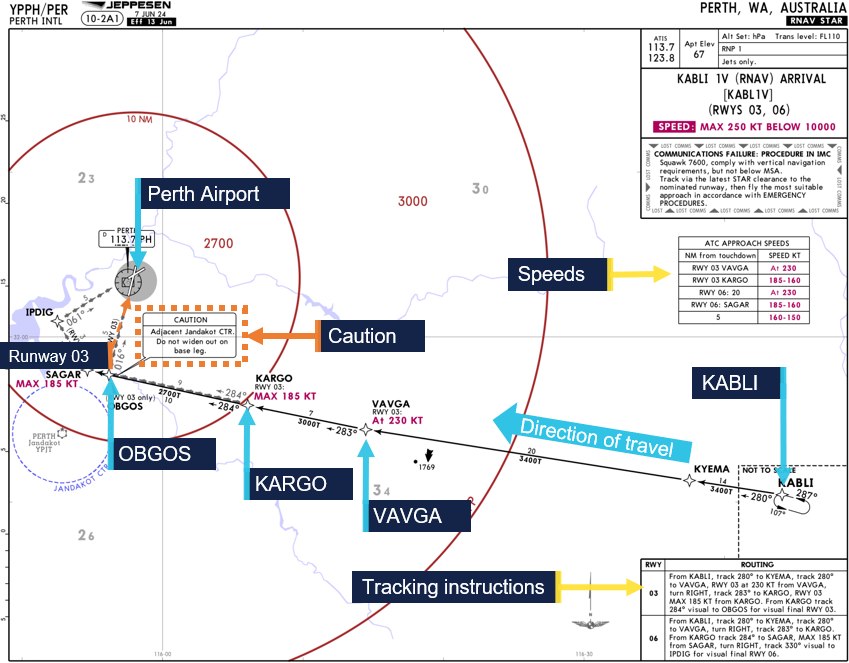
Note: Airservices advised that the VOR depicted on the chart is historical, does not serve a navigational purpose for the depicted procedure and can be removed. Source: Jeppesen, annotated by the ATSB
At about 1512, the flight crew were cleared to descend to FL 190 ‘when ready’ and instructed to switch to another Melbourne Centre ATC frequency. The PM reported having commenced descent from FL 340 at 1517, and 3 minutes later, the controller instructed them to maintain 250 kt (airspeed) from KABLI until advised and cleared them to descend via the STAR to 9,000 ft.
The aircraft passed waypoint KABLI at about 1527, descending through about FL 166 and then turned to track 50 NM via the STAR to fly-by waypoint[4] OBGOS, 5 NM from the runway 03 threshold.
During descent, approaching the transition level (FL 110),[5] the required transition check involved:
- each flight crewmember setting the current local QNH (in this instance 1,024 hPa), on the altimeter set panel
- changing the subscale for the captain’s (no 1) and first officer’s (no 2) primary flight displays (PFD), from standard (STD) to QNH by pressing the QNH/STD button on the electronic flight instrument system panel (Figure 2).
When set to QNH, the PFD displays the value selected on the altimeter set panel in hPa. When set to STD, the PFD displays ‘STD’.
Figure 2: Altimeter set panel and electronic flight instrument system (EFIS) panel (not collocated)

Source: Fokker, annotated by the ATSB
Recorded flight data showed that the first officer’s PFD altimeter reference pressure changed from STD to QNH passing about FL 114, but the captain’s PFD remained on STD. The standby altimeter pressure setting was not recorded, but the captain reported having set the standby altimeter to QNH.
After each setting their own PFD, the standard operating procedures required each flight crewmember to crosscheck all 3 altimeters were set correctly. The PF was required to call out ‘Transition [1,024] set. Passing [x] ft now. Speed [x] knots’. The PM was to respond, ‘[x] ft checked’. The crew reported completing the checks, but did not identify that the no 1 PFD was incorrectly set to STD and therefore indicating about 300 ft lower than the no 2 PFD (and the standby altimeter).
At about 1527, the PM contacted the Perth Approach controller, and at 1528:44, passing FL 136, was instructed to increase speed to 270 kt then cancel further speed restrictions, and descend to 7,000 ft (see the section titled Air traffic control speed instructions). About 4 minutes later, they were cleared to descend to 3,000 ft and report when visual.[6] The PM read back ‘descend 3,000’ and advised they were visual. The controller then cleared the flight crew to conduct a visual approach, which the PM read back.
At 1533, ATC broadcast that a new ATIS was current and the QNH had changed to 1,023 hPa. At that time, the aircraft was descending through about 5,000 ft. Passing 5,000 ft, the standard procedures required the PM to call out ‘5,000 ft on QNH [1,023]’ and the PF’s required response was ‘QNH [1,023] checked’. Both flight crewmembers recalled having set and then confirmed all 3 QNH displays were set to 1,023. However, they did not identify the altitude discrepancy between altimeters, or the no 1 PFD subscale setting of STD.
As ATC had cancelled the STAR speed restrictions, the flight crew did not have to adhere to the airspeeds on the approach chart. Therefore, as the aircraft descended through 5,000 ft, it passed waypoint VAVGA at an indicated airspeed of about 270 kt – 40 kt faster than the published speed restriction. The aircraft subsequently passed waypoint KARGO, descending through about 3,300 ft at 230 kt airspeed – 45 kt faster than the published speed restriction.
Approaching 2,500 ft and at about 200 kt airspeed, the PM selected flap 8. As the aircraft descended through 2,500 ft, the flight crew were required to crosscheck the radio altitude[7] indicating on both PFDs. The flight crew confirmed the radio altitudes matched, but again did not identify the no 1 altimeter subscale incorrectly set to STD. At the same time, the approach controller instructed the PM to change to the Perth Tower ATC frequency. The PM contacted the aerodrome controller at 1536:15.
A review of recorded flight data identified that, at 1536:46, the aircraft commenced the right turn past waypoint OBGOS (Figure 3), at about 2,000 ft above mean sea level (AMSL) and 180 kt airspeed. During the turn, landing gear was extended, followed by flap 25. Just before the aircraft was levelled, the captain deployed the speed brake.
Figure 3: Recorded flight data showing VH‑FKF turn past fly‑by waypoint OBGOS

Source: Recorded flight data overlaid on Google Earth, annotated by the ATSB
The captain reported identifying a discrepancy between the altimeter and the radio altitude during the turn, passing about 1,500 ft, and assessed it as an instrument error. As they were visual, the captain was primarily focused outside, ensuring the aircraft aligned with the runway and on the correct profile by following the precision approach path indicator (PAPI) guidance.
About 1 minute after commencing the turn, the aircraft was aligned with the runway centreline, about 4 NM from the threshold, at 1,250 ft radio altitude and 172 kt airspeed. The captain later reported that the airspeed was faster than normal due to their focused attention on the observed altimeter discrepancy. As the aircraft descended through about 1,000 ft radio altitude (also about 1,000 ft above aerodrome elevation), the PM assessed that all stabilised approach criteria were met and called ‘stable’, and the flight crew continued the approach.
The aerodrome controller cleared the flight crew to land as the aircraft passed about 600 ft radio altitude. At 1539, the aircraft landed normally within the touchdown zone. After landing, the captain realised that the no 1 PFD was set to STD and changed the setting to QNH.
Context
Flight crew information
The captain held an air transport pilot licence (aeroplane), class 1 aviation medical certificate, and had accrued 24,797 hours total flying time, 1,497 of which were in the Fokker 70 and 100 aircraft types.
The first officer held a commercial pilot licence (aeroplane), class 1 aviation medical certificate, and had 4,600 hours total flying time, 520 of which were on the Fokker aircraft types.
The captain reported their fatigue as 3/7 and the FO as 1/7.[8] There was no evidence fatigue was a factor in this occurrence.
Key speeds
The flight crew used the onboard performance tool to calculate the landing reference speed (VREF) of 122 kt. The Alliance Airlines Fokker 70–100 Aircraft Operating Manual (AOM) Supplement (SUP) defined the approach speed as VREF + 5 kt with the following wind correction:
The approach speed (VREF + 5) should be corrected for wind, including gusts, as follows:
Wind 0 up to 10 knots inclusive: no correction
Wind (+gust) more than 10 up to 20kts inclusive: add 5kts
Wind (+gust) more than 20kts: add 10 kts
Based on the ATIS specified wind speed of 10 kt and the Alliance AOM SUP, there was no wind correction required and the VAPP was 127 kt. However, the crew added 5 kt for wind correction and used VAPP of 132 kt. The flight crew could not recall their decision‑making around the wind correction, but reported it may have included consideration of the wind the aircraft was experiencing at the time of the calculation, and the aerodrome forecast wind speed of 12 kt.
The Fokker Aircraft Operating Manual specified maximum flap extended speeds of:
- flap 8° – 250 kt
- flap 15° and 25° – 220 kt
- flap 42° – 180 kt
and the maximum landing gear extended and operating speed was 200 kt.
Air traffic control speed instructions
Airservices Australia’s Aeronautical Information Publication (AIP) included the following content related to airspeed requirements:
ENR 1.5 – 47:
10.1.5 When a clearance for the termination procedure is authorised e.g. visual approach, the published STAR speed restrictions still apply unless specifically cancelled.
10.2.5 Cancellation of ‘published speed restrictions’ cancels all speeds published on the STAR chart. Cancellation of ‘ATC-issued speed control instruction’ cancels any speed control instructions issued by ATC. Airspace speed limitation must be complied with unless specifically cancelled.
ENR 1.4 – 13:
4.1 Airspace speed limitations stated ‘N/A’ for IFR aircraft in Class C (and Class A) airspace.
GEN 3.4 – 56 included the phraseology [DESCEND VIA STAR TO (level)], CANCEL SPEED RESTRICTION(S), for the circumstances:
During a STAR descent:
a. comply with published level restrictions
b. follow the lateral profile of the STAR
c. published speed restriction and ATC-issued speed control instructions are cancelled
ENR 1.6 – 5:
5.2 The pilot must request an alternative when at ATC-issued speed control instruction is unacceptable on operational grounds.
5.5 A pilot will be advised when a specific ATC-issued speed control instruction is no longer necessary. Unless otherwise stated, an ATC-issued speed control instruction applies until the aircraft reaches the point in the descent profile where the speed would normally be reduced below that assigned by ATC. Except for a STAR, a DME arrival, or unless otherwise specified, a clearance for final approach or a clearance for a visual approach terminates speed control.
On this flight, after being cleared for the STAR, the flight crew were instructed to ‘increase speed to 270 knots and then cancel further speed restrictions’. About 3 minutes later, they were cleared to conduct a visual approach.
Airservices Australia advised that in this case, the aircraft was expected to maintain 270 kt until the point of normal profile speed reduction. The flight crew could then resume their desired profile speed.
The aircraft maintained 270 kt until it passed waypoint VAVGA, less than 2 minutes after being cleared for a visual approach. The captain reported that the cancellation of speed restrictions created a ‘subtle pressure’ to maintain a higher airspeed, and contributed to the faster approach speed.
Recorded flight data
At 1528:44 the aircraft was 40 NM from OBGOS at 13,915 ft (corrected barometric altitude for comparison) and 250 kt when ATC instructed the flight crew to increase speed to 270 kt then cancel further speed restrictions.
At 1531:42, the aircraft was 24.6 NM from OBGOS at 7,698 ft barometric altitude and 272 kt when cleared for a visual approach. The aircraft then continued at about 270kt to waypoint VAVGA, 16 NM from OBGOS. From there, about 140 kt deceleration to VAPP (132 kt) was required by 1,000 ft.
At VAVGA the aircraft was at 5,000 ft, 1,600 ft higher than the minimum permitted altitude. To that point, the average descent rate since the crew were instructed to increase to 270 kt (40 NM from OBGOS), had been 1,938 fpm. A descent rate of 2,286 fpm was required for the aircraft to have passed VAVGA at 3,400 ft and subsequently achieve the required deceleration.
Figure 4 depicts key parameters of the recorded flight data during the approach from 3,000 ft. At 1,000 ft radio altitude, the recorded airspeed was 158 kt, which reduced to the stabilised criterion of VAPP + 10 (142 kt) by 800 ft, 9 seconds later. The vertical speed was not recorded but was calculated from the change in recorded altitudes.
Table 1 shows the derived vertical speed, with exceedances of the stabilised criterion of 1,000 fpm between about 1,000 ft and 450 ft radio altitude. These included an expected increase in vertical speed associated with the retraction of the speed brake, passing about 800 ft radio altitude. The recorded data also showed that the aircraft was within one dot of the 3° glideslope from 1,000 ft and therefore on the correct approach profile.
Figure 4: Recorded flight data of approach to runway 03 from 3,000 ft

Source: ATSB analysis of recorded flight data
Table 1: Descent rates from about 1,000–400 ft radio altitude
| Radio altitude (ft) | Descent rate (fpm) |
| 1,015 | -1,217 |
| 977 | -1,127 |
| 965 | -1,123 |
| 915 | -1,087 |
| 913 | -1,030 |
| 873 | -890 |
| 868 | -843 |
| 843 | -870 |
| 843 | -983 |
| 797 | -990 |
| 798 | -1,013 |
| 805 | -1,103 |
| 773 | -1,203 |
| 720 | -1,200 |
| 719 | -1,050 |
| 708 | -1,013 |
| 683 | -1,123 |
| 668 | -1,170 |
| 609 | -1,097 |
| 611 | -1,067 |
| 606 | -1,110 |
| 587 | -1,197 |
| 541 | -1,023 |
| 550 | -940 |
| 561 | -953 |
| 492 | -1,140 |
| 491 | -1,207 |
| 455 | -1,163 |
| 437 | -1,027 |
| 391 | -820 |
Alliance Airlines documented procedures
Descent rates
The OPPM stated:
The following values for the rate of descent below the transition altitude shall not normally be exceeded:
• 3000 fpm down to an altitude of 3000 ft above aerodrome level (AAL).
• 2000 fpm down to an altitude of 2000 ft AAL transitioning to 1000 ft AAL
• 1000 fpm below 1000 feet AAL.
Visual approach
The OPPM stated that in visual meteorological conditions (VMC)[9] on a visual approach, the aircraft must join the circuit on the upwind, crosswind or downwind leg, or make a straight-in approach after establishing on final approach by 5 NM.
The Alliance Airlines F70–100 AOM SUP (versions 2.5 published in March 2024 and 2.6 published 10 June 2025) included section 7.12 Visual approach with subheadings 7.12.1 Procedure and 7.12.2 Straight-in visual approach. Both subsections included:
If not in the correct landing configuration at 1000ft AAL [above aerodrome level], a go around must be initiated.
If not stabilised on speed and glide path at 500ft AAL, a go around must be initiated.
Additionally, section 7.12.2 Straight-in visual approach included:
The following are the requirements for configuring a straight in approach.
• The aircraft must be configured landing gear down and flap 25 prior to 1500ft AAL and a 5nm final.
• Select flap 42 (if required) at 1300ft AAL.
Vertical speed should not exceed 1000ft/min inside 5nm to touchdown.
Stabilised approach criteria
The Alliance Airlines OPPM defined a stabilised approach as one that met the following criteria:
a) the correct flight path;
b) only small changes in heading/pitch are required to maintain the correct flight path;
c) the aircraft speed is not more than VAPP + 10 knots indicated airspeed and not less than VREF;
d) the aircraft is in the correct landing configuration;
e) sink rate is no greater than 1,000 feet per minute
f) thrust or power setting is appropriate for the aircraft configuration;
g) all briefings and checklists have been completed;
h) specific types of approaches are stabilized if they also fulfil the following
i. instrument landing system (ILS) approaches must be flown within one dot of the glideslope and localizer
ii. a Category II or Category III ILS approach must be flown within the expanded localizer band
i) unique approach procedures or abnormal conditions requiring a deviation from the above elements of a stabilized approach require a special briefing to have been completed prior to beginning the approach.
• Note 1: A momentary excursion is permitted for points (c) & (e). A momentary excursion is defined as a deviation lasting only a few seconds and where every indication is that it will return to the stabilised criteria as listed in points (c) & (e).
• Note 2: Where the nominal descent path for a particular approach requires a descent rate greater than 1000 fpm. This is only permitted when expected rates of descent have been briefed prior to the approach being commenced.
Stabilized Heights
All flights shall meet all of the above stabilized approach criteria by 1,000 feet above aerodrome level except under the following circumstances:
Visual approach:
• Speed may be higher than VAPP + 10, provided it is within limits and expected to reduce to VAPP+10 or below by no later than 500ft AAL.
• Note 3: Visual conditions as defined by Jeppesen AUS or AIP - the pilot has established and can continue flight to the airport with continuous visual reference to the ground or water; and visibility along the flight path is not less than 5000m.
Visual circuit:
• Manoeuvring shall be completed no later than 500 AAL.
Circling approach
• Final Flap shall be selected no later than leaving the Circling Altitude.
• By 500ft AAL for the following shall be achieved.
◦ Approach Speed must be achieved
◦ Checklists must be completed
◦ Manoeuvring must be completed.
…[RNP-AR approach]
An approach that does not meet, or subsequently exhibits sustained deviations outside of these criteria requires an immediate go-around.
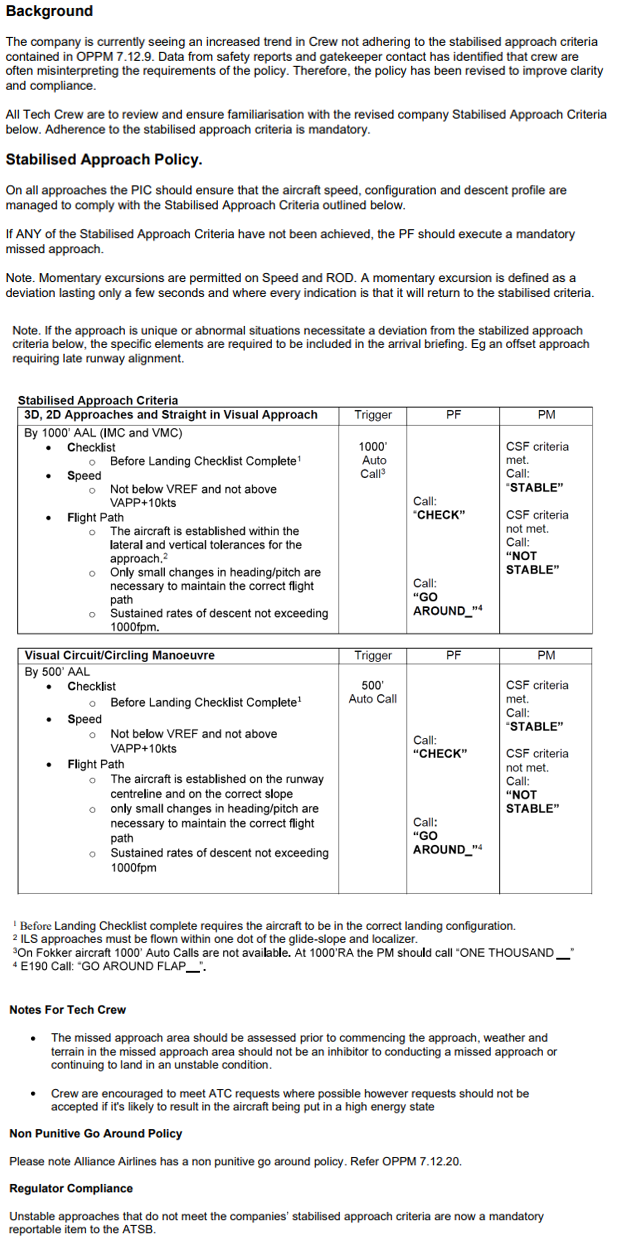
On 3 April 2025, Alliance issued Operations notice 25-038:
The Alliance Airlines Fokker AOM SUP (v2.5 released March 2024 and v2.6 released 10 June 2025) included the following visual approach standard calls:

Hierarchy of manuals
The Alliance Airlines hierarchy of manuals stated that the Operations Policy and Procedures Manual (OPPM) was the primary manual, and the aircraft operating manuals and supplements were supporting manuals. The OPPM section 7 – Standard operating procedures stated:
All Pilots must be fully aware and observant of the procedures and calls outlined in this chapter. Operate Alliance Airlines aircraft in accordance with the appropriate Aircraft Operating Manual and the Alliance Airlines Operations Policy and Procedures Manual. If information in either of these manuals conflict, the information in the most recent revision of the Aircraft Operating Manual or Operations Notice ‘date’ can be assumed to be valid.
Based on the hierarchy, the operations notice replaced the stabilised approach criteria documented in the OPPM. At the time of the incident, the operations notice had a more recent publication date than the AOM SUP and therefore took precedence where the information conflicted. However, an amendment to the AOM SUP was published after the incident (and subsequent to the operations notice), which did not amend the information that conflicted with the operations notice.
Alliance Airlines advised that it intended the flight crew to comply with the operations notice, which at the time of writing was to be incorporated into an amended OPPM. Additionally, a further amendment would be made to the AOM SUP to remove conflicting information.
Applicable stabilisation height
Alliance assessed that for the visual STAR via OBGOS the applicable stabilisation height was 1,000 ft, ‘because the STAR has FMS [flight management system] guidance and is not a visual circuit or circling manoeuvre’. However, Alliance’s stabilisation heights depended on whether a visual straight-in approach, instrument approach or visual circling/circuit approach was being conducted. The procedure did not describe the height based on whether an arrival was coded in the FMS. Alliance advised that initially the flight did not flag an exceedance in Alliance’s flight data analysis program and would therefore not have been further reviewed had the flight crew not reported setting the incorrect QNH. Having reviewed the recorded flight data, Alliance initially determined that there were no speed exceedances, and although the descent rate exceeded 1,000 fpm between 1,000 and 500 ft, this was considered transitory in nature and therefore was permitted in accordance with the stabilised approach criteria. However, Alliance subsequently assessed that the duration of the speed exceedance was not momentary.
The captain and first officer were familiar with the content of the operations notice. The first officer identified the approach as a straight‑in visual approach and therefore made the appropriate callout of ‘1,000 ft’, assessed that the stabilised approach criteria were met, then called ‘stable’. The first officer reported that due to the ‘busyness of [turning] the corner’, this check may have occurred slightly below 1,000 ft. Additionally, they reported assessing that the airspeed was reducing as required and subsequent vertical speed exceedances were momentary and therefore acceptable within the criteria.
Prior to Alliance Airlines issuing operations notice 25‑038, 26 days prior to the occurrence, the stabilisation height for a visual approach in VMC was 500 ft. However, the captain assessed that the visual approach via the STAR and waypoint OBGOS was not specifically defined in the operations notice, either by a visual approach with a 5 NM final, or a visual circuit, which did not permit joining the circuit on a base leg. Further, that for the intent of a stabilised approach, the approach was more aptly comparable to a visual circuit, albeit that the aircraft entered the circuit on base leg before turning onto final. The captain therefore interpreted the applicable stabilisation height to be 500 ft. As pilot flying, the captain reported having flown the approach with the intent to be stable by 500 ft, and had observed that otherwise the airspeed was too high at 1,000 ft.
The ATSB assessed that the approach was a straight‑in visual approach, though by design had a final leg somewhat less than 5 NM, and therefore based on the operations notice, the applicable stabilisation height was 1,000 ft.
Safety analysis
The flight crew reported performing the transition checks, which required each flight crewmember setting and then crosschecking that all 3 altimeters were set to the correct pressure subscale. However, neither flight crewmember identified that the captain’s primary flight display (PFD) had not been switched from standard (STD) to barometric pressure (QNH). This was again missed at the required 5,000 ft check, which coincided with air traffic control (ATC) advising of a change in the QNH.
The flight crew also did not identify the error when they later crosschecked that the radio altitudes matched on both PFDs, when passing about 2,500 ft. It could not be determined why this was missed, but it resulted in the captain’s PFD indicating about 300 ft lower than the aircraft’s actual height.
Having the altimeter set correctly is important to ensure the aircraft is operating at the same height basis as other aircraft in the same airspace, and to ensure adequate separation from terrain. In this case, indicating 300 ft lower than actual did not increase the risk of a collision with terrain. Additionally, had the captain, as pilot flying, based the approach profile on the indicating lower altitude, it should have resulted in the aircraft being stabilised 300 ft higher than the stabilisation height. However, by that stage, the flight crew were referencing radio altitude rather than barometric altitude.
The captain reported identifying the discrepancy between the altimeter and the radio altitude at about 1,500 ft, during the turn onto final. Their focus on the discrepancy may have contributed to the delay in achieving the required stabilised speed. However, having assessed the required stabilisation height as 500 ft, the captain was unconcerned (although aware) that the airspeed was fast at 1,000 ft. The airspeed reduced below the stabilisation criterion by 800 ft.
The first officer’s assessment that the 1,000 ft stabilised height applied, and all requirements were met, was consistent with Alliance Airlines’ assessment that the vertical speed deviations were transient and acceptable within the stabilisation criteria. However, at 1,000 ft, the airspeed was 26 kt above the approach speed, with only a 10 kt exceedance permitted. The pilot monitoring did not call ‘unstable’ as required by the stabilised approach policy. This may have been influenced by the pilot monitoring experiencing the turn onto final as a ‘busy corner’, the required checks being completed slightly below 1,000 ft and an assessment that the airspeed was reducing.
The ATC speed instructions resulted in the aircraft being significantly faster than the published speeds during the standard instrument arrival (STAR). Additionally, the captain reported some pressure to keep the speed up during the approach. However, according to the Airservices Australia Aeronautical Information Publication (AIP), an ATC‑issued speed instruction only applied to the point where the flight crew would reduce the speed on the normal profile for the approach. Furthermore, if flight crew assessed a speed control instruction was unacceptable, they were to request an alternative.
The aircraft’s average descent rate was less than 2,000 fpm between about 14,000 ft to 5,000 ft, during which 270 kt airspeed was maintained. As Alliance permitted up to 3,000 fpm above 3,000 ft, there was opportunity to descend faster earlier in the approach, which would have facilitated more effective speed reduction later in the approach. The airspeed was below the 200 kt landing gear extension speed for about 1 minute before the landing gear fully extended during the turn onto final. As the airspeed was only above the required stabilised approach speed at 1,000 ft for 9 seconds, extending the landing gear, flap, and/or speed brake slightly earlier, would likely have ensured the stabilised criteria could be met.
Findings
ATSB investigation report findings focus on safety factors (that is, events and conditions that increase risk). Safety factors include ‘contributing factors’ and ‘other factors that increased risk’ (that is, factors that did not meet the definition of a contributing factor for this occurrence but were still considered important to include in the report for the purpose of increasing awareness and enhancing safety). In addition ‘other findings’ may be included to provide important information about topics other than safety factors. These findings should not be read as apportioning blame or liability to any particular organisation or individual. |
From the evidence available, the following findings are made with respect to the unstable approach involving Fokker 100, VH-FKF, near Perth Airport, Western Australia on 29 April 2025.
Contributing factors
- The pilot flying incorrectly assessed that the applicable stabilisation height was 500 ft. As a result, they did not manage the aircraft's energy state to ensure the stabilised approach speed requirement was met by 1,000 ft.
- The pilot monitoring did not announce that the approach was unstable when the speed‑related stabilised approach criteria was not met at 1,000 ft. This may have been influenced by workload, the required check being completed slightly late, and an assessment that the airspeed was reducing.
Other factors that increased risk
- Passing the transition level, the captain inadvertently omitted to change the altimeter setting from standard pressure to QNH, resulting in the left altimeter indicating 300 ft lower than the right altimeter. Neither flight crewmember detected the incorrect setting during 2 subsequent checks prior to landing.
Sources and submissions
Sources of information
The sources of information during the investigation included:
- the flight crew
- Alliance Airlines
- Honeywell
- Airservices Australia
- the Bureau of Meteorology
- recorded flight data from the aircraft.
Submissions
Under section 26 of the Transport Safety Investigation Act 2003, the ATSB may provide a draft report, on a confidential basis, to any person whom the ATSB considers appropriate. That section allows a person receiving a draft report to make submissions to the ATSB about the draft report.
A draft of this report was provided to the following directly involved parties:
- the flight crew
- Alliance Airlines
- Airservices Australia
- the Civil Aviation Safety Authority
- Fokker
- the Dutch Safety Board.
Submissions were received from:
- Alliance Airlines
- Airservices Australia
- Fokker
- the Dutch Safety Board.
The submissions were reviewed and, where considered appropriate, the text of the report was amended accordingly.
Purpose of safety investigationsThe objective of a safety investigation is to enhance transport safety. This is done through:
It is not a function of the ATSB to apportion blame or provide a means for determining liability. At the same time, an investigation report must include factual material of sufficient weight to support the analysis and findings. At all times the ATSB endeavours to balance the use of material that could imply adverse comment with the need to properly explain what happened, and why, in a fair and unbiased manner. The ATSB does not investigate for the purpose of taking administrative, regulatory or criminal action. TerminologyAn explanation of terminology used in ATSB investigation reports is available here. This includes terms such as occurrence, contributing factor, other factor that increased risk, and safety issue. Publishing informationReleased in accordance with section 25 of the Transport Safety Investigation Act 2003 Published by: Australian Transport Safety Bureau © Commonwealth of Australia 2025 
Ownership of intellectual property rights in this publication Unless otherwise noted, copyright (and any other intellectual property rights, if any) in this report publication is owned by the Commonwealth of Australia. Creative Commons licence With the exception of the Commonwealth Coat of Arms, ATSB logo, and photos and graphics in which a third party holds copyright, this report is licensed under a Creative Commons Attribution 4.0 International licence. The CC BY 4.0 licence enables you to distribute, remix, adapt, and build upon our material in any medium or format, so long as attribution is given to the Australian Transport Safety Bureau. Copyright in material obtained from other agencies, private individuals or organisations, belongs to those agencies, individuals or organisations. Where you wish to use their material, you will need to contact them directly. |
[1] Pilot flying (PF) and Pilot monitoring (PM): procedurally assigned roles with specifically assigned duties at specific stages of a flight. The PF does most of the flying, except in defined circumstances, such as planning for descent, approach and landing. The PM carries out support duties and monitors the PF’s actions and the aircraft’s flight path.
[2] Flight level: at altitudes above 10,000 ft in Australia, an aircraft’s height above mean sea level is referred to as a flight level (FL). FL 340 equates to 34,000 ft.
[3] QNH: the altimeter barometric pressure subscale setting used to indicate the height above mean seal level.
[4] Fly-by waypoint: a waypoint that requires turn anticipation to allow tangential interception of the next segment of a route or procedure.
[5] At and above transition level, the altimeter subscale is set to standard pressure 1,013.2 hPa. At and below transition altitude, the altimeter subscale is set to local or area QNH.
[6] Visual conditions: The pilot has established and can continue flight to the airport with continuous visual reference to the ground or water and visibility along the flight path is not less than 5,000 m.
[7] Radio altitude is the height of the aircraft above terrain immediately below the aircraft measured by a radio altimeter.
[8] Self-assessed Samn-Perelli 7-point fatigue scale.
[9] Visual meteorological conditions (VMC): an aviation flight category in which visual flight rules (VFR) flight is permitted – that is, conditions in which pilots have sufficient visibility to fly the aircraft while maintaining visual separation from terrain and other aircraft.
Occurrence summary
| Investigation number | AO-2025-025 |
|---|---|
| Occurrence date | 29/04/2025 |
| Location | Near Perth Airport |
| State | Western Australia |
| Report release date | 12/08/2025 |
| Report status | Final |
| Investigation level | Short |
| Investigation type | Occurrence Investigation |
| Investigation status | Completed |
| Mode of transport | Aviation |
| Aviation occurrence category | Aircraft preparation, Unstable approach |
| Occurrence class | Incident |
| Highest injury level | None |
Aircraft details
| Manufacturer | Fokker B.V. |
|---|---|
| Model | F28 MK 0100 |
| Registration | VH-FKF |
| Serial number | 11365 |
| Aircraft operator | Alliance Airlines Pty Limited |
| Sector | Jet |
| Operation type | Part 121 Air transport operations - larger aeroplanes |
| Departure point | West Musgrave Airport (Mantamaru), Western Australia |
| Destination | Perth Airport, Western Australia |
| Damage | Nil |