

Final report
Report release date: 25/11/2025
Investigation summary
What happened
From 31 March to 20 May 2025, taxiway construction works were carried out at Adelaide Airport, South Australia. To accommodate the works, the runway 23 start of take-off (SOT) position was temporarily displaced 650 m beyond the normal runway start, with the runway 23 landing threshold displaced a further 508 m beyond the temporary SOT position.
Subsequently, 13 occurrences were identified (during both daylight and night‑time), in which aircraft commenced the take-off from the displaced threshold, instead of the intended SOT position. As the flight crews had used take-off performance data based on commencing the take-off from the SOT position, this increased the risk of a runway overrun, especially if a high speed rejected take-off had been required.
What the ATSB found
The ATSB found that the flight crews of multiple aircraft misidentified the start of runway 23 due to confusing temporary markings and lights. This resulted in several take‑offs commencing from the displaced threshold using performance parameters for a longer runway.
The ATSB also found that lights and markings in accordance with the Civil Aviation Safety Regulations Part 139 Manual of Standards (MOS) did not recommend or provide standardised options for movement area guidance signs or other visual aids to draw flight crew attention to the SOT position, especially those distant from a displaced threshold and not coincident with a taxiway/runway intersection.
Additionally, the ATSB found that the initial NOTAM released at the start of the runway works used inconsistent terminology for the runway end, did not refer to the white line marking the SOT position, and referred to red runway end lights not visible to pilots departing on runway 23.
For one of the reported occurrences, the ATSB found that the aerodrome controller did not challenge 2 incorrect readbacks of displaced threshold instead of displaced runway end, which likely contributed to the flight crew commencing the take-off from the displaced threshold instead of the SOT position.
The ATSB also found that proactive action taken by aircraft operators to highlight the SOT position, and require use of performance data and/or take-off from a runway intersection where possible, probably reduced the total number of occurrences. Similarly, air traffic control interventions likely reduced the total number of occurrences.
What has been done as a result
The Civil Aviation Safety Authority (CASA) intends to publish an updated Part 139 MOS in quarter 4 of 2025 to incorporate Amendment 15 to Annex 14 Volume1. CASA is considering Amendment 18 to Annex 14 Volume I for future incorporation in the MOS.
CASA is also considering visual aids to mark a temporary start of take-off run position (SOT), where SOT is not collocated with the permanent runway end, or a temporary displaced threshold, as part of the development of Advisory Circular (AC) 139.C-15 Safe planning and conduct of aerodrome works. A report will be submitted for consideration to the National Runway Safety Group in November 2025. To assist in the development of method of working plans, the AC includes a sample list of stakeholders and purposes for airports to consider. CASA intends to publish AC 139.C-15 in quarter 4 of 2025.
Safety message
The International Civil Aviation Organization (ICAO) Annex 14 – Aerodromes, Volume I Aerodrome Design and Operations, detailed standards for aerodrome markings, lights and signs. Although this included standards for a displaced threshold and a displaced runway end, different countries implemented varying lights and markings, and none were specific for highlighting a displaced start of take-off position. However, the United States Federal Aviation Administration had implemented construction signage, including one for the start of take-off position, showing the start of take-off run distance available. That signage was scheduled to be incorporated in the next amendment to Annex 14.
The standards also differed depending on whether the displacement was permanent or temporary. Mitigation of the elevated risks associated with aerodrome works and displaced thresholds, to as low as reasonably practicable, requires use of best practice markings and lights. This should therefore be incorporated in the regulations and standards such that when aerodrome operators comply with the standards, the visual cues are unlikely to be confusing for pilots.
It is also essential that pilots review all available information to understand the visual cues necessary to identify both the threshold and the start of take-off positions. This investigation highlights that the visual cues for the SOT position may be more difficult to identify than those for aircraft landing on a displaced threshold. The risks for departing aircraft in using the incorrect start of take-off position include becoming airborne closer to the (far) runway end than expected, or a runway excursion if a rejected take-off is conducted.
The ICAO Global Aviation Safety Plan identified runway safety as a global safety priority. Analysis of international runway safety accidents and incidents found runway excursions to be the highest risk category. Management of airport works was identified as a key contributing factor to runway excursions. Runway safety during runway works requires a system-wide approach including:
- flight crew: reviewing all available documentation and information, and asking air traffic control if they are unsure
- airport operators: ensuring visual aids are in accordance with the standards, and where necessary, using additional conspicuous visual cues such as construction signage soon to be incorporated in ICAO Annex 14 to ensure visual cues are not confusing for flight crew
- aircraft operators: disseminating information to flight crew that clearly identifies key visual cues; monitoring flight data analysis programs to identify runway events and applying appropriate risk management
- air traffic service providers: using clear plain language when no standard phraseology applies, and assisting flight crews by providing timely information when requested or when they identify a threat to safety
- regulators: ensuring effective safety management; establishing and maintaining best practice standards.
The occurrences
Adelaide Airport runway 23 temporary layout
From 31 March to 20 May 2025, Adelaide Airport Limited (AAL) conducted aerodrome works, involving the construction of taxiway Lima 2 (L2) (Figure 1). L2 extended from the apron to runway 05/23[1] between taxiways Bravo 2 (B2) and Delta 1 (D1). The construction occurred between 2300 and 0600 local time, during which runway 05/23 was closed. Outside of those hours, runway 23 operated with a displaced threshold and a displaced start of take-off (SOT) position, which was the displaced end of runway 05.
Outside of the work period, the north-eastern portion of the runway beyond the 05 temporary runway end was available as a taxiway only. The temporary taxiway was marked with a yellow centreline and double lines on either edge, and lit with centreline lighting that was green for aircraft departing on runway 23 and alternating green and yellow for aircraft landing on runway 05.
The end of runway 05 was displaced 650 m from its normal location at the taxiway B2 intersection and marked with a 1.2 m-wide white line spanning the runway. This was the SOT position, and the maximum take-off run available for runway 23. Three red unidirectional lights either side of the temporary runway end were visible to pilots of aircraft landing on runway 05 but not for aircraft taking off on runway 23.
From the SOT to the displaced threshold, white arrows painted on the runway centreline directed landing aircraft to the displaced threshold, and runway edge lights showed red to aircraft departing on runway 23 and white to aircraft landing on runway 05.
The runway 23 displaced threshold was 508 m beyond the SOT (1,158 m beyond the collocated permanent threshold and runway end), and marked by white arrowheads, a white line, and the numerals 23. There were 5 green lights and one flashing white runway threshold identification light (RTIL) either side of the displaced threshold.
The precision approach path indicator (PAPI) was temporarily relocated 450 m beyond the displaced threshold. Additionally, AAL trialled enhanced touchdown zone markings (ETZM) beyond the PAPI, to the left of runway 23, comprising 4 pairs of white gable markers with green lights positioned between them.
Figure 1: Adelaide runway 05/23 showing temporary displaced threshold and runway end
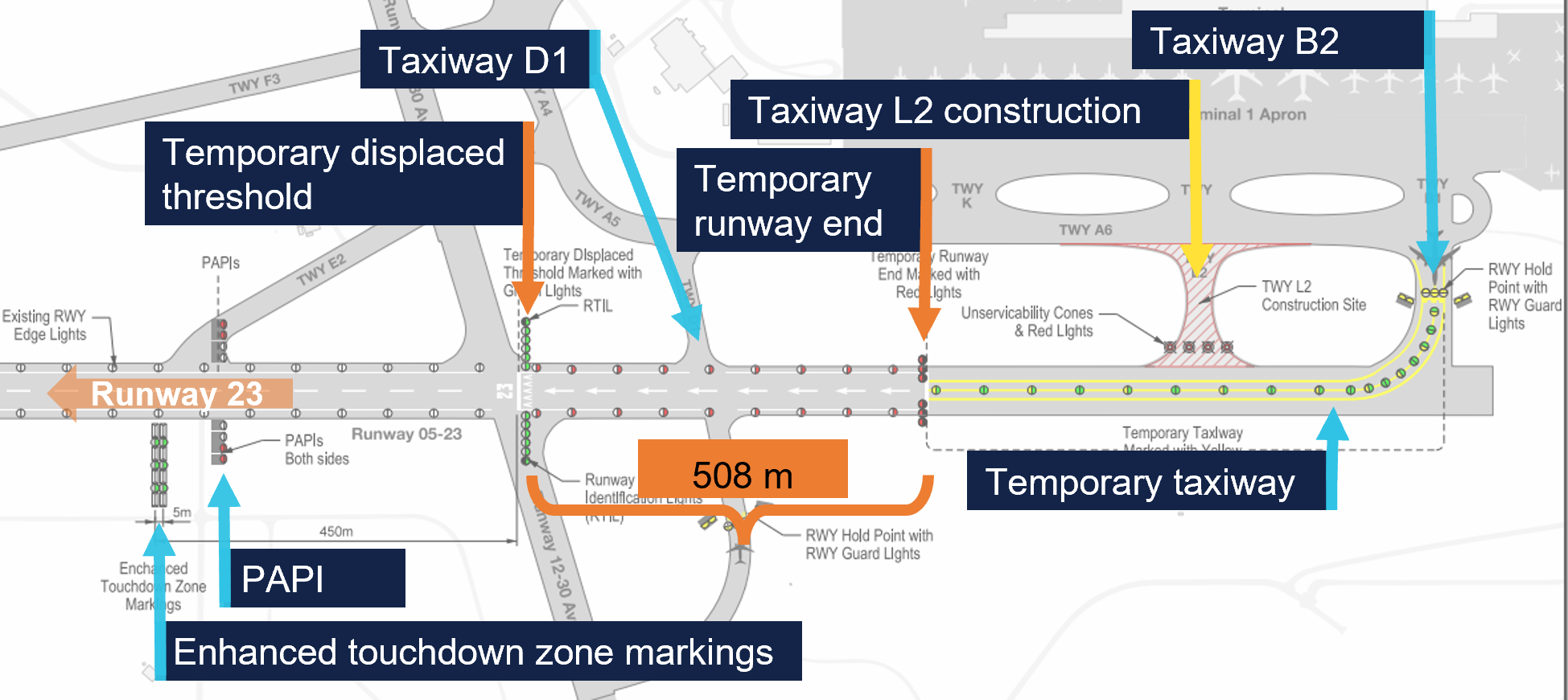
Source: Adelaide Airport Limited’s method of working plan, annotated by the ATSB
Start of take-off position terminology
The term ‘runway end’ was not defined in the Civil Aviation Safety Regulations (CASR) Part 139 – Aerodromes, Manual of Standards (MOS) or the International Civil Aviation Organization Annex 14 – Aerodromes, or the Aeronautical Information Publication (AIP).[2] Although a runway technically has 2 ends, the term ‘runway end’ usually refers to the far (departure) end of the runway in the landing direction. The AIP included the abbreviation ‘DER – departure end of runway’, but nothing for the start of the runway.
The MOS referred to the beginning of a runway in the take-off direction as the reciprocal runway end. For example, the MOS 8.16 Pre-threshold area markings included:
…an area before the non-displaced threshold, or the runway end in the reciprocal direction…
The MOS did not define the SOT position, but the abbreviation SOT was defined in the AIP as ‘start of TORA[3] (take-off)’ but noted that the abbreviation was not included in Doc 8400 – Procedures for Air Navigation Services: [International Civil Aviation Organization] ICAO Abbreviations and Codes and ‘must not be used in international NOTAM’.[4]
The MOS provided the following definitions:
threshold means the beginning of that portion of the runway usable for landing
displaced threshold means a threshold not located at the extremity of a runway.
In the evidence obtained for this investigation, the runway 23 SOT position was variously referred to as the:
- runway 23 runway end
- runway 05 end
- temporary runway end
- temporary displaced runway end
- displaced runway end
- displaced take-off threshold
The runway 23 displaced threshold was referred to as the:
- temporary displaced threshold
- displaced threshold
- displaced landing threshold
- landing threshold.
In describing these runway 23 positions during the works period, the ATSB has respectively referred to them as the SOT position and the displaced threshold throughout the report.
Pre-works communications
Late in 2024, AAL commenced notifying aircraft operators of the planned works, alerting them to the reduced runway length, which would potentially limit the maximum operating weight at which aircraft could safely land and take off. AAL also provided aircraft operators with a briefing package detailing the runway lighting and markings, and the relevant take-off and landing distances. Feedback received from 4 operators was considered by AAL.
On 3 March 2025, as required under CASR Part 139, AAL issued a method of working plan (MOWP) YPAD 25/03 Construction of taxiway L2 pavement adjacent to runway 05/23.[5] The MOWP described the respective positions of the displaced threshold and SOT position (temporary runway 05 end) throughout the document, as the:
- Runway 23 displaced threshold
- Runway 23 displaced end.
The MOWP was distributed, with a request for feedback, to stakeholders including:
- aircraft operators
- ground handling personnel
- Airservices Australia (Airservices)
- Civil Aviation Safety Authority (CASA).
The following day, AAL also submitted a safety case to CASA for approval to use ETZM for runway 23 during the works period. This approval was required as the ETZM was not included in the Part 139 MOS.
AAL also drafted an AIP Supplement (SUP),[6] which was first published by Airservices on 5 March, then republished with a minor amendment on 11 March. The same minor amendment was incorporated into the MOWP as, amendment 1, on 17 March. Those 2 versions of the published SUP included:
4. RWY 05/23 DETAILS
4.1 RWY 23 threshold displaced 1,158M.
4.2 RWY 23 runway end displaced 650M.
On 19 March, the CASA aerodromes inspector assessing the ETZM safety case, sent it to a CASA flight operations inspector (FOI) for review. The FOI responded with no issues with the ETZM, but identified an error in the AIP SUP, in that it was the runway 05 end not the runway 23 end that was temporarily displaced. The aerodromes inspector then liaised with AAL, who amended the SUP, which was published on 20 March, amending ‘RWY 23 end’ to ‘RWY 23 SOT’, and highlighting the runway 05 shortened take-off in section 4:
4. RWY 05/23 DETAILS
4.1 RWY 23 threshold displaced 1,158M.
4.2 RWY 23 SOT displaced 650M.
4.3 RWY 05 takeoff shortened by 650M.
No changes were made to 3 other references to the displaced runway 23 end in section 3 of the SUP.
AAL then forwarded the updated SUP to CASA to show the inclusion of the suggested amendment. CASA replied to that email on 24 March, asking whether the ETZM lights were hardwired. AAL replied that they were solar-powered and not hardwired. AAL subsequently hardwired the lights and advised CASA on 8 April that this had been completed.
Amendment 2 of the MOWP was issued on 25 March, in which section 2.2.1 was amended consistent with the change to the SUP, to:
The Runway 23 threshold will be displaced by 1158m.
The Runway 23 start of takeoff will be displaced by 650m.
The Runway 05 takeoff shortened by 650m.
However, 5 other references to the ‘Runway 23 displaced runway end’ were not amended to ‘runway 23 start of take-off’ or ‘runway 05 end’.
The MOWP included draft NOTAMs, which were published by Airservices prior to commencement of the works. The relevant NOTAM included:
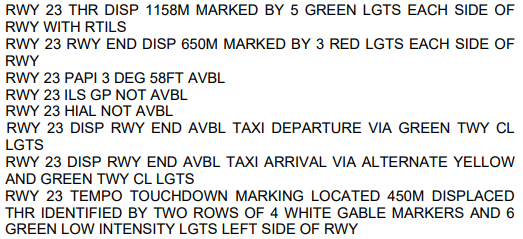
31 March 2025 occurrences
31 March 2025 was the first day of the airport operating with the runway 23 displaced threshold and SOT position. On that day, CASA approved the safety case for the ETZM and subsequently a task was allocated to a CASA officer to draft an instrument for AAL’s ‘Use of Gable Markers and Portable Green Lights in a Non-standard Manner due to Runway Works’, which CASA had previously done for Hobart Airport (Tasmania). However, although a drafter was allocated, the instrument for AAL was not issued during the works period or prior to expiration of the MOWP on 17 June 2025.
CASA issued an instrument for use of ETZM on 4 September 2025, which referenced ‘the method of working plan presented in relation to the relevant works, as it exists at the time this instrument commences’. The instrument conditions did not require the green lights to be hardwired. However, the MOWP had expired 10 weeks earlier and CASA advised the ATSB that the instrument did not apply retrospectively.
Through its flight data analysis program (FDAP),[7] Qantas identified 2 instances during daylight on 31 March, in which flight crews inadvertently commenced the take-off from the displaced threshold instead of the SOT position, having selected take-off performance data based on the SOT. This meant there was 508 m less runway available than planned for.
On the evening of 31 March, an Airbus A350-900 aircraft, registered A7-ANH and operating Qatar flight 915, was being prepared for a flight from Adelaide Airport to Hamad International Airport, Doha, Qatar. The flight crew selected take-off performance data for the reduced length runway, which they believed to be for a take-off commencing at the displaced threshold.
Having received air traffic control (ATC) clearance, the flight crew taxied the aircraft to holding point B2 where they contacted the aerodrome controller (ADC) on the Tower frequency. Table 1 details the recorded transmissions between the flight crew and ADC.
Table 1: Recorded transmissions on Adelaide Tower frequency (1)
| Time (CDT)[8] | Station | Transcript |
| 2141:29 | QTR-9Q | Tower, good evening, Qatari Niner Quebec, Bravo 2 ready for departure |
| 2141:33 | Tower | Qatari Niner Quebec Heavy, Adelaide Tower, at Bravo 2, enter Runway 23 at the displaced runway end, line up. |
| 2141:42 | QTR-9Q | Bravo 2 cleared to line up Runway 23 at the displaced threshold line up, Qatari Niner Quebec. |
| 2142:32 | Tower | Qatari Niner Quebec assigned heading 225, from the displaced runway end cleared for take-off |
| 2142:40 | QTR-9Q | Displaced threshold, clear for take-off, runway 23 maintain heading 225 affirm? |
| 2142:44 | Tower | Qatari Niner Quebec, affirm, assigned heading 225. |
| 2142:48 | QTR-9Q | Heading 225 clear for take-off runway 23 Qatari Niner Quebec. |
About 2.5 minutes later, the ADC observed the aircraft taxiing beyond the SOT position and towards the displaced threshold of runway 23. Table 2 details the resulting radio exchange.
Table 2: Recorded transmissions on Adelaide Tower frequency (2)
| Time (CDT) | Station | Transcript |
| 2145:11 | Tower | Niner Quebec, you have passed the runway end you can, cleared for take-off. |
| 2141:33 | QTR-9Q | Clear for take-off 23 Qatari Niner Quebec |
The flight crew reported that having acknowledged the clearance, they applied take-off thrust before the displaced threshold, consistent with the recorded data showing this occurred about 40 m prior to the threshold. As the aircraft rotated, the flight crew observed there was less runway remaining than expected. In later reviewing the occurrence, the flight crew assessed they had used performance data for commencing the take-off from the SOT position, not the displaced threshold, where they thought they had been cleared to take off from. Recorded automatic dependent surveillance‑broadcast (ADS-B) data showed the aircraft was still at 0 ft altitude approaching the departure end of the runway.
2 April 2025 occurrences
Airservices reported that at 1008 local time on 2 April 2025, a Qantas pilot phoned Adelaide Tower to request clarification of where to commence the take-off roll on runway 23. The pilot stated that the NOTAM was unclear as to where the take-off roll should commence.
Two occurrences during daylight hours on 2 April, involving Virgin Australia and Qantas aircraft, were identified via FDAP. In both instances the aircraft commenced the take-off from the displaced threshold, while using performance data based on the SOT position.
3 April 2025 occurrences
At 1330 on 3 April 2025, the Adelaide Tower ATC manager emailed Airservices’ safety team and AAL, stating that there was ‘a LOT of confusion with pilots as to where the take-off commences’. As a result, controllers were frequently having to explain where the start of take-off position was, as opposed to the displaced threshold. This was taking time and affecting the sequencing of aircraft.
The following day, email communications between AAL and ATC resulted in AAL amending the key text in the NOTAM from:
RWY 23 RWY END DISP 650M MARKED BY 3 RED LIGHTS EACH SIDE OF RWY
to
RWY 23 START OF TKOF DISP 650M MARKED BY PAINTED WHITE BAR AND COMMENCES AT RED RWY EDGE LGT
Additionally, ATC agreed to leave the runway lights on day and night to provide additional visual cues to assist pilots in identifying the SOT position.
A review of FDAP data identified one incorrect take-off position occurrence involving an Alliance Airlines aircraft and one involving a Virgin Australia aircraft, both during daylight on 3 April.
Later that day, Emirates personnel emailed AAL requesting clarification of the lights visible to flight crew at night to depict the SOT position, as the red runway end lights were not visible to flight crew departing on runway 23. The email included a photo taken from the cockpit of a Boeing 777 aircraft, with a box marked around the last green taxiway light to confirm that it was the correct cue for the SOT position (Figure 2).
Figure 2: Photo taken from an Emirates Boeing 777 cockpit highlighting the last green taxiway light as the cue for the runway 23 SOT position
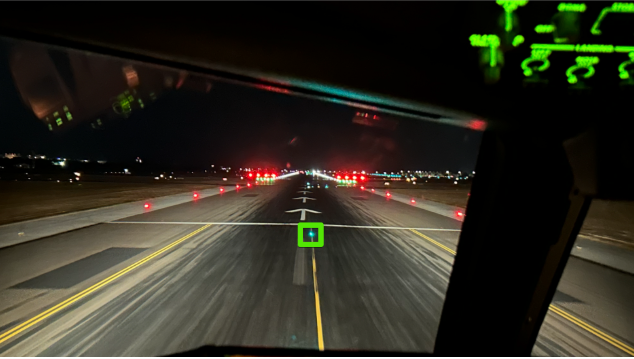
Source: Emirates, provided to the ATSB by Adelaide Airport Limited
5 April 2025 occurrence
During daylight on 5 April 2025, a Qantas aircraft taxied beyond the SOT position while positioning for a departure from runway 23. The ADC alerted the flight crew, who elected to exit the runway and reposition the aircraft behind the SOT position prior to take-off.
7 April 2025
On 7 April 2025, AAL issued amendment 3 of the MOWP, which incorporated the 3 April changed NOTAM text.
11 April 2025 occurrences
An AAL Apron Safety Committee Meeting was held on 11 April 2025, during which it was discussed that there had been incidents in which aircraft started the take-off run at the displaced threshold instead of the SOT position. Notes from the meeting included that ‘AAL has modified the NOTAM and sent additional communication’.
Through its FDAP, Jetstar identified that a Jetstar Airbus A320 operating flight JQ 801 on 11 April, commenced take-off from the displaced threshold instead of the SOT position.
Virgin Australia occurrence 1
On the same day, Boeing 737-800 VH-VOL was operating Virgin Australia flight VA 413 (callsign ‘Velocity 413’) from Adelaide, South Australia, to Sydney, New South Wales. The captain was the pilot flying (PF), and the first officer (FO) was the pilot monitoring (PM).[9] For both flight crewmembers, this was their first time operating to Adelaide Airport since aerodrome works started on 31 March 2025.
Prior to approaching Adelaide on the previous sector, the flight crew had conducted the approach briefing, which included reviewing the relevant Virgin Australia flight crew operational notice (FCON)[10] and AIP SUP regarding the displaced threshold and SOT position.
During the 35-minute turnaround in Adelaide, the flight crew conducted pre-flight briefings, during which they identified the displaced threshold as a ‘threat’ and reviewed the relevant information. The flight crew confirmed they had selected the correct runway 23 ‘works in progress’ (WIP-N) take-off position for the take-off run available (TORA) data in the onboard performance tool (OPT).[11] The flight crew also discussed the expected end of green centreline lights and start of red runway edge lights indicating the SOT position, as outlined in the NOTAM and FCON. The captain then used the Jeppesen[12] aerodrome chart, which did not depict the temporary changes due to aerodrome works, to brief the expected taxi route to holding point B2 and from there to taxi along the runway and line up.
At 0950 local time, the PM contacted the Adelaide surface movement controller (SMC), advised they had received automatic terminal information service (ATIS)[13] ‘Oscar’ and requested a taxi clearance. The controller cleared the flight crew to taxi via taxiway Tango and initially hold short of taxiway Lima, then one minute later, to taxi via Lima to holding point B2.
At B2 at 0953, the PM advised the ADC that they were ready (for take-off). The flight crew observed a Jetstar Airbus A320 aircraft ahead taxi to the displaced threshold and commence take-off from there, which the captain assessed must be the correct take-off position. After another aircraft landed, the flight crew were cleared to taxi and line up on runway 23. About 80 seconds later, they were cleared for take-off.
After issuing the take-off clearance, the ADC commenced a handover to an oncoming controller. During the handover, the ADC looked out the tower window and was unsure whether the aircraft had commenced the take-off roll. The ADC asked the oncoming controller ‘is Velocity rolling?’. The oncoming controller replied, ‘they’re rolling’, and, assessing that the aircraft was in the take-off roll, no action was needed, and the handover continued.
The flight crew’s normal runway verification procedure included confirming the runway signage or markings with their take-off and landing data card[14] (Figure 3). In this case, there was no intersection at the SOT position and no sign indicating the position or runway number painted on that part of the runway.
Figure 3: Extract of the Virgin Australia Boeing 737 Flight Crew Operations Manual
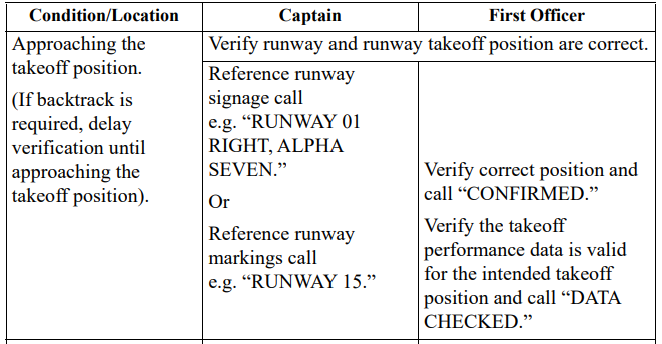
Source: Virgin Australia
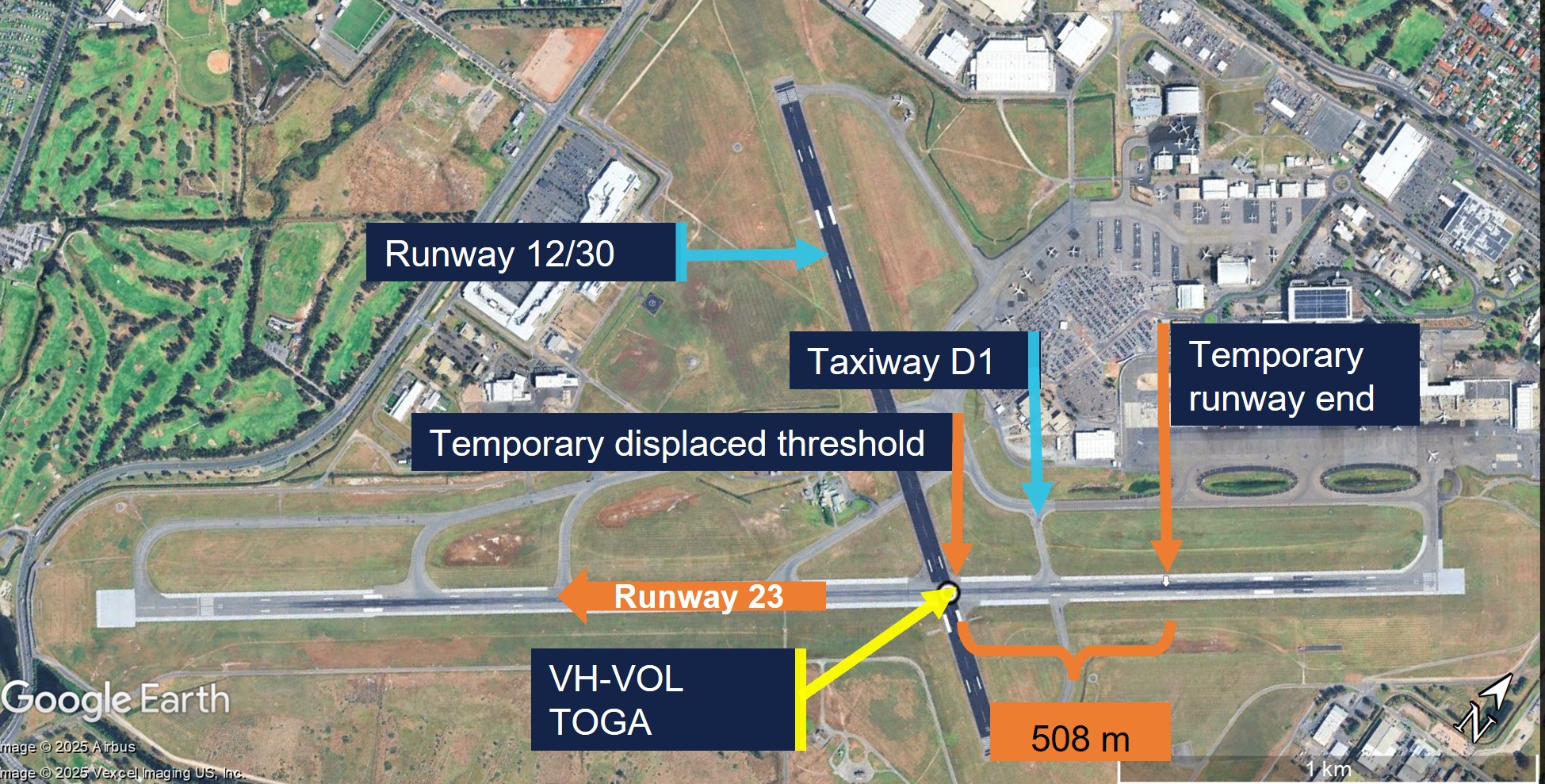
The flight crew reported that as the aircraft taxied along the runway at about 30 kt, they missed identifying the briefed change from green centreline to red edge lights, which were not distinct in the bright sunshine, and reported that the displaced threshold was much more prominent. Additionally, they reported that, while the centreline arrows had not been part of their briefing, they seemed to indicate to keep moving forward. The captain recalled setting take-off thrust passing approximately the Delta 1 (D1) taxiway and the recorded flight data showed the take-off go-around (TOGA) button/switch was pressed at the temporary displaced threshold (Figure 4).
Figure 4: VH-VOL TOGA position at the displaced threshold
Source: Virgin Australia flight data overlaid on Google Earth and annotated by the ATSB
The flight crew later reported that the take-off did not look unusual because they knew the runway was short and therefore did not take any action (such as to increase thrust). The flight continued without incident.
At the end of the day’s flying, the flight crew reviewed the documentation and realised they had commenced the take-off from an incorrect position. The captain reported the incident to the Virgin Australia safety team. By that time, Virgin Australia had already issued a safety alert and revised FCON due to another reported incident. The captain assessed using the OPT that there would have been sufficient runway to commence the take-off at the D1 intersection. However, Virgin Australia advised that having pressed TOGA at the displaced threshold, there would probably have been insufficient runway remaining to stop the aircraft on the remaining runway had the flight crew been required to abort the take-off near V1.[15]
Virgin Australia occurrence 2
On 11 April 2025, Boeing 737-800 VH-IJR was being operated as Virgin Australia flight VA 222 from Adelaide, South Australia, to Melbourne, Victoria. It was the FO’s first time operating to Adelaide Airport during the period of the aerodrome works, and the captain’s second, having been there the previous day. On that flight, the captain had been PF for the landing on runway 05 and PM for the take-off from runway 23, which had been without incident.
The FO and captain reported reviewing the documents the night before the flight, including FCON and NOTAM. The FO then re-read the FCON and NOTAM and the weather forecast in the morning about 2 hours before sign-on to conduct the flight to Adelaide that preceded VA 222, and described it as a ‘beautiful CAVOK[16] day’.
Before commencing the approach to Adelaide Airport, the flight crew briefed the threats for their arrival and discussed the touchdown area. The FO, who was PF for that sector, reported being focused on ensuring the aircraft did not touch down too early with the displaced threshold, identified the latest point of touchdown (ETZM), and taxied the aircraft to the bay.
During the turnaround, the flight crew reviewed the AIP SUP and FCON and assessed that the works were the main threat for departure. They confirmed that the take-off performance was calculated from the temporary runway end using nil wind. The captain reported noting the FCON’s reminder to flight crew not to commence the take-off too early. They briefed the procedure for taxiing along the start of the runway and commencing take-off from the temporary runway end. The flight crew reported that there was no time pressure, with about 5 minutes until their calculated off block time (COBT).[17]
At 1305, the FO, who was the PM for the sector, contacted the SMC, reported having received ATIS ‘Sierra’ and requested taxi clearance. The controller cleared the flight crew to taxi via taxiways Tango and Lima to holding point B2.
At 1309, from holding point B2, the PM contacted the ADC, advising that they were ready for take-off. The flight crew were then cleared to enter runway 23 at B2 and line up at the runway end, which the PM read back. The flight crew confirmed they were at B2, had selected the correct take-off data, and called ‘confirm data checked’, before they entered the runway. They received a take-off clearance one minute later.
The ADC then observed the aircraft continue taxiing beyond the start of the runway and stated, ‘Velocity 222 clear for take-off?’, which the PM read back. At the time, the PM assumed the controller had forgotten they had already issued the take-off clearance, but later reflected that this may have been a ‘subtle prompt’ to commence take-off.
The captain, who was the PF, reported that as they got to the runway start, they could see the green (threshold) lights in the distance and assumed that was where they were to commence the take-off. The captain observed that the aircraft lifted off further down the runway than expected, but assessed that the take-off was normal.
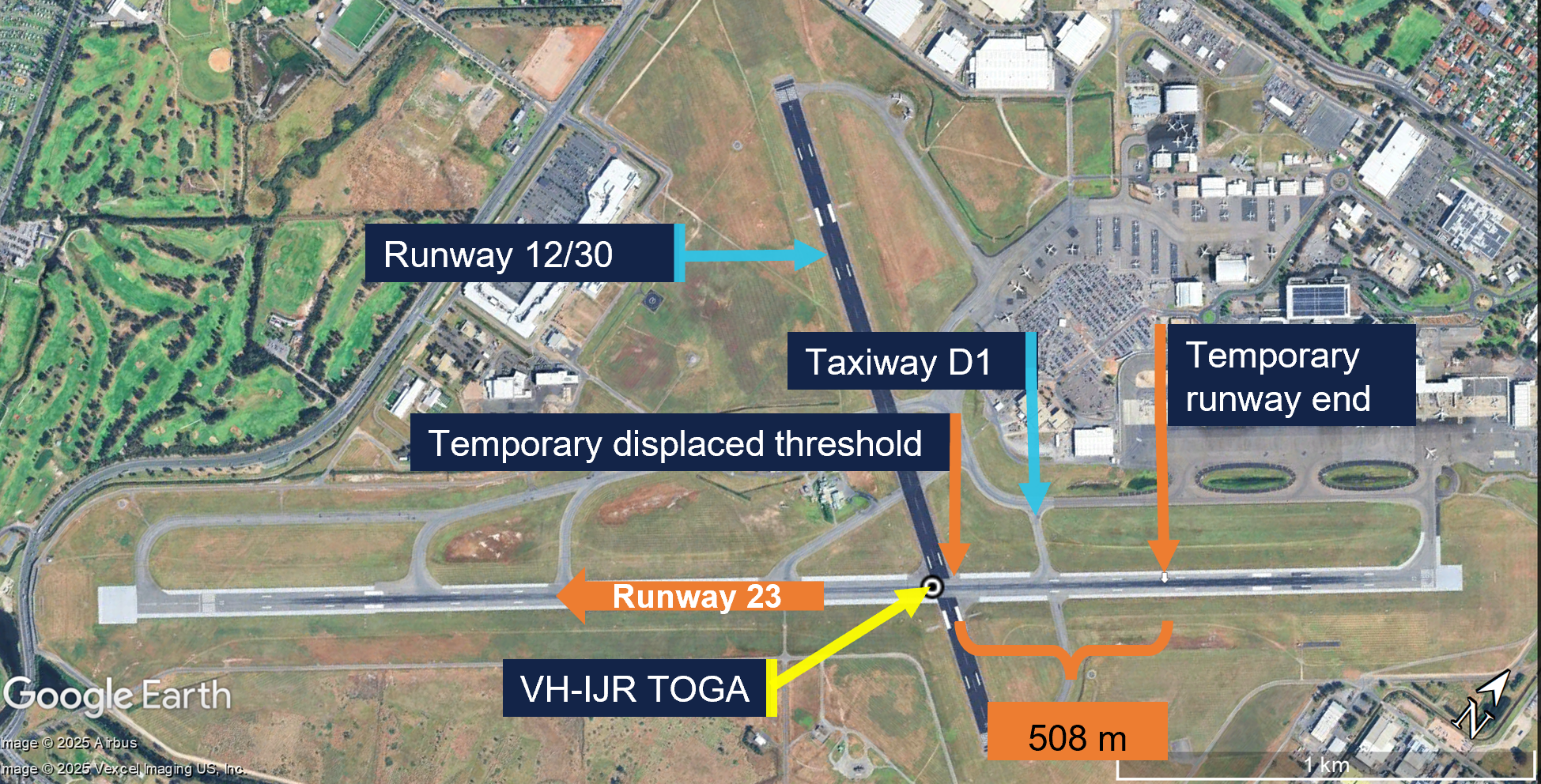
After departure, the flight crew reviewed the FCON and AIP SUP and realised that they had commenced the take-off from the incorrect position (Figure 5). The Virgin Australia safety department assessed that had the flight crew been required to reject the take-off just before V1, there may not have been adequate runway remaining to stop.
Figure 5: VH-IJR TOGA position at the displaced threshold
Source: Virgin Australia flight data overlaid on Google Earth and annotated by the ATSB
13 April 2025 occurrence
Virgin Australia FDAP identified one flight that erroneously commenced take-off from the displaced threshold at night.
14 April 2025 occurrence
Qantas FDAP identified one inadvertent take-off from the displaced threshold at night.
ATC and AAL met and agreed that ATC would issue instructions to pilots entering runway 23 at B2 to taxi to the SOT position for runway 23 marked with a white bar. When an aircraft arrived at the SOT position, ATC would then give the flight crew clearance to take off.
Virgin Australia changed its procedures to require flight crew to use the D1 intersection for take-off on runway 23, unless operationally required to commence at the SOT position.
17 April 2025
Qantas changed its procedures to require flight crew to use the D1 intersection for take‑off on runway 23, unless operationally required to commence at the SOT position.
20 April 2025 occurrence
Alliance Airlines’ FDAP identified one occurrence of flight crew inadvertently commencing take-off from the displaced threshold at night.
23 April 2025
A CASA senior aerodrome inspector provided the CASA team leader (aerodromes) with some notes ‘having read the MOWP’ for the latter’s planned discussion with the AAL head of operations. During that conversation, the team leader was advised of an occurrence involving the inadvertent commencement of a take-off run from the displaced threshold.
7 May 2025
AAL commenced an investigation in accordance with its safety management system requirements following a reported incident related to the inadvertent take-off from the displaced threshold rather than the SOT position.
8 May 2025
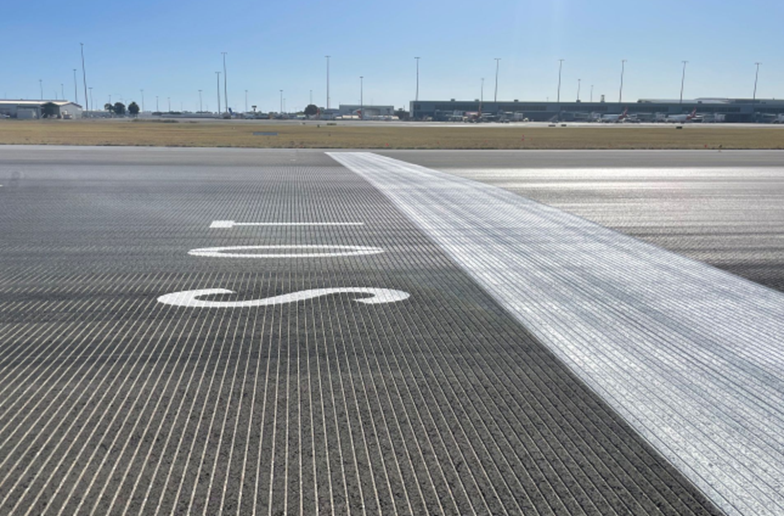
AAL doubled the width of the painted white runway end line (from 1.2 to 2.4 m) and painted ‘SOT’ just beyond the line (Figure 6). The same day, CASA provided AAL with feedback on the MOWP, including that there were ‘insufficient visual cues for the SOT’ and suggested signage.
Figure 6: Runway 23 enhanced start of take-off position marking
Source: Adelaide Airport Limited
Following that action, there were no subsequent occurrences reported to the ATSB of flight crews inadvertently commencing the take-off from the displaced threshold instead of the SOT position.
Context
Runway excursions
Accidents and contributing factors
The International Civil Aviation Organization (ICAO) Global Aviation Safety Plan identified runway safety as a global safety priority. Analysis of international runway safety accidents and incidents found runway excursions to be the highest risk category. Management of airport works was identified as a key contributing factor to runway excursions (a veer off or overrun of the runway surface).
The Flight Safety Foundation report, Reducing the risk of runway excursions, analysed accidents involving commercial transport aircraft from 1995 to 2008. The report identified 417 runway excursion accidents, accounting for 83% of fatal runway-related accidents.
Although most occurred during landing, 21% of the runway excursion accidents occurred during take-off. Rejecting the take-off after reaching decision speed (V1) was the most common factor contributing to take-off excursions. Incorrect performance calculations for decision speed and/or runway length was also a key contributing factor. In addition to risk factors relating to flight operations, other risk factors for runway excursions related to:
- air traffic management, for example, late runway changes, or not providing timely wind/runway condition information to flight crews
- airport, for example, incorrect or obscured runway markings, or inadequate runway end safety areas
- aircraft manufacturers, for example, a lack of performance information for certain runway conditions
- regulators, for example, a lack of regulatory requirement to provide consistent take-off and landing data.
Take-off performance data
Flight crew of large aircraft usually use an onboard performance tool (OPT)[18] to calculate take-off performance data. Based on the aircraft weight, runway distances available, runway elevation, outside air temperature and configuration, key speeds are calculated for the take-off, including V1[19] and rotate speed (VR).
When the thrust required for take-off is less than the maximum available, reduced thrust is often used to increase engine life and reduce overhaul costs and aircraft noise. A reduced thrust take-off will result in slower acceleration along the runway, a longer take‑off roll, and a reduced initial climb rate. For many large aircraft, the flight crew will set the relevant take-off thrust position, then press the take-off/go-around (TOGA) button or switch to commence the take-off roll. If required, flight crew can increase to the maximum TOGA thrust available by moving the thrust levers forward.
However, in the event of an engine failure or other malfunction that requires the flight crew to abort the take-off when below V1, a runway overrun can result if the:
- incorrect available runway length is used when conducting take-off performance calculations
- take-off commences from a position with less runway remaining than used for the take-off performance assessment.
Personnel information
VH-VOL (VA 413) 11 April 2025
The captain had accrued 13,933 hours total flying time, 4,090 of which were on Boeing 737 (B737) aircraft. The first officer (FO) had accrued 13,170 hours total time, 6,365 of which were on B737 aircraft. The captain’s self-assessed fatigue was 1/7 and the FO’s was 2/7.[20] There was no evidence that inexperience or fatigue were factors in this occurrence.
Although both flight crewmembers had significant flying experience, neither could recall having previously operated with a displaced runway start that did not coincide with a taxiway or runway intersection. They noted that the start of take-off (SOT) position did not have such a reference point at which to cross-reference the starting position with the take-off data, and no signage showing take-off run available at the take-off position.
The captain reported that, in hindsight, they should have briefed the taxi from the Aeronautical Information Publication (AIP)[21] Supplement (SUP)[22] rather than the Jeppesen chart, which did not include the SOT position. Additionally, they considered that the ability to incorporate the aerodrome works information in the Jeppesen aerodrome chart, or a link to that information, would have improved the briefing.
The flight crew commented that there was some ambiguity in the terms used, including displaced runway end and temporary runway end to mean the same position.
Additionally, the crew identified that there were different meanings for the lights and markings for landing and departing aircraft. The flight crew described the arrows as a good visual cue, in that they stood out, but it had not been highlighted that the start of the arrows was where to press the TOGA switch, rather than continue taxiing. For the landing, the arrows indicated to continue to the displaced threshold, but for take-off they were an indication the aircraft was beyond the start of take-off position. Further, for the landing, the red runway edge lights indicated to continue to the green displaced threshold lights, but for take-off, the green centreline lights were for taxiing, the start of the red runway edge lights were to indicate start of take-off, and the green displaced threshold lights were over 500 m beyond the start of take-off position.
VH-IJR (VA 222) 11 April 2025
The captain had 14,099 hours total flying time, 5,445 of those on Boeing 737 aircraft. The FO had 6,325 hours total flying time, 861 of those on Boeing 737 aircraft, and had been with Virgin Australia for about 1 year. The captain self-assessed their fatigue as 1/7 and the FO as 2/7. There was no evidence that inexperience or fatigue were factors in this occurrence.
Regarding the aerodrome works information, the FO stated that the flight crew operational notice (FCON) was simplified and more useful than the NOTAM. It described lights, which the flight crew did not notice in the daylight. The captain reported that on a blue-sky day, the runway end and edge lights were less prominent than the displaced threshold lights, markings and the large white arrows pointing to it, which were not mentioned in the documents. Additionally, they noted that the green displaced threshold and touchdown zone lights were very visible, but the red runway 05 end lights were not visible to flight crew departing on runway 23.
The captain also reported that they were used to seeing green lights indicating where to go, instead of red lights, and they were conditioned to ‘think red means stop or you’re too low on the [precision approach path indicator] PAPI’. During the departure briefing, they did not identify the visual cue to take off where the red edge lights start and green taxi lights stop. The FO had been the pilot flying (PF)[23] on the previous sector and reported that they were focused on ensuring the aircraft did not touch down too early on landing, which may have also carried over to taxiing too far before pressing the TOGA switch.
The flight crew reported that the FCON and runway image noted different take-off and landing positions but did not highlight the visual cues to identify them. The captain later reported that they understood that the take-off and landing were 2 different positions but did not ‘dwell enough’ on the differentiating cues between them during the briefing.
The captain also made the same observation as the VA 413 crew that the SOT position was not as salient as others they had encountered. The captain also reported that in hindsight the location of taxiway D1 between the start of take-off and displaced threshold provided a cue that the aircraft was beyond the SOT position.
The flight crew reported that the revised FCON and linked image published after the incident were clearer and more obvious. The captain reported that the SUP was the only one with a picture showing the aerodrome works and therefore was their primary reference (over the NOTAM and FCON).
The flight crew also reported that the airport operator subsequently distributed a photo of a ‘pilot’s eye view’ from the cockpit, which clearly showed the cues for the start of runway.
Adelaide Airport information
Adelaide Airport was a certified aerodrome[24] operated by Adelaide Airport Limited (AAL). It had scheduled international and domestic air transport operations, with restricted aircraft movements during curfew hours from 2300–0600 local time. The airport had 2 intersecting runways:
- runway 12/30,[25] 1,652 m long and 45 m wide
- runway 05/23,[26] 3,100 m long and 45 m wide, with a precision approach (under normal operations) and a permanently displaced threshold for runway 05.
Table 3 depicts the numbers of reported aircraft movements at Adelaide Airport in March, April and May 2025.
Table 3: Aircraft movements at Adelaide Airport March–May 2025 by aircraft weight
| Month (2025) | > 136 tonnes | 7–136 tonnes | < 7 tonnes | Helicopter | Military |
| March | 326 | 6,582 | 1,764 | 354 | 18 |
| April | 314 | 6,544 | 1,622 | 296 | 20 |
| May | 330 | 6,348 | 1,742 | 354 | 20 |
Source: Airservices Australia https://www.airservicesaustralia.com/aviation-reporting/movements-at-australian-airports/
Aircraft take-off performance
The 4 required declared distances to be available for each runway direction were:
- take-off run available (TORA)
- take-off distance available (TODA)
- accelerate-stop distance available (ASDA)
- landing distance available (LDA).
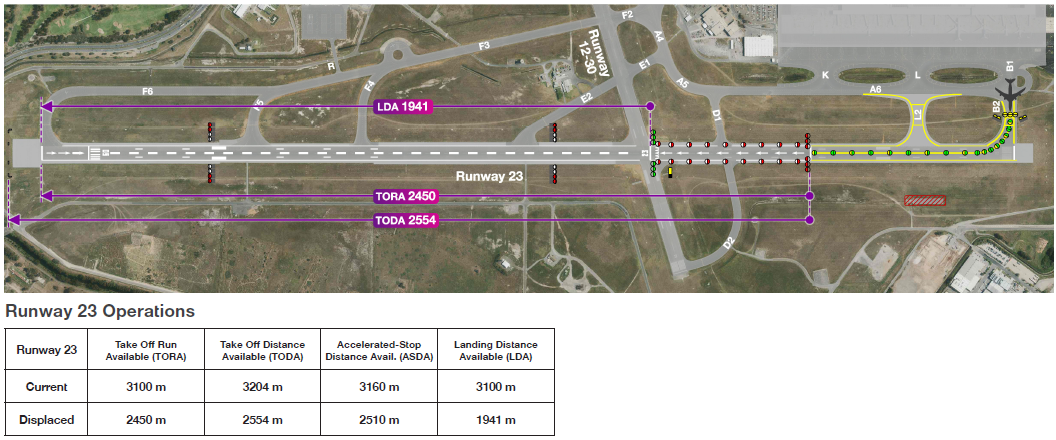
AAL’s briefing to aircraft operators included a diagram and figures for runway 23 during the works period (Figure 7).
Figure 7: Runway 23 declared distances during displaced threshold operations
Source: Adelaide Airport Limited
Civil Aviation Safety Regulations Part 139 (Aerodromes) Manual of Standards
Markings and lights
Part 139 of the Civil Aviation Safety Regulations (CASR) set out requirements and standards for aerodromes with published instrument flight procedures, such as Adelaide Airport. These were detailed in the Part 139 Manual of Standards (MOS).
The key features of the markings and lights specified in the MOS relevant to runway 23 for the aerodrome works at Adelaide were:
- runway end marking: a 1.2 m-wide white line extending the full width of the runway (MOS 8.20)
- temporarily displaced threshold markings – more than 30 days (MOS 8.28):
- 1.2 m‑wide white line marked across the full width of the runway at the displaced threshold, with adjacent 10 m‑long white arrowheads each 1 m wide
- existing centreline markings between the reciprocal runway end and displaced threshold converted to arrows
- the permanent threshold and runway number obscured, and a temporary runway number painted 12 m beyond the displaced threshold
- temporarily displaced threshold lights: 5 green (in the direction of the runway) lights either side of and perpendicular to the runway centreline were required at night (MOS 9.60–9.62)
- runway threshold identification lights (RTIL): one flashing white light each side of the runway required by day to mark a temporarily displaced threshold of a runway serving scheduled international air transport operations, ‘should have an acquisition of approximately 7 km in bright sunlight’ (MOS 8.27 and 9.59)
- runway edge lights before the displaced threshold: red in the direction approaching the displaced threshold and white in the opposite direction (MOS 9.63)
- runway end lights: at least 6 high intensity inset unidirectional red lights for aircraft landing in the direction of the runway, perpendicular to the runway, such that an aircraft does not cross the row of red lights (MOS 9.64–9.66)
- touchdown markings and lights were not required as high intensity approach lighting (HIAL) was unavailable (as the instrument landing system was unavailable due to the displaced threshold). The enhanced touchdown zone markers (ETZM) and lights in use by AAL were not included in the MOS.
The MOS defined a runway starter extension as:
an additional length of pavement that:
(a) is immediately before the runway threshold; and
(b) increases the distance available for take-off; but
(c) must not be used for landing.
As the area between the SOT position and displaced threshold was available for aircraft landing on the reciprocal runway, it did not meet the definition of a runway starter extension.
AAL assessed that the aerodrome layout was in accordance with the MOS, other than the ETZM, for which AAL had requested the Civil Aviation Safety Authority’s (CASA) approval. Additionally, a CASA-authorised check pilot had certified on 31 March 2025 that they had flight checked the aerodrome lighting system and ‘it met the relevant operational requirements’.
Movement area guidance signs
The Part 139 MOS Division 6 stated that mandatory instruction movement area guidance signs (MAGS) (white lettering on red background) must be provided at international aerodromes with scheduled air transport operations and at any aerodrome with air traffic control (ATC). It further stated that information only MAGS (black letters on yellow background or vice versa) must be provided where taxiway intersection departures are promulgated in the AIP. MAGS were also required to be illuminated at aerodromes with scheduled international air transport operations.
Mandatory instruction MAGS included:
(a) runway designation signs;
(b) CAT I, II or III holding position signs;
(c) runway holding position signs;
(d) aircraft NO ENTRY signs;
(e) vehicular STOP signs;
(f) runway/runway intersection signs.
Information MAGS included:
(a) taxiway location signs;
(b) direction signs;
(c) destination signs;
(d) take-off run available signs;
(e) runway exit signs;
(f) distance-to-go signs;
(g) LAHSO distance-to-go signs.
MOS 8.97 Take-off run available signs included:

Departures from the runway 23 SOT position did not represent an intersection departure and therefore did not require a take-off run available (TORA) MAGS, nor was one in place. MOS 8.87 required that the TORA MAGS be in place at the taxiway/runway intersection, which were the B2 and D1 holding points. For temporary displacement, the MOS 8.27(4) stated:

A MAGS displaying the full runway 23 TORA was ordinarily present at the taxiway B2 holding point. At the time of the works, this had been obscured as it displayed incorrect declared distance information, albeit it due to the temporary displacement of the runway end, rather than the threshold as described in the MOS.
Method of working plan feedback
The MOS Chapter 15 Aerodrome works stated that:
The operator of a certified aerodrome must make all necessary arrangements to ensure that aerodrome works do not create a hazard to aircraft or cause confusion to pilots.
Chapter 15 also specified the conditions under which a method of working plan (MOWP)[27] was required, and referred to chapter 16 of the MOS for the details of the MOWP layout and contents. Subsection 15.02 included:
(2) When preparing a MOWP, an aerodrome operator must consult:
(a) air transport operators using the aerodrome; and
(b) operators of emergency services aircraft that are likely to operate at the aerodrome during the works period; and
(c) ATC (if applicable); and
(d) if the MOWP is likely to affect the unit’s ability to ensure the safety of aircraft operations at the aerodrome — the ARFF unit at the aerodrome (if any); and
(e) if any communications, navigation, surveillance or meteorological infrastructure or equipment would otherwise be affected by the works — the provider of that infrastructure or equipment.
Note Consultation with other fixed-base operators at the aerodrome such as flight training organisations, sport aviation organisations, aerial application operators etc. is also recommended.
(3) Not less than 14 days before works commence, the aerodrome operator must supply a copy of the MOWP to:
(a) each operator or organisation mentioned in paragraphs (2) (a) to (e); and
(b) the relevant CASA aerodrome inspector (where known), or the local CASA office marked for the attention of an aerodrome inspector.
AAL prepared the MOWP in accordance with the MOS, and distributed it to the operators and organisations for feedback as required. Additionally, AAL distributed copies of the following versions of the MOWP to all stakeholders including CASA:
- issue 1, issued 3 March
- amendment 1, issued 17 March
- amendment 2, issued 26 March
- amendment 3, issued 7 April 2025.
Apart from the error identified by CASA in the AIP SUP on 19 March, which was reflected in amendment 2 of the MOWP (in section 2.2.1 ‘runway end’ was amended to ‘start of takeoff’), there was no feedback to AAL to indicate anything was contrary to the MOS prior to 8 May 2025.
Although a mandatory recipient of the MOWP, CASA advised that there was no legislative requirement for CASA to approve a MOWP. This was consistent with the standards and recommended practices set out in the International Civil Aviation Organization (ICAO) Annex 14 – Aerodromes. Further, CASA advised that:
CASA does not complete a formal review for any Method of Works Plan (MOWP) issued by an aerodrome operator, prior to their issue and use.
Under the Part 139 rules, the certified aerodrome operator is fully responsible for implementing and maintaining the required systems and processes for aerodrome works.
In accordance with CASA’s surveillance program, MOWPs are recorded on file, and the assigned aerodrome inspector may conduct a ‘sampling activity’[28] at that time, or closer to a surveillance event. CASA further detailed that this would involve potentially choosing at random a portion of the MOWP and if any anomalies with the MOS were identified, this would inform appropriate CASA action.
In contrast, in the United States (US) (also an ICAO contracting State), an aerodrome operator’s Construction safety and phasing plan (equivalent to a MOWP) is subject to review and approval under the Federal Aviation Administration’s (FAA) safety risk management procedures (FAA, 2017). CASA advised that the context of the aerodrome regulations and the US funding model differed substantially from Australia’s. CASA issued aerodrome operators a certificate and then monitored their performance and compliance under ongoing surveillance/regulatory oversight, using sampling methods. Unlike the FAA, CASA did not approve MOWPs or funding arrangements.
In 2024, CASA received 119 MOWPs, 6 of which involved a displaced threshold. From January to July 2025, CASA received 73 MOWPs, 8 of which involved a displaced threshold. Eleven of the 14 plans involved a displaced threshold that was not coincident with the displaced reciprocal runway end. CASA aerodromes inspectors reported that in conducting sampling activities there was a focus on works that resulted in displaced thresholds. They also assessed that AAL was very thorough, had a mature safety management system and generally went above and beyond the MOS requirements.
On 17 April 2025, CASA was advised of one occurrence from 11 April 2025, and the CASA manager aerodromes unsuccessfully attempted to contact AAL. CASA reported that on 22 April 2025, the aerodromes team leader conducted a ‘sampling activity’ of the MOWP and provided feedback over the phone to AAL. On 8 May 2025, CASA provided AAL comments and clarification requests of the MOWP, including that:
- Unserviceability cones and lights were not depicted in the diagram (Figure 1) at the taxiway A end of the L2 construction. AAL responded that these were in place.
- Gable markers showing the displaced runway 05 strip were not evident on the drawings (MOS 8.11). AAL responded that they had not interpreted this requirement from the MOS.
- ‘Runway 23 start of take-off – visual indication for pilots is not clear’. AAL responded that it was marked with a white line in accordance with the MOS, and at the commencement of the red runway edge light. Further, that AAL had subsequently doubled the width of the white line and painted ‘SOT’ on the pavement.
- ‘Provision of MAGS with information’. AAL noted that in hindsight it could have used a ‘START OF TAKE OFF’ MAGS, also noting that there was a long lead-in time (4–6 weeks) for the manufacture and delivery of MAGS.
- Confirmation was sought, and received from AAL, that the runway 23 designator and piano keys had been obscured, along with the MAGS.
Addressing pilot confusion
Having identified that the SOT position was confusing to pilots despite being marked and lit in accordance with the MOS, CASA advised the ATSB that this should have been addressed through the aerodrome operator’s safety management system (SMS) or risk management plan (RMP) as applicable based on the MOS. ‘Appropriate control measures can then be implemented if required, or the risk otherwise accepted by the responsible party’. Mitigation measures outside of the MOS requirements ‘can be implemented freely, unless there is a regulatory conflict’. CASA advised that in the case of a conflict, the operator could submit a safety case, as AAL did for the ETZM, for approval.
Other options for depicting the start of take-off position
ICAO Annex 14, Volume I – Aerodrome Design and Operations (ICAO July 2022) provided Standards and Recommended Practices for Aerodromes for ICAO Contracting States, which included Australia. Annex 14 did not include a standard for runway end markings but provided a standard for (red) runway end lights. The annex also described a white ‘transverse stripe’ at least 1.8 m wide to be added to the threshold marking when the threshold was displaced from the runway extremity. This was wider than the 1.2 m white threshold line in Australia’s MOS. In comparison, the US FAA’s white threshold bar was 3 m wide.
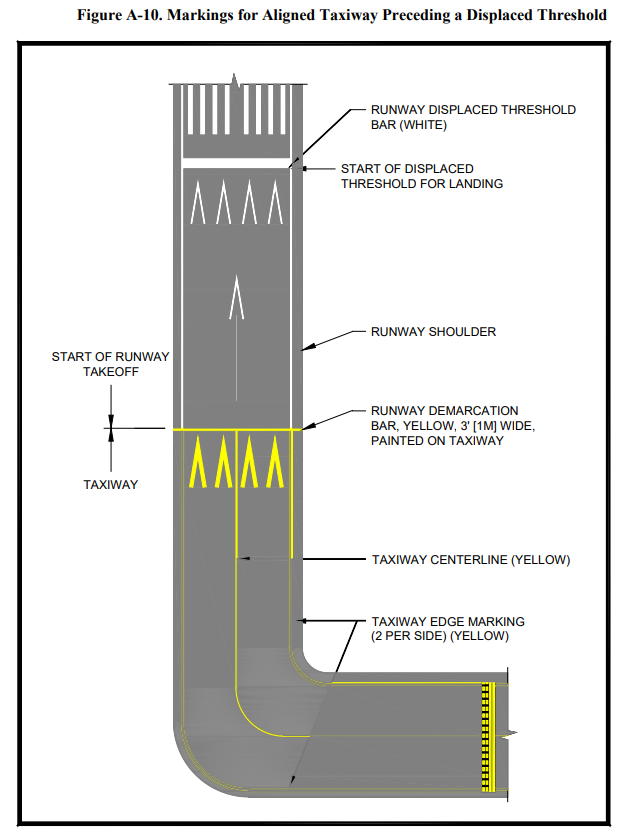
In the absence of an international standard, the US FAA and Transport Canada incorporated a 0.9 m-wide yellow runway demarcation bar marking, which, according to the FAA Advisory Circular (AC) 150/5340-1M Standards for Airport Markings:
Delineates a runway with a displaced threshold from a blast pad, stopway or an aligned taxiway that precedes the runway…the portion of the aligned taxiway before the demarcation bar is not part of the usable runway for takeoff or for landing from the opposite direction.
Described as the ‘rare case in which a displaced threshold is preceded by an aligned taxiway’, the AC depicted a yellow demarcation bar (Figure 8).
Figure 8: Extract from Federal Aviation Administration Advisory Circular 150/5340-1M Figure A-10 showing yellow demarcation bar
Source: Federal Aviation Administration AC 150/5340-1M
The AC included a note that aligned taxiways were ‘prohibited for new construction or reconstruction of existing aligned taxiways’, and referenced FAA AC/150-5300-13B Airport Design, which included that aligned taxiways, defined as one whose centreline coincides with the runway centreline:
represent an elevated hazard risk due to the potential for taxiing aircraft to take a position in direct line with departing or landing aircraft. Aligned taxiways also contribute to a pilot’s loss of situational awareness.
Annex 14 Section 5.2.2 Runway designation marking Annex 14 included:
Note.— If the runway threshold is displaced from the extremity of the runway, a sign showing the designation of the runway may be provided for aeroplanes taking off.
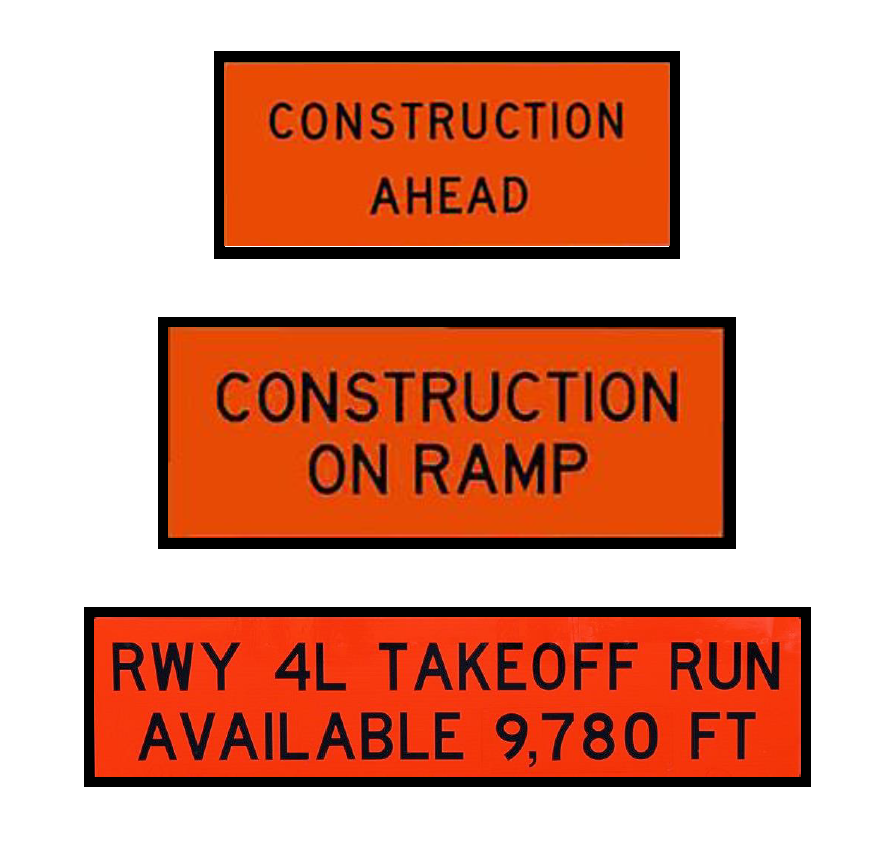
In 2010, the US FAA initiated the Airport Construction Advisory Council (ACAC),[29] which was a collaborative working group of industry stakeholders. The ACAC’s aim was to help identify hazardous situations during runway and taxiway construction projects, and to mitigate the associated risk. Through the ACAC, the FAA introduced additional risk controls for aircraft operations during aerodrome works and/or with reduced runway length. One risk control was the introduction of construction signage.
The FAA AC 150/5370 Operational safety on airports during construction provided guidance for airport operators to comply with Title 14 Code of Federal Regulations (CFR) Part 139, Certification of Airports. Since December 2017, the FAA AC included guidance for the optional use of temporary orange construction signs to increase pilot situational awareness of changed conditions on the movement area. The AC included 3 permissible sign legends (Figure 9).
Figure 9: Federal Aviation Administration approved construction sign legends
Source: Federal Aviation Administration AC 150/5370-2G
In May 2023, the ICAO Air Navigation Commission (ANC), distributed State letter AN 4/1.159-23/33 to member states for comment on proposed amendments to Annex 14 – Aerodromes, Volume I – Aerodrome Design and Operations, and the Procedures for Air Navigation Services (PANS) – Aerodromes. One proposed amendment was the inclusion of orange ‘unserviceability signs’, in line with the FAA’s construction signs, to indicate temporary changes to runway declared distances. The proposed applicability date for the amendment is 27 November 2025. The ANC included the following rationale for introduction of the signs:
Unserviceability signs as means of risk mitigation during temporary changes to the movement area (reduction in the runway length, reduction in the maximum allowable wingspan, taxiway closure or any other closure to the movement area) was assessed on several airports in Europe and in the United States. The results showed acceptance and comprehension by pilots, while also portraying safety benefits (decrease in the rate of misleading operations).
The new Standard pertaining to unserviceability signs, where there is an operational need to indicate temporary changes to runway declared distances, strongly mitigates the risk of using the wrong TORA value for take-off.
The provision of unserviceability signs where there is an operational need to indicate temporary changes to taxiways and aprons, is only a recommendation as the safety impact of such a change may not be as high as that of the use of a wrong TORA value.
Existing signs providing inadequate or misleading information as a consequence of temporary changes to the movement area shall be removed or obscured in order to avoid any confusion with the appropriate messages conveyed by unserviceability signs.
In July 2025, CASA published proposed amendments to Part 139 MOS, to incorporate amendments to Annex 14 Volume1 (Amendment 15), introduced by ICAO in 2020. This did not include the proposed Annex 14 Volume 1 (Amendment 18) due to be implemented in November 2025.
Air traffic services
Air traffic services objectives
The Australian Manual of Air Traffic Services (MATS)[30] outlined requirements, procedures and standards for the provision of air traffic services. The listed air traffic services objectives included to:
- prevent collisions between aircraft on the manoeuvring area and obstructions on that area
- provide advice and information useful for the safe and efficient conduct of flights.
Temporary local instructions
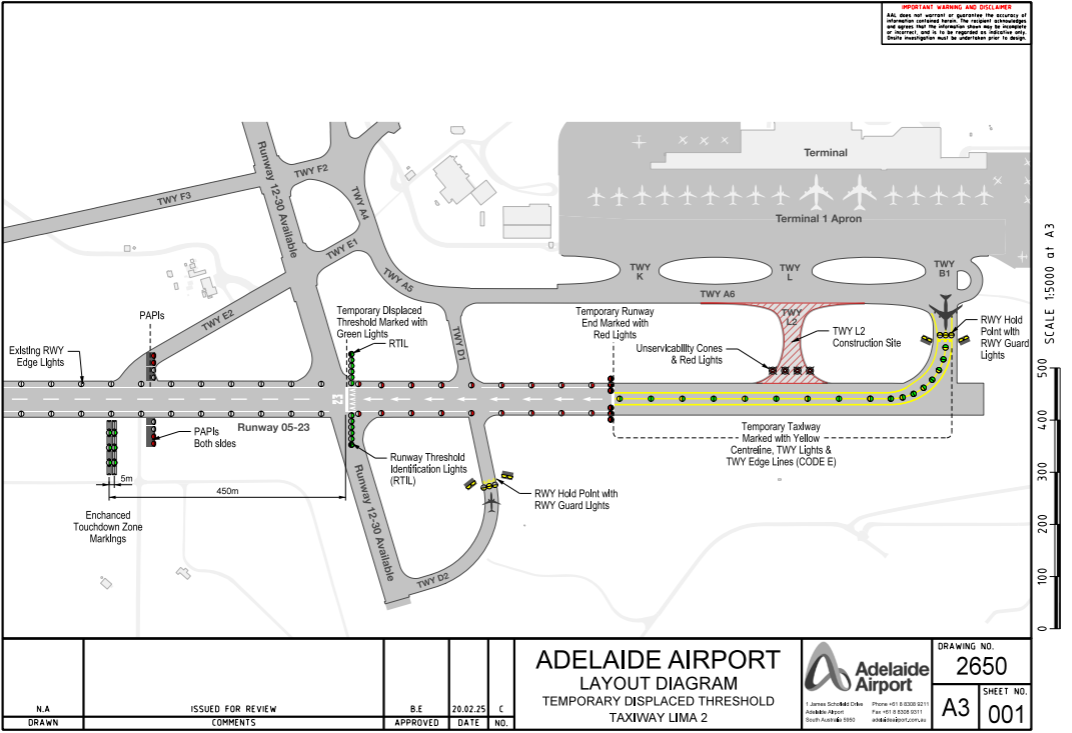
In preparation for the works, on 24 March, Airservices Australia issued Adelaide Airport temporary local instruction[31] (TLI) TLI_25_0064 – Taxiway L2 works temporary restrictions. The TLI described the aerodrome works layout and the facilities that would be unavailable during the period. It included the MOWP Drawing 3 (Figure 10).
Figure 10: Adelaide Airport layout diagram as printed in the AIP Supplement
Source: Airservices Australia
The TLI also instructed controllers not to permit an aircraft to land on runway 23 when an aircraft was stationary:

Also:

The TLI also included suggested phraseology for runway 23:

On 8 April 2025, a minor amendment clarifying precision approach path indicator (PAPI) selection and aircraft holding requirements on taxiway A6, was published as TLI_25_0093.
Commencing take-off from D1
Following multiple occurrences of flight crew incorrectly commencing take-off from the displaced threshold, on 14 and 17 April 2025 respectively, Virgin Australia and Qantas implemented a requirement for flight crew to commence the take-off from D1 intersection unless operationally required to use the runway 23 SOT position. There was 1,280 m take-off run available from D1. However, as documented in the SUP and the TLI, due to obstacle clearance requirements for aircraft landing on the displaced runway 23 threshold, aircraft larger than a Saab 340 could not be held stationary at D1, or the landing aircraft would be required to conduct a go-around.
This meant possible extended delays for aircraft waiting to depart via D1. Instead, the surface movement controller (SMC) would usually instruct pilots to taxi to B2, then contact the aerodrome controller (ADC) and request taxiway Delta for their start of take‑off position. The SMC would then advise the ADC, who would instruct the pilot to line up adjacent to the D1 taxiway prior to receiving a take-off clearance.
Automatic terminal information service
MATS included examples of standard phraseology for the provision of essential aerodrome information through the automatic terminal information service (ATIS),[32] including for reduced runway lengths and a displaced threshold (Table 4). There was no standard phraseology for a displaced runway end or SOT position.
Table 4: MATS standard ATIS phraseology
| Content | Phraseology |
| During runway work resulting in reduced runway lengths | REDUCED RUNWAY LENGTH(S) IN OPERATION ATIS may include: RUNWAY (number), TORA (or LANDING DISTANCE AVAILABLE) (number) METRES |
| Other essential operational information | RWY 21 DISPLACED THRESHOLD SOUTH OF RWY 24 INTERSECTION |
For Virgin Australia flight VA 413 on 11 April, ATIS ‘Oscar’ was current:
- runway 23 and runway 12 for arrivals, runway 23 for departures
- runway 23 displaced threshold
- take-off run available 2,450 m, landing distance available 1,942 m
- taxiway E2 closed
- wind 230° 5 kt, maximum tailwind 5 kt runway 12
- CAVOK[33]
- temperature 20°
- QNH 1,024.[34]
For Virgin Australia flight VA 222 on 11 April, ATIS ‘Sierra’ was current:
- runway 23
- runway 23 displaced threshold
- take-off run available 2,450 m, landing distance available 1,942 m
- taxiway E2 closed
- wind 230° 10 kt
- CAVOK
- temperature 23°
- QNH 1,023.
Controller comments
Tower manager
The Adelaide tower manager at the time of the 2 Virgin Australia occurrences reported that pilots were ‘finding it very difficult’ to clearly identify the SOT position. They reported that if controllers used the phrase ‘runway end’, pilots would read back ‘displaced threshold’. After AAL revised the NOTAM to use ‘start of take-off’, ATC phraseology included advising pilots that ‘you have now passed your start of take-off … take-off run available at D1 is … and take-off run available at the displaced threshold is …’
The manager reported that the impact on controllers was that it was quite workload intensive; pilots were not sure where to go. The controllers needed time to have a conversation with the pilot, which slowed things down. Because of pilots’ uncertainty, aircraft were being taxied at varying speeds, some very slowly to try to identify the SOT position.
Aerodrome controller for VA 413 on 11 April
The ADC for Virgin Australia flight VA 413 on 11 April did not identify that the aircraft started the take-off from the incorrect position. The controller had been an air traffic controller since 2004 and at Adelaide Airport since 2010 and provided the following comments regarding operations with the displaced runway end:
- The ADC was using the phrase ‘displaced runway end’ and estimated about half the pilots read back ‘displaced threshold’. The ADC would respond 'just confirm it's taxi and hold short of the displaced runway end’.
- Some aircraft were taxiing quite slowly after entering the runway at B2.
- The white runway end line was not obvious at night, and the pilots would continue taxiing beyond the runway end lights.
- The ADC suggested to their domain support specialist that they liaise with the airport operator to position a MAGS at the SOT position.
- The ADC would often clear pilots for take-off when the aircraft was about 100 m from the SOT line to prompt commencement of the take-off.
- The displaced threshold was not visible from the tower. At night, the touchdown markings were visible but the red runway end lights at the SOT were very difficult to see.
- Individual controllers adopted their own solutions.
Aerodrome controller 2 for VA 222 on 11 April
The ADC for Virgin Australia flight VA 222 on 11 April was an experienced controller who had been endorsed as an Adelaide ADC on 4 April 2025, after the aerodrome works started. The controller could not recall the specific occurrence, but provided the following comments:
- There had been a few instances where the ADC had been required to re-specify the take-off clearance, with confusion between the SOT position and the displaced threshold.
- Standard phraseology was used where possible.
- Pilots were commonly issued an instruction to enter the runway and line up, before being cleared for take-off.
Notice to Airmen
Airservices Australia’s NOTAM Data quality requirements for aerodrome operators, document stated:
NOTAM should be originated, issued, and distributed promptly when:
- information is of a temporary nature, unplanned, and of short duration
- operationally significant permanent changes, or temporary changes of long duration, are made at short notice.
Information that is of short duration, but which contains extensive text and/or graphics, is to be published as an AIP Supplement (SUP).
Included in the listed NOTAM promulgation criteria was:
- establishment, closure, or significant changes in operation of aerodrome(s) or heliport(s) or runways
The document provided examples of how to format NOTAM text (item E of a NOTAM). These included the following for a displaced threshold:

For aerodrome works where a MOWP was issued, the Part 139 MOS required that:
…a NOTAM giving the time and date of the planned commencement of the works, or a planned change in works stage, must be requested as early as possible but not less than 48 hours before commencement of the works or works stage.
AAL drafted 3 NOTAMs that were promulgated by Airservices to cover the operational changes to the aerodrome during the works. These were for:
- runway 05/23 closure during night works
- nighttime taxiway closures/unserviceabilities
- the displaced runway 23 threshold.
The displaced threshold NOTAM issued just prior to commencement of the works included the following text:
E) THR RWY 23 DISPLACED 1158M
REFER METHOD OF WORKING PLAN YPAD 25/03 AMENDMENT 2 RWY 23 THR DISP 1158M MARKED BY 5 GREEN LGTS EACH SIDE OF RWY WITH RTILS RWY 23 END DISP 650M MARKED BY 3 RED LGTS EACH SIDE OF RWY RWY 23 PAPI 3 DEG 58FT AVBL RWY 23 HIAL U/S RWY 23 DISP RWY END AVBL TAXI DEPARTURE VIA GREEN TWY CL LGT RWY 23 DISP RWY END AVBL TAXI ARRIVAL VIA ALTERNATE YELLOW AND GREEN TWY CL LGT RWY 23 TEMPO TOUCHDOWN MARKING LOCATED 450M DISPLACED THR IDENTIFIED BY TWO ROWS OF 4 WHITE GABLE MARKERS AND 6 GREEN LOW INTENSITY LGTS LEFT SIDE OF RWY TWY B2, D2 HOLD POINT TEMPO REPOSITIONED ACFT LTD NOT ABV SF340 HOLD TWY A6 AT TWY K INTERSECTION ACFT LTD NOT ABV A321/A320 B737 HOLD TWY A6 AT TWY L INTERSECTION DECLARED DISTANCE AND GRADIENT CHANGES
RWY TORA TODA ASDA LDA
05 2450 2450(2) 2510 2298
23 2450 2554(2.63) 2510 1942
SUPPLEMENTARY TKOF DISTANCES
RWY05- 2273(1.6) 2412(1.9)
RWY23- 2216(1.6) 2379(1.9) 2475(2.2) 2533(2.5)
This was amended on 4 April to:
E) THR RWY 23 DISPLACED 1158M
REFER METHOD OF WORKING PLAN YPAD 25/03 AMENDMENT 2 RWY 23 THR DISP 1158M MARKED BY 5 GREEN LGTS EACH SIDE OF RWY WITH RTILS RWY 05 RWY TAKE OFF SHORTENED MARKED BY 3 RED LGTS EACH SIDE OF RWY RWY 23 START OF TAKE OFF DISP 650M MARKED BY PAINTED WHITE BAR AND COMMENCES AT RED RWY EDGE LGTS RWY 23 PAPI 3 DEG 58FT AVBL RWY 23 HIAL U/S RWY 23 DISP RWY END AVBL TAXI DEPARTURE VIA GREEN TWY CL LGT RWY 23 DISP RWY END AVBL TAXI ARRIVAL VIA ALTERNATE YELLOW AND GREEN TWY CL LGT RWY 23 TEMPO TOUCHDOWN MARKING LOCATED 450M DISPLACED THR IDENTIFIED BY TWO ROWS OF 4 WHITE GABLE MARKERS AND 6 GREEN LOW INTENSITY LGTS LEFT SIDE OF RWY TWY B2, D2 HOLD POINT TEMPO REPOSITIONED ACFT LTD NOT ABV SF340 HOLD TWY A6 AT TWY K INTERSECTION ACFT LTD NOT ABV A321/A320 B737 HOLD TWY A6 AT TWY L INTERSECTION DECLARED DISTANCE AND GRADIENT CHANGES
RWY TORA TODA ASDA LDA
05 2450 2450(2) 2510 2298
23 2450 2554(2.63) 2510 1942
SUPPLEMENTARY TKOF DISTANCES
RWY05- 2273(1.6) 2412(1.9)
RWY23- 2216(1.6) 2379(1.9) 2475(2.2) 2533(2.5)
Subsequent versions of the NOTAM were also issued, but they contained only minor changes to the abbreviations/contractions.
NOTAMs have known limitations that can hamper the identification of safety-critical information, including:
- the large volume that are produced
- formatting limitations – capitalised text with multiple abbreviations/contractions.
NOTAMs have previously been identified as contributing factors to accidents. As detailed in the 2020 Flight Safety Australia article, Missing the message,[35] the US FAA identified NOTAMs in its top 5 hazards in the airspace system. Additionally, the US National Transportation Safety Board’s investigation of a near-landing on a closed runway in 2017 identified the ‘need for more effective presentation of flight operations information to optimise pilot review and retention of relevant information’. International working groups have been collaborating for decades to improve the NOTAM system.
Aeronautical Information Publication Supplement
Due to the need for ‘extensive text and/or graphics’, AAL drafted an AIP SUP[36] – Adelaide aerodrome (YPAD) operational restrictions: Taxiway L2 construction project. The SUP comprised the following sections:
- Introduction
- References: to the MOWP and an associated SUP for temporary approach procedures
- Works: included similar information to the NOTAM, but without most of the abbreviations/contractions. Of relevance, it included:
3.9 RWY 23 displaced runway end will be marked with three (3) red lights each side of RWY 23.
3.10 Aircraft will taxi for departure to the RWY 23 displaced runway end via green TWY centreline lighting.
3.11 Aircraft will taxi on arrival from the RWY 23 displaced runway end via alternating yellow and green TWY centreline lighting.
- RWY 05/23 details: changed on 20 March 2025 (before works commenced) from:
4.1 RWY 23 threshold displaced 1,158M.
4.2 RWY 23 runway end displaced 650M.
to:
4.1 RWY 23 threshold displaced 1,158M.
4.2 RWY 23 SOT displaced 650M.
4.3 RWY 05 TO shortened by 650M.
(included a table of declared distances for TORA, TODA, ASDA and LDA)
Although CASA advised AAL that section 4.2 of the SUP should replace reference to ‘runway end’ with ‘SOT’, this was not similarly amended in section 3.9 of the SUP.
- Supplementary [take-off] TKOF distances
- Cancellation (date)
- Distribution (Airservices Australia website only)
- Appendix – Adelaide Airport Layout diagram (Drawing 3 from the MOWP) (Figure 10).
Aircraft operator information
Qatar special crew briefing
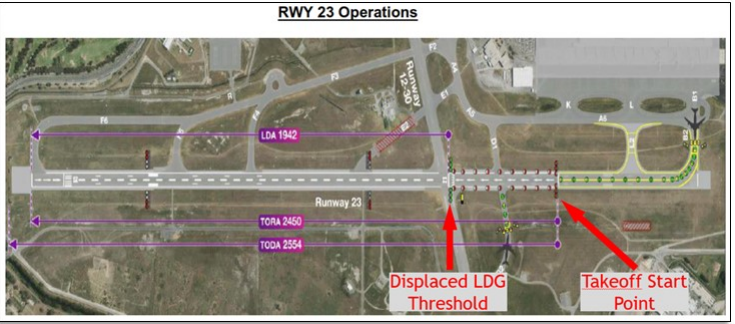
In response to the occurrence on 31 March 2025, Qatar flight safety office amended the associated special crew briefing with an image highlighting the take-off start point and landing threshold for runway 23 operations (Figure 11) and published a company NOTAM for pilot awareness.
Figure 11: Extract from Qatar Special Crew Briefing 275 showing displaced threshold and take-off start point
Source: Qatar Airways
Virgin Australia information
Dispatcher notes
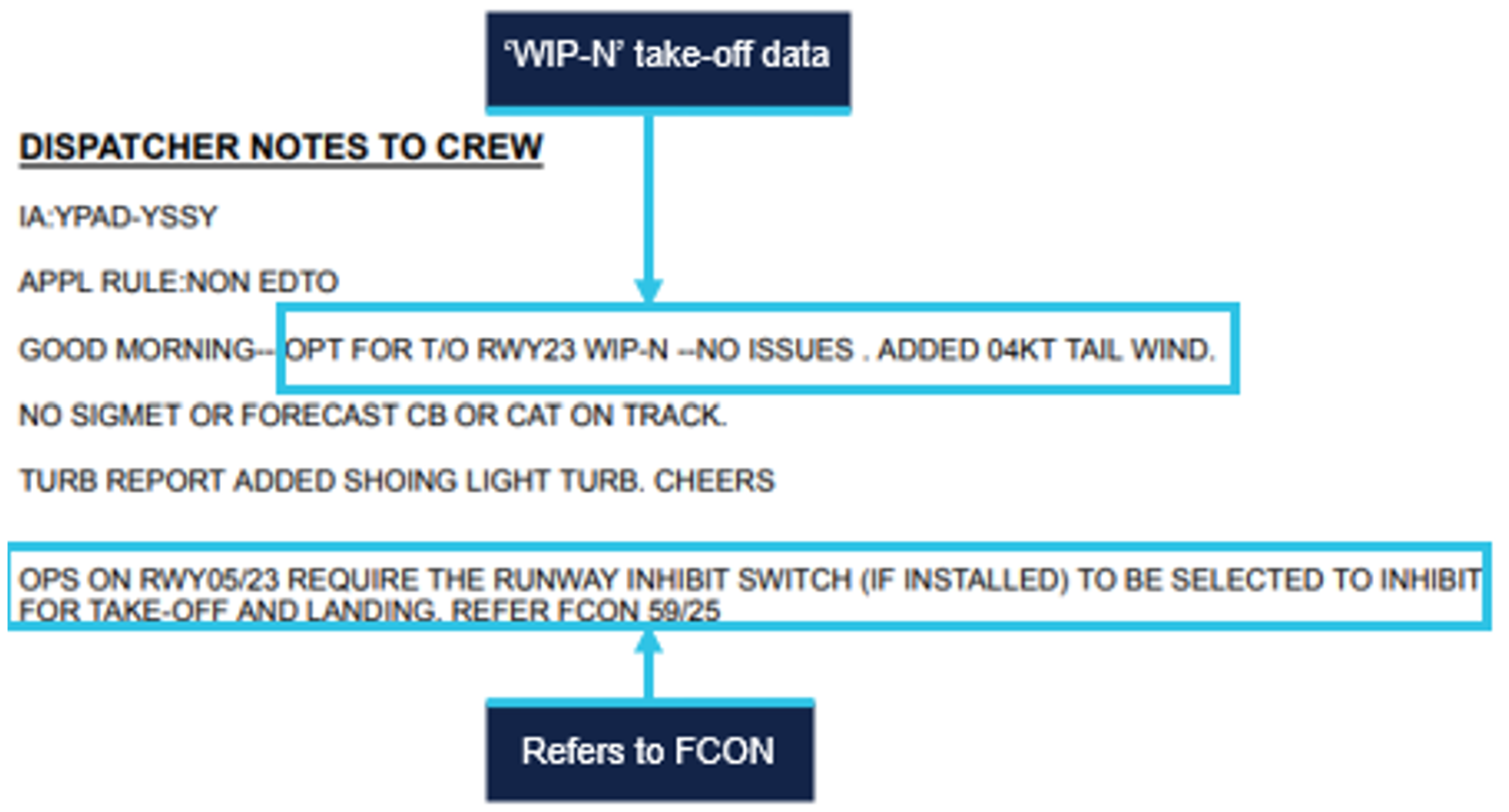
The dispatch package for VA 413 (YPAD–YSSY) on 11 April was 30 pages long and the dispatcher notes to crew included the required take-off performance data ‘WIP-N’. It also referenced the flight crew operational notice (FCON) for information about use of the inhibit switch (Figure 12).
Figure 12: Dispatcher notes – VA 413
Source: Virgin Australia, modified and annotated by the ATSB
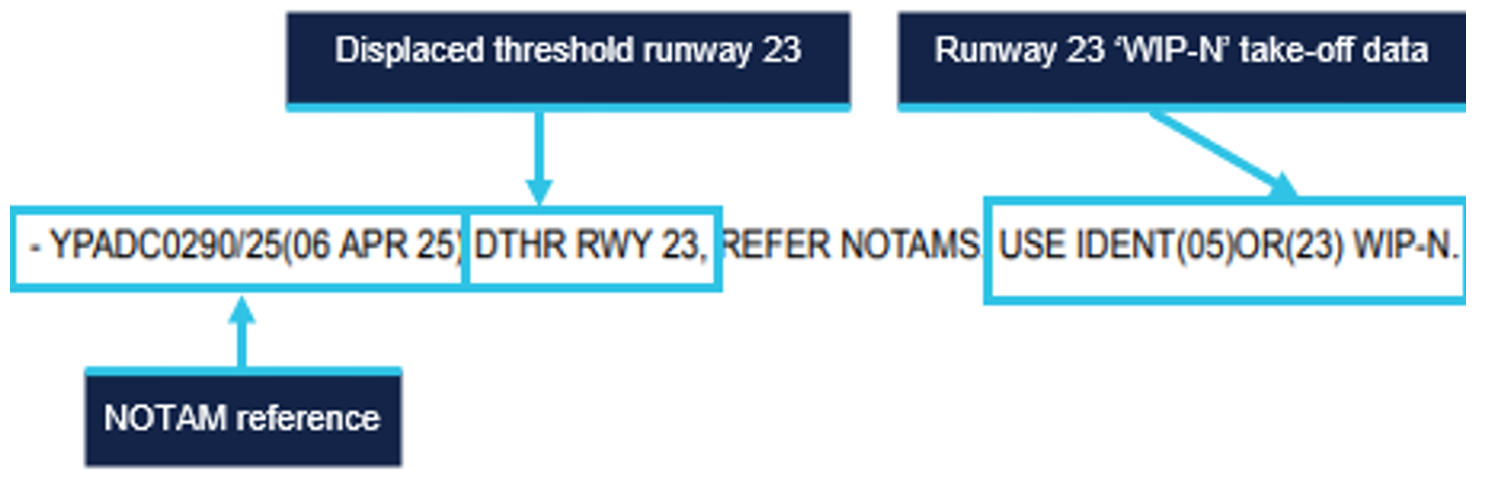
The 27-page dispatch package for VA 222 on 11 April included the same reference to the FCON, but the performance data information was presented differently (Figure 13).
Figure 13: Dispatcher notes – VA 222
Source: Virgin Australia, annotated by the ATSB
NOTAM and company remarks
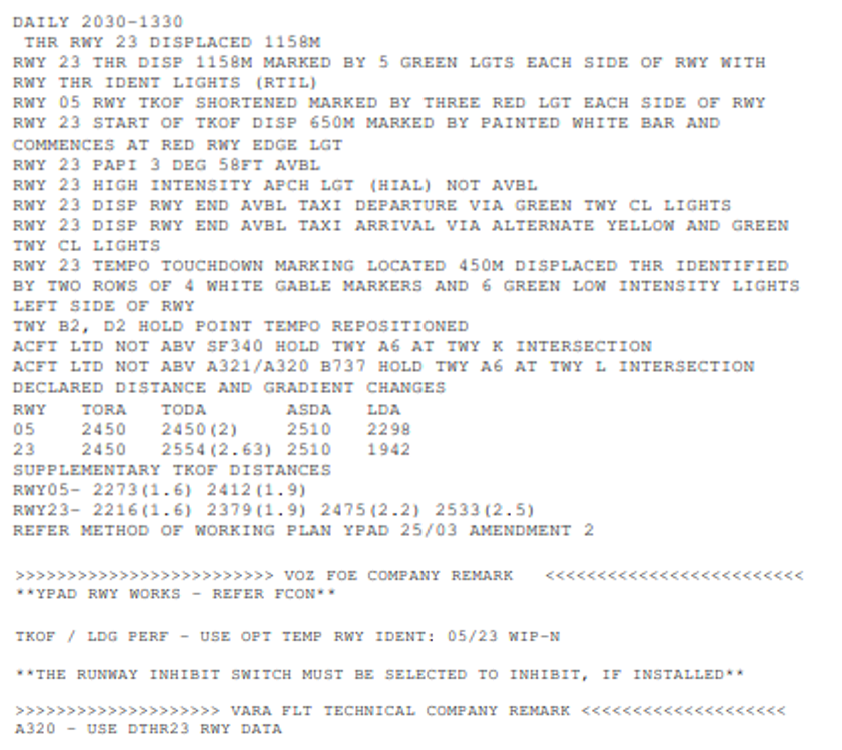
Both dispatch packages included the NOTAM YPADC0290/25, which referenced the MOWP. Beneath the NOTAM was a flight operations engineering (FOE) note that referred to the FCON and the use of WIP-N OPT data, and a fleet technical company remark for A320 aircraft to use ‘DTHR23 RWY DATA’:
Flight crew operational notices
The Virgin Australia FCON (25) current at the time of the 2 occurrences on 11 April provided:
- summary points about the works at Adelaide Airport
- specific information for use of runway 23 and runway 05
- links to the AIP SUP, diagrams of the works, and ‘further operational information’.
The summary points included:
- CAUTION: Reduced runway length 05/23, north-eastern end displaced 1158m.
While the runway 23 (north-eastern) threshold was displaced 1,158 m, the north-eastern runway end (SOT) was only displaced 650 m.
The runway 23 departure information stated:
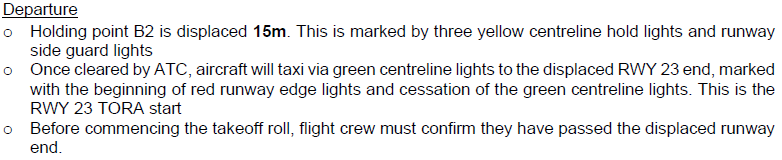
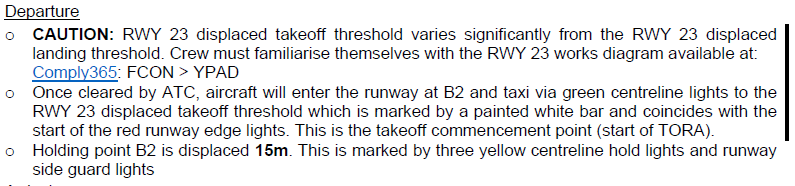
The FCON was updated on 11 April after the 2 occurrences. The summary information was unchanged, but the departure information was amended. For runway 23, the term ‘displaced RWY 23 end’ was amended to ‘RWY 23 displaced takeoff threshold’, and the requirement to confirm having passed the displaced runway end was removed:
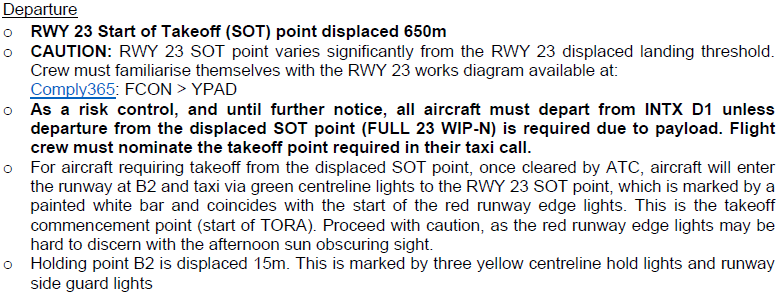
On 14 April, Virgin Australia issued an updated FCON (version 31). The reference to 1,158 m was removed from the summary information. Additionally, the departure information for runway 23 was amended to use the term ‘RWY 23 Start of Takeoff (SOT)’. Virgin Australia also required aircraft to depart from intersection D1 unless operationally required:
The FCON linked to the photo taken from a cockpit facing the start of take-off position, which had been provided to AAL, with the SOT position indicated (Figure 14).
Figure 14: Virgin Australia’s annotated cockpit image provided by AAL
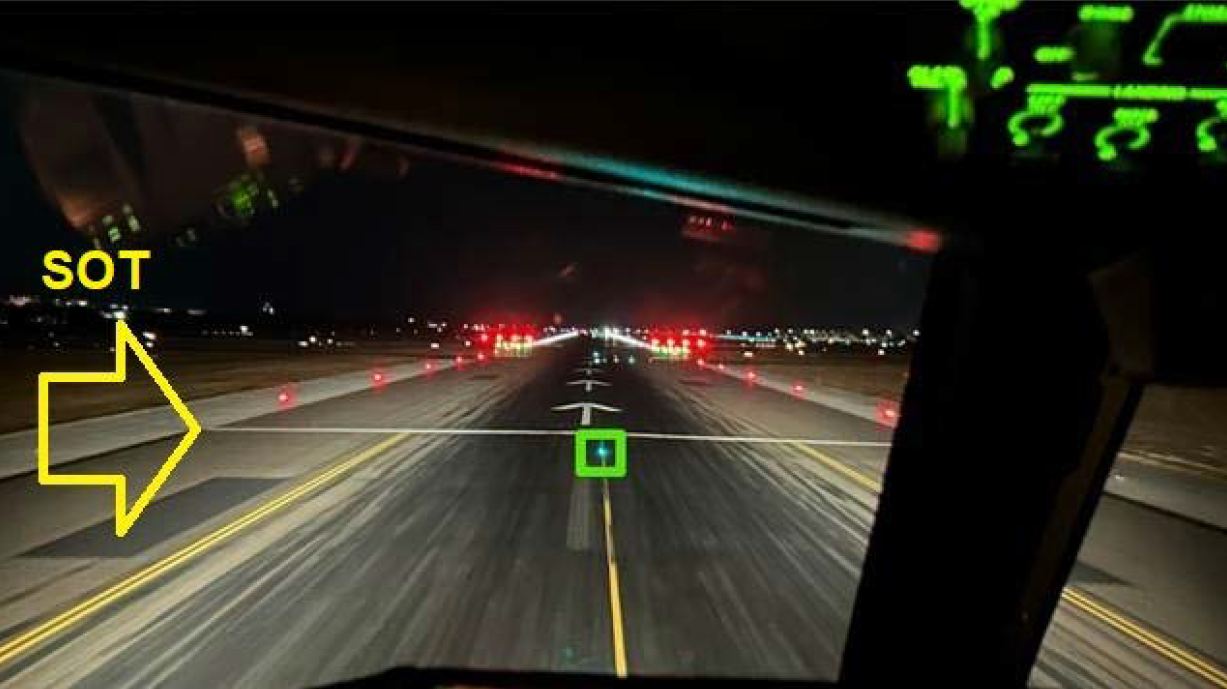
Source: Emirates, provided to the ATSB by Virgin Australia
Safety alert
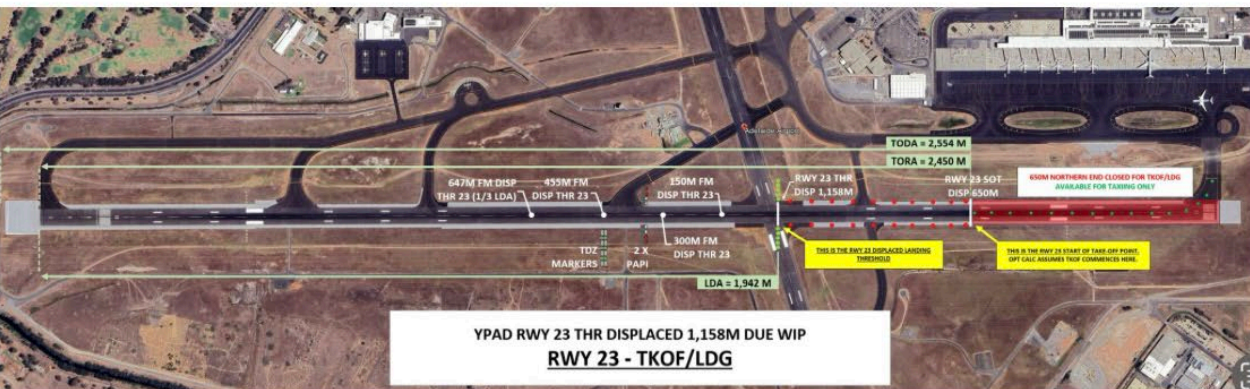
On 11 April, Virgin Australia issued a flight operations safety alert advising that a take-off had been initiated from the ‘RWY 23 Landing Threshold instead of the RWY 23 takeoff threshold’. It advised crew to read the FCON and works diagram together, and ensure they were familiar with the ongoing works. The safety alert included a runway diagram, which was also accessible via a link from the FCON, with 2 yellow labels that read (Figure 15):
- ‘THIS IS THE RWY 23 DISPLACED LANDING THRESHOLD’
- ‘THIS IS THE RWY 23 START OF TAKE-OFF POINT. OPT CALC ASSUMES TKOF COMMENCES HERE’.
Figure 15: Runway 23 image with yellow labels showing start of take-off and displaced landing threshold positions
Source: Virgin Australia
Qantas information
NOTAM, topnote and INTAM
Qantas added a ‘topnote’ to the aerodrome works NOTAM that provided additional information. At the commencement of works on 31 March 2025, the topnote referred flight crew to an internal NOTAM (INTAM) and the use of ‘23_MOWP’ for performance data for runway 23:

The topnote was modified on 1 April 2025 to highlight the ‘starter extension’ (see the section titled Civil Aviation Safety Regulations Part 139 (Aerodromes) Manual of Standards):

Qantas INTAM, effective 29 March 2025, detailed the aerodrome works, displaced threshold, and referred flight crew to diagrams, the AIP SUP and additional information:
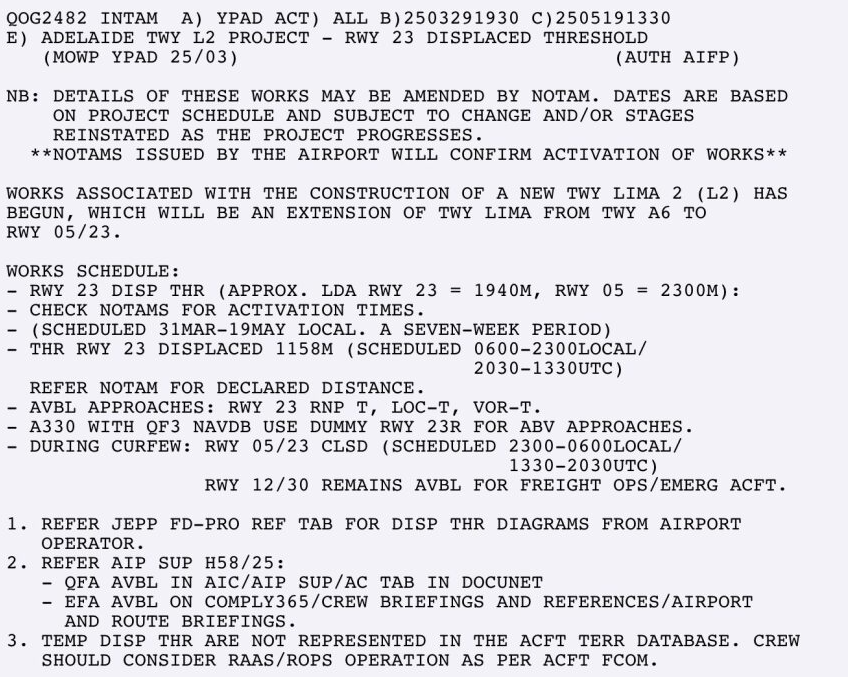
The INTAM was modified on 2 April 2025 to include:
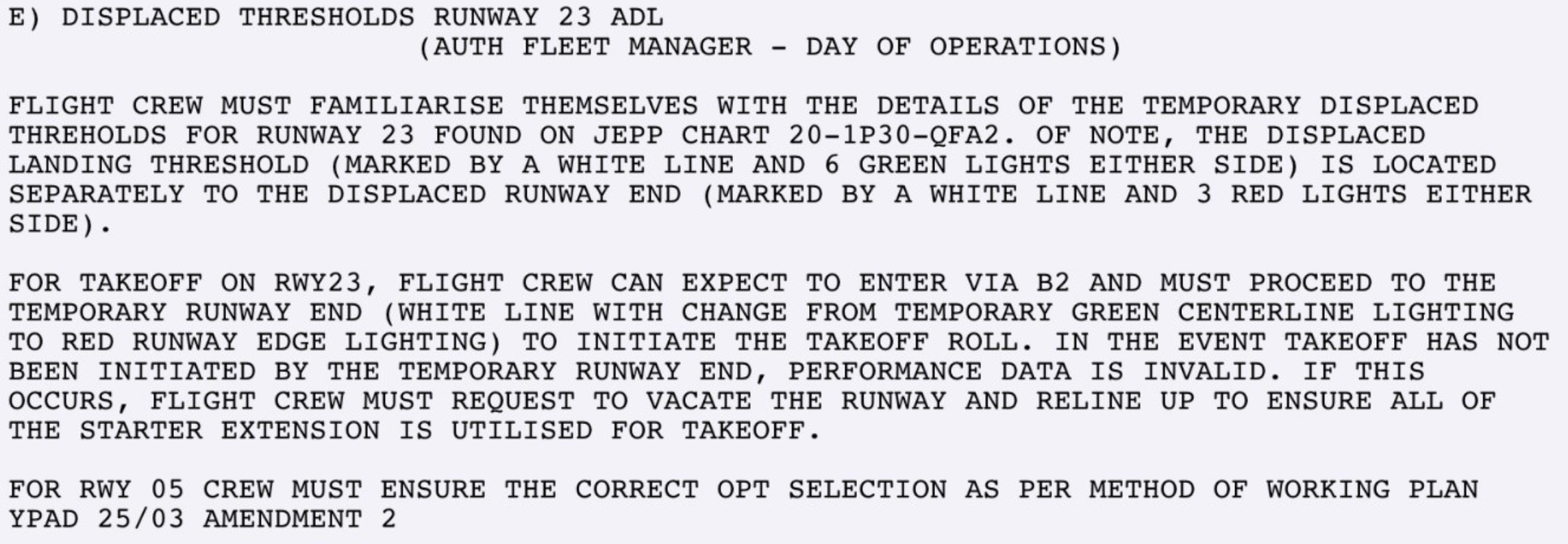
Flight standing orders
On 14 April 2025, following the fifth event involving a Qantas aircraft, flight standing order (FSO) FSO029 was issued. The FSO included a link to the amended AIP SUP (H58/25) and stated:
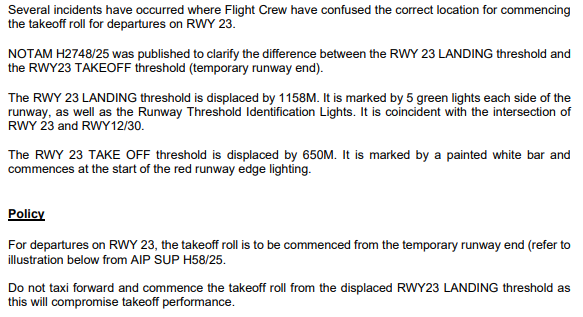
The FSO included the Adelaide Airport layout diagram with the start of take-off roll and landing threshold positions labelled (Figure 16).
Figure 16: Qantas’ Adelaide Airport layout diagram with the landing threshold and start of take-off roll positions labelled
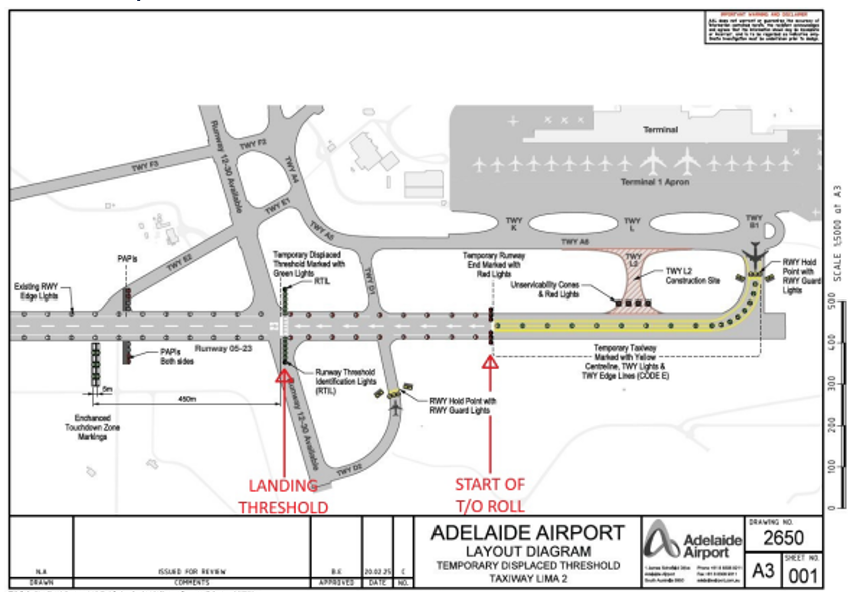
Source: Qantas
A replacement Qantas FSO (FSO032) was issued on 17 April 2025, introducing the policy to plan their take-off performance using the D intersection:
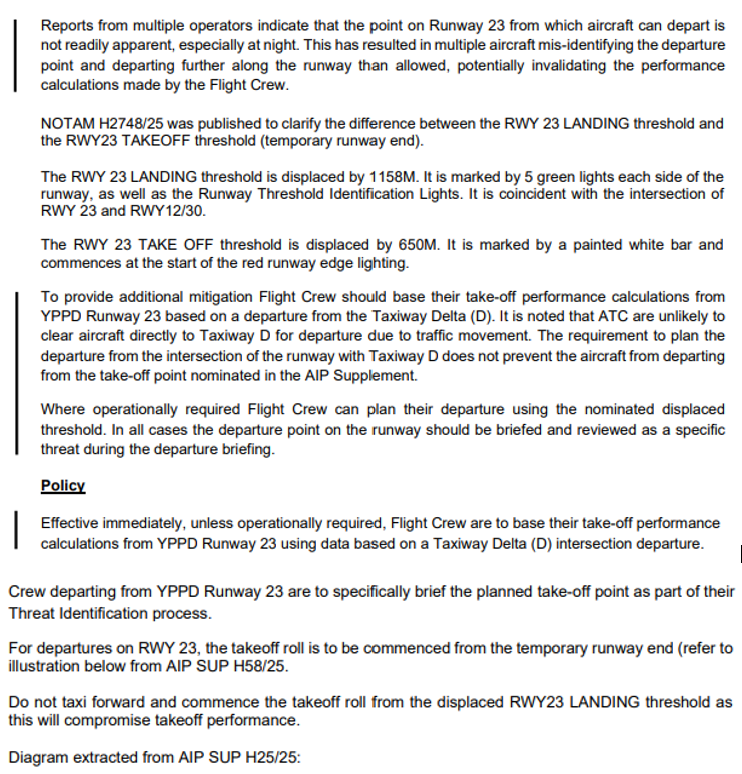
Jetstar flight standing order
Jetstar issued flight standing order FSO 072/25 on 9 May 2025, which stated that:
Industry has identified there may be a risk of misidentification of the correct take off point associated with the current Adelaide Airport (YPAD) Runway 23 and Hobart Airport (YMHB) Runway 30 Displaced Thresholds.
In these instances, the temporary displaced ‘Runway End’ (which is where the Takeoff is to commence) may have been misidentified as the temporary displaced ‘Threshold’ for takeoff which is significantly further down the runway.
Misidentification of the correct takeoff point could result in takeoff with less Take off Distance than that calculated in Flysmart. This could lead to a potential runway overrun during Take-off or during an RTO.
…
The subsequent diagram (Figure 17) from AIP SUP H58/25 depicts the ‘Displaced Runway End’ which is marked by temporary RED runway ‘end’ lights. This relates to performance data associated with Flysmart Takeoff position ‘RWY 23 N1 158 All’ and is the point at which take off should be commenced when utilising the displaced threshold.
Crew should be aware that the ‘Temporary Displaced Threshold’ is marked by GREEN threshold identification lights. This runway position should only be referenced for landing on Runway 23. Intersection departure from TWY D1 remains available and is unaffected by markings associated with the runway displacement.
Figure 17: Jetstar flight standing order’s labelled diagram
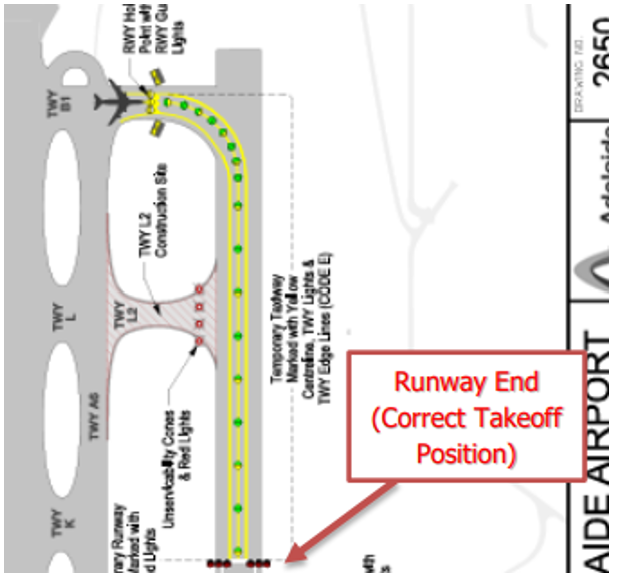
Source: Jetstar
Adelaide Airport Limited safety management
AAL had a safety management system (SMS) as required by CASR 139.095, which met the requirements of the Part 139 MOS Chapter 25 and CASA Advisory Circular 139.C‑26 (1) – Safety management systems for aerodromes. The SMS sat within AAL’s enterprise risk management framework. AAL conducted a risk assessment prior to commencement of the aerodrome works and revisited the assessment following reports of pilot confusion.
The initial risk assessment was compiled on 14 March 2025 and finalised on 26 March. Two risks relevant to the pilot confusion occurrences were:
- Pilot confusion – Pilots may become confused about the markings and lighting and misinterpret their meaning.
- Runway excursion – Insufficient guidance on runway to prevent an excursion.
Each had a list of causes and consequences. Pilot confusion was listed as a potential cause of a runway excursion and ‘aircraft excursion’ was listed as a potential consequence of pilot confusion. Most causes and consequences were listed for both risks, and some (but not all) of the causes and controls could be directly correlated. For example:
- Cause: ‘Details not included in AIP-SUP’.
- Control: ‘Documented in AIP-Supplement’.
Although the lighting, markings, and unusual position of the SOT had not been identified as potential causes of confusion, the related controls were that these had been:
- documented in the MOWP and AIP SUP
- described in the NOTAMs
- laid out correctly (in accordance with the MOS) and operational
- described with adequate timely communication, including with:
- aircraft operators
- Air Traffic Services
- AAL personnel
- Apron Safety Committee.
Both risks had the same ‘unmanaged’ risk rating of extreme, with:
- likelihood as ‘likely’: ‘is likely to occur during the project period’ (50–75% probability)
- consequence as ‘major’: $5–20 million and significant damage to aircraft including potential for major injury/fatality.
With the listed controls ‘currently in place’, both had the same ‘current’ risk of ‘high’, with:
- likelihood as ‘unlikely’: ‘is unlikely but possible to occur during the project period’ (5–25%)
- consequence as ‘major’.
The current risk was assessed to be ‘as low as reasonably practicable’ (ALARP). The AAL risk tolerance levels defined in the SMS stated that ‘high’ was ‘tolerable’ with ‘risk reduction action and continuous review required’.
The risk assessment spreadsheet included a risk appetite statement, which included:
Very low appetite for risk impacting on aviation safety and security outcomes which could result in crash, loss of life, loss or significant damage to an aircraft and/or airport or other infrastructure.
Very low appetite was defined as:
We will not follow a course of action that may expose AAL to risk unless it is essential.
Risk exposures will be avoided as any incidents arising would be outside of appetite.
Following the report from Airservices regarding ‘a lot of pilot confusion’ on 4 April, AAL reviewed the risk assessment. The following causes and controls were added to the risks of pilot confusion and runway excursion. The existing unmanaged and current risk ratings remained the same.
Table 5: Additional causes and controls
| Risk | Causes | Controls |
| Pilot confusion |
|
|
| Runway excursion |
|
|
The risk assessment was not subsequently revisited. However, on 17 April, AAL was notified of the Virgin Australia occurrences (from 11 April 2025) and met with representatives from the airline and Adelaide ATC. AAL documented that ATC had agreed to only issue a take-off clearance once an aircraft was observed at the correct runway 23 start of take-off position.
In accordance with its standard operating procedures, on 7 May 2025, AAL initiated an investigation in response to 3 reported incidents, due to their ‘potential consequence rating of high or above’.[37]
The AAL investigation assessed that the incident ‘was not preventable’ from an AAL perspective. The investigation identified several contributing factors, summarised as follows:
- Pilot confusion due to the misidentification of the runway threshold for the start of take-off position.
- ATC not identifying aircraft having taxied beyond the SOT.
- No documented temporary ATC instructions to pilots regarding the SOT, prior to being issued a take-off clearance.
- Due to the unusual layout with the runway being used as a taxiway, and the distance between the SOT and the displaced threshold, consideration could have been given to non-standard signage, markings and lighting, such as:
- SOT being painted adjacent to the white bar (AAL painted SOT and doubled the width of the white bar on 8 May)
- MAGS adjacent to the start of take-off position
- the runway lights remaining on in daylight hours to provide additional visual cues (implemented on 3 April).
- Although CASA provided feedback regarding the AIP SUP as part of its response to the ETZM safety case before works commenced, it did not provide feedback on the MOWP until 8 May.
AAL’s stated actions identified during its investigation were:
For future displaced thresholds where the start of take-off may be confused with the displaced runway threshold consideration for the installation of MAG signs identifying the Runway start of take-off location and the Take off distance available.
Ensure that this risk is included in any future displaced threshold risk assessments.
The Head of Airside Operations will be involved in reviewing the visual aid and marking standards for displaced thresholds as part of the National Runway Safety Group - Displaced Thresholds Runway Works Working Group.
CASA surveillance activity
CASA conducted a Level 1 systems audit at Adelaide Airport on 23–26 June 2025. CASA made 7 safety findings and 7 safety observations, including one safety finding on AAL’s SMS:
The current version of the Adelaide Airport Safety Management System Manual (SMS) was dated March 2024. The document’s amendment record indicated that the last review occurred outside of the 12 month scheduled requirement.
Hobart Airport aerodrome works
Runway 30 displaced threshold
The operator of Hobart Airport, Hobart International Airport (HIA), conducted aerodrome works from 11 September 2024 to 24 July 2025. According to HIA’s MOWP, the stage 3C works commenced on 15 April 2025, and included removal and reconstruction of the runway 12/30 pavement, installation of ground lighting, and drainage works at the southern end of the runway.
Stage 3C was expected to take 7 weeks and the MOWP stated that the works required 829 m displacement of runway 30 threshold. This reduced the operational length by 634 m at the southern end, and 195 m between the displaced runway end and threshold (Figure 18). Runway lights were extinguished from the displaced threshold to the runway end. The relevant information was also published in an AIP SUP.
Figure 18: Hobart Airport runway 30 temporary displaced threshold and runway end
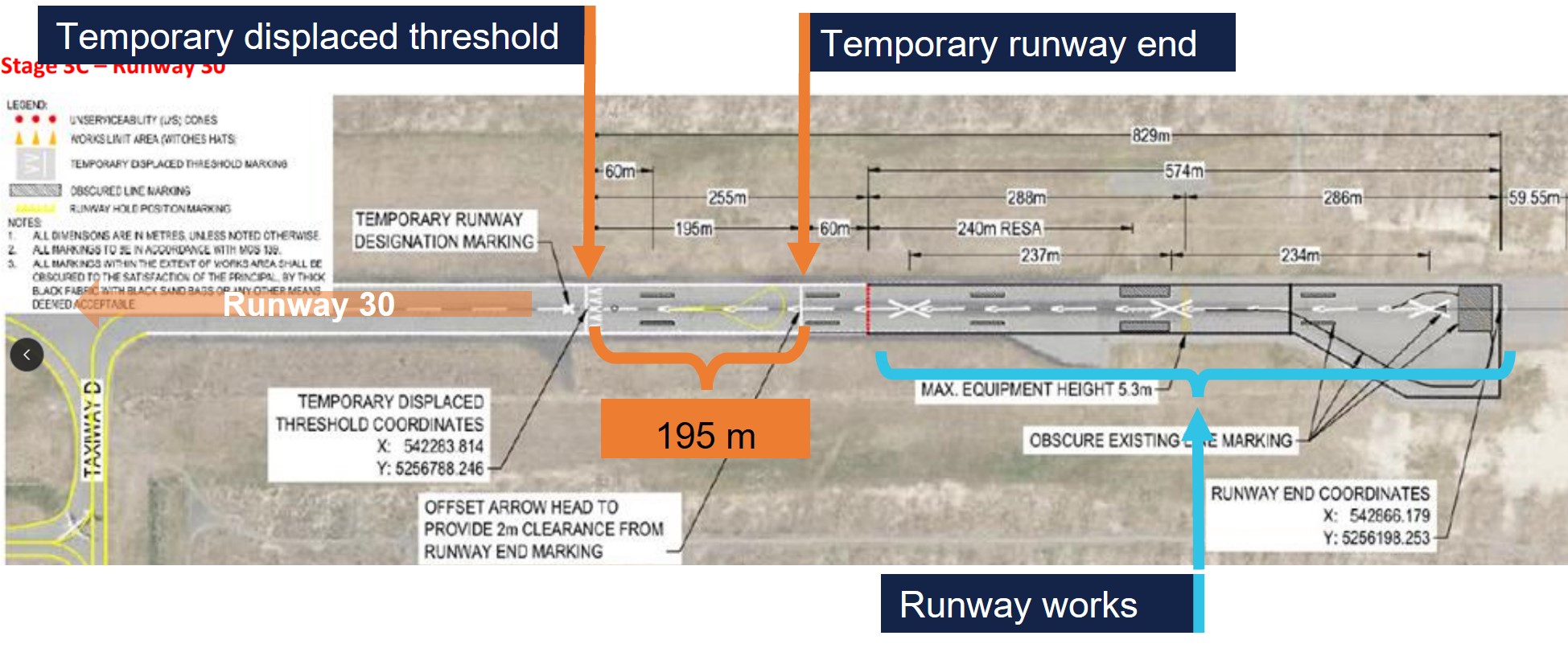
Source: Hobart International Airport, annotated by the ATSB
Although the markings referred to the temporary runway end (of runway 12), the MOWP also included a draft NOTAM with the following information referring to the runway 30 start of take-off position:
RWY 30 TKOF TO COMMENCE AT WHITE TH LINE HJ AND RED LGTS HN
This was amended on 17 April, after discussion with aircraft operators and ATC, to include:
RWY 30 TKOF TO COMMENCE AT THE RUNWAY END WHITE LINE HJ CO LOCATED WITH RED LGTS HN
HIA advised that the turn pad marking was installed, along with the remainder of the displaced threshold markings and lights, on 15 April 2025. The turn pad markings were required as per paragraph 8.33(1) of the Part 139 MOS and Figure 8.33(1) (Figure 19):
Figure 19: Part 139 MOS Figure 8.33(1) showing turn pad marking (yellow)
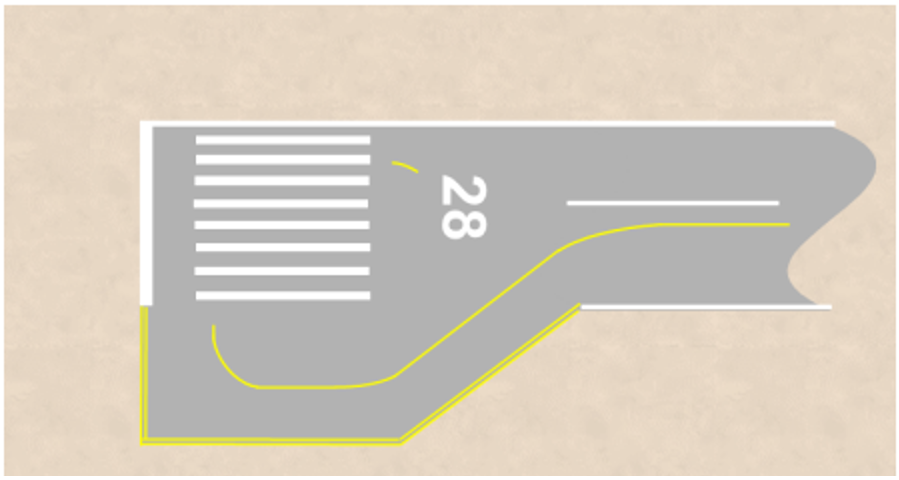
Source: CASA
Hobart occurrences
During the investigation into the occurrences at Adelaide Airport, the ATSB was advised of 4 similar occurrences at Hobart Airport while operating with a temporarily displaced threshold. In those instances, pilots commenced the take-off from, or close to, the displaced threshold instead of the SOT position, having used performance data for the SOT position. Two of the occurrences (22 April 2025 and 24 April) involved Virgin Australia aircraft.
In response, on 29–30 April 2025, HIA:
- updated the MOWP and SUP to include a new drawing and a label indicating where RWY 30 TORA/TODA commences
- distributed an amended diagram, depicting the runway end lights, yellow turn pad line, displaced threshold lights and PAPI (Figure 20)
- amended the turn pad marking to include direction arrows.
Figure 20: Extract of revised diagram depicting turn pad marking, displaced threshold and runway end
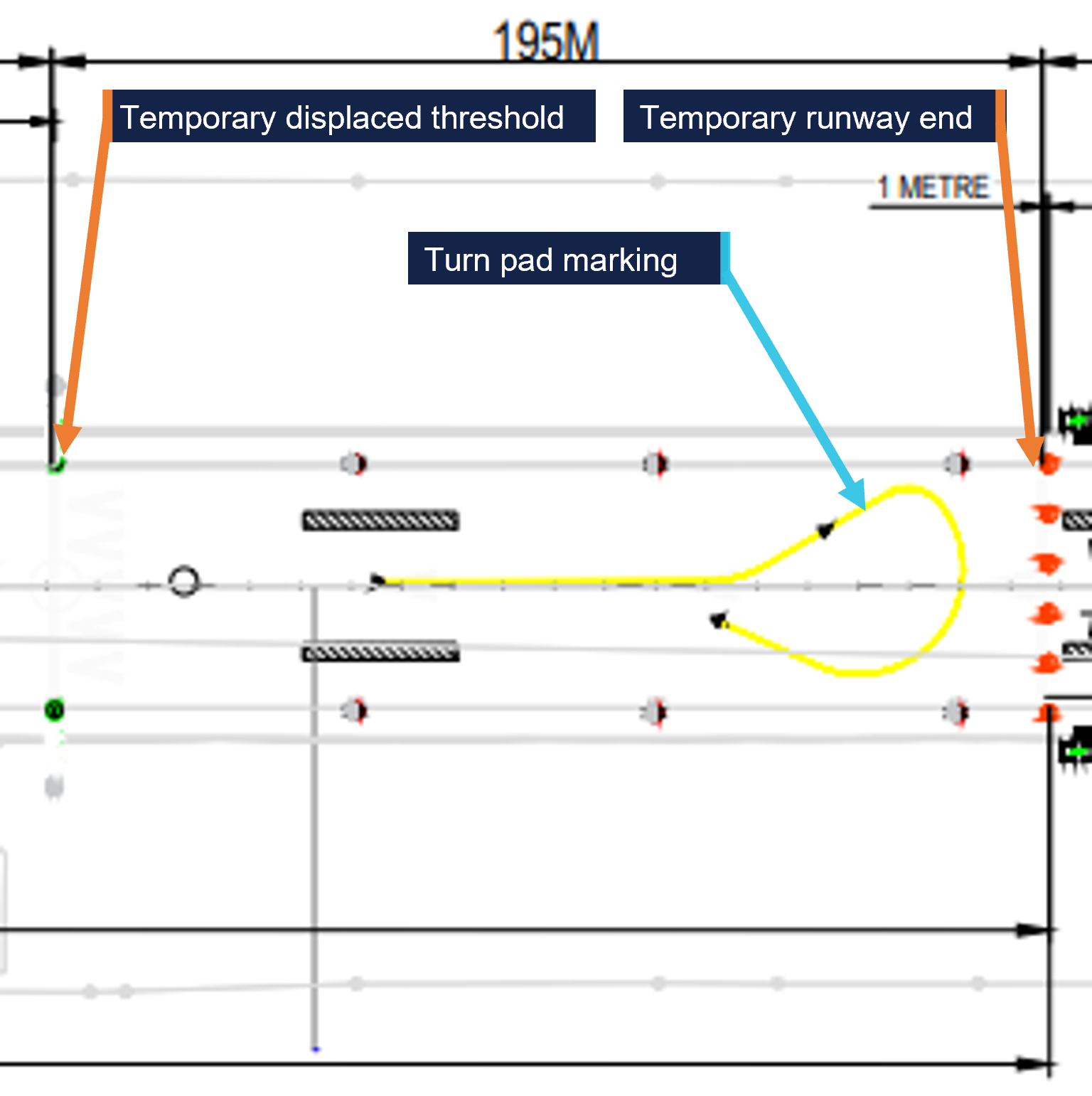
Source: Hobart International Airport, annotated by the ATSB
Routine analysis of recorded flight data by Jetstar identified 2 other occurrences in which the take-off commenced close to the displaced threshold instead of the SOT position. One of those occurred in wet weather with low light conditions and the flight crew reported being unable to see the yellow turn line.
In response, on 9 May 2025, Jetstar issued the FSO 072/25 (see the section titled Jetstar Flight Standing Order), applicable to Adelaide and Hobart airports. Following completion of the Adelaide Airport works, the FSO was reissued as FSO 082/25 on 21 May, only applicable to Hobart. The FSO included the following information and diagram (Figure 21) for Hobart:
The subsequent diagram from AIP SUP H87/25 depicts the ‘Displaced Runway End’ which is marked by temporary RED Runway ‘end’ lights. This relates to the performance data associated with Flysmart Takeoff position ‘RWY 30 S829 NON/SHK’ and is the point at which take off should be commenced when using the displaced threshold.
Crew should be aware that the ‘Temporary Displaced Threshold’ is marked by GREEN threshold identification lights. This runway position should only be referenced for landing on Runway 30. Nominal Touchdown Markers and Lights are also located further down the runway.
Crew should be mindful when back tracking the runway the aircraft will pass two sets of markers (the nominal touch down point markers, and the threshold markers). The aircraft must continue to the red ‘runway end markers’ to commence the 180 degree turn for takeoff.
…
Figure 21: Jetstar’s annotated Hobart International Airport diagram
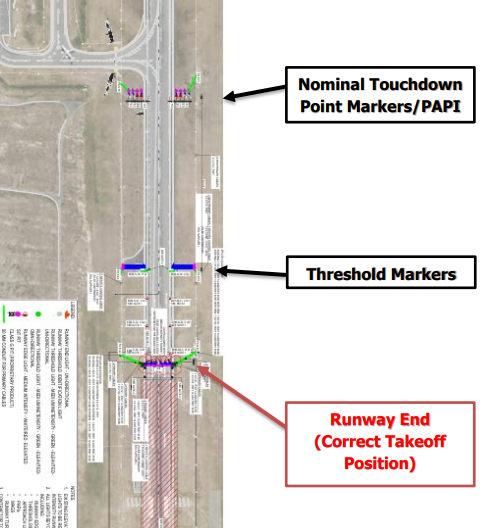
Source: Jetstar
Similar occurrence
On 28 March 2018, a Boeing 787 being operated by Norwegian airlines on a scheduled passenger flight from London Gatwick Airport, United Kingdom (UK), to Buenos Aires, Argentina, at night, was observed by ATC to only just get airborne before reaching the end of the runway. An investigation by the UK Air Accident Investigation Board found that the aircraft began its take-off roll from the displaced threshold of runway 26 Right instead of the beginning of the runway. The investigation identified the unusual runway configuration with the taxiway leading to the runway on the same heading, with no turn required to enter the runway.
The flight crew did not identify the beginning of the runway, instead taxied the aircraft forward to the landing threshold. A combination of an unusual straight-line runway entry, a perceived lack of lighting in the pre-threshold area and the bright threshold lights ahead contributed to the crew not identifying the beginning of the runway.
From the point at which the aircraft began its take-off roll, its performance did not meet regulatory requirements for both stopping and continuing should an engine have failed close to V1. The risks in both cases were significant to the aircraft and its occupants.
Safety analysis
Introduction
From 31 March to 20 May 2025, taxiway construction works were carried out at Adelaide Airport, South Australia. To accommodate the works, the runway 23 start of take-off (SOT) position was temporarily displaced 650 m beyond the normal runway start, with the runway 23 landing threshold displaced a further 508 m beyond the temporary SOT position.
Subsequently, 13 occurrences were identified in which aircraft commenced the take-off from the displaced threshold, instead of the intended SOT position. As the flight crews had used take-off performance data based on commencing the take-off from the SOT position, this increased the risk of a runway overrun. The occurrences took place during both daylight and night‑time hours, and involved several aircraft operators, with the first incident on 31 March 2025 and the last on 20 April 2025. Several more occurrences were prevented either by intervention from air traffic control (ATC), or by flight crews contacting ATC or their flight operations support personnel prior to departure to confirm the correct SOT position.
This analysis will discuss the effectiveness of the works information provided to flight crews, including aerodrome works lights and markings, and the required aerodrome standards. It will also review the contents of the NOTAM and its effectiveness in describing the SOT position. ATC phraseology will also be discussed, along with strategies used by controllers to assist pilots in identifying the SOT position. Finally, the Civil Aviation Safety Authority’s (CASA) review of the method of working plan and the timeliness of that review will be analysed.
Lights and markings confusion
The 2 flight crews interviewed by the ATSB had read the available documentation regarding the aerodrome works and received the automatic terminal information service (ATIS) prior to taxiing to depart from runway 23. They had also identified the works and displaced threshold as threats, and were aware there were different runway positions for landing and take-off. Additionally, they had landed on the runway less than 35 minutes earlier, having successfully identified the displaced threshold. The flight crews also noted a reminder in the operational documentation not to commence the take-off before passing the runway end.
However, having received clearance to enter the runway at the B2 holding point and taxi to the displaced runway end (SOT position), the flight crews did not identify the white line indicating the SOT position as stated in the revised NOTAM (and elsewhere). As it was a bright sunny day, they also did not see the start of red edge lights (specified to be visual cues for night and low visibility conditions), which commenced at the SOT position. As a result, the flight crew taxied to the displaced threshold before commencing the take-off. In one of the incidents, this was also likely influenced by observing an aircraft ahead commence the take-off from the displaced threshold. The flight crews later realised the error and reported the occurrences.
For the 11 other occurrences, identified by aircraft operators’ analysis of their recorded flight data, it was unknown how much of the related documentation flight crews had been reviewed, or whether they were aware that the aircraft had departed from the incorrect position. As the ATIS did not contain any information relating to the SOT position, other than a difference between the stated take-off and landing distances, it did not offer a means to correct an incorrect understanding of its location.
Given the high number of occurrences, both day and night involving different aircraft operators, and the combined significant experience of the involved flight crews, the visual cues for the SOT position were almost certainly confusing.
By day, the white arrows and threshold lights were more prominent than the white runway end line designating the SOT position. However, there was no mention in the documentation of the white arrows, which pointed towards the displaced (landing) threshold. Flight crews found that these indicated to continue moving forwards before commencing take-off.
The red runway edge lights were illuminated day and night from 4 April 2025, but not readily visible in daylight. At night, the start of runway being a transition from green taxiway lighting to red edge lighting was insufficiently distinct. Additionally, being red as they were intended to indicate to pilots of landing aircraft not to land before the displaced threshold, the edge lights did not intuitively indicate the start position for take-off (or 'go'). The runway end line, while perceptible, did not identify the line as an indication of the start of runway position to many of the flight crew. It also had the same characteristics as the white displaced threshold line.
In addition to the reported occurrences and those identified by aircraft operators’ analysis of their flight data, many pilots queried ATC as to the correct SOT position, taxied very slowly to identify the SOT, and some were advised by ATC when they had missed the SOT and obtained clearances to re-taxi to the runway. Having observed aircraft pass the SOT position at slow speed, some controllers also reiterated the take-off clearance. While well intended, it was ineffective at alerting crews that they had commenced the take-off beyond the position used for take-off performance calculations.
Although the Civil Aviation Safety Regulations Part 139 Manual of Standards (MOS) required movement area guidance signs (MAGS) showing the take-off run available from an intersection, this did not apply for a temporary SOT position that was not at a taxiway or runway intersection.
In the absence of any signage, holding point or runway/taxiway intersection at the SOT, there was no reference for flight crews to crosscheck the aircraft’s position before commencing the take-off, in accordance with standard operating procedures. To mitigate this absence of MAGS during aerodrome works with reduced runway length, based on research conducted by the Airport Construction Advisory Council, the United States Federal Aviation Administration (FAA) introduced black and orange construction signage, one of which stated the take-off run available from the SOT position.
The ineffective visual cues resulted in multiple take-offs from the displaced threshold instead of runway start by flight crew. These resulted in reduced safety margins and increased the risk of a runway overrun. In at least 3 of these occurrences, there would likely have been insufficient runway remaining had the flight crew been required to reject the take-off near the decision speed (V1).
Contributing factor The flight crews of multiple aircraft misidentified the start of runway 23 due to confusing temporary markings and lights. This resulted in several take-offs commencing from the displaced threshold using performance parameters for a longer runway. |
Civil Aviation Safety Regulations Part 139 Manual of Standards requirements
The Civil Aviation Safety Regulations Part 139 MOS prescribed a 1.2 m-wide white line across the runway marking the runway end, the same characteristics as the white line marking the displaced threshold. Additionally, the red runway end lights prescribed in the MOS were unidirectional and therefore not visible to aircraft departing from that end of the runway. In daylight, the threshold lights and white arrows leading to them, provide useful advice for landing aircraft, but conflicting information to departing crew commencing the take-off before that position. At night, the green threshold lights are cues for landing aircraft, but as discussed above, red edge lights provide limited cues for commencing take-off.
There was nothing in the MOS to assist identification of the SOT position when the start of runway (as in this case) was not coincident with a taxiway or runway intersection, or an obvious end of pavement that would normally provide key visual cues for flight crews.
The MOS permitted, but did not require, MAGS to indicate the SOT and take-off run available. The only MOS requirement was to cover up existing MAGS that were incorrect during runway works, which AAL reported was done.
Although already in use by the FAA, and scheduled to be incorporated in the International Civil Aviation Organization (ICAO) Annex 14 Volume 1 Amendment 18 in November 2025, orange and black construction/unserviceability signs had not been incorporated in the MOS. Additionally, in July 2025, the Civil Aviation Safety Authority (CASA) released its notice to amend the MOS to align with Amendment 15 (from 2020). That proposed amendment did not include the introduction of such signs, to provide a visual cue for the SOT position during the Adelaide and Hobart works.
Annex 14 did not include a marking standard for the runway end, but used a white line across the runway for a displaced threshold, which was required to be at least 1.8 m wide. In the absence of an ICAO standard, the FAA had implemented a yellow 0.9 m‑wide ‘demarcation bar’ to depict a displaced runway end, consistent with the use of yellow for taxiway markings and white for markings within the runway. Such marking would also likely have provided a distinct visual cue for the SOT position at both Adelaide and Hobart.
Adelaide Airport Limited (AAL) assessed that the risk of pilot confusion was adequately managed, as the lights and markings were compliant with the MOS, other than the CASA-approved enhanced touchdown zone markings. Additionally, AAL assessed that the incidents were not AAL-attributable, primarily due to MOS compliance. Therefore, when pilots found it confusing, AAL amended the documentation, engaged with ATC and airlines, but did not change the lights (other than illuminating the runway lights in daylight) and markings until about one week before the works ended.
Contributing factor The Civil Aviation Safety Regulations Part 139 Manual of Standards did not recommend or provide standardised options for movement area guidance signs or other visual aids to draw flight crew attention to the start of take-off position, especially those distant from a displaced threshold and not coincident with a taxiway/runway intersection. (Safety issue) |
NOTAM clarity
The initial NOTAM released at the start of the runway works (and repeated in the Aeronautical Information Publication Supplement (AIP SUP) stated that the ‘Runway 23 displaced runway end will be marked with 3 red lights each side of runway 23’. This was referring to what is defined as the reciprocal (05) runway end, not the collocated SOT position. While the AIP included the abbreviation ‘SOT’ as the start of take-off run available (TORA) position, it was not well known, nor an international standard.
Being unidirectional, the red runway end lights were visible to aircraft landing on runway 05, but not visible to aircraft departing on runway 23. As such, the initial NOTAM wording did not assist clear identification of the SOT position for runway 23 and used inconsistent terminology for the runway end. Recognising that the NOTAM was not the sole source of information, it probably contributed to flight crew confusion and the subsequent occurrences.
The NOTAM text was included in the method of working plan (MOWP) and referred to the MOWP for more detailed information. The AIP SUP was published as required for more complex information. Although one reference to the runway 23 end was amended to the runway 23 SOT in the AIP SUP and MOWP before works commenced, that was not reflected in the NOTAM until after the works commenced and pilot confusion had occurred. The amended version of the NOTAM gave the white line and red edge lights as cues for the start of take-off, but it was not sufficient to prevent further occurrences.
In general, NOTAMs present summary abbreviated information and do not distinguish between operationally critical and less relevant information for flight crew. The works NOTAM had typical limitations including a large block of capitalised text with no prioritisation of key information and no obvious way to identify key information for aircraft departing on runway 23.
Contributing factor The initial NOTAM released at the start of the runway works used inconsistent terminology for the runway end, did not refer to the white line marking the start of take‑off position, and referred to red runway end lights not visible to pilots departing on runway 23. |
Air traffic control phraseology and intervention
Prior to commencement of the works, based on the information provided by AAL, Adelaide Tower ATC issued a temporary local instruction with suggested phraseology for controllers to clear flight crew to line up at, or take-off from, the ‘displaced runway end’. However, flight crews found the use of 'displaced' for both the landing threshold and runway end confusing.
On the first night of the works, the aerodrome controller did not challenge the flight crew of a Qatar Airbus A350 incorrectly reading back ‘displaced threshold’ twice, when issued instructions about the ‘displaced runway end’. This likely contributed to the aircraft taking off from the displaced threshold instead of the SOT position.
In the absence of standard phraseology, individual controllers used different approaches and phrases to assist pilots identify the correct SOT position. Controllers raised the issues through available channels, including:
- advising AAL that pilots found it confusing
- suggesting amendments to the NOTAM
- suggesting MAGS be installed at the SOT position.
Additionally, controllers took action to mitigate the risk of pilot confusion, such as:
- leaving the runway lights on day and night
- using plain English to communicate the visual cues (white line) for the SOT position
- sequencing aircraft movements in anticipation of slower taxi and more time occupying the runway.
Contributing factor In one occurrence, the aerodrome controller did not challenge 2 incorrect readbacks of displaced threshold instead of displaced runway end, which likely contributed to the flight crew commencing the take-off from the displaced threshold instead of the start of take-off position. |
Other finding Air traffic control interventions to mitigate the risk of pilot confusion likely reduced the number of occurrences. |
Civil Aviation Safety Authority method of working plan review
Although not required under legislation to approve a MOWP, CASA received copies of AAL’s MOWP and its 3 subsequent amendments.
CASA advised that it did not review MOWPs except as part of its surveillance sampling process. That involved random selection of a page/pages of a MOWP, assessment against the MOS and incorporation of any findings in future surveillance activities. CASA aerodromes inspectors also reported prioritising works that resulted in displaced thresholds. They also stated that AAL was very thorough, had a mature safety management system and generally went above and beyond the MOS requirements.
In response to notification of an occurrence from 11 April 2025, CASA reviewed the MOWP and provided comments to AAL on 8 May 2025. Of note, these comments included an assessment that the SOT ‘visual indication for pilots is not clear’ and suggested provision of MAGS with information. AAL had that day painted ‘SOT’ on the runway and doubled the width of the runway end line (compared with what the MOS required), but had not erected MAGS as this required a significant lead time.
Although only required to randomly sample MOWPs for surveillance activities, CASA’s review of the AAL MOWP during the works period provided AAL with useful feedback to assist AAL in mitigating risks associated with runway works. As the author of the MOS, CASA was the best placed authority to provide feedback where an aerodrome operator attempted to comply with the MOS but misinterpreted its intent, or where the MOS did not include a standard, such as for the start of take-off position.
Had CASA reviewed the initial MOWP upon receipt and provided its subject matter expertise earlier, AAL would almost certainly have provided additional visual cues for the SOT sooner and rectified other minor inconsistencies with the MOS. As such, CASA’s delayed review of the MOWP was a missed opportunity to have reduced the total number of occurrences.
Additionally, although also not formally required to review the AIP SUP, CASA’s review of the AIP SUP identified the incorrect use of the term ‘runway 23 end’. Had CASA reviewed the MOWP at that time, it would have been an opportunity to replace ‘runway 23 end’ with SOT position throughout the MOWP and the included NOTAM.
Flight crew notice effectiveness
Operational information, including safety notices, proactively provided to flight crew was effective at highlighting the distinct positions of the SOT and the displaced threshold. Of note, dissemination of a photograph showing a cockpit view of the SOT position at night, highlighting the last green taxiway light as the cue for the SOT position, likely reduced the number of occurrences.
Additionally, implementation of the requirement by some operators for flight crews to commence take-off from the D1 intersection instead of the SOT position where possible, also probably contributed to a reduction in occurrences.
Other finding Proactive action taken by aircraft operators to highlight the start of take-off position, and require take-off from the D1 intersection where possible, probably reduced the number of occurrences. |
Findings
ATSB investigation report findings focus on safety factors (that is, events and conditions that increase risk). Safety factors include ‘contributing factors’ and ‘other factors that increased risk’ (that is, factors that did not meet the definition of a contributing factor for this occurrence but were still considered important to include in the report for the purpose of increasing awareness and enhancing safety). In addition, ‘other findings’ may be included to provide important information about topics other than safety factors. Safety issues are highlighted in bold to emphasise their importance. A safety issue is a safety factor that (a) can reasonably be regarded as having the potential to adversely affect the safety of future operations, and (b) is a characteristic of an organisation or a system, rather than a characteristic of a specific individual, or characteristic of an operating environment at a specific point in time. These findings should not be read as apportioning blame or liability to any particular organisation or individual. |
From the evidence available, the following findings are made with respect to the multiple misidentified runway start occurrences during aerodrome works at Adelaide Airport, South Australia, between 31 March and 20 May 2025.
Contributing factors
- The flight crews of multiple aircraft misidentified the start of runway 23 due to confusing temporary markings and lights. This resulted in several take-offs commencing from the displaced threshold using performance parameters for a longer runway.
- The Civil Aviation Safety Regulations Part 139 Manual of Standards did not recommend or provide standardised options for movement area guidance signs or other visual aids to draw flight crew attention to the start of take-off position, especially those distant from a displaced threshold and not coincident with a taxiway/runway intersection. (Safety issue)
- The initial NOTAM released at the start of the runway works used inconsistent terminology for the runway end, did not refer to the white line marking the start of take-off position, and referred to red runway end lights not visible to pilots departing on runway 23.
- For one of the reported occurrences, the aerodrome controller did not challenge 2 incorrect readbacks of displaced threshold instead of displaced runway end, which likely contributed to the flight crew commencing the take-off from the displaced threshold instead of the start of take-off position.
Other findings
- Proactive action taken by aircraft operators to highlight the start of take-off position and require use of performance data and/or take-off from the D1 intersection where possible, probably reduced the number of occurrences.
- Air traffic control interventions to mitigate the risk of pilot confusion likely reduced the number of occurrences.
Safety issues and actions
Civil Aviation Safety Regulations Part 139 Manual of Standards requirements
Safety issue number: AO-2025-020-SI-01
Safety issue description: The Civil Aviation Safety Regulations Part 139 Manual of Standards did not recommend or provide standardised options for movement area guidance signs or other visual aids to draw flight crew attention to the start of take-off position, especially those distant from a displaced threshold and not coincident with a taxiway/runway intersection.
Glossary
| AAL | Adelaide Airport Limited |
| AC | Advisory circular |
| ACAC | Airport Construction Advisory Council |
| ADC | Aerodrome controller |
| ANC | Air Navigation Commission |
| AIP | Aeronautical information publication |
| ASDA | Accelerate stop distance available |
| ATC | Air traffic control |
| ATIS | Automatic terminal information service |
| CASA | Civil Aviation Safety Authority |
| CASR | Civil Aviation Safety Regulations |
| CAVOK | Visibility, cloud and present weather better than prescribed values or conditions |
| COBT | Calculated off block time |
| ETZM | Enhanced touchdown zone markings |
| FAA | Federal Aviation Administration |
| FCON | Flight crew operational notice |
| FDAP | Flight data analysis program |
| FO | First officer |
| FOE | Flight operations engineering |
| FSO | Flight standing order |
| ICAO | International Civil Aviation Organization |
| LDA | Landing distance available |
| MAGS | Movement area guidance sign |
| MATS | Manual of Air Traffic Services |
| MOS | Manual of Standards |
| MOWP | Method of working plan |
| NOTAM | Notice to Airmen |
| OPT | Onboard performance tool |
| PAPI | Precision approach path indicator |
| PF | Pilot flying |
| PM | Pilot monitoring |
| RMP | Risk management plan |
| RTIL | Runway threshold identification lights |
| SMC | Surface movement controller |
| SMS | Safety management system. A systematic approach to organisational safety encompassing safety policy and objectives, risk management, safety assurance, safety promotion, third party interfaces, internal investigation and SMS implementation. |
| SOT | Start of take-off (TORA) |
| SUP | Supplement |
| TLI | Temporary local instruction |
| TODA | Take-off distance available |
| TOGA | Take-off/go-around |
| TORA | Take-off run available |
| US | United States |
| V1 | Decision speed |
| VR | Rotation speed |
Sources and submissions
Sources of information
The sources of information during the investigation included:
- Adelaide Airport Limited
- Hobart Airport
- Virgin Australia
- Qantas
- Qatar Airways Company
- Jetstar Airways
- Alliance Airlines
- Emirates
- Civil Aviation Safety Authority
- Airservices Australia
- recorded flight and air traffic control data.
References
Federal Aviation Administration (FAA) Advisory Circular (AC) 150/5370-2G – Operational safety on airports during construction (2017)
Federal Aviation Administration (FAA) Advisory Circular (AC) 150/5300-13B – Airport design (2024)
Federal Aviation Administration (FAA) Advisory Circular (AC) 150/5340-1M – Standards for airport markings (2020)
Flight Safety Australia, Missing the message (2020)
The Flight Safety Foundation, Reducing the risk of runway excursions (2009)
International Civil Aviation Organization (ICAO) Annex 14, Volume I – Aerodrome design and operations (2022)
International Civil Aviation Organization (ICAO), Runway Safety Programme – Global runway safety action plan, Second edition, February 2024
International Civil Aviation Organization (ICAO) Air Navigation Commission (ANC), State letter AN 4/1.159-23/33
Submissions
Under section 26 of the Transport Safety Investigation Act 2003, the ATSB may provide a draft report, on a confidential basis, to any person whom the ATSB considers appropriate. That section allows a person receiving a draft report to make submissions to the ATSB about the draft report.
A draft of this report was provided to the following directly involved parties:
- Adelaide Airport Limited
- Hobart Airport
- Virgin Australia
- Qantas
- Qatar Airways Company
- Jetstar Airways
- Alliance Airlines
- Emirates
- Civil Aviation Safety Authority
- Airservices Australia.
Submissions were received from:
- Adelaide Airport Limited
- Virgin Australia
- Qantas
- Airservices Australia
- Emirates
- Civil Aviation Safety Authority
- Alliance Airlines.
The submissions were reviewed and, where considered appropriate, the text of the report was amended accordingly.
Purpose of safety investigationsThe objective of a safety investigation is to enhance transport safety. This is done through:
It is not a function of the ATSB to apportion blame or provide a means for determining liability. At the same time, an investigation report must include factual material of sufficient weight to support the analysis and findings. At all times the ATSB endeavours to balance the use of material that could imply adverse comment with the need to properly explain what happened, and why, in a fair and unbiased manner. The ATSB does not investigate for the purpose of taking administrative, regulatory or criminal action. About ATSB reportsATSB investigation reports are organised with regard to international standards or instruments, as applicable, and with ATSB procedures and guidelines. Reports must include factual material of sufficient weight to support the analysis and findings. At all times the ATSB endeavours to balance the use of material that could imply adverse comment with the need to properly explain what happened, and why, in a fair and unbiased manner. An explanation of terminology used in ATSB investigation reports is available here. This includes terms such as occurrence, contributing factor, other factor that increased risk, and safety issue. Publishing informationReleased in accordance with section 25 of the Transport Safety Investigation Act 2003 Published by: Australian Transport Safety Bureau © Commonwealth of Australia 2025 
Ownership of intellectual property rights in this publication Unless otherwise noted, copyright (and any other intellectual property rights, if any) in this report publication is owned by the Commonwealth of Australia. Creative Commons licence With the exception of the Commonwealth Coat of Arms, ATSB logo, and photos and graphics in which a third party holds copyright, this report is licensed under a Creative Commons Attribution 4.0 International licence. The CC BY 4.0 licence enables you to distribute, remix, adapt, and build upon our material in any medium or format, so long as attribution is given to the Australian Transport Safety Bureau. Copyright in material obtained from other agencies, private individuals or organisations, belongs to those agencies, individuals or organisations. Where you wish to use their material, you will need to contact them directly. |
[1] Runway number: the number represents the magnetic heading of the runway. Runway 05 was on heading 042° and runway 23 was on heading 222°.
[2] AIP Australia consists of a package of documents which provides all of the operational information necessary for the safe and efficient conduct of domestic and international air navigation throughout Australia.
[3] TORA: Take-off run available
[4] NOTAM: A notice concerning the establishment, condition or change in any aeronautical facility, service, procedure or hazard, the timely knowledge of which is essential to personnel concerned with flight operations.
[5] The Civil Aviation Safety Regulations Part 139 Manual of Standards defined the MOWP as: a plan to ensure that aerodrome works do not present a hazard to aircraft operations.
[6] AIP SUP include operational information appropriate to the AIP. SUP are published when the information is of a temporary nature and requires advanced notification.
[7] Flight data analysis: a process of analysing recorded flight data to improve the safety of flight operations.
[8] Central Daylight-saving Time (CDT): UTC + 10.5 hours
[9] Pilot Flying (PF) and Pilot Monitoring (PM): procedurally assigned roles with specifically assigned duties at specific stages of a flight. The PF does most of the flying, except in defined circumstances, such as planning for descent, approach and landing. The PM carries out support duties and monitors the PF’s actions and the aircraft’s flight path.
[10] Virgin Australia Flight Crew Operational Notice (FCON) 25, issued 1 April 2025.
[11] Onboard performance tool (OPT): enables flight crew and ground personnel to perform real-time weight and balance and take-off and landing calculations.
[12] Jeppesen is an approved data service provider (as is Airservices Australia).
[13] Automatic Terminal Information Service (ATIS): The provision of current, routine information to arriving and departing aircraft by means of continuous and repetitive broadcasts during the hours when the unit responsible for the service is in operation.
[14] Take-off and landing distance (TOLD) card: a quick reference for essential take-off and landing parameters.
[15] V1 is the critical engine failure speed or decision speed. Engine failure below this speed shall result in a rejected take‑off; above this speed the take-off run should be continued.
[16] CAVOK: Visibility, cloud and present weather better than prescribed values or conditions.
[17] Calculated off block time (COBT): a time calculated and issued by Air Traffic Flow Management Unit, as a result of tactical slot allocation, at which a flight is expected to push back/vacate parking position to meet a calculated take-off time (CTOT) taking into account start and taxi time.
[18] Onboard performance tool (OPT): enables flight crew and ground personnel to perform real-time weight and balance and take-off and landing calculations.
[19] V1 is the critical engine failure speed or decision speed. Engine failure below this speed shall result in a rejected take‑off; above this speed the take-off run should be continued.
[20] Self-assessed Samn-Perelli 7-point fatigue scale.
[21] AIP Australia consists of a package of documents which provides all of the operational information necessary for the safe and efficient conduct of domestic and international air navigation throughout Australia.
[22] AIP SUPs include operational information appropriate to the AIP. SUPs are published when the information is of a temporary nature and requires advanced notification.
[23] Pilot Flying (PF) and Pilot Monitoring (PM): procedurally assigned roles with specifically assigned duties at specific stages of a flight. The PF does most of the flying, except in defined circumstances; such as planning for descent, approach and landing. The PM carries out support duties and monitors the PF’s actions and the aircraft’s flight path.
[24] The aerodrome meets the requirements set out in the Civil Aviation Safety Regulations Part 139 Manual of Standards
[25] Runway headings 115° and 295°
[26] Runway headings 042° and 222°
[27] The Civil Aviation Safety Regulations Part 139 Manual of Standards defined the MOWP as: a plan to ensure that aerodrome works do not present a hazard to aircraft operations.
[28] The CASA Surveillance Manual stated that sampling was ‘done by examining a representative portion of the total population of items available for review’.
[29] Federal Aviation Administration: https://www.faa.gov/airports/runway_safety/runway_construction
[30] Jointly owned by Airservices Australia and the Department of Defence.
[31] TLIs are additional to the instructions contained in MATS, and are a local rule-set applying to specific Airservices or RAAF unit(s) or group(s).
[32] Automatic Terminal Information Service (ATIS): The provision of current, routine information to arriving and departing aircraft by means of continuous and repetitive broadcasts during the hours when the unit responsible for the service is in operation.
[33] Visibility, cloud and present weather better than prescribed values or conditions.
[34] QNH altimeter setting: the pressure setting which, when placed on the pressure setting sub-scale of a sensitive altimeter of an aircraft located at the reference point of an aerodrome, will cause the altimeter to indicate the vertical displacement of the reference point above mean sea level.
[36] Temporary changes to information contained in the AIP, which are published by means of a supplement.
[37] AAL defined an incident as: any unplanned event resulting in, or having a potential for injury, illness, death, damage, disruption to operations, reputation or brand damage, harm to the environment or other adverse impact.
Occurrence summary
| Investigation number | AO-2025-020 |
|---|---|
| Occurrence date | 11/04/2025 |
| Location | Adelaide Airport |
| State | South Australia |
| Report release date | 25/11/2025 |
| Report status | Final |
| Investigation level | Defined |
| Investigation type | Occurrence Investigation |
| Investigation status | Completed |
| Mode of transport | Aviation |
| Aviation occurrence category | Runway - Other |
| Occurrence class | Incident |
| Highest injury level | None |
Aircraft details
| Manufacturer | Airbus |
|---|---|
| Model | A350 |
| Registration | A7-AMH |
| Serial number | 211 |
| Aircraft operator | Qatar Airways Company |
| Sector | Jet |
| Operation type | Part 129 Foreign air transport operators |
| Departure point | Adelaide Airport, South Australia |
| Destination | Hamad International Airport, Qatar |
| Damage | Nil |
Aircraft details
| Manufacturer | The Boeing Company |
|---|---|
| Model | 737-8SA |
| Registration | VH-IJR |
| Serial number | 44219 |
| Aircraft operator | Virgin Australia Airlines Pty Ltd |
| Sector | Jet |
| Operation type | Part 121 Air transport operations - larger aeroplanes |
| Departure point | Adelaide Airport, South Australia |
| Destination | Melbourne Airport, Victoria |
| Damage | Nil |
Aircraft details
| Manufacturer | The Boeing Company |
|---|---|
| Model | 737-8FE |
| Registration | VH-VOL |
| Serial number | 33759 |
| Aircraft operator | Virgin Australia Airlines Pty Ltd |
| Sector | Jet |
| Operation type | Part 121 Air transport operations - larger aeroplanes |
| Departure point | Adelaide Airport, South Australia |
| Destination | Sydney Airport, New South Wales |
| Damage | Nil |