

Final report
Report release date: 08/10/2025
Investigation summary
What happened
In the early morning of 27 March 2025, rapidly rising floodwater started surrounding the Queensland town of Adavale, flooding homes and requiring people to seek refuge on their roofs.
The planned Queensland Fire Department swift water rescue team were unable to deploy to Adavale, so Channel Country Helicopters, a local helicopter mustering company, was requested to assist with the evacuation of the town as a mercy flight. They agreed and subsequently dispatched three Robinson R22 helicopters to Adavale.
When the second helicopter arrived overhead the town, the pilot spotted a person on the roof of a demountable building with a strong flood current flowing around it. The pilot assessed the situation as critical and proceeded to land on a flat roof section to pick up the passenger. The pilot was not sure whether the roof could hold the weight of their helicopter, they kept the aircraft in a flying condition with the skids resting lightly on the roof.
After the passenger climbed in, the pilot took off from the roof and attempted to depart upwind. As the helicopter cleared the demountable roof it was no longer in ground effect and available performance was insufficient for level or climbing flight. The lack of available power caused the rotor RPM to decay, activating the ‘low RPM’ warning horn. The pilot then immediately realised the criticality of the situation, identified a sheltered landing spot and conducted a controlled ditching into chest-high floodwater in the lee of a nearby building.
The pilot and passenger then safely exited the helicopter into the water but were unable to climb to the roof of the building. The pilot then attempted to retrieve a ladder from the take-off site but was washed away by the current. They found shelter in a tree about 900 m downstream of the ditching site and was later rescued by another helicopter. The passenger avoided the strong current by standing close to the helicopter, but sustained significant chemical burns due to the fuel seeping out of the helicopter’s tank.
The helicopter was substantially damaged by the floodwater.
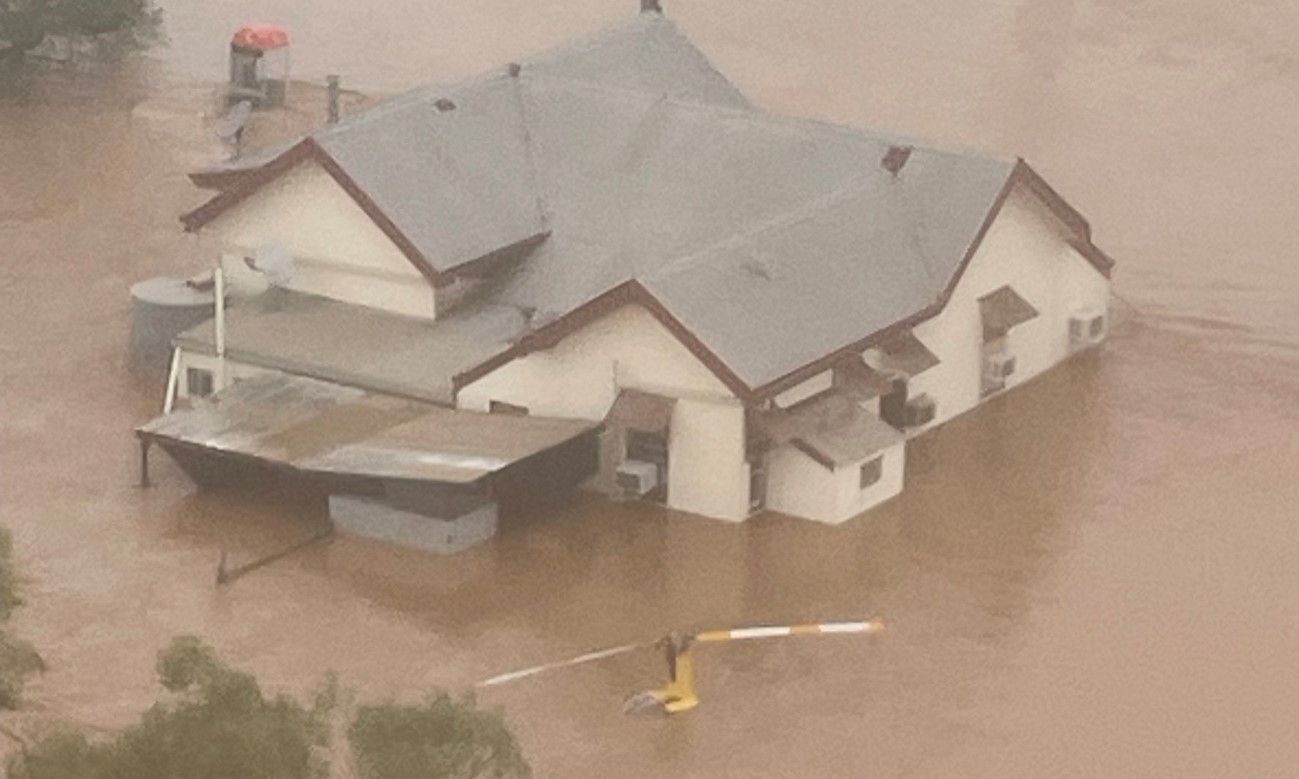
Source: Photo received from operator
What the ATSB found
After the embarkation of the passenger on the roof, the helicopter was overloaded to an extent that prevented flight out of ground effect, with insufficient clear space available to accelerate to an airspeed to obtain translational lift. Once this was recognised by the pilot, they conducted a successful ditching into floodwater. The pilot’s choice of landing site in the only sheltered area available allowed for the helicopter to remain upright in the otherwise fast‑flowing water. Additionally, their rapid and correct application of the helicopter manufacturer’s low RPM recovery procedures resulted in a controlled ditching which allowed both pilot and passenger to exit the helicopter without injury.
The pilot’s decision‑making was affected by the heavy workload of conducting a rescue operation, for which they were not prepared, in a light helicopter. The pilot conducted an unfamiliar and demanding rescue operation which likely overwhelmed their decision‑making capacity while the passenger was boarding the helicopter. This heavy workload, in addition to the rotor operating at high power, prevented the pilot from verbally briefing the passenger on seatbelt use and other safety information. The passenger was subsequently unrestrained during the flight.
Once committed to the rescue, under high workload and the perception of imminent danger of staying on the roof, the pilot continued with the plan and did not reassess the feasibility of the flight once they realised that helicopter performance was going to be marginal with the heavier than expected passenger on board.
The helicopter operator was aware that the requested flight was outside of their normal scope of operations. However, they felt a moral obligation to act due to their perception of being the only people that could help preserve life. This meant that they agreed to conduct mercy flight operations to attempt rooftop rescues for which they were not trained or equipped.
Safety message
Many aspects of emergency response in Australia rely on volunteers, both by organised groups and ad-hoc by people who happen to be in the right position to help. These ad‑hoc or bystander rescues save many lives when dedicated, trained assistance is not available. However, when responding to an emergency it is of paramount importance to stop and take a moment to assess risk to the rescuers before assisting others. This applies in any emergency context, not just aviation, and is strongly reinforced in training for surf rescue, medical first aid, fire-fighting and marine rescue operations.
In the aviation context, mercy flights are by definition outside the scope of the normal operations of the involved pilots and operators. This places a high burden on pilot and operator to assess risks that may be out of their area of expertise. Where possible it is important for all involved to take the time to reassess the risk of (continuing) the proposed flight and consider any alternatives. This may include discontinuing a rescue and waiting for additional assistance, as continuing may expose the crew and the people being assisted to much greater risks.
Summary video
The investigation
The occurrence
On the morning of 27 March 2025, widespread rain associated with a passing surface trough was causing catastrophic flooding in Queensland’s channel country region. In particular, the small rural town of Adavale, about 89 km north of Quilpie, was most heavily affected. Telephone communication had been lost the previous day, but during the night reports reached authorities indicating that the town was rapidly flooding and that some people in lower lying areas had sought shelter on roofs.
At around 0630,[1] an aerial work operator, Channel Country Helicopters, dispatched a Robinson R22 helicopter, registered VH-KNG, from Quilpie with the pilot and a police officer on board to assess the situation in Adavale. The officer had tried to reach Adavale in the days before but had found the roads impassable. A helicopter flight was previously arranged but had not been possible due to the heavy rain until the operator noted an improvement of weather conditions.
On arrival in Adavale at 0721, the pilot and the police officer found the situation in the town critical, with fast‑flowing floodwaters throughout the town. This limited landing access, with the only dry place available at the town waste disposal site, about 1 km to the north‑east. After disembarking the police officer, the pilot returned to Quilpie and refuelled the helicopter.
Around 0915, the helicopter operator received a phone call from the local disaster management group asking ‘if they were able to conduct a mercy flight’[2] as there were people reported on the roofs of buildings in Adavale and no other rescue assets were available. The operator assessed that the weather was not suitable for VFR flight at the time, but agreed to send its helicopters when able. The operator then briefed its pilots on some of the risks involved, including the possibility of overloading roofs when landing and the need to pay special attention to powerlines and other overhead obstructions that were expected in the town.
Once the weather cleared, the operator mobilised the first 2 Robinson R22 helicopters, shortly followed by a third helicopter.
The first helicopter that arrived in Adavale touched down on a roof of a demountable building, boarded a resident who was waiting on the roof, and departed to a nearby cattle station.
At around 1115, the second helicopter, VH-KNG (flown by the pilot who had ferried the police officer to Adavale that morning), which had stopped en route to avoid flying through rain showers,[3] was back overhead Adavale where the pilot observed that the fast-flowing water was ‘pushing around a parked semi‑trailer road‑train’, reinforcing a sense of urgency to evacuate residents. The pilot then spotted a person on the same roof and elected to conduct a rooftop rescue.
On approach to the rescue site, the pilot recalled that they assessed that the building was at immediate risk of being washed away, and that the roof strength was insufficient to carry the full weight of the helicopter. The pilot then opted to maintain lift on the main rotor while picking up the passenger to reduce the load on the roof sheeting. The helicopter touched down on the flat roof between the two demountable buildings (Figure 1). The pilot kept the helicopter flying throughout the passenger embarkation, with only part of the skids lightly touching the roof.
Figure 1: View underneath roof
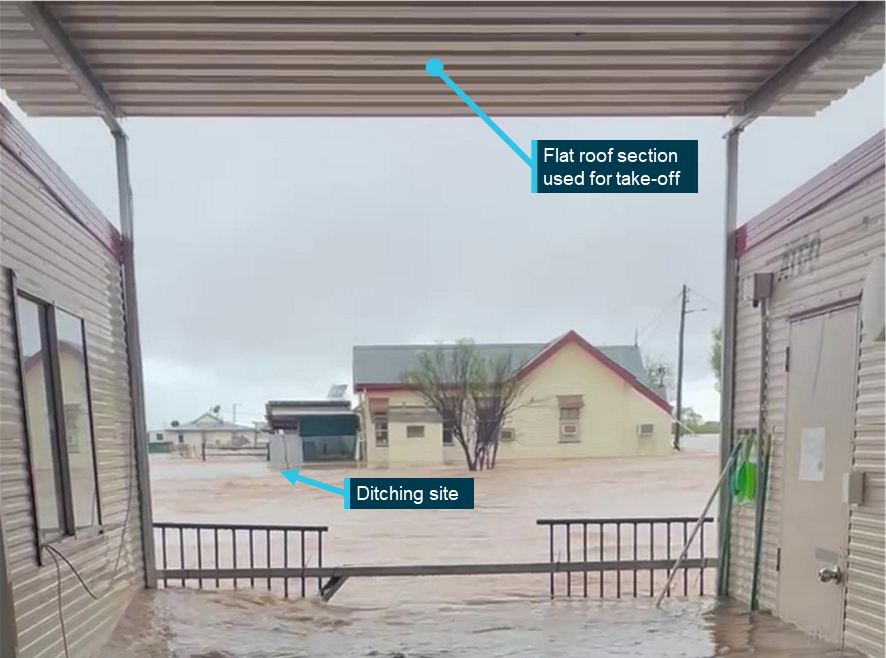
Source: Video still from passenger, annotated by the ATSB
The passenger boarded the helicopter from the left side, into the left seat, wearing a rain jacket with some personal effects. During the rapid boarding and take-off, the noise of the engine running at full power did not allow verbal communication with the boarding passenger. The passenger did not attempt to secure their seat belt prior to take‑off.
The pilot reported realising the passenger was heavy, but being confident that the helicopter would be able to fly away after building up airspeed to obtain translational lift.[4] The pilot lifted off the helicopter (in ground effect[5] over the roof) and immediately departed into wind. However, once clear of the roof with reduced ground effect, the helicopter was no longer able to sustain level flight. As rotor speed decayed below 97%, the low rotor RPM light and horn alarms activated in the cockpit.
The pilot lowered the collective[6] and applied aft cyclic[7] and quickly concluded that the helicopter would not be able to clear approaching obstacles such as trees, buildings and powerlines during the take‑off run. They then selected an area sheltered from the floodwater current, behind a building about 60 metres away, and conducted a controlled ditching.

Source: Google Earth, annotated by the ATSB
After ditching, the helicopter became submerged in floodwater, stopping the engine. Due to the lee of the building protecting the helicopter from the main current, it remained upright, allowing both the passenger and pilot to egress into the chest deep water.
There was no access to the roof of the building, so the pilot attempted to return to the take-off site to retrieve a ladder. However, the pilot was swept away by the current before finding shelter in a tree about 900 metres downstream, where they were later rescued by a larger helicopter.
The passenger stayed in the lee of the building, in the sheltered water near the helicopter, and was later transported to a temporary shelter on a roof by the police officer, who had commandeered a small motorboat.
The pilot was unhurt, but the passenger sustained serious chemical burns due to exposure to the fuel leaking from the submerged helicopter’s tank. The passenger was treated for their injuries by the swift-water rescue team and later in hospital.
No further rooftop rescues were conducted by the operator, instead company helicopters guided motorboat and swift-water rescue teams to people in need of rescue.
Figure 3: Adavale flood in the afternoon after the accident
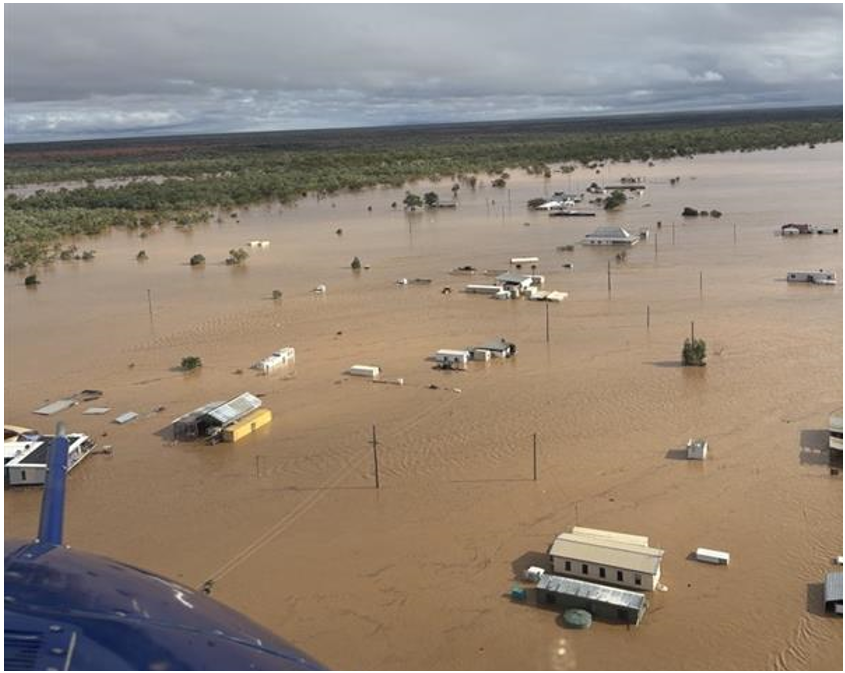
Source: Nathan Covey
Context
Pilot information
The pilot held a Commercial Pilot Licence (CPL) for helicopters and aeroplanes, a valid class 2[8] aviation medical certificate and a low‑level mustering endorsement for helicopters.
The pilot reported having flown for about 25 years, first in fixed wing aircraft and then operating helicopters for the last 3 years, mostly in support of cattle mustering operations.
At the time of the accident, the pilot had accumulated about 11,400 hours aeronautical experience, of which about 800 hours were on R22 helicopters. The pilot had flown about 30 hours in the preceding 90 days but had not flown for 5 days prior due to the poor weather conditions.
The pilot was very familiar with the area, having flown there for most of their career, and felt well rested on the day of the accident. They reported that they started work at about 0600 for the initial flight to Adavale with the police officer, and that they were not experiencing any effects of fatigue.
Aircraft information
General information
The Robinson Helicopter Company R22 Beta II helicopter is powered by a Textron Lycoming O‑360‑J2A 4‑cylinder piston engine. The R22 has 2 seats, with the pilot flying from the right seat, with each seat fitted with a 3‑point, inertia reel shoulder strap seatbelt, similar to those used in motor vehicles.
The R22 is commonly used for helicopter flight training, private flight and livestock mustering operations. It has a payload capacity of about 215 kg and a maximum seat limit of 109 kg (including any items in the small luggage compartment under the seats).
VH-KNG
VH-KNG was manufactured in the US in 2001 and first registered in Australia in October 2011. The helicopter had undergone a periodic inspection on 21 February 2025 with a total time in service of 13,424.2 hours.
The current maintenance release was not located and was likely lost in floodwaters. There were no indications of any mechanical issues with the aircraft before the accident.
Figure 4: VH-KNG after the accident

Source: Channel Country Helicopters
Weight and balance
During the last maintenance period the aircraft was weighed, and empty weight was recorded as 405 kg. The helicopter was used in mustering operations, and had both doors removed. This reduced the empty weight by about 5 kg, increasing the total payload to about 222 kg for a maximum take‑off weight of 622 kg.
With full fuel when it departed Quilpie, the ATSB calculated, based on the flying time from departure in Quilpie, the helicopter had approximately 70 L or 50 kg of 100LL Avgas[9] on board on arrival in Adavale. The pilot reported their weight was 78 kg. As can be seen in Table 1, that left an available load of about 94 kg.
The passenger reported their weight as around 130 kg with an estimated additional 10 kg for their wet clothing and essential medical equipment also carried. This resulted in the helicopter being about 46 kg overweight.
Table 1 VH-KNG calculated take-off weight
| Item | Weight (kg) |
| Basic Empty weight | 405 |
| Removed doors left and right | -5 |
| Fuel (avgas 70 litres) | 50 |
| Pilot | 78 |
| Total | 528 |
| Maximum all up weight | 622 |
| Available margin on landing | 94 |
| Passenger weight | 130 |
| Passenger personal effects /clothing | 10 |
| Total | 668 |
| Available margin on take-off | -46 |
Helicopter performance
Performance data provided by the Robinson R22 pilot’s operating handbook (POH) indicated that, at its maximum take‑off weight (MTOW) of 622 kg and the temperature at the time of the accident of 24°C (see Meteorological conditions), the helicopter should have had sufficient available performance to hover in ground effect (IGE) up to a pressure altitude of about 7,900 ft and an out of ground effect (OGE) up to a pressure altitude of about 3,400 ft (Figure 5).
This performance is based on ‘ideal conditions’, however, in this case, high humidity would likely have further decreased the available performance by as much as 3 or 4% (FAA, Federal Aviation Agency, 2021). However, this should still have allowed OGE hover at maximum take‑off weight, at the calculated pressure altitude of 811 ft at the time and location of the accident.
No performance data was available for the helicopter outside its maximum allowed take‑off weight and the manufacturer advises against exceeding limits due to possible overloading of the rotor drive components.[10]
Figure 5 shows the maximum pressure altitude for flight out of ground effect at maximum take‑off weight (orange line) and the calculated helicopter weight and actual pressure height (red line).
The pilot recalled that they thought that the helicopter performance would be ‘marginal’ on take‑off, but believed they would be able to climb out using translational lift after take‑off.
Figure 5: OGE hover ceiling vs gross weight
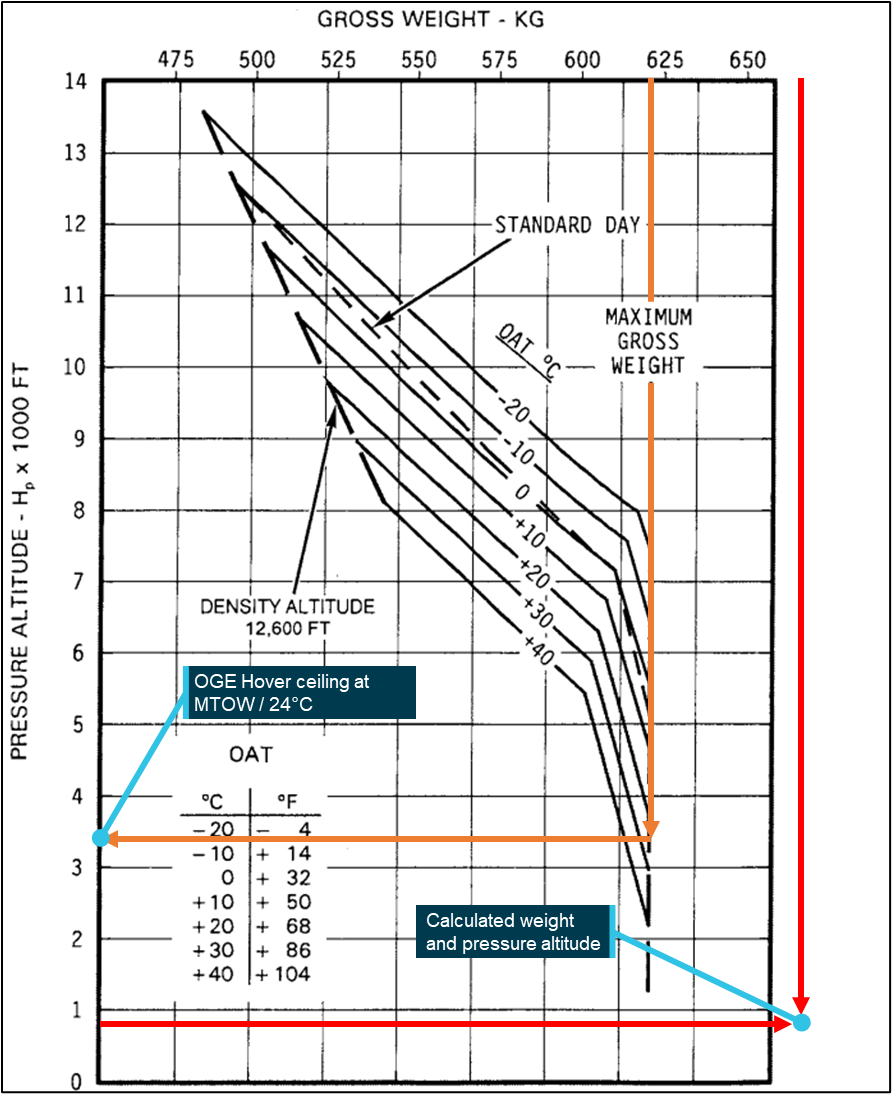
Source: Robinson R22 Pilot’s operating handbook, annotated by the ATSB
Power check
To confirm sufficient power is available for hover out of ground effect, the Robinson flight training guide (Robinson Helicopter Company, 2019) recommends conducting a power check before committing to a take‑off requiring OGE hover performance:
…Perform a takeoff to a 2 foot IGE hover and complete a hover check to confirm available power. The [OGE] maneuver should not be attempted unless the IGE hover manifold pressure is 2 inches below the maximum takeoff power (5 minute) limit…
The pilot did not conduct a power check but they stated that they were aware the helicopter was heavily loaded and that they had to take off straight away as the building was ‘highly likely to be washed away’.
Confined area take-off
The manufacturer’s recommend take-off profile, as defined in the POH (Figure 6), involves accelerating in ground effect before pitching up into a climb. This technique ensures sufficient energy and reaction time available at any stage of the take‑off to enter autorotation in case of an engine or tail‑rotor failure. For the R22, this required acceleration to 45 kt indicated airspeed in ground effect before starting to climb.
Figure 6: Height velocity diagram Robinson R22

Source: R22 Pilot’s operating handbook, annotated by the ATSB
When operating from unprepared landing areas, physical space may not be available to follow the recommended take‑off profile. As this forces the helicopter to climb out of ground effect before obtaining translational lift, the pilot must ensure that the helicopter’s weight is below the OGE limit before attempting a confined area take‑off.
The Civil Aviation Safety Authority (CASA) has published advisory circular 91‑29 (AC 91‑29): Guidelines for helicopters – suitable places to take‑off and land (CASA, 2023). Section 11.1.1 provided the following description of a ‘confined area’:
An unprepared landing site that has obstructions that require a steeper than normal approach, where the manoeuvring space in the ground cushion is limited, or whenever obstructions force a steeper than normal climb-out angle is often defined as ‘Confined Area’.
Photos, video and satellite imagery of the take‑off site show several obstructions in the form of power lines and trees in the departure direction (Figure 2). These obstructions were high enough to limit departure using the recommended take‑off profile and to require a confined area take‑off.
Low RPM recovery
The lift produced by a helicopter rotor is determined by a combination of rotor RPM, and the angle of attack of the rotor blades. The pilot controls the amount of lift by using the collective lever to vary the pitch angle of the blades. As the pitch increases, the governor increases the engine throttle to maintain a constant rotor RPM. When the governor has fully opened the throttle, any further increase of collective pitch will result in the rotor RPM reducing, progressively reducing lift and resulting in a loss of climb performance or a descent.
Further increasing the collective pitch will force the blades to reach their critical angle of attack (around 15°) and airflow will separate from the blades resulting in aerodynamic rotor stalling.
As per Robinson Safety Notice 24:
The stall causes a sudden loss of lift and an increase in drag, slowing down rotor RPM further. As the helicopter begins to fall the upward moving air through the rotor increases angle of attack further making recovery virtually impossible, even with full down collective.[11]
And Robinson Safety Notice 10:
No matter what causes the low rotor RPM, the pilot must first roll on throttle and lower the collective simultaneously to recover RPM before investigating the problem. It must be a conditioned reflex. In forward flight, applying aft cyclic to bleed off airspeed will also help recover lost RPM.[12]
A low RPM light and warning horn are fitted in the R22 to warn the pilot of this condition; both activate when the rotor RPM decays below 97%.
The R22 pilot’s operating handbook states:
LOW RPM HORN
[…] The horn activates simultaneously with the LOW RPM caution light and indicates rotor speed below 97% RPM. To restore RPM, lower collective, roll throttle on and, in forward flight, apply aft cyclic. [..]
The R22’s light weight and low inertia rotor system means that rapid pilot intervention is required before control is lost.
Meteorological conditions
No weather forecast was available for either Quilpie or Adavale, a grid point wind and temperature forecast for southern Queensland showed winds near Adavale at around 6 kt at 010°, which is consistent with the pilot’s reported observations of a light northerly wind and localised showers. Temperature was reported at 24°C. No humidity observations were available for Adavale, but given the inclement weather and flooding conditions, it was expected to be high.
The nearest reported QNH,[13] at Charleville, about 175 km away, was reported as 1012 hPa. Adavale lies at an elevation of 781 ft which resulted in a pressure altitude of 811 ft and a density altitude of 2,048 ft.
Operator information
The helicopter was operated by Channel Country Helicopters (CCH), which was based at Quilpie Airport and held a Civil Aviation Safety Regulation 1998 (CASR) Part 138 aerial work certificate. It operated 3 Robinson R22 helicopters used primarily for mustering and agricultural aerial work.
While a CASR Part 138 aerial work certificate does not allow the operator to carry passengers as part of air transport operations, it did permit carriage of ‘aerial work passengers’ on operations which are aerial work operations.
These included aerial work passengers such as:
- persons rescued as part of search and rescue operations
- emergency service operation personnel carried as part of an aerial work operation that is also an emergency service operation.
Disaster response management
Managing disaster response in Australia is primarily a matter for the individual states and territories. To provide for disaster response and recovery at an appropriate level, Queensland has plans in place at local, district and state levels.
The disaster response for the flooding in south‑west Queensland was managed at a district level by the district disaster coordinator (DDC) in Charleville, guided by the district disaster management plan (DDMP), and locally in Quilpie council led by the local disaster coordinator (LDC), following the local disaster management plan (LDMP).
Flooding in the area had severely affected the roads around the region in the days before the accident, this was followed by a loss of phone coverage in both Quilpie and Adavale the day before the accident, which meant that only limited satellite communication was available.
However, the LDC had maintained some contact with Adavale residents and identified that overnight reports indicated that flooding was becoming more widespread and that the town of Adavale was at risk of severe flooding with residents beginning evacuation to the roofs of their dwellings.
Queensland Fire Department
As flooding had been anticipated in the wider region due to the expected heavy rains, a swift-water rescue team (SRT)[14] had been pre-positioned in Charleville in anticipation of the floods. This consisted of specially trained Queensland Fire Department personnel with an inflatable rescue craft (Figure 7) being transported by a chartered heavy‑lift helicopter to the site of the rescue. This helicopter was not equipped or crewed for instrument or night flying conditions and so could only be used during daylight and in visual meteorological conditions (VMC).[15]
As the only dedicated rescue asset available in the area, the SRT was planned to be used for life threatening situations only, under direction of the DDC.
The LDC in Quilpie contacted the DDC in Charleville for urgent assistance in the early hours of the morning of the accident. However, due to a combination of inclement weather conditions and a technical fault on the heavy‑lift helicopter, the SRT was not immediately available to deploy.
Figure 7: QFD swift-water rescue team and volunteer boats at Adavale

Source: Queensland Fire Department
Queensland Police Service
The Queensland Police (QPS) operational procedures manual (OPM) chapter 2.21.2 addresses helicopter use in search and rescue as well as disaster management situations. These procedures required approval from the DDC before tasking helicopters. The OPM specified that privately owned helicopters could be used if no other options were available, but did not include directions on the identification of hazards or the management of risk when using privately owned helicopters.
Disaster management plans
Neither the DDMP, LDMP nor the local evacuation sub‑-plan contained references to evacuation by helicopter. Adavale residents were anticipated to use their own means of transport to get to the evacuation centre.
The residents trapped on their roofs were unable to make their own way to higher ground due to the fast‑flowing floodwaters. As the SRT was unable to immediately deploy, and no other rescue assets were available at short notice, the DDC requested that the LDC check if local helicopters were available to conduct rescues.
Mercy flight
Although the term ‘mercy flight’ is no longer defined in aviation regulations, the Civil Aviation Safety Authority (CASA) recognises that there may be times when it is necessary for pilots to not follow aviation safety rules in order to respond to a sudden or extraordinary emergency.[16] The legal basis for this is the provision in section 10.3 of the Commonwealth Criminal Code Act 1995 which states that:
a person is not criminally responsible for an offence [in response to a] sudden or extraordinary emergency . . . if committing the offence is the only reasonable way to deal with the emergency.
CASA makes it clear that these provisions are a last resort option. For example, a pilot can get people to emergency medical treatment or out of a life‑threatening situation if there is no other (legal) way to do so. Before declaring a mercy flight, CASA states that pilots and operators should consider if the flight itself gives rise to equally serious or greater risks to safety and to manage those risks accordingly (CASA, 2025).
Tasking of local helicopters
The deputy LDC contacted the CCH chief executive officer (CEO) at Quilpie Airport at about 0915 on the morning of the accident and requested ‘mercy flight’ operations with their helicopters to rescue people from roofs in the Adavale township. Although outside the scope of their normal operations, the CEO recognised the urgency of the request and the need to provide immediate help to the people trapped in the floodwater and informed the deputy LDC that they would send out helicopters as soon as the weather cleared enough to conduct safe operations.
Operator processes
Pilot briefing
The CEO of Channel Country Helicopters (CCH) contacted the chief pilot, who was unable to get to Quilpie due to the floods. They discussed the mercy flight request and the need to conduct operations that were outside the scope of their normal operations in an effort to save lives. They agreed to assist in the rescue operation and identified a number of hazards to be mitigated.
The CEO then informed the pilots of the need to conduct rooftop rescues and provided a briefing which included:
- risks of placing too much helicopter weight on temporary roof structures, which would require pilots to continue to fly the helicopter while boarding passengers
- risks associated with power lines in close proximity to the township, which would restrict landing and take-off areas.
Task familiarity
In the course of their normal employment, the operator’s pilots mostly conducted low level flight and aerial stock mustering. The pilots were not familiar with rescue operations, particularly those requiring special landing techniques, passenger onboarding during flight and in‑flight risk assessment of rescue operations at low level during emergencies.
The accident pilot stated that they had never conducted rescue operations and had never landed on a structure before.
Pilot expectations
The pilot was well aware of the extent of the flooding due to the previous operations that morning and understood that there was little other external help available. They recalled that this set an expectation that they were the only available assistance at the time to evacuees in Adavale.
They reported that when asked to conduct a rescue flight, they felt compelled to assist due to the urgency of the natural disaster and the imminent risk to life.
STEP landing
The technique used for landing on rooftops is defined as ‘Single-Skid, Toe-in and Hover Exit/Entry Procedure’ or STEP landing. STEP landings are commonly used in military, search and rescue, helicopter skiing, or any operation where a helicopter is unable to fully set its full weight down on its landing gear due to uneven or soft terrain.[17]
The conduct of a STEP landing requires the pilot to keep most of their focus on controlling the helicopter throughout the boarding process. This was particularly important as any inadvertent interference with the controls by a boarding passenger into a small helicopter cabin could lead to uncontrolled helicopter movement.
While this manoeuvre is conducted routinely in certain types of operations, it is not commonly required during cattle mustering operations, and the pilot was not familiar with it.
Safety analysis
Introduction
On 27 March 2024, a Robinson Helicopter Company R22 Beta, registered VH-KNG, was being used to conduct rooftop rescue of residents of the township of Adavale, Queensland, during large scale flooding. After picking up a passenger from a rooftop, the pilot assessed during take-off that they did not have the required performance to continue flight and conducted a controlled ditching into floodwaters.
This analysis will explore the operational considerations pertaining to helicopter loading, take‑off performance, the pilot’s decision‑making and factors affecting the controlled ditching and survivability of the occupants.
Decision‑making processes
Pilot workload
Once committed to the rooftop landing, the pilot faced an increased workload due to a combination of factors which likely negatively affected their decision‑making processes.
While the pilot had significant aeronautical experience, including considerable recent experience flying the Robinson R22, they had never landed on top of a structure or conducted, or ever trained for, any type of rescue operations. The accident flight was their first attempt at a rescue operation and as such, it is likely that the pilot was under significant workload.
The high degree of concentration required likely limited the pilot’s cognitive capacity to assess the weight or brief the passenger prior to take‑off. Similarly, the lack of full consideration for the aircraft’s performance limitations were likely due to the narrowed attentional focus on the immediate control demands required in the confined area.
Plan continuation
Plan continuation is described as when pilots decide to continue with the original plan of action despite the presence of cues or information that suggests changing the course of action would be the safer (Orasanu, Fischer, & Davison, 2002)
Furthermore, as workload increases, the stimuli or conditions will appear obvious to people external to the situation; however, it can be very difficult for a pilot caught up in the plan to recognise the saliency of the cues and the need to alter the plan (Skybrary); (TSBC).
Plan continuation bias is often associated with situations involving dynamically changing risk and pilots underestimating the risk (Wiegmann, Goh, & O'Hare, 2002) as well as in high‑pressure environments where altruistic or time critical factors are present (Nadri and others 2024; Orasanu & Martin 1998)
The need to identify and control rapidly changing risks in emergency flights is emphasised in the procedures used by dedicated SAR operations and firefighting aircraft. For example, the AMSA ‘rotorcraft rescue standards and procedures manual’ chapter 1.6 (AMSA, 2025) contains procedures for dynamic risk assessment process that involves the whole crew of the aircraft and is repeated at critical points in the mission.
As the only crew member on an ad hoc search and rescue mission, the pilot did not have training in these specialised procedures nor the support of additional crew members to alert them to the emerging indications of increased risk. Additionally, their understanding at this point that the passenger was in grave danger, made it likely that the pilot did not consider disembarking the passenger as a possibility.
Consequently, although the pilot was aware that the helicopter weight (and consequently performance) was ‘marginal’, their perception of imminent danger of roof collapse meant they did not change their plan and continued the take‑off without considering an alternative course of action.
Helicopter performance
On conducting the rooftop landing and passenger loading, the pilot was unable to calculate the gross weight of the helicopter before conducting the take‑off. Their estimation of the passenger weight was likely hampered by the bulky raincoat the passenger was wearing and the focus of the pilot on controlling the aircraft during an operation that they were not specifically trained or experienced in.
Weight data supplied to the ATSB by the accident pilot and passenger and a calculation of the remaining fuel load indicated that the helicopter was likely at least 46 kg over its maximum allowable take‑off weight (MTOW).
Being significantly overweight, when the helicopter became airborne in ground effect over the building, there was no assurance that it could achieve the required performance that was needed to clear nearby obstacles during take‑off.
This could have been ascertained if the helicopter pilot had performed a power check while still above the building, however because the position of the helicopter on the roof was precarious with the passenger onboarding and the pilot held concerns that the structure would not support the helicopter weight or last much longer in the floodwater, this was not conducted.
Moral obligation to conduct rescue operations
After receiving a phone call from the deputy local disaster coordinator informing them of the emergency in Adavale and requesting urgent assistance, the CEO of Channel Country Helicopters likely felt a moral obligation to assist in the rescue of evacuees facing extreme danger in the flood zone.
The request for mercy flight operations reinforced the urgency of the request and the need to assist even though it was outside the scope of their normal operations. This moral obligation was likely also passed to the pilots conducting the operations and would have been a strong influence in their acceptance of additional risk to their normal operations.
Controlled ditching
While embarking the passenger, the pilot initially felt confident that the helicopter performance was adequate to obtain translational lift. However, once it cleared the roof and lost ground effect, the helicopter was no longer able to sustain level flight or climb.
The pilot applied the correct recovery technique for low rotor RPM, selected the only sheltered location available, next to a building about 60 m from the take‑off site and conducted a controlled ditching of the helicopter with very little lateral speed.
It is common for helicopters to roll over in emergency landings, especially when ditching. In this case, the identification of a sheltered landing site, and the correct emergency technique, allowed the helicopter to remain upright after landing. This made it possible for both the pilot and passenger to safely exit the helicopter.
Survivability
The pilot’s workload during the boarding of the passenger likely limited the pilot’s cognitive capacity to brief the passenger. Furthermore, the high noise levels in the cockpit would have made a normal passenger safety briefing very difficult. Consequently, the passenger was not made aware of the use of the seatbelt, the weight limit of the seat, exit procedures and the possibility of inadvertent interference with the aircraft controls.
The incorrect (or lack of) use of seatbelts has been identified by the ATSB as a factor affecting survivability in several light aircraft incidents.[18] Inadvertent interference with helicopter flight controls by passengers has been identified as an issue in several incidents and is the subject of a Robinson Helicopters safety notice.[19]
If the pilot had continued the flight while building up airspeed in ground effect, there would have been a high risk of a forward impact with an obstacle or the floodwater. In that case the lack of seatbelt would have likely resulted in severe injuries to the unrestrained passenger.
In this accident the correctly applied forced landing technique by the pilot meant that the passenger was not exposed to forces large enough to require a seatbelt and their lack of restraint may have made their exit from the small helicopter cabin easier.
Exposure to fuel
After exiting the helicopter, the passenger witnessed the pilot being washed away in the floodwater. Recognising the danger of entering the floodwater current, they stayed in the sheltered area near the submerged helicopter. This exposed the passenger to AVGAS floating on the water, causing significant chemical burns that were subsequently treated in hospital.
Findings
ATSB investigation report findings focus on safety factors (that is, events and conditions that increase risk). Safety factors include ‘contributing factors’ and ‘other factors that increased risk’ (that is, factors that did not meet the definition of a contributing factor for this occurrence but were still considered important to include in the report for the purpose of increasing awareness and enhancing safety). In addition ‘other findings’ may be included to provide important information about topics other than safety factors. These findings should not be read as apportioning blame or liability to any particular organisation or individual. |
From the evidence available, the following findings are made with respect to the ditching in floodwater involving Robinson R22 Beta, VH‑KNG, at Adavale, Queensland, on 27 March 2025.
Contributing factors
- The pilot conducted an unfamiliar and demanding rescue operation which likely overwhelmed their decision‑making capacity. Under time pressure due to the perceived imminent risk of a roof collapse, the pilot did not assess available performance after boarding a heavier than expected passenger and committed to the rescue with an immediate take‑off.
- The pilot departed with the helicopter significantly overweight. As a result, it did not have available performance to conduct a confined area take‑off.
- The CEO and pilot felt a moral obligation to conduct a rescue operation for which they were neither trained nor equipped.
Other factors that increased risk
- The passenger was not briefed before the flight, consequently they did not wear the fitted 3‑point seatbelt, which increased their risk of injury.
Other findings
- After take-off, the pilot immediately realised the helicopter could not maintain altitude and, following the correct procedure for low rotor RPM, made a controlled landing in the only sheltered area available, allowing the pilot and passenger to exit safely.
- Flood currents around the ditching site prevented the passenger from seeking shelter away from the helicopter while waiting to be rescued. This caused an extended exposure to fuel floating on the water, resulting in serious chemical burns.
Sources and submissions
Sources of information
The sources of information during the investigation included the:
- pilot of the accident flight
- passenger the accident flight
- CEO of Channel Country Helicopters
- Queensland Police Service
- Queensland Fire Department
- maintenance organisation for VH-KNG
- Bureau of Meteorology
- photographs and videos taken on the day of the accident
- district disaster management plan for Charleville region
- local disaster management plan for Quilpie.
References
AMSA, Australian Maritime Safety Authority. (2025). Rotary Wing Search and Rescue standards and procedures manual (Version 8 ed.). Canberra.
CASA, Civil Aviation Safety Authority. (2023, December). AC-91-29. Retrieved from CASA.gov.au: https://www.casa.gov.au/sites/default/files/2022-07/advisory-circular-9…
CASA, Civil Aviation Safety Authority. (2025). Mercy flights and operation in an emergency. Retrieved from CASA.gov.au: https://www.casa.gov.au/operations-safety-and-travel/safety-advice/merc…
FAA, Federal Aviation Agency. (2021). Helicopter Flying Handbook. United States of America: Simon and Schuster.
Nadri, C., Regalado, J., Ferris, T., & Zahabi, M. (2024). Cognitive Biases in Commercial Aviation: Empirical Review of Accident Reports. Proceedings of the Human Factors and Ergonomics Society Annual Meeting. 68, pp. 56-60. Los Angeles: SAGE publications.
Orasanu, J. &. (1998). Errors in aviation decision making: A factor in accidents and incidents. Proceedings of the workshop on human error, safety, and systems development, (pp. 100-107).
Orasanu, J., Fischer, U., & Davison, J. (2002). Risk perception: A critical element of aviation safety. 15th IFAC World Congress (pp. 50-51). Barcelona: Elsevier.
QPS, Queensland Police Service. (2025). Operational Procedures Manual 106.1. Retrieved from https://www.police.qld.gov.au/qps-corporate-documents/operational-polic…
Robinson Helicopter Company. (2019). Robinson Helicopter Company Flight Training Guide. Torrance.
Skybrary. (n.d.). Retrieved from https://skybrary.aero/articles/continuation-bias
TSBC, T. S. (n.d.). Retrieved from https://www.tsb.gc.ca/eng/rapports-reports/aviation/2018/a18p0031/a18p0…
Wiegmann, D. A., Goh, J., & O'Hare, D. (2002, 6). The role of situation assessment and flight experience in pilots' decisions to continue visual flight rules flight into adverse weather. Human Factors, 189-197.
Submissions
Under section 26 of the Transport Safety Investigation Act 2003, the ATSB may provide a draft report, on a confidential basis, to any person whom the ATSB considers appropriate. That section allows a person receiving a draft report to make submissions to the ATSB about the draft report.
A draft of this report was provided to the following directly involved parties:
- the pilot of the accident aircraft
- the operator of the accident aircraft
- Charleville district disaster coordinator
- Quilpie local disaster coordinator
- Civil Aviation Safety Authority
- Robinson Helicopter Company
A submission was received from the Civil Aviation Safety Authority.
The submission was reviewed and, where considered appropriate, the text of the report was amended accordingly.
Purpose of safety investigationsThe objective of a safety investigation is to enhance transport safety. This is done through:
It is not a function of the ATSB to apportion blame or provide a means for determining liability. At the same time, an investigation report must include factual material of sufficient weight to support the analysis and findings. At all times the ATSB endeavours to balance the use of material that could imply adverse comment with the need to properly explain what happened, and why, in a fair and unbiased manner. The ATSB does not investigate for the purpose of taking administrative, regulatory or criminal action. About ATSB reportsATSB investigation reports are organised with regard to international standards or instruments, as applicable, and with ATSB procedures and guidelines. Reports must include factual material of sufficient weight to support the analysis and findings. At all times the ATSB endeavours to balance the use of material that could imply adverse comment with the need to properly explain what happened, and why, in a fair and unbiased manner. An explanation of terminology used in ATSB investigation reports is available here. This includes terms such as occurrence, contributing factor, other factor that increased risk, and safety issue. Publishing informationReleased in accordance with section 25 of the Transport Safety Investigation Act 2003 Published by: Australian Transport Safety Bureau © Commonwealth of Australia 2025 
Ownership of intellectual property rights in this publication Unless otherwise noted, copyright (and any other intellectual property rights, if any) in this report publication is owned by the Commonwealth of Australia. Creative Commons licence With the exception of the Commonwealth Coat of Arms, ATSB logo, and photos and graphics in which a third party holds copyright, this report is licensed under a Creative Commons Attribution 4.0 International licence. The CC BY 4.0 licence enables you to distribute, remix, adapt, and build upon our material in any medium or format, so long as attribution is given to the Australian Transport Safety Bureau. Copyright in material obtained from other agencies, private individuals or organisations, belongs to those agencies, individuals or organisations. Where you wish to use their material, you will need to contact them directly. |
[1] All times referred to in this report are local time, Coordinated Universal Time (UTC) + 10 hours.
[2] By declaring a mercy flight, a pilot can operate beyond some of the usual regulatory constraints, for example to transport someone who needs lifesaving medical help or to evacuate someone from an emergency such as flood or fire.
[3] Apart from the requirements to maintain VMC visibility, flying through rain has a strong corrosive effect on the main and tail rotor blade’s leading edges of helicopters and is generally not recommended.
[4] Translational lift occurs when clear, undisturbed air, flows through the rotor system from wind or forward speed.
[5] When hovering within about one rotor diameter of the ground, the performance of the main rotor is affected by ground effect. A helicopter hovering in-ground-effect (IGE) requires less engine power to hover than a helicopter hovering out‑of-ground-effect (OGE).
[6] Cyclic: a primary helicopter flight control that is similar to an aircraft control column. Cyclic input tilts the main rotor disc, varying the attitude of the helicopter and hence the lateral direction.
[7] Collective: a primary helicopter flight control that simultaneously affects the pitch of all blades of a lifting rotor. Collective input is the main control for vertical velocity.
[8] Commercial pilots with a Class 2 medical certificate can fly commercial flights without passengers if the maximum take‑off weight is less than 8,618 kg (CASA).
[9] Avgas 100LL: leaded gasoline fuel for reciprocating piston engine aircraft.
[10] Robinson Safety Notice 37: ‘Exceeding Approved Limitations Can Be Fatal’.
[11] Robinson Safety Notice 24, ‘LOW RPM ROTOR STALL CAN BE FATAL’.
[12] Robinson Safety Notice 10, ‘Fatal Accidents Caused by Low RPM Rotor Stall’.
[13] QNH: the altimeter barometric pressure subscale setting used to indicate the height above mean seal level.
[14] Swift-water rescue teams are part of Queensland Fire Department (QFD) and consist of a team of specially trained firefighters equipped with either paddled or motorised inflatable craft.
[15] Minimum visibility requirements for VFR flight in helicopters are a horizontal visibility of 800 m and clear of cloud (Part 91 MOS 2.07).
[19] Robinson Safety Notice 17: Never Exit Helicopter With Engine Running, Hold Controls When Boarding Passengers, Never Land in Tall Dry Grass.
Occurrence summary
| Investigation number | AO-2025-016 |
|---|---|
| Occurrence date | 27/03/2025 |
| Location | Adavale |
| State | Queensland |
| Report release date | 08/10/2025 |
| Report status | Final |
| Investigation level | Short |
| Investigation type | Occurrence Investigation |
| Investigation status | Completed |
| Mode of transport | Aviation |
| Aviation occurrence category | Ditching, Loading related |
| Occurrence class | Accident |
| Highest injury level | Serious |
Aircraft details
| Manufacturer | Robinson Helicopter Co |
|---|---|
| Model | R22 Beta |
| Registration | VH-KNG |
| Serial number | 3042 |
| Aircraft operator | Channel Country Helicopters |
| Sector | Helicopter |
| Operation type | Part 138 Aerial work operations |
| Departure point | Quilpie Airport, Queensland |
| Destination | Adavale Aircraft Landing Area, Queensland |
| Damage | Substantial |