

Final report
Report release date: 02/09/2025
Investigation summary
What happened
Two separate Alliance Airlines crews operating Load 25 flight software Embraer ERJ 190‑100 IGW (E190) aircraft intended to land with the less commonly used full flap setting and entered that configuration, and the associated airspeeds, into the flight management system during the approach briefing prior to top of descent.
In both incidents, the crewmembers forgot that full flap had been briefed 25 minutes earlier, and with no requirement to crosscheck the flap setting, subsequently configured the aircraft for a flap 5 landing. This resulted in the aircraft targeting a slower airspeed than that required for a flap 5 landing.
What the ATSB found
Neither set of flight crew recalled briefing for the less common full flap configuration when actioning the before landing checklist, resulting in them landing with an incorrect flap setting. Although the landing flap setting briefed prior to commencing descent was entered into the flight management system, there was no requirement to crosscheck the briefed setting with the actual configuration selected during the before landing checklist.
What has been done as a result
Alliance Airlines has amended its Operations Policy and Procedures Manual to mandate that the before landing checklist includes a confirmation that the actual landing flap setting aligns with the planned flap configuration. Additionally, in E190 aircraft, the multifunction control and display unit page displaying required landing flap should be selected on the pilot flying side before the approach commences.
Finally, Alliance Airlines conducted a flight data review of unstable approaches over the previous 6 months operations to identify similar occurrences.
Safety message
These incidents highlight the importance in multi-crew operations of the role of the pilot monitoring in identifying if, and intervening when, the other flight crew member deviates from the briefed plan. It also illustrates the risk of reversion to routinely conducted actions, despite the intention to use a less-common configuration.
The United Kingdom Civil Aviation Authority’s guidance on the development of pilot monitoring skills states that during briefings for less common configurations, it can be beneficial to include ‘monitor me’ type comments to encourage intervention, such as ‘remind me we are doing a full flap landing’.
The occurrences
Occurrence 1
On 4 February 2025, an Alliance Airlines Embraer ERJ 190‑100 IGW aircraft, registered VH‑A2T, was operating scheduled passenger flight QQ3120 from Adelaide to Olympic Dam, South Australia. On board were the captain as pilot flying (PF), first officer as pilot monitoring (PM),[1] 2 cabin crew and 90 passengers.
Consistent with the operator’s standard operating procedures manual, the flight crew conducted their approach briefing prior to commencing the descent into Olympic Dam Airport. Due to the turbulent and windy conditions, the captain elected to use full flap[2] during the landing. The crew used the ePERF[3] tablet application and the PF entered the performance figures and associated speeds for a landing using full flap into the Landing page of the flight management system (FMS), which was crosschecked by the PM.
Around 25 minutes after the approach briefing, as the crew were configuring the aircraft for landing, the PF called for flap 5[4] rather than the previously briefed full flap, which was actioned by the PM. There was no crosscheck requirement to confirm the flap setting during the before landing checklist. At the time, neither flight crewmember recalled that the less-common full flap configuration had been briefed, nor identified that the landing speeds entered into the FMS were now incorrect (slower than required) for the selected flap setting.
During the later stage of the approach, the PF was required to manually override the auto thrust at times to keep the aircraft on profile. Both flight crewmembers later recalled that the pitch attitude on final seemed slightly high at times. They also stated that during the flare,[5] the aircraft encountered sink,[6] which the PF corrected with the appropriate control inputs. Both flight crewmembers reported recognising the profile, speed and thrust were not as expected, but assessed that this was due to the hot and turbulent conditions.
Following an uneventful landing, as the crew were completing the after‑landing flow, the captain realised that they had landed with flap 5 rather than full flap. Both crewmembers later reported having forgotten that full flap had been briefed.
Occurrence 2
On 8 March 2025, an Alliance Airlines Embraer ERJ 190‑100 IGW aircraft, registered VH‑A2V, was operating scheduled passenger flight QQ4801 from Alice Springs to The Granites, Northern Territory. The captain was PF, and the first officer was PM.
On the previous day, the threshold of runway 11[7] at The Granites Airport had been repaired. While there was no NOTAM[8] in place, the airport operator had requested that if an aircraft landed on runway 29, they try to stop by taxiway alpha (which led to the apron) if safe to do so. This was to avoid turning the aircraft on the newly repaired surface at the runway 11 threshold turning node. The captain had received an email from the operator the night prior to the flight requesting that they comply with the above request if possible.
Consistent with the operator’s procedures, prior to commencing their descent, the crew conducted their approach brief. The aerodrome weather information service (AWIS) indicated a 5 kt tailwind for runway 11, which was less than the maximum permitted of 10 kt. As the aircraft could not stop prior to taxiway alpha when landing on runway 29, and to avoid the repaired area, the flight crew elected to use runway 11 and full flap for the landing. The PM entered the performance figures and associated speeds for landing using full flap into the FMS Landing page and the PF crosschecked them.
During the approach, the PM was communicating with air traffic control via HF radio and making the required broadcasts on the common traffic advisory frequency. Additionally, they were regularly checking for updated AWIS information to ensure the tailwind remained within limits. The AWIS changed 3 times during the approach, with the tailwind component reaching 9 kt before dropping back to 8 kt.
The flight crew conducted a visual approach to runway 11 without incident. The operator’s flight data analysis program later detected that the aircraft had landed with flap 5, with full flap entered in the FMS. Both crewmembers later reported that they had forgotten that the use of full flap was briefed prior to top of descent.
Context
Flight crew information
Occurrence 1 crew
The captain and first officer both held an air transport pilot licence (aeroplane) and a class 1 aviation medical certificate. The captain had accumulated over 14,000 flight hours, including 1,500 on the Embraer E190, and the first officer had about 7,000 flight hours, including 800 on the E190.
Both flight crewmembers reported feeling well rested prior to the flight.
Occurrence 2 crew
The captain and first officer both held an air transport pilot licence (aeroplane) and a class 1 medical certificate. The captain had accumulated over 13,000 flight hours, including 1,500 on the Embraer E190. The first officer had about 4,000 flight hours, including 600 hours on the Embraer E190.
On the day of the incident, both flight crewmembers reported having sufficient sleep the night prior; however, both felt a little tired, having woken at approximately 0345 to commence duty at 0445.
Aircraft
Occurrence 1
The aircraft was an ERJ 190‑100 IGW, manufactured in Brazil in 2008 and issued serial number 19000179. It was registered in Australia as VH-A2T on 19 July 2024. The aircraft was fitted with 2 General Electric Company CF34-10E5 turbofan engines. It had an integrated avionics system with load 25 software installed.
Occurrence 2
The aircraft was an ERJ 190-100 IGW, manufactured in Brazil in 2009 and issued serial number 19000249. It was registered in Australia as VH-A2V on 29 April 2024. The aircraft was fitted with 2 General Electric CF34-10E6 turbofan engines. It had an integrated avionics system with load 25 software installed.
Software – Load 25 v Load 27
The operator operated Embraer E190 aircraft, most of which had Load 27 software installed. The remainder, primarily used for mining air transport operations, had Load 25 software installed.
For both software systems, flight crews would enter the relevant landing performance data into the landing page of the FMS during the approach briefing, prior to top of descent.
For E190s fitted with Load 25 software, crews were required to select manual speed mode when passing the final approach fix. In manual speed mode, the crew would manually enter the approach speeds, calculated on the ePERF tablet, into the flight management guidance control system (FMGCS), and the autopilot would target those manually entered speeds when active.
In Load 27 aircraft, flight crew would normally use FMS speed mode on approach. In this mode, the FMGCS would automatically target the appropriate speed for the aircraft’s configuration. In addition, in Load 27 aircraft, a CHECK LANDING FLAP message would appear on the FMS scratchpad[9] if there was a discrepancy between the flap position entered into the FMS landing page and the selected flap lever position in the landing configuration.
Standard operating procedures
Flap settings
The operator’s standard operating procedures manual stated that flap 5 was the preferred setting for landing as follows:
The use of flap 5 provides lower fuel consumption and reduced approach noise levels… Consider using flap full when the field length requires its use. Additional runway limitations, such as known slippery conditions may require its use.
The occurrence 2 captain stated that flap 5 was used around 90% of the time, and one of the FO’s stated that the only time they had ever used full flap was during training.
Relevant speeds
VREF
The landing reference speed (VREF) is the speed at 50 ft above the runway threshold in a normal landing configuration (thrust levers at idle, gear down and landing flaps). VREF is used for landing distance calculations and the operator’s crews used the ePERF iPad applications for calculating landing speeds.
The Embraer Airplane Operations Manual provided VREF speeds with flap 5 and full flap, for weights between 28–52 t. Because VREF is proportional to stall speed, and therefore aircraft weight:
For occurrence 1, VREF was 123 kt for full flap, aircraft weight 43 t.
For occurrence 2, VREF was 115 kt for full flap, aircraft weight 37.5 t.
From the reference speeds table:
- at 43 t – VREF flap 5 = 131 kt
- at 37.5 t – VREF flap 5 = 123 kt.
In both occurrences the flap 5 VREF was 8 kt higher than the full flap VREF.
Target approach speed
Target approach speed, VAPP, is the speed on the final approach in the landing configuration. The recommended method for approach speed calculation was to add one half of the steady headwind component plus the gust increment above the steady wind to the reference speed (VREF), with a minimum of +5 kt and a maximum +20 kt.
For occurrence 1, VAPP was 128 kt.
For occurrence 2, VAPP was 120 kt.
Before landing checklist
According to the operator’s procedures, by 1,500 ft above aerodrome elevation (AAL) the aircraft should be in a stable configuration with the landing gear extended, ready to configure for the final landing flap and configured for landing by 1,000 ft AAL. Consistent with this, both sets of flight crew stated that their preference, and usual practice, was to have the aircraft fully configured by 1,500 ft, to avoid rushing or if they encountered any distractions from air traffic control.
Once configured, including selection of landing flaps, the PF would call for the Before landing checklist. The before landing checklist comprised crosschecking the landing gear was down, and flaps were set.
This did not include checking the flap selected was the same as the flap setting entered into the FMS.
Stabilised approach criteria
According to the operator’s Operations Policy and Procedures Manual (OPPM):
Stabilised Approach Criteria:
a) the correct flight path
b) only small changes in heading/pitch are required to maintain the correct flight path
c) the aircraft speed is not more than VAPP + 10 knots indicated airspeed and not less than VREF
d) the aircraft is in the correct landing configuration
e) sink rate is no greater than 1,000 feet per minute
f) thrust or power setting is appropriate for the aircraft configuration
g) all briefings and checklists have been completed
Note 1: A momentary excursion is permitted for points (c) & (e). A momentary excursion is defined as a deviation lasting only a few seconds and where every indication is that it will return to the stabilised criteria as listed in points (c) & (e).
Flight data
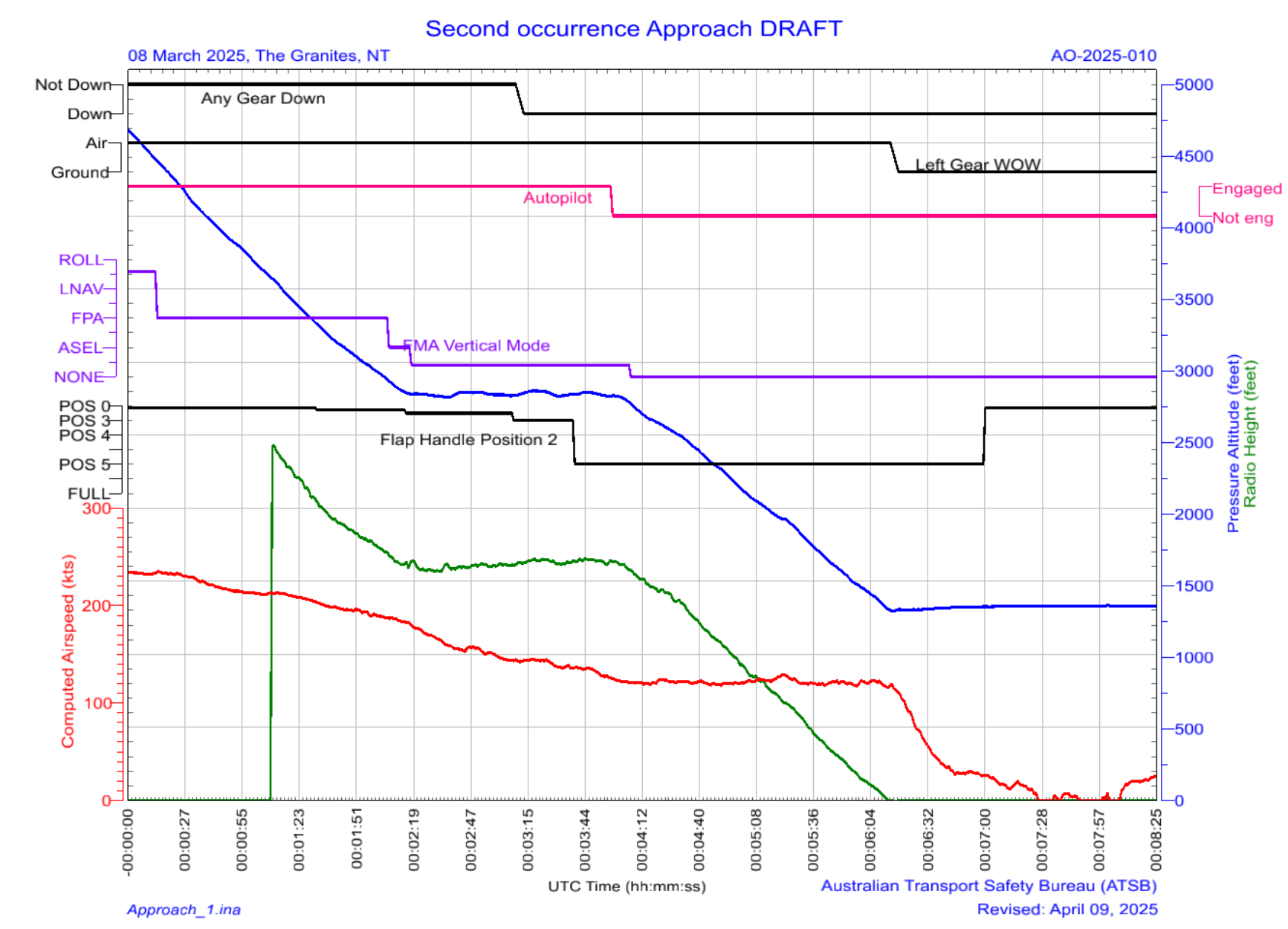
Data from both aircraft’s quick access recorders (Figure 1 and Figure 2) was analysed by the ATSB.
Occurrence 1
Figure 1: QAR data from event 1

Source: ATSB
In the first occurrence, the aircraft was VAPP + 13 kt at 500 ft, which was 3 kt above the stabilised approach criterion at 500 ft (stabilised approach requirement in VMC). However, the speed was trending downwards and VAPP + 10 kt was achieved 1 second later. This exceedance was unlikely to be readily detected by the PF during a visual approach, when their focus would be outside.
Occurrence 2
Figure 2: QAR data from event 2
Source: ATSB
In the second occurrence, the aircraft met all stabilised approach criteria, other than flap 5 being set rather than full flap.
Memory
Memory is fallible, particularly when a given task is not practiced often or recently completed. Memory failures (lapses) often appear as omitted items in a checklist or forgotten intentions.
Procedural memory is a specific type of implicit memory for the process involved in completing an action. It is when individuals no longer need to consciously remember to perform an action they have performed many times before, instead they do so automatically. Each time you retrieve a memory and perform an action, the more easily and readily you will recall it next time, a phenomenon called the retrieval practice effect (Pyc & Rawson, 2009).
Prospective memory, or ‘remembering to remember’, is an intention to perform an action in the future. However, an individual is unlikely to remember do so unless they get a timely retrieval cue from the environment (Dismukes 2010). In situations of high workload (such as approach), memory performance is reduced (Van Benthem et al, 2015) meaning without a cue such as a checklist, individuals are more likely to revert to actions they have performed previously instead of the intended task. This tendency is associated with prospective memory (Nowinski et al, 2003).
Safety analysis
Introduction
In both occurrences, both sets of crewmembers intended to use the less commonly used full flap for landing and entered that configuration and the associated VREF and VAPP speeds into the flight management system (FMS). Subsequently, when configuring the aircraft for landing, both sets of crewmembers forgot that full flap had been briefed some 25 minutes earlier, with both crews selecting flap 5 for the landing.
While operating with a different configuration to what was planned can result in reduced margins for landing speeds, in both these occurrences there were still sufficient margins to safely complete the landing.
Aircraft configuration
As the landing reference speed (VREF) is dependent on flap setting, when full flap is used, VREF, and VAPP, are slower than if using flap 5. If the aircraft is then configured to land with flap 5, and the aircraft is flown using the VAPP for full flap, the aircraft would be slower than it should be for the configuration. In both incidents, VAPP was 8 kt slower than the speed required for a flap 5 landing.
Both sets of crewmembers rarely, if ever, operated Load 25 aircraft, and in both incidents, the crews reverted to setting the flaps to flap 5, an action they had performed many times previously (procedural memory), most likely as they did not have a retrieval cue to recall what they had briefed approximately 25 minutes prior (prospective memory).
Contributing factor Neither sets of flight crew recalled briefing for the less commonly used full flap configuration when actioning the before landing checklist, resulting in them landing with an incorrect flap setting. |
Configuration error defences
In aircraft fitted with Load 25 software, crew were required to manually set the calculated approach speed, and the aircraft would target that speed regardless of the flap configuration. So having the incorrect flap setting resulted in the incorrect approach speed for the configuration.
In addition, in contrast to the Load 27 aircraft, Load 25 aircraft had no ‘check landing flap’ message when a different flap setting was configured to what was entered into the FMS. As such, an incorrect flap setting was more likely to occur in a Load 25 aircraft.
The procedures in place at the time of both occurrences required crew to brief the landing flap setting prior to top of descent, and there was no further prompt or crosscheck to ensure that the briefed flap settings were selected when configuring the aircraft for landing, around 25 minutes later.
Flight crew write down important information such as the automatic terminal information service (ATIS) or aerodrome weather information service (AWIS). However, there was no requirement to write down a less commonly used flap setting or to crosscheck that the flap setting was as previously briefed, in the before landing checklist. Although the flap setting was entered into the landing page in the FMS, crews normally did not have that page selected prior to the before landing checklist to cross-reference the flap selection.
Contributing factor Alliance Airlines had no procedure for flight crews to crosscheck the briefed flap setting entered into the flight management system with the actual configuration selected during the before landing checklist. (Safety issue) |
Findings
ATSB investigation report findings focus on safety factors (that is, events and conditions that increase risk). Safety factors include ‘contributing factors’ and ‘other factors that increased risk’ (that is, factors that did not meet the definition of a contributing factor for this occurrence but were still considered important to include in the report for the purpose of increasing awareness and enhancing safety). In addition ‘other findings’ may be included to provide important information about topics other than safety factors. Safety issues are highlighted in bold to emphasise their importance. A safety issue is a safety factor that (a) can reasonably be regarded as having the potential to adversely affect the safety of future operations, and (b) is a characteristic of an organisation or a system, rather than a characteristic of a specific individual, or characteristic of an operating environment at a specific point in time. These findings should not be read as apportioning blame or liability to any particular organisation or individual. |
From the evidence available, the following findings are made with respect to the incorrect configuration occurrences involving Embraer E190s, VH-A2T and VH-A2V, Olympic Dam Airport, South Australia, on 4 February 2025 and The Granites Airport, Northern Territory, on 8 March 2025.
Contributing factors
- Neither sets of flight crew recalled briefing for the less commonly used full flap configuration when actioning the before landing checklist, resulting in them landing with an incorrect flap setting.
- Alliance Airlines had no procedure for flight crews to crosscheck the briefed flap setting entered into the flight management system with the actual configuration selected during the before landing checklist. (Safety issue)
Safety issues and actions
Central to the ATSB’s investigation of transport safety matters is the early identification of safety issues. The ATSB expects relevant organisations will address all safety issues an investigation identifies. Depending on the level of risk of a safety issue, the extent of corrective action taken by the relevant organisation(s), or the desirability of directing a broad safety message to the Aviation industry, the ATSB may issue a formal safety recommendation or safety advisory notice as part of the final report. All of the directly involved parties are invited to provide submissions to this draft report. As part of that process, each organisation is asked to communicate what safety actions, if any, they have carried out or are planning to carry out in relation to each safety issue relevant to their organisation. Descriptions of each safety issue, and any associated safety recommendations, are detailed below. Click the link to read the full safety issue description, including the issue status and any safety action/s taken. Safety issues and actions are updated on this website when safety issue owners provide further information concerning the implementation of safety action. |
Flap configuration error detection
Safety issue number: AO-2025-010-SI-01
Safety issue description: Alliance Airlines had no procedure for flight crews to crosscheck the briefed flap setting entered into the flight management system with the actual configuration selected during the before landing checklist.
| Whether or not the ATSB identifies safety issues in the course of an investigation, relevant organisations may proactively initiate safety action in order to reduce their safety risk. All of the directly involved parties are invited to provide submissions to this draft report. As part of that process, each organisation is asked to communicate what safety actions, if any, it has carried out to reduce the risk associated with this type of occurrence in the future. The ATSB has so far been advised of the following proactive safety action in response to this occurrence. |
Additional safety action by Alliance Airlines
Alliance Airlines advised that the flight crew received retraining in the simulator on energy management and cross reference techniques.
In addition, Alliance Airlines conducted a flight data review of unstable approaches over the previous 6 months operations to identify similar occurrences.
Glossary
| AWIS | Automated weather information service |
| ePERF | A tablet application designed by Embraer that calculates take-off and landing performance |
| FMGCS | Flight management guidance computer system |
| FMS | Flight management system |
| HF | High frequency is the designation for the band of radio waves with frequency between 3 and 30 megahertz (MHz) |
| MCDU | Multifunction control and display unit |
| NOTAM | Notice to airmen |
| PF | Pilot flying |
| PM | Pilot monitoring |
| VAPP | Target approach speed |
| VREF | Landing reference speed |
Sources and submissions
Sources of information
The sources of information during the investigation included:
- flight crew of both incident flights
- the operator
- recorded data from the incident flights
- meteorological information provided by the Bureau of Meteorology
- the aircraft manufacturer.
References
- Alliance Airlines, ‘E190 standard operating procedures manual’, Issue 1.3, March 2024.
- Alliance Airlines, ‘Operations policy and procedures manual’, v2.16, 1 September 2024
- Dismukes, R.K. (2010) ‘Remembrance of things future: prospective memory in laboratory, workplace and everyday settings’
- Embraer S.A., ‘Embraer E190 Airplane Operations Manual, Volume 1, AOM-1502-047, November 27 2020, Revision 5 – January 31, 2024
- Van Benthem, K.D., Herdman, C.M., Tolton, R.G., & LeFevre, J.A. (2015), ‘Prospective memory failures in aviation: Effects of cue salience, workload, and individual differences.’ Aerospace Medicine and Human Performance, 86(4)
Submissions
Under section 26 of the Transport Safety Investigation Act 2003, the ATSB may provide a draft report, on a confidential basis, to any person whom the ATSB considers appropriate. That section allows a person receiving a draft report to make submissions to the ATSB about the draft report.
A draft of this report was provided to the following directly involved parties:
- flight crews of the incident flights
- Alliance Airlines
- Civil Aviation Safety Authority
- Brazilian Aeronautical Accidents Investigation and Prevention Center (CENIPA)
- Embraer
A submission was received from Alliance Airlines. The submission was reviewed and, where considered appropriate, the text of the report was amended accordingly.
Purpose of safety investigationsThe objective of a safety investigation is to enhance transport safety. This is done through:
It is not a function of the ATSB to apportion blame or provide a means for determining liability. At the same time, an investigation report must include factual material of sufficient weight to support the analysis and findings. At all times the ATSB endeavours to balance the use of material that could imply adverse comment with the need to properly explain what happened, and why, in a fair and unbiased manner. The ATSB does not investigate for the purpose of taking administrative, regulatory or criminal action. TerminologyAn explanation of terminology used in ATSB investigation reports is available here. This includes terms such as occurrence, contributing factor, other factor that increased risk, and safety issue. Publishing informationReleased in accordance with section 25 of the Transport Safety Investigation Act 2003 Published by: Australian Transport Safety Bureau © Commonwealth of Australia 2025 
Ownership of intellectual property rights in this publication Unless otherwise noted, copyright (and any other intellectual property rights, if any) in this report publication is owned by the Commonwealth of Australia. Creative Commons licence With the exception of the Commonwealth Coat of Arms, ATSB logo, and photos and graphics in which a third party holds copyright, this report is licensed under a Creative Commons Attribution 4.0 International licence. The CC BY 4.0 licence enables you to distribute, remix, adapt, and build upon our material in any medium or format, so long as attribution is given to the Australian Transport Safety Bureau. Copyright in material obtained from other agencies, private individuals or organisations, belongs to those agencies, individuals or organisations. Where you wish to use their material, you will need to contact them directly. |
[1] Pilot Flying (PF) and Pilot Monitoring (PM): procedurally assigned roles with specifically assigned duties at specific stages of a flight. The PF does most of the flying, except in defined circumstances, such as planning for descent, approach and landing. The PM carries out support duties and monitors the PF’s actions and the aircraft’s flight path.
[2] Full flap on E190 is 37° of flap and 25° slat extension.
[3] ePERF: a tablet application designed by Embraer that calculates take-off and landing performance.
[4] Flap 5 on E190 is 20° of flap and 25° of slat extension.
[5] Flare: the final nose-up pitch of a landing aeroplane used to reduce the rate of descent to about zero at touchdown.
[6] Sink: sudden decrease in altitude.
[7] Runway number: the number represents the magnetic heading of the runway. Runway 11 has a magnetic heading of 114 degrees.
[8] NOTAM (notice to airman): a notice issued by an aviation authority to alert pilots and other flight personnel to potential hazards or changes that may affect flight operations.
[9] FMS scratchpad: scratchpad messages generated by the FMS at the bottom of the FMS screen.
Occurrence summary
| Investigation number | AO-2025-010 |
|---|---|
| Occurrence date | 04/02/2025 |
| Location | Olympic Dam Airport, South Australia, and The Granites Airport, Northern Territory |
| Report release date | 02/09/2025 |
| Report status | Final |
| Investigation level | Defined |
| Investigation type | Occurrence Investigation |
| Investigation status | Completed |
| Mode of transport | Aviation |
| Aviation occurrence category | Incorrect configuration |
| Occurrence class | Incident |
| Highest injury level | None |
Aircraft details
| Manufacturer | Embraer S.A. |
|---|---|
| Model | ERJ 190-100 IGW |
| Registration | VH-A2T |
| Serial number | 19000179 |
| Aircraft operator | Alliance Airlines |
| Sector | Jet |
| Operation type | Part 121 Air transport operations - larger aeroplanes |
| Departure point | Adelaide Airport, South Australia |
| Destination | Olympic Dam Airport, South Australia |
| Damage | Nil |
Aircraft details
| Manufacturer | Embraer S.A. |
|---|---|
| Model | ERJ 190-100 IGW |
| Registration | VH-A2V |
| Serial number | 19000249 |
| Aircraft operator | Alliance Airlines |
| Sector | Jet |
| Operation type | Part 121 Air transport operations - larger aeroplanes |
| Departure point | Alice Springs Airport, Northern Territory |
| Destination | The Granites Airport, Northern Territory |
| Damage | Nil |