

Final report
Report release date: 29/07/2025
Investigation summary
What happened
On the morning of 25 February 2025, an Agusta A109E helicopter was conducting a marine pilot transfer operation on the inbound bulk carrier Star Coral at Blossom Bank pilot boarding ground, about 200 km north‑east of Mackay, Queensland.
At 0901 local time, during take‑off from the ship with 2 pilots on board, the helicopter developed severe vibrations. The pilots discontinued the take-off but their attempts to recover control of the helicopter were unsuccessful. The helicopter came to rest in an upright position on the helideck, having spun more than 90° counterclockwise from its initial heading, and sustaining substantial damage. The pilots and ship’s crew were unharmed.
What the ATSB found
The investigation did not identify any airworthiness issues with the helicopter and it was considered that the loss of control was not attributable to a mechanical issue.
The ATSB found that the vibration was likely the result of the helicopter entering ground resonance, a phenomenon that dissipates when airborne, while it was in the process of departing from the ship. The discontinuation of the take‑off, after the onset of the vibration, probably resulted in the loss of control and subsequent damage to the helicopter.
What has been done as a result
The operator has added new guidelines on ground resonance to its procedures. The guidelines include procedures for recognising and recovering from ground resonance and feature case studies and video resources for training purposes.
The operator has also developed an updated procedure for training and checking flight briefings that will include confirming the roles of each pilot, procedures for transferring aircraft control between pilots, and actions to be followed in the event of an actual emergency.
Safety message
The occurrence highlights the dangers of ground resonance, a potentially catastrophic phenomenon that can occur in helicopters with fully articulated rotor systems. Typically, the onset of ground resonance is sudden and if the pilot does not take immediate corrective action, a loss of control can rapidly occur.
The occurrence also highlights the importance of proper coordination between a helicopter’s pilots when responding to abnormal or emergency situations. This is particularly pertinent for situations where the pilot flying is not the pilot in command. Ideally, the pilots’ individual roles and responsibilities for emergency response and flying duties should be well established prior to the flight.
The investigation
The occurrence
At about 0730 local time on 25 February 2025, the 229 m bulk carrier Star Coral arrived at the Blossom Bank pilot boarding ground, about 200 km north‑east of Mackay, Queensland (Figure 1). The ship waited to embark a coastal marine pilot by helicopter for its inbound transit of the Great Barrier Reef via Hydrographers Passage.[1] It was in ballast and bound for Hay Point to load coal.
Figure 1: Blossom Bank pilot boarding ground and Hydrographers Passage
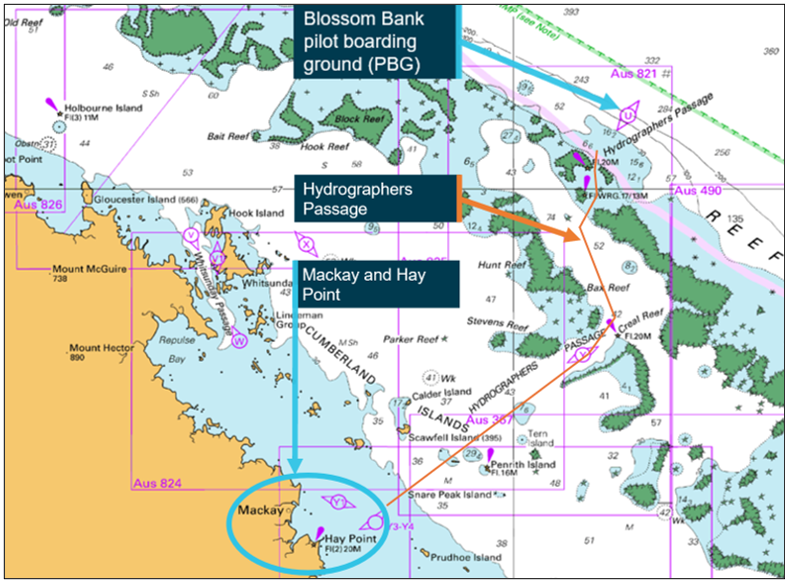
Source: Australian Hydrographic Office, annotated by the ATSB
Meanwhile, at Mackay Airport, a twin‑engine Agusta A109E helicopter, operated by Flyon Helicopters and registered VH‑XUM (XUM), with 2 pilots on board, embarked the marine pilot scheduled to conduct the ship’s pilotage. The marine pilot transfer (MPT) flight to Star Coral was the first scheduled for the helicopter and its pilots that day. These flights were normally conducted as a single‑pilot operation. However, on this occasion, the pilot flying, a pilot recently engaged by the operator under its ‘in‑command‑under supervision’ (ICUS)[2] program, was under the supervision of a company check pilot (pilot supervising).
The pilots’ plan was to transfer Star Coral’s marine pilot and then proceed to a nearby outbound ship to collect its marine pilot for return to Mackay.
At 0759, the helicopter departed Mackay Airport under the control of the pilot flying. En route, the pilots established communication with Star Coral’s master via VHF[3] radio. The master advised that the ship was rolling about 3° on its inbound heading due to a 2 m south‑easterly swell. Subsequently, the pilots requested the master to reposition the ship on a heading[4] of 270° to reduce rolling. At 0853, the pilot flying landed the helicopter on the ship’s helideck, situated on the number 5 cargo hold hatch cover (Figure 2). The marine pilot exited the helicopter and proceeded to the ship’s bridge.
Figure 2: Landing position of VH-XUM aboard Star Coral
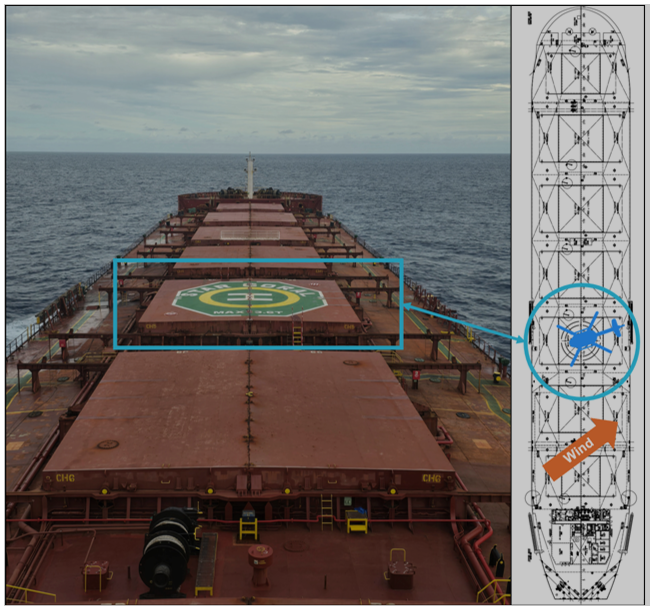
This figure is a representation of the helicopter’s orientation relative to the wind during the take‑off. Source: Flyon Helicopters and Star Coral, annotated by the ATSB
Meanwhile, the helicopter remained on the helideck at flight idle[5] while its pilots radioed the outbound ship’s pilot to coordinate the transfer. After some discussion, the pilots elected to keep the helicopter on the deck of Star Coral until the outbound ship had departed the compulsory pilotage area.
After about 5 minutes, as the 2 ships were about to pass each other, the helicopter pilots began conducting their pre‑take‑off checks. The pilots observed a 20 to 28 knot headwind (relative to the helicopter) and noted that the ship was rolling less than 2°. The pilot flying conducted a brief for a performance category 1[6] take‑off, which involved establishing the helicopter in a hover 35 ft above deck height before departing. Both pilots later recalled that everything seemed normal as the take‑off checks were completed.
At about 0900, the pilot flying raised the collective[7] and observed the engine torques increasing through 50%. The pilot flying recalled the aircraft became light on its oleos as though it was ‘right at the point of lifting off’. Meanwhile, the pilot supervising was observing the outbound ship passing. A few seconds later, both pilots felt a sudden and substantial vibration.
The pilot supervising immediately looked down at the controls and recalled that the pilot flying was holding the cyclic[8] in an abnormally aft position. Concerned that the main rotor might have struck the tail boom, the pilot supervising decided to assume control of the helicopter and took hold of the cyclic and collective unannounced. Meanwhile, the pilot flying was still attempting to lift off, unaware of the pilot supervising’s decision to take control. The pilot supervising recalled that the pilot flying had centred the cyclic and ‘must have’ lowered the collective by the time the pilot supervising took hold of the controls. In contrast, the pilot flying stated that the pilot supervising rapidly lowered the collective after the vibration started, causing the aircraft to descend from being light on its oleos and bounce heavily on the helideck.
Moments later, the cyclic became uncontrollable as the vibrations suddenly worsened into a violent, vertical oscillation of the airframe. The pilot supervising tried to stabilise the helicopter but was unable to control the cyclic movement. Subsequently, the pilot supervising elected to shut down the engines.
The pilot supervising initially struggled to reach the engine mode switches (located on the centre console) due to the severe vibrations but subsequently managed to shut down engine number 2. The vibrations slightly eased and moments later, they were able to also shut down engine number 1. The vibration dissipated and the helicopter came to rest in an upright position on the helideck, having spun more than 90° counterclockwise from its initial heading. The sequence, from the attempted take‑off to shut‑down occurred within a period of about one minute.
Soon after, the pilots exited the wreckage and inspected the damage. The tail rotor was separated from the helicopter and had come to rest on the main deck between cargo hatches 4 and 5. Items of debris, including main rotor fragments, laid scattered on the deck along with some hydraulic fluid pooled beneath the substantially damaged fuselage (Figure 3).
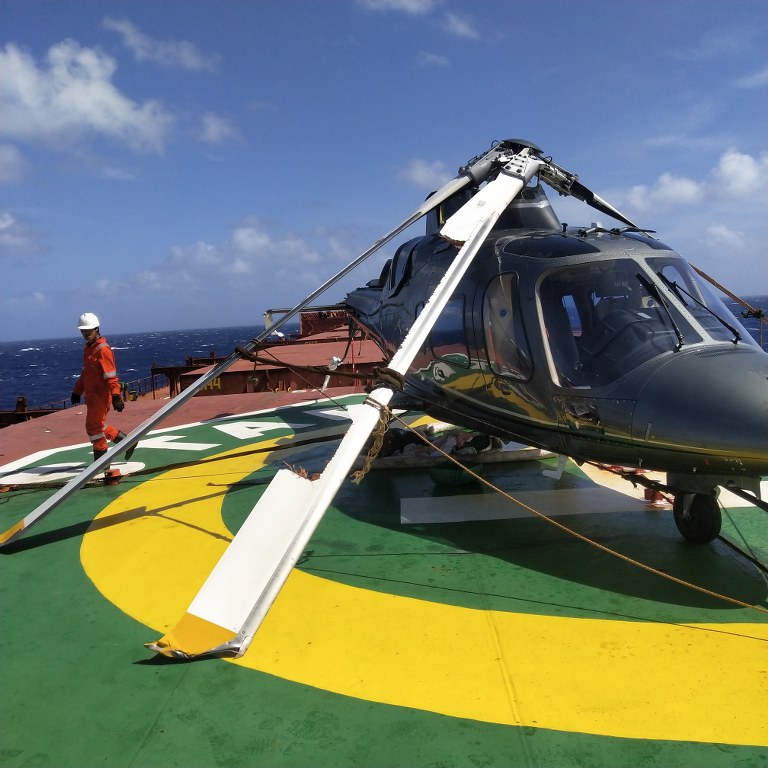
Source: Star Coral
Apart from a thumb sprain to the pilot supervising and some bruising to both pilots’ upper leg areas, where they had been struck by the cyclic, neither were significantly injured and no‑one on board Star Coral was injured.
Context
Helicopter information
The helicopter was an Agusta A109 E variant, manufactured in 2006 and issued serial number 11684. It was registered in Australia in 2006 and began services under the operator’s Air Operator’s Certificate (AOC) in 2023.
The Agusta A109E is a multipurpose helicopter equipped with 2 Pratt & Whitney PW206‑C turbine engines. It has a fully articulated 4‑blade main rotor system, a 2‑blade tail rotor and retractable tricycle landing gear. Able to carry up to 7 occupants, it has a maximum allowable take‑off weight of 2,850 kg.
The helicopter was able to perform flight performance class 1 operations by adherence to Category A procedures[9]. While the helicopter was normally operated from the right crew seat, it was fitted with dual controls. A left seat‑approved pilot in command (PIC) was permitted to occupy either seat during training flights. Each set of controls could not be operated independent of the other.
The helicopter’s wreckage was recovered from the ship 2 days after the incident and transported to a secure hangar at Mackay Airport. Prior to its removal, photographs of the wreckage and the accident area were taken. There were no indications that the main rotor or tail rotor had struck any part of the ship during the accident.
Based on its inspections, the operator advised that no engine faults or exceedance alarms had been recorded by the helicopter’s electronic engine management systems. Additionally, no faults or defects had been reported by any of XUM’s pilots or maintainers leading up to the occurrence flight.
Post-accident activities
There was no recorded flight data available to determine the flight control inputs and their effect on the motion of the helicopter during the occurrence.[10] The pilots’ accounts, a witness statement from the master of Star Coral and photographs of the wreckage were the main sources of evidence.
The ATSB also sought the manufacturer’s input for this occurrence. The manufacturer advised that its preliminary assessment of the available evidence suggested that the helicopter damage appeared consistent with a ground resonance phenomenon (see the section titled Ground resonance).
The licenced maintenance organisation for XUM carried out an examination of the wreckage at the Mackay hangar. On advice from the manufacturer, the examination included inspection of specific components commonly associated with ground resonance. These included main rotor dampers, landing gear struts and tyres. The operator advised the ATSB that the inspection did not identify any airworthiness issues that may have contributed to the occurrence. The operator did not provide the inspection report or findings to the manufacturer for its assessment.
Pilot flying
The pilot flying obtained a New Zealand commercial helicopter licence (CPL) in 2011 and started flying commercially in 2014. They converted their CPL over to an Australian CPL in 2016 and held a grade 2 flight instructor rating and a class 1 aviation medical certificate. They had experience flying both single and twin-engine helicopters in various operations. Prior to joining the operator’s in‑command‑under‑supervision (ICUS) program in September 2024, they had no previous experience on the A109E, or with marine pilot transfers (MPT).
Under the ICUS program, the pilot was required to accrue 200 hours on the A109E before they could be assessed to fly the helicopter unsupervised on daytime VFR[11] MPT operations. At the time of the occurrence, the pilot had completed the operator’s training requirements and accrued around 50 hours flight time on the A109E. They had also been cleared to conduct unsupervised MPT operations on single‑engine Eurocopter AS350 helicopters.
Pilot supervising
The pilot supervising was the operator’s head of flying operations and held an air transport pilot (helicopter) licence, issued in 2014, and a class 1 aviation medical certificate. They were approved under the operator’s training and checking system to conduct check and supervision flights on the A109E.
The pilot supervising had been flying helicopters for 26 years in various operations and had accumulated over 10,000 hours flying time, including 3,800 hours in the A109E. They first started MPT operations in 2007 and commenced working with the operator in December 2016.
Star Coral
Star Coral was built in 2009 by Jansu Newyangzi Shipbuilding, China, registered in The Bahamas and classed with Bureau Veritas. The ship was owned by Panormos Shipping, The Bahamas, and managed and operated by Charterwell Maritime, Greece.
At the time of the occurrence, the 229 m ship had a mean draught of 6.51 m and the helideck height was about 18 m above the waterline.
In a written witness statement, the master reported that:
• shortly after the helicopter started to take off, it began to pound on the helideck before it spun and the tail rotor separated
• during the sequence, the helicopter became airborne for no more than 2 seconds.
Ground resonance
Ground resonance can be defined as a vibration of large amplitude resulting from a forced or self‑induced vibration of a helicopter in contact with the ground.[12] The phenomenon is normally associated with helicopters equipped with fully articulated main rotor systems consisting of 3 or more rotor blades. It is more common on helicopters with sprung landing gear than those with skids. Typically, ground resonance occurs during landing, take‑off and ground manoeuvres.[13]
In fully articulated rotor systems, drag hinges allow each blade to advance or lag in the plane of rotation to compensate for the stresses caused by the acceleration and deceleration of the rotor hub. Such rotor systems are typically fitted with lead‑lag dampers to limit the extent of this movement and help prevent excessive vibrations. However, if for any reason one or more of the blades assumes a dragged position different to the others, the blades will move out of phase and the rotor will become imbalanced, transmitting an oscillation throughout the entire airframe.[14]
The risk of ground resonance arises when the unbalanced forces in the rotor system cause the fuselage to oscillate on its landing gear at or near its natural frequency. Ground resonance will occur if the helicopter’s damping systems are unable to compensate for the oscillation.[15] Unless corrective action is taken, the amplitude of the oscillation will increase until the helicopter becomes uncontrollable.[16] Ground resonance can also be induced when the helicopter is in light contact with the ground, if the landing gear oscillation frequency is in sympathy with the rotor head vibration.[17]
Ground resonance is commonly precipitated by the helicopter making hard or asymmetric contact with the ground, landing on a slope or sudden control movements by the pilot.[18] It can also result from other factors such as improper blade balancing and tracking, or damage to any of the blades.[19] Hard contact with the ground by some part of the landing gear when the main rotor is in an unbalanced state can further aggravate the condition.[20]
Additionally, improper maintenance of the helicopter’s main rotor and fuselage damping systems, or incorrect tyre pressures, can induce or worsen ground resonance.[21]
Flight control inputs that may induce ground resonance typically involve sudden control movements or a mishandling of the cyclic that causes the fuselage to bounce.[22]
The helicopter manufacturer advised that the application of certain cyclic commands, such as extreme aft cyclic input, could theoretically reduce the main rotor damper effectiveness in respect to the damping action on the blades’ regressive lead‑lag dynamic.
Recovery technique
The onset of ground resonance can be recognised by a rocking motion or oscillation of the fuselage while on the ground.[23] The United States Federal Aviation Administration (FAA) Helicopter Handbook[24] documented 2 widely accepted recovery techniques:
• if the condition arises when there is insufficient rotor speed for take‑off, the only option is to lower the collective to reduce the pitch of the blades. The rotor rpm[25] should also be reduced as soon as possible.[26]
• If the rotor speed is in the normal operating range for flight, the Helicopter Handbook recommends lifting the helicopter off the ground to allow the rotor blades to rephase themselves automatically.
Additionally, the FAA cautioned that:
If a pilot lifts off and allows the helicopter to firmly re‑contact the surface before the blades are realigned, a second shock could move the blades again and aggravate the already unbalanced condition. This could lead to a violent, uncontrollable oscillation.
In practice, a pilot experiencing ground resonance typically has seconds to identify the condition and take corrective action.
Similar occurrences
The ATSB reviewed several investigation reports relating to previous A109E accidents attributed to ground resonance. The incidents reviewed occurred outside of Australia between 2006 and 2025 and the contributing factors were found to be operational. Technical factors which may have caused or exacerbated ground resonance were not identified.
Details of the previous incidents bear similarity to the occurrence involving XUM, particularly in respect to subsequent damage to the helicopter (Figure 4).
Figure 4: Previous occurrences of ground resonance involving the Agusta A109E
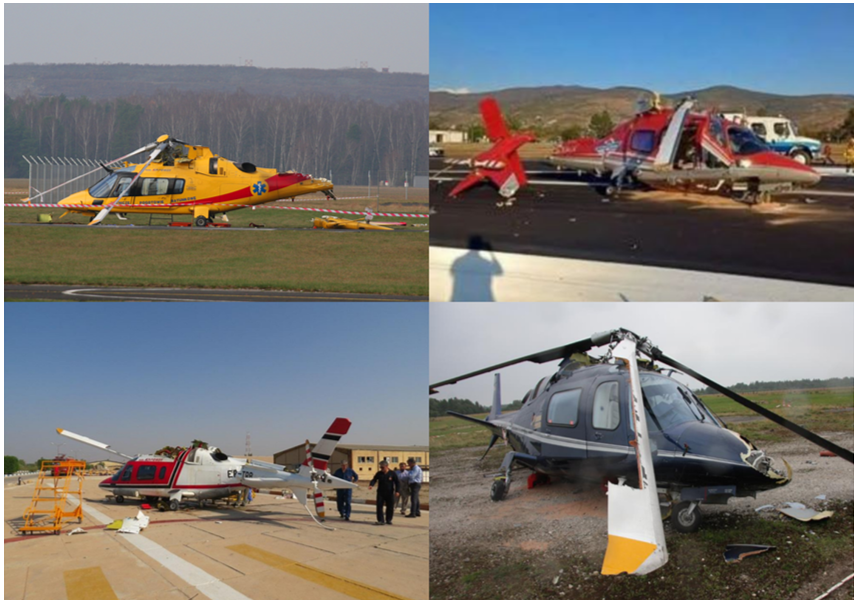
Source: Leonardo Helicopters
Flight manual procedures
The A109E rotorcraft flight manual (RFM) listed fault conditions and corrective actions for emergencies and malfunctions that might occur during take‑off.
The RFM included the caution below for ground resonance within the normal flight procedure for take‑off. This was not part of the emergency and malfunction procedures.
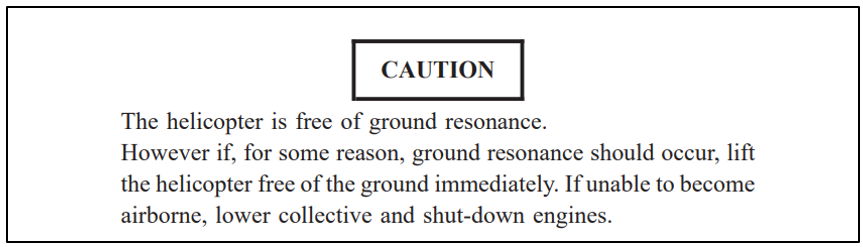
The RFM procedure for ground resonance was consistent with recovery techniques published by the FAA. The RFM reference to the helicopter being ‘free of ground resonance’ was intended to indicate that, like all helicopters, the A109E was designed and certified to applicable standards so that the rotor and fuselage systems do not vibrate at the same frequency under normal conditions.
Operator procedures
As an AOC holder, the operator maintained a CASA‑approved[27] operations manual/exposition[28] to promulgate general policy and standardised procedures for MPTs on the A109E. The version of the operations manual current at the time of the occurrence was issued by the operator in November 2023.
Ground resonance
The operator’s normal procedures and emergency checklists for the A109E were derived from the RFM and did not contain any procedures related to ground resonance.
Crew coordination in response to abnormal situations
While MPT flights were predominantly conducted by a single pilot, the helicopter was certified for operations with either a single pilot or 2 pilots. In either case, the normal procedure and emergency checklists remained the same, except that 2‑pilot checklist procedures were to be based on challenge and response.
Normal handover and takeover procedures provided that:
In the case where the pilot flying (PF) is not the PIC and the PIC determines that the PF is not maintaining adequate control of the aircraft, the PIC may elect to take control, in which case they will signal their intention by saying ‘I have control’ upon which the PF will immediately relinquish control and the roles will reverse.
In abnormal or emergency situations, the PIC was responsible for ensuring the aircraft was flown and kept under control. The operations manual emphasised the importance of cockpit resource management (CRM) standards throughout the situation, in accordance with the below procedure:
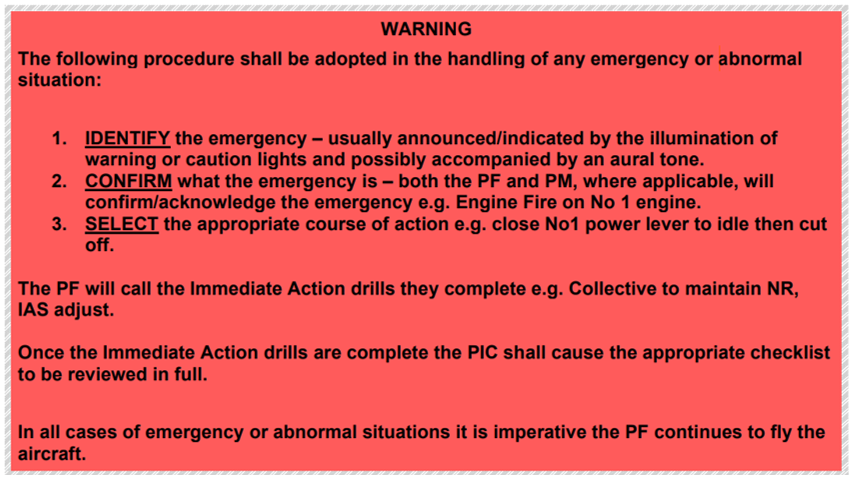
Note: In the above procedures PM stands for ‘pilot monitoring’, NR refers to main rotor speed and IAS means indicated airspeed.
In the context of rapidly escalating emergencies such as ground resonance, pilots have limited time to perform the procedure.
Pilot in command responsibility during training flights
As the holder of a certificate that authorised air transport and aerial work operations, the operator was required to have in place a training and checking system (TACS). A training and checking manual (TACM) sets out policies and procedures for conducting training flights. It provided that a check pilot supervising ICUS training was to be the PIC. Check pilots were to ensure that pilots involved in training exercises were made aware of who was acting as the PIC through proper handover of control procedures.
While an ICUS pilot might be considered the PIC for flight‑time logging purposes, the pilot supervising was deemed the PIC and responsible for the safety of the flight. The TACM stated that in the event of an actual emergency during flight training:
If the flight examiner or check pilot deems it necessary to take physical control of the aircraft at any stage after the occurrence of the emergency, then they shall do so in accordance with the hand‑over and take‑over procedures specified in the Operations Manual - Hand over and take‑over procedures.
The flight examiner or check pilot must be prepared and ready to assume physical control of the aircraft at any stage, particularly during critical manoeuvres such as during take‑off and landing.
As such, beyond the normal handover of control procedures, there were no special provisions in the TACM for the allocation of PIC responsibility and PF duties during ICUS flights.
Briefings
For 2‑pilot operations or training flights, the operator’s procedures did not require pilots to brief who would assume PF duties in the event of an abnormal or emergency situation during critical phases of flight.
Operational limits
Under the operator’s operations manual, the A109E was permitted to conduct daytime MPT operations up to a wind strength of 30 knots, with a maximum crosswind of 20 knots. The operational limit for ship’s pitch was 4° up and 2° down while the maximum permissible roll was 4°. The manufacturer did not have input into these operator‑defined limits.
The pilots reported that the conditions at the time of the occurrence (20–28 knot headwind, 2° roll and minimal pitching) were within the operator’s limits for MPTs.
Safety analysis
Prior to the accident, VH‑XUM (XUM) made an uneventful landing on Star Coral and remained on the deck for several minutes without incident. There was no evidence that the helicopter was operating abnormally or experienced any instability during this period.
Examination of the accident site did not reveal any evidence to suggest that the occurrence resulted from the main rotor or tail rotor striking the ship. Star Coral’s master reported that the tail rotor separated after the helicopter started contacting on the deck, indicating that contact with the tail boom by the main rotor was a consequential rather than causative factor.
In that context, it is most likely that the helicopter encountered ground resonance. Assessment of the damage to the helicopter following the occurrence revealed significant similarities to that seen in previous A109E incidents attributed to this phenomenon.
It is well established that ground resonance only arises when the helicopter is in contact with the ground. Both pilots asserted that the helicopter did not become airborne prior to the vibrations while the master reported that it became airborne for about 2 seconds. However, it is more likely this occurred after the vibration worsened and the helicopter started rebounding on the helideck.
The exact cause of the vibration could not be determined. The possibility of causative operational factors such as flight control inputs or environmental factors could not be ruled in or out.
Similarly, while the operator’s post‑accident inspection of the helicopter (including examination of its rotor and fuselage damping systems) did not reveal any apparent defects, causative technical factors could not be discounted.
However, the sudden lowering of the collective after the onset of the vibration likely aggravated the situation. The helicopter was almost certainly light on its oleos when the vibration began. Therefore, a sudden lowering of the collective would have caused the helicopter to come down firmly on the helideck. The United States Federal Aviation Administration (FAA) Helicopter Handbook describes that such an impact when the rotor is already in an unbalanced state can cause the rotor blades to move further out of phase, resulting in violent uncontrollable oscillations. This description is consistent with the occurrence sequence described by the pilots and the master.
The pilots’ accounts of who lowered the collective differed. The recollection of the pilot flying that their intention was to lift the helicopter off the deck in response to the vibration was not consistent with a lowering of the collective. In contrast, the pilot supervising did not immediately identify the source of the vibration and later shut down the engines, believing the main rotor may have struck the tail boom. In this context, lowering of the collective would be a natural and expected response. Therefore, it is most likely that the pilot supervising lowered the collective while the pilot flying was attempting to lift the helicopter off the helideck.
In isolation, the immediate responses taken by each pilot following the sudden onset of the significant vibration were understandable. However, since the helicopter’s rotor speed was in the normal operating flight range, continuation of the take‑off would probably have resulted in the vibration dissipating (as detailed in the FAA Helicopter Handbook).
The operator had adequate procedures for responding to abnormal and emergency situations. However, the rapidly escalating nature of this occurrence meant that there was virtually no time to implement them. There was no requirement for the pilots to conduct a pre‑flight or pre‑take‑off brief about who would assume flying duties in the event of an emergency on take‑off. Therefore, the normal procedures for handover and takeover of control were assumed to apply.
However, the time between observing the vibrations and the loss of control severely limited the time available for a formal transfer of control between the pilots. As a result, neither of these procedures were followed and each pilot responded to the situation separately.
Findings
ATSB investigation report findings focus on safety factors (that is, events and conditions that increase risk). Safety factors include ‘contributing factors’ and ‘other factors that increased risk’ (that is, factors that did not meet the definition of a contributing factor for this occurrence but were still considered important to include in the report for the purpose of increasing awareness and enhancing safety). In addition ‘other findings’ may be included to provide important information about topics other than safety factors. These findings should not be read as apportioning blame or liability to any particular organisation or individual. |
From the evidence available, the following findings are made with respect to the loss of control during marine pilot transfer operations, involving an Agusta A109E, VH‑XUM and bulk carrier Star Coral, about 200 km north‑east of Mackay, Queensland, on 25 February 2025.
Contributing factors
- During take‑off, the helicopter likely experienced ground resonance, resulting in the rapid onset of significant vertical oscillations through the airframe.
- Discontinuing the take‑off after the onset of the vibration, with the rotor speed in the flight range, probably resulted in the loss of control and substantial damage to the helicopter.
Safety actions
Safety action by Flyon Helicopters
Following this occurrence, the helicopter’s operator, Flyon Helicopters, established ground resonance guidelines for its pilots. Forming part of its exposition, the guidelines were purposed to raise awareness of ground resonance and provide information about how to recognise and respond to the phenomenon. They included response procedures and featured case studies and video resources. The procedures were to be implemented into the operator’s training framework for new and current pilots.
Flyon Helicopters advised the ATSB that it also planned to implement an additional briefing procedure in its training and checking manual (TACM). The briefing is to be conducted by the training or checking pilot prior to any training or checking flight. It will include:
- the objectives and scope of the flight, including the intended lesson plan or sequence
- the training/checking outcomes
- the roles of each pilot, including the allocation of aircraft command responsibility
- procedures for transferring aircraft control between pilots
- actions to be followed in the event of an actual emergency
- procedures to be used in the simulation of emergencies
- procedures for the conduct of unusual operations
- the method to be used to simulate instrument flight conditions, if required
- human factors/non‑technical stills and threat and error management.
Sources and submissions
Sources of information
The sources of information during the investigation included:
- the pilots and operator of VH-XUM
- the master and manager of Star Coral
- the helicopter manufacturer, Leonardo Helicopters
References
Lemmens Y, Troncone E, Dutré S, Olbrechts T. (2012). Identification of Helicopter Ground Resonance with Multi-body Simulation, 28th International Congress of the Aeronautical Sciences
United Kingdom Ministry of Defence, AP3456 Central Flying School Manual of Flying Vol 12 - Helicopters
Salini S N, Haradev G S, Ranjith M. (2020). Ground Resonance: Nonlinear Modelling and Analysis, 6th Conference on Advances in Control and Optimization of Dynamical Systems (ACODS), India
United States Federal Aviation Administration. (2019). Helicopter Flying Handbook
Schafer J. (1980). Helicopter Maintenance
Submissions
Under section 26 of the Transport Safety Investigation Act 2003, the ATSB may provide a draft report, on a confidential basis, to any person whom the ATSB considers appropriate. That section allows a person receiving a draft report to make submissions to the ATSB about the draft report.
A draft of this report was provided to the following directly involved parties:
- the pilots and operator of VH-XUM
- the master and manager of Star Coral
- the ship’s flag State administration, The Bahamas
- the helicopter manufacturer, Leonardo Helicopters
- Agenzia Nazionale per la Sicurezza del Volo (ANSV)
- Civil Aviation Safety Authority
- Australian Maritime Safety Authority
Submissions were received from:
- the pilots of VH-XUM
- the ship’s flag State administration, The Bahamas
- the helicopter manufacturer, Leonardo Helicopters
- Agenzia Nazionale per la Sicurezza del Volo (ANSV)
The submissions were reviewed and, where considered appropriate, the text of the report was amended accordingly.
Purpose of safety investigationsThe objective of a safety investigation is to enhance transport safety. This is done through:
It is not a function of the ATSB to apportion blame or provide a means for determining liability. At the same time, an investigation report must include factual material of sufficient weight to support the analysis and findings. At all times the ATSB endeavours to balance the use of material that could imply adverse comment with the need to properly explain what happened, and why, in a fair and unbiased manner. The ATSB does not investigate for the purpose of taking administrative, regulatory or criminal action. TerminologyAn explanation of terminology used in ATSB investigation reports is available here. This includes terms such as occurrence, contributing factor, other factor that increased risk, and safety issue. Publishing informationReleased in accordance with section 25 of the Transport Safety Investigation Act 2003 Published by: Australian Transport Safety Bureau © Commonwealth of Australia 2025 
Ownership of intellectual property rights in this publication Unless otherwise noted, copyright (and any other intellectual property rights, if any) in this report publication is owned by the Commonwealth of Australia. Creative Commons licence With the exception of the Commonwealth Coat of Arms, ATSB logo, and photos and graphics in which a third party holds copyright, this report is licensed under a Creative Commons Attribution 4.0 International licence. The CC BY 4.0 licence enables you to distribute, remix, adapt, and build upon our material in any medium or format, so long as attribution is given to the Australian Transport Safety Bureau. Copyright in material obtained from other agencies, private individuals or organisations, belongs to those agencies, individuals or organisations. Where you wish to use their material, you will need to contact them directly. |
[1] Hydrographers Passage provides a deep-water shipping route through the Great Barrier Reef between Blossom Bank pilot boarding ground, near the entrance to the passage, and the Cumberland Islands, north-east of Mackay. Pilotage is compulsory through Hydrographers Passage for ships over 70 m, as well as for loaded oil and chemical tankers and gas carriers, irrespective of size.
[2] In-command-under-supervision (ICUS) generally refers to a pilot who is acting as the pilot in command (PIC) for a flight under the supervision of a more experienced pilot.
[3] Very high frequency.
[4] All ship’s headings are reported in degrees true.
[5] Flight idle refers to the lowest engine power setting that allows the aircraft to maintain stable operations during flight. A flight idle setting when the helicopter is on the ground allows for the engine(s) to go to higher power settings faster and facilitate take-off when collective pitch is raised.
[6] Performance Class 1 (PC1) refers to operations for which, in the event of a critical engine failure, performance is available to enable the helicopter to safely continue the flight to an appropriate landing area.
[7] Collective: a primary helicopter flight control that simultaneously affects the pitch of all blades of a lifting rotor. Collective input is the main control for vertical speed.
[8] Cyclic: a primary helicopter flight control that is similar to an aircraft control column. Cyclic input tilts the main rotor disc, varying the attitude of the helicopter and hence the lateral direction.
[9] Category A (CAT A) operations were those where, in the event of an engine failure, the helicopter has adequate performance to safely continue or reject the take-off or landing.
[10] The aircraft type involved was not required under regulations to carry a cockpit voice recorder (CVR) or flight data recorder (FDR).
[11] Visual flight rules.
[12] United Kingdom Ministry of Defence, AP3456 Central Flying School Manual of Flying Vol 12 – Helicopters.
[13] Lemmens Y, Troncone E, Dutré S, Olbrechts T. (2012). Identification of Helicopter Ground Resonance with Multi-body Simulation, 28th International Congress of the Aeronautical Sciences.
[14] United Kingdom Ministry of Defence, AP3456 Central Flying School Manual of Flying Vol 12 – Helicopters.
[15] Salini S N, Haradev G S, Ranjith M. (2020). Ground Resonance: Nonlinear Modelling and Analysis, 6th Conference on Advances in Control and Optimization of Dynamical Systems (ACODS), India.
[16] United States Federal Aviation Administration. (2019). Helicopter Flying Handbook.
[17] United Kingdom Ministry of Defence, AP3456 Central Flying School Manual of Flying Vol 12 – Helicopters.
[18] ibid.
[19] ibid.
[20] United States Federal Aviation Administration. Helicopter Flying Handbook, 2019.
[21] Schafer J. Helicopter Maintenance, 1980.
[22] United Kingdom Ministry of Defence, AP3456 Central Flying School Manual of Flying Vol 12 – Helicopters.
[23] United Kingdom Ministry of Defence, AP3456 Central Flying School Manual of Flying Vol 12 – Helicopters.
[24] United States Federal Aviation Administration. Helicopter Flying Handbook, 2019.
[25] Revolutions per minute.
[26] United Kingdom Ministry of Defence, AP3456 Central Flying School Manual of Flying Vol 12 – Helicopters.
[27] Civil Aviation Safety Authority.
[28] ‘Exposition’ is a term used in some regulatory domains for a document or set of documents that describe how an organisation will comply with all applicable legislative requirements, and how they will manage the safety of their operations. An exposition is broadly equivalent to an operations manual in other domains.
Occurrence summary
| Investigation number | AO-2025-009 |
|---|---|
| Occurrence date | 25/02/2025 |
| Location | 200 km north-east of Mackay |
| State | Queensland |
| Report release date | 29/07/2025 |
| Report status | Final |
| Investigation level | Short |
| Investigation type | Occurrence Investigation |
| Investigation status | Completed |
| Mode of transport | Aviation |
| Aviation occurrence category | Collision with terrain, Loss of control |
| Occurrence class | Accident |
| Highest injury level | None |
Aircraft details
| Manufacturer | Agusta, S.p.A, Construzioni Aeronautiche |
|---|---|
| Model | A109E |
| Registration | VH-XUM |
| Serial number | 11684 |
| Sector | Helicopter |
| Operation type | Part 138 Aerial work operations |
| Departure point | Mackay Airport, Queensland |
| Destination | Mackay Airport, Queensland |
| Damage | Substantial |
Ship details
| Name | Star Coral |
|---|---|
| IMO number | 9477854 |
| Flag | The Bahamas |
| Departure point | Tianjin, China |
| Destination | Hay Point, Queensland |