

Final report
Report release date: 15/08/2025
Investigation summary
What happened
On 24 January 2025, a Cirrus SR22, VH-DCB, was conducting a private flight from the Gold Coast, Queensland, to Mildura, Victoria with the pilot and one passenger on board.
About 2 hours and 43 minutes into the flight, while approaching the Mitchell Highway to the east of Nyngan, New South Wales, the pilot observed a cautionary alert, advising of low engine oil pressure. The pilot diverted to Nyngan Aerodrome and a short time later, the engine subsequently sustained an in-flight mechanical failure and engine fire. The aerodrome was beyond the aircraft's glide range at the time and the pilot elected not to deploy the Cirrus Aircraft parachute system, but to perform a forced landing on the Mitchell Highway.
The pilot conducted a successful forced landing, both pilot and passenger were uninjured and the aircraft sustained only minor damage.
What the ATSB found
The engine lost oil pressure during flight and sustained an in-flight mechanical failure, prompting the pilot to declare an emergency. The pilot exercised timely and effective decision‑making, which mitigated the risk of injury to the occupants and further damage to the aircraft. The pilot then promptly executed a successful forced landing on a nearby highway, while experiencing fire and reduced visibility from oil over the windscreen and smoke entering the cabin.
Safety message
In-flight engine failures in single-engine aircraft require pilots to exercise effective and timely decision-making to reduce the severity of injuries and damage. These events often result in the pilot experiencing high workload and time pressure, where preparedness is critical.
The ‘aviate, navigate and communicate’ framework establishes a clear hierarchy of priorities, particularly during emergencies. Taking action in the appropriate order of priority improves situational awareness and supports coordinated responses in a dynamic environment.
Scenario-based training should reinforce these principles by developing both technical and non-technical skills, helping pilots become familiar with the appropriate responses and techniques required during high‑stress situations.
Decision-making tools also enables pilots to take a structured approach to problem‑solving which enhances safety by minimising the risk of errors during emergencies.
The investigation
The occurrence
On 25 January 2025, the pilot of a Cirrus SR22, registered VH-DCB, planned to conduct a private flight from Gold Coast, Queensland, to Mildura, Victoria. The aircraft departed Gold Coast Airport with the pilot and one passenger at about 0735 AEST.[1]
At 1018, while cruising at an altitude of about 8,000 ft above mean sea level (AMSL), the engine oil pressure decreased below the normal operating limits for the engine, 30 pounds per square inch (psi), and the pilot recalled an engine oil pressure alert. The pilot identified that Nyngan Aerodrome was the nearest aerodrome, about 15 NM (28 km) to the north-west. At 1019, the pilot diverted directly to Nyngan with the aid of the autopilot (Figure 1).
Figure 1: VH-DCB flight track and key events taken from recorded data

Source: Google Earth, annotated by the ATSB
The pilot calculated the distance, altitude and glide ratio[2] of the SR22 and concluded that they would likely not make it to Nyngan in the event that the engine failed. They continued towards Nyngan but began to look around for suitable landing sites and identified the Mitchell Highway on the left side of the aircraft.
After checking the engine indications and confirming the engine oil pressure was below normal operating limits and continuing to decrease, the pilot made a PAN PAN[3] broadcast to air traffic control (ATC), advising they were losing engine oil pressure and would be tracking directly to Nyngan. During this broadcast, the pilot recalled the engine began to ‘rev up’ which was followed by an audible ‘bang.’
The pilot then made a MAYDAY[4] broadcast to ATC, advising that the engine had experienced a mechanical failure and they would be making an emergency landing on the highway. As ATC acknowledged the broadcast, the pilot observed flames ‘pouring’ from the top of the cowl.
At 1020 the pilot began a controlled descent towards Nyngan and the Mitchell Highway (Figure 1), and they selected idle power, mixture to cut off and turned off the fuel pump. They attempted to switch the fuel selector lever to off, but they were unable to, recalling that they required both hands to do so. At this time their forward visibility became partially obscured by engine oil on the windscreen.
The pilot reported being concerned that the fire was fuel related and elected to continue with a forced landing rather than deploying the airframe parachute system fitted to the aircraft (see Cirrus airframe parachute system). The pilot was also aware of the increased risk of fire damage to the aircraft rescue system and potential injuries during a parachute‑assisted landing to the passenger, who was pregnant.
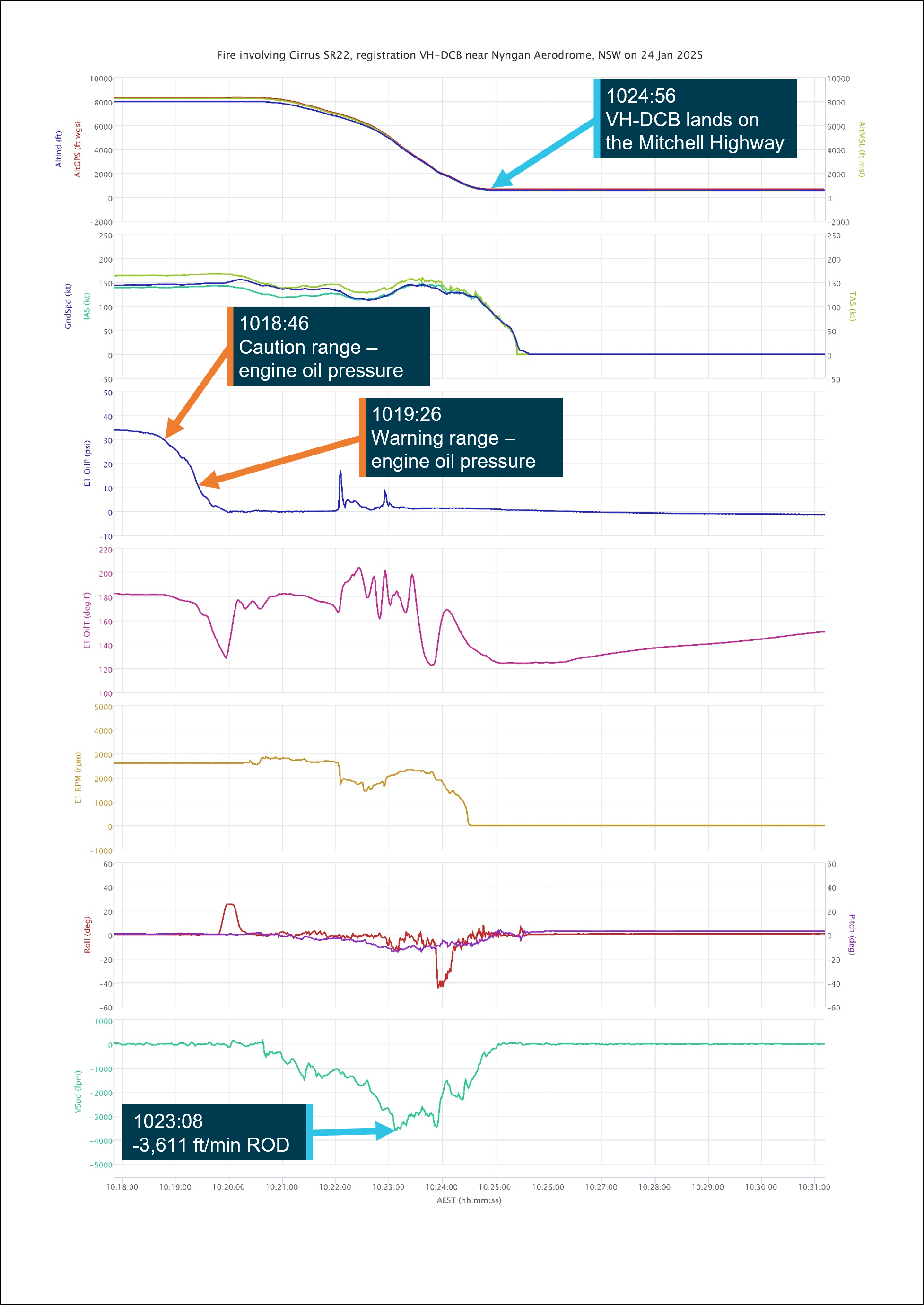
At 1023, the pilot commenced a left turn at about 5,000 ft in the direction of the Mitchell Highway. The pilot elected to ‘dive the plane down’ to supress the fire, and increased the rate of descent to over 3,600 ft/min (see Appendix A, Figure A1) and then set up for an immediate forced landing on the highway.
The pilot recalled that the fire appeared to extinguish as the aircraft descended through 4,000 ft and reported they were able to switch the fuel selector off at about 3,250 ft. However, they recalled smoke began to enter the cockpit at about 3,000 ft as the aircraft continued to descend. The pilot selected the first stage of flap and lined up on a section of the Mitchell Highway in a south‑easterly direction. On final approach, the pilot had to adjust the emergency landing flightpath to avoid 2 motor vehicles on the highway and safely conducted the emergency landing, vacating the highway onto a dirt access road at about 1024 (Figure 2).
The pilot recalled that, during the emergency, they had continuously tried to anticipate the next event or action, then evaluated the best course of action and confirmed their decision before proceeding.
The aircraft sustained minor damage to several components on the left wing as a result of colliding with roadside guideposts during the landing roll (Figure 2 right insert) and the pilot and passenger were uninjured. The New South Wales rural fire service attended the scene shortly after the aircraft had safely landed.
Figure 2: VH-DCB alongside Mitchell Highway and minor damage to left wing

Source: Operator, annotated by the ATSB
Context
Pilot information
The pilot held a Commercial Pilot Licence (aeroplane) with an instrument rating and a class 1 aviation medical certificate. They had 3,496 flight hours, including about 1,900 hours on the Cirrus SR22 and had recently logged about 40 hours on type in the last 90 days.
The pilot reported sleeping about 9 hours the night before the occurrence and had been awake for about 5 and a half hours at the time of the occurrence. They further reported that they felt ‘fully alert and wide awake’ on the day of the occurrence and were not tired or fatigued.
Aircraft information
The Cirrus Design Corporation SR22 is a low wing general aviation aircraft with 5 seats and a single piston engine, driving a constant speed propeller. The aircraft was registered as VH-DCB in Australia on 9 November 2018 to the pilot, who was the registered operator. The aircraft was certified for day and night VFR[5] and IFR[6] operations.
Powerplant
The SR22 is equipped with a single Continental Motors Inc. IO-550-N engine. The engine oil used for lubrication and cooling is drawn from an 8-quart capacity sump located in the engine crankcase. The engine had a total time in service of 1,678.5 hours and the manufacturer‑approved time between overhaul[7] was 2,200 hours total time in service.
Engine oil system
The aircraft’s pilot operating handbook required an engine oil level between 6 and 8 quarts for normal operation, with the manufacturer recommending a pre-flight dipstick indication of 7 quarts for extended flights. On the day of the occurrence, the pilot recalled that the engine dipstick was reading 8 quarts prior to departure.
Cirrus airframe parachute system
The Cirrus airframe parachute system (CAPS) was designed to lower the aircraft and its passengers to the ground in the event of a life-threatening emergency and is operated by the pilot. The CAPS system consists of a parachute, a solid-propellant rocket used to deploy the parachute, an activation handle, and a parachute harness embedded within the fuselage structure.
Maintenance history
Immediately prior to the occurrence, the aircraft had undergone a 50‑hour inspection at a Cirrus‑authorised service centre. No engine‑related defects were recorded in the aircraft maintenance certification log.
Prior to that, on 23 October 2024 at the same service centre, the engine had been inspected during an annual inspection and was certified in accordance with approved maintenance data as airworthy at a total time in service of 1,637.6 hours.
All records of inspections and maintenance tasks obtained by the ATSB in the course of the investigation were certified as being conducted in accordance with the latest revisions of the Cirrus airplane maintenance manual and the Continental maintenance manual.
The pilot recalled that they had completed the daily inspection prior to the flight, with no identified issues before certifying the daily inspection on the aircraft maintenance release.
Meteorological information
The Bureau of Metrology aviation meteorological information report, which included the graphical area forecast[8] encompassing Nyngan Aerodrome at the time of the occurrence, contained the following:
- visibility greater than 10 km
- nil significant weather or cloud
- moderate turbulence below 7,000 ft in dust devils and thermals north of Dubbo Airport.
At the time of the occurrence, the pilot stated that the weather was generally fine with good flying conditions and ‘not a cloud in the sky.’
Post-incident inspection
The pilot inspected the aircraft engine after the serious incident and found the crankcase had ruptured adjacent to cylinder 6 (Figure 3 right insert) below the induction duct assembly. They recovered a connecting rod that had separated from the crankshaft (Figure 4) and identified that the air filter was visibly damaged as a result of a fire (Figure 3 left insert). The pilot recalled performing a post‑landing dipstick check and observed that about 6 quarts of oil remained in the engine.
Figure 3: VH-DCB engine bay and damage to the air filter and crankcase

Source: Operator, annotated by the ATSB
Figure 4: Fractured connecting rod recovered from VH-DCB

Source: Operator, annotated by the ATSB
Due to the remoteness of the location, the aircraft was secured on a nearby property and the engine was retained with the fuselage until a replacement was fitted to the aircraft. Following the subsequent removal of the engine, a disassembly and inspection had not been conducted at the time of publication of this report. As a result, the ATSB was unable to determine the root cause for the loss of oil pressure or the mechanical failure of the engine.
Aircraft manufacturer’s emergency procedures
The emergency procedures section of the Cirrus SR22 pilot’s operating handbook (POH) prescribes procedures for handling emergencies and critical flight situations that may occur while operating the aircraft. The POH states:
Although this section provides procedures for handling most emergencies and critical flight situations that could arise in the aircraft, it is not a substitute for proper flight training, thorough knowledge of the airplane, and recognised piloting techniques and standards.
Additionally, the POH recommends 4 basic actions that can be applied to any emergency which include:
- maintain aircraft control
- analyse the situation
- take appropriate action
- land as soon as conditions permit.
In cases when a procedure directs a pilot to ‘land as soon as possible’, the POH states:
Land without delay at the first site at which a safe landing can be made. Continued flight beyond an available airfield at which a safe landing can be made will result in increased risk and shall not be attempted.
Loss of engine oil pressure in-flight
When engine oil pressure decreases below 10 psi the aircraft’s crew alerting system[9] (CAS) will annunciate ‘oil pressure’ in red text on the primary flight display which is accompanied by a repeating double chime audio alert. The alert prompts the pilot to carry out the following procedure contained in the emergency procedures section of the POH:
1. Oil Pressure Gauge..............................................................CHECK
◆ If pressure low / high:
a. Power..........REDUCE TO MINIMUM FOR SUSTAINED FLIGHT
b. Land as soon as possible.
(1) Prepare for potential engine failure
Procedure Complete
Engine fire in-flight
In cases of smoke and fire, the CAS will not alert the pilot to this condition. When a pilot identifies an engine fire in-flight, they must action the following items by memory:
Mixture...............................................................................CUTOFF
Fuel Pump.................................................................................OFF
Fuel Selector.............................................................................OFF
Airflow Selector.........................................................................OFF
Power lever..............................................................................IDLE
Ignition Switch...........................................................................OFF
Land as soon as possible.
Procedure Complete
The POH also contained a note which suggested that in the case of a wing fire in-flight, ‘putting the airplane into a dive may blow out the fire.’
During the occurrence, the pilot carried out their actions by memory and stated that they were unable to refer to checklists during the serious incident due to the lack of time. Although the ‘engine fire in-flight’ procedure did not direct the pilot to dive, the pilot decided that diving the aircraft would assist in extinguishing the fire in this case.
The pilot also stated that they encountered difficulty switching off the fuel selector while simultaneously flying the aircraft during the glide approach and managing the emergency. The POH stated ‘to select off, first raise the fuel selector knob release and then rotate the knob to off.’ This is not performed during normal operations which meant the pilot was not familiar with the action. The pilot also recalled turning the ignition switch off after the aircraft had landed.
Cirrus airframe parachute system deployment
The emergency section of the POH contains procedures regarding the deployment of the ballistic parachute in-flight. This section contains the following explanatory notes:
It should also be used in other life threatening emergencies where CAPS deployment is determined to be safer than continued flight and landing. Expected impact in a fully stabilised deployment is equivalent to a drop from approximately 13 feet.
A cautionary note also explains that ‘CAPS deployment will likely result in damage or loss to the airframe.’
The POH identifies several possible scenarios for deploying the CAPS:
- midair collision
- structural failure
- loss of control
- landing in inhospitable terrain
- pilot incapacitation.
No specific guidance is contained in the POH regarding the use of the CAPS in cases of in-flight smoke and fire.
Recorded information
The Garmin avionics suite installed in the SR22 included a flight data logging feature that automatically stored critical flight and engine data on a removable data card.
The ATSB was provided with the data card installed in the aircraft at the time of the occurrence. The data on the card was downloaded by the ATSB and confirmed to have contained flight data recorded during the occurrence on 24 January 2025.
Recorded data
The recorded flight data captured parameters such as engine parameters, altitude, airspeed, vertical speed, bank angle and various avionics functions (Appendix A – Recorded data). This data enabled a detailed reconstruction of the flight, providing insights into the aircraft’s performance and pilot actions during the occurrence (Figure A1).
Prior to the occurrence, the recorded flight data (Figure A2) indicated that all recorded engine parameters were within normal operating limits outlined in the powerplant limitations section of the pilot’s operating handbook prior to the loss of engine oil pressure. Table 1 depicts the normal and recorded ranges of each engine parameter from the time the aircraft became airborne at 0733:21 until the engine oil pressure decreased below the normal range of 30 psi at 1018:46.
Table 1: Recorded in-flight range prior to loss of engine oil pressure
Instrument
| Range and units | Normal range | Recorded in-flight range |
| Cylinder head temperature[10] (CHT) | 100 – 500 °F | 240 – 420 | 270 – 382[1] |
| Engine speed | 0 – 3,000 RPM | 500 – 2,700 | 2,109 – 2,693 |
| Exhaust gas temperature[11] (EGT) | 1000 – 1,600 °F | 1,000 – 1,600 | 1,118– 1,555 [2] |
| Manifold pressure (MAP) | 10 – 35 Inch Hg | 15 – 29.5 | 18 – 27.7 |
| Oil pressure | 0 – 100 psi | 30 – 60 | 30 – 48 |
| Oil temperature | 75 – 250 °F | 100 – 240 | 170 – 219 |
| Percent power | 0-100% | 0 – 100 | 38 – 94 |
| |||
Source: Operator supplied flight data card, tabulated by the ATSB
Related occurrences
The following ATSB investigations highlight the risks associated with encountering engine failures in flight, demonstrating the importance of effective decision‑making.
ATSB investigation AO-2012-154
On 21 November 2012, a Cirrus SR22 aircraft, registered VH‑WYH, departed Emerald, Queensland for Dubbo, New South Wales, on a private flight conducted under instrument flight rules. The pilot and one passenger were on board.
During the flight, the oil pressure annunciation illuminated, and the engine oil pressure indicated 30 pounds per square inch (psi). As the oil pressure continued to slowly drop, the pilot became increasingly concerned and tracked via Gilgandra, New South Wales. They overflew Gilgandra and continued on towards Dubbo, at which point the oil pressure gauge indicated about 12 psi.
Two hours and 39 minutes after the oil pressure light illuminated, the engine failed. When it became evident that a landing at Gilgandra aerodrome was not achievable, the pilot deployed the ballistic parachute. The aircraft impacted the ground and was substantially damaged with the pilot receiving minor injuries while the passenger was uninjured. The pilot reported that the oil pressure indication dropped very gradually giving a false sense of security.
ATSB investigation AO-2020-060
On 6 November 2020, the pilot of a S.E.D.E. Morane-Saulnier MS.893A (Rallye) aircraft, registered VH‑UQI, was conducting a private flight from Moruya, New South Wales, to Archerfield, Queensland. About 22 km south‑west of Archerfield Airport, the engine began running rough before eventually failing.
The pilot elected to conduct a forced landing into an open but slightly undulating paddock. The approach direction resulted in a tail wind landing. The aircraft over‑ran the open area before it impacted with a grove of trees, significantly disrupting the aircraft structure. A post‑impact fire consumed most of the fuselage. The pilot was seriously injured, and the aircraft was destroyed.
The pilot was ferrying the aircraft on behalf of the owner and had limited aircraft type experience and knowledge of its performance capabilities, and it was found that the pre‑flight planning was limited.
Safety analysis
During the investigation, the ATSB was unable to determine the initiating factor that led to the loss of oil pressure and subsequent mechanical failure of the engine. However, the recorded data from the occurrence revealed that all engine parameters were within normal operating limits prior to the loss of engine oil pressure and subsequent in‑flight mechanical failure of the engine.
After observing the oil pressure caution message, the pilot made a timely decision to divert to Nyngan Aerodrome. Being aware of the aircraft’s gliding capabilities and after the oil warning alert, they were immediately able to determine that the aircraft did not have sufficient altitude to safely conduct a forced landing at the aerodrome. They then identified the Mitchell Highway as the most suitable landing site before investigating the engine parameters.
When the engine experienced a mechanical failure, the pilot was able to immediately enact their pre‑planned forced landing procedure, declare the emergency and communicate their intention to land on the Mitchell Highway.
After observing flames and oil coming from the engine cowl, which obscured their visibility, the pilot made a timely decision and elected not to deploy the aircraft’s ballistic parachute. This was due to the pilot’s concern that the fire was fuel‑related and may affect the deployed parachute system as well as the potential risk of injury to the passenger, who was pregnant, and aircraft damage associated with a parachute‑assisted landing.
The pilot began an emergency descent, putting the aircraft into a ‘dive’ in an attempt to put out the fire. Once the fire self-extinguished, smoke entered the cockpit. However, the pilot proceeded to navigate the aircraft to land on the highway among traffic for a successful forced landing with no injuries and only limited damage.
The ATSB research report Engine failures and malfunctions in light aeroplanes, 2009 to 2014 (AR-2013-107) indicated that although engine failures are relatively rare, they do happen. Given the potential severity of the consequences of an engine failure or power loss in a single‑engine aircraft, such occurrences therefore need to be planned for and managed appropriately.
On this occasion, the pilot made effective and timely decisions to manage the evolving emergency and appropriately prioritised their actions. Their decision‑making was likely supported by their experience on the aircraft type and knowledge of the performance capabilities. This enabled prompt and appropriate responses from the pilot, which contributed to a safe outcome.
Additionally, the pilot’s methodical approach during this occurrence highlights the importance of decision-making tools to aid pilots to mitigate the possibility of errors and ensure a considered approach in resolving issues or problems (Civil Aviation Safety Authority, 2019).
Findings
ATSB investigation report findings focus on safety factors (that is, events and conditions that increase risk). Safety factors include ‘contributing factors’ and ‘other factors that increased risk’ (that is, factors that did not meet the definition of a contributing factor for this occurrence but were still considered important to include in the report for the purpose of increasing awareness and enhancing safety). In addition ‘other findings’ may be included to provide important information about topics other than safety factors. These findings should not be read as apportioning blame or liability to any particular organisation or individual. |
From the evidence available, the following findings are made with respect to the engine failure involving Cirrus SR22, VH-DCB, 29 km east-south-east of Nyngan, New South Wales, on 24 January 2025.
Contributing factors
Other findings
- The pilot exercised timely and effective decision making in flight to divert and then identify a safe forced landing area.
- The pilot successfully executed an immediate forced landing on a nearby highway while experiencing fire and reduced visibility from oil over the windscreen and smoke entering the cabin. This resulted in no injuries to the 2 occupants and only minor additional aircraft damage.
Sources and submissions
Sources of information
The sources of information during the investigation included the:
- pilot of the serious incident flight
- maintenance organisation
- Bureau of Meteorology
- Civil Aviation Safety Authority
- aircraft manufacturer
- recorded data from the GPS unit on the aircraft.
References
ATSB. (2016). AR-2013-107, Engine failures and malfunctions in light aeroplanes, 2009 to 2014. Available from /publications/investigation_reports/2013/aair/ar-2013-107.
Civil Aviation Safety Authority. (2019). Safety behaviours: human factors for pilots 2nd edition. Resource booklet 7 Decision making. Available from https://www.casa.gov.au/sites/default/files/2021-06/safety-behaviours-human-factor-for-pilots-7-decision-making.pdf.
Submissions
Under section 26 of the Transport Safety Investigation Act 2003, the ATSB may provide a draft report, on a confidential basis, to any person whom the ATSB considers appropriate. That section allows a person receiving a draft report to make submissions to the ATSB about the draft report.
A draft of this report was provided to the following directly involved parties:
- pilot of the serious incident flight
- maintenance organisation
- Civil Aviation Safety Authority
- United States National Transportation Safety Board
- Cirrus Design Corporation
- Continental Motors Incorporated.
Submissions were received from:
- pilot in command/operator
- Cirrus Design Corporation
- Continental Motors Incorporated.
The submissions were reviewed and, where considered appropriate, the text of the report was amended accordingly.
Appendices
Appendix A – Recorded data
Figure A1: In-flight data and key events after loss of engine oil pressure
Source: Operator supplied flight data card, annotated by the ATSB
Figure A2: In-flight engine parameters after loss of engine oil pressure

Source: Operator supplied flight data card, annotated by the ATSB
Purpose of safety investigationsThe objective of a safety investigation is to enhance transport safety. This is done through:
It is not a function of the ATSB to apportion blame or provide a means for determining liability. At the same time, an investigation report must include factual material of sufficient weight to support the analysis and findings. At all times the ATSB endeavours to balance the use of material that could imply adverse comment with the need to properly explain what happened, and why, in a fair and unbiased manner. The ATSB does not investigate for the purpose of taking administrative, regulatory or criminal action. About ATSB reportsATSB investigation reports are organised with regard to international standards or instruments, as applicable, and with ATSB procedures and guidelines. An explanation of terminology used in ATSB investigation reports is available here. Publishing informationReleased in accordance with section 25 of the Transport Safety Investigation Act 2003 Published by: Australian Transport Safety Bureau © Commonwealth of Australia 2025 
Ownership of intellectual property rights in this publication Unless otherwise noted, copyright (and any other intellectual property rights, if any) in this report publication is owned by the Commonwealth of Australia. Creative Commons licence With the exception of the Commonwealth Coat of Arms, ATSB logo, and photos and graphics in which a third party holds copyright, this report is licensed under a Creative Commons Attribution 4.0 International licence. The CC BY 4.0 licence enables you to distribute, remix, adapt, and build upon our material in any medium or format, so long as attribution is given to the Australian Transport Safety Bureau. Copyright in material obtained from other agencies, private individuals or organisations, belongs to those agencies, individuals or organisations. Where you wish to use their material, you will need to contact them directly. |
[1] Local time was Australian Eastern Standard Time (AEST), which is Coordinated Universal Time (UTC) +10 hours. Times in this report are AEST unless otherwise noted.
[2] Glide ratio: the glide ratio of an aircraft is the distance of forward travel divided by the altitude lost in that distance. The Cirrus SR22 pilot’s operating handbook stated the maximum glide ratio for the aircraft was 8.8:1.
[3] PAN PAN: an internationally recognised radio call announcing an urgency condition which concerns the safety of an aircraft or its occupants but where the flight crew does not require immediate assistance.
[4] MAYDAY: an internationally recognised radio call announcing a distress condition where an aircraft or its occupants are being threatened by serious and/or imminent danger and the flight crew require immediate assistance.
[5] Visual flight rules (VFR): a set of regulations that permit a pilot to operate an aircraft only in weather conditions
generally clear enough to allow the pilot to see where the aircraft is going.
[6] Instrument flight rules (IFR): rules which allow properly equipped aircraft to be flown under instrument meteorological
conditions
[7] Time between overhaul: is a time limit specified by the engine manufacturer for a specific engine in a specific installation, after which overhaul is either recommended or mandated depending on how the aircraft is used.
[8] Graphical area forecast (GAF) is a combination of graphical and textual information. The graphic is divided into areas that share common weather characteristics which are detailed in an associated table.
[9] Crew alerting system (CAS): aircraft annunciations and alerts are displayed in the CAS window located to the right of the altimeter and vertical speed indicator. Aircraft annunciations are grouped by criticality and sorted by order of appearance with the most recent message on top.
[10] Cylinder head temperature (CHT): CHT is measured by a temperature-sensing probe located at the cylinder head, and it measures heat energy wasted during the power stroke, when the cylinder is under maximum stress from high internal pressures and temperatures.
[11] Exhaust gas temperature (EGT): is a measurement of the temperature of the exhaust gases at the exhaust manifold.
Occurrence summary
| Investigation number | AO-2025-004 |
|---|---|
| Occurrence date | 24/01/2025 |
| Location | 29 km east-south-east of Nyngan |
| State | New South Wales |
| Report release date | 15/08/2025 |
| Report status | Final |
| Investigation level | Short |
| Investigation type | Occurrence Investigation |
| Investigation status | Completed |
| Mode of transport | Aviation |
| Aviation occurrence category | Abnormal engine indications, Engine failure or malfunction, Fire, Forced/precautionary landing, Smoke |
| Occurrence class | Serious Incident |
| Highest injury level | None |
Aircraft details
| Manufacturer | Cirrus Design Corporation |
|---|---|
| Model | SR22 |
| Registration | VH-DCB |
| Serial number | 4651 |
| Sector | Piston |
| Operation type | Part 91 General operating and flight rules |
| Departure point | Gold Coast Airport, Queensland |
| Destination | Mildura Airport, Victoria |
| Damage | Minor |