

Final report
Report release date: 29/01/2026
Investigation summary
What happened
On 15 January 2025, the pilot of a Piper PA-28-181 aircraft was conducting a flight between Bankstown Airport and Orange Airport, New South Wales, under visual flight rules (VFR). The pilot held a Private Pilot Licence (Aeroplane) (PPL‑A) and was conducting a solo flight to gain command flight experience required to obtain a Commercial Pilot Licence (Aeroplane). Although the pilot held a PPL‑A, they were required to obtain a flight authorisation from a supervising instructor, as a condition of hiring the aircraft from the operator, Basair.
The weather at Bankstown Airport at the time of departure was below the visual meteorological conditions (VMC) required for flight under VFR. However, prior to departure the pilot and authorising instructor did not review the local weather observations or otherwise identify that the weather was not suitable for a VFR flight.
Although the pilot was subsequently advised by the Bankstown Tower air traffic controller that the zone was not VMC, they decided to depart Bankstown Airport under a special VFR clearance, which is a clearance that allowed for flight in reduced visibility and distance to cloud than normal VFR while operating in controlled airspace. However, soon after take-off, the aircraft entered adverse weather conditions, which were presented on the local weather observations. While manoeuvring to avoid cloud, the pilot attempted to fly between a gap in the clouds. The gap closed and the aircraft inadvertently entered cloud.
After completing a 180° turn, in an attempt to return to VMC, the aircraft remained in cloud. The pilot then contacted the Bankstown Tower and advised them of the situation. The Bankstown Tower controller provided traffic information about a nearby instrument flight rules (IFR) aircraft to the pilot, along with further navigation assistance to regain visual flight conditions.
The aircraft then returned to Bankstown with no damage and the pilot was uninjured.
What the ATSB found
The ATSB found that the pilot’s decision to depart was probably influenced by self‑imposed internal pressure to complete the flight, which resulted in them requesting a departure from Bankstown Airport under special VFR. This decision resulted in the pilot finding themselves in adverse weather conditions and unable to maintain VMC. The aircraft subsequently entered cloud, increasing the risk of:
- spatial disorientation
- collision with terrain while operating below the lowest safe altitude
- collision with an aircraft operating under the instrument flight rules.
The ATSB also identified that the instrument training the pilot received to escape inadvertent entry to cloud assisted in their safe return to visual conditions.
What has been done as a result
At the time of writing Basair was implementing changes to its processes regarding when students may request special VFR prior to departure, and how such requests were reviewed and approved by instructors.
Safety message
Between the beginning of 2020 and end of 2025, the ATSB recorded 57 occurrences of VFR aircraft entering instrument meteorological conditions (IMC), resulting in 8 fatal accidents and 17 people fatally injured. Early assessment of weather conditions combined with early decisions to land at suitable nearby airports or to delay/not depart, are still the best way to prevent VFR pilots flying into IMC. Forecasts are only an expectation of the weather. Where possible, pilots should utilise local and current observations of the weather conditions to determine if the conditions are suitable. Tools such as the Civil Aviation Safety Authority’s Flight planning - Standing personal minimums checklist can also be helpful for determining if the conditions are suitable for your experience level. Navigating the margins with Special VFR | Flight Safety Australia, may assist pilots in their decision‑making regarding when it is appropriate to use special VFR.
If a pilot inadvertently enters IMC, they should fly the aircraft first with reference to instruments and inform air traffic control. Additionally, if an autopilot is fitted to the aircraft, it can be a valuable tool to assist a pilot who is competently trained in its use.
The occurrence
On the morning of 15 January 2025, the pilot of a Piper PA-28-181 aircraft, registered VH‑BTN (BTN) planned to conduct a flight between Bankstown Airport and Orange Airport, New South Wales, under the visual flight rules (VFR).[1] The pilot held a Private Pilot Licence (Aeroplane) (PPL‑A) and the aircraft was hired from Basair to support the development of cross-country command capability and decision-making experience required for the issue of a Commercial Pilot Licence (Aeroplane).
Pre-flight preparation
After arriving at Bankstown Airport at 0604 local time, the pilot obtained weather information from Airservices Australia and completed their pre‑flight planning. At 0700, the pilot attended a scheduled authorisation briefing with an instructor, along with 3 other pilots. Although the pilot held a PPL‑A, due to their low level of command experience, the operator required an instructor to authorise the flight.
During the authorisation briefing, the instructor reviewed the weather with all 4 students and discussed the threat posed by low cloud forecast near the Blue Mountains and the possibility of not being able to complete the flight. At the conclusion of the briefing, only the occurrence pilot was assessed as having completed the required planning and preparation to be authorised. In interview with the ATSB, the instructor stated they reviewed the visual meteorological conditions[2] (VMC) criteria with the students and explained that they should return to Bankstown if VMC could not be maintained.
The Bankstown Airport forecast obtained by the incident pilot at 0604 indicated that the weather would not be suitable for departure from Bankstown due to low cloud. However, the amended forecast for Bankstown Airport, issued at 0650, indicated that the low cloud layer would lift at 0800, making a VMC departure possible. Both the supervising instructor and occurrence pilot reviewed this forecast, however the current weather observations and automated terminal information service[3] (ATIS) information were not considered during the briefing.
At the end of the authorisation briefing, the instructor signed the command flight record, which approved the pilot to conduct the occurrence flight.
The flight
Prior to taxiing, the pilot accessed the ATIS that reported the presence of overcast[4] cloud at 1,000 ft above ground level. At 0832, the pilot requested and obtained taxi clearance, and taxied as instructed by the Bankstown Ground controller to runway 29R.[5] At 0840 the following communication exchange occurred:
0840:42 BTN: ‘Bankstown Tower, Archer Bravo Tango November at holding point alpha 8, 29R ready for an upwind departure’
0840:47 Bankstown Tower: ‘Bravo Tango November the zone is not VMC, advise’
0840:53 BTN: ‘Bravo Tango November request special VFR’
At 0843 the pilot was cleared for take-off and departure under special VFR (see the section titled Visual flight rules). At 0846 the pilot communicated to Bankstown Tower that they were leaving the Bankstown airspace. At approximately 0848, flying at 1,500 ft above mean sea level (AMSL), the pilot made a left turn to fly between a gap in the clouds. As they passed through the gap, the gap closed and visual reference of both the horizon and ground were lost.
Finding themselves in cloud, the pilot did as they had been previously trained for such circumstances and focused on their instruments to conduct a 180° turn in an attempt to return to visual conditions. However, the turn completed by the pilot exceeded 180° and the aircraft did not return to VMC (Figure 1). The pilot later reported to the ATSB that, while operating in cloud, they believed the aircraft was in a safe position and under control thanks to their training.
However, while still in cloud, the pilot became alarmed about a potential collision risk with other aircraft when they recognised on their GPS that they were near Prospect Reservoir, a Bankstown Airport inbound reporting point.
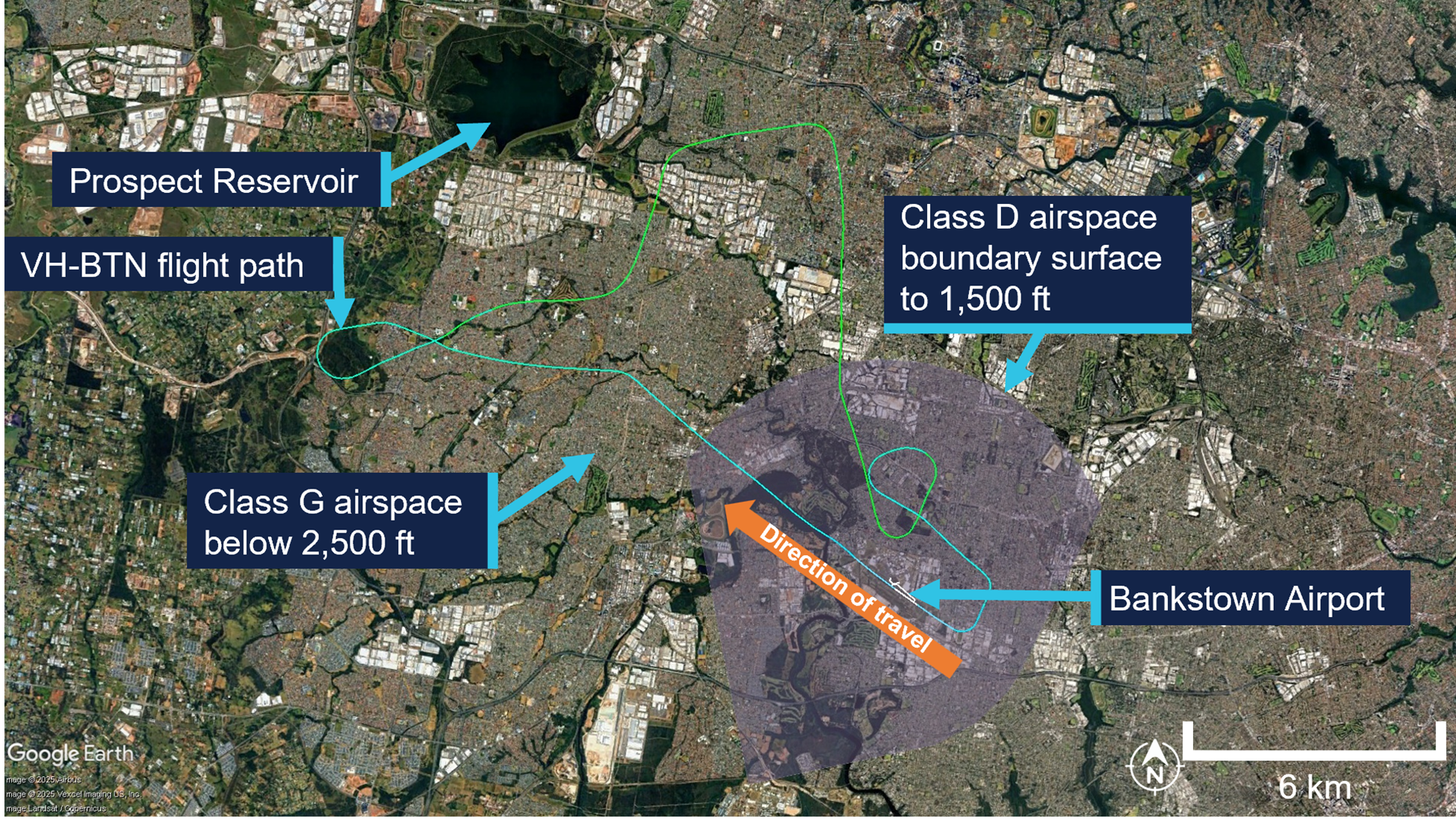
Source: Flight Radar 24 flight data on Google Earth, annotated by the ATSB
At 0850, the pilot advised the Bankstown Tower controller that they were in IMC just outside the controlled area. At this time, the controller advised the pilot of an instrument flight rules (IFR)[6] aircraft that had departed Bankstown and was 1.5 NM (2.8 km) east of their position, tracking west bound and climbing through their altitude. The pilot of VH‑BTN replied that they were unable to see anything.
VH-BTN entered cloud at approximately 1,500 ft AMSL in an area where the lowest safe altitude was 2,500 ft AMSL (see the section titled Lowest safe altitudes). Once traffic separation was assured, the Bankstown Tower controller advised the pilot to climb above the cloud and the lowest safe altitude. The pilot responded they were climbing above the cloud and, a short time later, the controller suggested the pilot should climb to 2,500 ft. At 0851 the pilot reported that they were now above the cloud. The tower controller provided the pilot with suggested tracking to return to Bankstown and advised that there was a gap in the cloud over the airport sufficient to descend through.
The pilot returned to the airport, landing shortly after 0858.
Context
Pilot information
Pilot in command
The pilot in command held a Private Pilot Licence (Aeroplane) (PPL-A) issued on 15 October 2024[7] and a class 1 aviation medical certificate valid until 8 October 2025. They had a total flight experience of 92 hours, of which 86.2 hours were obtained on PA‑28 type aircraft.
The pilot reported they had approximately 25 hours experience as pilot in command of an aircraft. The pilot had also accrued 6.7 hours of instrument flight experience.
In a post-occurrence survey completed by the pilot in command, they described that at the time of the occurrence, their fatigue level was ‘very lively and responsive, but not at their peak’.
Supervising instructor
The supervising instructor held a Commercial Pilot Licence (Aeroplane) (CPL-A) issued on 5 July 2021 and a class 1 aviation medical valid until 13 May 2025. Their grade 2 instructor rating was issued on 3 April 2024.
On the day of the incident, the supervising instructor’s schedule was to conduct flight authorisations from 0700–0800 and then attend a staff meeting from 0800–0830.
Aircraft information
The aircraft was a Piper PA-28-181, which was manufactured in 2003 in the United States of America and issued serial number 2843564. It was first placed on the Australian register in March 2017.
The aircraft was powered by a Lycoming O-360-A4M engine driving a 2‑bladed Sensenich propeller. It was certified for instrument flight rules (IFR) flight and was equipped with 2 Garmin 430 GPSs and an S-Tec autopilot system. According to the aircraft maintenance release, all systems were serviceable at the time of the incident.
Airspace
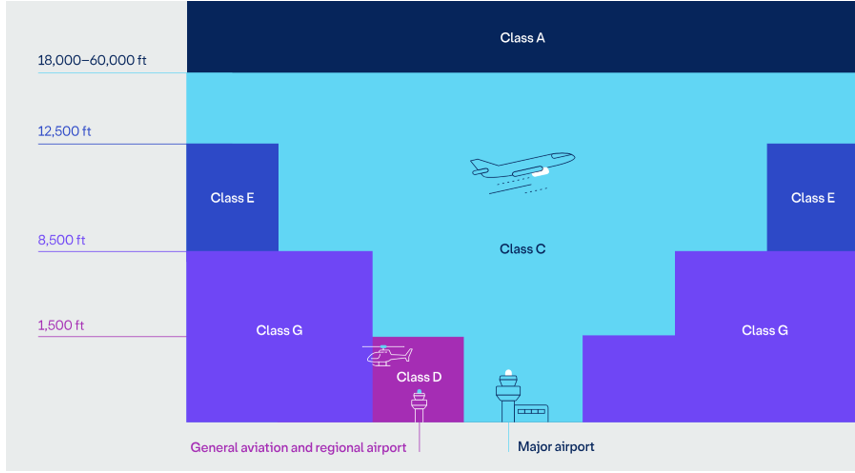
Australia’s airspace is broken into different classes, which have different operating rules (Figure 2). The 2 classes relevant to this incident are Class D and Class G.
Class D airspace is often used at high-density traffic airports, which have a control tower, and is mostly used by general aviation aircraft. It requires pilots to obtain a clearance from an air traffic controller to arrive and depart the airport. Bankstown Airport was a metropolitan Class D airport.
Class G airspace is the areas that are not otherwise classified. It does not require a clearance and is non-controlled. Pilots are responsible for their own separation from other aircraft in this airspace.
Figure 2: Australian airspace structure
Source: Airservices Australia
Bankstown Airport
When active, Bankstown Tower provided Air Traffic Services in the Class D airspace surrounding Bankstown Airport. The Class D airspace extended from the ground to 1,500 ft.
Bankstown Airport had 3 runways in the 29 direction. They were designated 29L, 29C, and 29R. When the 29 runways were in use, the local traffic regulations required departing aircraft to climb and maintain 1,000 ft AMSL until leaving the controlled airspace. This required a minimum cloud height of 1,500 ft to comply with Class D airspace visual meteorological conditions (VMC) during departure (see the section titled Visual flight rules).
Aircraft leaving Class D airspace in a westerly direction at 1,000 ft AMSL enter Class G airspace.
Lowest safe altitudes
To ensure safe flight under IFR or VFR at night, pilots who have received training for these flight activities will be aware of the requirement to calculate and comply with lowest safe altitude (LSALT) requirements. LSALT is the lowest altitude that will provide safe terrain clearance at a given place.
There are multiple ways of determining the LSALT in a specific area. It can be extracted from maps, an airport’s departure and approach procedure plate, manually calculated, or ATC can provide assistance to pilots in determining a safe altitude.
The expectation is that VFR pilots will continually see and avoid terrain. Therefore, they are not required to calculate the LSALT prior to flight. The lowest available LSALT for the area within 15 NM (28 km) of Bankstown Airport was 2,500 ft.
The pilot was unaware of the LSALT in the area where they entered IMC.
Meteorological information
The operator provided the ATSB with scanned copies of the pilot’s flight planning materials. This included the meteorological information they used to plan their flight.
The Bureau of Meteorology provided weather forecasts and observations for the day of the incident. The Bankstown Airport terminal aerodrome forecast (TAF) issued at 0604 forecast variable winds at 3 kt, flight visibility of 10 km and broken[8] cloud at 800 ft above the airport elevation. The TAF did not forecast an improvement of cloud conditions to meet the VMC requirements until 1300 (see the section titled Visual flight rules).
A SPECI[9] for Bankstown Airport issued at 0600 included overcast cloud at 1,100 ft recorded by the automatic weather station, consistent with the forecast low cloud on the TAF. Significantly, the cloud base and extent in this observation were below that required for a standard VMC departure in Class D airspace:
SPECI YSBK 141900Z AUTO 13003KT 9999 // OVC011 23/21 Q1003 RMK RF00.0/000.0
An amendment to the Bankstown TAF was issued at 0650. The forecast at that time showed broken cloud at 1,300 ft and improving from 0800 to scattered cloud at 1,500 ft:
TAF AMD YSBK 141950Z 14119/1512
VRB03KT 9999 BKN013
FM142100 VRB03KT 9999 SCT015…
Additionally, Airservices Australia provided the ATSB with the Bankstown Airport automatic terminal information service (ATIS) from 0830, designated information ‘Delta’.
Information Delta stated:
- overcast cloud was present at 1,000 ft
- runway 29 right, centre, and left were in use
- arriving aircraft should expect an instrument approach.
VH-BTN called for taxi clearance at 0832 advising air traffic control (ATC) they had received information ‘Delta’.
The automated SPECIs for Bankstown Airport between 0700 and 0900 all showed overcast cloud at 1,100 ft.
While the amended TAF issued at 0650 indicated the weather was improving and would be suitable for a VMC departure, the actual observations from Bankstown Airport at the departure time showed that weather conditions did not support a departure without the use of special VFR.
Specifically, at 0830 (13 minutes prior to take-off), the airport observation recorded the cloud as overcast at 1,100 ft. The subsequent Bankstown Airport weather observations recorded that the cloud base lifted and reduced in sky coverage from 0900 (28 minutes after the original taxi time) – broken cloud was at 1,300 ft. At 0930 the observation recorded broken cloud at 1,500 ft.
The supervising instructor stated that their briefing highlighted the threat presented by low cloud forecast over the Blue Mountains. To mitigate the risk of students flying into IMC, the supervising instructor quizzed them on the VMC requirements in Class G airspace (see the section titled Visual flight rules).
The supervising instructor also stated that from the time of the student’s booking, the weather was supposed to improve to scattered cloud at 1,500 ft.
The supervising instructor did not consider the actual weather observations in the vicinity of the airport at the time of departure. Instead, they reviewed the expected conditions based on the weather forecast. Neither the pilot nor the supervising instructor recalled discussing delaying the departure. While the pilot did listen to the ATIS prior to taxi, at that time, they had already received the required flight authorisation.
Visual flight rules
The flight was planned to operate under the visual flight rules (VFR), which required the pilot to continuously maintain VMC. The Civil Aviation Safety Authority’s (CASA) Civil Aviation Safety Regulations 1998 stated:
91.280 VFR flight–compliance with VMC criteria
(1) The pilot in command of an aircraft for a VFR flight contravenes this subregulation if, during the flight, the aircraft is not flown in accordance with a requirement of the VMC criteria for the aircraft and the airspace in which the flight is conducted.
(2) Subregulation (1) does not apply to a flight of an aircraft if:
(a) air traffic control has authorised the pilot in command of the aircraft to conduct the flight under the special VFR; and
(b) the pilot in command complies with the special VFR.
The requirements for VMC differed depending on the airspace and altitude at which the aircraft operated.
Class D
The conditions required to maintain VMC in class D airspace were:
- minimum flight visibility 5,000 m
- minimum distance from cloud
- 600 m horizontal
- 1,000 ft vertically above cloud
- 500 ft vertically below cloud
Class G
The conditions required to maintain VMC in class G airspace below 3,000 ft AMSL or below 1,000 ft above ground level (whichever was higher) were:
- minimum flight visibility 5,000 m
- remain clear of cloud
- maintain sight of ground or water
Special VFR
The CASA visual flight rules guide stated:
By day, when VMC do not exist, the ATC unit responsible for a control zone (CTR) or control area (CTA), at your request may issue a ‘special VFR clearance’ for flight in the CTR, or in a CTA next to the CTR, for the purpose of entering or leaving the CTR, providing an IFR flight will not be unduly delayed.
The conditions required to maintain VMC while operating with a special VFR authorisation were:
- minimum flight visibility 1,600 m
- remain clear of cloud.
The CASA flight safety publication Navigating the margins with special VFR stated that it is most often requested under the following circumstances:
• departures, where the pilot can see a path to VMC outside controlled airspace
• arrivals, when weather at the aerodrome is marginal but the pilot is visual
• transits, particularly in coastal areas prone to mist or patchy fog.
Additionally, CASA highlights the risks involved when flying under the special VFR:
• choosing special VFR due to less-than-VMC cloud conditions means reducing the margin for error, often bringing you closer to terrain and risking inadvertent IMC
• if visibility is the issue, you’ll be reducing your forward visual window, requiring intense concentration, greater situational awareness and rapid decision-making
• even after receiving a Special VFR clearance to depart controlled airspace, you will need to ensure you can meet normal VMC criteria as soon as you leave that airspace, and the clearance no longer applies.
The publication provides the following warning to pilots:
But Special VFR is not a workaround for poor planning or an excuse to press on. It’s a tool to be used deliberately and sparingly, and with careful consideration. If better options exist – such as diverting, delaying or requesting IFR clearance – they’re often safer.
The authorising instructor stated that they did not anticipate the pilot’s use of special VFR and did not expect they would be able to depart Bankstown Airport if the airport conditions were not VMC.
During interview with the ATSB, the pilot stated that they heard other aircraft in the area requesting special VFR and, while not fully understanding what they were requesting, they believed it would facilitate their departure. They also believed that the weather conditions would be suitable for the navigation exercise if they could depart the Bankstown Airport controlled airspace.
VFR into IMC
Between 2016 and 2025 (inclusive), the ATSB occurrence database recorded 105 occurrences of VFR aircraft entering IMC conditions. About 1 in 10 of these occurrences resulted in a fatal outcome.
Sensory illusions and spatial disorientation
One of the dangers associated with VFR into IMC is that, without a visual reference such as the horizon, pilots who have not received specialised training are vulnerable to sensory illusions and often become spatially disoriented.
The ATSB’s Accidents involving Visual Flight Rules pilots in Instrument Meteorological Conditions (2019) stated:
…for a non-instrument rated pilot, even with basic attitude instrument flying proficiency, maintaining control of an aircraft in IMC by reference to the primary flight instruments alone entails a very high workload that can result in narrowing of attention and loss of situational awareness.
The CASA AvSafety publication Spatial disorientation (CASA) stated:
Flying into poor weather without the right training and experience can rapidly lead to spatial disorientation which is a potentially dangerous anatomical reaction to an unnatural situation.
This publication describes various somatogyral[10] and somatogravic[11] illusions that may be experienced by pilots who find themselves in IMC. These illusions result from a human body’s misinterpretation of what is occurring, and often lead to spiral dives, spins, and aerodynamic stalls. Occurrence of these illusions increase the risk of a fatal accident occurring.
Recovery from inadvertent entry to IMC
Industry guidance
CASA provided multiple resources for assisting VFR pilots with preventing inadvertent entry to IMC.
The AvSafety Flying into bad weather (CASA) publication stated:
Flying into bad weather without the right training and experience can rapidly lead to spatial disorientation.
It provided multiple points of advice to pilots which included:
• Maintain control – fly the aircraft first.
• Make decisions early. When in doubt, turn about, divert or hold in an area of good weather.
• Make a 180-degree rate 1 turn – establish on instruments early.
• If you need assistance, ask ATC. They are there to help you.
Additionally, CASA’s Visual flight rules guide stated:
The dangers of VFR pilots flying into IMC have been recognised for a very long time, yet they still fly into deteriorating weather and IMC.
Pilot decision-making, particularly regarding weather and flight, is often complex; however, the solution to avoiding VFR into IMC when weather is marginal before take-off is not to depart. During flight, it is to turn back or divert before it becomes impossible to do so.
Accidental flight into cloud can be prevented by always ensuring you have a defined horizon above the terrain and below the cloud and, when this is not the case, deciding early to turn back or divert.
The CASA Flight Safety article Caught in the clouds (2024) recognised the dangers of high workload and spatial disorientation attributed to VFR into IMC occurrences and advised using modern equipment to assist pilots, where they are adequately trained.
Another way to fly out of cloud is to use the aircraft’s systems. Modern GPS equipment often includes basic variations of ground proximity (GPWS) and terrain awareness warning systems (TAWS). Although individual commercial brands are largely unregulated, they can still offer some degree of obstacle awareness in the absence of any visual references. Before using uncertified GPWS/TAWS, check you are adequately trained to use them properly.
The Federal Aviation Administration (FAA) safety publication Fly the aircraft first (FAA, 2018) highlighted the well-known slogan ‘aviate, navigate, communicate’. This is a simple way of prioritising the fundamental tasks that a pilot must complete. The highest priority is flying the aircraft and managing the flight path. Then the pilot needs to determine where they are and where they are going. Finally, the pilot should communicate their intentions to other traffic and/or ATC.
Regulations regarding Instrument flight training
The CASA Civil Aviation Safety Regulations 1998 Part 61 Flight crew licencing stated the following instrument flight experience requirements for the issue of the relevant licence:
• 61.525 Aeronautical experience requirements for grant of private pilot licences—aeroplane category…
(e) at least 2 hours of dual instrument time; and
(f) at least one hour of dual instrument flight time in an aeroplane.
• 61.590 Aeronautical experience requirements for grant of commercial pilot licences—aeroplane category…
(d) at least 10 hours of instrument time; and
(e) at least 5 hours of instrument flight time in an aeroplane.
The 61.475 Requirements to grant recreational pilot licences did not state a minimum instrument flight experience requirement.
The CASA Manual of Standards Part 61 described the skills and knowledge requirements to meet the competency standards for full instrument panel manoeuvres. The following requirements were necessary to issue an RPL‑A, PPL‑A, or CPL‑A.
• IFF.1[12] – Determine and monitor the serviceability of flight instruments and instrument power sources
• IFF.2 – Perform manoeuvres using full instrument panel
• IFF.3 – Recover from upset situations and unusual attitudes
The range of variables across which these criteria are to be applied included conducting a 180° turn to re-establish visual flight, which was consistent with the operator’s training.
IFF Full instrument panel manoeuvres
3 Range of variables
(c) for RPL, PPL, CPL licence and multi-engine aeroplane class rating training and assessment, day VFR simulated inadvertent entry into IMC with a level 180° turn to re‑establish visual flight
Autopilot use
An autopilot manipulates the aircraft flight controls on behalf of the pilot, to either maintain a desired aircraft state or transition to a new desired aircraft state. A wide range of autopilot systems are fitted to General Aviation aircraft; these systems differ in capability and complexity.
Autopilot use can reduce the pilot’s workload and susceptibility to spatial disorientation allowing a pilot to focus on scanning instruments and managing the situation.
The FAA Instrument flying handbook (FAA, 2012) stated:
The autopilot should be utilized to reduce workload, which affords the pilot more time to monitor the flight. Utilization of the autopilot also decreases the chances of entry into an unusual attitude.
Additionally, the Advanced avionics handbook (FAA, 2009) stated:
…autopilot can be extremely useful during an emergency. It can reduce pilot workload and facilitate efforts to troubleshoot the emergency.
The United Kingdom Civil Aviation Authority Civil Aviation Publication 2960 Safety Sense, VFR flight into IMC (UK CAA, 2024) stated:
When an unanticipated entry into IMC occurs, you may experience spatial disorientation. This occurs when your perception of the aircraft’s position, attitude, or motion does not align with reality. You may make control inputs based on this false perception, and experience loss of control.
If the aircraft has an autopilot, engaging it will allow you to retain control of the aircraft and free up capacity for situational awareness.
The Airservices Australia In-flight emergency response checklist (Airservices Australia, 2024), contained a checklist for ATC personnel to apply when assisting a pilot who has inadvertently entered IMC. This included the suggestion for pilots to utilise their autopilot to assist in cases of inadvertent entry to IMC. The ATC checklist stated:
Instruct pilot:
• no abrupt manoeuvres
• shallow climbs/descents/turns
• turn first, establish straight and level then climb/descend
• suggest use of autopilot if equipped and competent.
Autopilot safety concerns
Autopilots can be an extremely useful tool for pilots who are competent in their use. However, autopilots can be complex, and research has found that in some cases increasing the level of automation can result in undesired aircraft states.
The Federal Aviation Administration’s Advanced Avionics Handbook (2009) states that programming complex functions of an autopilot can increase workload. Additionally, over‑reliance on automation can reduce manual handling skills which are necessary if the system fails or it becomes safer to reduce the level of automation.
Servo actuators commanded by the autopilot to control the aircraft can also fail and manually opposing an autopilot servo can also result in significant flight control forces. These can result in loss of control and pilots flying aircraft with such systems should be familiar with the emergency checklists associated with recovering from these events. These concerns, and others relevant to the autopilot system, should be addressed when training and assessing someone as competent.
Organisational information
The operator held a CASA-issued Air Operators Certificate with Part 141 and 142 Flight training approval. They were a registered training organisation and provided flight training across 2 locations in single and multi-engine aircraft.
Student loan
The operator provided training for the qualification AVI50222 Diploma of Aviation (Commercial Pilot Licence – Aeroplane). Students enrolled in this qualification could take advantage of the vocational education and training (VET) student loans programs.
The VET student loans program was an Australian Government initiative designed to financially support higher education students in areas of high industry need. The occurrence pilot was enrolled in the VET student loans program, which required compulsory repayment when the loan holder’s income was above the threshold.
Recency requirements
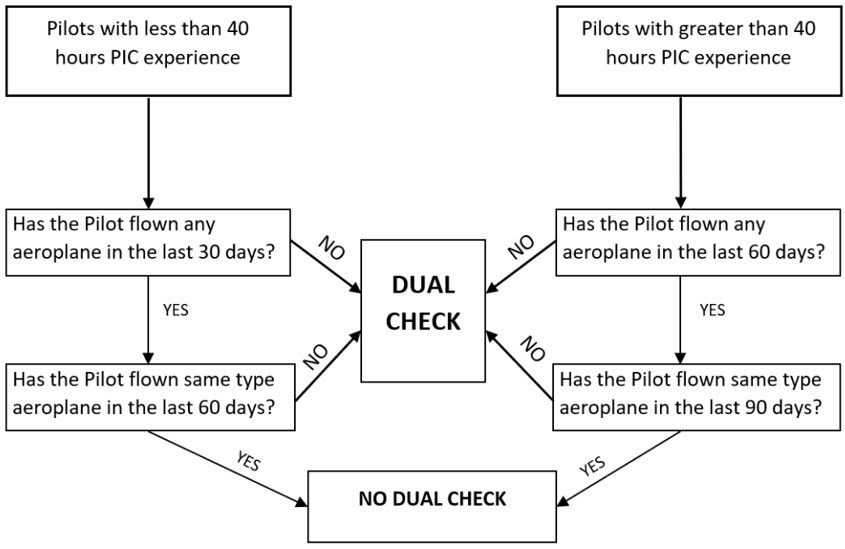
The operator’s flight training manual stated licensed pilots were not to act as pilot in command of a school aircraft unless they had complied with the company’s recency requirements (Figure 3).
Figure 3: Operator recency requirement flow chart
Source: Operator
The pilot previously flew on 19 December 2024. As they had less than 40 command hours, their recency was set to expire on 18 January 2025, 3 days after the planned flight.
Basair informed the ATSB that if the pilot’s 30-day recency had not expired, a single take-off and landing was sufficient to reset their recency. The pilot stated that they were aware of this prior to commencing the cross-country[13] flight, however, they also believed that circuits were not available due to the prevailing weather at the time they departed Bankstown Airport.
If a flight, which included a single take-off and landing, was not completed in the 30 days, a dual check flight with an instructor was required. This flight would include circuits, abnormal procedures, arrival and departures from another aerodrome. The operator stated that the duration of this flight was expected to be 1.5 to 2.0 hours, costing approximately $910, plus any applicable aerodrome landing fees. The cost of a dual check flight required when a student did not maintain recency was not covered by the loan program.
During the post-occurrence interview with the ATSB, the pilot stated that their recency was about to expire, and they noted the financial consequence of this. They also stated that the day of the occurrence was the best forecast weather before their recency expired and that completing the flight would remove their concern about its expiration.
Solo flight authorisation
Prior to the operator approving solo flights, students, including those who held a PPL‑A, were required to complete the flight authorisation procedure and obtain authority from the supervising instructor on duty. The operator’s Authorise and conduct solo operations procedure stated:
Each student will present their documents to the supervising instructor for review. The following documents must be checked:
• Licence, Medical, ARN[14], ELP[15] valid and appropriate for flight
• Training file stating competency for solo flight
• Maps, charts, ERSA[16] in date, covering the area of operation
• Check aircraft MR[17] suitable for operations
If there is an element that prevents the student from operating solo, the student’s flight should be cancelled.
Additionally, the supervising pilot was required to provide a threat and error management briefing. The procedure also provided the structure of this briefing:
Beginning with the base aerodrome, the supervising instructor will brief the NOTAMs[18] and associated weather. The briefing will continue with a focus to the local training area. Once the local area has been briefed, the supervising instructor will authorise the pilots conducting local operations.
The briefing will continue to include all enroute weather, airspace, terrain and aerodromes for the area of operations.
Training
Instrument flight training
The operator provided training to pilots to assist them in the case of inadvertent entry to IMC. Their Recreational Pilot Licence (Aeroplane) (RPL‑A) training lessons included basic instrument flight in a simulator and in an aircraft. Students were required to show competency in the following:
- determine and monitor the serviceability of flight instruments and instrument power sources
- perform manoeuvres using full instrument panel
- recover from upset situations and unusual attitudes
The ATSB conducted interviews with the pilot in command and the supervising instructor. The pilot in command told the ATSB they had completed instrument flight training where they were trained to use their flight instruments, conduct a rate 1[19] 180° turn and fly out of the cloud. The supervising instructor confirmed that the training described by the pilot was a standard syllabus requirement.
Special VFR
The operator stated that special VFR was outlined to students during their aviation legislation theory classes and that it was mainly to help the pilot to conduct a safe arrival and landing in controlled airspace.
During an interview with the ATSB, the pilot stated they had heard other aircraft in the area requesting special VFR. They had not previously used special VFR, and they were unsure of what to expect from a special VFR clearance. However, they believed it would assist in obtaining a departure clearance from the aerodrome.
Autopilot training
The pilot reported they were aware the aircraft had an autopilot but had never used it in any aeroplane and did not know how to turn it on. The pilot’s recollection was consistent with the supervising instructor who informed the ATSB that PPL‑A level trained pilots were not taught how to use an autopilot.
Regulatory information
Minimum altitude
The CASA Civil Aviation Safety Regulations 1998 Part 91 General operating and flight rules stated that aircraft flying over populus areas or public gatherings were not to be flown at less than 1,000 ft above the highest obstacle or ground feature within a 600m horizontal radius unless certain circumstances applied. In this case, the extent of cloud and its low base provided very little margin to attempt VMC operation while maintaining a minimum of 1,000 ft over the populous area to the west of Bankstown Airport.
Pre-flight weather review
The CASA Manual of Standards Part 91 Chapter 7 Flight preparation (weather assessments) requirements stated that the pilot in command must study authorised weather forecasts and authorised weather reports for:
- the route to be flown
- the departure aerodrome
- the destination aerodrome
- any planned alternate aerodromes
- any other reasonably available weather information that is relevant to the intended operation.
Furthermore, the CASA Manual of Standards Chapter 10 Matters to be checked before take-off stated:
The prescribed checks are the following:
a) check to confirm that each aerodrome, air route and airway facility that the pilot plans to use for the flight will be available, suitable and safe for use.
General competency requirement
The CASA Civil Aviation Safety Regulations 1998 Part 61 61.385 Flight crew licencing–Limitations on exercise of privileges of pilot licences—general competency requirement stated:
(1) The holder of a pilot licence is authorised to exercise the privileges of the licence in an aircraft only if the holder is competent in operating the aircraft to the standards mentioned in the Part 61 Manual of Standards for the class or type to which the aircraft belongs, including in all of the following areas:
a) operating the aircraft’s navigation and operating systems.
CASA informed the ATSB that this included the autopilot, when fitted to an aircraft, even when the pilot did not intend to use such systems.
Related occurrences
VFR into IMC and collision with trees involving Cessna 182T, VH-TSS, 57 km south-east of Mount Surprise, Queensland, on 16 June 2025 (AO-2025-028)
About 35 minutes after initiating an in-flight diversion due to poor weather, the pilot descended the aircraft to about 500 ft above ground level, following a road. As they tracked towards rising terrain, their height reduced to about 200 ft above ground level. The pilot recalled that suddenly conditions ahead became a ‘white-out’ and they commenced a left turn and reduced the aircraft’s power in an attempt to avoid flying into the cloud.
During the turn the aircraft entered cloud and the pilot lost visual reference with the ground. Recorded data indicated the aircraft conducted a 360° left turn with several changes in altitude and coming in close proximity to terrain before the pilot could engage the autopilot to attempt to stabilise the aircraft.
The pilot then commanded a 180° left turn using the autopilot, intending to return to visual meteorological conditions. However, as the aircraft climbed, the air speed reduced and the aircraft likely stalled, leading to a rapid descent.
The pilot received a terrain warning and immediately applied recovery actions; as they eased out of the dive, the pilot momentarily became visual with terrain before the aircraft contacted tree-tops but continued to remain airborne.
VFR into IMC involving a Piper PA-28-181, 16.4 km south‑south‑east of Richmond Airport, New South Wales, on 24 January 2025 (AB-2025-007)
During climb, while passing 4,800 ft, the aircraft deviated from its flight plan track and began a right turn. The controller advised the pilot that they appeared to be in a right turn and the pilot informed the controller they had entered cloud. Although the aircraft was equipped with a serviceable autopilot, the pilot had not received training in its use. The pilot manually flew the aircraft to visual conditions.
Collision with terrain involving a SOCATA-Groupe Aerospatiale TB-20, VH-JTY, 65 km west of Mackay Airport, Queensland, on 28 October 2023 (AO-2023-052)
On the morning of 28 October 2023, a SOCATA-Groupe Aerospatiale TB-20, registered VH-JTY, departed Montpelier aircraft landing area, Queensland, for a VFR private flight to Palmyra aircraft landing area, Queensland. The flight was to be just over one hour duration and the pilot and their passenger were familiar with the route.
During the flight, the pilot contacted a friend at the destination for an appreciation of the weather. After the friend advised them of the prevailing conditions including cloud, the pilot replied that they would need to go through some cloud before arriving.
Around 30 NM from the destination, shortly after commencing descent for the intended landing, the aircraft began a steep descending turn to the left towards mountainous terrain. During this descent, the aircraft exceeded the airframe’s designed maximum airspeed before pitching up and passing over the top of Bull Mountain. The aircraft then entered a second steep descending turn, this time to the right, before the recorded flight path data ceased.
The wreckage was located nearby in dense forest on the north-east face of Bull Mountain. The accident site indicated that the aircraft had collided with terrain at a steep angle, and with significant forward velocity. The aircraft was destroyed and both occupants received fatal injuries.
Although the aircraft was equipped with an autopilot, the investigation safety analysis stated:
This manoeuvring indicates that the autopilot was not being used during this part [the accident sequence] of the flight.
Safety analysis
Introduction
On 15 January 2025, a Private Pilot Licence (Aeroplane) holder commenced a flight under a special visual flight rules (VFR) approval from Bankstown Airport. Shortly after departure, the aircraft inadvertently entered instrument meteorological conditions (IMC).
The safety analysis will discuss the:
- flight authorisation process
- pilot’s individual actions on the day of the incident and the factors that influenced them
- recovery from IMC.
Pre-flight briefing
The Bankstown Airport amended terminal aerodrome forecast (TAF) issued at 0650, forecast suitable weather conditions from 0800, coincident with the time the flight was authorised. The supervising instructor likely used this amended TAF to determine the expected weather at the time of departure as they reported that the extent of the cloud was supposed to improve to scattered at 1,500 ft above the airport elevation. Those predicted conditions would have provided visual meteorological conditions (VMC) for the pilot’s departure. However, the actual local weather conditions at the departure time, were less than VMC, with overcast low cloud. Neither the weather observations nor the Bankstown Airport automatic terminal information service (ATIS) were considered during the authorisation briefing.
The instructor focused the briefing on what they believed would be the most critical weather in the vicinity of the Blue Mountains and quizzed the students about the VMC requirements. Furthermore, as Bankstown Airport was a towered aerodrome, the instructor believed that a pilot operating under the VFR would not be granted a take-off clearance if the airspace was not VMC. They had not considered that the pilot would request to depart under special VFR.
The airport observations and ATIS provided a reliable indication that extensive low cloud could be present beyond the Class D airspace boundary. Under those conditions, departure under special VFR carried a high risk of inadvertent entry into IMC, rather than a useful tool to assist in reaching more favourable flight conditions.
Additionally, the extent of cloud and its low base provided very little margin to attempt the flight visually while maintaining the required minimum of 1,000 ft operating height over the populous area to the west of Bankstown Airport.
Neither the supervising instructor nor the pilot recalled any discussion regarding delaying the flight until Bankstown Airport met the VMC requirements. Significantly, the pilot believed that as they had been authorised, they were able to depart.
Contributing factor Insufficient consideration of the prevailing weather conditions at Bankstown Airport by the instructor and pilot resulted in neither of them identifying that the flight could not be conducted visually until the forecast weather improvement occurred. |
Pilot actions
VFR into IMC
To comply with the Bankstown Airport local procedures, a departing aircraft needed to maintain an altitude of 1,000 ft when departing the Class D airspace. To meet the VFR requirement to remain in VMC, the pilot needed to have 500 ft between their aircraft and any cloud above them until they reached the Class G airspace. However, with local weather observations stating cloud was at 1,100 ft and the ATIS indicating cloud was at 1,000 ft, it was not possible to depart Bankstown under standard VFR at the time of departure.
The pilot was told by the Bankstown Tower controller that the control zone was not VMC and decided to continue with the departure by requesting special VFR, the requirements of which they were unfamiliar with, instead of waiting for conditions to improve. Shortly after leaving the Bankstown Airport control zone, the aircraft inadvertently entered cloud below the lowest safe altitude, where it remained for several minutes. While in cloud, the pilot was vulnerable to experiencing spatial disorientation, which often leads to loss of control. Additionally, during that time another aircraft operating under the instrument flight rules departed from Bankstown Airport and climbed through the same altitude in close proximity.
Contributing factor The pilot used special VFR to depart Bankstown Airport with extensive low cloud present. The aircraft subsequently entered cloud, increasing the risk of:
|
Internal pressure
The pilot’s flight training was covered by a government-backed loan, so the cost of their flight training was deferred. However, the loan did not cover any dual recency flights required by the operator.
The pilot’s 30-day recency period was close to expiring and they believed that the day of the occurrence was their best chance to complete a flight and avoid the cost associated with a dual check flight. In combination, these factors probably resulted in the pilot feeling self-imposed pressure to undertake a flight despite the adverse weather conditions.
Although the pilot was aware that a single take-off and landing would reset their recency and provide them with another 30 days to complete the cross-country flight, they assessed that circuits were not available at the time due to the prevailing weather. Having obtained a flight authorisation from a flight instructor to undertake the planned cross-country flight, the pilot probably felt that the navigation flight was their best chance of completing the recency requirement.
Contributing factor The pilot probably felt self-imposed pressure to attempt the flight despite the adverse weather conditions. |
Recovery from IMC
Following the aircraft’s entry into cloud, the pilot followed their training, and the priorities of ‘aviate, navigate, communicate’, by immediately transitioning to controlling the aircraft via cockpit instruments. That action likely resulted in the aircraft remaining stable and provided the means to safely conduct a reversal turn. Given the pilot described conducting a 180° turn after entering IMC, based on their flight data track, the aircraft likely entered IMC at approximately 0848 and was in IMC below the lowest safe altitude for approximately 2 minutes before the pilot informed air traffic control.
Heading towards the Prospect Reservoir reporting point, the pilot recognised they were in a high traffic area and contacted Bankstown Tower for assistance. The tower controller was then able to assist the pilot to regain a safe operating altitude clear of cloud and return to Bankstown Airport.
Other finding The instrument training the pilot received to escape inadvertent entry to cloud assisted in their safe return to visual conditions. |
Findings
| ATSB investigation report findings focus on safety factors (that is, events and conditions that increase risk). Safety factors include ‘contributing factors’ and ‘other factors that increased risk’ (that is, factors that did not meet the definition of a contributing factor for this occurrence but were still considered important to include in the report for the purpose of increasing awareness and enhancing safety). In addition ‘other findings’ may be included to provide important information about topics other than safety factors. |
From the evidence available, the following findings are made with respect to the VFR into IMC involving Piper PA-28, VH-BTN, 12 km north-west of Bankstown Airport, New South Wales, on 15 January 2025.
Contributing factors
- Insufficient consideration of the prevailing weather conditions at Bankstown Airport by the instructor and pilot resulted in neither of them identifying that the flight could not be conducted visually until the forecast weather improvement occurred.
- The pilot used special VFR to depart Bankstown Airport with extensive low cloud present. The aircraft subsequently entered cloud, increasing the risk of:
- spatial disorientation
- collision with terrain while operating below the lowest safe altitude
- collision with an aircraft operating under the instrument flight rules.
- The pilot probably felt self-imposed pressure to attempt the flight despite the adverse weather conditions.
Other findings
- The instrument training the pilot received to escape inadvertent entry to cloud assisted in their safe return to visual conditions.
Safety issues and actions
Safety action not associated with an identified safety issue
Basair is implementing changes to its processes regarding when students may request special VFR prior to departure, and how such requests are reviewed and approved by instructors.
Glossary
| AMSL | Above mean sea level |
| ATC | Air traffic control |
| ATIS | Automatic terminal information service |
| CASA | Civil Aviation Safety Authority |
| CPL‑A | Commercial Pilot Licence (Aeroplane) |
| FAA | Federal Aviation Administration |
| IFR | Instrument flight rules |
| IMC | Instrument meteorological conditions |
| LSALT | Lowest safe altitude |
| PPL‑A | Private Pilot Licence (Aeroplane) |
| RPL‑A | Recreational Pilot Licence (Aeroplane) |
| SPECI | Special aviation weather observation |
| TAF | Terminal aerodrome forecast |
| VET | Vocational education and training |
| VFR | Visual flight rules |
| VMC | Visual meteorological conditions |
Sources and submissions
Sources of information
The sources of information during the investigation included:
- the pilot of the occurrence flight
- the supervising instructor
- the operator safety manager
- Civil Aviation Safety Authority
- Airservices Australia
- ADS-B exchange
- Flight Radar 24.
References
Airservices Australia. (2024). In-flight emergency response checklist. Airservices Australia
Civil Aviation Safety Authority. Flying into bad weather. Civil Aviation Safety Authority
Civil Aviation Safety Authority. Spatial disorientation. Civil Aviation Safety Authority
Civil Aviation Safety Authority. Navigating the margins with Special VFR. Civil Aviation Safety Authority
Rusby, L. (2024). Caught in the clouds. Flight Safety Australia.
UK Civil Aviation Authority. (2024). VFR flight into IMC. UK Civil Aviation Authority
United States Department of Transport – Federal Aviation Administration. (2009). Advanced Avionics Handbook. Federal Aviation Administration
United States department of Transportation – Federal Aviation Administration. (2012). Instrument Flying Handbook. Federal Aviation Administration
United States Department of Transportation – Federal Aviation Administration. (2018). Fly the Aircraft First. Federal Aviation Administration.
Submissions
Under section 26 of the Transport Safety Investigation Act 2003, the ATSB may provide a draft report, on a confidential basis, to any person whom the ATSB considers appropriate. That section allows a person receiving a draft report to make submissions to the ATSB about the draft report.
A draft of this report was provided to the following directly involved parties:
- pilot of occurrence flight
- supervising instructor
- operator
- Civil Aviation Safety Authority.
Submissions were received from:
- the operator
- Civil Aviation Safety Authority.
The submissions were reviewed and, where considered appropriate, the text of the report was amended accordingly.
Purpose of safety investigationsThe objective of a safety investigation is to enhance transport safety. This is done through:
It is not a function of the ATSB to apportion blame or provide a means for determining liability. At the same time, an investigation report must include factual material of sufficient weight to support the analysis and findings. At all times the ATSB endeavours to balance the use of material that could imply adverse comment with the need to properly explain what happened, and why, in a fair and unbiased manner. The ATSB does not investigate for the purpose of taking administrative, regulatory or criminal action. About ATSB reportsATSB investigation reports are organised with regard to international standards or instruments, as applicable, and with ATSB procedures and guidelines. Reports must include factual material of sufficient weight to support the analysis and findings. At all times the ATSB endeavours to balance the use of material that could imply adverse comment with the need to properly explain what happened, and why, in a fair and unbiased manner. An explanation of terminology used in ATSB investigation reports is available here. This includes terms such as occurrence, contributing factor, other factor that increased risk, and safety issue. Publishing informationReleased in accordance with section 25 of the Transport Safety Investigation Act 2003 Published by: Australian Transport Safety Bureau © Commonwealth of Australia 2025 
Ownership of intellectual property rights in this publication Unless otherwise noted, copyright (and any other intellectual property rights, if any) in this report publication is owned by the Commonwealth of Australia. Creative Commons licence With the exception of the Commonwealth Coat of Arms, ATSB logo, and photos and graphics in which a third party holds copyright, this report is licensed under a Creative Commons Attribution 4.0 International licence. The CC BY 4.0 licence enables you to distribute, remix, adapt, and build upon our material in any medium or format, so long as attribution is given to the Australian Transport Safety Bureau. Copyright in material obtained from other agencies, private individuals or organisations, belongs to those agencies, individuals or organisations. Where you wish to use their material, you will need to contact them directly. |
[1] Visual flight rules (VFR): a set of regulations that permit a pilot to operate an aircraft only in weather conditions generally clear enough to allow the pilot to see where the aircraft is going.
[2] Visual meteorological conditions (VMC): weather in which visual flight rules (VFR) flight is permitted – that is, conditions in which pilots have sufficient visibility to fly the aircraft while maintaining visual separation from terrain and other aircraft.
[3] Automatic terminal information service (ATIS): a continued and repetitive voice frequency broadcast, which contains standard operational information such as the type of approaches to expect, the runways in use, and weather conditions. Updated ATIS information is labelled in terms of ascending phonetic code letters and pilots confirm with ATC that they have received and understood the most up to date information.
[4] Cloud cover: in aviation, cloud cover is reported using words that denote the extent of the cover – ‘few’ indicates that up to a quarter of the sky is covered, ‘scattered’ indicates that cloud is covering between a quarter and a half of the sky, ‘broken’ indicates that more than half to almost all the sky is covered, and ‘overcast’ indicates that all the sky is covered.
[5] Runway number: the number represents the magnetic heading of the runway. The runway identification may include L, R or C as required for left, right or centre.
[6] Instrument flight rules (IFR): a set of regulations that permit the pilot to operate an aircraft in instrument meteorological conditions (IMC) – meteorological conditions other than VMC. Procedures and training are significantly more complex as a pilot must demonstrate competency in IMC conditions while controlling the aircraft solely by reference to instruments. IFR-capable aircraft have greater equipment and maintenance requirements.
[7] The pilot in command also completed their Recreational Pilot Licence (Aeroplane) in August 2024. This included a controlled aerodrome endorsement.
[8] Cloud cover: in aviation, cloud cover is reported using words that denote the extent of the cover – ‘scattered’ indicates that cloud is covering between a quarter and a half of the sky, ‘broken’ indicates that more than half to almost all the sky is covered.
[9] SPECI: a special report of meteorological conditions, issued when one or more elements meet specified criteria significant to aviation. SPECI is also used to identify reports of observations recorded 10 minutes following an improvement (in visibility, weather or cloud) to above SPECI conditions.
[10] Somatogyral: involving the semi‑circular canals of the inner ear
[11] Somatogravic: involving the otolithic organs of the inner ear
[12] Instrument Flight Full-panel (IFF): a unit of competency required to be tested for the issue of certain flight crew licences
[13] Cross-country is a flight that involves navigation away from the take-off location.
[14] Aviation reference number (ARN): a unique identifying number issued by the Civil Aviation Safety Authority.
[15] English language proficiency (ELP): documented evidence of the pilot’s proficiency with the English language.
[16] En Route Supplement Australia (ERSA): a publication which provides information about airports in Australia
[17] Maintenance release (MR): an official document, issued by an authorised person as described in Regulations, which is required to be carried on an aircraft as an ongoing record of its time in service (TIS) and airworthiness status. Subject to conditions, a maintenance release is valid for a set period, nominally 100 hours TIS or 12 months from issue.
[18] Notice to airmen (NOTAM): a notice distributed by means of telecommunication containing information concerning the establishment, condition or change in any aeronautical facility, service, procedure or hazard, the timely knowledge of which is essential to personnel concerned with flight operations.
[19] Rate 1 turn: the turn radius which results in the aircraft completing a 180° turn in 1 minute.
Occurrence summary
| Investigation number | AO-2025-003 |
|---|---|
| Occurrence date | 15/01/2025 |
| Location | 12 km north-west of Bankstown Airport |
| State | New South Wales |
| Report release date | 29/01/2026 |
| Report status | Final |
| Investigation level | Defined |
| Investigation type | Occurrence Investigation |
| Investigation status | Completed |
| Mode of transport | Aviation |
| Aviation occurrence category | Aircraft separation, Diversion/return, VFR into IMC |
| Occurrence class | Serious Incident |
| Highest injury level | None |
Aircraft details
| Manufacturer | Piper Aircraft Corp |
|---|---|
| Model | PA-28-181 |
| Registration | VH-BTN |
| Serial number | 2843564 |
| Aircraft operator | Basair Australia Pty Ltd (Vectra Holdings Pty Ltd) |
| Sector | Piston |
| Operation type | Part 142 Integrated and multi-crew pilot flight training |
| Departure point | Bankstown Airport, New South Wales |
| Destination | Orange Airport, New South Wales |
| Damage | Nil |