

Summary
The ATSB is investigating a collision with water involving a Cessna 208 Caravan Amphibian, registered VH-WTY, near Rottnest Island, Western Australia, on 7 January 2025. On board was one pilot and 6 passengers.
During the water take-off, the aircraft was observed to become airborne then impact the water. The pilot and 2 passengers were fatally injured, and 3 passengers sustained serious injuries.
Preliminary and interim reports, which detail factual information established during the course of the investigation, have been released (see below).
To date, the ATSB has conducted the following activities:
- interviewed current and former Swan River Seaplanes personnel and other parties involved in the maintenance of VH-WTY
- engaged Pratt & Whitney to conduct a tear-down examination of the aircraft engine, and reviewed the findings from that examination
- reviewed information recorded by avionics equipment on board VH-WTY
- reviewed video recordings from witnesses, CCTV and other sources
- reviewed information recovered from mobile devices
- reviewed the forecast and observed weather conditions at Rottnest Island
- reviewed maintenance documentation for VH-WTY
- reviewed Swan River Seaplanes operational procedures
- analysed recorded flight data and weather information for previous take-offs from Thomson Bay
- engaged medical specialists to review post-mortem records to support analysis of the cause of the 3 fatalities.
The investigation is continuing and will include review and consideration of:
- aircraft handling and performance prior to and following the separation from the water
- take-off performance requirements and limitations considering environmental conditions
- the pilot of VH-WTY’s assessment of conditions for the take-off from Thomson Bay, including the decision to conduct an eastwards take-off
- accident survivability, consistent with the ATSB SafetyWatch priority Reducing the severity of injuries in accidents involving small aircraft; this will include consideration of the crashworthiness of Cessna 208 Caravan aircraft, and the suitability of the emergency equipment and procedures for accidents involving immersion in water
- VH-WTY aircraft preservation actions and return to service inspection activity
- Cessna 208 Caravan stall warning system configuration and the stall warnings provided to pilots during water take-offs and landings
- Swan River Seaplanes’ identification and assessment of Thomson Bay for floatplane operations
- Swan River Seaplanes’ operational oversight practices
- Swan River Seaplanes’ procedures and other risk controls for Thomson Bay operations, including safety management system functions
- regulatory oversight of Swan River Seaplanes and VH-WTY maintenance activities.
A final report will be released at the conclusion of the investigation. Should a critical safety issue be identified during the course of the investigation, the ATSB will immediately notify relevant parties, so that appropriate safety action can be taken.
Last updated:
Interim report
Report release date: 19/12/2025
| This interim report details factual information established in the investigation’s early evidence collection phase, and has been prepared to provide timely information to the industry and public. Interim reports contain no analysis or findings, which will be detailed in the investigation’s final report. The information contained in this interim report is released in accordance with section 25 of the Transport Safety Investigation Act 2003. |
The occurrence
Events prior to the accident flight
On 7 January 2025 a Cessna 208 Caravan amphibian (floatplane), registered VH‑WTY and operated by Swan River Seaplanes, was being utilised for non-scheduled passenger air transport flights to and from South Perth and Rottnest Island, Western Australia. The flights were conducted using the waters of the Swan River at South Perth and Thomson Bay at Rottnest Island.
At about 0840, the pilot and 10 passengers prepared for the flight to Rottnest Island. Prior to boarding at South Perth, passengers watched a safety briefing video and were fitted with life jackets.
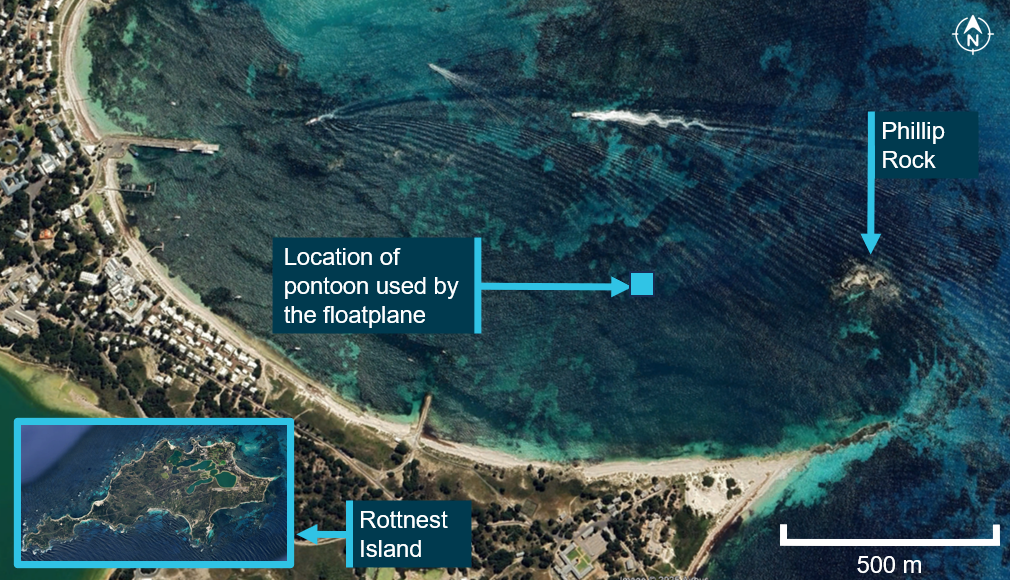
At 0915 the aircraft departed the Swan River, before climbing to a cruising altitude of about 1,600 ft. The aircraft orbited to the north of Rottnest Island then landed in a south‑south‑west direction on the waters of Thomson Bay at 0926 (Figure 1). Passengers recalled that the flight was uneventful.
Figure 1: Rottnest Island (insert) and key locations in Thomson Bay
Source: Google Earth, annotated by the ATSB
The passengers alighted the aircraft onto a pontoon and were then conveyed to the island on board a tender vessel. The aircraft remained at Thomson Bay throughout the day, with the pilot remaining on the island.
At 1116, the Swan River Seaplanes head of flying operations (HOFO)[1] sent the pilot a text message stating that winds were forecast to increase that afternoon. The HOFO sent the pilot an image from a weather website, showing that winds at Rottnest Island were 25 kt with gusts to 34 kt.
The pilot responded that they may need to return to South Perth earlier than the planned 1600 departure time. The HOFO indicated they agreed with this, stating that if necessary the passengers could return via ferry. The pilot responded to this text with a thumbs up.
Closed‑circuit television (CCTV) recordings showed that at about 1305 the Swan River Seaplanes tender vessel departed from alongside the aircraft, with the pilot operating the vessel solo. The video appeared to show the pilot travel north from the pontoon. The tender vessel was then returned to shore where it was docked at a jetty on Rottnest Island at about 1320.
At about 1330, the pilot sent a text message to the HOFO, stating that the wind had reduced but the swell remained high towards the centre of Thomson Bay, from where take-offs were normally commenced (see Thomson Bay departures). The pilot stated they planned to depart taking a quartering crosswind closer to shore, where they perceived conditions were calmer. The HOFO responded to this message stating they trusted the pilot’s judgement, encouraging the pilot to resist any perceived pressure to depart.
At about 1500, the pilot requested the coxswain[2] operate the tender vessel to the area normally used for floatplane take-offs from Thomson Bay, so the pilot could conduct an inspection of the sea conditions. The coxswain recalled that the pilot determined the conditions to be unsuitable for take-off, and requested to be taken closer to the southern shore of Thomson Bay. The coxswain recalled that conditions were calmer in this location, and the pilot had planned to take off eastwards towards Phillip Rock. At the completion of this inspection, the pilot requested to be conveyed to the aircraft.
At 1511, one of the directors of Swan River Seaplanes (who was also the approved safety manager) texted the pilot and asked about the wind conditions. The pilot responded that conditions were ‘ok but rough’, however the swell was ‘not too bad’ closer to shore. The pilot also noted in that text message conversation that the aircraft would be ‘pretty light’ for the take‑off.
At about 1540, the passengers for the flight from Rottnest Island to South Perth were conveyed by the coxswain to the pontoon at which the aircraft was moored. The pilot met the passengers at the aircraft.
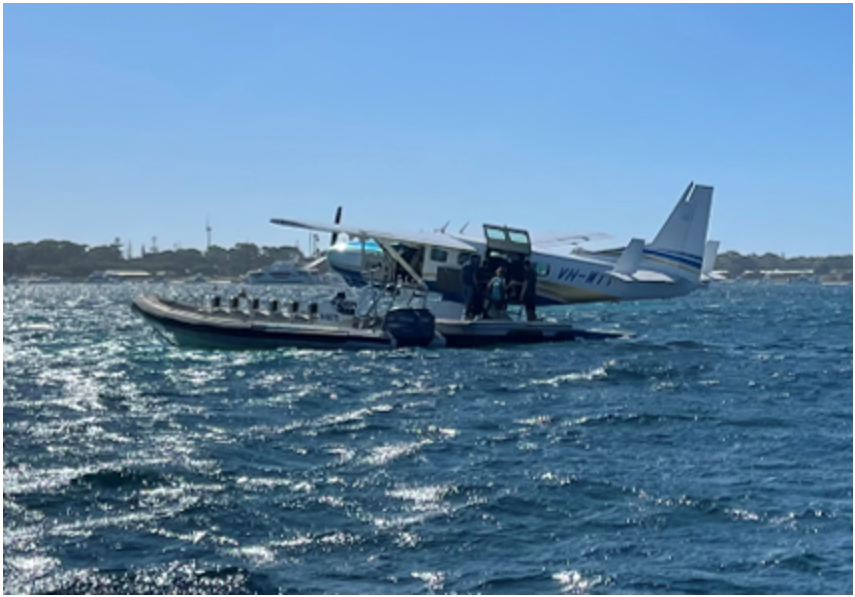
There were 6 passengers for the return flight, all of whom had travelled to Rottnest Island on the morning flight. Passengers described conditions on board the vessel and pontoon as rough and windy. Each passenger was fitted with a life jacket before boarding the aircraft (Figure 2).
Figure 2: Passengers boarding VH-WTY at Thomson Bay
Source: Witness
Passengers recalled the pilot told them the departure would be rough. Some passengers recalled the pilot using the term ‘choppy’, and others recalled the pilot said the departure ‘might get a bit bumpy’.
Once all passengers were boarded, the pilot signalled to the coxswain to release the mooring lines securing the aircraft to the pontoon. The aircraft then drifted before the pilot started the engine and taxied the aircraft to the south then north-west, before lining up for an eastwards take‑off. At 1558, while taxiing the aircraft, the pilot was recorded making a broadcast on the Rottnest Island common traffic advisory frequency,[3] announcing an intention to depart from Thomson Bay to the south-east.
Accident flight
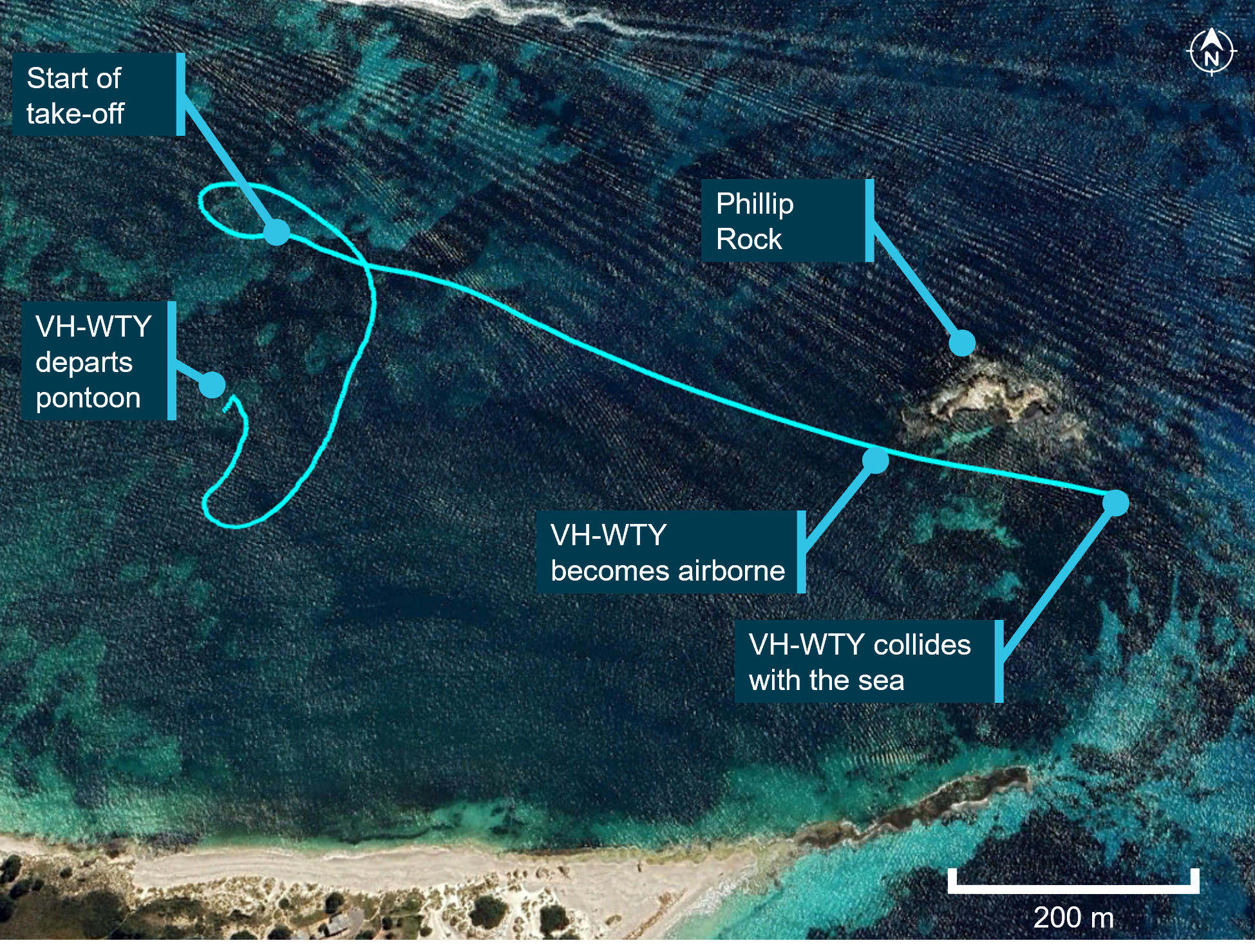
Figure 3 shows the track of the aircraft during its take-off from Thomson Bay. Recorded data showed that engine power was applied for take-off at about 1600:20. The aircraft accelerated in the plowing position[4] to about 31 kt groundspeed and 21 kt indicated airspeed (IAS)[5] by 1600:30, and yawed slightly left, on course towards Philip Rock.
The aircraft continued to accelerate, reaching about 37 kt IAS by 1600:34. At about this time, the pilot corrected the track to the south of Philip Rock.
Figure 3: VH-WTY take-off track with approximate location of key events
Source: Google Earth, annotated by the ATSB
At about 1600:38, as the aircraft accelerated to about 43 kt IAS, the pilot manoeuvred the aircraft onto the step.[6]
The aircraft continued to accelerate, reaching 50 kt IAS by 1600:44. As it accelerated on the step, the aircraft encountered sea swell and chop. Passengers recalled the aircraft bumping loudly and forcefully against the water, perceiving this to be much rougher than the take-off from South Perth. Video captured by a passenger on board included the sound of these bumps.
At about 1600:49, as the aircraft accelerated to about 57 kt IAS, it struck swell and became airborne. The aircraft nose attitude increased significantly, reaching a maximum 18° nose up. The aircraft reached a maximum altitude of 16 ft above the surface of the water, before rolling to the left (see Flight data and video).
Impact and passenger escape
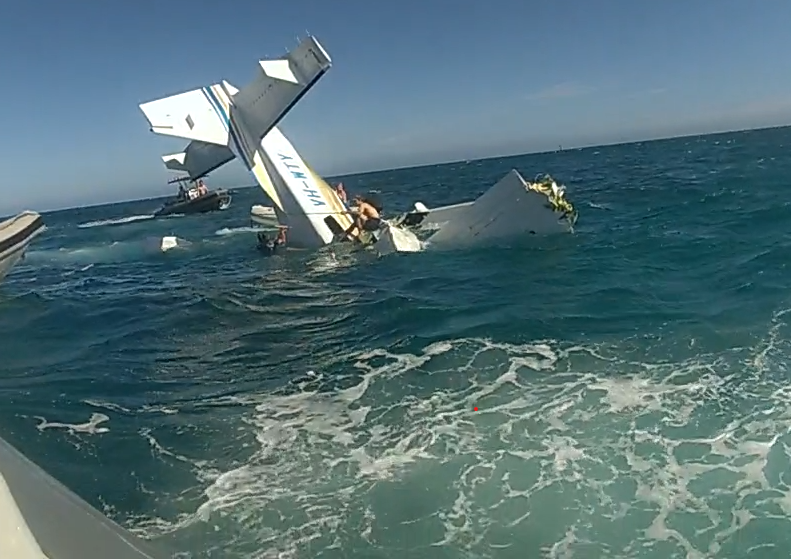
The left wing impacted the water, followed by the fuselage and the rest of the aircraft. Surviving passengers and other witnesses recalled the aircraft remained partially afloat in a vertical orientation, with the aircraft nose resting on the sea floor. The surviving passengers reported that all cabin doors were submerged.
The forward section of the cabin rapidly filled with water. Four passengers moved into a pocket of air in the rear cabin. One passenger opened the top section of the rear right door, through which they escaped with another passenger.
The coxswain of the Swan River Seaplanes tender vessel, having observed the collision, piloted the vessel to the crashed aircraft. Upon reaching the aircraft, the coxswain observed a passenger in the rear cabin. This passenger recalled perceiving they were stuck inside the sinking aircraft, as they were unable to exit through the door opened by the other passenger.
The coxswain broke the rear left window, through which 2 passengers recalled escaping. The pilot and the 2 other passengers remained in the aircraft.
Police officers stationed at Rottnest Island responded to the accident, arriving at the aircraft at about 1610. Police body-worn camera footage showed the aircraft was partially submerged in a vertical orientation, with the rear left window above the water surface (Figure 4). Under conditions of uncertainty and potential danger, police and members of the public entered the water and attempted to rescue the occupants. Despite these efforts, none of the remaining occupants were able to be freed from the aircraft. Police who entered the water were not able to open the forward aircraft doors.
Figure 4: VH-WTY inverted in the water shortly after the collision
Source: WA Police
At about 1630 the aircraft began to sink, becoming fully submerged at about 1640.
Police divers recovered the 3 deceased occupants on the evening of 7 January 2025.
Context
Pilot information
Licencing and experience
Licence and experience details for the pilot of VH-WTY are shown in Table 1.
Table 1: Pilot licencing and experience
| Licence type | Commercial Pilot Licence (Aeroplane) |
| Medical certificate | Class 1, valid to October 2025 |
| Total aeronautical experience | 1908.5 hours |
| Total time on type (Cessna 208 amphibian) | 708.0 hours |
| Recent aeronautical experience (90 days) | 60.1 hours |
| Recent aeronautical experience (7 days) | 7.8 hours |
The pilot obtained a Private Pilot Licence in 2014 and had held a Commercial Pilot Licence (Aeroplane) since June 2019. The pilot obtained a floatplane endorsement in August 2019.
The pilot’s experience included almost 1,400 hours on floatplanes and over 2,600 water landings. Since commencing with the Swan River Seaplanes in October 2024, the pilot had accrued over 60 hours, including 102 water landings.
Recent history
The pilot’s roster for the week prior to the accident (from 1 to 7 January 2025) is shown in Table 2. The pilot had conducted multiple floatplane flights during this week however none involved operating from Thomson Bay.
Table 2: Pilot rostered duties, 1 to 7 January 2025
| Date | Shift start-finish time | Total flight hours |
| 1 January | OFF | |
| 2 January | 0630-1430 | 1.5 |
| 3 January | 0630-1430 | 2.1 |
| 4 January | 0630-1430 | 1.8 |
| 5 January | 0630-1430 | 2.4 |
| 6 January | OFF | |
| 7 January | 0730-1630 |
The Swan River Seaplanes incident reporting system included a report from one of these shifts. At about 0800 on 4 January, the pilot was departing from Jandakot, Western Australia,[7] for the first flight of the day when they omitted to retract the aircraft water rudders. The pilot submitted an incident report for this, which identified that the pilot was ‘likely in a fatigued state’.
The pilot’s partner recalled the pilot went to bed at about 2130 on 6 January, before waking at 0645 on 7 January and leaving for work at about 0730. Records from the pilot’s mobile phone were consistent with these estimates, and indicated the pilot had opportunity to sleep from 2124 on January to 0645 on 7 January.
Witnesses recalled that the pilot of VH-WTY appeared happy and alert on the day of the accident. There were no reports of the pilot appearing tired.
Prior flights into Thomson Bay
The system used by Swan River Seaplanes to track flight and duty times showed that the pilot had conducted 12 water landings (and take-offs) at Thomson Bay prior to the day of the accident (Table 3). Flight tracking records from the operator’s aircraft and notes from the flights the pilot conducted under supervision showed only 10 landings at Thomson Bay. It is possible that the pilot conducted touch-and-go landings[8] at Thomson Bay during initial training flights.
All the pilot’s prior landings at Thomson Bay had been conducted in the other Cessna 208 amphibian utilised by Swan River Seaplanes, VH‑UOZ (see Organisational background).
Table 3: Thomson Bay landings conducted by the pilot
| Date | Thomson Bay landings | Aircraft crewing information | Recorded wind [1] |
| 1 November 2024 | 2 | Under supervision by the HOFO | 13–15 kt SSW |
| 2 November 2024 | 1 | Under supervision by the HOFO | 17 kt SSW |
| 9 November 2024 | 2 | Under supervision alternate HOFO (Thomson Bay proficiency check) | 20–22 kt SSW |
| 16 November 2024 | 2 | Pilot in command, without supervision | 23–28 kt SSW[2] |
| 1 December 2024 | 3 | Pilot in command, without supervision | 13–17 kt WNW |
| |||
The Swan River Seaplanes Head of Flying Operations (HOFO) recalled having a positive impression of the pilot’s performance at Thomson Bay. The HOFO’s notes from the flights undertaken on 2 November included that all water landings were conducted well in ‘lumpy conditions’. The Swan River Seaplanes alternate HOFO indicated a similar impression from the flights conducted on 9 November. Flight tracking records showed that all the Thomson Bay take‑offs on 1, 2 and 9 November were conducted on a predominantly southerly track, consistent with the typical water runway used for Thomson Bay take-offs (see Thomson Bay departures). After the flight conducted on 9 November, the pilot was checked to line to conduct flights from Thomson Bay without supervision.
Analysis of the pilot’s subsequent 5 take-offs from Thomson Bay (without supervision) showed that 4 of these were conducted using tracks which were significantly different to the operator’s typical water runway.
The Swan River Seaplanes HOFO stated that they had reviewed the take-offs conducted by the pilot. The HOFO stated that the take-offs from Thomson Bay on 16 November and 1 December did not raise any concerns and were consistent with the wind direction at the time.
Previous cancellations
The HOFO stated the pilot was comfortable making command decisions to cancel flights if conditions were not suitable, and had been supported in these decisions by company personnel.
Records extracted from the pilot’s mobile phone included communication between the pilot and other company personnel, and demonstrated the pilot’s assessment of weather conditions for 2 previous departures:
- On 16 November 2024, the pilot sent the HOFO an image of the conditions at Thomson Bay and said 'this is on limits'. The HOFO responded 'Yeah that'd be pretty close to limits… Next one is light. But totally your call’. The pilot texted 'Yeah, we're done for the afternoon…way too rough’.
Later that day, a company director (who was also the safety manager) sent a group message stating 'hey guys, great call this afternoon’. The director also said the following flight had been cancelled and passengers had been booked on ferries for their return from Rottnest Island. - On 24 November 2024, the pilot texted the company director and safety manager of Swan River Seaplanes and advised that wind conditions were 26 kt and forecast to increase. The pilot stated they would cancel an afternoon flight due to the winds.
The director responded by thanking the pilot.
Aircraft information
General information
VH-WTY was a Cessna[10] 208 Caravan amphibian floatplane, powered by a Pratt & Whitney Canada (P&WC) PT6A-114A turboprop engine and a 3-bladed McCauley constant speed propeller. The aircraft was fitted with Wipline 8750 amphibious floats, manufactured by Wipaire, which enabled operation from both land and water. The aircraft was manufactured in the United States in June 2016, then registered in Australia in September 2016. It had accumulated about 1,125 hours total time in service at the time of the accident.
Operating procedure documentation
The Cessna 208 Pilot’s Operating Handbook (POH) provided normal and emergency operating procedures, performance and aircraft systems information for the Cessna 208 equipped with standard landing gear.[11]
The Wipaire Approved Pilot’s Operating Handbook and Airplane Flight Manual Supplement (AFMS) provided procedures for the Cessna 208 equipped with Wipline 8750 floats.[12]
Weight and balance
The maximum take-off weight (MTOW) for the Cessna 208 equipped with Wipline 8750 floats was 3,968.9 kg (8,750 lb). Considering recorded passenger weights and other information, VH‑WTY was estimated at about 3,206 kg without fuel and about 3,565 kg with fuel at the commencement of the take-off from Thomson Bay. The aircraft was within its centre of gravity envelope.
Water rudders
Most floatplanes are equipped with retractable water rudders to provide for greater manoeuvrability on the water surface while taxiing. The Wipline 8750 floats were equipped with a water rudder steering and retract system, with water rudders fitted to the rear end of each float.
Quadrant friction lock
The Cessna 208 is equipped with a quadrant friction lock, which is a knob located on the side of the pedestal that when rotated adjusts the level of friction on the engine controls. The POH stated that the friction lock was provided ‘to minimise creeping of the engine controls once they have been set’.
Stall warning system
The Cessna 208 was equipped with a vane-type stall warning unit in the leading edge of the left wing. The stall warning unit sensed change in the airflow over the wing, and produced a warning horn if the sensed airspeed was between 5 and 10 kt above the stall speed. The purpose of this system was to provide a warning to the pilot if the aircraft was approaching a stall.[13]
The POH identified that the stall warning system was protected by a pull-off circuit breaker, labelled STALL WARN. This circuit breaker was also provided as a means to shut off the warning horn in the event it became stuck on.
Meteorological and environmental information
Location information
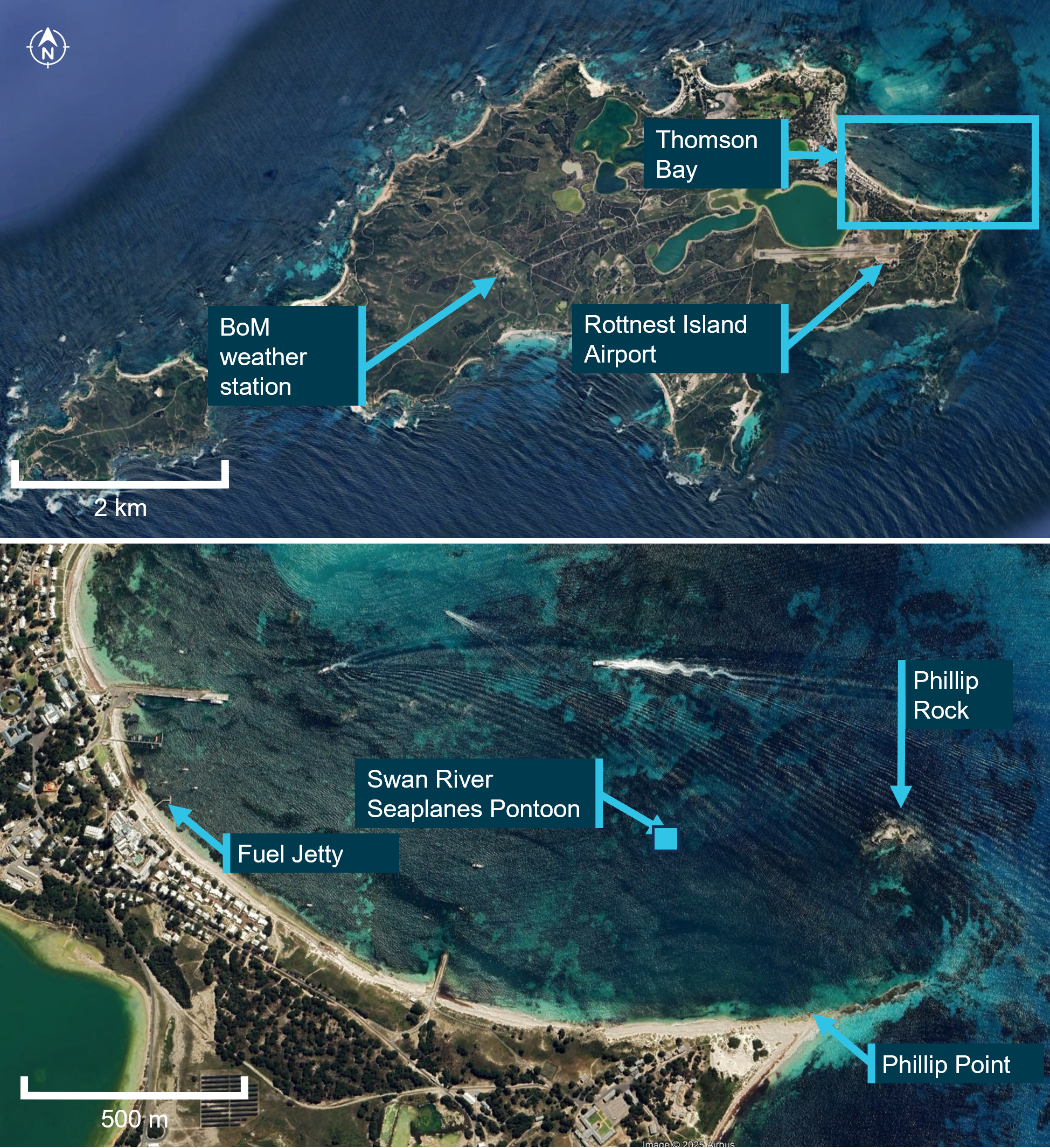
Rottnest Island is located 18 km from the Western Australian coast. Rottnest Island Airport has a sealed runway, which is oriented east-west and provides 1,293 m for take‑off and landing.
Figure 5: Rottnest Island and Thomson Bay
Source: Google Earth, annotated by the ATSB
Thomson Bay is on the eastern side of Rottnest Island and is the main landing point for marine vessels visiting the island. Swan River Seaplanes conducted operations in the south-eastern quadrant of Thomson Bay. This section of the bay extends to the east towards Phillip Point. Phillip Rock is a rocky outcrop about 400 m offshore of the eastern tip of the southern shore.
Swan River Seaplanes maintained a pontoon close to the southern shore of Thomson Bay. A tender vessel was used to ferry passengers from the pontoon to the Rottnest Island Fuel Jetty.
Local climate
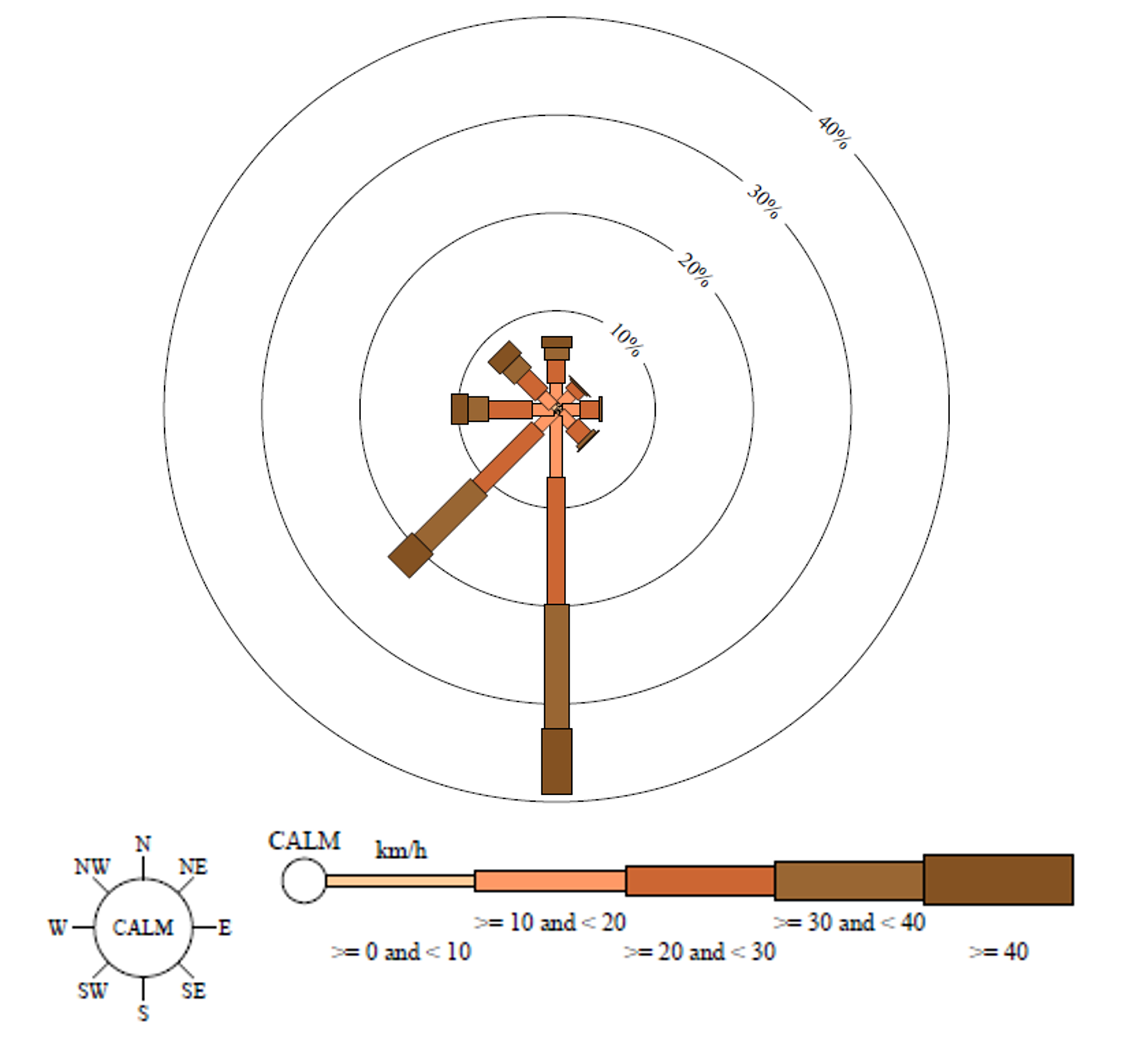
The Bureau of Meteorology (BoM) maintained a weather station about 5.5 km south-west of Philip Rock. The weather station was located at an elevation of 43.1 m above sea level, on the side of a hill with exposure to the south-west. BoM records showed the mast anemometer[14] was 10m high and had been replaced in 2016.
Records from the BoM captured the wind direction and speed at 1500 local time, from November 1987 to August 2024 (over 12,000 observations). Southerly winds were recorded on nearly 40 per cent of days, with south-westerly winds recorded on over 20 per cent of days (Figure 6). Recorded winds were regularly over 30 km/h (16 kt).
Figure 6: Climatology data from BoM showing winds recorded at Rottnest Island at 1500 local time, from 1987 to 2024
Source: Bureau of Meteorology
Coastal geography and sea conditions
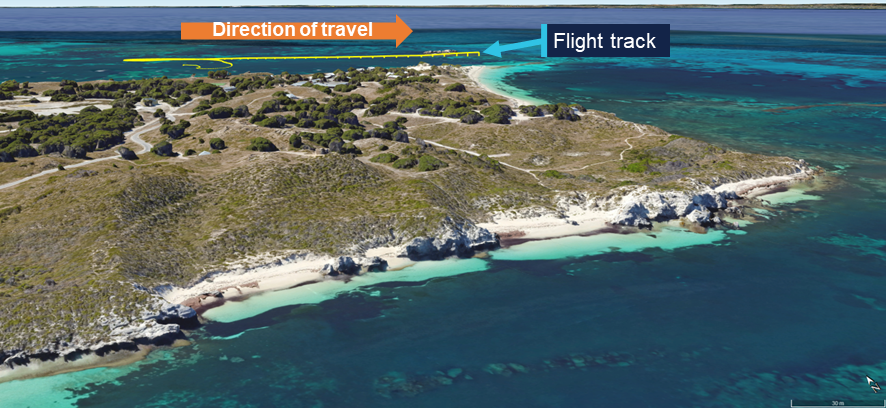
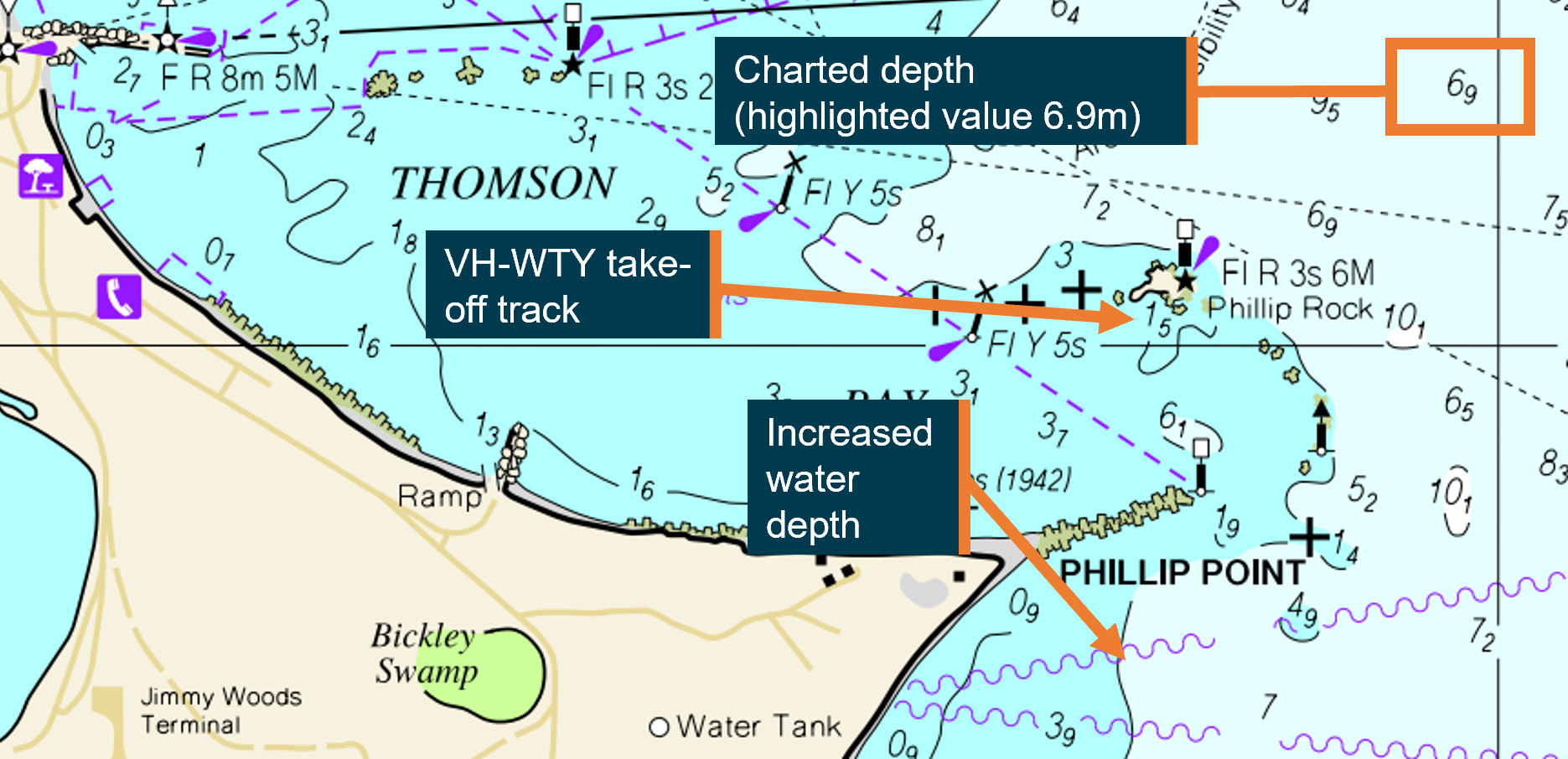
The terrain surrounding the bay near Phillip Point includes coastal dunes, some small hills and buildings, with elevation to about 16 m above sea level (Figure 7). Maritime charts showed that the sea in Thomson Bay was around 3–4 m deep, whereas past Phillip Point the depth increased significantly (Figure 8).
Figure 7: Overhead photography of Thomson Bay near Phillip Point, with accident flight track of VH‑WTY highlighted
Source: Google Earth, annotated by the ATSB
Figure 8: Maritime chart showing sea depth in Thomson Bay
Source: WA Department of Transport, annotated by the ATSB
Thomson Bay was protected from wind and sea conditions during typical southerly and south‑westerly winds, particularly close to the southern shore. Witnesses familiar with boating at Rottnest Island identified that conditions east of Phillip Rock were typically much rougher than in the bay.
Meteorological forecasts and observations
The BoM issued a grid point wind and temperature forecast for the southern portion of Western Australia (including Rottnest Island) at 0726 on 7 January. This forecast showed that, from 1400, conditions on Rottnest Island were forecast to include south-westerly winds of 21 to 26 kt.
The BoM provided meteorological aerodrome reports (METAR) for Rottnest Island Airport every half hour. The METAR issued at 1600 showed winds from 210° at 25 kt, which was unchanged from the previous report issued at 1530. Table 4 shows the METAR from 1400 to 1600 on the afternoon of the accident.
Table 4: Rottnest Island Airport METAR, 1400 to 1600 on 7 January 2025
| Time | Wind speed | Wind direction (º) | Temperature (ºC) |
| 1400 | 25 kt | 210 | 24 |
| 1430 | 23 kt | 210 | 25 |
| 1500 | 26 kt | 210 | 24 |
| 1530 | 25 kt | 210 | 24 |
| 1600 | 25 kt | 210 | 24 |
The Western Australia Department of Transport maintained a wave monitoring buoy approximately 17 km south-west of Thomson Bay. Data from this buoy recorded a relatively constant 0.6 m swell[15] with a marked increase in the sea waves[16] from 1 m at 0900 to around 2 m by 1500. At 1600 the wave monitoring buoy recorded a sea wave height of 2 m. The total wave height[17] was 1.2 m at 0900, increasing to 2.1 m at 1600.
Directional wave data showed that the swell and sea waves were from a south-westerly direction (230°).
Witness environmental observations and recorded video
Witnesses recalled strong gusty winds and choppy seas in Thomson Bay on the afternoon of the accident. One witness, who was an experienced mariner, who observed the accident from the shore about 500 m away, estimated the wind at the time of the accident at 25 kt. The witness recalled that the aircraft operated in protected, calmer water at the start of the take-off, with conditions becoming rougher during the take-off run.
The coxswain who operated the Swan River Seaplanes tender vessel recalled that conditions in Thomson Bay included winds of about 30 kt and waist-height (approximately 1 m) waves near the usual floatplane departure location. Conditions closer to the shore were calmer, with waves at about 20 cm high.
Video recordings taken on the afternoon of the accident showed that the sea was calm close to the southern shore of Thomson Bay. Further into the bay, however, waves were larger and more frequent.
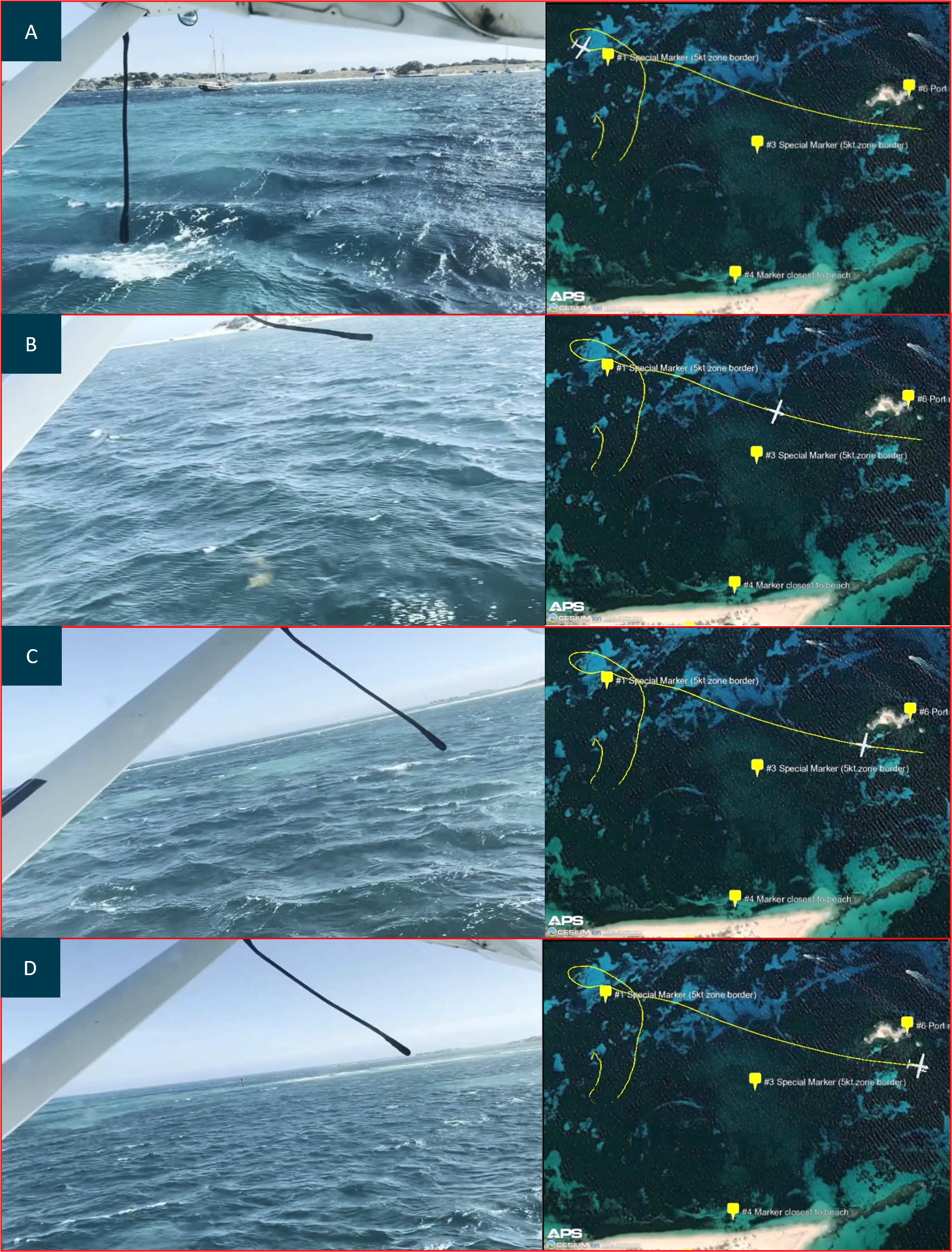
Video recorded by the passenger in seat 2A (see Passenger video) showed:
- The aircraft encountered waves immediately prior to the application of power for take‑off. These waves may have been influenced by reef in the area. The video showed the waves encountered by the aircraft at this point were perpendicular to its take‑off track (Figure 9, A).
- As the aircraft transitioned onto the step, the sea became smoother and continued to improve during the step phase (Figure 9, B).
- The aircraft encountered rougher sea conditions later in the step phase, causing it to bounce. Figure 9 (image C) shows the sea conditions at the time the aircraft separated from the water. The video showed that the waves encountered by the aircraft had changed in direction, and were now more reciprocal to the take-off track.
- Sea conditions developed east of Philip Rock, with larger waves observed. Figure 9 (image D) shows the sea conditions almost directly beneath the nose of the aircraft when it was about 25 ft above the water surface.
Figure 9: Sea conditions encountered by VH-WTY during take-off
Source: Passenger video and Google Earth, annotated by the ATSB
Flight recorders and other recorded information
Onboard recorders
VH-WTY was not fitted with a flight data recorder or cockpit voice recorder, and nor were these recorders required for the type of aircraft or operation.
The aircraft was fitted with a Garmin G1000 integrated electronic flight instrument system that presented flight instrumentation, position, navigation, communication, and identification information to the pilot through large-format displays.
The G1000 had a flight data logging feature that stored flight and engine parameters onto a secure digital (SD) card at approximately one second intervals while the multi‑function display was powered on. The ATSB retrieved the SD card from VH-WTY after the accident and downloaded data from the SD card. The data comprised of the accident flight and 71 previous flights from 30 December 2024. For the accident flight, the G1000 recorded data up to 1600:54, about 2 seconds before the aircraft impacted the water.
The aircraft was also fitted with a Pratt & Whitney Canada digital aircraft data acquisition system (ADASD) that primarily recorded engine parameters at approximately 0.5 second intervals. The data was extracted by Pratt & Whitney Canada and provided to the ATSB and included the accident flight and previous flights. For the accident flight, the ADASD recorded data up to and after the impact with water.
Passenger video
The passenger in seat 2A recorded a video of the accident flight, including about 35 seconds of footage prior to the aircraft colliding with the sea. The video was mainly focused outside the aircraft, and captured sound including the aircraft moving along the sea during the take-off.
Recorded engine performance
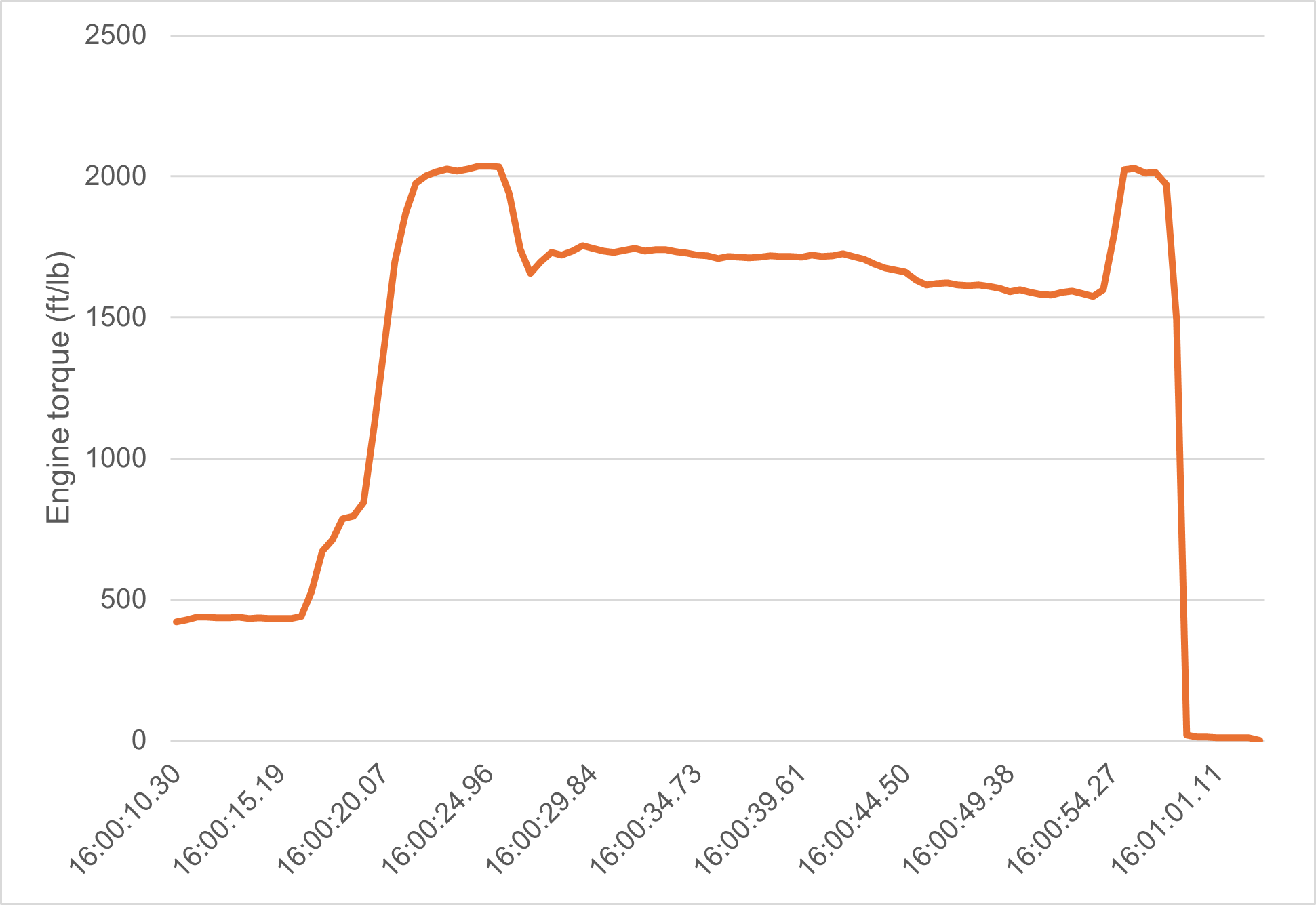
Engine parameters were recorded on both the G1000 and ADASD and showed good agreement. The data showed the following (Figure 10):
- The propeller speed was relatively constant, just below the maximum take-off limit of 1,900 RPM. Fuel flow and temperature values were consistent with the recorded engine torque.
- At the beginning of the take-off, between 1600:21 and 1600:26, the engine torque was above the maximum take-off limit of 1,865 ft lb. This was below the maximum transient limit of 2,400 ft lb.
- Between 1600:29 and 1600:42, the engine torque was relatively stable between about 1,750 ft lb and 1,710 ft lb.
- Between 1600:43 and 1600:52, the engine torque reduced from about 1,720 ft lb to about 1,580 ft lb.
- At 1600:53, the engine torque increased, exceeding the maximum take-off limit until the aircraft impacted the water. The engine torque did not exceed the maximum transient limit.
Figure 10: Engine torque recorded by ADASD unit on board VH-WTY
Source: ATSB
Flight data and video
Flight data recorded by the G1000 unit on board VH-WTY is displayed in Table 5.
Table 5: VH-WTY selected flight data parameters.
| Time | Groundspeed (kt) | Indicated airspeed (kt) | Heading (º) | Pitch attitude (º) | Altitude MSL[1] (ft) |
| 1600:10 | 8 | 0 | 116 | 6 | 1 |
| 1600:26 | 23 | 1 | 114 | 10 | 2 |
| 1600:30 | 31 | 21 | 111 | 12 | 3 |
| 1600:35 | 39 | 39 | 125 | 9 | 3 |
| 1600:40 | 48 | 44 | 120 | 10 | 3 |
| 1600:45 | 55 | 52 | 117 | 9 | 3 |
| 1600:46 | 56 | 53 | 116 | 11 | 4 |
| 1600:47 | 57 | 55 | 114 | 10 | 4 |
| 1600:48 | 59 | 56 | 117 | 14 | 4 |
| 1600:49 | 61 | 57 | 113 | 9 | 2 |
| 1600:50 | 61 | 56 | 112 | 16 | 5 |
| 1600:51 | 62 | 54 | 110 | 17 | 10 |
| 1600:52 | 62 | 55 | 113 | 16 | 13 |
| 1600:53 | 62 | 57 | 117 | 18 | 15 |
| 1600:54 | 62 | 56 | 115 | 17 | 16 |
| [1] Altitude MSL: Altitude above mean sea level | |||||
The flight data and recorded video indicated the following:
- The aircraft separated from the sea at about 1600:49 with high pitch angle, increasing to a maximum of 18º.
- Video footage indicated the elevator was deflected up and the left aileron was deflected down after the aircraft separated from the sea. The float rudders were also shown to be extended as the aircraft separated from the sea.
- The aircraft climbed to about 16 ft above the surface of the water.
- At 1600:53, there was a simultaneous reduction in pitch and commencement of left roll which continued until the aircraft impacted the water.
Ongoing investigation focus Aircraft handling and performance prior to and following the separation from the water. |
Wreckage information
Accident site and recovery
Analysis of witness video and recorded information showed that the aircraft collided with the sea approximately 70 m south-east of Phillip Rock. The right float and part of the left float separated from the aircraft after the collision and were later recovered by WA Police and members of the public. The rear section of the left float remained tethered to the aircraft by the fly wire and sea rudder control cables.
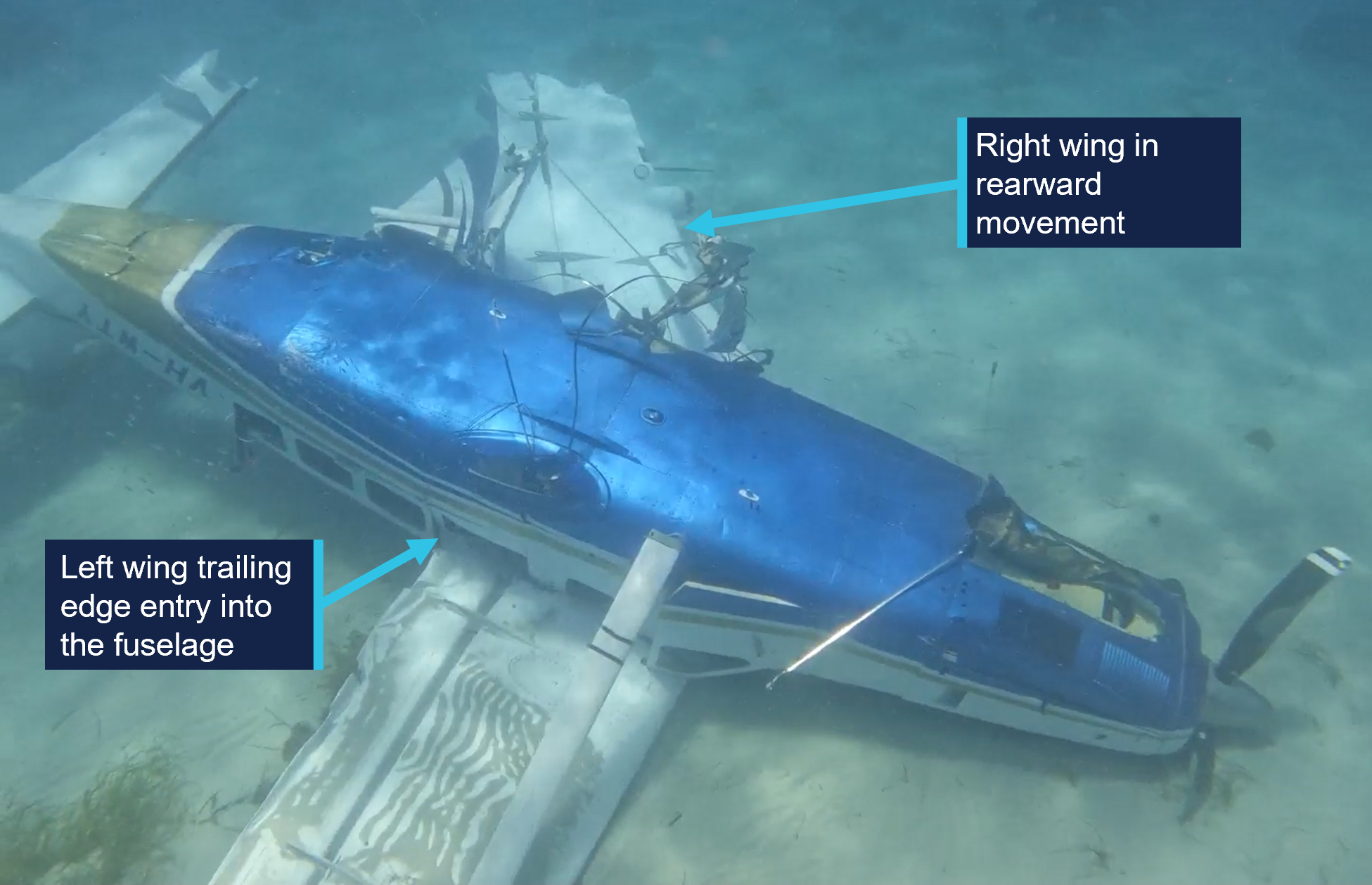
The aircraft drifted approximately 800 m north of Phillip Rock until being tethered to the sea floor by WA Police divers. Their dive video showed that the main structure of the aircraft remained largely intact following the collision. Both wings had separated from the fuselage at the leading (forward) edge and had hinged rearward, entering the fuselage at the trailing (aft) edge (Figure 11). The right wing had been pushed back significantly more than the left wing.
On 9 January 2025, the aircraft was recovered from the sea and transported to a secure storage facility for further examination.
Figure 11: VH-WTY submerged in Thomson Bay on 8 January 2025
Source: WA Police, annotated by the ATSB
Wreckage examination
The wreckage examination identified structural damage consistent with a collision with water. The floats had been separated from the aircraft, as had the left wing section outboard of the aileron pushrods. The wings were swept back, with significant damage to both wings outboard the ailerons. The lower surface of the tail had sustained buckling and puncture damage, consistent with damage from impact with the floats during the accident sequence.
The cockpit windscreen was intact, while several of the cabin windows were broken including inboard of the right wing and the rear left window. The wings, fuselage and floats did not display any physical markings to suggest that the aircraft had struck landmass or a submerged object prior to the collision with the sea.
The pilot’s seat was observed in a locked, forward position. The seat rails were firmly attached to the aircraft structure, and the adjusting and locking system were observed to be functional. None of the passenger seats displayed any damage, buckling or failure.
The examination identified that the engine controls were attached to the associated engine components and were free to move through their full range of movement. The propeller blades were intact and attached to the propeller hub. All 3 propeller blades were significantly bent toward the blade face. The significance of this could not be determined due to the propeller assembly resting on the sea floor prior to recovery.
Due to structural damage from the accident, the primary flight controls could not be moved when examined. The flight control pushrods, bell-cranks and control cable hardware were examined for continuity and correct assembly. No pre-existing damage or defects were identified.
The instrument panel appeared undamaged. All circuit breakers were in the pushed-in (power on) position except those corresponding to the strobe light and stall warning which were in the out (power off) position.
Wing ingress into cabin structure
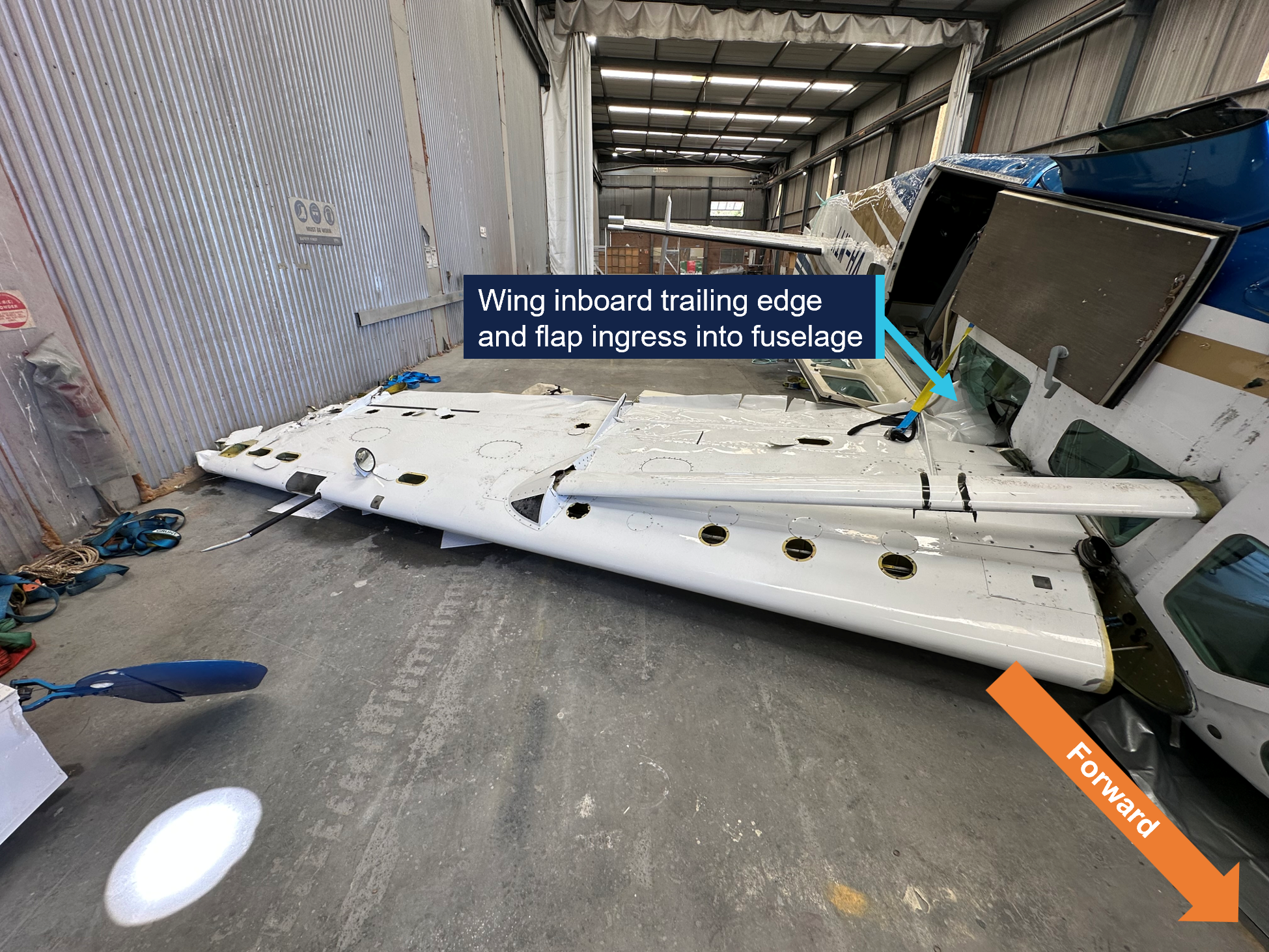
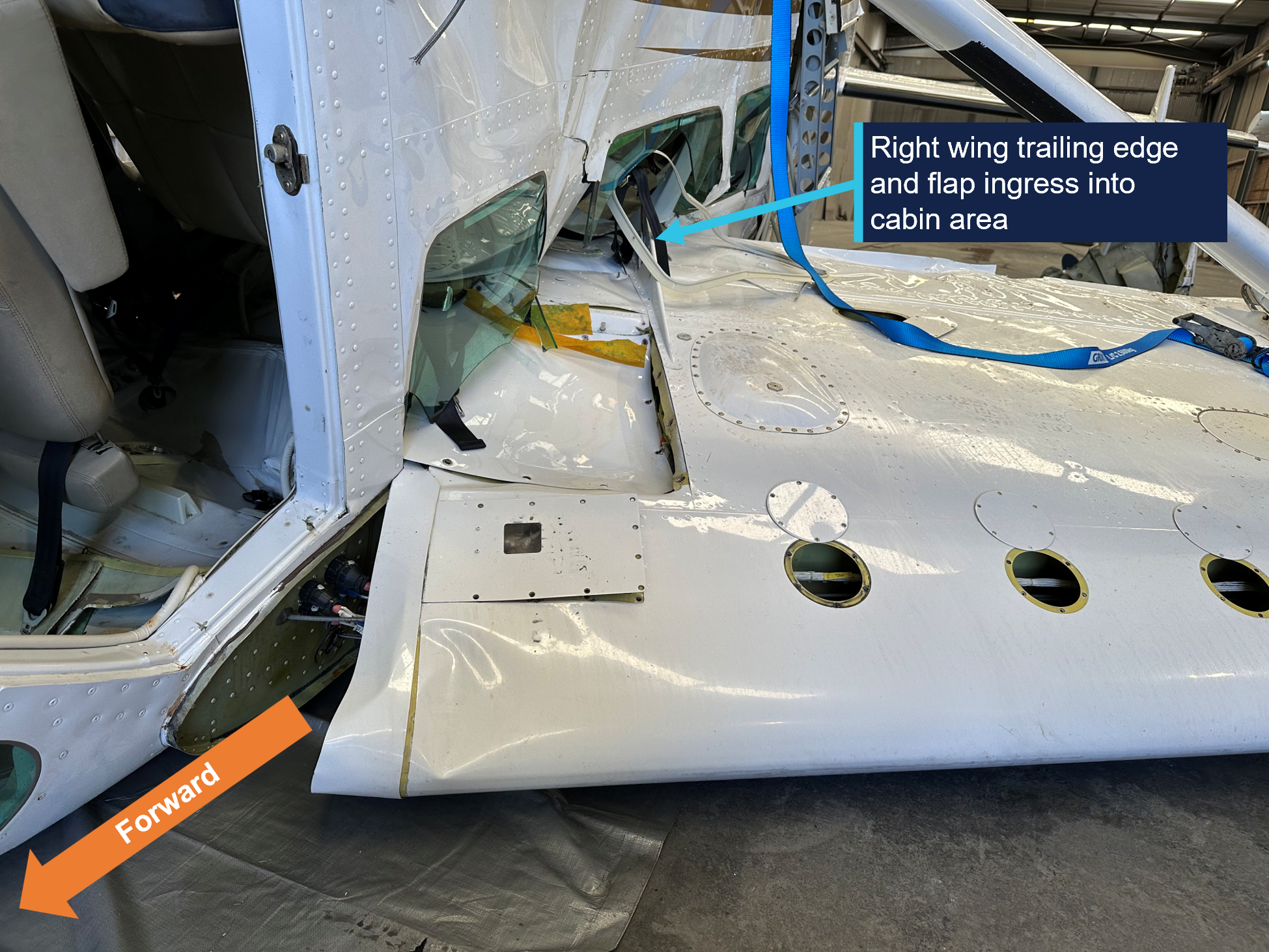
The trailing edge and inboard flap sections of both wings had been forced into the cabin area at the wing rear attachment points. The fuselage was deformed and the passenger windows broken around the wing structure (Figure 12 and Figure 13).
Figure 12: Ingress of left wing into VH-WTY fuselage. Image depicts inverted aircraft facing aft
Source: ATSB
Figure 13: Ingress of right wing into VH-WTY fuselage. Image depicts inverted aircraft facing aft
Source: ATSB
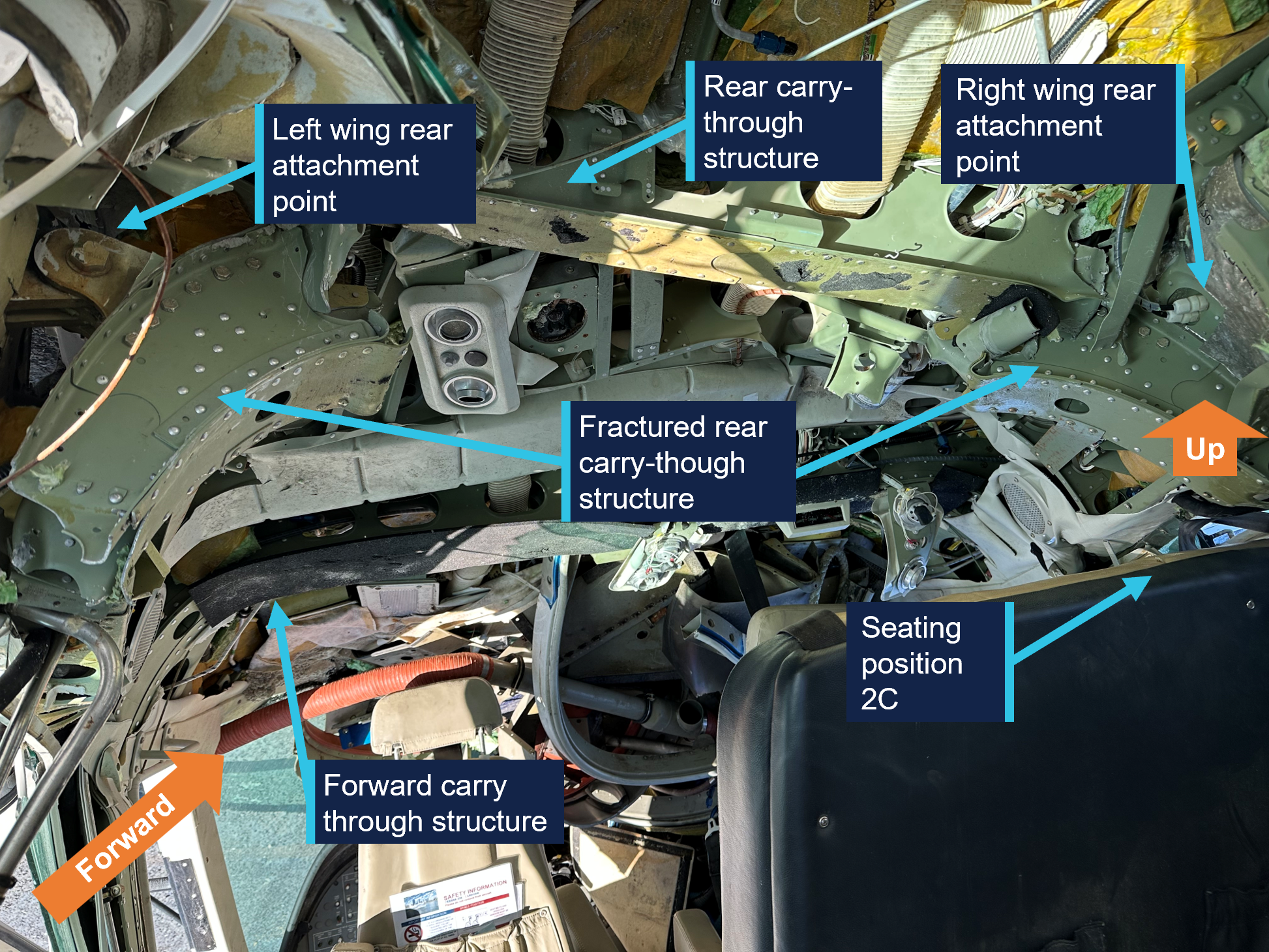
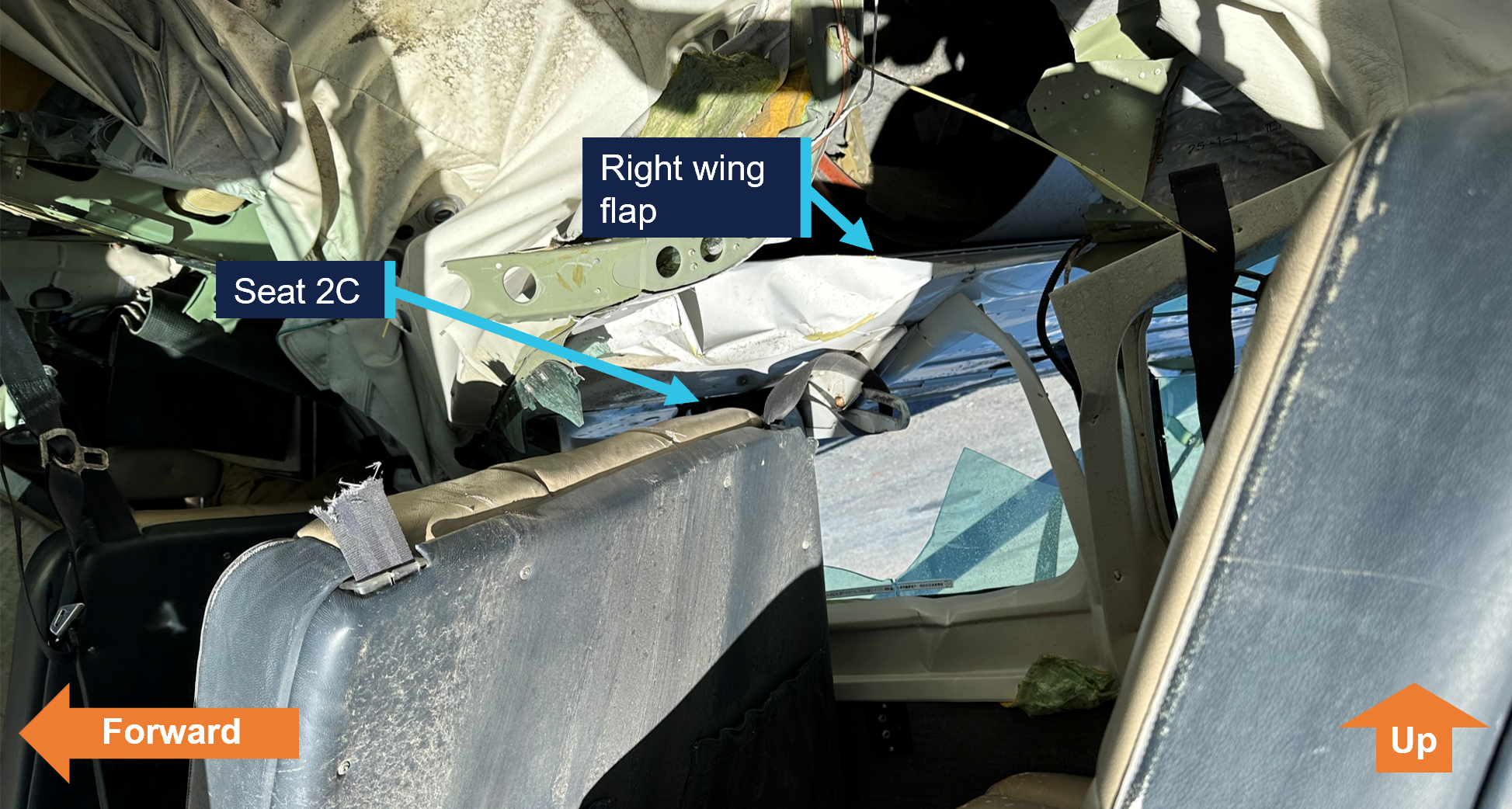
Examination of the wing support structure showed the left and right carry‑through structure[18] had fractured at the wing rear attachment points (Figure 14). The fractured sections of the carry-through structure were forced inwards and downwards into the space normally occupied by passengers seated in row 2 of the cabin.
Figure 14: Internal cabin showing fuselage and wing support structural damage. The image is taken from the rear of the cabin looking towards the cockpit.
Source: ATSB
Wing flap position
The wing flaps were observed in the retracted (0°) position. The flap selector however was in the ‘full’ (extended) position, and the flap position indicator was showing an intermediate position of about 15°. The emergency flap switches were in the guarded position and lockwire was present.
Examination of the flap control system showed that the jack screw which controlled the movement of the wing flaps was in a position indicative of a ‘full’ (extended) flap position. It is very likely that the wing flaps were in the ‘full’ position during the take-off, and that discrepancies between the flap selector, the position indicator and the wing flaps were because of disruption following the collision with the sea.
Additional engine examination
The engine was removed from the airframe and transported to the Pratt & Whitney facilities in Canada for a detailed teardown examination.[19] The report from this examination identified that the engine displayed rotational contact marks to internal engine components, characteristic of the engine developing power at the time of impact. The report further identified that there were no indications of pre-impact mechanical anomalies to the engine components which would have precluded normal operation.
The report also reviewed the data recorded by the digital aircraft data acquisition system (ADASD), noting the data showed the engine was running at high power at the time of impact. ATSB analysis of this data is provided in Recorded engine performance.
Aircraft structure and passenger seating
VH-WTY was configured in a 13-seat layout. This comprised the pilot (left) and copilot (right) seats in the front row, followed by 4 rows of passenger seats. The first 3 rows of passenger seats were configured with 2 seats on the right side of the cabin and 1 seat on the left. The rear row provided 2 seats in a bench layout.
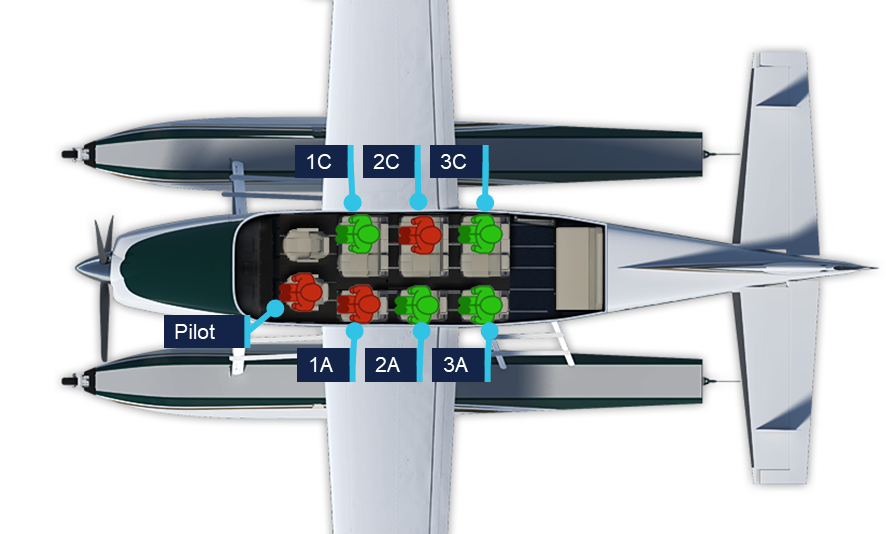
Surviving passengers recalled that the seating positions for the accident flight were as follows (illustrated in Figure 15):
- The pilot was seated in the normal position in the front left seat, and was fatally injured in the accident. There was no passenger seated in the front right seat.
- Two passengers were seated in the first passenger row (seats 1A and 1C), with the central seat vacant. The passenger seated in the left seat was fatally injured in the accident.
- Two passengers were seated in the second passenger row (2A and 2C), with the central seat vacant. The passenger seated in the right seat was fatally injured in the accident.
- Two passengers were seated in the third passenger row (3A and 3C), with the central seat vacant. Both passengers in the third row survived the accident.
Figure 15: Cessna 208 seating plan showing the occupant location of those who survived (green) and those who sustained fatal injuries (red)
Source: ATSB
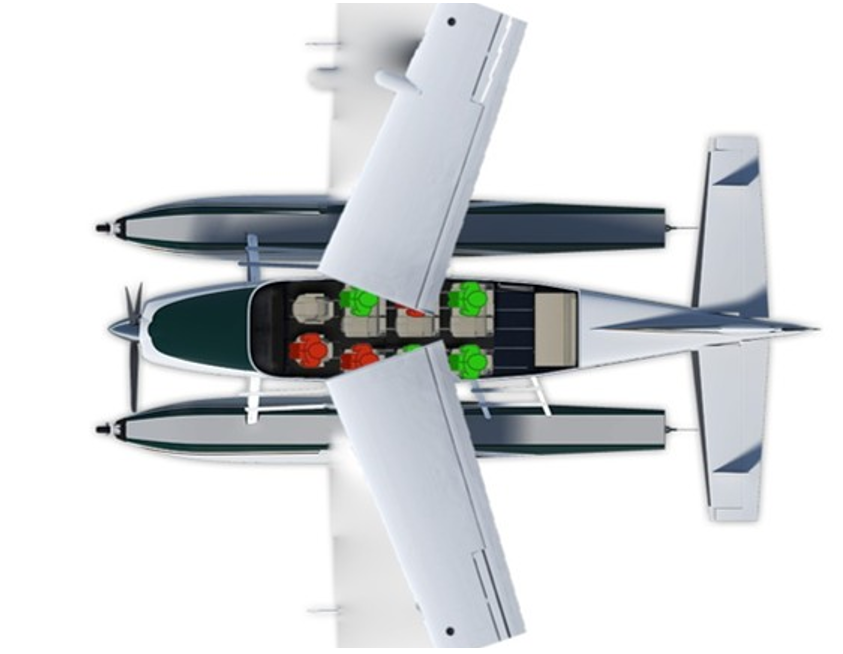
Figure 16 is an illustration showing the ingress of the wing trailing edges into the cabin area and encroaching seats 2A and 2C. It also illustrates how the wings were hinged and rotated on the forward attachment points and wing struts. Figure 17 shows the ingress of the wing structure relative to the position of seats 2A and 2C.
Figure 16: Projected movement of wings inboard into cabin space
Source: ATSB
Figure 17: Right wing ingress into VH-WTY cabin and position of seat 2C
Source: ATSB
Post-mortem and other medical information
Post-mortem examinations of the 3 deceased occupants were conducted by a qualified pathologist, on behalf of the Coroner’s Court of Western Australia. The pathologist’s reports identified the following:
- The cause of death for the pilot was drowning. The post-mortem report for the pilot did not identify evidence of significant internal or skeletal injury or the presence of significant natural disease. Toxicological analysis for the pilot was negative for the presence of alcohol and other common drugs.
- The cause of death for the passenger in seat 1A was drowning. The report did not identify evidence of significant internal injury or natural disease relevant to the accident.
- The cause of death for the passenger in seat 2C was drowning with head injury. The report identified the passenger had sustained a brain injury which was traumatic in nature.
The surviving passengers sustained injuries including:
- The passenger in seat 1C sustained bruising and lacerations to the torso.
- The passenger in seat 2A sustained bruising and lacerations to their arms and shoulders.
- The passenger in seat 3C experienced a significant hand injury.
The ATSB has engaged medical specialists to provide analysis of the post-mortem records and assist the investigation to identify the factors which may have contributed to the non-survival of the pilot and 2 of the passengers.
Aircraft restraints and exits
Restraints
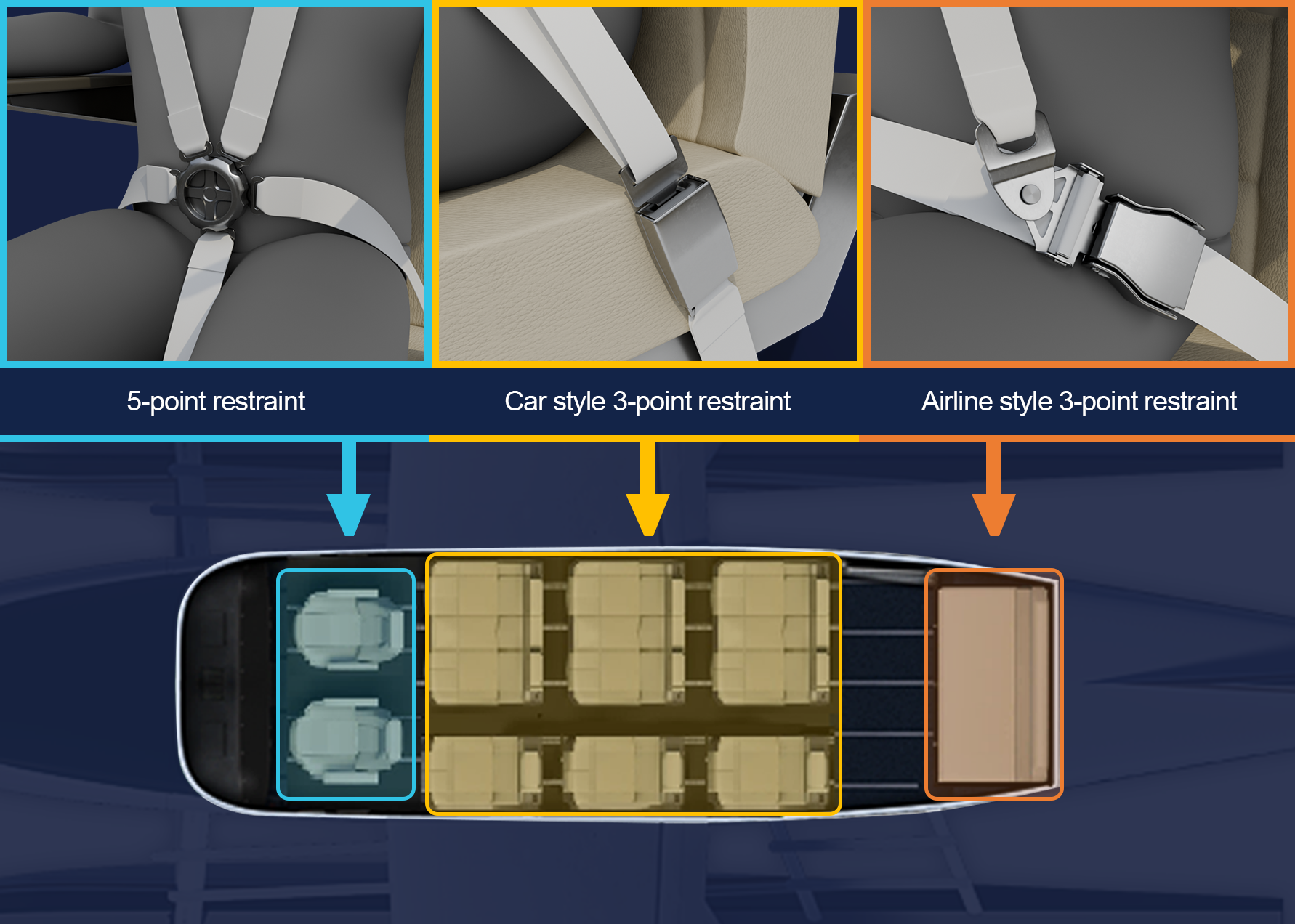
Figure 18 shows the restraints provided for occupants of VH-WTY. The pilot and copilot seat were equipped with 5-point restraint which consisted of 5 webbing straps all connecting to a central release buckle. The buckle released when twisted in either direction.
Figure 18: Types of restraints fitted to VH-WTY and their positions
Source: ATSB
The passenger restraints for the first 3 rows were a 3-point lap-sash design which clicked into place in a buckle with a push-button release, similar to a motor vehicle. The restraints for the bench seat were also 3-point design with lap belt and shoulder strap. These restraints, however, required separate fastening of the shoulder and lap belts.
All surviving passengers recalled wearing their restraint during the flight, and that the deceased passengers were also secured. Three of the surviving passengers recalled successfully disconnecting their restraint, with one recalling that another passenger disconnected their restraint for them. Passenger video showed the pilot secured by the 5-point restraint during the accident flight.
Police video footage from the recovery of the deceased occupants showed that the pilot and 2 passengers were not secured by their restraints. The pilot and the passenger in seat 1A were found near their seats. The passenger in seat 2C was partially outside the aircraft, with their torso through an overwing window that had broken in the accident. The circumstances by which the deceased occupants became released from their restraints, and by which the passenger of seat 2C partially exited the aircraft, has not been determined.
Crew entry doors
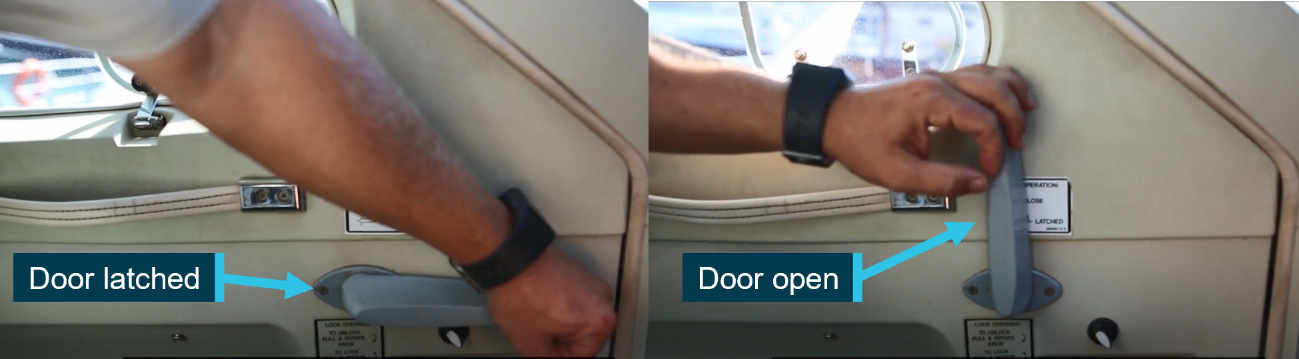
The aircraft had 2 crew entry doors at the front of the cabin, next to the pilot (left) and copilot (right) seats. The crew entry doors had interior and external handles, which could be set to OPEN, CLOSE and LATCHED positions. The doors were also equipped with separate locks, and with lock override knobs inside the aircraft. To close the door, aircraft operating procedures instructed pilots to place the handle in the CLOSE position and pull the door closed, before rotating the handle to the LATCHED position. When unlocked and in the LATCHED position, the crew entry doors could be opened from either inside or outside the aircraft by rotating the handle to the OPEN position (Figure 19).
Figure 19: Operation of front door handles on a Cessna 208
Source: Swan River Seaplanes briefing video, annotated by the ATSB
The wreckage examination found the right (copilot) door handle in the LATCHED position. The door sustained significant damage in the accident, rendering it inoperable.
Footage captured by WA Police divers on the evening of 7 January showed the left (pilot) door handle in the LATCHED position. The divers unlatched the left (pilot) door during the recovery of the deceased occupants. When examined by the ATSB, the left (pilot) door handle was in the OPEN position, and the door was free to open. The reason why the door was not unlatched and opened by the pilot immediately following the accident has not been determined.
Passenger doors
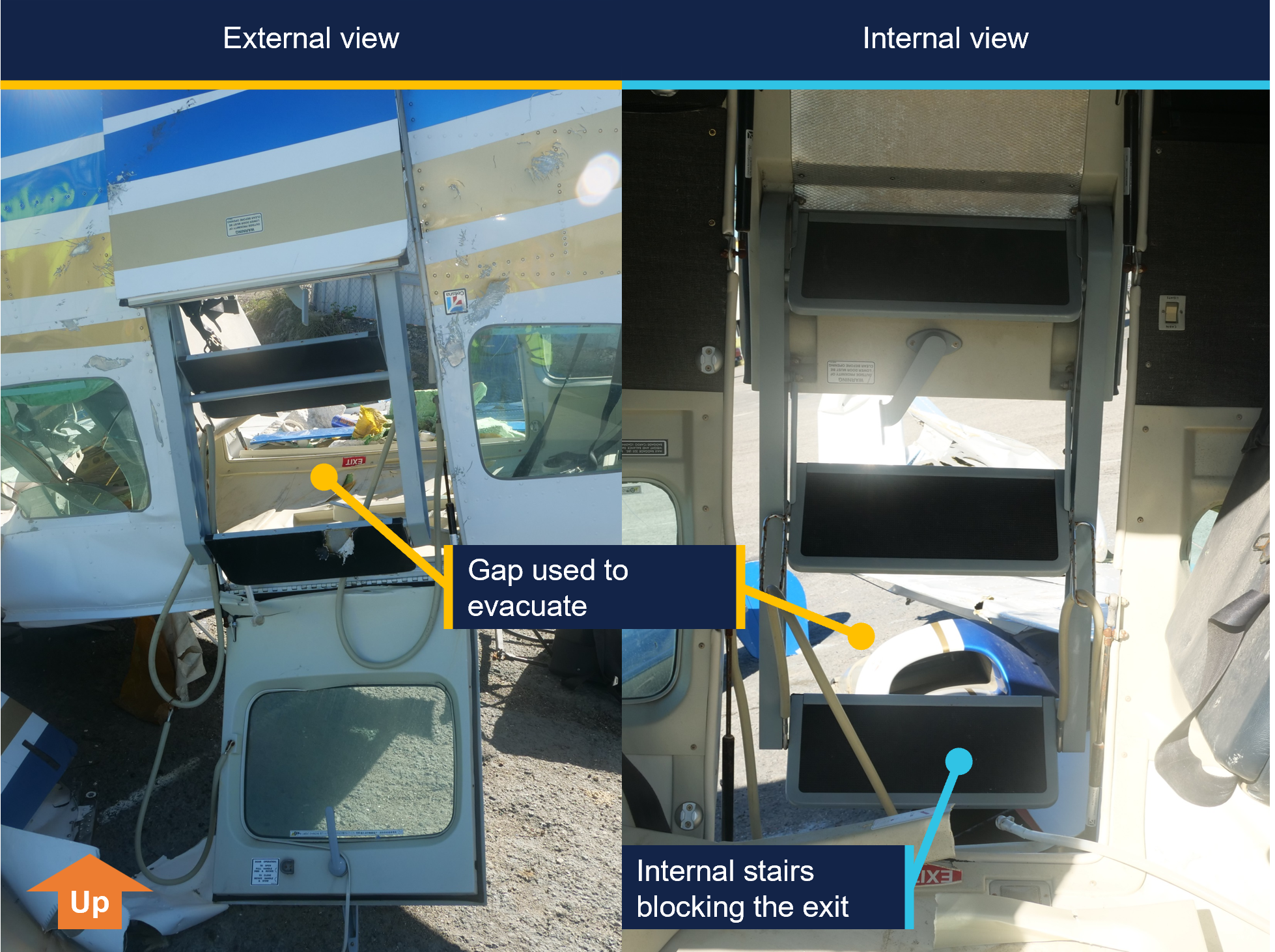
There were 2 doors towards the rear of the cabin, each with a horizontal clamshell opening. Each rear door included separate handles for the upper and lower sections. The upper section had to be opened first by pulling the handle inwards before rotating it from CLOSED to OPEN. The lower section was released by pulling up on the inside door handle, rotating the handle to the OPEN position and pushing outwards. When the lower section of the right rear door opened, a set of integral airstairs deployed.
After the collision, the passenger in seat 3A opened the top section of the right rear door. Because the aircraft was inverted, however, the aircraft stairs were extended across the aircraft exit (Figure 20). The passengers in seat 3A and 3C recalled this restricted the opening to a narrow gap, requiring both passengers to swim through the rungs of the aircraft stairs to escape.
The passenger in seat 2A recalled unsuccessfully attempting to open a door in the rear of the aircraft.
Figure 20: VH-WTY right rear door
Source: ATSB
Other information related to passenger escape
Passengers recalled that water filled the aircraft immediately after the collision. The surviving passengers moved to the rear of the cabin, where a small pocket of air was available. The passengers recalled that carry-on bags and a seat cushion had also floated into this air pocket, reducing the space available and hindering their escape.
The passengers in seats 1C and 2A recalled escaping through the rear left window, which had been broken by the coxswain of the operator’s tender vessel.
Other survivability information
Life jackets
The Swan River Seaplanes Aircraft Operations Manual[20] stated that prior to any flight over water, the pilot was to ensure that all persons on board were wearing a life jacket.
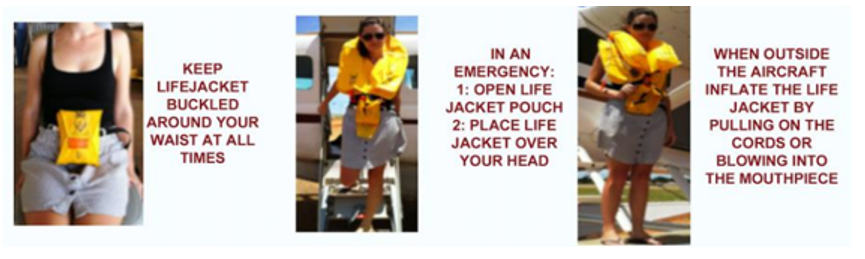
Swan River Seaplanes provided passengers pouch-style life jackets which were designed for constant wear, and to be donned and inflated when required in an emergency. The life jackets could be inflated using a gas-cylinder inflation system or using an oral inflation system. Instructions for wearing, donning and inflating the life jackets (as shown in Swan River Seaplanes safety information cards) are depicted in Figure 21.
Figure 21: Passenger life jacket wearing, donning and inflating instructions
Source: Swan River Seaplanes
The pilot and all passengers wore their life jackets during the accident flight.
None of the surviving passengers had donned or inflated their life jackets during the evacuation process. Similarly, the pilot and the 2 deceased passengers were found with their life jackets secured around their waists.
Safety briefings and passenger briefing cards
Part 135 of the Civil Aviation Safety Regulations requires pilots to ensure passengers are provided safety briefings (regulation 135.280). The regulations also require the operator of an aeroplane with more than 2 rows of seats to have a safety briefing card available to each passenger, and that the safety briefing card meets the requirements of the Part 135 Manual of Standards (regulation 135.275).
Swan River Seaplanes utilised a safety briefing video, which was shown to passengers prior to departures from South Perth. The surviving passengers all recalled watching the video on the morning of the accident. The video demonstrated:
- the use of the aircraft safety equipment, including the location of the aircraft exits, how to open the front and rear doors and how to don the life jackets
- the operation of the seatbelts equipped to the final (rear) row of seats.
The video did not demonstrate the operation of the seatbelts equipped to the forward three passenger rows.
The Swan River Seaplanes Aircraft Operations Manual required that prior to all departures, pilots were to ensure that all passengers had received a briefing that included the proper use and adjustment of restraints, the location and operation of emergency exits, and the proper stowage of luggage. The manual required that for overwater flights, the use of life jackets must be demonstrated. The HOFO reported that Swan River Seaplanes pilots were required to provide a passenger briefing in addition to, and including repeating content provided in, the safety video.
Surviving passengers recalled that prior to the departure from South Perth on the morning of the accident, the pilot instructed them to fasten their seatbelts. Passengers did not recall the pilot providing additional instructions about the aircraft exits prior to the morning departure, however they did perceive the video and briefing were comprehensive.
Surviving passengers recalled that the pilot did not provide a briefing during the boarding and preparation for the return flight from Thomson Bay (the accident flight). The passenger in seat 3A recalled that during the boarding, the pilot requested they assist with closing the rear left door. The passenger recalled the pilot provided detailed instructions on how to operate the 2 sections of the rear door, and requested the passenger push the door closed. The passenger considered that the pilot’s instructions for closing the door were helpful for the passenger to subsequently open the right door after the aircraft collided with the sea.
Ongoing investigation focus Accident survivability, consistent with the ATSB SafetyWatch priority Reducing the severity of injuries in accidents involving small aircraft. This will include consideration of the crashworthiness of Cessna 208 Caravan aircraft, and the suitability of the emergency equipment and procedures for accidents involving immersion in water. |
Aircraft maintenance information
Maintenance procedures
The Textron Aircraft Maintenance Manual (AMM) and the Pratt & Whitney Engine Maintenance Manual (EMM) provided manufacturer procedures for the maintenance of the airframe and engine, respectively. Both manuals specified requirements for preservation for extended periods of inactivity, and for return to service inspection procedures following inactivity.
For periods of inactivity greater than 90 days, the EMM required preservation actions including draining the engine oil, installing numerous caps, covers and plugs, and coating numerous surfaces with preservative oils and compounds. The EMM stated that the preservation requirements for periods of inactivity could be substituted by alternatively ensuring the engine is ground run[21] once a week.
The EMM also provided an engine unpreserved procedure, which was for inspection of engines which had been inactive without preservation. For periods of inactivity greater than 90 days, the procedure required examination of engine components, fuel system flush, engine runs and inspection of the fuel control unit at an approved facility. Pratt & Whitney stated that extended inactivity of PT6 engines without the required preservation carried risks associated with moisture ingress and corrosion, and that the risk of corrosion was exacerbated for aircraft operated in a salt-laden environment. Pratt & Whitney further advised that a PT6 engine inactive for the periods specified in the EMM, which had neither been preserved for inactivity nor inspected following inactivity according to the EMM procedures, would be considered to have been not maintained in accordance with the published instructions for continued airworthiness.
Maintenance history prior to acquisition by Swan River Seaplanes
Maintenance documentation associated with VH-WTY showed that the aircraft had been inactive for extended periods of time from June 2021 until it was leased and operated by Swan River Seaplanes in late December 2024. The aircraft was inactive for 1,265 out of 1,277 days during this period and was only operated for 12 days and for 8.1 hours. The main periods of inactivity are shown in Table 6.
Table 6: VH-WTY periods of inactivity June 2021 to December 2024
| Dates | Duration (days) |
| 29 June 2021 – 22 June 2022 | 358 |
| 25 June 2022 – 16 March 2023 | 263 |
| 16 March 2023 – 20 October 2023 | 217 |
| 4 March 2024 – 27 December 2024 | 298 |
There was no record the engine was preserved according to the EMM procedures for any of these periods of inactivity. Other than during the first few weeks of the final period of inactivity (discussed in the following paragraph) there was no record of engine runs having been conducted while the aircraft was inactive.
During the final period of inactivity, from March to December 2024, VH-WTY was at Bankstown Airport, New South Wales. Another operator had intended to acquire the aircraft and conducted checks of the airframe and associated maintenance documentation. The aircraft was initially stored in a hangar in Bankstown, and the operator conducted weekly engine runs in the first few weeks after VH-WTY arrived.
The acquisition, however, did not eventuate, and with no ongoing commercial arrangement with the aircraft owner, the Bankstown operator moved VH-WTY to a location outside its hangar in about June 2024. The Bankstown operator discontinued weekly engine runs on VH-WTY in around April 2024.
Ferry and inspection prior to operation by Swan River Seaplanes
VH-WTY was leased by Swan River Seaplanes in late December 2024. On 27 December 2024, a special flight permit was issued by an authorised approver on behalf of the Civil Aviation Safety Authority (CASA), for a ferry flight from Bankstown to Jandakot. This permit was required due to the expiry of the maintenance release on 20 October 2024.
On 28 December, VH-WTY departed Bankstown Airport, and on 29 December arrived at Jandakot Airport. A maintenance organisation at Jandakot then conducted checks to meet the time-expired requirements of the maintenance release. The maintenance documentation showed this included conducting the 12-month, 100‑, 200‑, 400‑ and 800‑hour inspections as described in the AMM. A new elevator pushrod bearing was installed, and new rudder pulleys were installed for the left and right floats. Engine work included a compressor power recovery wash and desalination rinse. A seal kit was installed on the engine, which included a new fuel filter. Additionally, the chip detector plugs were recorded to have been inspected with no defects listed.
The records from these maintenance activities did not include reference to the engine unpreserved procedure. The ongoing investigation will consider the maintenance activities conducted prior to VH-WTY being returned to service on 2 January 2025.
Ongoing investigation focus VH-WTY aircraft preservation actions and return to service inspection activity. |
Aircraft operating procedures
Use of water rudders
The AFMS required that water rudders only be used for taxiing the aircraft. The first item on the before take-off checklist was to retract the water rudders.
Witness video footage from the shore of Thomson Bay showed the water rudders extended while the aircraft taxied, consistent with normal practice. Video showed the water rudders were also extended when the aircraft separated from the water, whereas they should have been retracted by this stage.
It is possible that the water rudders were retracted by the pilot during the take-off, but released back to the extended position as the aircraft moved through sea swell. Operational experience is that the Cessna 208 water rudders can inadvertently deploy in rough swell, and a previous operator of VH-WTY had installed an additional restraint strap to prevent this occurring. The pilot of VH-WTY did not use the additional water rudder restraint strap.
Witness and passenger video recorded the aircraft encounter significant swell during the take-off (see Witness environmental observations and recorded video). Video recorded by a passenger on board the aircraft also captured sounds consistent with the water rudder being retracted at a normal stage for the floatplane departure (the video did not show the operation of the water rudder controls).
The primary reason water rudders were required to be retracted during take-off and flight was to prevent damage to the rudders, which can occur if they are left extended during flight operations. Wipaire stated operational experience was that water rudders extended during take-off had benign influence on performance.
Use of quadrant friction lock
The POH, when describing before take-off procedures, required the pilot to adjust the friction lock. It was not possible to determine the setting of the quadrant friction lock for the accident flight.
Stall warning procedures and Cessna 208 amphibian pilot practices
The POH warned pilots that the circuit breaker must be closed for approach and landing. The POH identified that the stall warning system was required to be installed and operable during flight. It further required that pilots check that all circuit breakers were in the ‘IN’ position prior to engine start.
Video recorded by a passenger on board VH-WTY recorded sound within the cabin as the aircraft approached Philip Rock and became airborne. No stall warning horn was captured on the footage. The stall warning circuit breaker was found in the out (power off) position after the accident.
Cessna 208 amphibian aircraft are used by several Australian operators. Pilots experienced with these operations identified that the stall warning system regularly activates during normal water take-offs. These pilots noted that the stall warning horn was loud and distracting, and caused concern to passengers. The pilots identified it was a common practice for Cessna 208 amphibian aircraft pilots to disable the stall warning system by pulling the circuit breaker to the out (power off) position.
The Swan River Seaplanes HOFO stated they were aware that some C208 amphibian pilots engaged in the practice of disconnecting the stall warning circuit breaker. They stated, however, that this was not a common practice of Swan River Seaplanes pilots, and that the operator's procedures required pilots to operate company aircraft according to the aircraft procedures, including ensuring the stall warning circuit breaker was connected.
Ongoing investigation focus Cessna 208 Caravan stall warning system configuration and the stall warnings provided to pilots during water take-offs and landings. |
Take-off procedures
General background
When compared to land-based operations, floatplane take-offs involve the additional challenge of overcoming hydrodynamic drag, parasite drag and the additional weight of the floats. To achieve this, the pilot accelerates the aircraft through the water in a high nose attitude to build hydrodynamic pressure under the floats. This is known as the 'plow' or ‘plowing’ phase. Once there is sufficient pressure, the weight of the aircraft can be supported by the forward section of the floats with the rear section held out of the water. Modern floats feature a stepped construction to reduce drag and facilitate faster acceleration during this phase of the take-off. When the aircraft weight is supported by this forward section of the floats, the aircraft is said to be 'on the step'. Once on the step, the pilot maintains the aircraft in a ‘planing’ attitude and as airspeed increases, more of the aircraft weight is supported by the aerodynamic lift of the wings. When the airspeed is sufficient for the wings to support all the weight of the aircraft, the aircraft becomes airborne.
In crosswind conditions, seaplane pilots may attempt to use a technique whereby they utilise co‑ordinated control inputs to counter the effect of the crosswind to maintain directional control. A crosswind will generally raise the upwind wing, pushing the downwind float into the water which increases drag. By applying ailerons to lift the downwind wing, this drag is reduced. Coordinated use of rudder to keep the floats tracking straight through the water, and elevator to maintain the correct planing attitude on the step, will further minimise drag and assist with acceleration until the upwind float separates from the water.
Procedures for Wipline 8750 equipped Cessna 208 floatplanes
The Airplane Flight Manual Supplement (AFMS) water take-off procedures instructed the pilot to configure the aircraft with the wing flaps set to either 10 or 20°, and the rudder trim at the floatplane take-off index. The pilot was then required to set the power lever for take-off, before retracting the water rudders. Considering the ambient temperature and altitude of the departure from Thomson Bay, the maximum torque for take-off was 1,865 ft lb.
Once on the step, the procedures required the pilot to maintain the planing attitude to allow the aircraft to accelerate. The procedures stated that once the aircraft reached the take-off speed of between 65–70 kt IAS, the pilot could apply light back pressure on the controls to fly the aircraft off the water smoothly.
Take-off performance
Wind component information
The Rottnest Island weather station recorded winds of 23 to 27 kt (with gusts to 33 kt), at 210–220°, from 1530 to 1600 on the day of the accident. While the weather conditions in Thomson Bay may have differed to those recorded at the weather station (about 5.5 km away, and at an elevation of 43.1m), observations from witnesses indicate conditions were similar to those recorded. Further description of recorded and observed weather is provided in Meteorological and environmental information.
Recorded data showed VH-WTY departed on a heading of about 110°. Assuming the aircraft encountered winds consistent with those recorded at the Rottnest Island weather station at 1600, this indicates a tailwind of about 4.3 kt and a crosswind of about 24.6 kt in the prevailing winds.
Performance information
The AFMS provided guidance on the distance required for a water take-off, including values for the distance required for aircraft to achieve a lift-off speed of approximately 67 kt IAS, when configured for take-off with flaps set to 20° and the engine torque set for maximum continuous power.
Considering the values and guidance provided by the AFMS, for the conditions encountered by VH-WTY during its take-off from Thomson Bay:
- The aircraft would require a take-off distance of approximately 756 m (2,482 ft) considering ambient temperature of 24°C and sea-level altitude.[22]
- The take-off distance required was extended by 20% (151 m) due to the approximately (mean) 4 kt tailwind.
- The take-off distance required was increased by 1% (8 m) due to the pilot setting the inertial separator system[23] to BYPASS.
The take-off distance required, according to the guidance provided in the AFMS, was thus estimated to be about 915.4 m (3,003.2 ft).
As identified in Meteorological forecasts and observations, the recorded wind strength and direction remained relatively constant from 1400, and therefore this calculation is likely to be reflective of the conditions apparent when the pilot inspected Thomson Bay at 1500 (see Assessment of environmental conditions by the pilot of VH-WTY).
The AFMS calculated take-off distances were based on smooth (not glassy) water conditions, and at the maximum take-off weight for the aircraft. The AFMS did not provide methods for adjusting the calculations for variations in water conditions or take‑off weight. The ATSB notes that VH-WTY was operated at less than its MTOW (see Weight and balance), and that the water conditions in Thomson Bay included significant swell and waves (see Witness environmental observations and recorded video).
The calculated take-off distances do not account for variations in wind direction or strength, including gusts, which were present on the afternoon of the accident. The ATSB final investigation report may include additional calculation of the take-off distance required considering these factors.
Regulatory requirements for determining take-off distances
The Civil Aviation Safety Regulations (CASR), Part 135.350, states that the Part 135 Manual of Standards (MOS) may prescribe requirements relating to the take-off performance for a flight of an aeroplane. The Part 135 MOS states that an operator and pilot in command must ensure that the take-off run available for a selected runway does not exceed the factored take-off run for that aircraft. The factored take-off run is the take‑off run required for the aeroplane, multiplied by a standard take-off factor determined by the MTOW of the aircraft. The Part 135 MOS states that for an aeroplane with a MTOW of greater than 3,500 kg a take-off factor of 1.25 must be applied.
The required factored take-off run for VH-WTY was estimated to be about 1,144 m.
Aircraft crosswind limitations
The Cessna 208 was certified under US Federal Aviation Regulations Part 23[24] and approved in October 1984 with ongoing production. Under Part 23 certification testing requirements the manufacturer was required to demonstrate handling characteristics and adequate directional stability and control. The regulations defined the required crosswind handling characteristics as:
A 90 degree cross-component of wind velocity, demonstrated to be safe for taxiing, takeoff, and landing must be established and must be not less than 0.2 VS0.
The published Vs0[25] for the Cessna 208 is 60 kt calibrated airspeed.[26] This means that the aircraft was required to demonstrate adequate handling, stability and control in crosswinds of at least 12 kt.
The AFMS specified the maximum crosswinds in which Cessna 208 aircraft equipped with the Wipline 8750 floats had been demonstrated during certification testing. The AFMS stated that for water take-offs, the maximum demonstrated crosswind was 14 kt. The AFMS further stated that the demonstrated limitation was ‘close to the capabilities of the airplane’.
Aircraft tailwind limitations
The US Federal Aviation Administration (FAA) Floatplane Handbook identifies that downwind take-offs (that is, take-off conducted with a tailwind component) may be necessary or preferred due to water conditions. The FAA Floatplane Handbook notes, however, that this will result in a longer take-off run due to the requirement for the aircraft to first accelerate to the speed of the wind, then to the correct speed to generate lift for take-off.
The FAA Floatplane Handbook notes that during floatplane operations, tailwind has an additional effect to further lengthen the required take-off run due to float drag. It states:
The speed of the floats in the water corresponds to the higher groundspeed required in a landplane, but the drag of the floats increases as the square of their speed. This increase in drag is much greater than the increase in rolling resistance of tires and wheel bearings in a landplane. A tailwind may lengthen the seaplane’s takeoff distance much more dramatically than the same tailwind in a landplane.
There was no maximum tailwind for take-off identified in the AFMS. The AFMS stated that for tailwind up to 10 kt, take-off distance required increased by 10% for every 2 kt of tailwind.
Aircraft wave and sea limitations
Rough water can adversely affect the performance of floatplanes during take-off and landing. The FAA Floatplane Handbook states:
In most cases an experienced seaplane pilot can safely take off in rough water, but a beginner should not attempt to take off if the waves are too high…The advisability of canceling a proposed flight because of rough water depends on the size of the seaplane, wing loading, power loading, and, most importantly, the pilot’s ability. As a general rule, if the height of the waves from trough to crest is more than half the height of the floats from keel to deck, takeoffs should not be attempted except by expert seaplane pilots.
The FAA Floatplane Handbook provides guidance on pilot techniques for rough water take-offs and states:
Fortunately, a takeoff in rough water is generally accomplished within a short time because if there is sufficient wind to make water rough, the wind is also strong enough to produce aerodynamic lift earlier and enable the seaplane to become airborne quickly.
The FAA Handbook does not consider the suitability of conducting a rough-water take-off with headwind and crosswind component.
The AFMS stated that the Cessna 208:
Has been demonstrated to operate satisfactorily in wave heights (trough to crest) of approximately 14 inches [35.6 cm]. This is not considered to be a limitation.
Wipaire identified that the effect of rough wind is not easily quantifiable, and these effects were not directly assessed during certification testing beyond the demonstrated 14‑inch limit noted in the AFMS. Wipaire also noted that very rough water with large swell can cause the aircraft to lift off before intended.
Ongoing investigation focus Take-off performance requirements and limitations considering environmental conditions. |
Swan River Seaplanes Thomson Bay operations
Regulatory context for water aerodromes
The Civil Aviation Safety Authority (CASA) advisory circular AC 139.F-01 provided guidance for the design and operation of water aerodromes for air transport operations. Water aerodromes were defined as:
A defined area, primarily on water, intended to be used either wholly or in part for the arrival, departure and movement of seaplanes, and any building and equipment on ground or water.
AC 139.F-01 noted that the International Civil Aviation Organization (ICAO) recommends that States certify water aerodromes open to public use through an appropriate regulatory framework. AC 139.F-01 stated that as CASA does not require certification of water aerodromes, it has notified a difference with this requirement.
Guidance provided by AC 139.F-01 included that:
- The take-off direction of water runways will vary depending on prevailing conditions. AC 139.F-01 stated that floatplane pilots will determine the correct direction at the time of take‑off.
- The length of a water runway should be sufficient to meet the requirements of the floatplane with which take-offs are intended to be conducted, considering the conditions in the local operating environment.
- The dimensions available for aircraft use should be provided in a suitable format. Any limits or restrictions should be made available to pilots operating to the area.
Regulatory context for use of water runways
The CASR Part 91.410, stated that take-offs and landings must only be conducted at a location if:
The aircraft can land at, or take off from, the place safely having regard to all the circumstances of the proposed landing or take‑off (including the prevailing weather conditions).
The regulations specified that aircraft may take-off or depart from certified aerodromes, or from a place ‘that is suitable for the landing and taking-off of aircraft’. The water alighting area at Thomson Bay was not certified, and therefore the use of the bay for floatplane operations was dependent on the pilot and Swan River Seaplanes determining the area was suitable for the aircraft.
The CASA publication AC 91-02[27] provided advisory guidance to assist pilots when determining the suitability of a place to safely take off and land. The publication stated that pilots have a responsibility to satisfy themselves that an aeroplane can safely take off from, or land at, a location. The publication advised that this requires consideration of the aircraft type and weight, the prevailing weather conditions and the dimensions and other characteristics of the intended landing or take-off location. AC 91-02 recommended that water aerodromes provide a channel of at least 60 m width for day operations, and sufficient depth.[28]
AC 91-02 further stated pilots must resist personal and external pressures to proceed when evidence suggests safety is not reasonably assured. The publication advised that persons involved in operating an aircraft should pre-identify criteria for cancelling an operation (‘no-go decision criteria’). AC 91-02 advised that operations should not be commenced in circumstances where no-go criteria have been met, unless appropriate consideration has been given to safety mitigation and regulatory requirements.
Swan River Seaplanes procedures
The Swan River Seaplanes Air Routes and Aerodromes manual described the aerodromes and water alighting areas regularly used by the operator. The exposition stated that Rottnest Island (Thomson Bay) was a ‘water alighting area’ approved by Swan River Seaplanes for use for CASR Part 135 operations.
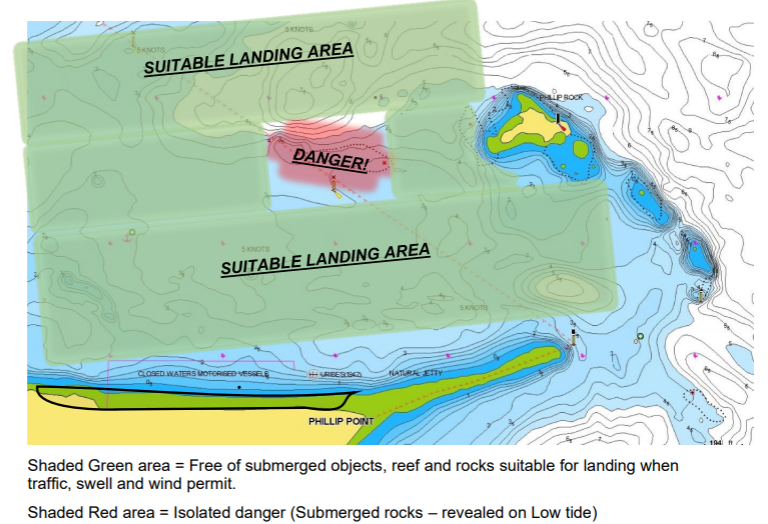
The procedures for the Thomson Bay water alighting area provided a water alighting area diagram, which showed a defined ‘suitable landing area’ (Figure 22). The procedures did not describe the dimensions of the suitable landing area, and nor did they indicate the tracks which should be utilised for take-offs and landings in the area.
Figure 22: Swan River Seaplanes water alighting area diagram for Thomson Bay
Source: Swan River Seaplanes
The water alighting area procedures stated that water landings were only to be conducted at Thomson Bay ‘in a clear area with safe available landing and take-off distances. These factors are to be determined by pilot in command’. The procedures also stated that the (red shaded) danger area was to be avoided at all times.
Rottnest Island approvals
The Rottnest Island Authority[29] provided approval for Swan River Seaplanes pilots to conduct water landings and departures from Thomson Bay. Following approval to conduct trial take-offs and landings in January to April 2023, the authority provided and renewed approvals for the operations from October 2023 to June 2025.
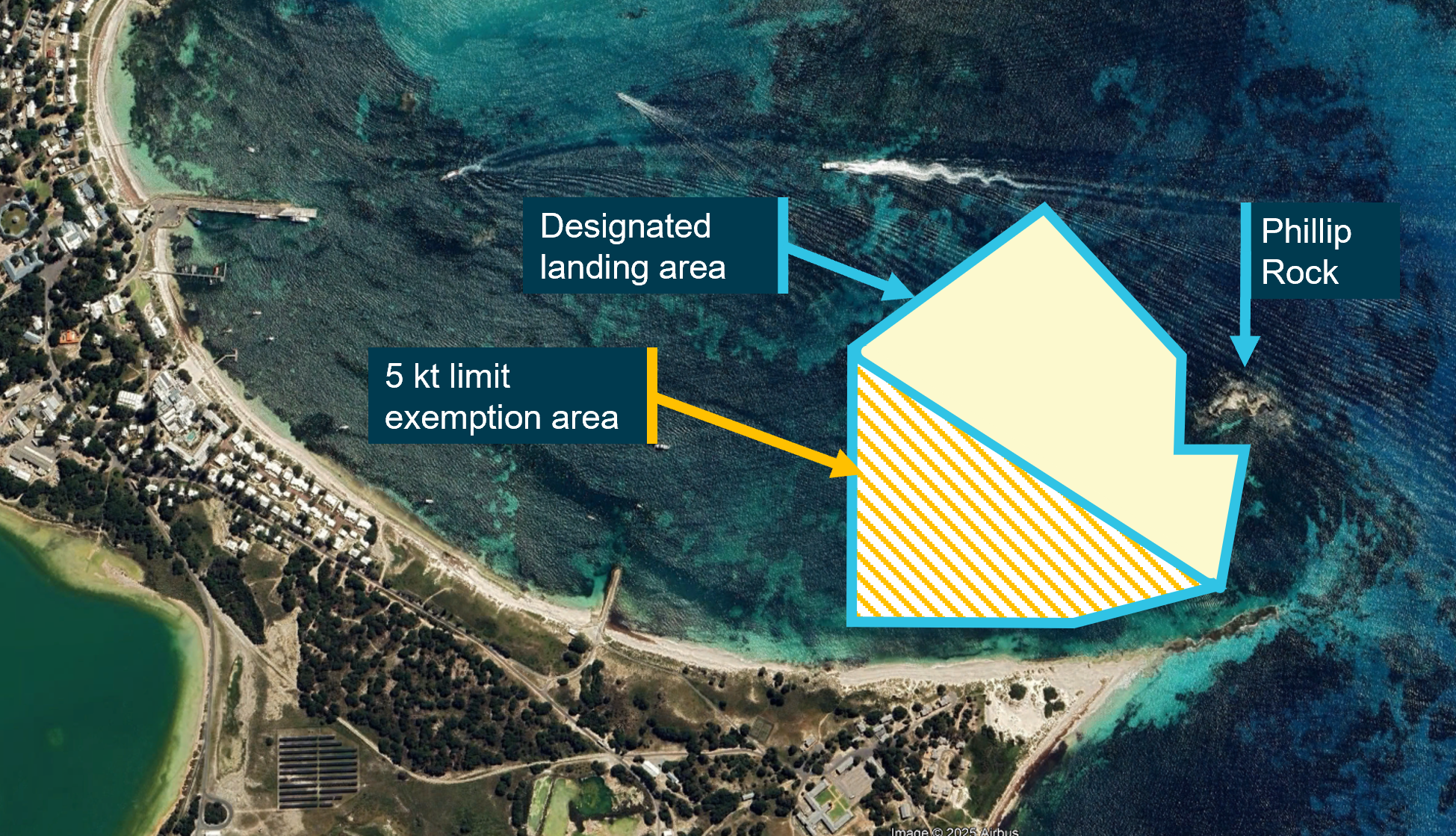
The approvals to conduct operations in Thomson Bay specified several conditions, including that landings may only occur in a designated area. The Rottnest Island Authority and Swan River Seaplanes personnel confirmed it was understood that take‑offs were also to only occur in this area. The Swan River Seaplanes HOFO stated that company pilots were permitted to operate outside the designated area if required for safety of flight.
Figure 23: Thomson Bay area of approved operations, as described in Rottnest Island Authority approval
Source: Google Earth, annotated by the ATSB based on information provided by Rottnest Island Authority
Marine vessels were restricted to a maximum 5 kt in parts of Thomson Bay. The Western Australian Department of Transport provided an exemption to this limit for seaplanes during take-off and landing, in a designated section of the bay. The exemption was gazetted in May 2023.
Ongoing investigation focus Swan River Seaplanes’ identification and assessment of Thomson Bay for floatplane operations. |
Thomson Bay departures
The ATSB examined available electronic flight data records of previous take-offs from Thomson Bay by aircraft operated by Swan River Seaplanes since 2023. Swan River Seaplanes operated another Cessna 208 amphibian, registered VH-UOZ, and used this aircraft for all flights conducted in 2023 and 2024.
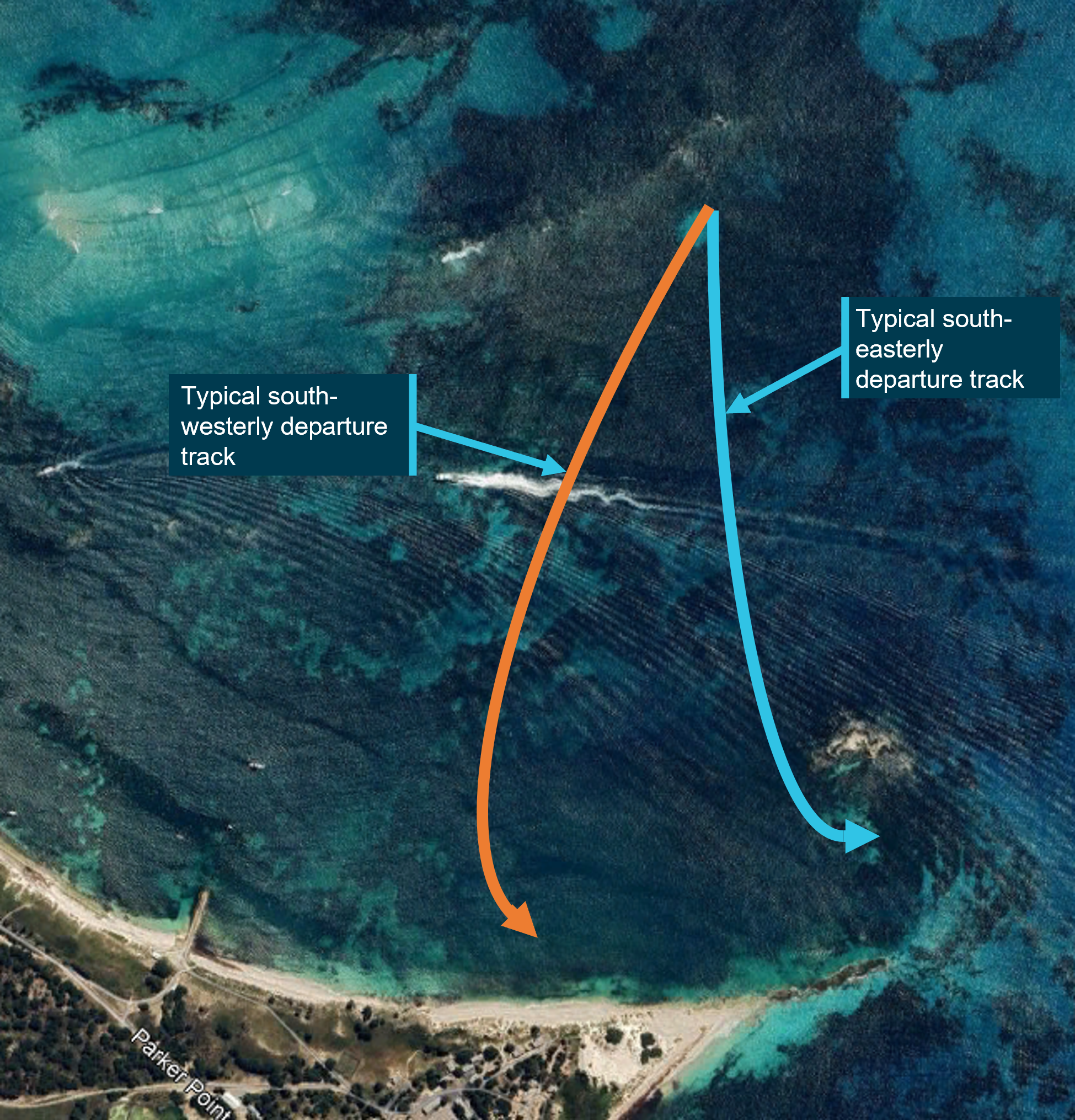
A flight tracking device equipped to VH-UOZ recorded 95 departures from Thomson Bay in 2023 and 2024. The flight tracking data showed that departures from Thomson Bay typically involved the aircraft taxiing from the pontoon to the north‑east, into the centre of the bay. The take-off run would then typically be conducted on a south-westerly or south‑easterly heading (Figure 24).
Figure 24: Typical tracks recorded for take-offs from Thomson Bay in VH-UOZ
Source: Google Earth, annotated by the ATSB
Flight tracking information from the accident aircraft, VH-WTY, recorded the flights conducted from Thomson Bay on 4 and 5 January under the command of the Swan River Seaplanes HOFO. All of these flights were conducted on a south-easterly track (Figure 25). The pilot of the accident flight had not conducted a take-off from Thomson Bay using VH-WTY prior to the day of the accident.
Figure 25: Recorded departure (including taxiing phase) tracks for VH-WTY within Thomson Bay displaying the difference between the accident flight and the previous flights
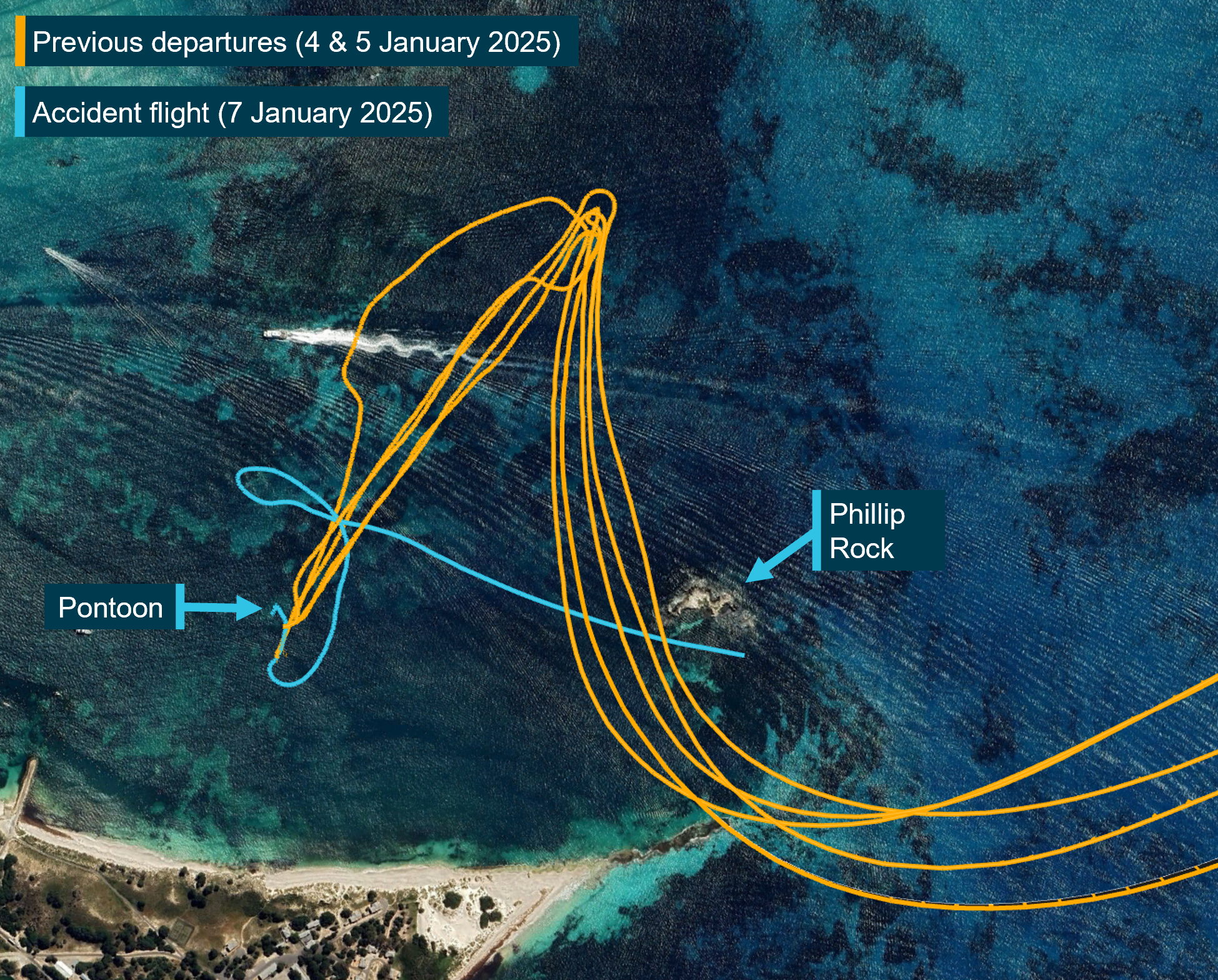
Source: Google Earth, annotated by the ATSB
Take-off wind for previous flights
Observations recorded at the Rottnest Island weather station included the wind strength and direction at the time of take-offs from Thomson Bay, as captured in the flight tracking information for VH-UOZ and VH-WTY. Recorded weather and flight tracking information for 30[30] take-offs from Thomson Bay in 2024 and 2025 (including the accident flight) showed the following:
- Only 2 flights were conducted from Thomson Bay with a tailwind, with the accident flight being conducted with the highest tailwind (4.3 kt).
- The accident flight take-off was conducted with the highest crosswind component (24.6 kt), with only 1 other take-off having a crosswind component of over 18 kt. The majority of the take-offs (25 of 30) were conducted with a crosswind component of less than 13 kt.
- Most (25 of 30) take-offs were conducted with a recorded windspeed of less than 20 kt.
Pre-flight assessments
Swan River Seaplanes procedures
The Swan River Seaplanes Aircraft Operations Manual stated that all flights were to be authorised by the HOFO. Prior to authorising flights, the HOFO was to consider whether the pilot in command was rated for the aircraft type and class, had a current flight review and was current for the route. The HOFO was deemed to have authorised a flight when they rostered a pilot onto a flight sector.
The Aircraft Operations Manual stated that once the HOFO had authorised a flight, a pilot with more than 250 water landings may be given ‘a general approval to operate in weather conditions at their discretion’. Such pilots had authority to make decisions regarding whether a flight should proceed, proceed subject to modification, or be cancelled. The manual stated that the HOFO retained the authority to override a pilot’s decision and was still responsible for controlling operations.
The Aircraft Operations Manual stated that within one hour prior to a flight, the pilot in command must study all available information relevant to the flight. This was to include all current weather reports and forecasts for the route, departure and destination aerodromes.
The Aircraft Operations Manual did not provide or suggest any limits for forecast wind conditions.
Ongoing investigation focus Swan River Seaplanes’ operational oversight practices. |
Suitability of alighting areas
The Aircraft Operations Manual stated that water take-offs and landings must be conducted from an area conforming to the recommendations described in Civil Aviation Advisory Publication (CAAP) 92(1).[31] CAAP 92(1) provided similar guidance to that contained in AC 91-02, recommending that water alighting areas provide:
a runway length equal to or greater than that specified in the aeroplane's flight manual or approved performance charts or certificate of airworthiness, for the prevailing conditions is required...
CAAP 92(1) further recommended:
A pilot should not use a landing area without taking all reasonable steps to ensure the physical characteristics and dimensions are satisfactory. For aerial work and charter operations the operator should provide evidence to the pilot on the suitability of a landing area prior to its use.
The Aircraft Operations Manual further required pilots assure themselves that the proposed take-off area provided a suitable water surface that was clear of obstructions. The manual indicated that pilots must assure themselves of the suitability of the water surface. The manual indicated this check was to be conducted from the air, stating:
Pilots shall make judgments when airborne, of the suitability of the sea surface for alighting on the water. If in doubt - do not operate. This shall consider variables such as, wind velocity, turbulence, sea state, tidal flow and natural protection by bays, reefs etc.
Ongoing investigation focus Swan River Seaplanes’ procedures and other risk controls for Thomson Bay operations, including safety management system functions. |
Assessment of environmental conditions by the pilot of VH-WTY
The pilot’s mobile phone and other sources showed that the pilot had access to multiple sources of weather observation and forecast information while preparing for the departure from Thomson Bay. This included:
- The HOFO messaged the pilot at 1116, providing an image from a weather website showing that winds at Rottnest Island were 25 kt with gusts to 34 kt.
- At 1316, the pilot accessed and saved weather observation and forecast information for Rottnest Island. The image showed that winds had been recorded at 25 kt, gusting to 34 kt, and that actual winds were much stronger than predicted.
- At 1525, the pilot accessed the same forecast and saved another image. This showed that winds were still recorded at 25 kt south-south‑west, however the gusts had reduced to 27 kt. The image showed forecast winds increasing (Figure 26).
Figure 26: Rottnest Island wind measurement and prediction obtained by pilot of VH‑WTY at about 1525 on 7 January 2025
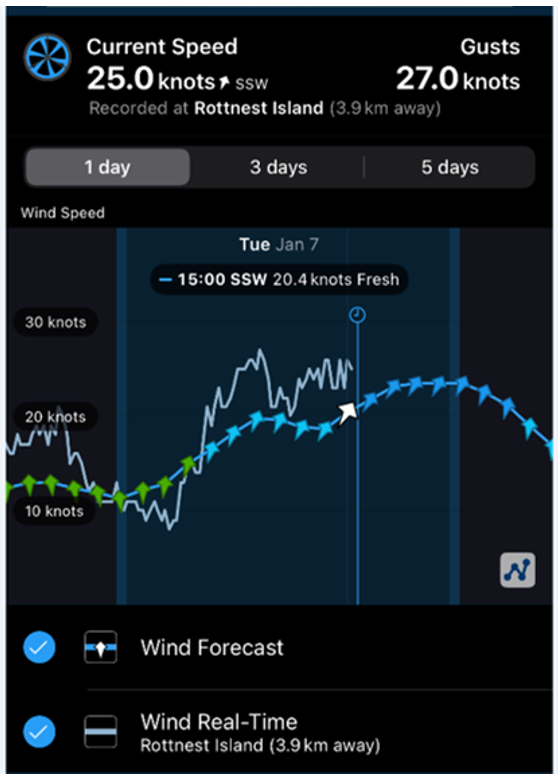
Source: Mobile phone records
The tender vessel used by Swan River Seaplanes was equipped with a tracking device, which recorded positional information at approximately 1-minute intervals. Closed‑circuit television (CCTV) recorded the jetty where the tender vessel docked at in Thomson Bay, and showed the times the vessel arrived and departed.
The tracking data and CCTV showed that the pilot operated the tender vessel solo at about 1300, with the tracking data showing the tender vessel operated to about 400 m north-west of Philip Rock. The vessel was recorded at this location at about 1310 on a heading of 55° at 22 kt. The vessel returned to the jetty at about 1320.
Figure 27: Thomson Bay showing farthest (most easterly) recorded positions of the tender vessel during inspection journeys at 1300 and 1500, 7 January 2025
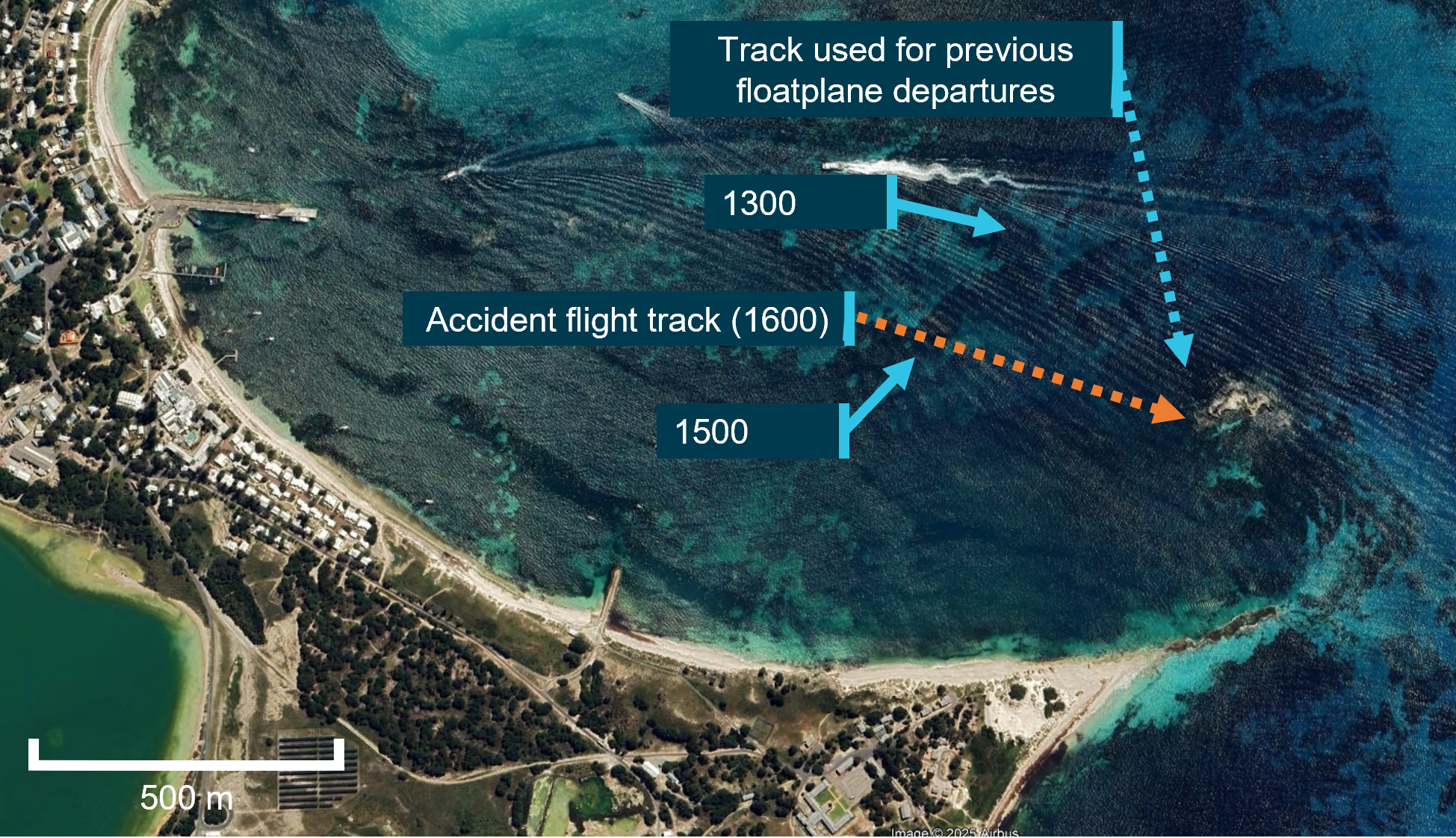
Source: Google Earth, annotated by the ATSB
CCTV recorded the coxswain arrive at the jetty and board the tender vessel with the pilot at about 1450. The tracking data showed the tender vessel was then operated to about 450 m west of Philip Rock, before returning to the fuel jetty. Regarding this journey, the coxswain recalled that:
- The tender was navigated along the operator’s normal north-south take-off track.
- Both the pilot and the coxswain agreed that conditions along that track were not suitable.
- The pilot decided to conduct a crosswind take-off, using an easterly track.
- The tender was not operated along this easterly track.
- Conditions in Thomson Bay were calm, but were rough beyond Philip Rock. The coxswain did not recall the pilot describing an assessment of the conditions along the easterly departure track, or identifying an intended lift-off point.
Ongoing investigation focus The pilot of VH-WTY’s assessment of conditions for the take-off from Thomson Bay, including the decision to conduct an eastwards take-off. |
Swan River Seaplanes
Organisational background
Swan River Seaplanes commenced flight operations in 2017. The organisation initially conducted flights from the Swan River to Margaret River, Western Australia, using a leased Cessna 208 amphibian. Swan River Seaplanes reported commencing flights to the sealed runway at Rottnest Island Airport in October 2017, with operations from Thomson Bay commencing in January 2023. In addition to operating to Rottnest Island, Swan River Seaplanes conducted scenic flights departing and arriving on the Swan River. The operator also conducted occasional charter flights to Busselton, Western Australia.
Swan River Seaplanes had 2 directors, one of whom founded the organisation and was also the approved chief executive officer for the air operator’s certificate (AOC).[32] The other director was also the approved safety manager for the AOC.
Swan River Seaplanes had a HOFO and alternate HOFO. The HOFO also held the positions of head of training and checking, head of aircraft airworthiness and maintenance control, and conducted line flying duties. The alternate HOFO conducted check and training activities for Swan River Seaplanes. The organisation also employed 2 line pilots, one of whom was the pilot of VH-WTY. The alternate HOFO had previously conducted line flights but was not operating in that function at the time of the accident.
Additionally, Swan River Seaplanes employed several personnel to conduct duties such as operating the company tender vessel and docking company aircraft.
Swan River Seaplanes operated 2 Cessna 208 amphibian aircraft, registered VH-UOZ and VH-WTY. The operator used VH-UOZ for all flights conducted in 2023 and 2024, until the aircraft became unserviceable due to a mechanical problem. The operator leased VH-WTY and commenced operations using the aircraft on 2 January 2025.
Regulatory context
Swan River Seaplanes had a valid AOC with approval to conduct air transport operations under Part 135 of the CASRs. The company also had valid approval to conduct aerial work (Part 138) and to operate a flight check system.
Further investigation
To date, the ATSB has conducted the following activities:
- interviewed current and former Swan River Seaplanes personnel and other parties involved in the maintenance of VH-WTY
- engaged Pratt & Whitney to conduct a tear-down examination of the aircraft engine, and reviewed the findings from that examination
- reviewed information recorded by avionics equipment on board VH-WTY
- reviewed video recordings from witnesses, CCTV and other sources
- reviewed information recovered from mobile devices
- reviewed the forecast and observed weather conditions at Rottnest Island
- reviewed maintenance documentation for VH-WTY
- reviewed Swan River Seaplanes operational procedures
- analysed recorded flight data and weather information for previous take-offs from Thomson Bay
- engaged medical specialists to review post-mortem records to support analysis of the cause of the 3 fatalities.
The investigation is continuing and will include review and consideration of:
- aircraft handling and performance prior to and following the separation from the water
- take-off performance requirements and limitations considering environmental conditions
- the pilot of VH-WTY’s assessment of conditions for the take-off from Thomson Bay, including the decision to conduct an eastwards take-off
- accident survivability, consistent with the ATSB SafetyWatch priority Reducing the severity of injuries in accidents involving small aircraft; this will include consideration of the crashworthiness of Cessna 208 Caravan aircraft, and the suitability of the emergency equipment and procedures for accidents involving immersion in water
- VH-WTY aircraft preservation actions and return to service inspection activity
- Cessna 208 Caravan stall warning system configuration and the stall warnings provided to pilots during water take-offs and landings
- Swan River Seaplanes’ identification and assessment of Thomson Bay for floatplane operations
- Swan River Seaplanes’ operational oversight practices
- Swan River Seaplanes’ procedures and other risk controls for Thomson Bay operations, including safety management system functions
- regulatory oversight of Swan River Seaplanes and VH-WTY maintenance activities.
A final report will be released at the conclusion of the investigation. Should a critical safety issue be identified during the course of the investigation, the ATSB will immediately notify relevant parties so appropriate and timely safety action can be taken.
Purpose of safety investigationsThe objective of a safety investigation is to enhance transport safety. This is done through:
It is not a function of the ATSB to apportion blame or provide a means for determining liability. At the same time, an investigation report must include factual material of sufficient weight to support the analysis and findings. At all times the ATSB endeavours to balance the use of material that could imply adverse comment with the need to properly explain what happened, and why, in a fair and unbiased manner. The ATSB does not investigate for the purpose of taking administrative, regulatory or criminal action. About ATSB reportsATSB investigation reports are organised with regard to international standards or instruments, as applicable, and with ATSB procedures and guidelines. Reports must include factual material of sufficient weight to support the analysis and findings. At all times the ATSB endeavours to balance the use of material that could imply adverse comment with the need to properly explain what happened, and why, in a fair and unbiased manner. An explanation of terminology used in ATSB investigation reports is available here. This includes terms such as occurrence, contributing factor, other factor that increased risk, and safety issue. Publishing informationReleased in accordance with section 25 of the Transport Safety Investigation Act 2003 Published by: Australian Transport Safety Bureau © Commonwealth of Australia 2025 
Ownership of intellectual property rights in this publication Unless otherwise noted, copyright (and any other intellectual property rights, if any) in this report publication is owned by the Commonwealth of Australia. Creative Commons licence With the exception of the Commonwealth Coat of Arms, ATSB logo, and photos and graphics in which a third party holds copyright, this report is licensed under a Creative Commons Attribution 4.0 International licence. The CC BY 4.0 licence enables you to distribute, remix, adapt, and build upon our material in any medium or format, so long as attribution is given to the Australian Transport Safety Bureau. Copyright in material obtained from other agencies, private individuals or organisations, belongs to those agencies, individuals or organisations. Where you wish to use their material, you will need to contact them directly. |
[1] The position ‘head of flying operations’ is also commonly referred to as the ‘chief pilot’.
[2] A coxswain is a person in charge of navigating and steering a small water vessel.
[3] A common traffic advisory frequency is a designated frequency on which pilots make positional broadcasts when operating in the vicinity of a non-controlled airport or within a broadcast area.
[4] A nose high, powered taxi characterised by high water drag and an aftward shift of the centre of buoyancy. The weight of the floatplane is supported primarily by buoyancy, and partially by hydrodynamic lift. Also referred to as the ‘plow’ position.
[5] Indicated airspeed (IAS): the relative velocity between the aircraft and the surrounding air (airspeed), as measured by the equipped airspeed indicator and corrected for instrumentation error.
[6] The aircraft is said to be ‘on the step’ when the weight of the aircraft is supported on the forward portion of the floats by hydrodynamic and aerodynamic lift, as it is during high-speed taxi or just prior to take-off. This position, which is also referred to as the planing position, produces the least amount of water drag.
[7] Swan River Seaplanes stored its aircraft at Jandakot Airport. Prior to the first flight of the day, pilots would position the aircraft from Jandakot to the Swan River.
[8] A ‘touch-and-go’ is a practice landing in which the aeroplane is permitted to touch the landing area briefly.
[9] Wind direction information was not available for Rottnest Island weather station, and was estimated by averaging the wind direction recorded at nearby weather stations.
[10] Cessna is a brand of aircraft owned by Textron Aviation, which is the aircraft manufacturer.
[11] The complete title of this manual was the Pilot’s Operating Handbook and FAA Approved Airplane Flight Manual, Caravan Model 208, 675 SHP – Gamin G1000. This manual was applicable to Cessna 208 aircraft equipped with G1000 avionics equipment. The revision applicable at the time of the accident, and referred to in this report, was Revision 6.
[12] The complete title for this manual was the FAA Approved Pilot’s Operating Handbook and Airplane Flight Manual Supplement for the Cessna Model 208 Caravan (675 Shp Pt6a-114a) with Wipline Model 8750 Amphibious Floats when operated at a Maximum Gross Weight Of 8750 Lbs.
[13] An aerodynamic stall is a rapid decrease in lift and increase in drag caused by the separation of airflow from the wing’s upper surface. A stall occurs when the angle of attack exceeds the wing’s critical angle of attack, resulting in the disruption to the smooth airflow over the wing. This can ordinarily occur at angles of around 16°.
[14] An anemometer is a device that measures wind speed and direction.
[15] Swell - swell waves are the regular, longer period waves generated by distant weather systems. Definition provided by the Department of Transport – WA.
[16] Sea waves – sea waves are generated by the local prevailing wind. Their height depends on the length of time the wind has been blowing, the fetch (the distance the wind has blown over the water), and the water depth. Definition provided by the Department of Transport – WA.
[17] Total wave height is the combined height of the sea waves and the swell. It's also called the combined sea and swell. Definition and method for calculating total wave height obtained from Waves and swell | The Bureau of Meteorology.
[18] The carry-through structure of an aeroplane joins, and transmits loads between, the wings and the fuselage.
[19] Pratt & Whitney examined the engine on 25 to 27 March 2025. The examination was overseen by the Transportation Safety Board of Canada, which is an accredited representative of the ATSB investigation under the provisions of Annex 13 to the Convention on International Civil Aviation.
[20] The formal title of this document was ‘Part 135/138 Exposition: Volume 2A – Aircraft Operations – General’.
[21] Engine ground running is the operation of the aircraft engine while on the ground for the purpose of checking the operation of the engines or other aircraft systems.
[22] The AFMS provided take-off distances for ambient temperatures of 20° and 30°C. The ATSB interpolated between these figures to estimate the distance required for 24°C.
[23] An inertial separator is an engine component designed to prevent foreign objects from entering the engine air intake.
[24] These regulations prescribe the airworthiness standards for Normal category aeroplanes.
[25] Vs0 is an abbreviation of Velocity stall 0. It represents the stall speed of an aircraft configured for landing.
[26] Calibrated airspeed is the aircraft’s speed through the air once non-standard atmosphere (or atmosphere of the day) effects are applied to true airspeed.
[27] The full title of this document was ‘CASA Advisory Circular 91-02 - Guidelines for Aeroplanes not Exceeding 5700 kg MTOW - Suitable Places to Take Off & Land’, dated November 2022.
[28] AC 91-02 recommended ‘ensuring that the depth of water over the whole water channel be 300 mm or greater below the hull or floats when the aeroplane is stationary and loaded to maximum take-off weight.’
[29] The Rottnest Island Authority is a statutory authority responsible for the management of Rottnest Island on behalf of the Western Australian Government.
[30] There were 32 take-offs conducted from Thomson Bay in VH-UOZ in 2024 and 6 conducted in VH-WTY in 2025. Records from several departures were not included due to issues with recorded wind data. For 4 recorded flights, wind direction information was not available for Rottnest Island weather station, and was estimated by averaging the wind direction recorded at nearby weather stations.
[31] Civil Aviation Advisory Publication 92-1. Guidelines for Aeroplane Landing Areas. Note: This publication was discontinued by CASA in 2021.
[32] A certificate issued by CASA under the provisions of the Civil Aviation Act (1998), Part 3, Division 2. The Civil Aviation Safety Regulations, Part 119, require that a valid Australian air transport AOC is required for all air transport operations.
Preliminary report
Report release date: 27/02/2025
| This preliminary report details factual information established in the investigation’s early evidence collection phase, and has been prepared to provide timely information to the industry and public. Preliminary reports contain no analysis or findings, which will be detailed in the investigation’s final report. The information contained in this preliminary report is released in accordance with section 25 of the Transport Safety Investigation Act 2003. |
The occurrence
On 7 January 2025 a Cessna 208 Caravan Amphibian (floatplane), registered VH-WTY and operated by Swan River Seaplanes, was being utilised for non-scheduled passenger air transport flights to and from South Perth and Rottnest Island, Western Australia.
At about 0840, the pilot and 10 passengers prepared for the flight to Rottnest Island. Prior to boarding at South Perth, passengers watched a safety briefing video and were fitted with life jackets. At 0915 the aircraft departed, before climbing to a cruising altitude of about 1,600 ft. The aircraft orbited to the north of Rottnest Island, then landed in a south-south-west direction on the waters of Thomson Bay at 0926 (Figure 1). Passengers recalled that the flight was uneventful. The passengers alighted the aircraft onto a pontoon and were then conveyed to the island onboard a tender vessel. The aircraft remained at Thomson Bay throughout the day, with the pilot remaining on the island.
Figure 1: Map showing Rottnest Island and key locations in Thomson Bay (inset)
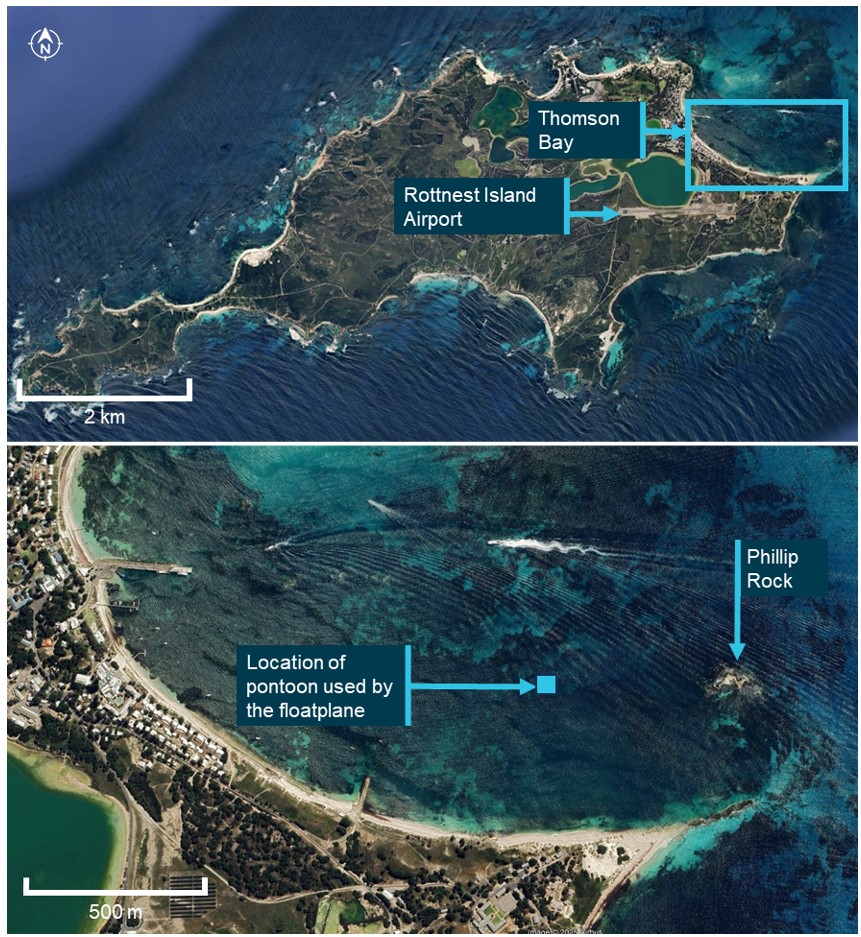
Source: Google Earth, annotated by the ATSB
At 1116, the chief pilot of Swan River Seaplanes sent the pilot a text message stating that winds were forecast to increase that afternoon, and included an image from a weather website, showing that winds at Rottnest Island were 25 kt with gusts to 34 kt.
The pilot responded that they may need to return to South Perth earlier than the planned 1600 departure time. The chief pilot indicated they agreed with this, stating that if necessary the passengers could return via ferry. The pilot responded to this text with a thumbs up.
CCTV recordings showed that at about 1305, the tender vessel used by Swan River Seaplanes to ferry passengers to and from the pontoon in Thomson Bay departed from alongside the aircraft. The video appeared to show the pilot travel north on the vessel from the pontoon. The vessel was then returned to shore where it was docked at a jetty on Rottnest Island at about 1320.
At about 1330, the pilot sent a text message to the chief pilot of Swan River Seaplanes, stating that the wind had reduced but the swell remained high at the normal departure location. The pilot stated they planned to depart taking a quartering crosswind closer to shore, where they perceived conditions were calmer. The chief pilot responded to this message stating they trusted the pilot’s judgement, encouraging the pilot to resist any perceived pressure to depart. Following this exchange, there was no further discussion around rescheduling the departure time.
At about 1500 the pilot requested the coxswain take them out in the tender vessel to the area normally used for floatplane departures from Thomson Bay to inspect the sea conditions. The coxswain recalled perceiving that conditions were rough, with swell about knee to waist high, and wind of at least 30 kt. The coxswain recalled that the pilot determined the conditions to be unsuitable for the planned departure, and requested to be taken closer to the southern shore of Thomson Bay. The coxswain recalled that conditions were calmer in this location, and the pilot had planned to depart on an easterly track towards Phillip Rock.
At 1511, one of the directors of Swan River Seaplanes texted the pilot and asked about the wind conditions. The pilot responded that conditions were ‘ok but rough’, however the swell was ‘not too bad’ closer to shore. The pilot also noted in that text message conversation that the aircraft would be ‘pretty light’ for the departure.
At about 1540, the passengers for the flight from Rottnest Island to South Perth were conveyed via the transfer vessel to the pontoon where the aircraft was moored. There were 6 passengers for the return flight, all of whom had travelled to Rottnest on the flight earlier that morning. Passengers described conditions onboard the vessel and pontoon as rough and windy. Each passenger was fitted with a life jacket before boarding the aircraft.
Once all passengers were boarded, the pilot signalled to the coxswain to release the mooring lines securing the aircraft to the pontoon. The aircraft then drifted before the pilot started the engine and taxied the aircraft to the south then north-west, before lining up for an easterly take‑off (Figure 2). At 1558, while taxiing the aircraft, the pilot was recorded making a broadcast on the Rottnest Island Common Traffic Advisory Frequency, announcing an intention to depart from Thomson Bay to the south-east.
Figure 2: VH-WTY take-off track with approximate location of key events
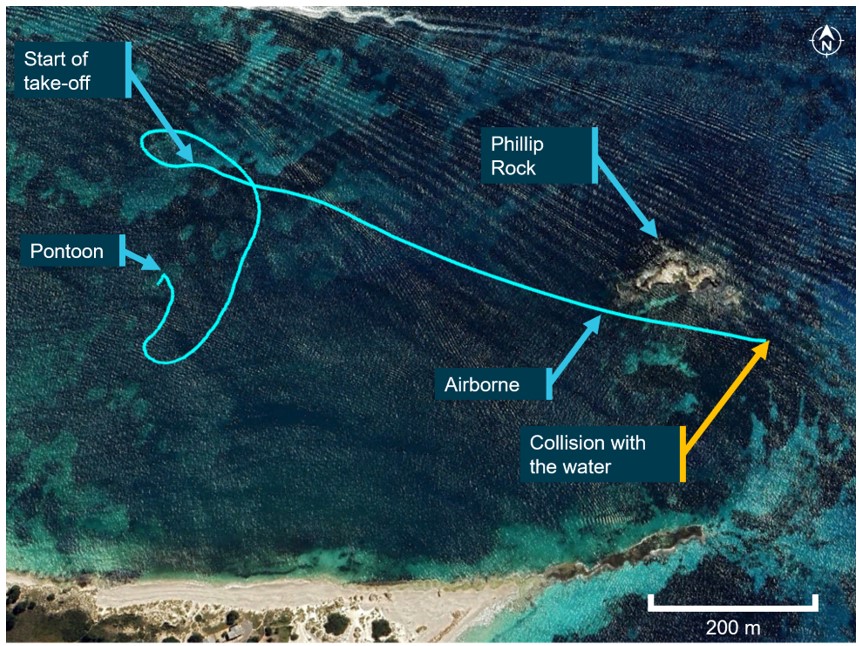
Source: Google Earth, annotated by the ATSB
Flight data showed at 1600:20 engine power was applied for the take-off. Over the following 32 seconds, the aircraft travelled along the surface of the water in an easterly direction. Witness video and the fight data showed that at 1600:52,[1] as the aircraft approached the western tip of Phillip Rock it became airborne with a high nose attitude. At 1600:58, the aircraft rolled rapidly to the left with the left wingtip and then fuselage impacting the water. Further description of the aircraft behaviour during the take-off sequence is described in Recorded information.
Survivors and other witnesses recalled the aircraft remained partially afloat in a perpendicular orientation, with the aircraft nose resting on the sea floor. The survivors reported that all cabin doors were submerged. The rear windows were not submerged. Four passengers moved into a pocket of air in the rear cabin and one of the passengers opened the top section of the rear right door. They and another passenger exited through this door. The coxswain of the tender vessel broke the rear left aircraft window, and 2 passengers recalled escaping through this broken window.
The pilot and the 2 other passengers remained in the aircraft, which later sank. Western Australia Police Force (WA Police) divers recovered the 3 deceased occupants in the evening of 7 January 2025.
Context
Pilot information
The pilot held a commercial pilot licence (aeroplane), with a current single-engine class rating and endorsements including for floatplane operations. The pilot had a current Class 1 medical certificate, with no restrictions.
The pilot had a total aeronautical experience of over 1,900 hours, including almost 1,400 hours on floatplanes and over 2,600 water landings. The pilot had about 700 hours experience in the Cessna 208 Caravan Amphibian, including over 60 hours accrued since commencing with Swan River Seaplanes in October 2024. Since commencing with the operator, the pilot had conducted 102 water landings, 12 of which were at Thomson Bay.
Aircraft information
VH-WTY (Figure 3) was a Cessna 208 Caravan Amphibian[2] floatplane, powered by a single Pratt & Whitney Canada (P&WC) PT6A-114A turboprop engine and a 3-bladed McCauley constant speed propeller. The aircraft was fitted with Wipline Model 8750 amphibious floats which enabled operation from both land and water. It was configured in a 13-seat interior layout. The aircraft was manufactured in the United States in June 2016, then registered in Australia in September 2016. It had accumulated about 1,125 hours total time in service at the time of the accident. Further aircraft information is detailed in VH-WTY maintenance history below.
The aircraft had 2 crew entry doors at the front of the cabin, next to the pilot (left) and copilot (right) seats. The crew entry doors had interior and external handles, which could be set to OPEN, CLOSE and LATCHED positions. The doors were also equipped with separate locks, and with lock override knobs inside the aircraft. To close the door, aircraft operating procedures instructed pilots to place the handle in the CLOSE position and pull the door closed, before rotating the handle to the LATCHED position. When unlocked and in the LATCHED position, the crew entry doors could be opened from either inside or outside the aircraft by rotating the handle to the OPEN position.
There were also 2 doors towards the rear of the cabin, each with a horizontal clamshell opening. Each rear door included separate handles for the upper and lower sections, and the upper section had to be opened first by pulling the handle inwards before rotating it from CLOSED to OPEN. When the lower section of the right rear door opened, a set of integral airstairs deployed. Information about passenger use of these exits following the accident is described in Seating arrangement and occupant injuries below.
Figure 3: VH-WTY
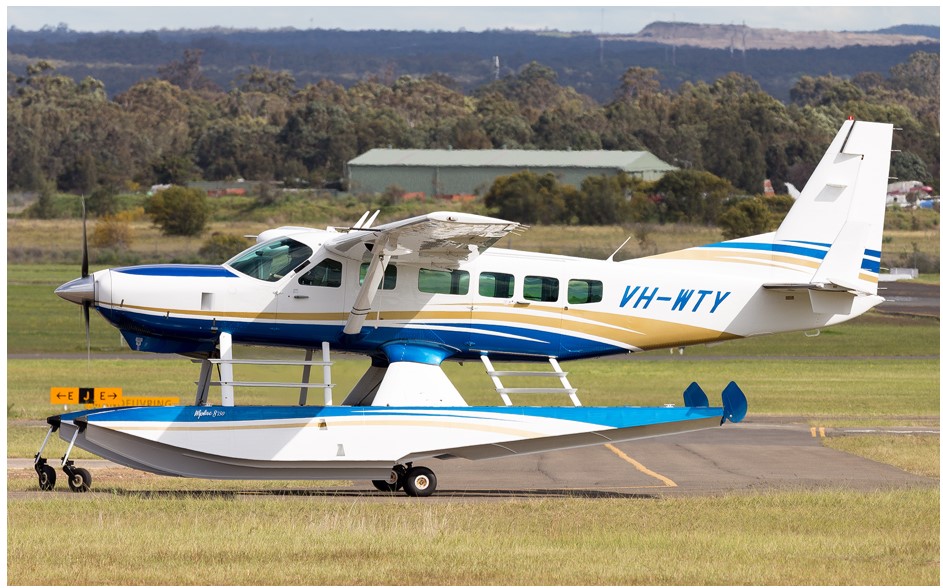
Source: www.JetPhotos.com, Sebastian Sowa
Location information
Rottnest Island is located 18 km offshore the West Australian coast. The island has a sealed runway with 1,293 m available for the take-off run at Rottnest Island Airport. The runway is oriented east-west.
Thomson Bay is situated on the eastern side of Rottnest Island and is the main landing point for marine vessels visiting the island. Phillip Rock is a rocky outcrop about 400 m offshore the eastern tip of Thomson Bay.
The operator had received approval to conduct water landings and departures into and out of Thomson Bay. Swan River Seaplanes pilots reported that flights to Rottnest Island would normally utilise the sealed runway at the airport, and that Thompson Bay would only be utilised if forecast weather (wind direction and wind speed) would make the sealed runway unsuitable. The approval included a designated landing area, located in the south-eastern end of Thomson Bay, with the south-western area of the landing area subject to a 5 kt marine traffic limitation (Figure 4). Company pilots reported that it was normal practice to depart from Thomson Bay along a southerly track and to become airborne prior to the 5 kt limitation.
An initial review of flight data by the ATSB showed results consistent with these recollections. There were 6 flights which departed from Thomson Bay after Swan River Seaplanes commenced operations with VH-WTY on 2 January, comprising 3 flights on 4 January, 2 flights on 5 January, and the accident flight on 7 January. All these flights departed with a southerly track, except for the accident flight which departed with an easterly track (Figure 5).
Figure 4: Thomson Bay approved floatplane landing area
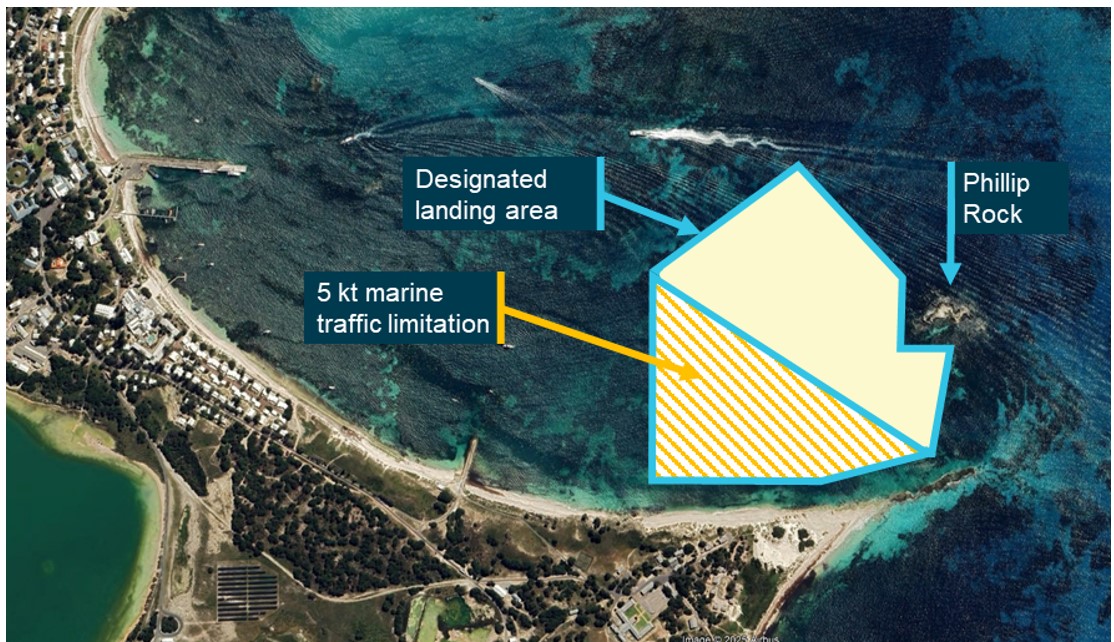
Source: Google Earth and Rottnest Island Authority, annotated by the ATSB
Figure 5: Recorded departure tracks for VH-WTY within Thomson Bay displaying the difference between the accident flight and the previous flights
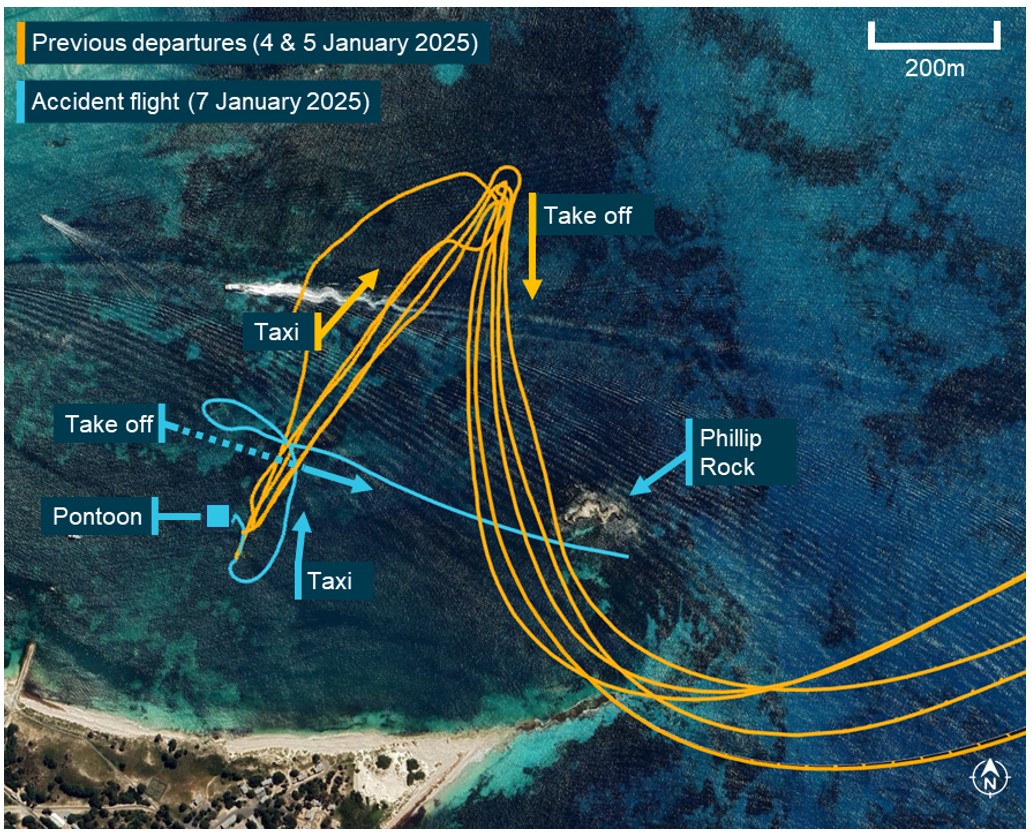
Source: Google Earth, annotated by the ATSB
Weather and sea conditions
The Bureau of Meteorology automated weather information service (AWIS) located at Rottnest Island Airport provided meteorological observations at one-minute intervals. At 1600, the AWIS reported winds of 25 kt from 210° (approximately south-south-westerly). The temperature was 24°C.
Witnesses to the accident recalled strong gusty winds in Thomson Bay throughout the afternoon of the accident. Video recordings taken on the afternoon of the accident showed that the sea was calm close to the southern shore of Thomson Bay. Further into the bay, however, waves were larger and more frequent. The sea state around the aircraft during the take-off run was choppy, with some white caps. Video showed that beyond the eastern end of Thomson Bay, sea conditions became significantly worse, with larger and more frequent white caps (Figure 6).
Figure 6: Aerial view shortly after the accident near to the impact point showing the rougher sea state outside of Thomson Bay (top), with surface photography from a vessel in Thomson Bay (bottom left) and a witness on the shore (bottom right) showing conditions shortly before the accident.
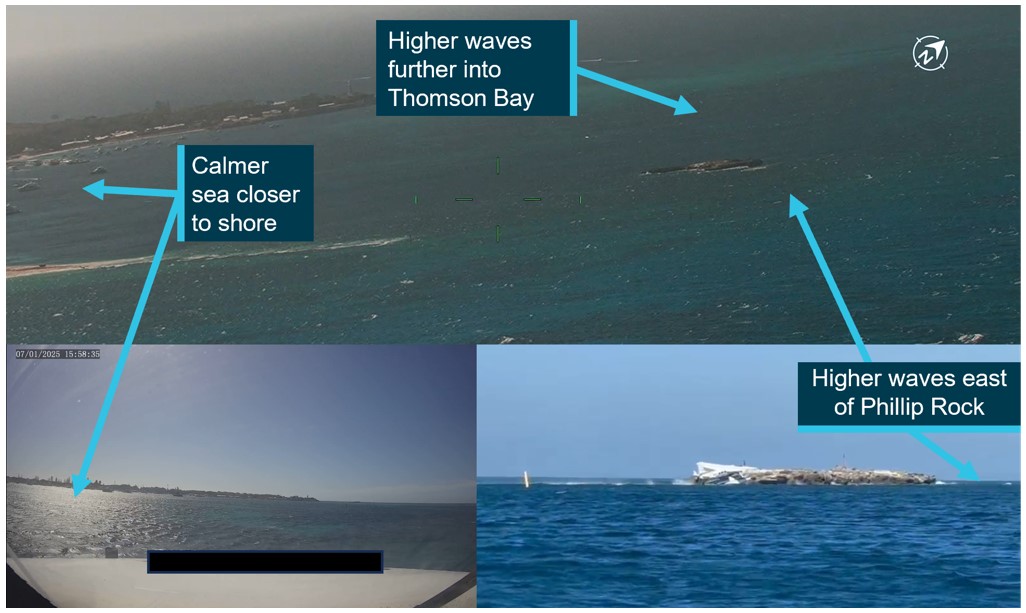
Note: The police video (top image) was captured at about 1627, approximately 26 minutes after the accident. Source: Western Australia Police Force, ferry operator and witness video, modified by the ATSB
Site and wreckage information
Accident site information and wreckage recovery
Analysis of witness video and information recorded by avionics and navigational equipment onboard the aircraft showed that the aircraft collided with the sea approximately 70 m south-east of Phillip Rock. The right float and part of the left float separated from the aircraft after the collision, and these were later recovered by WA Police and members of the public. The rear section of the left float remained tethered to the aircraft by the fly wire and sea rudder control cables.
The aircraft drifted approximately 800 m north of Phillip Rock until being tethered to the sea floor by WA Police divers. Their dive video showed that the main body of the aircraft remained largely intact following the collision (Figure 7). On 9 January 2025, commercial salvors lifted and recovered the aircraft using barges and a crane (Figure 8), before it was transported to a secure storage facility near Perth for further examination.
Figure 7: The aircraft sank inverted onto the sea floor within Thomson Bay
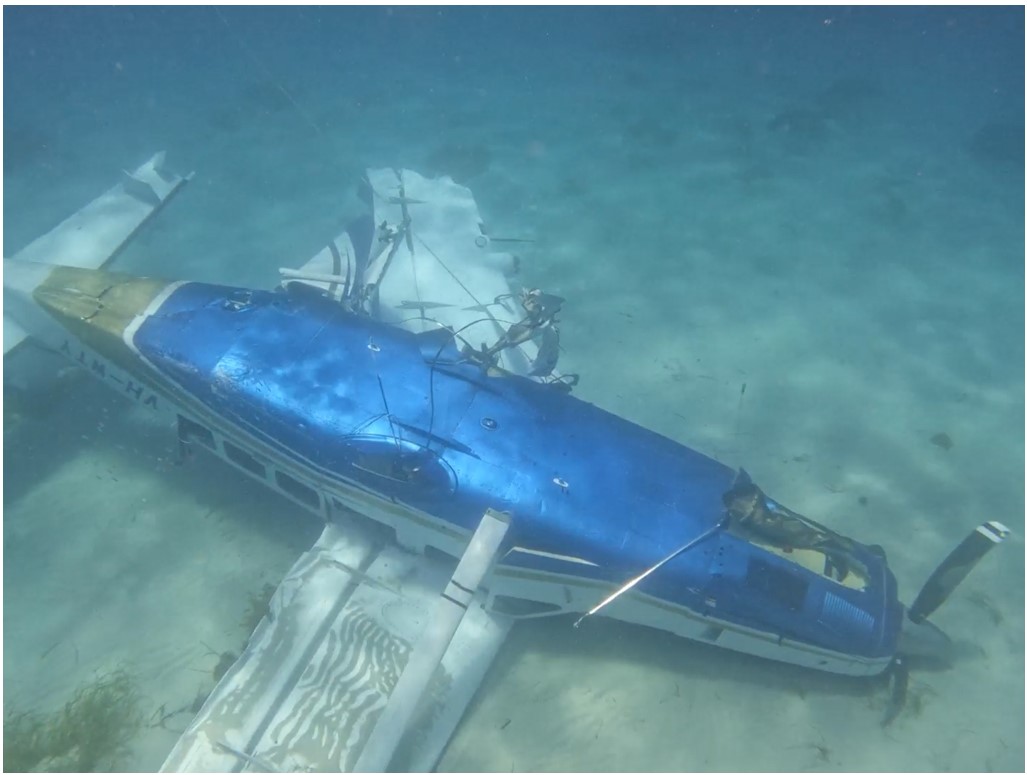
Source: Western Australia Police Force
Figure 8: VH-WTY recovery from Thomson Bay
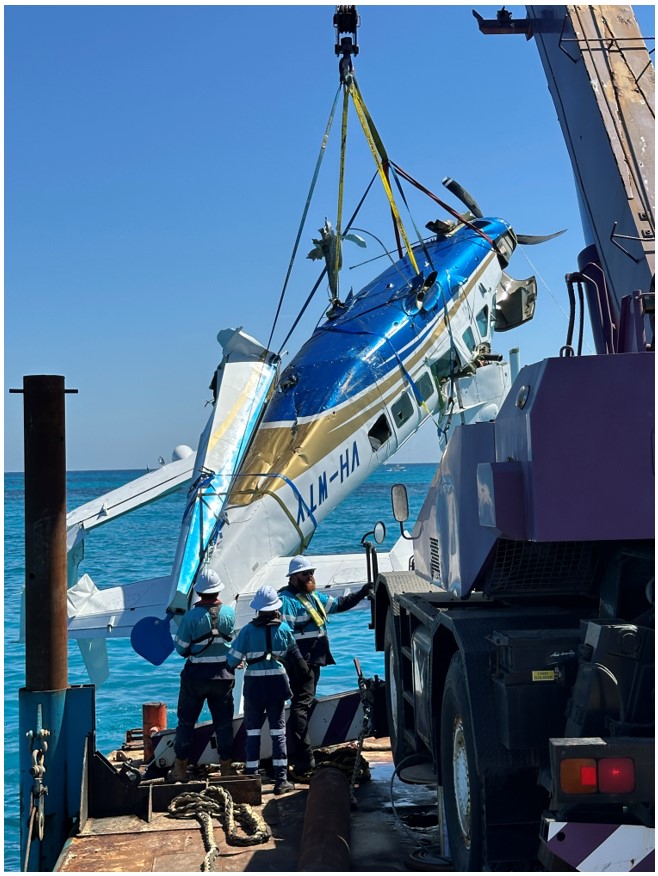
Source: ATSB
Wreckage examination
Examination of the aircraft wreckage at the secure facility identified:
- The wings, fuselage and floats did not display any physical markings that the aircraft had struck landmass or a submerged object prior to the collision with the sea.
- The engine controls were attached to the associated engine components and were free to move through their full range of movement.
- The propeller blades were intact and attached to the propeller hub. They could be rotated through 360º about the feathering axis, indicating internal damage to the feathering mechanism. The investigation will include further analysis to determine the significance of this damage.
- All 3 propeller blades were significantly bent toward the blade face. The significance of this was not able to be determined due to the propeller assembly resting on the sea floor prior to recovery.
- The primary flight controls could not be moved due to structural damage from the accident. The flight pushrods, bellcranks and control cable hardware were examined for continuity and correct assembly. No pre-existing damage or defects were identified.
- The flap selector was in the ‘full’ position and the flap position indicator was showing an intermediate position of about 15°. The wing flaps were in the retracted position.
- The instrument panel and combing appeared undamaged. All circuit breakers were pushed in except those corresponding to the strobe light and stall warning.
- The wings were swept back, with significant damage to both wings outboard of the ailerons. The left wing section, outboard of the aileron pushrods, was separated during the accident sequence and not recovered.
- Video footage from WA Police divers for the recovery of the deceased occupants showed that the left (pilot) crew door was in the LATCHED position and the right crew door was in the LATCHED position. The upper section of the right rear door was open but the lower section, incorporating the airstairs, remained closed. Both sections of the left rear door were closed (with ATSB examination showing both handles in the CLOSED position).[3] The ATSB examined the functionality of all doors and determined that they could be unlatched and opened. Some doors were difficult to open, most likely due to structural damage to doorframes following the accident.
Engine examination
- P&WC provided an engineering specialist to complete an internal borescope inspection of the engine. No evidence of pre-accident damage was identified.
- The engine was removed from the aircraft in preparation for detailed teardown examination at the P&WC facilities in Canada. The ATSB analysis will consider the report from that examination.
Recorded information
The ATSB recovered the Garmin G1000 avionics equipment from VH-WTY. Using the flight data recovered from the G1000, witness video recordings of the accident, and automatic dependent surveillance broadcast (ADS-B) data[4] the following was identified:
- Engine power was applied to commence the take-off at 1600:20, with the aircraft about 600 m from the western tip of Phillip Rock, and at a heading of 108°.
- Fifteen seconds into the take-off the aircraft had accelerated to 40 kt and was about 400 m from Phillip Rock. The aircraft transitioned onto the step[5] and the nose was lowered. The aircraft heading was manoeuvred on a course between Phillip Rock and the eastern tip of Thomson Bay.
- About 200 m from Phillip Rock, and with a recorded airspeed of 46 kt, the aircraft appeared to cross a wave or swell. Video footage showed the aircraft appearing to bounce on the water, becoming airborne momentarily before settling back onto the water.
- Over the next few seconds, the left wing rose on 2 occasions as the aircraft approached Phillip Rock, with the left float separating from the water. On each occasion, the aircraft struck waves and the right float did not separate from the water.
- There was a gradual reduction in engine power for about 20 seconds, commencing prior to the aircraft becoming airborne.
- About 30 m from Phillip Rock, the aircraft had accelerated to a recorded airspeed of 57 kt, and again appeared to strike waves.
- At 1600:52, the aircraft then became airborne, with a nose high attitude and on a heading of about 110°. Over the next few seconds, the aircraft maintained a nose-up attitude of between about 15°–18°. The aircraft climbed to about 16 ft above the surface of the water. The right wing then dropped, followed by an apparent aerodynamic stall of the left wing, with the aircraft rolling to the left.
- A witness video recording at about the time the aircraft separated from the water showed that the flaps were extended for take-off. The video also indicated the water rudders were extended.
- At 1600:56 the engine torque increased rapidly.
- At 1600:58 the left wingtip struck the water then followed by the fuselage.
Seating arrangement and occupant injuries
Surviving passengers recalled watching a safety briefing video prior to boarding the flight to Rottnest Island on the morning of the accident, with the pilot providing an additional safety briefing in the aircraft prior to departing from South Perth. Passengers recalled that there was no briefing provided prior to the departure from Thomson Bay, with the pilot asking if the passengers recalled the briefing from the morning. Passengers reported that the safety video and pilot briefing were thorough and provided adequate information on the use of seatbelts and the location and use of the aircraft exits.
One passenger additionally recalled that during boarding the aircraft prior to the departure from Thomson Bay, the pilot requested the passenger assist with closing and latching the left rear door. The passenger considered that the pilot’s instructions for closing the door were crucial for the passenger to subsequently open the right door after the aircraft struck the water.
The ATSB identified multiple safety information cards for the Cessna 208 Caravan in the aircraft wreckage, which showed information including the location of the aircraft exits, and how to unlatch and open the aircraft doors.
Surviving passengers recalled wearing life jackets during the accident flight. The life jackets worn by passengers were designed for constant wear in a pouch, with a belt securing the pouch around the waist. The life jackets were designed to be donned and inflated when required in an emergency. The life jackets could be inflated using a gas-cylinder inflation system or using an oral inflation system.
Surviving passengers recalled that the seating positions (Figure 9) for the accident flight were as follows:
- The pilot was seated in the normal position in the front left seat, and there was no passenger seated in the front right (copilot) seat.
- Two passengers were seated in the second row, with the central seat vacant. The passenger seated in the left seat was fatally injured in the accident. The passenger in the right seat recalled escaping through the rear left window, which had been broken by the coxswain of the operator’s tender vessel.
- Two passengers were seated in the third row, with the central seat vacant. The passenger seated in the right seat was fatally injured in the accident. The passenger seated in the left seat was pulled from the aircraft through the left rear window by the coxswain of the operator’s tender vessel.
- Two passengers were seated in the fourth row, with the central seat vacant. Both passengers in the fourth row survived the accident. The passenger seated in the left seat of the fourth row opened the top section of the right rear door, through which they exited the aircraft along with the passenger seated in the left seat of the fourth row.
The investigation will consider the post-mortem examination reports for each of the fatally injured occupants, including in support of analysis of the accident survivability.
Figure 9: Cessna 208 seating plan showing the occupant location for those who survived (green) and those who sustained fatal injuries (red)
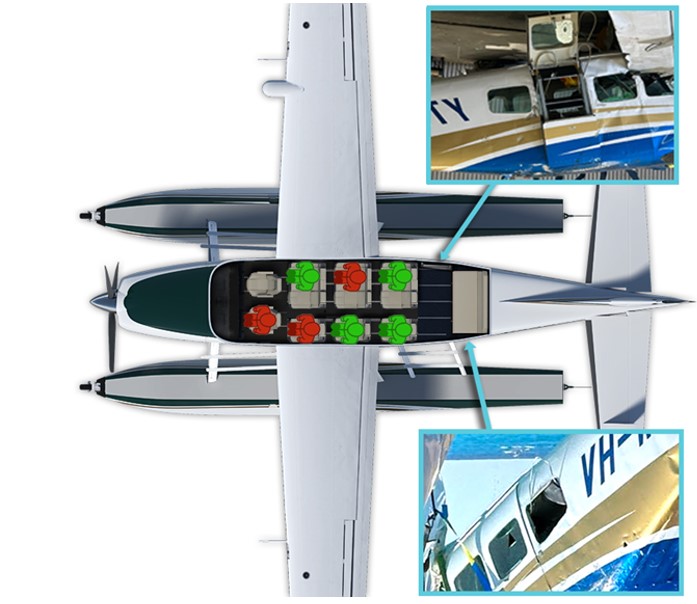
Passengers were able to exit the aircraft using the top section of the right rear door (upper inset) and left rear window (lower inset). Source: Textron Aviation, modified by the ATSB
Swan River Seaplanes
Swan River Seaplanes conducted Part 135 of CASR air transport operations for the purpose of passenger flights from the Swan River to Rottnest Island and Margaret River, Western Australia. It also operated flights around Perth, Western Australia, departing and landing on the Swan River. The operator reported commencing flights to Rottnest Island in October 2017, with operations from Thomson Bay commencing in January 2023.
Swan River Seaplanes had cross-hired VH-WTY, commencing passenger‑carrying flights in the aircraft on 2 January 2025. Swan River Seaplanes operated another Cessna 208, registered VH‑UOZ, however due to maintenance requirements this aircraft had been unavailable for operations since December 2024.
Swan River Seaplanes had 3 line pilots including the chief pilot. Another pilot, who conducted check and training for the operator, had also previously conducted line flights but was not operating in that function at the time of the accident.
VH-WTY maintenance history
Maintenance documentation for VH-WTY showed that:
- The aircraft had been operated in the Whitsunday region of Queensland (Qld) since arrival into Australia. In the period between 29 June 2021 to 20 October 2023, it had not been operated and was inactive at Shute Harbour Airport, Qld.
- It was then flown to Caloundra, Qld where it stayed for 31 days, and then flown to Sunshine Coast Airport, Qld where it remained for 37 days. It was not operated during these periods except for a relocation flight where it was flown to Bankstown Airport, New South Wales (NSW) on 3 March 2024.
- The aircraft had been inactive at Bankstown, NSW, from 4 March 2024 to 27 December 2024, with no recorded flights. Maintenance releases and logbooks did not show evidence of engine or airframe preservation having been performed for the periods of storage of the aircraft.
- On 27 December 2024, a special flight permit was issued by an authorised approver on behalf of the Civil Aviation Safety Authority, for a ferry flight to Jandakot, Western Australia (WA). This permit was required due to the expiry of the maintenance release on 20 October 2024.
- Maintenance documentation showed that a new battery was installed in the aircraft at Bankstown on 27 December 2024.
- On the morning of 28 December 2024, a 12-minute flight was recorded for the Bankstown Airport flying circuit.
- From 28 December to 29 December 2024, the aircraft was flown from Bankstown Airport, NSW to Jandakot Airport, WA.
- The aircraft and engine logbooks identified that from 30 December 2024 to 1 January 2025, the airframe, floats and role equipment (life jackets, fire extinguisher and first aid kit) were inspected. From the records, a new elevator pushrod bearing was installed, and new rudder pulleys were installed for the left and right floats. Engine work included a compressor power recovery wash and desalination rinse. Additionally, the chip detector plugs were recorded to have been inspected with no defects listed.
Further investigation
To date, the ATSB has conducted the following activities:
- interviewed Swan River Seaplanes personnel and survivors of the accident
- examined the aircraft wreckage
- reviewed information recorded by avionics equipment onboard VH-WTY
- reviewed the forecast and observed weather conditions at Rottnest Island
- reviewed video recordings from witnesses, CCTV and other sources.
The investigation is continuing and will include review and examination of:
- information recovered from mobile devices
- the recorded data from the aircraft engine
- the results of the engine teardown by Pratt & Whitney Canada
- weather and sea conditions in Thomson Bay on the day of the accident
- the information available to the pilot for Thomson Bay operations on the day of the accident
- the operator’s procedures and other risk controls for assessing the suitability of planned floatplane departures from Thomson Bay
- the history, identification and assessment of Thomson Bay for floatplane operations
- the aircraft maintenance history
- pilot training records, medical information and recent history
- pilot and passenger injuries and post-mortem reports
- the safety briefings provided to passengers, the location and availability of exits after the accident, and the performance of the aircraft seatbelts
- regulatory oversight and surveillance for the floatplane operations from Thomson Bay and for the maintenance of VH-WTY.
A final report will be released at the conclusion of the investigation. Should a critical safety issue be identified during the course of the investigation, the ATSB will immediately notify relevant parties so appropriate and timely safety action can be taken.
Acknowledgements
The ATSB acknowledges the support of the Western Australian Police Force and those involved with the recovery of VH-WTY.
Purpose of safety investigationsThe objective of a safety investigation is to enhance transport safety. This is done through:
It is not a function of the ATSB to apportion blame or provide a means for determining liability. At the same time, an investigation report must include factual material of sufficient weight to support the analysis and findings. At all times the ATSB endeavours to balance the use of material that could imply adverse comment with the need to properly explain what happened, and why, in a fair and unbiased manner. The ATSB does not investigate for the purpose of taking administrative, regulatory or criminal action. TerminologyAn explanation of terminology used in ATSB investigation reports is available here. This includes terms such as occurrence, contributing factor, other factor that increased risk, and safety issue. Publishing informationReleased in accordance with section 25 of the Transport Safety Investigation Act 2003 Published by: Australian Transport Safety Bureau © Commonwealth of Australia 2025 
Ownership of intellectual property rights in this publication Unless otherwise noted, copyright (and any other intellectual property rights, if any) in this report publication is owned by the Commonwealth of Australia. Creative Commons licence With the exception of the Commonwealth Coat of Arms, ATSB logo, and photos and graphics in which a third party holds copyright, this report is licensed under a Creative Commons Attribution 4.0 International licence. The CC BY 4.0 licence enables you to distribute, remix, adapt, and build upon our material in any medium or format, so long as attribution is given to the Australian Transport Safety Bureau. Copyright in material obtained from other agencies, private individuals or organisations, belongs to those agencies, individuals or organisations. Where you wish to use their material, you will need to contact them directly. |
[1] Witness videos were aligned to the time of events recorded on the flight data, and the synchronisation between these sources has a margin of error of +/- 1 second.
[2] The term amphibian refers to an aircraft equipped to operate from land runways and water.
[3] The ATSB examined the aircraft after the deceased occupants had been recovered by the police. The investigation will include analysis to determine the likely configuration of door control positions during and after the accident sequence.
[4] The ADS-B tracking of VH-WTY on the afternoon of the accident can be viewed at ADSBexchange.com.
[5] The step position is the attitude of the aircraft when the entire weight of the aircraft is supported by hydrodynamic and aerodynamic lift, as it is during high-speed taxi or just prior to take‑off. This position produces the least amount of water drag.
Occurrence summary
| Investigation number | AO-2025-001 |
|---|---|
| Occurrence date | 07/01/2025 |
| Occurrence time and timezone | 1601 Australian Western Standard Time |
| Location | Rottnest Island |
| State | Western Australia |
| Report release date | 19/12/2025 |
| Report status | Interim |
| Anticipated completion | Q4 2026 |
| Investigation level | Systemic |
| Investigation type | Occurrence Investigation |
| Investigation phase | Examination and analysis |
| Investigation status | Active |
| Mode of transport | Aviation |
| Aviation occurrence category | Collision with terrain |
| Occurrence class | Accident |
| Highest injury level | Fatal |
Aircraft details
| Manufacturer | Textron Aviation Inc. |
|---|---|
| Model | 208 Caravan (amphibian) |
| Registration | VH-WTY |
| Serial number | 20800586 |
| Aircraft operator | Swan River Seaplanes |
| Sector | Turboprop |
| Operation type | Part 135 Air transport operations - smaller aeroplanes |
| Activity | Commercial air transport-Non-scheduled-Passenger transport charters |
| Departure point | Thomson Bay, Rottnest Island, Western Australia |
| Destination | Elizabeth Quay Aircraft Landing Area, Western Australia |
| Injuries | Crew - 1 (fatal), Passengers - 2 (fatal) 3 (Serious) |
| Damage | Destroyed |