

Final report
Report release date: 23/09/2025
Investigation summary
What happened
On 10 April 2024, a pilot of an Aeroprakt-32 aircraft, registered VH-VIK, was conducting a private flight from Moruya to Griffith, New South Wales. During the flight, while near Canberra, the pilot observed a lower-than-normal engine oil pressure indication. They continued following their planned track, climbed to 6,500 ft, and shortly thereafter flew over mountainous terrain. Around 14 minutes later, the pilot contacted air traffic control to advise of the indication and that they were diverting to Tumut Aerodrome. The pilot commenced the diversion and immediately initiated a descent. Soon after, the engine failed. They aimed to reach the runway at Tumut but had insufficient height to do so and conducted a forced landing in the field to the north of the aerodrome. The pilot received minor injuries and the aircraft sustained substantial damage.
What the ATSB found
For reasons that could not be determined, oil pressure was lost during the flight. This resulted in an engine failure when the aircraft was about 5 NM (9.2 km) from Tumut Aerodrome. The time taken by the pilot to make the decision to divert after the low oil pressure indication was first observed, resulted in the aircraft flying further away from a safe landing place (Canberra Airport) as the situation continued to deteriorate.
After diverting towards Tumut Aerodrome for a precautionary landing, the pilot elected to commence a descent rather than maintain altitude. This meant that, when the engine failed, there was insufficient altitude remaining to reach the runway.
Safety message
When faced with an abnormal event, pilots should not only consider the immediate situation but also the potential future implications of any issues they detect with the operation of their aircraft. For any issue that could lead to a loss of engine power, consideration should be given to making a precautionary landing at the nearest suitable location. Flight over inhospitable terrain should be avoided if possible. This investigation also highlights that, maintaining altitude whenever practical will provide more opportunity to find a suitable landing place should a situation develop where a forced landing is required.
The investigation
| The ATSB scopes its investigations based on many factors, including the level of safety benefit likely to be obtained from an investigation and the associated resources required. For this occurrence, the ATSB conducted a limited-scope investigation in order to produce a short investigation report, and allow for greater industry awareness of findings that affect safety and potential learning opportunities. |
The occurrence
On 10 April 2024, a pilot planned a private flight in an Aeroprakt‑32 aircraft, registered VH‑VIK, from Moruya to Griffith, New South Wales, which included a scenic flight route around Canberra, Australian Capital Territory. The aircraft departed Moruya at about 1038 local time, tracking along the coast to Ulladulla, before turning inland towards Canberra. The pilot entered the controlled airspace around Canberra Airport at 1136, maintaining an altitude of about 4,000 ft above mean sea level.[1] They completed three‑quarters of the City route alpha one scenic flight,[2] before continuing north‑east towards Griffith. During the flight, the aircraft experienced some turbulence and the pilot elected to hand fly the aircraft, instead of using autopilot as they would normally have done. In hindsight, they stated feeling fatigued from the increased workload of hand flying.
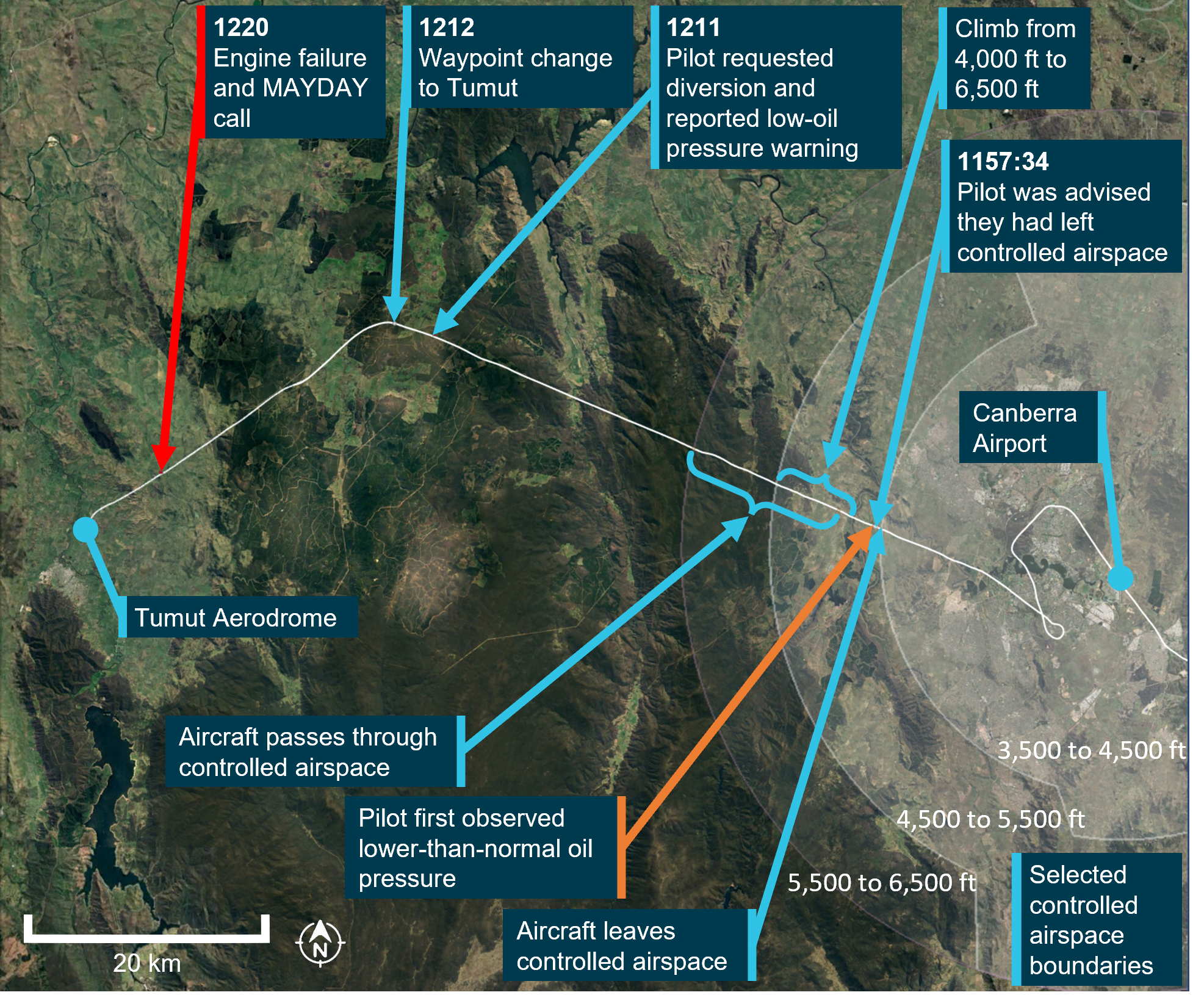
At 1157:34, air traffic control (ATC) advised the pilot that they had left controlled airspace and offered them flight following.[3] The pilot acknowledged leaving controlled airspace and accepted flight following. They then requested a climb from 4,000 ft to 6,500 ft, which ATC cleared. Although the aircraft was not in controlled airspace at this time, the pilot requested the clearance as they would briefly pass through controlled airspace to complete the climb to 6,500 ft (Figure 1). The pilot was cleared to enter and leave controlled airspace as required during the climb.
During interview with the ATSB, the pilot stated that, after they were contacted by ATC to advise of leaving controlled airspace, but before obtaining the clearance to climb, they observed a lower-than-normal engine oil pressure indication (Figure 1). At about 1158, when the pilot commenced the climb, the aircraft was around 11.4 NM (21.1 km) from Canberra Airport.
The pilot recalled initially thinking the low oil pressure might be related to the slower than usual airspeeds selected to conduct the scenic flight and a cooler outside air temperature. They thought the increased engine revolutions per minute (RPM) required during the climb would result in an increased engine oil pressure. On reaching 6,500 ft, the oil pressure was still low. When assessing options due to the ongoing engine oil pressure indication, the pilot believed Canberra was ‘far’ and reasoned that the farmland beyond the upcoming mountain range might be suitable if a precautionary,[4] or a forced landing[5] was necessary. The pilot continued the planned route towards Griffith over mountainous terrain. In interview with the ATSB, the pilot acknowledged they were reluctant to return to Canberra Airport to conduct a precautionary landing due to concerns with flying over a populated area, the presence of passenger aircraft, and lower familiarity with controlled airspace.
As the flight continued, the oil pressure did not recover and further dropped from 30 psi to 10 psi. The pilot stated that they delayed making a decision about diverting or landing, wanting to believe that there was no issue with the aircraft. At 1211:42, around 15 minutes after the initial observation of the low oil pressure, the pilot contacted ATC and reported that they were diverting to Tumut Aerodrome due to a low oil pressure warning. At this time Tumut Aerodrome, located west of the Great Dividing Range at an elevation of 863 ft, was the closest landing area, at 16.6 NM (30.7 km) distance. The pilot changed their navigation waypoint in their Dynon Skyview Touch flight computer to Tumut Aerodrome, turned the aircraft on to the new track, and immediately began a descent to expedite the landing. The pilot recalled feeling in denial that there was an issue, but with hindsight, recognised that it would have been beneficial to maintain altitude for as long as possible.
At 1220:17, around 9 minutes after the diversion, and while the aircraft was still 5 NM (9.3 km) from Tumut Aerodrome, the engine failed. The pilot reported focusing on the need to aviate, navigate, and communicate, then attempted to restart the engine, but was unsuccessful. At 1221:12, the pilot declared a MAYDAY,[6] reporting their location and an engine failure. They attempted a glide approach to runway 17,[7] which was aligned with their direction of travel, but the pilot judged that they had insufficient height, and at 1225 they conducted a forced landing in the field to the north of the aerodrome. The aircraft sustained substantial damage, and the pilot received minor injuries.
Figure 1: Flight track of VH-VIK after passing Canberra Airport
Source: FlightRadar24, Dynon Skyview unit, and Google Earth, annotated by the ATSB
Context
Pilot information
The pilot obtained a private pilot licence (aeroplane) in January 2016. At the time of the occurrence, the pilot had 790 hours flying experience, with around 600 hours in VH‑VIK. The pilot had flown 23.1 hours in the last 90 days, all of which were in VH‑VIK. The pilot stated that they flew with survival equipment including a personal locator beacon that they wore on their person.
Aircraft information
General
The aircraft was an Aeroprakt‑32 (serial number 025), which was manufactured in Ukraine and registered in Australia in 2016. It had a Bombardier Rotax 912 ULS piston engine. The most recent maintenance was a 50‑hour inspection completed on 15 March 2024. At this time, the aircraft had accumulated about 634.5 hours total time in service. The ATSB’s examination of documentation found that the aircraft maintenance was up to date with no outstanding maintenance items. The aircraft total time in service at the time of the occurrence was 655.9 hours.
Pre-flight inspection
On the morning of the flight, the pilot conducted a pre‑flight inspection. This included inspection of the engine compartment where there was no evidence of oil leaks. They checked the oil and observed that there was sufficient oil and it was a normal colour. The pilot stated that ‘normal’ in‑flight oil pressure for the aircraft was around 50 psi. This was consistent with the oil pressure information provided in the pilot’s operating handbook, which indicated a normal range of 29 to 73 psi when operating above 2,500 rpm, and a minimum and maximum of 12 psi and 100 psi, respectively.
Emergency procedures
The pilot’s operating handbook provided recommendations for pilots in case of an emergency in flight. For a ‘loss of oil pressure’, the instructions were:
Follow PRECAUTIONARY LANDING procedure, see section 3.2.6.
Engine overheating or stopped – follow EMERGENCY LANDING procedure, see section 3.2.5.
The recommendations for a precautionary landing were:
1. Airspeed – SELECT SAFE for the particular situation.
2. Throttle – SET to maintain selected airspeed.
3. Fuel – CHECK level and valves.
4. Map – CHECK for nearest airfields/area suitable for landing.
5. Landing area – SELECT.
6. Radio – REPORT decision to land on the selected place if necessary.
7. Landing – follow NORMAL or SHORT-FIELD landing procedure as appropriate.
Meteorological information
The Bureau of Meteorology graphical area forecast predicted that visibility for the flight would be greater than 10 km. Until 1200 local time, there was broken[8] cumulus and stratocumulus cloud with a 3,500 ft base over the Canberra region. In addition, moderate turbulence over land was expected below 7,000 ft.
The pilot did not mention any cloud at or below their eye level that would have required a descent to maintain visual meteorological conditions.[9] The prevailing wind conditions were more suited to a landing on runway 17 at Tumut Aerodrome.
Recorded data
The ATC audio recordings were obtained for the relevant part of the flight, starting at 1100 and ending at 1300. Automatic dependent surveillance‑broadcast (ADS‑B)[10] flight data was obtained from FlightRadar24. Further flight data was obtained from the pilot’s electronic flight bag[11] (AvPlan).
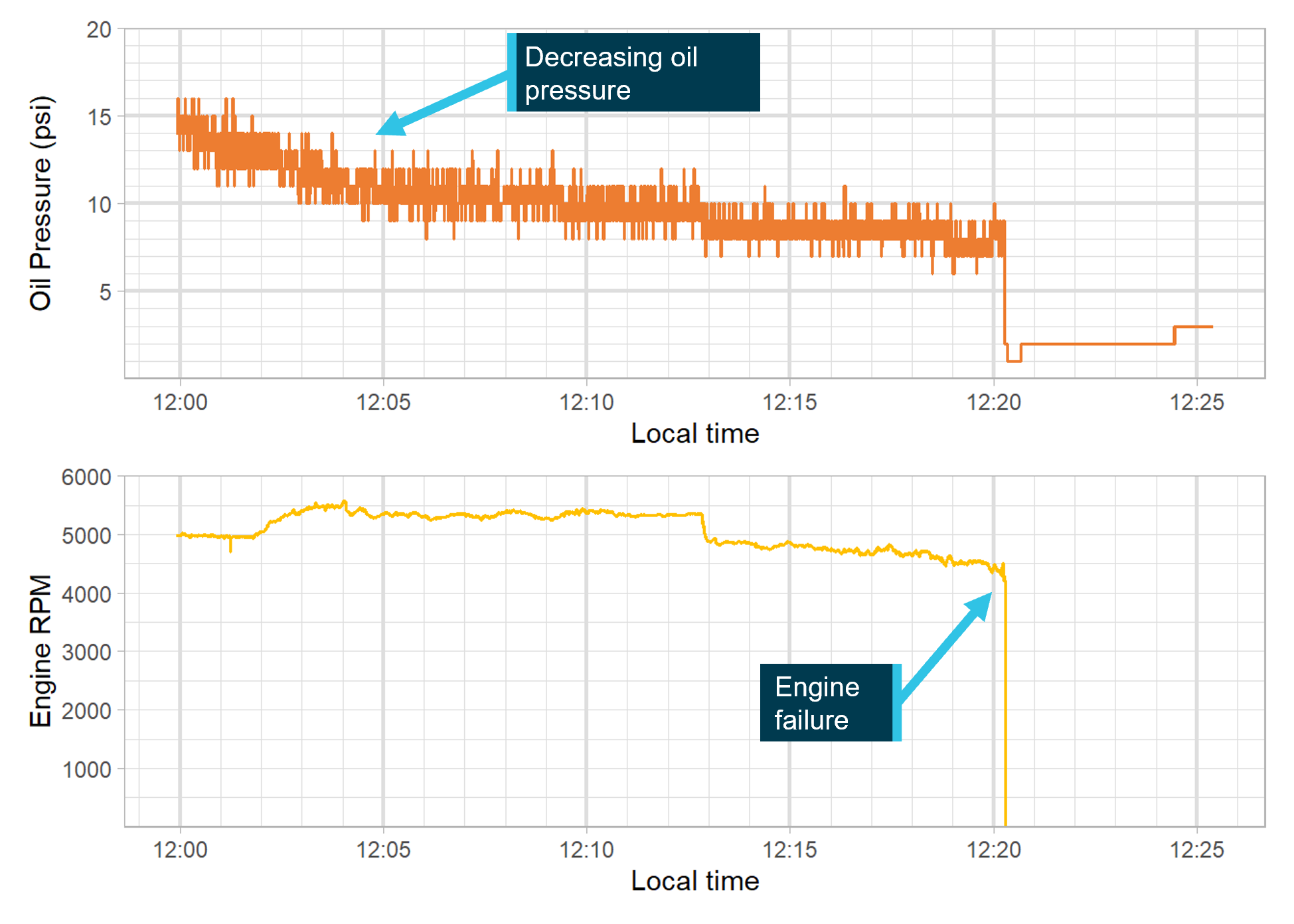
The aircraft was equipped with a Dynon Skyview Touch avionics system. This system recorded flight and engine parameters over the final 25 minutes of the flight, at a sampling rate of 16 entries every second. As such, it did not capture when the oil pressure began to drop below normal. The unit recorded that the pilot changed the programmed waypoint to Tumut at 1212:45, at which time the aircraft was about 16.6 NM (30.7 km) from Tumut Aerodrome. The data showed that the oil pressure continued to decrease after the diversion, and that the engine stopped at 1220:17, 7 minutes and 32 seconds after the waypoint change (Figure 2). Data recorded in previous flights indicated that the normal oil pressure was around 50 psi, which was consistent with the pilot’s recollection.
Figure 2: Oil pressure and engine RPM data recorded for accident flight
Source: Dynon Skyview unit, annotated by the ATSB
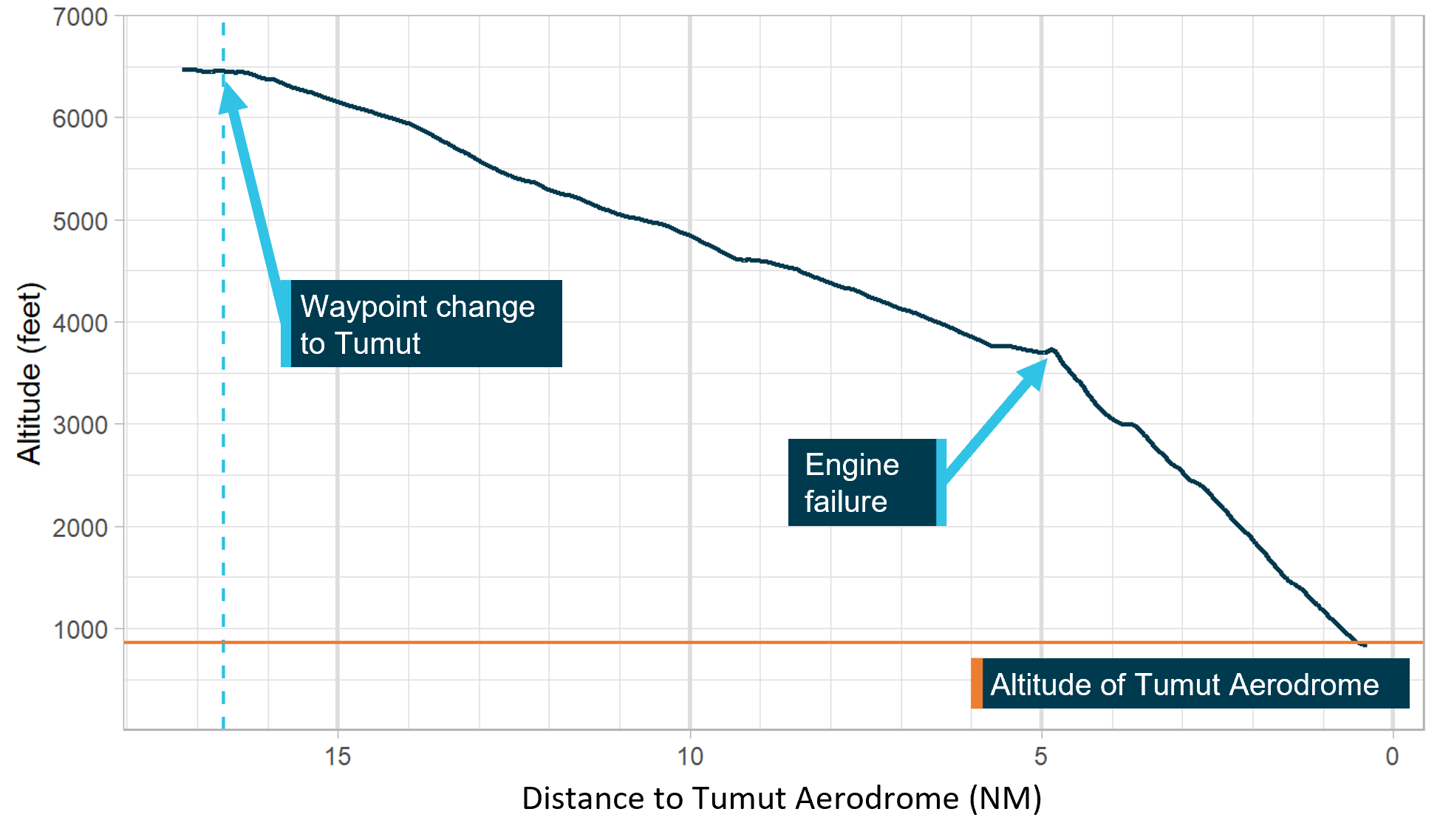
GPS data from the Dynon captured the descent profile of the aircraft from the diversion point until the forced landing (Figure 3). The profile showed that the pilot assumed a fairly constant rate of descent from the diversion point until the engine failed. Once the engine failed the rate of descent increased. Considering the descent profile of the aircraft following the engine failure, the ATSB estimated that, if the cruise altitude had been maintained until the failure, the aircraft would have been within glide range of the runway at Tumut.
Figure 3: Altitude (above mean sea level) as a function of distance to Tumut Aerodrome
Source: Dynon Skyview unit, annotated by the ATSB
Wreckage and impact information
The aircraft came to rest around 250 m north of runway 17 at Tumut Aerodrome, in a field of undulating terrain. The damage to the airframe was consistent with the landing and there was no indication of a pre‑existing airframe issue. No defects were noted with the flight control system and the pilot did not report any control issues during the descent. Accordingly, full control of the aircraft was likely available.
In addition to damage sustained from the landing, the engine had a hole in the upper crank‑case region. The oil cap was securely in position and no engine oil was visible on the oil tank dipstick. A significant quantity of oil was noted to be coating the engine lower cowl in the region of the oil cooler assembly. Oil residue also coated the aircraft belly aft of the engine, the left undercarriage fairing and wheel spat, and the upper surface of the left horizontal stabiliser. A fine sheen of oil was present on the cabin windscreen. Oil residues were also noted on the external surfaces of the engine cowl, in the region of the propeller shaft opening.
The engine oil cooler was collected for testing at the ATSB technical facilities. The testing indicated that, while the oil cooler was damaged during the landing sequence, there was no indication that the oil cooler was defective, and the condition of the vessel was regarded as intact and unlikely to be a source of oil leakage. The other engine systems that could have contributed to the engine failure appeared to have only sustained consequential damage.
Considerations for emergency landings
The United States Federal Aviation Administration (FAA) Airplane Flying Handbook (FAA, 2021) defines 2 types of emergency landings:
• Forced landing – an immediate landing, on or off an airport, necessitated by the inability to continue further flight. A typical example of which is an airplane forced down by engine failure
• Precautionary landing – a premeditated landing, on or off an airport, when further flight is possible, but inadvisable. Examples of conditions that may call for a precautionary landing include deteriorating weather, being lost, fuel shortage, and gradually developing engine trouble.
The FAA (2021) identified that a precautionary landing is generally less hazardous than a forced landing as the pilot has more time to select terrain and plan the approach, but also cautioned pilots that:
…many situations calling for a precautionary landing are allowed to develop into immediate forced landings, when the pilot uses wishful thinking instead of reason…
The FAA (2021) suggests that, following the identification of low oil pressure, pilots should land as soon as possible and that one factor that governs a pilot’s choice of emergency landing site is the height above the ground when the emergency occurs. Geeting and Woerner (1988) stated, regarding emergency landings while mountain flying, that ‘forced landings of any type nearly always benefit from having altitude and holding it as long as possible’. Training for a forced landing pattern indicated aiming for a height of 2,500 ft above ground level on the crosswind leg (CASA, 2006).
Decision‑making
The FAA (2023) defined aeronautical decision‑making as:
A systematic approach to the mental process used by pilots to consistently determine the best course of action in response to a given set of circumstances.
A crucial component of the aeronautical decision-making process is risk management. When faced with a hazard, the pilot assesses that hazard based on various factors and determines a course of action. Some situations, such as loss of oil pressure or engine failure, require an immediate pilot response using procedures. On other occasions there may be time during a flight to gather information and assess risks before reaching a decision.
Orasanu-Engel and Mosier (2019) stated that decision errors may arise within the 2 major components of the aviation decision model: (1) pilots may develop an incorrect interpretation of the situation, which leads to an inappropriate decision; or (2) they may establish an accurate picture of the situation, but choose an inappropriate course of action. Furthermore, decisions may not be optimal when pilots were aware of a threat that requires a response, but underestimates the likelihood or severity of possible consequences, especially when conditions are changing dynamically (Orasanu-Engel and Mosier, 2019). Operational factors, such as high workload, may affect pilots’ ability to make optimal decisions. Fatigue can be an effect of increased and sustained workload (United Kingdom Civil Aviation Authority, 2023).
Similar occurrences
ATSB occurrence database
A search of the ATSB database for similar occurrences over the 12 months prior to this event was conducted. Sixty occurrences were found related to aircraft in the cruise phase of flight that experienced either abnormal engine indications, an engine failure, or an engine malfunction. Of these, 44 occurrences resulted in the aircraft landing safety at either the destination or a diversion airport, while 14 occurrences resulted in a forced landing. There was insufficient information to categorise 2 occurrences. The forced landings resulted in 4 accidents, 8 serious incidents, and 1 incident. An example of a low oil pressure indication event that resulted in a precautionary landing is described in more detail below. In addition, an investigation where the benefit of maintaining aircraft altitude in an emergency was raised in association with a contributing factor to the accident is discussed.
ATSB occurrence (OA2024-02070)
On 8 April 2024, while conducting an aerial survey, the pilot of a Cessna 172 aircraft identified that the oil pressure had dropped below the green indicated area. They closely monitored the oil pressure and decided that landing as soon as possible would be the best course of action. The pilot identified a potential safe landing area and conducted a successful precautionary landing with no damage to the aircraft. The pilot reported that later inspection found a leak from the oil cooler.
ATSB investigation (AO-2023-029)
On 20 June 2023, while conducting an air transport flight, the pilot of a Cessna 310R aircraft experienced engine surging as a result of fuel starvation. In their management of the situation, the pilot did not maintain altitude. Instead, they initiated a descent at the normal top of descent position. The report stated that maintaining the aircraft's potential energy (altitude) is crucial for extending an aircraft's range during an engine failure, providing more landing options and time to manage the emergency effectively.
Safety analysis
Delayed decision to divert
When about 11.4 NM (21.1 km) from Canberra Airport, the pilot observed lower‑than‑normal engine oil pressure, which continued to decay. Under these circumstances, the pilot’s operating handbook recommended course of action was to conduct a precautionary landing, which included a check for the nearest suitable airfield or landing area. The pilot acknowledged that they delayed making the decision to divert and that this was influenced by incorrectly interpreting that the low-oil pressure was due to the flight characteristics. Consistent with Orasanu-Engel and Mosier (2019), this resulted in the pilot underestimating the risk posed by the abnormal indication. Additionally, the pilot reasoned that they were already far from Canberra and were reluctant to return due to the perceived complexity of conducting a precautionary landing at an airport in controlled airspace. The pilot’s decision‑making may have also been degraded by fatigue generated by the increased workload they reported when they were hand flying the aircraft in turbulence near Canberra.
Given that the engine was operational for about 23 minutes after the initial observation of low oil pressure, it was very likely that, had the pilot diverted to Canberra Airport at this time, it would have been possible to conduct a safe precautionary landing before the engine failed. Ultimately, the 14 minutes taken to make the decision to divert took the aircraft 20 NM (37 km) further from Canberra Airport, over mountainous terrain, and meant that the engine failed in‑flight.
Intentional descent with developing engine issue
The recorded data showed that once the pilot made the decision to conduct a precautionary landing, they commenced a powered descent towards Tumut Aerodrome. Given the decreasing oil pressure, the pilot could not be assured the engine would continue to operate normally. As such, maintaining altitude, as suggested in the literature, until they were confident of reaching the aerodrome with a glide profile in case the engine stopped, would have increased the likelihood that Tumut Aerodrome would be reached.
At about 5 NM (9.3 km) from Tumut, the engine failed and, as expected, the data showed the descent rate increased. This escalated the situation from requiring a precautionary landing to a forced landing. The height of the aircraft at that location was insufficient to reach the runway and the pilot’s remaining option was to conduct the forced landing in a field. ATSB calculations indicated that it was likely that, had the cruise altitude of 6,500 ft been maintained to within 5 NM (9.3 km) of Tumut, the aircraft would have been within glide range of the runway. As such, when the engine failed, the pilot would have been able to complete the forced landing onto the runway.
Engine oil loss
The ATSB’s examination of the aircraft identified a lower‑than‑normal amount of oil in the engine and oil coating various parts of the aircraft. There was also no oil on the dipstick. The loss of oil observed was consistent with the flight data, which showed a decline in the oil pressure until the engine failed. The oil cap was found secure, the oil cooler was not defective, and no issues were found with the other systems that would explain the loss of oil and engine failure. Therefore, the ATSB could not determine the source of the engine oil loss.
Findings
ATSB investigation report findings focus on safety factors (that is, events and conditions that increase risk). Safety factors include ‘contributing factors’ and ‘other factors that increased risk’ (that is, factors that did not meet the definition of a contributing factor for this occurrence but were still considered important to include in the report for the purpose of increasing awareness and enhancing safety). In addition ‘other findings’ may be included to provide important information about topics other than safety factors. These findings should not be read as apportioning blame or liability to any particular organisation or individual. |
From the evidence available, the following findings are made with respect to the engine failure and forced landing involving Aeroprakt-32, VH-VIK, 0.1 km north of Tumut Aerodrome, New South Wales, on 10 April 2024.
Contributing factors
- Following the low engine oil pressure indication, the pilot delayed the decision to divert, which removed an opportunity to conduct a precautionary landing at nearby Canberra Airport.
- Commencing a powered descent after diverting towards Tumut meant that the pilot had to conduct a forced landing short of the runway due to insufficient glide range when the engine failed.
Other findings
- The reason for the engine oil loss could not be determined.
Sources and submissions
Sources of information
The sources of information during the investigation included:
- the pilot
- the insurance provider of VH-VIK
- the Civil Aviation Safety Authority
- the aircraft manufacturer
- the maintenance organisation
- Airservices Australia
- recorded data from the avionics unit on the aircraft
- the Bureau of Meteorology.
References
Civil Aviation Safety Authority. (2006). Flight Instructor Manual Aeroplane (Issue 2).
Federal Aviation Administration. (2021). Airplane Flying Handbook (FAA-H-8083-3C). Department of Transportation (U.S.). https://www.faa.gov/regulations_policies/handbooks_manuals/aviation/airplane_handbook
Federal Aviation Administration. (2023). Pilot's Handbook of Aeronautical Knowledge (FAA-H-8083-25C). Department of Transportation (U.S.). https://www.faa.gov/regulations_policies/handbooks_manuals/aviation/phak
Geeting, D., & Woerner, S. (1988). Mountain Flying (First ed.). TAB Books Inc.
Orasanu-Engel, J., & Mosier, K. L. (2019). Flight Crew Decision-Making. In B. G. Kanki, J. Anca, & T. R. Chidester (Eds.), Crew Resource Management (Third ed., pp. 587-607). Academic Press.
United Kingdom Civil Aviation Authority. (2023). Flight-crew human factors handbook (Second Edition).
Submissions
Under section 26 of the Transport Safety Investigation Act 2003, the ATSB may provide a draft report, on a confidential basis, to any person whom the ATSB considers appropriate. That section allows a person receiving a draft report to make submissions to the ATSB about the draft report.
A draft of this report was provided to the following directly involved parties, the:
- pilot
- Civil Aviation Safety Authority.
A submission was received from the pilot.
The submission was reviewed and, where considered appropriate, the text of the report was amended accordingly.
Purpose of safety investigationsThe objective of a safety investigation is to enhance transport safety. This is done through:
It is not a function of the ATSB to apportion blame or provide a means for determining liability. At the same time, an investigation report must include factual material of sufficient weight to support the analysis and findings. At all times the ATSB endeavours to balance the use of material that could imply adverse comment with the need to properly explain what happened, and why, in a fair and unbiased manner. The ATSB does not investigate for the purpose of taking administrative, regulatory or criminal action. TerminologyAn explanation of terminology used in ATSB investigation reports is available here. This includes terms such as occurrence, contributing factor, other factor that increased risk, and safety issue. Publishing informationReleased in accordance with section 25 of the Transport Safety Investigation Act 2003 Published by: Australian Transport Safety Bureau © Commonwealth of Australia 2025 
Ownership of intellectual property rights in this publication Unless otherwise noted, copyright (and any other intellectual property rights, if any) in this report publication is owned by the Commonwealth of Australia. Creative Commons licence With the exception of the Commonwealth Coat of Arms, ATSB logo, and photos and graphics in which a third party holds copyright, this report is licensed under a Creative Commons Attribution 4.0 International licence. The CC BY 4.0 licence enables you to distribute, remix, adapt, and build upon our material in any medium or format, so long as attribution is given to the Australian Transport Safety Bureau. Copyright in material obtained from other agencies, private individuals or organisations, belongs to those agencies, individuals or organisations. Where you wish to use their material, you will need to contact them directly. |
[1] All altitude values in this report are above mean sea level unless stated otherwise.
[2] Scenic flight is commonly used to describe a flight over interesting sights and landmarks or near a popular tourism area.
[3] Flight following is the provision of an ongoing surveillance information service to visual flight rules flights in Class E and G airspace. This service can provide improved situational awareness and assists pilots in avoiding collisions with other aircraft.
[4] Precautionary landing: a premeditated landing, on or off an airport, when further flight is possible but inadvisable. Examples of conditions that may call for a precautionary landing include deteriorating weather, being lost, fuel shortage, and gradually developing engine trouble (FAA, 2021).
[5] Forced landing: an immediate landing, on or off an airport, necessitated by the inability to continue further flight. A typical example of which is an airplane forced down by engine failure (FAA, 2021).
[6] MAYDAY: an internationally recognised radio call announcing a distress condition where an aircraft or its occupants are being threatened by serious and/or imminent danger and the flight crew require immediate assistance.
[7] The runway number represents the magnetic heading of the runway. Tumut Aerodrome had one sealed runway with heading 17/35.
[8] Cloud cover: in aviation, cloud cover is reported using words that denote the extent of the cover – ‘broken’ indicates that more than half to almost all the sky is covered.
[9] Visual meteorological conditions: an aviation flight category in which visual flight rules flight is permitted – that is, conditions in which pilots have sufficient visibility to fly the aircraft while maintaining visual separation from terrain and other aircraft.
[10] ADS-B: Automatic dependent surveillance–broadcast is a surveillance technology in which an aircraft determines its position via satellite navigation and periodically broadcasts it, enabling it to be tracked.
[11] Electronic flight bag: software and data-service solution to digitise logbooks charts, and other flight documents to achieve paperless cockpit.
Occurrence summary
| Investigation number | AO-2024-010 |
|---|---|
| Occurrence date | 10/04/2024 |
| Location | 0.1 km north of Tumut Aerodrome |
| State | New South Wales |
| Report release date | 23/09/2025 |
| Report status | Final |
| Investigation level | Short |
| Investigation type | Occurrence Investigation |
| Investigation status | Completed |
| Mode of transport | Aviation |
| Aviation occurrence category | Abnormal engine indications, Diversion/return, Engine failure or malfunction, Forced/precautionary landing |
| Occurrence class | Accident |
| Highest injury level | Minor |
Aircraft details
| Manufacturer | Aeroprakt Ltd |
|---|---|
| Model | Aeroprakt-32 |
| Registration | VH-VIK |
| Serial number | 25 |
| Sector | Piston |
| Operation type | Part 91 General operating and flight rules |
| Departure point | Moruya Airport, New South Wales |
| Destination | Griffith Airport, New South Wales |
| Damage | Substantial |