

Final report
Report release date: 05/09/2017
What happened
On 23 June 2017, at about 1549 Central Standard Time,[1] a QantasLink Bombardier DHC-8-315 aircraft, registered VH-TQH, was being operated on a scheduled passenger service from Port Lincoln to Adelaide, South Australia. There were two flight crew, two cabin crew and 46 passengers on board. The captain was designated as the pilot monitoring and the first officer (FO) was the pilot flying.[2]
When on final approach to runway 23 at Adelaide, at about 300 ft, the captain noticed fumes in the cockpit and mentioned this to the FO, who did not notice the smell. Shortly after, at about 200 ft, both crew detected the fumes, which smelt like electrical/chemical burning. They looked down at the centre console and noticed light grey smoke coming from the switch on the aileron/rudder trim control panel. The captain instructed the FO to focus on the landing and that they would manage the problem when they were on the ground. The captain notified air traffic control of smoke in the cockpit and requested emergency services. The controller considered this a ‘PAN PAN’[3] call.
After landing, the aircraft was stopped on the taxiway and the captain called for the Smoke checklist from the Quick Reference Handbook to be completed. This involved donning oxygen masks, switching the microphone to mask, and turning the recirculation fans off to prevent the smoke being circulated within the aircraft. The smoke had dissipated from the cockpit, but fumes were still present.
Air traffic control called back to ask if the flight crew could continue taxiing. The FO responded they were using oxygen masks and would be shutting down on the taxiway. The captain delivered a public address to the passengers advising there was an issue and to await further instructions. The captain then made a call to the cabin crew to inform them of the smoke, that they were using oxygen, and were planning to do a precautionary disembarkation. The cabin crew member indicated that passengers seated in rows 4 and 5 could also smell the fumes, but there was no smoke.
The FO retrieved the On ground non-normal checklist. The captain completed the checklist and made the ‘precautionary disembarkation’ public address to the passengers. The FO exited and directed the passengers outside to an area away from the aircraft. The cabin crew cleared the cabin to ensure all the passengers had disembarked and the captain switched off all power before they exited as per the Precautionary disembarkation and Evacuation checklists.
The captain spoke to the airport fire personnel and provided them a description of the issue and where it occurred. The fire personnel assessed the situation and determined there was no fire risk.
The captain briefed the passengers on the incident, describing what happened and why they disembarked. There were no reported injuries or ill effects from the smoke and fumes, and the aircraft was not damaged.
Aileron/rudder trim control panel inspection
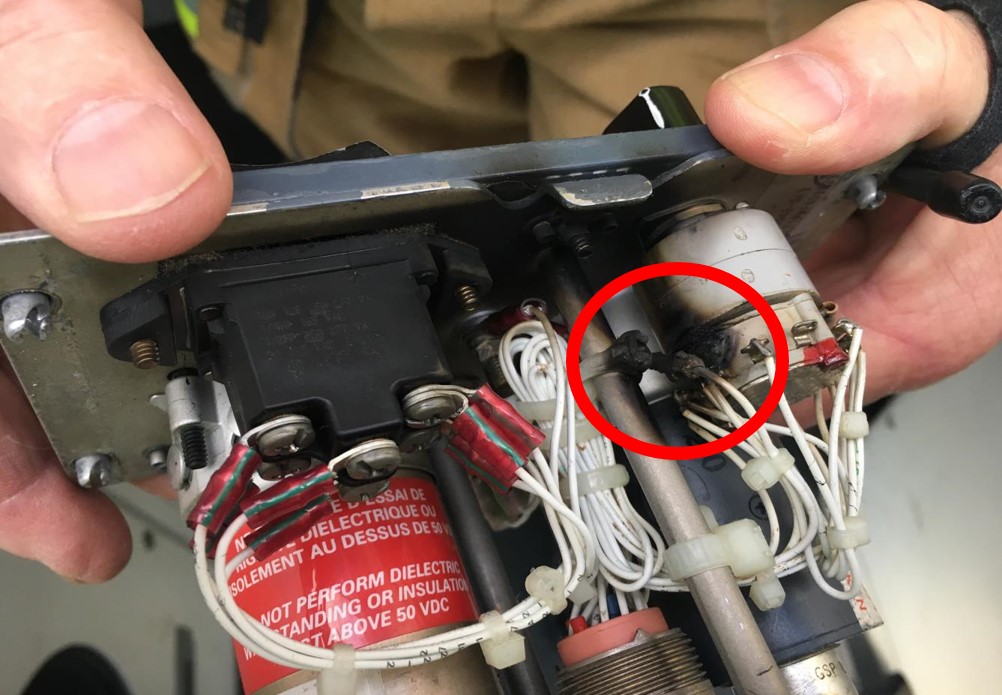
Following the incident, engineers removed the aileron/rudder trim control panel for inspection. That inspection identified visible damage underneath the rudder trim switch. Specifically, the rudder trim potentiometer[4] was blackened and burnt (Figure 1). The trim control panel was subsequently replaced.
Figure 1: Burnt potentiometer in the aileron/rudder trim control panel (circled in red)
Source: Operator, modified by the ATSB
Additional comments
The following additional comments were made by the captain and operator:
- When the smoke and fumes were detected, the aircraft was about 1 minute from landing. Consequently, the captain elected to continue the landing, rather than action the appropriate checklist. The captain reported that, if the checklist was commenced during the approach, the aircraft’s controls would have been handed between the crew while donning masks. The captain considered this to be dangerous while hand flying the aircraft and when close to landing.
- While the crew were disembarking, the aviation rescue and firefighting personnel attempted to enter the aircraft, but unintentionally blocked the exit. This resulted in a minor delay for crew exiting.
- The aviation rescue and firefighting personnel did not allow the cabin crew to remove the first aid kit from the aircraft, which contradicted the operator’s emergency procedures.
- The operator reported that communications throughout the incident were well managed and the crew were commended for their response to the incident.
Airservices Australia comments
Airservices advised that the airport fire personnel were present at the exit only after all the passengers had disembarked and then attempted to enter the aircraft to talk to the crew and assess the internal conditions. The request not to remove the first aid kit was made in consideration that fire personnel carry first aid kits at all time. In addition, it was standard practice when securing a site not to remove anything from the aircraft until an internal assessment had been made. Airservices were not aware that it was company policy to remove the first aid kit.
Previous occurrences
A search of the ATSB’s database found the following occurrences involving smoke or fumes in DHC-8 aircraft originating from in the cockpit:
- On 29 July 2013, the crew of a Bombardier DHC-8-315 were en route from Sydney to Wagga Wagga, New South Wales (ATSB investigation AO-2013-120) when they noticed a blank area in the centre of the flight management system screen. About 10 minutes later, the screen went completely blank and thick, light-grey smoke was observed coming from the unit. Examination of the unit found that two capacitors failed, resulting in the smoke and failure of the unit.
- On 8 June 2014, the crew of a Bombardier DHC-8-202 were on take-off at Cairns, Queensland (ATSB occurrence 201405530). During the take-off, the FO’s electronic displays failed and fumes were detected in the cockpit. The take-off was rejected and the aircraft returned to the bay. An engineering inspection revealed water contamination to the No.2 symbol generator.
- On 10 November 2016, the crew of a Bombardier DHC-8-315 were on approach to Adelaide, South Australia (ATSB investigation AO-2016-151). At about 9,000 ft, the FO noticed the captain’s electronic attitude director indicator screen had gone blank and the crew conducted the display failure checklist. After the crew were cleared to descend, they noticed an electrical smell, which was suspected to originate from the failed screen. The crew actioned the fuselage fire or smoke checklist and made a ‘PAN PAN’ call to air traffic control. After landing, a precautionary disembarkation on the taxiway was conducted. An engineering inspection found the fumes were caused by damage to a circuit card assembly due to a blown resistor on the video driver.
Findings
These findings should not be read as apportioning blame or liability to any particular organisation or individual.
- The rudder trim potentiometer burnt in-flight, resulting in fumes and smoke in the cockpit during a critical phase of flight.
- Shortly after landing, the crew conducted a precautionary disembarkation on the taxiway, which reduced the risk of fumes exposure to the aircraft’s occupants.
Safety message
This incident highlights the effective flight crew management of an in‑flight issue during a critical phase of flight. The ATSB has published a research report, An analysis of fumes and smoke events in Australia from 2008 to 2012, which found that, from a flight safety perspective, the majority of fumes/smoke events were minor in consequence and the most common source was aircraft systems issues. The research also identified that fumes and smoke events were generally appropriately managed by flight and cabin crew due to effectiveness of crew training and operational procedures, such as using checklists.

Aviation Short Investigations Bulletin - Issue 62
About this reportDecisions regarding whether to conduct an investigation, and the scope of an investigation, are based on many factors, including the level of safety benefit likely to be obtained from an investigation. For this occurrence, a limited-scope, fact-gathering investigation was conducted in order to produce a short summary report, and allow for greater industry awareness of potential safety issues and possible safety actions. Publishing informationReleased in accordance with section 25 of the Transport Safety Investigation Act 2003 Published by: Australian Transport Safety Bureau © Commonwealth of Australia 2017 
Ownership of intellectual property rights in this publication Unless otherwise noted, copyright (and any other intellectual property rights, if any) in this report publication is owned by the Commonwealth of Australia. Creative Commons licence With the exception of the Coat of Arms, ATSB logo, and photos and graphics in which a third party holds copyright, this publication is licensed under a Creative Commons Attribution 3.0 Australia licence. Creative Commons Attribution 3.0 Australia Licence is a standard form licence agreement that allows you to copy, distribute, transmit and adapt this publication provided that you attribute the work. The ATSB’s preference is that you attribute this publication (and any material sourced from it) using the following wording: Source: Australian Transport Safety Bureau Copyright in material obtained from other agencies, private individuals or organisations, belongs to those agencies, individuals or organisations. Where you wish to use their material, you will need to contact them directly. |
__________
- Central Standard Time (CST): Coordinated Universal Time (UTC) + 9.5 hours.
- Pilot Flying (PF) and Pilot Monitoring (PM) are procedurally assigned roles with specifically assigned duties at specific stages of a flight. The PF does most of the flying, except in defined circumstances; such as planning for descent, approach and landing. The PM carries out support duties and monitors the PF’s actions and aircraft flight path.
- PAN PAN: an internationally recognised radio call announcing an urgency condition which concerns the safety of an aircraft or its occupants but where the flight crew does not require immediate assistance.
- An instrument for measuring electromotive force or difference in potential between two points in a circuit; the measurement is made without drawing electric current.
Occurrence summary
| Investigation number | AO-2017-065 |
|---|---|
| Occurrence date | 23/06/2017 |
| Location | Adelaide Airport |
| State | South Australia |
| Report release date | 05/09/2017 |
| Report status | Final |
| Investigation level | Short |
| Investigation type | Occurrence Investigation |
| Investigation status | Completed |
| Mode of transport | Aviation |
| Aviation occurrence category | Smoke |
| Occurrence class | Incident |
| Highest injury level | None |
Aircraft details
| Manufacturer | Bombardier Inc |
|---|---|
| Model | DHC-8-315 |
| Registration | VH-TQH |
| Serial number | 597 |
| Aircraft operator | Eastern Australia Airlines |
| Sector | Turboprop |
| Operation type | Air Transport High Capacity |
| Departure point | Port Lincoln, South Australia |
| Destination | Adelaide, South Australia |
| Damage | Nil |