On 11 May 2013, the pilot of a Pacific Aerospace Fletcher FU24-950 aircraft was conducting aerial agricultural spraying activities near North Rawajitu, Lampung, Indonesia, when the aircraft collided with terrain. The pilot was fatally injured and the aircraft destroyed.
The National Transportation Safety Committee (NTSC) of Indonesia is responsible for investigating this accident. The aircraft carried an Ag-Nav GPS-based guidance and track monitoring system which the NTSC downloaded using conventional techniques. The normal download yielded data prior to the accident flight. The NTSC requested specialist assistance from the Australian Transport Safety Bureau (ATSB) to recover any accident flight data from the Ag-Nav system non-volatile memory chips that may not yet have been written to the unit's normal file system.
In accordance with clause 5.23 of Annex 13 to the Convention on International Civil Aviation (ICAO Annex 13), and to provide for the necessary protections of the Ag-Nav information, the ATSB appointed an Accredited Representative to assist the NTSC and initiated an investigation under the Australian Transport Safety Investigation Act 2003.
Download, examination and correspondence with the unit's manufacturer yielded no additional data beyond that retrieved in Jakarta. The latest available data from the Ag-Nav unit was found to be on 10 May 2013 consequently no accident flight data was available to assist the NTSC investigation team.
A report detailing the download and data examination was provided to the NTSC on 29 October 2013.
All inquiries regarding the investigation into this accident should be forwarded to the National Transportation Safety Committee of Indonesia.
National Transportation Safety Committee Ministry Of Transportation Republic Of Indonesia Transportation Building 3rd Floor Jalan Medan Merdeka Timur No. 5 Jakarta Pusat 10110 Indonesia
On 19 October 2013, an ATR-42-320F cargo aircraft (registered P2-PXY) with three persons on-board was substantially damaged following a high-speed rejected takeoff and subsequent runway overrun at Madang Airport, Papua New Guinea.
An investigation of the occurrence is being undertaken by the Accident Investigation Commission (AIC) of Papua New Guinea, in accordance with Papua New Guinea's obligations as the State of Occurrence under Annex 13 to the Convention on International Civil Aviation.
The aircraft was fitted with a cockpit voice recorder (CVR) and a separate flight data recorder (FDR). The AIC requested assistance from the Australian Transport Safety Bureau (ATSB) in the download and analysis of information from both recorders. In accordance with paragraph 5.23 of Annex 13, the ATSB appointed an Accredited Representative to assist the AIC and commenced an investigation under the Australian Transport Safety Investigation Act 2003.
After removal from the aircraft, the recorders were transported by an AIC officer to the ATSB’s technical facilities in Canberra, Australia, and were received on 22 October 2013.
The CVR and FDR were successfully downloaded and it was confirmed that both recorders had recorded the accident sequence. The recorders were returned to the AIC on 23 October 2013 together with a copy of the downloaded CVR audio files, FDR plots and data listings.
The PNG AIC is responsible for the final investigation report into this accident. Any enquiries regarding the AIC investigation should be directed to:
On 23 September 2013, the crew of a Boeing 777-3ZGER aircraft operated by Virgin Australia, registered VH-VPE (VPE) conducted a scheduled passenger flight from Brisbane, Australia to Los Angeles, United States. At about 0305 Coordinated Universal Time in the cruise at flight level (FL) 310 and flying in clear air the aircraft encountered abrupt severe turbulence. The flight crew turned on the seat belt sign, reduced the speed of the aircraft and requested from air traffic control a descent to a block altitude from FL310 to FL 290.
At the same time, the cabin crew had begun the meal service and the seat belt signs were turned off. Cabin crew members reported being thrown around the cabin by the turbulence with two of the 12 cabin crew hitting their heads on the aircraft cabin ceiling. Food and catering equipment were spread over seats, passengers and the aisles with the rear section of the aircraft affected the most. All passengers were seated at the time with their seat belts on. One passenger reported a sore neck and another passenger reported a burn injury as a result of a spilt hot meal. There were no reported injuries to the four flight crew.
This incident is a timely reminder for passengers to keep their seatbelt fastened when seated, pay attention to the safety demonstration and any instructions given by the cabin crew and read the safety information card in the seat pocket.
On 3 October 2013 at 1223 UTC[1] an Airbus A330-302, registered B-18358 and operated by China Airlines, departed Sydney Australia on a scheduled passenger transport flight to Taipei, Taiwan ROC. Approximately 4 hours into the flight, the flight crew completed a precautionary shutdown of the number one engine in response to a low oil pressure warning. The aircraft diverted to Cairns, Australia where it landed without further incident.
What the ATSB found
The model ATS200-61 air turbine starter from the number one engine sustained an uncontained failure. Released debris from the starter severed an adjacent oil sump scavenge pipe, resulting in the loss of oil from the engine and necessitating the in-flight shutdown.
The starter manufacturer’s investigation concluded that the starter failure resulted from failure of the output shaft bearing. Damage to the bearing was reported as being consistent with a transient loading event, typical of that resulting from crash engagement of the starter clutch during engine starts or from axial loads transferred from the horizontal driveshaft. There was no evidence in the recorded data from the most recent series of engine starts to indicate that a crash engagement had occurred, however, it was possible that the transient loading event had occurred outside this timeframe.
What's been done as a result
Following the occurrence, the starter manufacturer, the engine manufacturer and the operator made a number of changes to their procedures for starter oil level check and starter oil changes.
To eliminate the potential for future crash engagements, the starter manufacturer was phasing out the single pawl and ratchet clutches such as that in the model ATS200-61 to be replaced by a full range pawl and ratchet or sprag clutch. The engine manufacturer had initiated a design change in the horizontal driveshaft to eliminate this as a source of axial load on the bearing.
On 3 October 2013 at 1223 UTC, an Airbus A330-302 aircraft, registered B-18358 and operated by China Airlines, departed Sydney, Australia on a scheduled passenger transport flight to Taipei, Taiwan ROC. On board the aircraft were 205 passengers and 13 crew.
At 1611, when the aircraft was approximately 890km ENE of Darwin, Australia, the flight crew received an ECAM[2] low oil quantity advisory and, a minute later, a low oil pressure warning for the No. 1 engine. The flight crew initiated a precautionary shutdown of the affected engine at 1613 and then diverted the aircraft to Cairns, Australia where it landed at 1813 without further incident. There were no injuries as a result of the occurrence.
Post-occurrence
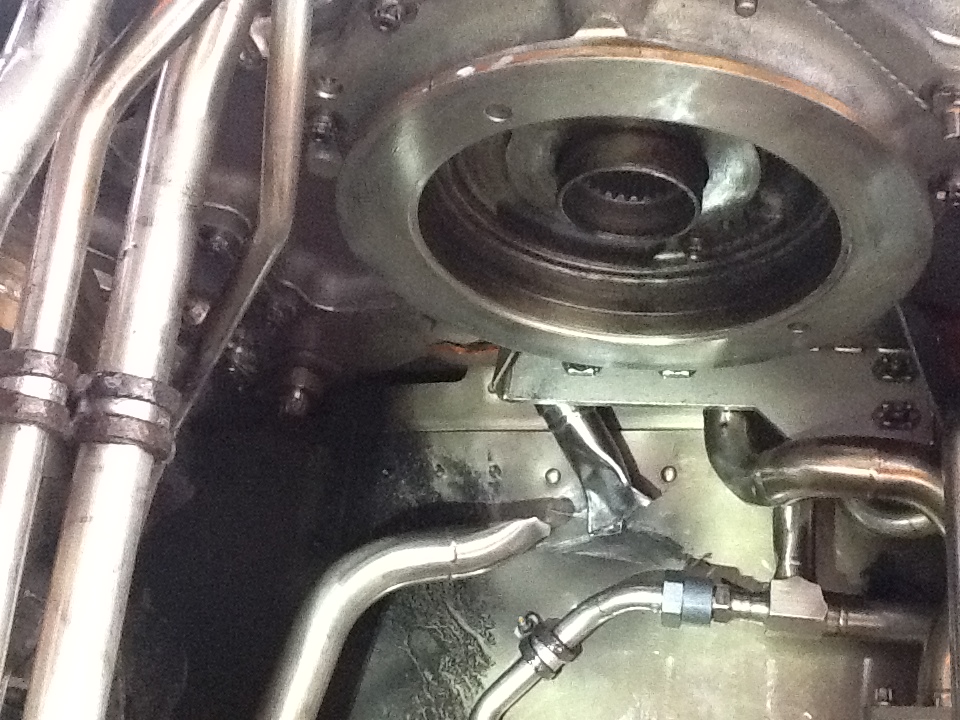
Preliminary examination of the No. 1 engine by maintenance personnel at Cairns found that the air turbine starter had sustained an uncontained failure. Debris released from the starter had severed the adjacent B-sump engine oil scavenge pipe and damaged (without rupturing) the C-sump oil scavenge pipe (Figure 1). This resulted in the complete loss of oil from the No. 1 engine, necessitating the engine shut down.
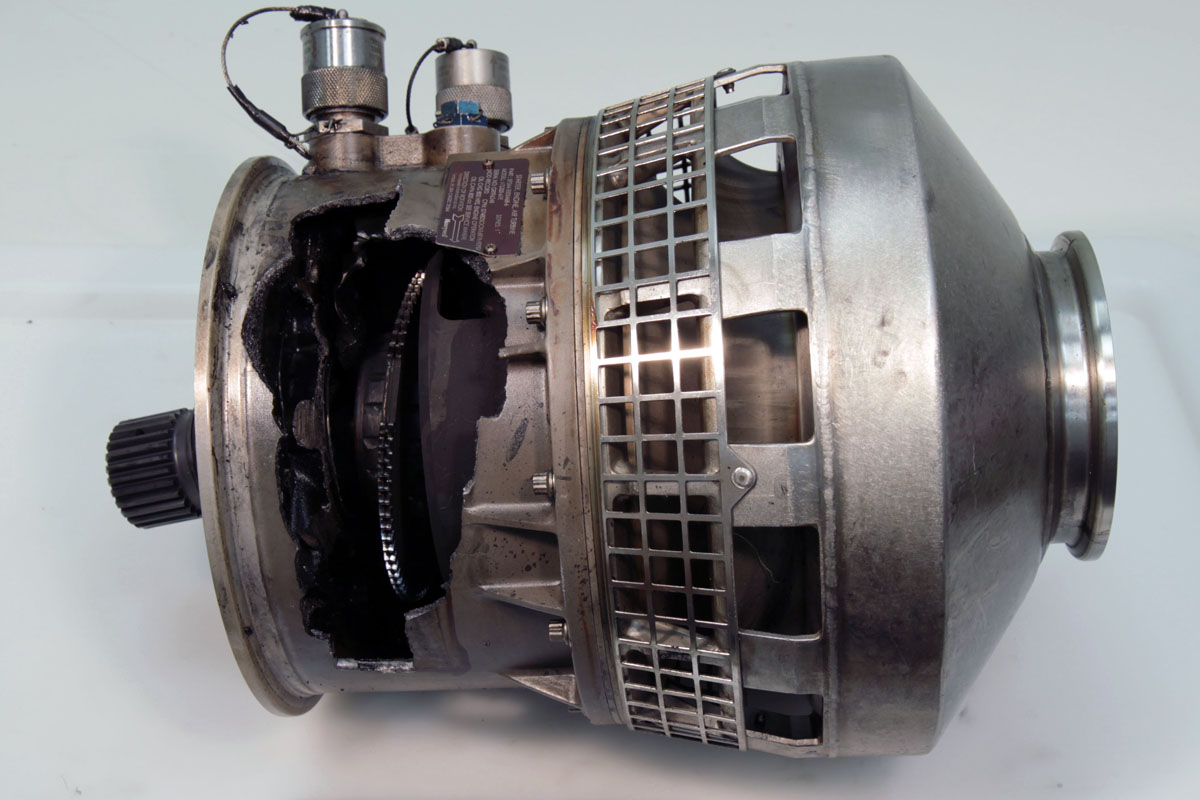
The starter (Figure 2) and associated starter air valve were initially sent to the ATSB for visual examination before being forwarded to the starter manufacturer for detailed disassembly and inspection.
Figure 1: Damage to oil pipes visible after removal of the starter
Source: China Airlines
Figure 2: The air turbine starter removed from B-18358, as-recovered
The aircraft was fitted with both a cockpit voice recorder (CVR) and flight data recorder (FDR). The aircraft operator provided a download of the FDR for analysis by the ATSB. Analysis of the data confirmed the sequence of events and showed that the engine oil quantity for the No. 1 engine decreased to zero at a steady rate, commencing at 16:10:33 UTC, for a duration of approximately 1 minute. The engine oil pressure subsequently started to decrease once the oil quantity reached the minimum recordable level. This resulted in the oil pressure warnings received by the flight crew. There were no other anomalies noted in the recorded data.
The FDR data also contained the 20 previous flight sectors and start sequences for the aircraft engines. The data was examined by the ATSB and the engine manufacturer and showed no evidence of any errors or anomalies relating to the air turbine starter or starter air valve.
Engine details
Aircraft propulsion was provided by two General Electric CF6-80E engines. Engine serial number 811612 was installed in the No. 1 position and was a new engine at the time of installation. The engine had completed 4,096 hours and 1,169 cycles at the time of the occurrence. The failed air turbine starter was the original part fitted to the engine at the introduction to service.
Air turbine starter
Manufacturer:
Honeywell International Inc.
Part number:
59364-3505468-6
Model number:
ATS200-61E (Series 1)
Serial number:
GRTF6248
Time since new:
4096
Cycles since new:
1169
The air turbine starter utilises pressurised air from either the aircraft auxiliary power unit, another aircraft engine or a ground power unit to drive a turbine at high speed. The high-speed, low-torque from the starter turbine is converted to a lower-speed, high torque output via a reduction gear and the engine accessory drive system. The starter output is used to drive the engine high pressure rotor. Air supply to the starter is controlled by the starter air valve, which is pneumatically operated and electrically controlled.
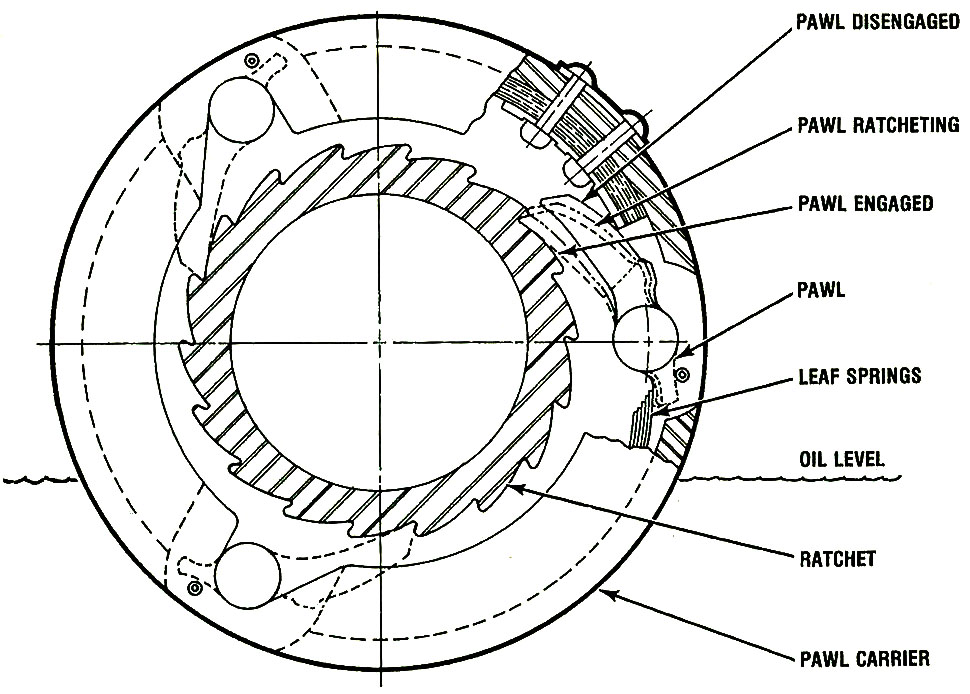
Engagement of the air turbine starter with the engine is controlled via a ratchet and pawl clutch assembly (Figure 3). At zero or low speeds the three pawls are engaged with the ratchet, which is driven by the starter turbine. The pawl carrier is integral with the starter output shaft, which is constantly engaged with the engine. On a normal start, after ignition, the engine will accelerate to a speed whereby the pawls, acting like flyweights, will disengage from the ratchet to prevent the engine from back-driving the starter. The output shaft continues to rotate with the engine.
The 3505468-6 starter design was introduced to service in February 2009 beginning at serial number GRTF2607. The -6 designation included improvements to turbine axial containment.
Figure 3: Ratchet and pawl clutch example
Source: Aircraft Gas Turbine Engine Technology, Treager, 1996.
Air turbine starter investigation
Disassembly and examination of the starter was conducted by the starter manufacturer at their investigation facility and a detailed report was provided to the ATSB. The report concluded that the failure sequence was initiated by failure of the output shaft support bearing. This allowed contact between the rotating pawl carrier and ratchet, which subsequently failed, along with the hub gear. Failure of these components resulted in the fracture of the starter casing and release of debris with enough energy to sever the adjacent B-sump scavenge pipe on the engine.
Recovered output shaft bearing components were limited to fragments of the bearing cage, one fractured ball and one ball with significantly reduced diameter. The inner and outer bearing races were extensively damaged, but intact. It was likely that the output shaft continued to run for some time after the loss of oil, which caused additional damage to the bearing. It was therefore difficult to accurately assess the bearing failure mechanism. Nevertheless, the report indicated that based on analysis of the starter components, the most probable factor contributing to failure of the output shaft bearing was damage caused by a prior crash-engagement[3] of the clutch.
Following on from the initial report from the starter manufacturer, the engine manufacturer conducted further analysis of the starter failure. Their investigation concluded that a high transient load sustained by the output shaft bearing could subsequently lead to overrunning bearing failure. Further work by the engine manufacturer showed that trimming of the engine accessory gearbox horizontal drive shaft could prevent this axial load. As a result, a change in design had been approved at the time of writing this report, with the redesigned shafts to be available from November 2015. The change will be introduced to both the CF6-80C2 and the CF6-80E1 engines, which utilise a common Horizontal Driveshaft (HDS). It should be noted that the CF6-80C2 design already included extra axial clearance, which has prevented the over-running bearing failures, like those seen on the CF6-80E1.
Maintenance history
The Aircraft Maintenance Manual (AMM) recommended air turbine starter oil level checks at intervals of 800 hours and oil changes at intervals of 1,600 hours or 800 cycles. At the time of the occurrence, the AMM stated that the oil quantity until overflow was 800mL and that the quantity if visible at the bottom of the sight gauge was 700mL. At an oil check or change, if the oil level quantity was less than the sight gauge (700mL), a further check for evidence of oil leakage around the seals was required, and if recorded at less than 600mL the starter was to be replaced. Additional information stated that the output shaft bearing could fail from lack of lubrication and overheat when the oil level dropped below 600mL.
The AMM advised that normal oil consumption between maintenance operations was 30 – 200mL. The airline’s task card instructed that the starter had to be replaced if more than 200mL of oil was required during an oil check.
It was a requirement to record the level of oil drained from the starter during each oil change. Maintenance records indicated that the starter had undergone a previous oil check on 3 September 2013 at 3,715 hours since new (TSN) and 1,075 cycles since new (CSN) and an oil change on 8 July 2013 at 2,979 TSN and 887 CSN. At that most recent change, only 610mL of oil was recorded to have been drained, which was close to the lower limit of 600mL.
There was a discrepancy between what was included in the maintenance documentation and the data plate attached to the starter motor. The data plate on the starter stated an oil change at 800 hours as opposed to the 1600 hours stated in the AMM.
As a result of the findings related to potential low oil levels in the starter, the manufacturer conducted a number of tests running the starter with varying levels of oil. Their testing found that the starter actually had a capacity of 1000mL and was more susceptible to damage during operation with high oil levels rather than low. The starter could also be operated with almost zero oil without failure. However, it was noted that it would be unlikely to survive a series of engine starts with no oil due to failure(s) of the starter bearings, particularly turbine shaft bearings.
Following the occurrence, oil samples were collected from various sources, including oil from the same container that was used to service the failed starter, oil from in-service starters that had been serviced by the same container, and oil from the current container that was being used at the time of the sampling. Analysis of the oil samples found them to be within acceptable limits.
Starter air valve
The starter air valve (SAV) regulates the flow of pressurised air to the starter. The SAV was examined and subjected to functional testing at the manufacturer’s test facility. The results showed that the SAV was functioning as designed and had no pre-existing condition that would preclude normal operation.
Previous occurrences
There had been 13 over running bearing failures relating to the ATS200-61 starter model between January 2007 and August 2014. Five of these failures were identified as being uncontained relative to the starter housing;
On 7 July 2014, an Airbus A330 aircraft performed an air turn back following low oil quantity and pressure indications approximately 90 minutes after departure. Post-flight inspection revealed a fire in the starter area as a result of the uncontained failure of part number 3505468-6 starter. The starter had been installed in November 2013 and had accumulated 3,105 hours and 483 cycles since that time. The most likely failure scenario was low starter oil quantity as a result of leaking pressure fill fittings.
In November 2013, a part number 3505468-6 starter sustained an uncontained failure on an Airbus A330-300 aircraft. The mechanism of failure was similar to that of the subject occurrence, except that the failure occurred while the aircraft was on the ground and there was no secondary damage to the engine. The air turbine starter failed 16 days after the last oil change, and 2,758 hours since new. The failure was directly attributed to a lack of lubrication.
In July 2013, an uncontained starter failure was found during the post-flight inspection. The starter had 216 hours since new. The failure was related to a lack of lubrication with no oil found in the sump.
The fourth uncontained starter failure was in December 2011, and was again attributed to a lack of oil with the sump being found to completely dry. The starter was 27 hours since an oil change, and 6,180 hours since overhaul.
In 2007, the ATSB investigated an uncontained air turbine starter occurrence (AO-2007-052), featuring a 3505468-4 starter. In that occurrence, the turbine bearings failed, allowing the turbine disk to move axially inside the starter. The starter was fitted with cutter pins to remove the turbine blades in such an event, to prevent the starter going into a free-run condition. The pins partially separated the blades, but the starter did not contain the blades as designed, resulting in secondary damage to the engine. As a result of this occurrence, the manufacturer implemented corrective actions to prevent reoccurrence of this failure mechanism.
The starter manufacturer used the current failure data to perform a risk analysis of the hazard of a dual inflight shut down due to over running bearing failures. Three of the failures above were used to calculate the risk to the fleet, the two in flight shut down events and the diversion. They identified that bearing failures could be attributed to three main scenarios: axial overload from the main engine, crash engagement or improper oil servicing. The manufacturer’s risk assessment concluded that the risk to the fleet from all failure scenarios was at an acceptable level.
The most likely failure sequence of air turbine starter (part number 3505468-6, serial number GRTF6248) was a failure of the output shaft bearing, followed by the hub gear, pawls and ratchets and then finally failure of the housing. The starter manufacturer determined that the most probable cause was excessive loading, which could have been associated with a previous crash engagement or a transient load provided by the horizontal driveshaft. While direct evidence of a crash engagement was not detected on the previous 20 starts, the starter manufacturer indicated that it did not necessarily mean the output shaft had not been damaged prior to this time and that it may have taken operation over an extended period to manifest in a failure. The starter manufacturer demonstrated that the impact load and subsequent damage to the shaft was a function of velocity and acceleration at engagement and the backlash in the start system at the moment of engagement. The engine manufacturer also performed some analysis which showed that a high transient load applied to the bearing could lead to overrunning bearing failure.
The risk analysis conducted by the starter manufacturer, covering the period from January 2007 to August 2014, identified 13 bearing failures in the starter type. The overall risk to the fleet was determined to be at the acceptable level.
At the most recent oil change, the quantity of oil drained was just above that required for a replacement starter to be installed. While a lack of lubrication did not appear to be an issue in this case, the high loss of oil between maintenance leading up to the failure was potentially indicative of a leak. This allowed the oil level to get down to around the lower limit of 600 mL, where previously the oil had shown little loss between inspections. The engine manufacturer indicated that output shaft seal leaking was responsible for a high number of starter shop findings. The design of the output shaft seal assembly meant that it was installation-sensitive and steps have been taken by both the engine and starter manufacturers to clarify and provide additional information to operators and maintainers of the affected starters.
Furthermore, while the aircraft operator had been conducting maintenance on the starter in accordance with the CMM, the discrepancy between information in the CMM and on the air turbine starter data plate had the potential to affect future air turbine starter maintenance. At the time of writing, the starter manufacturer had initiated an engineering change to remove maintenance information from the data plate.
Findings
From the evidence available, the following findings are made with respect to the in-flight engine shutdown, involving an Airbus A330-302 aircraft, registered B-18358 that occurred 887 km ENE of Darwin, Northern Territory on 3 October 2013. These findings should not be read as apportioning blame or liability to any particular organisation or individual.
Safety issues, or system problems, are highlighted in bold to emphasise their importance. A safety issue is an event or condition that increases safety risk and (a) can reasonably be regarded as having the potential to adversely affect the safety of future operations, and (b) is a characteristic of an organisation or a system, rather than a characteristic of a specific individual, or characteristic of an operating environment at a specific point in time.
Contributing factors
The number one engine air turbine starter experienced an in-flight failure of the over-running output section as a result failure of the output shaft bearing.
Debris originating from the starter failure was not contained by the starter casing and severed the number one engine B-sump oil scavenge pipe. (Safety issue)
Complete loss of engine oil through the severed oil scavenge pipe resulted in a forced-shutdown of the number one engine.
Other factors that increase risk
The starter was operated for a period of time with a marginal oil level which may have affected the longevity of the output shaft bearing.
Safety issues and actions
The safety issues identified during this investigation are listed in the Findings and Safety issues and actions sections of this report. The Australian Transport Safety Bureau (ATSB) expects that all safety issues identified by the investigation should be addressed by the relevant organisation(s). In addressing those issues, the ATSB prefers to encourage relevant organisation(s) to proactively initiate safety action, rather than to issue formal safety recommendations or safety advisory notices.
All of the directly involved parties were provided with a draft report and invited to provide submissions. As part of that process, each organisation was asked to communicate what safety actions, if any, they had carried out or were planning to carry out in relation to each safety issue relevant to their organisation.
The initial public version of these safety issues and actions are repeated separately on the ATSB website to facilitate monitoring by interested parties. Where relevant the safety issues and actions will be updated on the ATSB website as information comes to hand.
Uncontained failure of air turbine starter led to loss of engine oil
Safety issue description: Debris originating from the starter failure was not contained by the starter casing and severed the number one engine B-sump oil scavenge pipe.
Sources and submissions
Sources of information
The sources of information during the investigation included the:
China Airlines
Honeywell
General Electric
Airbus
References
Treager I E, 1996, Aircraft Gas Turbine Engine Technology, Third Edition, Glencoe/McGraw-Hill New York, p 381.
Submissions
Under Part 4, Division 2 (Investigation Reports), Section 26 of the Transport Safety Investigation Act 2003, the ATSB may provide a draft report, on a confidential basis, to any person whom the ATSB considers appropriate. Section 26 (1) (a) of the Act allows a person receiving a draft report to make submissions to the ATSB about the draft report.
A draft of this report was provided to China Airlines, Honeywell, General Electric, the Aviation Safety Council (ASC, Taiwan ROC), The National Transportation Safety Board (NTSB, USA), Airbus and the Bureau d’Enquêtes et d’Analyses (BEA, France).
Submissions were received from to China Airlines, Honeywell, General Electric, the Aviation Safety Council (ASC, Taiwan ROC), The National Transportation Safety Board (NTSB, USA), Airbus and the Bureau d’Enquêtes et d’Analyses (BEA, France). The submissions were reviewed and where considered appropriate, the text of the report was amended accordingly.
Purpose of safety investigations
The objective of a safety investigation is to enhance transport safety. This is done through:
identifying safety issues and facilitating safety action to address those issues
providing information about occurrences and their associated safety factors to facilitate learning within the transport industry.
It is not a function of the ATSB to apportion blame or provide a means for determining liability. At the same time, an investigation report must include factual material of sufficient weight to support the analysis and findings. At all times the ATSB endeavours to balance the use of material that could imply adverse comment with the need to properly explain what happened, and why, in a fair and unbiased manner. The ATSB does not investigate for the purpose of taking administrative, regulatory or criminal action.
Terminology
An explanation of terminology used in ATSB investigation reports is available here. This includes terms such as occurrence, contributing factor, other factor that increased risk, and safety issue.
Publishing information
Released in accordance with section 25 of the Transport Safety Investigation Act 2003
Ownership of intellectual property rights in this publication
Unless otherwise noted, copyright (and any other intellectual property rights, if any) in this report publication is owned by the Commonwealth of Australia.
Creative Commons licence
With the exception of the Coat of Arms, ATSB logo, and photos and graphics in which a third party holds copyright, this publication is licensed under a Creative Commons Attribution 3.0 Australia licence.
Creative Commons Attribution 3.0 Australia Licence is a standard form licence agreement that allows you to copy, distribute, transmit and adapt this publication provided that you attribute the work.
The ATSB’s preference is that you attribute this publication (and any material sourced from it) using the following wording: Source: Australian Transport Safety Bureau
Copyright in material obtained from other agencies, private individuals or organisations, belongs to those agencies, individuals or organisations. Where you wish to use their material, you will need to contact them directly.
On 7 September 2013, an Airbus A320, registered VH-VFJ, was on descent into Auckland, New Zealand via a Required Navigation Performance (RNP) approach to runway 23L. During the later stages of their descent, the crew managed the aircraft speed to meet an Air Traffic Control request and according to applicable company speed restrictions.
The auto-flight system sequenced to final approach mode passing about 4,200 ft, but exited final approach mode when the crew subsequently levelled the aircraft approaching 3,000 ft. The crew levelled the aircraft to reduce speed to comply with a company speed restriction of 210 kt maximum below 3,000 ft. Having slowed sufficiently, subsequent manipulation of the auto-flight system resulted in the inadvertent engagement of open climb mode, which resulted in an increase in engine thrust and aircraft acceleration.
Attempting to avoid exceeding the limiting speed applicable to the existing aircraft configuration, the captain retarded the thrust levers to the idle stop, inadvertently disconnecting the auto-thrust system. The crew resumed the approach, unaware that the auto-thrust system was disconnected, and therefore no longer controlling aircraft speed. As the aircraft continued to decelerate, soon after the final stage of flap was selected for landing, the Flight Management Guidance System generated a low energy warning. As the crew was responding to the low-energy warning, alpha-floor auto-thrust mode engaged. The crew accelerated the aircraft to approach speed using manual thrust control, and was able to continue the approach for an uneventful landing.
The operator’s investigation into the incident found that, among other things, there may be some commonly held misunderstandings with respect to some aspects of instrument approach procedures, particularly their application to RNP approaches. The operator planned to communicate relevant procedural information to flight crew, with appropriate explanatory information, and communicate with flight crew regarding procedural requirements associated with auto-flight system mode awareness and speed monitoring. The operator also planned to include more guidance in appropriate documentation dealing with transfer of aircraft control between flight crew.
This incident highlights the need for robust and clear instrument approach and auto-flight system management procedures. It also highlights the need for consistent attention to aircraft auto-flight modes and energy state.
On 30 August 2013, a Boeing 737 aircraft, registered ZK-NGI, was involved in a cabin depressurisation incident near Auckland, New Zealand.
An investigation into the circumstances of this incident is being conducted by the Transport Accident Investigation Commission (TAIC) of New Zealand. The TAIC investigation reference is 13-008 / AO‑2013-008.
TAIC requested assistance from the Australian Transport Safety Bureau (ATSB) in the download of the aircraft’s cockpit voice recorder (CVR). To facilitate this support and to provide the appropriate protections for the CVR information, the ATSB appointed an accredited representative in accordance with paragraph 5.23 of ICAO Annex 13 and commenced an investigation under the Australian Transport Safety Investigation Act 2003.
The CVR was hand-carried to the ATSB’s facilities in Canberra by a TAIC officer and was downloaded on 5 September 2013. The downloaded audio and a replay report were provided to TAIC.
TAIC is responsible for releasing the final investigation report regarding this incident.
Transport Accident Investigation Commission of NZ www.taic.org.nz
______________
Released in accordance with section 25 of the Transport Safety Investigation Act 2003.
On 13 April 2013, an Indonesian registered B737-800 aircraft collided with water on approach to Denpasar Airport, Indonesia.
As the accident took place in Indonesia, the Indonesian National Transportation Safety Committee (NTSC) is responsible for investigating this occurrence, consistent with Indonesia’s obligations as State of Occurrence under Annex 13 to the Convention on International Civil Aviation Aircraft Accident and Incident Investigation (Annex 13).
The NTSC requested ATSB assistance to seek weather and visibility reports from Australian flight crews operating into Denpasar close to the time of the accident. To facilitate this support, the ATSB appointed an accredited representative in accordance with paragraph 5.23 of Annex 13 and, in order to protect the information supplied by the NTSC, commenced an external investigation under the Transport Safety Investigation Act 2003. The ATSB completed its work as accredited representative on 26 April 2013.
The National Transport Safety Committee of Indonesia is responsible for releasing the investigation report.
National Transportation Safety Committee Ministry Of Transportation Republic Of Indonesia Transportation Building 3rd Floor Jalan Medan Merdeka Timur No. 5 Jakarta Pusat 10110 Indonesia
On 9 September 2011, a Cessna 208B ‘Grand Caravan’ aircraft, registered PK-VVE, collided with terrain and was destroyed on a cargo flight from Wamena to Kenyam in the Pasema District of West Papua, Republic of Indonesia. The pilot and copilot, the only persons on board were fatally injured.
As the accident took place in Indonesia, the Indonesian National Transportation Safety Committee (NTSC) is responsible for investigating this occurrence, consistent with Indonesia’s obligations as State of Occurrence under Annex 13 to the Convention on International Civil Aviation Aircraft Accident and Incident Investigation (Annex 13).
The pilot of the aircraft was an Australian citizen and, in accordance with the ‘special interest’ provisions of paragraph 5.27 of Annex 13, the Australian Transport Safety Bureau (ATSB) appointed an expert to the NTSC investigation. This allowed the ATSB to receive relevant factual information that was approved by the NTSC for public release and a copy of the NTSC’s final investigation report.
The NTSC subsequently requested ATSB support in the analysis of the available recorded data from the flight and with finalising the draft investigation report. To facilitate this support, the ATSB appointed an accredited representative in accordance with paragraph 5.23 of Annex 13 and, in order to protect the information supplied by the NTSC, commenced an external investigation under the Transport Safety Investigation Act 2003. The ATSB completed its work as accredited representative in March 2013.
The National Transport Safety Committee of Indonesia is responsible for releasing the investigation report.
National Transportation Safety Committee Ministry Of Transportation Republic Of Indonesia Transportation Building 3rd Floor Jalan Medan Merdeka Timur No. 5 Jakarta Pusat 10110 Indonesia
On 15 January 2013, at about 1500 Coordinated Universal Time (UTC), a Cessna Citation 750, registered VH-RCA departed Faleolo International Airport, Samoa for Sydney Airport, New South Wales, with two flight crew and five passengers on board. About 1 hour 35 minutes into the flight the crew received a WSHLD HEAT INOP L (windshield heat inoperative left) message on the engine-indicating and crew-alert system (EICAS) and approximately 2 minutes later the windshield outer ply shattered with a loud bang. An immediate descent was commenced along with a turn towards Nadi International Airport, Fiji. The flight continued to Nadi without further incident and there were no injuries to passengers or crew.
The manufacturer reported that they had experienced two reliability issues with the windshield part number installed on the aircraft (9914380-11/-12). It was likely that the electrically heated windshield had been affected by moisture ingress resulting in a degradation of the electrical connection between the bus bar and the heating film. Changes to the windshield to address the issue were incorporated into part number 9914380-13/-14. There have been no reported cases of either of the failure modes in the -13/-14 windshields.
While the failure of the windshield involved the outer pane only, and did not result in a depressurisation, the precautions taken by the flight crew to descend to a lower altitude and diversion to the alternate airport highlighted the importance of good flight planning.
On 25 December 2012, a Fokker 100 aircraft, registered XY-AGC, collided with terrain on approach to Heho Airport, Myanmar, fatally injuring one of the aircraft’s occupants and a motorist on the ground.
The Myanmar Accident Investigation Bureau (MAIB) is responsible for investigating this occurrence. As part of its investigation, the MAIB requested assistance from the Australian Transport Safety Bureau (ATSB) in the recovery and download of data from the aircraft’s Flight Data Recorder (FDR) and Cockpit Voice Recorder (CVR) units. In accordance with clause 5.23 of Annex 13 to the Convention on International Civil Aviation (ICAO Annex 13), the ATSB appointed an accredited representative to assist the MAIB and initiated an investigation under the Australian Transport Safety Investigation Act 2003.
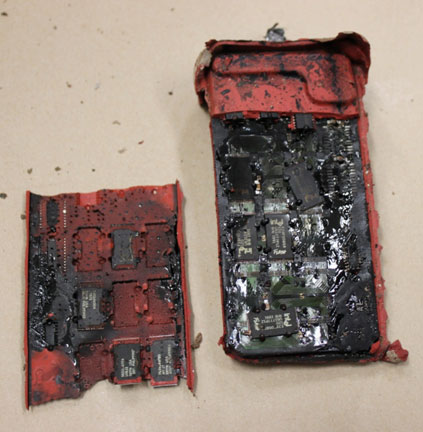
Following receipt of the CVR and FDR units on 21 January 2013, both units were successfully downloaded in accordance with the relevant manufacturer’s instructions. The download and data recovery operations were overseen by representatives of the MAIB and an Accredited Representative from the Dutch Safety Board (DSB). During preparations for the download process, ATSB specialists found that the crash survivable memory units (CSMU’s) from the both recorders had suffered damage from fire exposure. The CSMU is the module which carries the solid state chips that contain the recorded information. The CVR CSMU was dismantled and the data recovered using data retrieval techniques appropriate for an accident-damaged flight recorder. However, the FDR CSMU had sustained a significantly greater degree of thermal damage and required specialised data recovery techniques involving recovery and downloading of individual chips. The data recovered from the discrete chips was later compiled into a single coherent data file using a specialised utility provided by the recorder manufacturer.
The downloaded audio and flight data was examined and confirmed as containing detail from the accident flight. The recovered information, together with a selection of graphical and tabular presentations of the flight data was provided to MAIB representatives on 25 January 2013.
Fire-damaged flight data recorder as-received
Thermally-damaged flight data recorder crash-survivable memory unit
The MAIB investigation has now been finalised and in accordance with the provisions of ICAO Annex 13, a copy of the final investigation report was provided to the ATSB on 28 January 2014.
A copy of the final report may be requested through the contact details below:
Myanmar Accident Investigation Bureau First Floor, DCA HQ Building (B) Yangon 11021, Myanmar Tel: 951 533162 Fax: 951 533016 Email: ddmaib@dca.gov.mm
______________
Released in accordance with section 25 of the Transport Safety Investigation Act 2003.