Separation issue

Separation issue involving a Diamond DA 40 and a Cessna 172, Brisbane West Wellcamp, Queensland, on 23 April 2020

Brief

Occurrence Briefs are concise reports that detail the facts surrounding a transport safety occurrence, as received in the initial notification and any follow-up enquiries. They provide an opportunity to share safety messages in the absence of an investigation.

What happened

On 23 April 2020, the pilot of a Diamond DA 40 was conducting a solo navigation flight from Gold Coast, Queensland to Brisbane West Wellcamp (Wellcamp), Queensland. On the same day, the pilot of a Cessna 172 was conducting a return solo navigation flight from Gold Coast and had planned to conduct circuit training at Wellcamp on the return leg.

The standard circuit altitude at Wellcamp is 2,500 ft for piston aircraft utilising a non-standard right-hand circuit for runway 12 to avoid high terrain to the north-east of the runway. At about 1430 Eastern Standard Time, the pilot of the DA 40 overflew active runway 12 at Wellcamp at 3,500 ft with the intention of descending on the dead side[1] to join a right circuit. Around this time, the 172 was approaching the aerodrome from the west. Both pilots reported broadcasting on the common traffic advisory frequency (CTAF).

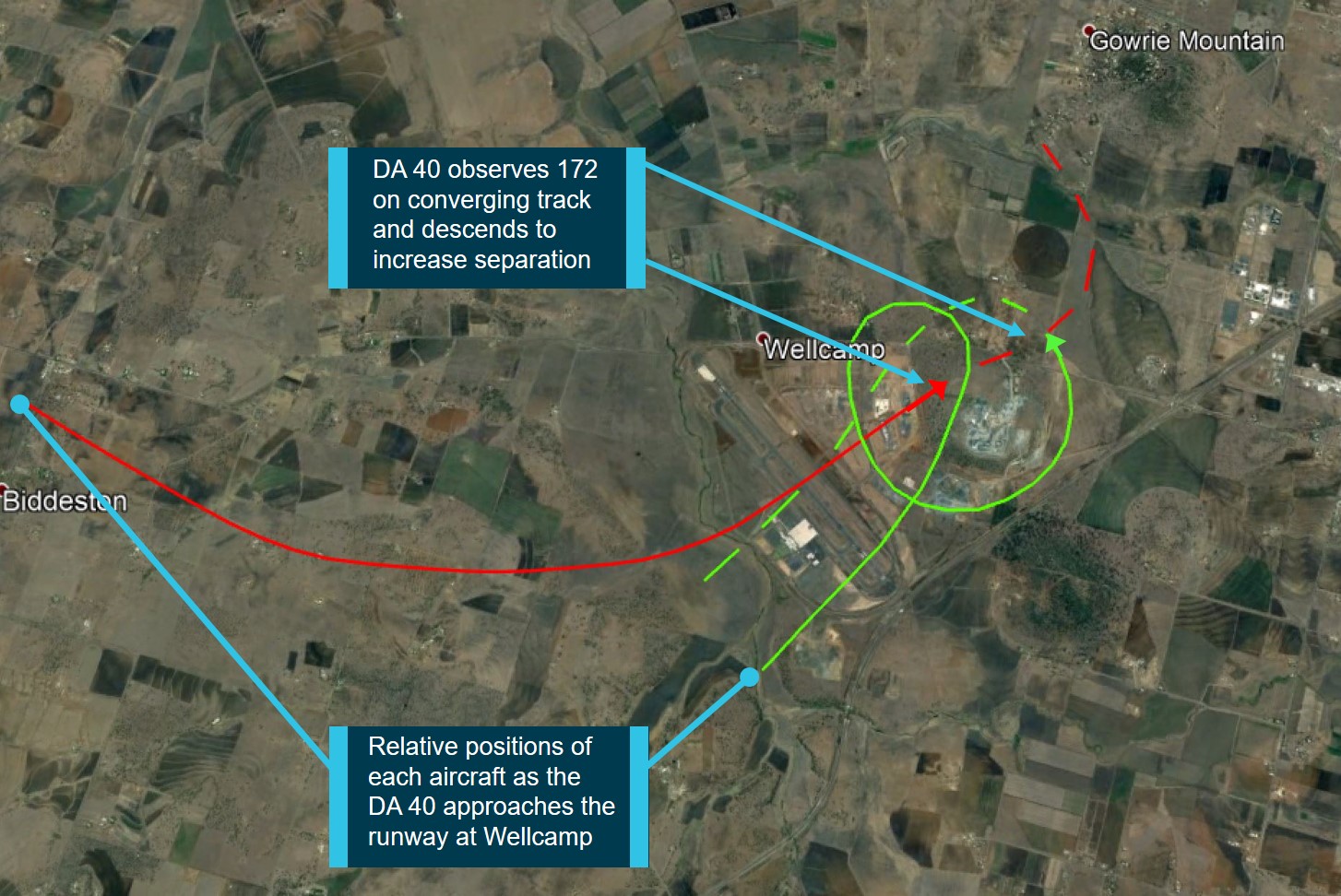
The pilot of the DA 40 conducted two descending orbits to join at the correct circuit height and as the aircraft turned back towards the runway to join midfield, the pilot detected the 172 on a converging track (Figure 1) and manoeuvred the aircraft to increase separation.

The two aircraft passed within close proximity, resulting in a vertical separation of approximately 100 ft and a horizontal separation of 300 m.

Figure 1: Relative flight paths and position of detected conflict (Diamond DA40 represented by green line, Cessna 172 represented by red line)

Figure 1: Relative flight paths and position of detected conflict (Diamond DA 40 represented by green line, Cessna 172 represented by red line)

Source: Google Earth. Annotated by the ATSB

The 172 pilot had made an inbound call at 10 NM stating that they were, ‘on descent to 2,500 for midfield crosswind for left base runway 12.’ The pilot reported being aware of the requirement to conduct right-hand circuits for runway 12 but recalled hearing traffic already in the circuit area conducting left circuits and elected to follow the existing traffic. A descent to circuit height was conducted on the dead side for a left circuit; however, this resulted in the aircraft tracking in the opposite direction to circuit traffic at the same height. After the 172 pilot observed the DA 40 pass in close proximity, a CTAF call was made to query the runway direction, which was relayed as the published right-hand circuit. The 172 pilot elected to discontinue the approach to Wellcamp and climbed away on the dead side of the circuit before continuing on the navigation exercise.

Operator comments

The operator of the 172 has advised the ATSB that during their internal investigation, it was apparent that there was some confusion as to what direction circuits were actually being conducted prior to the arrival at Wellcamp. Although the query regarding circuit direction was made late by the pilot, this action avoided any further conflict.

Safety message

This incident highlights the need for pilots to consult the En Route Supplement Australia (ERSA) when flying to an unfamiliar aerodrome. As illustrated by this incident, not all non-controlled aerodromes follow the same procedures. Being aware of local traffic procedures helps pilots to anticipate the likely position of other aircraft.

Additionally, this incident reinforces the need for pilots to maintain situational awareness and a vigilant lookout at all times. This is especially important when operating at non-controlled aerodromes where pilots are responsible for monitoring and broadcasting their intentions on the CTAF as effective communication is vital to the prevention of potential conflicts developing. Research conducted by the ATSB has found that insufficient communication between pilots contributes to a breakdown of situational awareness. Further information about operating safely at non-controlled aerodromes can be found on the ATSB website, A pilot's guide to staying safe in the vicinity of non-controlled aerodromes and the CASA website, Radio procedures in non-controlled airspace.

The ATSB SafetyWatch highlights the broad safety concerns that come out of our investigation findings and from the occurrence data reported to us by industry. One of the priorities is Non-controlled airspace.

The ATSB SafetyWatch highlights the broad safety concerns that come out of our investigation findings and from the occurrence data reported to us by industry. One of the priorities is Non-controlled airspace.

About this report

Decisions regarding whether to conduct an investigation, and the scope of an investigation, are based on many factors, including the level of safety benefit likely to be obtained from an investigation. For this occurrence, no investigation has been conducted and the ATSB did not verify the accuracy of the information. A brief description has been written using information supplied in the notification and any follow-up information in order to produce a short summary report, and allow for greater industry awareness of potential safety issues and possible safety actions.

__________

  1. Dead side: The area on the opposite side of the runway to where the circuit is flown.

Occurrence summary

Mode of transport Aviation
Occurrence ID AB-2020-022
Occurrence date 23/04/2020
Location Brisbane West Wellcamp
State Queensland
Occurrence class Incident
Aviation occurrence category Separation issue
Highest injury level None
Brief release date 29/07/2020

Aircraft details

Manufacturer Diamond Aircraft Industries
Model DA 40
Sector Piston
Operation type Flying Training
Departure point Gold Coast, Queensland
Destination Brisbane West Wellcamp, Queensland
Damage Nil

Aircraft details

Manufacturer Cessna Aircraft Company
Model 172S
Sector Piston
Operation type Flying Training
Departure point Gold Coast, Queensland
Destination Gold Coast, Queensland
Damage Nil

Separation issue involving a Diamond DA40 and a de Havilland Canada DHC-1, Warren Reservoir, South Australia, on 15 September 2019

Brief

Occurrence Briefs are concise reports that detail the facts surrounding a transport safety occurrence, as received in the initial notification and any follow-up enquiries. They provide an opportunity to share safety messages in the absence of an investigation.

What happened

On 15 September 2019, a Diamond DA40 was operating a dual training flight with an instructor and a student pilot on board from Strathalbyn to Parafield, South Australia. The pilot of a de Havilland Canada DHC-1 was also airborne at the same time after departing Parafield on a private flight.

The crew of the DA40 reported that during cruise at 2,500 ft on track for Dam Wall, they received a TCAS alert on an aircraft directly ahead on a reciprocal heading. Shortly after, the instructor observed the outbound DHC-1 at the same altitude, took control of the aircraft, and turned left to increase separation.

The pilot of the DHC-1 reported that upon leaving Sub Station and setting a course to the east, he saw an aircraft in the distance and perceived it not to be a risk as he judged his track would take him south of the inbound aircraft for Parafield. At the position given by the other pilot, he reported he was on climb to 3,500 ft and would have been clear of any aircraft operating at 2,500 ft.

Both the instructor and student of the DA40 and the pilot of the DHC-1 report monitoring the Adelaide Approach radio frequency and did not hear any radio calls from the other aircraft.

Safety message

This incident highlights the need for pilots to maintain situational awareness and a vigilant lookout at all times. Most aircraft conflicts in uncontrolled airspace are due to ineffective communication between pilots operating in close proximity, the incorrect assessment of other aircraft’s positions and intentions, and relying on the radio as a substitute for an effective visual lookout.

The ATSB’s SafetyWatch highlights broad safety concerns that come out of our investigation findings and from the occurrence data reported to us by industry. One of those priorities is Non-controlled airspace.

About this report

Decisions regarding whether to conduct an investigation, and the scope of an investigation, are based on many factors, including the level of safety benefit likely to be obtained from an investigation. For this occurrence, no investigation has been conducted and the ATSB did not verify the accuracy of the information. A brief description has been written using information supplied in the notification and any follow-up information in order to produce a short summary report, and allow for greater industry awareness of potential safety issues and possible safety actions.

Occurrence summary

Mode of transport Aviation
Occurrence ID AB-2019-035
Occurrence date 15/09/2019
Location 24 km E of Parafield, South Australia
State South Australia
Occurrence class Incident
Aviation occurrence category Separation issue
Highest injury level None
Brief release date 24/10/2019

Aircraft details

Manufacturer Diamond Aircraft Industries
Model DA40
Sector Piston
Operation type Flying Training
Damage Nil

Aircraft details

Manufacturer De Havilland Canada/De Havilland Aircraft of Canada
Model DHC-1
Sector Piston
Operation type Private
Damage Nil

Separation event involving a Cessna 441 and a Beechcraft B200, Dubbo, New South Wales, on 12 November 2018

Brief

Occurrence Briefs are concise reports that detail the facts surrounding a transport safety occurrence, as received in the initial notification and any follow-up enquiries. They provide an opportunity to share safety messages in the absence of an investigation.

What happened

On 12 November 2018 at approximately 1300 Eastern Daylight-saving Time, the pilot of a Cessna 441 was on a westerly approach to Dubbo Airport, New South Wales. On the same day, a Beechcraft B200 and a Piper PA-31 were also on approach to Dubbo; with the B200 inbound from the south-east and the PA-31 from the south-west. Both the 441 and the B200 were given aircraft traffic by Melbourne Centre[1], advising both crews that the B200 was arriving first for runway 05 followed by the 441 and PA-31.

Just prior to reaching the 5 NM point from the airport, the crew of the B200 reported their position on the Dubbo common traffic advisory frequency (CTAF) and requested a position update from the 441. The crew of the 441 advised that they were passing WI. Upon realisation of the potential confliction, the crew of the B200 informed the 441 of their converging track and requested the 441 conduct an orbit to maintain separation. At about the same time the crew of the 441 received a TCAS alert alerting them that the conflicting traffic was 1 NM away. They immediately conducted an orbit to the left until it was clear to resume their approach.

Pilot comments

Pilot of Cessna 441

The pilot advised that throughout their approach, they were in communication with the crew of the PA-31 coordinating their approach via the CTAF. Because of the multiple radio transmissions on the CTAF and with Melbourne Centre, they were unable to communicate with the crew of the B200 earlier.

Safety message

This incident highlights the need for pilots to maintain situational awareness and a vigilant lookout at all times. This is especially important when operating at non-controlled aerodromes where pilots are responsible for monitoring and broadcasting their intensions on the CTAF. Research has found that the most hazardous phases of flight are within 5 NM of an aerodrome and at an altitude below 3,000 ft, as there is a higher traffic density within this area.

The ATSB SafetyWatch highlights the broad safety concerns that come out of our investigation findings and from the occurrence data reported to us by industry. One of the priorities is Non-controlled airspace.

Further information about operating safely at non-controlled aerodromes can be found on the ATSB website A pilot's guide to staying safe in the vicinity of non-controlled aerodromes and CASA website Operations at non-controlled aerodromes.

The ATSB SafetyWatch highlights the broad safety concerns that come out of our investigation findings and from the occurrence data reported to us by industry. One of the priorities is Non-controlled airspace.

About this report

Decisions regarding whether to conduct an investigation, and the scope of an investigation, are based on many factors, including the level of safety benefit likely to be obtained from an investigation. For this occurrence, no investigation has been conducted and the ATSB did not verify the accuracy of the information. A brief description has been written using information supplied in the notification and any follow-up information in order to produce a short summary report, and allow for greater industry awareness of potential safety issues and possible safety actions.

__________

  1. The Melbourne flight information region (FIR) includes the southern half of Australia and the Southern and Indian oceans. The centre is directly responsible for en route services throughout the FIR.

Occurrence summary

Mode of transport Aviation
Occurrence ID AB-2018-121
Occurrence date 12/11/2018
Location Dubbo
State New South Wales
Occurrence class Incident
Aviation occurrence category Separation issue
Highest injury level None
Brief release date 21/12/2018

Aircraft details

Manufacturer Cessna Aircraft Company
Model 441
Sector Piston
Operation type Charter
Destination Dubbo, NSW
Damage Nil

Aircraft details

Manufacturer Beech Aircraft Corp
Model B22
Sector Piston
Operation type Aerial Work
Destination Dubbo, NSW
Damage Nil

Separation event involving BRM Aero Bristell and Vans RV-8, Bathurst Airport, New South Wales, on 27 April 2018

Brief

Occurrence Briefs are concise reports that detail the facts surrounding a transport safety occurrence, as received in the initial notification and any follow-up enquiries. They provide an opportunity to share safety messages in the absence of an investigation.

What happened

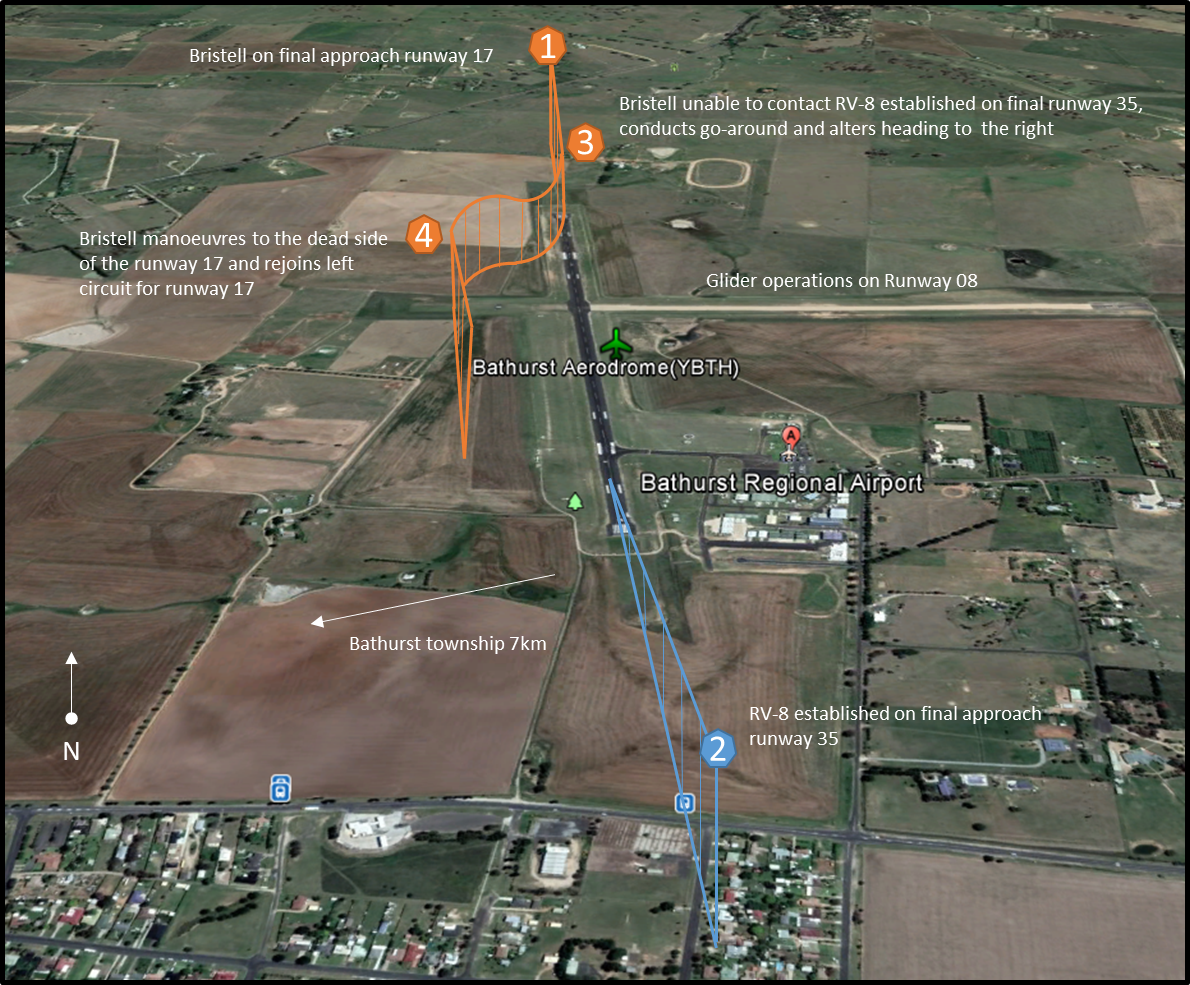
On the afternoon of 27 April 2018, a BRM Aero Bristell was conducting flight training at Bathurst Airport, New South Wales. During final approach to runway 17 at, the crew observed a Van's RV-8 on short final approach to runway 35. The crew of the Bristell conducted a go-around[1] and manoeuvred to the dead side[2] of runway 17 to maintain separation and visibility of the RV-8 on final for runway 35 while trying to contact the RV-8 by radio with no response. The Bristell re-joined the circuit and both aircraft landed without further incident.

It was later established that the pilot of the RV-8 had not selected the appropriate radio frequency for Bathurst and was distracted by glider operations on runway 08 and had not seen the Bristell until after landing.

Figure 1: Separation sequence of events at Bathurst Aerodrome 

Figure 1: Separation sequence of events at Bathurst Airport. Source: Google Earth image annotated by ATSB

Source: Google Earth image annotated by ATSB

Safety action

As a result of this occurrence, the RV-8 pilot advised the ATSB that they will in future write the relevant frequencies of the destination aerodrome on the flight plan in the pilot notes area, to have them readily available in flight.

Safety message

The ATSB SafetyWatch highlights the broad safety concerns that come out of our investigation findings and from the occurrence data reported to us by industry. Non-controlled airspace is an ATSB safety watch priority.

Maintaining situational awareness of your surroundings is a key element of safe operations in the vicinity of non-towered aerodromes. Pilots should:

  • maintain effective lookout
  • use radio to supplement un-alerted see and avoid
  • be aware that other aircraft may not be on the correct frequency or broadcasting.

Appropriate radio broadcasts made on the correct frequency within 10 NM of non-towered aerodromes whilst maintaining good visual scanning is eight times more effective than normal lookout in detecting and avoiding other traffic.

The ATSB booklet A pilot’s guide to staying safe in the vicinity of non-controlled aerodromes outlines many of the common problems that occur at non-controlled aerodromes, and offers useful strategies to keep yourself and other pilots safe.

The Civil Aviation Safety Authority (CASA) has produced several publications and resources that provide important safety advice for operations at, or in the vicinity of non-towered aerodromes.

About this report

Decisions regarding whether to conduct an investigation, and the scope of an investigation, are based on many factors, including the level of safety benefit likely to be obtained from an investigation. For this occurrence, no investigation has been conducted and the ATSB did not verify the accuracy of the information. A brief description has been written using information supplied in the notification and any follow-up information in order to produce a short summary report, and allow for greater industry awareness of potential safety issues and possible safety actions.

__________

  1. To abandon the landing and make a fresh approach [Cambridge Aerospace Dictionary]
  2. Side of airfield or active runway away from that of the circuit pattern in use. [Cambridge Aerospace Dictionary]

Occurrence summary

Mode of transport Aviation
Occurrence ID AB-2018-062
Occurrence date 27/04/2018
Location Bathurst Airport
State New South Wales
Occurrence class Incident
Aviation occurrence category Separation issue
Highest injury level None
Brief release date 16/11/2018

Aircraft details

Manufacturer Van's Aircraft
Model RV-8
Sector Piston
Operation type Private
Departure point Bathurst Airport, NSW
Damage Nil

Aircraft details

Manufacturer BRM Aero S.R.O.
Model Bristell
Sector Sport and recreational
Operation type Flying Training
Departure point Bathurst Airport, NSW
Damage Nil

Aircraft separation issue involving Glaser-Dirks DG-1000S and a Cessna aircraft, Bathurst Airport, New South Wales, on 27 April 2018

Brief

Occurrence Briefs are concise reports that detail the facts surrounding a transport safety occurrence, as received in the initial notification and any follow-up enquiries. They provide an opportunity to share safety messages in the absence of an investigation.

What happened

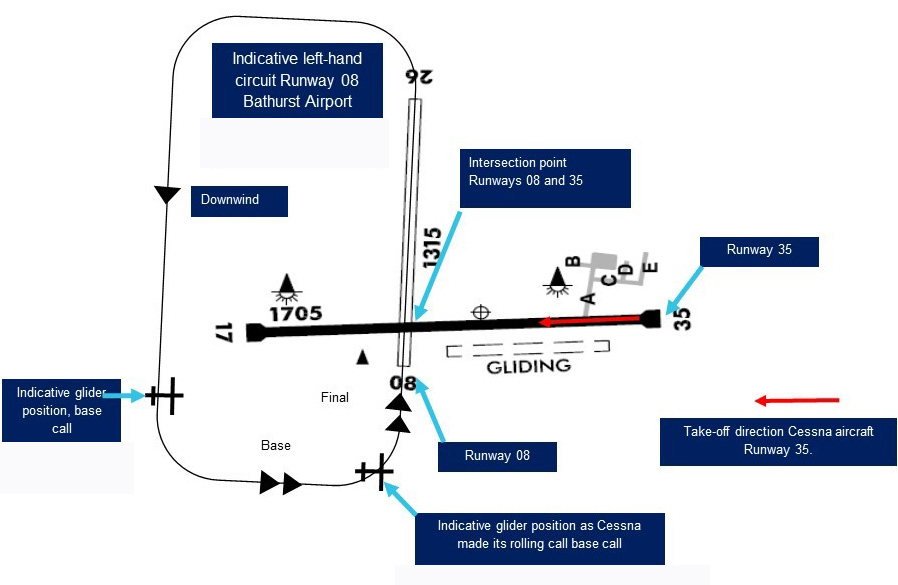
On 27 April 2018 at approximately 0905 Eastern Standard Time, a Glaser-Dirks DG-1000S glider aircraft (the glider) was conducting solo training in the left-hand circuit of runway 08 at Bathurst Airport, New South Wales. As the glider made its downwind radio call, a Cessna aircraft broadcast that it was taxiing for runway 35. The pilot of the Cessna acknowledged a further call made by the glider ground controller that there was a glider training in the circuit area.

Several seconds later the glider turned onto the left base of the circuit and broadcast, “turning left base, runway 08”.

Later, as the glider was turning final for runway 08, the Cessna broadcast its rolling call on runway 35. Recognising the potential separation issue at the intersection points of runways 08 and 35, the glider ground controller called “ABORT, ABORT, ABORT, glider on final runway 08”.

The Cessna pilot brought the aircraft to a full stop prior to the intersection and the glider landed on runway 08 without incident. The Cessna pilot then backtracked and departed from runway 35.

Figure1: Diagram of Bathurst Airport showing indicative aircraft position 

Figure1: Diagram of Bathurst Airport showing indicative aircraft position

Related occurrences

A search of the ATSB database revealed a similar occurrence that took place at Bathurst Airport in 2016:

AO-2016-034

On 13 April 2016, an instructor and student of a Jabiru J170-D aeroplane, registered 24-7750 (7750), conducted a local training flight from Bathurst Airport, New South Wales. At about 1446 Eastern Standard Time, the aircraft arrived in the circuit, and the instructor broadcast that they were joining the circuit on an early downwind for runway 17, for a full-stop landing.

Powered aircraft were operating on runway 17 and gliders (and towing aircraft) were operating on runway 08.

Meanwhile, a student pilot of a Glaser-Dirks DG-1000S glider, registered VH-NDQ (NDQ) was conducting a solo flight at Bathurst. At about 1449, about 90 seconds after the pilot of 7750 had communicated with Glider Ground regarding glider traffic in the air, the pilot of NDQ broadcast on the Bathurst CTAF that they were on left downwind for runway 08.

After 7750 touched down on runway 17, about 100 m before the intersection with runway 08, the pilot sighted a glider (NDQ) on short final for runway 08, at an estimated 100 feet above ground level. The pilot applied full power to cross runway 08 as quickly as possible.

As 7750 landed, the pilot of NDQ assessed that there was the potential for a collision, closed the glider’s airbrakes and initiated a climb to pass over 7750. The glider then landed ahead on runway 08.

The instructor in 7750 lost sight of NDQ as it passed overhead. As 7750 accelerated with a high power setting, the instructor elected to continue a take-off and conducted a circuit before landing safely.

Safety message

While in this case, the incident did not result in a near collision, the safety message remains the same between the two occurrences.

Simultaneous operations on crossing runways can be problematic, particularly where the operation types are different (such as powered flight and gliding operations). Organisations responsible for the coordination and conduct of such activities are encouraged to carefully assess and manage the risks involved. This is particularly important when operations are likely to involve instructional flights and less experienced pilots, where workload and the potential for pilot distraction may be elevated.

This incident highlights the importance of effective communication. The primary purpose of communications on the CTAF is to ensure the maintenance of appropriate separation through mutual understanding by pilots of each other’s position and intentions. Where a pilot identifies a risk of collision, that pilot should alert others as soon as possible to allow a coordinated and effective response.

stated that ‘whenever pilots determine that there is a potential for traffic conflict, they should make radio broadcasts as necessary to avoid the risk of a collision’.

About this report

Decisions regarding whether to conduct an investigation, and the scope of an investigation, are based on many factors, including the level of safety benefit likely to be obtained from an investigation. For this occurrence, no investigation has been conducted and the ATSB did not verify the accuracy of the information. A brief description has been written using information supplied in the notification and any follow-up information in order to produce a short summary report, and allow for greater industry awareness of potential safety issues and possible safety actions.

Occurrence summary

Mode of transport Aviation
Occurrence ID AB-2018-061
Occurrence date 27/04/2018
Location Bathurst Airport
State New South Wales
Occurrence class Incident
Aviation occurrence category Separation issue
Highest injury level None
Brief release date 16/11/2018

Aircraft details

Manufacturer Glaser-Dirks
Model Glaser-Dirks DG-1000S
Sector Sport and recreational
Operation type Gliding
Destination Bathurst Airport, NSW
Damage Nil

Aircraft details

Manufacturer Cessna Aircraft Company
Sector Piston
Operation type Unknown
Departure point Bathurst Airport, NSW
Damage Nil

Separation issue involving Aero Commander 500-U and Mooney Aircraft Corp M20J, 28 km south-south-west of Bourke, New South Wales, on 18 January 2018

Brief

Occurrence Briefs are concise reports that detail the facts surrounding a transport safety occurrence, as received in the initial notification and any follow-up enquiries. They provide an opportunity to share safety messages in the absence of an investigation.

What happened

On 18 January 2018, an Aero Commander 500-U departed Cobar, New South Wales (NSW), for Charleville, Queensland (Qld). Another aircraft, Mooney M20J, was also airborne at the same time, flying from Broken Hill, NSW, to Archerfield, Qld.

During cruise at 8,500 ft, the pilot of the 500-U observed traffic on their electronic flight bag (EFB) application in their 10 o’clock position at 10 NM. The EFB application indicated the traffic was within 200 ft of the 500-U’s altitude. The pilot of the 500-U reported that the application displayed the relative positions of the two aircraft remained constant and the distance between them was reducing.

The pilot of the 500-U initiated contact with the crew of the M20J, resulting in the M20J descending to 7,500 ft. Two minutes later, the 500-U pilot observed the M20J passing directly underneath, crossing their track at almost 90 degrees.

Airspace

The aircraft passed each other in Class G airspace. Class G airspace is non-controlled airspace in which IFR[1] and VFR[2] aircraft are permitted to operate without a clearance. There is no air traffic control separation service in Class G airspace.

Weather

The pilot of the 500-U reported that a grey haze prevented sighting the M20J until it passed directly underneath.

Safety message

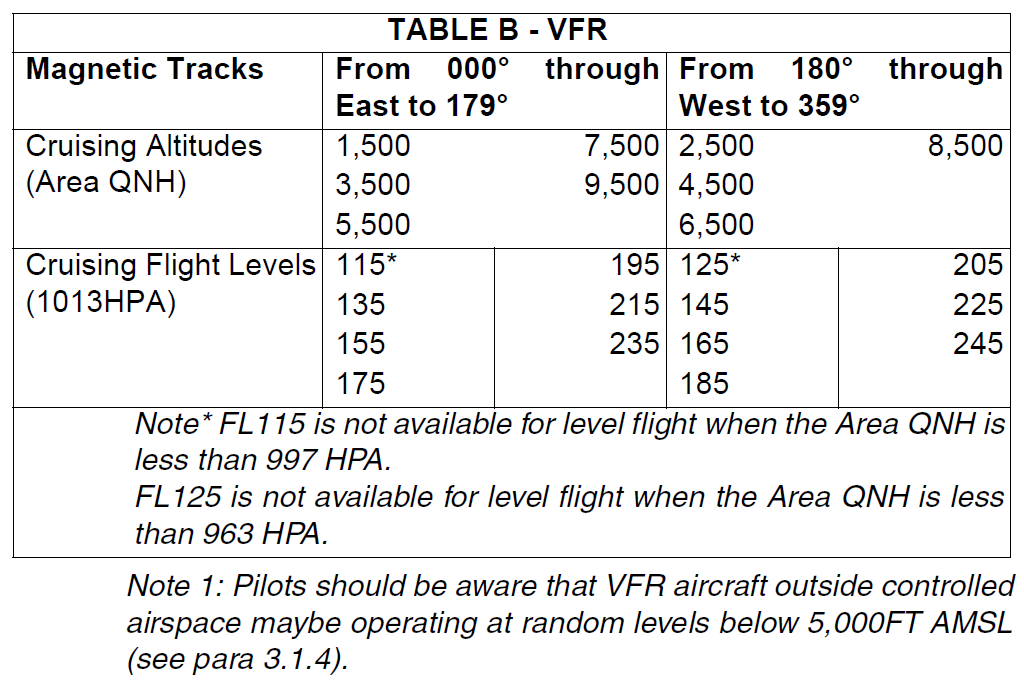
This occurrence highlights the importance of following the altitude requirements for VFR flight (see Figure 1) in uncontrolled airspace. This is especially significant when considering the limitations discussed in the ATSB research report Limitations of the See-and-Avoid Principle.

Figure 1: Table of VFR cruising levels

Table of VFR cruising levels.  Source: Aeronautical Information Publication Australia

Source: Aeronautical Information Publication Australia

It also highlights the importance of monitoring area frequency for potential traffic and that electronic aids can be used as a supplementary tool that may enhance maintaining situational awareness.

About this report

Decisions regarding whether to conduct an investigation, and the scope of an investigation, are based on many factors, including the level of safety benefit likely to be obtained from an investigation. For this occurrence, no investigation has been conducted and the ATSB did not verify the accuracy of the information. A brief description has been written using information supplied in the notification and any follow-up information in order to produce a short summary report, and allow for greater industry awareness of potential safety issues and possible safety actions.

__________

  1. Instrument flight rules (IFR): a set of regulations that permit the pilot to operate an aircraft in instrument meteorological conditions (IMC), which have much lower weather minimums than visual flight rules (VFR). Procedures and training are significantly more complex as a pilot must demonstrate competency in IMC conditions while controlling the aircraft solely by reference to instruments. IFR-capable aircraft have greater equipment and maintenance requirements.
  2. Visual flight rules (VFR): a set of regulations that permit a pilot to operate an aircraft only in weather conditions generally clear enough to allow the pilot to see where the aircraft is going.

Occurrence summary

Mode of transport Aviation
Occurrence ID AB-2018-010
Occurrence date 18/01/2018
Location 28 km SSW Bourke
State New South Wales
Occurrence class Incident
Aviation occurrence category Separation issue
Highest injury level None
Brief release date 28/03/2018

Aircraft details

Manufacturer Aero Commander
Model 500-U
Sector Piston
Operation type Private
Damage Nil

Aircraft details

Manufacturer Mooney Aircraft Corp
Model M20J
Sector Piston
Operation type Private
Damage Nil