Separation issue

Near collision on ground, Bankstown Airport, New South Wales, on 15 December 2005

Safety Action

As a result of this occurrence, the Civil Aviation Safety Authority (CASA) has advised the Australian Transport Safety Bureau that they intend to take the following actions:

CASA will consider whether that 'beep back' equipment should be mandated for all Common Air Traffic Advisory Frequency (CTAF) and CTAF (R) aerodromes and whether a full tower service when night circuit training is taking place should also be mandated, especially during ab-initio circuit training by solo students.

Factual Information

At approximately 2200 Eastern Daylight-saving Time on 15 December 2005, the pilot of a Piper PA-31-350 Chieftain aircraft, registered VH-HJS, was approaching Bankstown Airport to land on Runway 11.  Following touchdown, the pilot of the Chieftain noticed another aircraft on the right side of the runway and took avoiding action by manoeuvring to the left, off the runway sealed surface and on to the grass, to prevent a collision.  The pilot reported that the other aircraft appeared to have only a dim taillight on at the time.

Subsequently, the other aircraft was identified as a Piper PA-28-151 Cherokee aircraft, registered VH-LMY.  The pilot of the Cherokee had completed a number of night circuits at Bankstown and reported that he was taxiing on runway 11 following a full stop landing.

At the time of the incident, Bankstown Airport was operating as a Common Traffic Advisory Frequency (R) (CTAF - radio required to be carried and used).

The Australian Transport Safety Bureau reviewed the recorded frequency channels for the Bankstown CTAF (R).  The recordings indicated that the pilot of the Chieftain had broadcast his intentions on the Bankstown CTAF (R) during the approach. In addition, transmissions from other traffic and the Bankstown Aerodrome Frequency Response Unit (ARFU) were recorded.

The pilot of the Cherokee reported that he had listened to the information from the aerodrome Automatic Terminal Information Service (ATIS) prior to commencing circuits. During the circuit training, he reported that he had made all the normal transmissions on the Bankstown CTAF (R), but did not hear any transmissions from other aircraft or the Bankstown ARFU. However, there were no recorded transmissions from the pilot of the Cherokee on the Bankstown CTAF (R).

The owner of the Cherokee reported that the aircraft radio equipment functioned correctly with no unserviceability reported and that the aircraft was equipped with functional lights, including navigation, anti-collision and strobe lights.  The pilot of Cherokee reported that all lights were on at the time of the incident.

ATSB Comment

The investigation was unable to determine why the transmissions from the pilot of the Cherokee were not recorded on the Bankstown CTAF (R), but it is likely that that an inadvertent mis-selection of the radio was made at some time after the pilot listened to the Bankstown ATIS. The investigation was also unable to rationalise the difference in evidence from the pilots of each the aircraft regarding the aircraft lighting on the Cherokee.

Summary

At approximately 2200 Eastern Daylight-saving Time on 15 December 2005, the pilot of a Piper PA-31-350 Chieftain aircraft, registered VH-HJS, was approaching Bankstown Airport to land on Runway 11.  Following touchdown, the pilot of the Chieftain noticed another aircraft on the right side of the runway and took avoiding action by manoeuvring to the left, off the runway sealed surface and on to the grass, to prevent a collision.  The pilot of the Chieftain reported that the other aircraft appeared to have only a dim taillight on at the time.

Subsequently, the other aircraft was identified as a Piper PA-28-151 Cherokee aircraft, registered VH-LMY.  The pilot of the Cherokee had completed a number of night circuits at Bankstown and reported that he was taxiing on runway 11 following a full stop landing.

At the time of the incident, Bankstown Airport was operating as a Common Traffic Advisory Frequency (R) (CTAF - radio required to be carried and used).

The Australian Transport Safety Bureau reviewed the recorded frequency channels for the Bankstown CTAF (R).  The recordings indicated that the pilot of the Chieftain had broadcast his intentions on the Bankstown CTAF (R) during the approach. In addition, transmissions from other traffic and the Bankstown Aerodrome Frequency Response Unit (ARFU) were recorded.

However, there were no recorded transmissions from the pilot of the Cherokee on the Bankstown CTAF (R).

Occurrence summary

Investigation number 200506646
Occurrence date 15/12/2005
Location Bankstown Aerodrome
Report release date 31/08/2006
Report status Final
Investigation type Occurrence Investigation
Investigation status Completed
Mode of transport Aviation
Aviation occurrence category Separation issue
Occurrence class Incident
Highest injury level None

Aircraft details

Manufacturer Piper Aircraft Corp
Model PA-28
Registration VH-LMY
Serial number 28-7615407
Sector Piston
Operation type Private
Departure point Bankstown NSW
Destination Bankstown NSW
Damage Nil

Aircraft details

Manufacturer Piper Aircraft Corp
Model PA-31
Registration VH-HJS
Serial number 31-7652091
Sector Piston
Operation type Charter
Departure point Taree NSW
Destination Bankstown NSW
Damage Nil

Breakdown of separation, VH-LAX, Boeing 717-200, VH-PVX, Cessna A152

Safety Action

Australian Transport Safety Bureau

Previous recommendation history

On 7 June 2004, the Australian Transport Safety Bureau (ATSB) issued the following recommendation to Airservices Australia:

R20040063

The Australian Transport Safety Bureau recommends that Airservices Australia review the Manual of Air Traffic Services (MATS) amendment decision that removed the mandatory requirement to provide traffic information to aerodrome traffic.

On 23 July 2004, the ATSB received the following response from Airservices Australia:

This is agreed. A MATS amendment process has been initiated regarding the mandatory requirement to provide traffic information to aerodrome traffic. The current instruction is in contravention of the CASR Part 172 Manual of Standards (MOS) and is being rectified. This difference between the MATS and the Part 172 MOS was due to the MATS being amended and updated between the development and the implementation of the MOS.

The ATSB accepted the response and the recommendation remained on 'MONITOR' awaiting incorporation of the MATS amendment.

On 1 September 2005, Airservices Australia amended the MATS to completely remove the previously amended section 4.5.2.3 relating to the provision of aerodrome traffic information.

On 16 September 2005, the Civil Aviation Safety Regulation Part 172 Manual of Standards was amended, after agreement between CASA and Airservices Australia, to state:

When aircraft are operating visually as aerodrome traffic ATC must issue 1 or more of the following:

(a) clearances designed to maintain separation

(b) sequencing instructions

(c) relevant traffic information

On 15 September 2006, the ATSB classified the issue as 'CLOSED - NOT ACCEPTED'.

New recommendation

As a result of this, and other, investigations the Australian Transport Safety Bureau

considers that pilot situational awareness can be limited by controller actions and issues the following safety recommendation:

R20060018

The Australian Transport Safety Bureau recommends that Airservices Australia review guidance material and training for aerodrome controllers relating to the provision of relevant traffic information, to enhance pilot situational awareness.

Airservices Australia

Airservices Australia has advised that all mandated regional tower refresher training relating to Hobart tower, including a separation assurance module, has now been completed.

Airservices Australia has advised that they are addressing the issue of obtaining read-backs, when necessary, through controller education. The following article was published to all Airservices Australia tower staff in the February 2006 issue of 'Safety Talk' magazine.

Did the Pilot Really Understand?

A number of incidents have occurred in the circuit area when pilots have used a callsign to acknowledge an ATC instruction and then operated contrary to the instruction. eg.

  • An aircraft turned base after being instructed to maintain downwind or
  • An aircraft made a left circuit after being instructed to make a right circuit.

In both of the incidents above the pilot acknowledged the controllers instructions with only a callsign.

Read back requirements are clearly specified in MATS 6.1.13.1 (a-g). But have you really read the fine print?

The first sentence of paragraph 6.1.13.1 requires ATSO [air traffic services officers] to ensure that a correct read back of ATC clearances, instructions and information 'in sufficient detail' is obtained. The second sentence then prescribes the read back requirements for some very specific ATC voice transmission types such as route clearances, hold short instructions, assigned runway, direction of turn etc.

You are now probably wondering what 'read back in sufficient detail' means in relation to those instructions you give that are not covered by the seven types. A good rule of thumb is the more critical the clearance, instruction or information that is provided to the pilot then the more detailed should be the read back.

In the original incidents if instead of only a callsign, the pilot responses have been 'ABC Roger maintain downwind' or 'ABC right circuit' then there would have been an increased possibility that the pilot actually understood what the controller really intended. Remember; if you do not get a read back that confirms the required action, then ask for one 'ABC Confirm……'. It may be too late when you next see what the pilot has actually done.

Airservices Australia has advised that as a follow-up to this article they have developed a roving check and standardisation programme for regional towers. As part of the programme, check and standardisation officers place emphasis on the use of correct phraseology and read-back.

Instructor pilot

The instructor advised that he has adjusted his aviation and non-aviation work commitments to ensure that he is adequately rested prior to undertaking flying operations.

Analysis

Although there was no applicable minimum distance standard specified for visual separation, the controller was unable to maintain continuous visual separation between the 152 and the 717. The decision by the pilot of the 152 to turn directly onto the base leg of the circuit, and not continue on the downwind leg as instructed, contributed to the infringement of separation standards.

This analysis examines the development of the occurrence and highlights the safety issues that became evident as a result of the investigation.

The controller did not provide the pilots of the 152 or the crew of the 717 with traffic information, or a number in the landing sequence as required by the Manual of Air Traffic Services (MATS). The provision of traffic information was not mandatory and the MATS did not provide any guidance to controllers on the circumstances under which the provision of traffic information would be appropriate. While the controller had intended to provide this information to the pilot of the 152, he relied on a pilot report prior to turning base as a prompt, and this report was not received.

Without the timely provision of traffic or sequence information, the situational awareness of the pilots of both aircraft was reduced. They were effectively excluded from participating in the separation process as described in the Aeronautical Information Publication (AIP) and the MATS. Consequently, the pilots of the 152 were not aware of the broader consequences of their actions once they turned their aircraft onto the base leg. They simply did not recognise that a potential conflict between their aircraft and the 717 existed.

While the flight crew of the 717 was not provided with directed information by the controller, they had been monitoring the radio transmissions between the controller and the pilots of other aircraft in the area. That, together with active scanning of the circuit area for traffic using the traffic alert and collision avoidance system and visual observations, assisted in the resolution of the situation.

The MATS provided no guidance as to whether routinely issued sequencing and separation instructions, such as 'continue downwind', required a read-back. While it may be impractical for the controller to obtain a read-back for every circuit instruction, emphasis should be placed on obtaining a read-back of safety critical instructions. Had the controller requested a read-back of the instruction to continue downwind, and provided a reason for the action, the likelihood of any misunderstanding would have been significantly reduced.

The investigation could not establish whether any aspect of the occurrence sequence could be attributed to the effects of fatigue. However, due to the instructor's non-aviation working commitments, the possibility that fatigue contributed to the occurrence could not be discounted.

Factual Information

On 30 April 2005, at about 1033 Eastern Standard Time1, a Cessna Aircraft Company A152 (152) aircraft, registered VH-PVX, was being operated on circuit flying training at Hobart Airport, Tasmania. On board were a student pilot and an instructor. The pilot had been issued with a clearance by the aerodrome controller (controller) to conduct right circuits from runway 30 and to operate not above 1,000 ft above mean sea level.

At 1037, a Boeing Company 717-200 (717) aircraft registered VH-LAX, en route from Melbourne to Hobart, commenced the final leg of the Hobart runway 30 VOR2 instrument approach. The crew had been issued a clearance by the controller to conduct the final approach. The aircraft was being operated under the instrument flight rules. At about the same time, the controller instructed the pilot of the 152 to make a left orbit to enable the controller to visually separate the 152 with both the inbound 717 and another jet aircraft departing from runway 30. At that time the 152 was at the end of the downwind leg of the circuit.

At about 1039, the pilot of the 152 reported that the orbit was complete and the controller instructed the pilot to continue on the downwind leg and to report prior to turning on to the base leg. However, the pilot had not completed a full orbit but had 'rolled out' of the orbit after completing only a 270 degree turn, directly onto the base leg of the circuit. At that time the 717 was on the final approach leg of the circuit, 90 degrees to the left of the flight path of the 152 and converging.

At about 1041, when the pilots of both aircraft became aware of the potential conflict, the minimum horizontal distance between the two aircraft had reduced to between 400 and 500 m. The 717 was about 300 ft below the 152, and the pilots of both aircraft commenced avoiding action.

The Manual of Air Traffic Services (MATS) 4.5.1.1 stated that visual separation shall be achieved by the use of visual procedures, or by assigning visual separation responsibility to a pilot. The MATS did not specify any minimum distance requirement for the application of visual separation. As the controller was unable to continue to visually observe separation between the 152 and the 717, and had not assigned separation responsibility to the pilot of the 152, there was an infringement of separation standards.

The routine aerodrome weather report (METAR) for Hobart issued at 1030, recorded the cloud as few3 at 3,000 ft and broken at 5,000 ft with visibility greater than 10 km. The pilot in command of the 717 and the controller later reported that the cloud was scattered at 4,000 ft while the 152 instructor believed the cloud base to be broken at about 3,000 ft.

The 152 instructor reported that he had a total of about 270 flying hours including 15 to 20 hours as an instructor. He was relatively new to Hobart and worked about 5 to 10 hours a week flying. He also worked casually in another non-aviation position with shifts that finished late at night or in the early morning.

The instructor believed that his inexperience, together with the cockpit workload involved in instructing the student pilot and controlling the aeroplane in moderately difficult crosswind conditions, reduced his situational awareness. He reported that he was not aware of the 717 on final, and believed he would not have had any opportunity to observe the aircraft until it was established on the final approach because of the low cloud in the area.

The controller had extensive experience in the provision of aerodrome control services at Hobart, and reported that the workload at the time of the occurrence was both moderately busy and complex.

The controller reported that he was applying visual separation between the 152 and several other aircraft. The MATS specified that:

4.5.2.3When aircraft are operating visually as aerodrome traffic or in an Aerodrome Traffic Zone, ATC shall issue clearances designed to maintain separation; and/or sequencing instructions and/or relevant traffic information.
4.5.2.4Pilots shall be advised of their number in the landing sequence to assist in identification of traffic.
4.5.2.5The pilot will position the aircraft in such a manner that, while complying with ATC instructions, they maintain separation from other aircraft.

The requirement to provide traffic information was changed from 'mandatory (and)' to 'optional (and/or)' by Airservices Australia in April 2003. On 1 September 2005, Airservices Australia amended the MATS to completely remove the previously amended section 4.5.2.3 relating to the provision of aerodrome traffic information, with the concurrence of the Civil Aviation Safety Authority (CASA), to remove ambiguity over separation responsibilities in the aerodrome traffic zone.

On 16 September 2005, the Civil Aviation Safety Regulation Part 172 Manual of Standards was amended, after agreement between CASA and Airservices Australia, to state:

When aircraft are operating visually as aerodrome traffic ATC must issue 1 or more of the following:

(a) clearances designed to maintain separation

(b) sequencing instructions

(c) relevant traffic information

The issue of the provision of traffic information is subject to an Australian Transport Safety Bureau (ATSB) safety recommendation4 (see also Safety Actions section of this report).

The Aeronautical Information Publication (AIP) GEN 2.14.3 also specified that:

ATC will provide relevant traffic information to aerodrome traffic to enable pilots, while complying with ATC instructions, to maintain separation from other aircraft.

The controller reported that the initial orbit instruction given to the pilot of the 152 was to allow for the departure of another jet aircraft and his plan was for the 152 to then extend on a downwind leg until it was possible for the 152 to safely follow the 717 on final. He had intended to pass the pilot of the 152 a number in the landing sequence when the pilot reported prior to turning base. However, as this report was not received, the pilot was not provided with either a number in the sequence or traffic information.

AIP GEN 4.4.1 specified that 'pilots must transmit a correct read-back of ATC clearances, instructions and information which are transmitted by voice' and ensure 'sufficient detail is included to indicate compliance'. The MATS 6.1.13 specified that ATC 'shall ensure that a correct read-back in sufficient detail is obtained'.

Both documents indicated that only key elements relating to certain clearance items must be read back, including 'level instructions, direction of turn, heading and speed instructions'.

The pilot of the 152 did not read back the instruction to continue on the downwind leg, nor did the controller request the read-back. There was no specific requirement in either the AIP or the MATS for the read-back to be provided.

The controller later acknowledged that a sequence number and traffic information should have been provided to the pilot of the 152 and that he believed that a read-back of the downwind instruction would have been beneficial.

Airservices Australia had an annual refresher training program for tower controllers that detailed several mandatory and optional training modules. One mandated module relating to separation assurance was not available to the Hobart controllers at the time of the occurrence.

The 717 flight crew was not provided with traffic information by the controller, but reported that they had been monitoring the radio transmissions between the controller and other pilots. Additionally they had observed the 152, initially on the traffic alert and collision avoidance system (TCAS),5 then visually, before commencing avoiding action.

  1. The 24-hour clock is used in this report to describe the local time of day, Eastern Standard Time (EST), as particular events occurred. Eastern Standard Time was Coordinated Universal Time (UTC) + 10 hours.
  2. Very high frequency omnidirectional radio range.
  3. Cloud amounts are reported in oktas. An okta is a unit of sky area equal to one-eighth of total sky visible to the celestial horizon. Few = 1 to 2 oktas, scattered = 3 to 4 oktas, broken = 5 to 7 oktas and overcast = 8 oktas.
  4. ATSB occurrence investigation report 200205540 and associated safety recommendation R20040063 available at www.atsb.gov.au.
  5. TCAS is an independent onboard collision avoidance system. It is designed as a backup to the ATC system and the 'see and avoid' concept.

Summary

On 30 April 2005, the pilot of a Cessna Aircraft Company A152 (C152) aircraft was conducting circuit training at Hobart. The C152 was on the downwind leg of the circuit when the crew of a Boeing Company B717-200 (B717) aircraft commenced the final leg of an instrument approach to the same runway.

The Hobart aerodrome controller was applying visual separation standards and had instructed the pilot of the C152 to make an orbit, and then continue downwind, to separate the C152 from other aircraft. The C152 pilot did not complete a full orbit, but turned onto the base leg of the circuit when the B717 was on final approach. The minimum distance between the converging aircraft reduced to between 400 and 500 m horizontally and 300 ft vertically and required the pilots of both aircraft to commence avoiding action. There was an infringement of separation standards.

The pilot of the C152 did not read back the instruction to continue on the downwind leg to the controller, nor did the controller request this read-back. There was no specific requirement in published documents for the read-back to be provided.

The controller did not provide the pilot of the C152 or the B717 with traffic information, or a number in the landing sequence as required by published documents. This led to a reduction in the situational awareness of the pilots of both aircraft and excluded them from participating effectively in the separation process.

Airservices Australia has advised that they are addressing the issue of obtaining read-backs, when necessary, through controller education and have developed a roving check and standardisation programme for regional towers. As part of that programme, check and standardisation officers place emphasis on the use of correct phraseology and read-back.

The ATSB issued a safety recommendation to Airservices Australia to enhance pilot situational awareness.

Occurrence summary

Investigation number 200501921
Occurrence date 30/04/2005
Location Hobart, Aero.
State Tasmania
Report release date 03/10/2006
Report status Final
Investigation type Occurrence Investigation
Investigation status Completed
Mode of transport Aviation
Aviation occurrence category Separation issue
Occurrence class Incident
Highest injury level None

Aircraft details

Manufacturer The Boeing Company
Model 717
Registration VH-LAX
Serial number 55057
Sector Jet
Operation type Air Transport High Capacity
Departure point Melbourne, VIC
Destination Hobart, TAS
Damage Nil

Aircraft details

Manufacturer Cessna Aircraft Company
Model 152
Registration VH-PVX
Serial number A1520941
Sector Piston
Operation type Flying Training
Departure point Hobart, TAS
Destination Hobart, TAS
Damage Nil

Boeing Co 747-438, VH-OJI, 370 km SW Honolulu, (VOR), 16 January 2005

Summary

Information was provided to the ATSB indicating that there was a breakdown of separation between two Australian registered Boeing Company 747 aircraft, in international airspace under the control of Honolulu Centre, on 16 January 2005.

The ATSB commenced a category 4 investigation to determine if safety was compromised. The ATSB subsequently received advice from the US National Transportation Safety Board (NTSB) that the US Federal Aviation Administration (FAA) had investigated the circumstances of the report and found that appropriate separation standards, using radar control techniques, were applied at all times. There as no infringement of separation standards – the minimum longitudinal spacing between the aircraft was 47 NM.

Status: Downgraded the occurrence to category 5 and investigation discontinued.

Occurrence summary

Investigation number 200500155
Occurrence date 16/01/2004
Location 370 km SW Honolulu, (VOR)
State International
Report release date 19/01/2004
Report status Discontinued
Investigation type Occurrence Investigation
Investigation status Discontinued
Mode of transport Aviation
Aviation occurrence category Separation issue
Occurrence class Incident
Highest injury level None

Aircraft details

Manufacturer The Boeing Company
Model 747
Registration VH-OJI
Operation type Air Transport High Capacity
Damage Nil

Aircraft details

Manufacturer The Boeing Company
Model 747
Registration VH-OEB
Operation type Air Transport High Capacity
Damage Nil

Beech Aircraft Corp 58, VH-FDN

Safety Action

The report produced by Airservices Australia recommended that the office of the Head Air Traffic Controller review the MATS in regard to the feasibility of how ATC shall ensure that appropriate broadcasts have been made on frequencies not monitored by that ATC sector.

The report also recommended that the intent of the letter of agreement (LOA) with the operator be clarified and that they be reminded that the LOA does not absolve them from complying with the requirements of AIP ENR 5.5.

Airservices Australia reported that the office of the Head Air Traffic Controller will be assuring that these recommendations are actioned.

Summary

The Australian Transport Safety Bureau did not conduct an on-scene investigation of this occurrence. The report presented below was prepared principally from information supplied to the Bureau and includes information from an investigation report produced by Airservices Australia.

REPORTED INFORMATION

On 1 December 2004, at 1403 western standard time, a Beech Aircraft Corporation Baron was tracking from Jandakot, WA for Cunderdin, WA. The aircraft was being operated under the instrument flight rules (IFR) at 7,000 ft. At 1409, a Cessna Aircraft Company Caravan, operating under the visual flight rules (VFR), was climbing to 14,000 ft for a parachute jumping exercise (PJE) within 5 NM of Brooklands, WA. Both aircraft were operating within radar coverage and were radar identified.

The airspace in the Brooklands area was classified as class G (non-controlled) airspace from ground level to 8,500 ft, and class C (controlled) airspace from 8,500 ft to 18,000 ft.

At 1419, the controller managing the class G airspace provided the pilot of the Baron with traffic information on the Caravan as part of a radar information service (RIS). The pilot of the Baron became concerned that the pilot of the Caravan was unaware of the Barons proximity to the parachute drop area, and was unable to establish radio contact with the pilot of the Caravan to determine whether the parachute drop was imminent.

At 1420, the pilot of the Caravan requested a clearance to deploy the parachutists, and to descend. The controller who was managing the class C airspace provided the pilot of the Caravan with a clearance and radar derived traffic information on the location of the Baron. At that time, the Baron was 2 NM ahead of the Caravan and heading north-east.

At 1421, the pilot of the Baron established radio contact with the pilot of the Caravan and negotiated a delay in the parachute drop until the Baron was clear of the area.

The Aeronautical Information Publication (AIP) ENR 5.5 4 paragraphs 2.1.3 to 2.3.4, effective 25 Nov 2004, specified that not less than two minutes before parachutists exit an aircraft, the pilot must make a broadcast on all relevant frequencies for the airspace through which the parachutists may descend, including a broadcast on each frequency specified for controlled and uncontrolled airspace. The pilot must not allow parachutists to exit the aircraft unless these broadcasts have been made.

In addition to the requirements specified in the AIP, a letter of agreement (LOA), effective 25 Nov 2004, existed between Airservices Australia and the PJE operator, which detailed the radio frequencies and procedures for PJE operations in that area. This LOA required the pilot to broadcast, on the class G frequency, an intention to deploy the parachutists, approximately 4 minutes prior to the drop point.

The Manual of Air Traffic Services (MATS) section 4.6.1, specified that Air Traffic Control (ATC) shall not issue a clearance to a pilot to deploy parachutists before the broadcasts specified in the AIP have been made.

The pilot of the Caravan later stated that all required broadcasts had been completed. However, transcripts provided by Airservices Australia of the ATC voice recordings of the relevant frequencies contained no evidence that the pilot had made the required broadcasts on either of the class G or class C frequencies, in accordance with either the AIP or the LOA, prior to the intended parachute deployment.

The controller managing the class C airspace did not ensure that those broadcasts had been made, prior to issuing the pilot of the Caravan with a clearance to deploy the parachutists.

Occurrence summary

Investigation number 200404930
Occurrence date 01/12/2004
Location 74 km E Perth, Aero.
State Western Australia
Report release date 22/06/2005
Report status Final
Investigation type Occurrence Investigation
Investigation status Completed
Mode of transport Aviation
Aviation occurrence category Separation issue
Occurrence class Incident
Highest injury level None

Aircraft details

Manufacturer Beech Aircraft Corp
Model 58
Registration VH-FDN
Serial number TH-126
Sector Piston
Operation type Private
Departure point Jandakot, WA
Destination Jandakot, WA
Damage Nil

Aircraft details

Manufacturer Cessna Aircraft Company
Model 208
Registration VH-OAI
Serial number 20800093
Sector Turboprop
Operation type Sports Aviation
Departure point Brooklands, WA
Destination Brooklands, WA
Damage Nil

Robinson R22 Beta, VH-HSI

Summary

The Australian Transport Safety Bureau did not conduct an on-scene investigation of this occurrence. The report presented below was prepared principally from information supplied to the Bureau.

REPORTED INFORMATION

On 4 December 2004, at approximately 1407 western standard time, a Robinson Helicopter Company R22 (helicopter) became airborne from the helipad adjacent to runway 06 left (L)/24 right (R) at Jandakot Airport. The helicopter departed in a south-westerly direction parallel to runway 24 and continued on that track. The pilot reported that he planned to depart the Jandakot circuit area to the south-west of the airport at 1,000 ft. While the helicopter was climbing on that south-westerly track, a Cessna 172R (C172) became airborne off runway 24R at Jandakot. The Jandakot control zone was operating under the General Aviation Airport Procedures (GAAP) at the time of the occurrence.

The C172 pilot reported that he had planned to depart the Jandakot circuit area on a north-westerly track. That track required a right turn from runway 24R, across the track of the departing helicopter. When the two aircraft were at an altitude of approximately 600 ft, the pilot of the C172 reported to the Jandakot aerodrome controller (ADC) that he had a helicopter in sight to his right. The ADC advised the pilot of the C172 to pass behind the helicopter. The pilot of the C172 acknowledged that broadcast and commenced a right turn.

The Aeronautical Information Publication (AIP) ENR 1.1, 25.1.1 stated that:

A pilot must:

  1. sight and maintain separation from other aircraft whilst operating in a GAAP control zone;
  2. comply with ATC instructions while ensuring that separation is maintained from other aircraft;
  3. advise ATC immediately if unable to comply with a control instruction;
  4. advise ATC if unable to sight, or if sight lost of, other aircraft notified as traffic.

The AIP ENR 1.1, 26.1 stated that:

Traffic information shall be issued by ATC when:

  1. the pilot of one aircraft was required to give way to, follow, or otherwise adjust the aircrafts flight path relative to that flown by another aircraft.

The ADC did not pass traffic information to the pilot of the C172 when he cleared that aircraft for take-off, because he believed there would be sufficient spacing to allow the C172 to pass behind the helicopter.

The instructor pilot of the helicopter reported that the C172 was in his 10 oclock position at the same altitude when the C172 pilot requested a right turn. He also reported that once the C172 pilot commenced the right turn, both aircraft would have collided if he had not taken evasive action that involved a rapid descent and a steep turn.

The pilot of the C172 reported that the helicopter was in his 2 oclock position when he requested the right turn. He subsequently commenced the right turn because he considered that it was safe to do so. He believed he would pass behind, and well clear of, the helicopter.

The ATSB was unable to determine the proximity of the two aircraft from recorded radar data due to the radar coverage limitations in the Jandakot circuit area. Therefore, the ATSB was unable to resolve the difference between the recollections of the helicopter pilot and the C172 pilot.

Occurrence summary

Investigation number 200404815
Occurrence date 04/12/2004
Location Jandakot, Aero.
State Western Australia
Report release date 23/03/2005
Report status Final
Investigation type Occurrence Investigation
Investigation status Completed
Mode of transport Aviation
Aviation occurrence category Separation issue
Occurrence class Incident
Highest injury level None

Aircraft details

Manufacturer Robinson Helicopter Co
Model R22
Registration VH-HSI
Serial number 2496
Sector Helicopter
Operation type Flying Training
Departure point Jandakot, WA
Destination Jandakot, WA
Damage Nil

Aircraft details

Manufacturer Cessna Aircraft Company
Model 172
Registration VH-YXS
Serial number 17280882
Sector Piston
Operation type Flying Training
Departure point Jandakot, WA
Destination Unknown
Damage Nil

Piper PA-31-350, VH-LTW

Analysis

While the investigation was unable to establish the actual altitudes the aircraft were maintaining, due to the lack of radar coverage, both aircraft were reported to be at altitudes that would enable 500 ft spacing. However, even had that spacing been achieved, an unalerted aircraft suddenly appearing in a pilot's vision might be perceived to be closer than it actually is, leading an observer to think that there is a collision risk. It is also possible, given the error margins of altitude equipment on each aircraft, that the actual spacing may have been less than 500 ft.

It is possible that the pilot of the Shrike did not hear the Chieftain pilot's report because it was mixed with radio transmissions from other pilots on the frequency at the time. Given the reported altitude of the Chieftain of 7,000 ft and the Shrike's reported altitude of 6,500 ft, even if the Shrike pilot had heard that report there would have been no requirement for him to make a radio transmission and the situation would have remained unalerted for the Chieftain pilot.

Radio broadcasts can enhance a pilot's situational awareness when used in conjunction with maintaining a look out to see and avoid other aircraft. Flying in Class G airspace often involves the simultaneous monitoring of two radio frequencies, such as the area frequency and the MBZ frequency. If a radio transmission is not heard, a pilot has to rely on segregation from other aircraft through use of appropriate cruising altitudes and seeing other aircraft.

The limitations of see and avoid as a sole means to maintain awareness are well known (see ATSB website).

Factual information

On 31 August 2004, at about 1000 eastern standard time, the pilot of a Piper Aircraft Corporation PA-31 (Chieftain), registered VH-LTW, was conducting an instrument flight rules (IFR) flight from King Island to Devonport. The aircraft was maintaining 7,000 feet in visual meteorological conditions. The pilot saw an aircraft flying in the opposite direction passing between 100 ft and 200 ft, down the left of the Chieftain. He took immediate avoiding action. The pilot estimated that there was two to three seconds between initially seeing and then passing the other aircraft.

The other aircraft was later identified as an Aero Commander 500-S (Shrike), registered VH-LET, on a visual flight rules (VFR) flight at 6,500 feet from Launceston to King Island via overhead Devonport. The presence of the Shrike was established when the pilot of that aircraft advised the pilot of a third aircraft, that was east of King Island en route to Wynyard at 7,000 ft, of his position and altitude of 6,500 ft. The pilot of the third aircraft (tracking to Wynyard) had broadcast his intention to descend from 7,000 ft and that radio transmission alerted the Shrike pilot to a possible conflict. The pilots agreed to maintain their respective altitudes until the aircraft had passed. Neither the pilot nor the passenger in the Shrike saw the Chieftain.

At 1001, the Chieftain was 61 NM from Devonport and the pilot advised the controller of the occurrence and requested traffic information on any other aircraft in the area. The controller replied that there was no observed traffic [displayed on the radar].

Both pilots reported operating their aircraft transponders, including the Mode C altitude function, as required by the Aeronautical Information Publication (AIP) procedures. A review of the recorded air traffic control radar data confirmed that both aircraft were cruising at their reported altitudes about 20 minutes before they passed. However, the area where the aircraft passed was not within radar coverage and the investigation could not confirm the altitudes of the aircraft when they passed.

The Chieftain was fitted with two altimeters and the pilot reported that he had set both subscales to the area QNH and had engaged the autopilot. The Shrike was fitted with two altimeters and the pilot reported that he had set both subscales to either the local QNH or, when outside the mandatory broadcast zone (MBZ), the area QNH. The pilot had also engaged the auto-pilot. Both aircraft were maintained to IFR equipment requirements.

The AIP detailed altitudes to be used for aircraft on IFR/VFR flights in an easterly or westerly direction. The altitudes reported by the pilots were in accordance with the AIP.

Both aircraft were fitted with dual very high frequency radios. From about 0954, both pilots were simultaneously monitoring the Melbourne Centre area frequency on 122.6 MHz and the Devonport/Wynyard MBZ frequency on 126.9 MHz. At that time, the Chieftain pilot reported his Devonport estimate of 1020 to the Melbourne Centre controller. The pilot of the Shrike was monitoring Melbourne Centre on 122.6 MHz, but could not recall hearing the position report by the Chieftain pilot to Melbourne Centre. The pilot of the Shrike was not required to make any radio broadcasts. Also, pilots were not required to make any radio broadcasts when leaving an MBZ. A replay of the Melbourne Centre on 122.6 MHz revealed some interruptions by other pilots on that frequency.

Apart from the mandated broadcasts, the procedure in MBZ and Class G airspace is for pilots to listen on the appropriate frequency and to make a radio broadcast if there is the potential for aircraft to come into conflict.

In Class G airspace, air traffic control (ATC) provides traffic information to pilots of aircraft operating an IFR flight about other aircraft operating as IFR flights and military jet aircraft. Pilots operating a VFR flight may request traffic information from ATC, but it is provided subject to workload at the time. Pilots may make additional radio broadcasts at their discretion.

Neither aircraft was fitted with a traffic alert and collision avoidance system, nor was there any legislated requirement to do so.

Summary

On 31 August 2004, at about 1000 eastern standard time, the pilot of a Piper Aircraft Corporation PA-31 (Chieftain), registered VH-LTW, was conducting an instrument flight rules (IFR) flight from King Island to Devonport. The aircraft was maintaining 7,000 feet in visual meteorological conditions. The pilot saw an aircraft flying in the opposite direction passing between 100 ft and 200 ft, down the left of the Chieftain. He took immediate avoiding action. The pilot estimated that there was two to three seconds between initially seeing and then passing the other aircraft.

Occurrence summary

Investigation number 200403227
Occurrence date 31/08/2004
Location 113 km WNW Devonport, VOR
State Tasmania
Report release date 18/05/2005
Report status Final
Investigation type Occurrence Investigation
Investigation status Completed
Mode of transport Aviation
Aviation occurrence category Separation issue
Occurrence class Incident
Highest injury level None

Aircraft details

Manufacturer Piper Aircraft Corp
Model PA-31
Registration VH-LTW
Serial number 31-8152025
Sector Piston
Operation type Air Transport Low Capacity
Departure point King Island, TAS
Destination Devonport, TAS
Damage Nil

Aircraft details

Manufacturer Aero Commander
Model 500
Registration VH-LET
Serial number 3264
Sector Piston
Operation type Private
Departure point Launceston, TAS
Destination King Island, TAS
Damage Nil

de Havilland Canada DHC-8-102, VH-WZS

Safety Action

Dash 8 operator safety action

The Dash 8 operator has conducted a risk assessment in relation to their policy on the use of the company frequency during ground manoeuvring. All standard transmissions on company frequency are to be completed before the aircraft moves from the blocks before departure.

The Dash 8 operator's Procedures Review Group will further assess and modify procedures to minimise company frequency usage.

Saab operator safety action

The Saab operator reviewed procedures and issued two bulletins that amended the policy and procedures manual in relation to the use of the company frequency during ground manoeuvring. On departure, all radio communication with the company must be made prior to leaving the bay and on arrival radio communication with the company should only be made after contact with the SMC. The timing of any communications following arrival shall be such that all crew members are not distracted from monitoring SMC when approaching runways and taxiways where a clearance is usually required.

The next Flight Operations Safety meeting will consider the requirement for a policy on monitoring aircraft groundspeed while taxiing.

Analysis

The SMC did not anticipate the aircraft conflict. The night environment, lack of aircraft taxi lights and the distraction with entering system data may have limited his situational awareness despite the availability of the SMR. The use of a segmented or a conditional clearance to the pilots of either aircraft would have assured that the aircraft would not conflict. Alternatively, the SMC could have requested assistance to either enter the system data, or to monitor the taxiing aircraft visually or by using the SMR.

The situational awareness of all the pilots was reduced by the lack of specific traffic information on the other potentially conflicting aircraft. They did not see the other aircraft's taxi light as they carried out their standard lookout. Even if the other aircraft had been seen, it may have been interpreted as an aircraft holding, or even preparing to give way, because the taxi light was selected off.

Both aircraft were being taxied at speeds that limited either crews' ability to react to a conflict in a known busy area of the airport. In this instance a slower taxiing speed would have been appropriate. However, a limiting factor for both aircraft was the lack of a practical means to monitor or assess groundspeed, especially at night.

The SMC's use of the term 'expedite' and a perceived need to not delay taxiing, to assist both pilots and controllers, may have led the pilots of both aircraft to taxi faster than they might normally do. While high taxi speeds may be acceptable in some locations on the movement area, reduced taxi speeds are warranted in potential areas of conflict near runway exits, multiple crossing taxiways and apron access areas. The use of slower taxi speeds in those areas should assist pilots to more readily maintain separation from other taxiing aircraft while complying with air traffic control clearances.

The requirement for pilots to monitor the company frequency throughout the taxi period is a potential distraction for pilots, when the priority for their attention should be on operational duties. Procedures for non-operational radio usage could be better managed so as to have minimal impact on operational duties. This is particularly relevant in a busy taxiway environment like Sydney Airport. If the Dash 8 copilot had also been busy or distracted, a collision may have occurred.

Summary

On 2 July 2004, at about 1805 Eastern Standard Time, a de Havilland DHC-8-315 (Dash 8) was taxiing at Sydney Airport for a night departure on a scheduled fare-paying passenger flight to Williamtown, NSW. The Sydney Tower Surface Movement Controller (SMC) had issued a clearance for the crew of the Dash 8 to taxi from Domestic Terminal 1 to the holding point for runway 16 Left. The clearance was via taxiway Charlie, across runway 25 to Bravo 10.

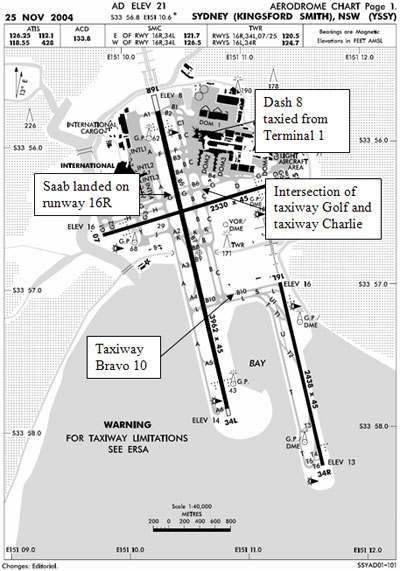
Figure 1: Sydney aerodrome chart

aair200402622_001.jpg

A Saab 340F (Saab) had landed on runway 16 Right and taxied from that runway via runway 25 then turned left onto taxiway Bravo. The SMC issued a clearance for the crew to taxi via taxiway Golf to the apron. The SMC had instructed the crew of the Saab to expedite. The dictionary definition of expedite means to 'speed up the progress of, or to hasten'. The Saab pilot in command (PIC) interpreted this instruction as to not waste any time and to keep the aircraft moving but at a safe speed.

As both aircraft were about to enter the intersection of taxiways Golf and Charlie (see figure 1), the copilot of the Dash 8, seated on the right of the cockpit, saw the Saab. He called for the PIC to stop. The PIC brought the Dash 8 to an abrupt stop as the Saab taxied through the intersection at a constant speed. Neither of the PICs saw the other aircraft until they had crossed at the intersection. The copilot of the Saab was busy with after-landing duties during the initial taxi period after vacating the runway. As the Saab taxied through the intersection he was occupied with a company frequency transmission on the radio and did not see the Dash 8 at any stage. The SMC was unaware of the situation until queried by the PIC of the Dash 8 regarding which aircraft had right of way.

A replay of the surface movement radar (SMR) of the occurrence showed that the taxi speed of the Saab was 26 knots. At 1800:08, the taxi speed of the Dash 8 was 21 knots. It then decelerated and stopped at 1800:11 with the Saab passing directly in front, moving from right to left. The SMR displayed the distance between the aircraft as 42 m. The impression of both PICs was that the aircraft passed in very close proximity.

Normally, pilots use a technique of scanning left and right to check for other aircraft that may conflict with them at intersections. Generally pilots on the left observe the left side and those on the right observe the right side. The standard procedure for the Saab operator was for pilots to survey the area to both the left and the right of the aircraft before entering or crossing any taxiway.

Neither operator had a policy or general guidance material in relation to aircraft taxi speeds, although the Saab operator did require turns in the aircraft to be 'at a speed below 20 kts'. Consequently, the speed at which aircraft were taxied varied between pilots.

Pilots recalled taxi speed limits from their training as 'fast walking pace' but agreed that this was impractical over the long distances involved at Sydney Airport. Neither the Civil Aviation Regulations (CARs) nor the Aeronautical Information Publication (AIP) nominate any specific aircraft taxi speed limits.

A groundspeed readout (utilising a Global Positioning System (GPS)) is available in the Dash 8, but its use is limited by its position on the lower pedestal in the cockpit. This makes it difficult for pilots to cross refer to it while taxiing and looking out for other taxiing aircraft. Similarly, a groundspeed readout is available in the Saab from either the lower pedestal or from the electronic horizontal situation indicator. In addition, a pilot's ability to estimate speed is more difficult at night due to the lack of visual cues used in judging the relative motion of the aircraft with other objects.

The Saab taxi light was unserviceable. The pilots' recollection of the event indicates that the Dash 8 taxi light was not illuminated. Some pilots turn taxi lights off while holding or passing close to other aircraft, to prevent a dazzling effect. The navigation lights and rotating beacons of both aircraft were operating. Both aircraft were backlit to some degree by the domestic terminal and suburban lighting on the far side of the airport.

The SMC was operating the SMC east and SMC west positions on combine. Immediately prior to the occurrence, the controller was endeavouring to manage the arrival and departure from the apron of four aircraft while updating radar system data. System updating included the assigning of labels to radar returns on the SMR for aircraft taxiing for departure. The controller was aware of the disposition of aircraft but his impression, at the time he issued the clearance to the crew of the Dash 8, was that the Saab would pass through the intersection before the Dash 8 would be near that intersection. Consequently, he did not provide traffic information on the other aircraft to either crew, nor did he assess that there was a need to use a segmented or a conditional clearance to either crew. A segmented clearance enables a crew to taxi and to stop at a possible point of conflict, while a conditional clearance enables a crew to taxi subject to specified requirements. In this situation, the Dash 8 crew could have been instructed to taxi and to hold short of the intersection of taxiways Charlie and Golf; or alternatively, to taxi to the runway, with a requirement to pass behind the Saab on taxiway Golf.

Even though crews receive and acknowledge clearances to taxi on the aerodrome manoeuvring areas, the CARs and AIP put the onus on the PIC to maintain a good lookout and observe other traffic to avoid collision.

Both airlines have a procedure where one or both of the pilots listen (and transmit as required) to the company frequency from taxi to just before take off and, from after landing till after shutdown at the parking bay. The Saab copilot was the only pilot reported to be operating a radio at the time of the occurrence.

Occurrence summary

Investigation number 200402622
Occurrence date 02/07/2004
Location Sydney, Aero.
State New South Wales
Report release date 26/04/2005
Report status Final
Investigation type Occurrence Investigation
Investigation status Completed
Mode of transport Aviation
Aviation occurrence category Separation issue
Occurrence class Incident
Highest injury level None

Aircraft details

Manufacturer De Havilland Canada/De Havilland Aircraft of Canada
Model DHC-8
Registration VH-WZS
Serial number 005
Sector Turboprop
Operation type Air Transport Low Capacity
Departure point Sydney, NSW
Destination Williamtown, NSW
Damage Nil

Aircraft details

Manufacturer Saab Aircraft Co.
Model 340
Registration VH-RXE
Sector Turboprop
Operation type Air Transport Low Capacity
Departure point Dubbo, NSW
Destination Sydney, NSW
Damage Nil

de Havilland Canada DHC-8-102, VH-TQQ

Summary

The de Havilland DHC-8 (Dash 8) aircraft, registered VH-TQQ, departed Mildura, Victoria, and was within the mandatory broadcast zone (MBZ), on climb to its cruising level, when it came into conflict with a Cessna Aircraft Company 150G (Cessna) aircraft, registered VH-KXF.

The Australian Transport Safety Bureau did not conduct an on-scene investigation of this occurrence.

Occurrence summary

Investigation number 200401411
Occurrence date 19/04/2004
Location 13 km SE Mildura, Aero.
State Victoria
Report release date 17/12/2004
Report status Final
Investigation type Occurrence Investigation
Investigation status Completed
Mode of transport Aviation
Aviation occurrence category Separation issue
Occurrence class Incident
Highest injury level None

Aircraft details

Manufacturer De Havilland Canada/De Havilland Aircraft of Canada
Model DHC-8
Registration VH-TQQ
Serial number 204
Sector Turboprop
Operation type Air Transport Low Capacity
Departure point Mildura, VIC
Destination Melbourne, VIC
Damage Nil

Aircraft details

Manufacturer Cessna Aircraft Company
Model 150
Registration VH-KXF
Serial number 15066535
Operation type Flying Training
Departure point Swan Hill, VIC
Destination Kulinine, VIC
Damage Nil

Boeing 737-7BX, VH-VBT and Lancair IV-P, VH-LDJ, 93 km north-west of Brisbane Airport, Queensland, on 7 April 2004

Safety Action

As a result of this and other occurrences, Airservices Australia has:

  • issued National Instruction NI 09/2004, Safety Alerts, Traffic Avoidance Advice and Traffic Information;
  • issued to all holders of the Aeronautical Information Publication, Aeronautical Information Circular H10/04, Traffic Information - Safety Alerts, dated 2 Sep 04;
  • produced a computer-based training program for ATS controllers on duty of care, which provides guidance on when a safety alert is required to be initiated.

Related Documents: | Media Release |

Analysis

Throughout this analysis it should be noted that the pilots of both aircraft and the ATS controller involved in the occurrence complied with the rules and procedures for operation in Class E airspace associated with the NAS phase 2b, implemented on 27 November 2003.

The regulations, procedures and educational material associated with that implementation stated that there was a shared responsibility by pilots of IFR and VFR flights to see-and-avoid each other in Class E airspace.

Prior to the implementation of NAS phase 2b on 27 November 2003, both aircraft involved in this occurrence would have been operating in Class C airspace. As such, they would have been subject to an ATS airways clearance and would have been provided with separation in accordance with Class C airspace rules and procedures. In order for two aircraft to pass in close proximity at these flight levels in Class C airspace, those rules and procedures would need to have been compromised. As the pilots of both aircraft and the ATS controller complied with the rules and procedures for Class E airspace under NAS, those rules and procedures do not preclude an IFR high performance, high-capacity regular public transport aircraft from passing within such close proximity as to generate a TCAS RA on either known or unknown VFR traffic.

The controller's relatively low workload and other factors, such as the Lancair pilot submitting flight notification details, and broadcasting his departure from Maroochydore, assisted the ATS controller to detect a possible conflict. Although there was no requirement for the controller to pass traffic information to the pilot of the Lancair about the location of the 737 under NAS Class E airspace procedures, the controller provided traffic information to both aircraft with respect to each other.

Part 5 of MATS also stated that controllers shall issue a safety alert when, in the consideration of the controller, such an advice was warranted to avoid conflict. In the circumstances of this occurrence, the controller had provided traffic information to the crews of both aircraft, and the Lancair pilot had broadcast that he had the 737 in sight. Accordingly, the onus was then on the Lancair pilot to avoid the 737. In those circumstances, the provision of a safety alert, which may have included a suggested course of action, may also have complicated the situation, if that suggestion was contrary to what the pilots of each aircraft considered necessary.

Provision of a safety alert, in the circumstances of this occurrence, was not required. However, MATS did not provide any guidance to controllers on the circumstances under which the provision of a safety alert would be appropriate. Publication of those guidelines may assist controllers to determine when a safety alert should be issued.

In Class E airspace, the provisions of CAR 163A required the crews of both aircraft to 'see and avoid' each other. The 737 crew were unable to see the Lancair despite their attempts to do so. The Lancair pilot reported that he had the 737 in sight. When the 737 crew observed the position of the Lancair on the TCAS navigation display, they commenced action to avoid a confliction prior to receipt of both the TCAS TA and RA. In concert with that action, they continued in their attempts to visually acquire the Lancair, in accordance with Class E airspace see-and-avoid requirements.

In the circumstances of this occurrence:

  • the ATS controller took more actions than those required by the published requirements for Class E airspace and MATS;
  • the Lancair pilot took more actions than those required by the published procedures for Class E airspace under NAS;
  • the early action taken by the 737 crew to avoid the conflict was not contrary to the published procedures for Class E airspace under NAS.

Despite those actions, the two aircraft came into such proximity that a TCAS RA was generated in the 737.

Both aircraft were operating in Class E airspace that was introduced as part of the National Airspace System (NAS) phase 2b on 27 November 2003. (An ATSB research report titled National Airspace System Stage 2b: Analysis of Available Data was released in July 2004.) As no prescribed separation standards are applicable in these circumstances, there was no infringement of separation standards. However, ATS audio tapes, radar and TCAS data, and information obtained from the air traffic controller and the pilots of both aircraft were consistent and indicate that the aircraft came into such close proximity that a threat to the safety of the aircraft may have existed. Therefore, the incident has been classified by the ATSB as an airprox event.

The incident at Canty IFR reporting point, on 3 December 2003 (ATSB report 200304963) was also classified as an airprox event.

Unlike this incident north of Brisbane on 7 April 2004 and the Canty incident, the occurrence near Launceston on 24 December 2003 (ATSB report 200305235) was classified as a serious incident due to the lack of radar coverage in the Launceston area and the absence of radio broadcasts from the pilot of the Tobago, which created an unalerted see-and-avoid environment for the crew of the Boeing 737. The air traffic controller also was unaware of the Tobago.

Summary

On 7 April 2004, a Boeing 737-7BX (737) aircraft registered VH-VBT, operating under the instrument flight rules (IFR), was en route from Townsville and descending for a landing at Brisbane. A Neico Lancair IV-P aircraft registered VH-LDJ, operating under the visual flight rules (VFR), was en route from Maroochydore to St George, on climb to flight level (FL) 1651. Both aircraft were operating in radar Class E airspace at the time of the occurrence.

The Lancair pilot reported to the Air Traffic Services (ATS) controller that he had departed Maroochydore at 0718 Eastern Standard Time2, although in accordance with the National Airspace System (NAS) procedures, there was no requirement for him to do so3. The controller issued the Lancair pilot with a discrete transponder code to assist with his situational awareness. Published NAS procedures stated that:

In Class E airspace, IFR and VFR flights are permitted. IFR flights are provided with an air traffic control service, are separated from other IFR flights, and receive traffic information on VFR flights as far as is practicable. VFR flights receive a Radar Information Service (RIS)4 on request.5

Those procedures also stated that, for VFR aircraft operating in Class E airspace, '…no flight notification was required…' and pilots of aircraft conducting operations under the VFR were required to monitor the appropriate radio frequency. The Lancair pilot submitted flight notification details to ATS prior to departure from Maroochydore, and reported that departure to ATS.

In accordance with those procedures, the controller was not providing traffic separation6 to either aircraft, and advised the 737 crew accordingly. Recorded ATS audio information showed that the controller provided traffic information about the Lancair to the 737 crew on three occasions between 0721:58 and 0725:08. At 0722:17, and again at 0725:38, the controller provided the Lancair pilot with traffic information about the 737, although there was no requirement for him to do so in Class E airspace. During the first transmission at 0722:17, the controller advised the Lancair pilot that the 737 was crossing traffic which would pass in about 15 NM and was on descent into Brisbane. During the second transmission at 0725:38, the controller advised the Lancair pilot that the 737 was 'in your 2 o'clock at 8 miles now'. ATS radar data showed that, at 0725:38, the 737 was 8.8 NM from the Lancair. At 0725:47, in response to that broadcast, the Lancair pilot advised the controller that he had the 737 in sight.

As the 737 was passing through about FL157 at 0726:01, the crew reported that they observed a traffic alert and collision avoidance system (TCAS)7 traffic symbol on the aircraft's navigation display, about the Lancair. They attempted to visually acquire the Lancair, but were unable to see that aircraft. Recorded data from the 737's flight data recorder (FDR) showed that, at that point, the crew commenced manoeuvring the aircraft by reducing the rate of descent. At about 0726:18, the crew received a TCAS traffic advisory (TA)8. The crew reported that they were still unable to visually acquire the Lancair and were uncertain of its relative position. Recorded FDR data indicated that at 0726:34, the crew disengaged the autopilot and commenced a right turn away from the Lancair. They subsequently levelled the 737 at FL153 and then climbed to FL154. At 0726:40 and at 15,420 ft the 737 received a TCAS resolution advisory (RA)9 aural warning instructing them to climb, in response to the proximity of the Lancair. They subsequently climbed the 737 to FL166 and continued the turn to about 15 degrees right of track. The duration of the RA was 10 seconds and commenced when the Lancair was about 650 ft vertically lower and about 0.7 NM to the left of the 737.10 Recorded ATS radar data showed that, at about 0726:45, the Lancair altered track 8 degrees to the right away from the 737, just before passing behind and below the 737. The Lancair pilot reported that he did not experience the effect of wake turbulence from the 737. The minimum distance between the two aircraft was about 600 ft vertically at about 0.3 NM laterally.11

The Class E airspace in which the 737 and the Lancair were operating at the time of the occurrence was introduced as part of NAS phase 2b on 27 November 2003. Prior to NAS phase 2b, that volume of airspace was classified as Class C airspace. In Class C airspace, both aircraft would have been subject to an ATS airways clearance and would have been separated in accordance with prescribed standards.

In Class E airspace, the pilots of aircraft operating under the IFR and VFR were required to:

…maintain vigilance so as to see, and avoid other aircraft.12

The NAS Implementation Group reference guide, distributed as part of the NAS phase 2b implementation, stated that:

The other important change is that the pilot of a VFR flight should not make broadcasts on ATC frequencies.13

It also stated that:

Pilots of VFR flights may monitor the ATC frequency to enhance situational awareness.

Please do not make broadcast transmissions or engage in chatter on an ATC frequency. The safety of others depends on you not doing this.

Pilots are not precluded from responding to any ATC or pilot transmission when they believe their safety is at risk from another aircraft.

Part 2, Section 2, paragraph 2.2.4.1 of the Manual of Air Traffic Services (MATS) stated that:

Before providing a radar service to an aircraft, radar identification shall be established.

Although the controller did not advise the Lancair pilot that the Lancair was radar identified, the controller issued a discrete transponder code to the Lancair pilot and radar-identified the aircraft before providing a Radar Information Service to the pilot.

Part 4, Section 1, paragraph 4.1.1.1 of MATS contained information regarding ATS controller responsibilities for providing aircraft separation. The manual stated that:

Separation shall be provided by ATC using approved separation standards and procedures.

In the circumstances of this occurrence, the ATS controller was not required to provide separation to either aircraft in respect of the other and there were no separation standards applicable in these circumstances in Class E airspace.

Part 4, Section 1, paragraph 4.1.1.3 of MATS stated that:

Nothing in this chapter precludes a controller from using discretion and initiative in any particular circumstance where these procedures appear to be in conflict with the requirement to promote the safe conduct of flight.

In the circumstances of this occurrence, the ATS controller provided traffic information to the crews of both aircraft in respect of the other, although under NAS procedures there was no requirement for him to provide traffic information to the pilot of the Lancair on the location of the 737.

Part 5, Section 1, paragraph 5.1.13 of MATS provided information regarding provision of safety alerts. Paragraph 5.1.13.1 stated that:

A safety alert shall be issued to an aircraft when a controller is aware the aircraft is in a situation which is considered to place it in unsafe proximity to terrain, obstructions, or other aircraft.

The controller reported that, once the Lancair pilot broadcast that he had the 737 in sight, there was no necessity to broadcast a safety alert to either the Lancair pilot or the 737 crew. The controller also reported that if that pilot had not broadcast that he had the 737 in sight, his next option was to issue a safety alert. MATS did not provide any guidance to controllers on what might be considered '…unsafe proximity…', or when to issue a safety alert.

The NAS Implementation Group reference guide contained information for VFR pilots regarding separation from other aircraft when operating in Class E airspace. Page 16 of that guide stated that:

When you are flying in Class E airspace you are responsible for separation from other aircraft. The onus is on you to look out and see and avoid other aircraft.

Part 12, The Rules of the Air, Division 1, of the Civil Aviation Regulations (CAR) 1988, contained information regarding right of way, prevention of collision, operating near other aircraft and responsibilities of flight crew to see and avoid aircraft. More specifically, CAR 161 contained information regarding right of way and stated that:

(1) An aircraft that is required by the rules in this Division to keep out of the way of another aircraft shall avoid passing over or under the other, or crossing ahead of it, unless passing well clear.14

(2) The pilot in command of an aircraft that has the right of way must maintain its heading and speed, but nothing in the rules in this Division shall relieve the pilot in command of an aircraft from the responsibility of taking such action as will best avert collision.

CAR 162 (1) contained information regarding prevention of collision and stated that:

When 2 aircraft are on converging headings at approximately the same height, the aircraft that has the other on its right shall give way…

Although not specifically referring to converging aircraft, CAR 162 also stated that '…each shall alter its heading to the right…', and when referring to the aircraft other than the aircraft having right of way, '…shall keep out of the way of the other aircraft by altering its heading to the right…'.


CAR 163 (1) contained information regarding operating near other aircraft and stated that:

The pilot in command of an aircraft must not fly the aircraft so close to another aircraft as to create a collision hazard.

The 737 was on the Lancair's right and, in accordance with CAR 161 and CAR 162 (1), had right of way. The Lancair pilot reported that he had the 737 in sight. While the crew of the 737 had observed a traffic symbol on the TCAS display, they reported that they did not see the Lancair, despite attempts to do so.

Information obtained from the crews of both aircraft, the ATS controller, recorded flight data from the 737, ATS audio recordings and radar data, was consistent and indicated that the crews of both aircraft and the ATS controller complied with the published procedures for Class E airspace under NAS.

Based on the factual data, and the definition contained in Regulation 2.2 of the Transport Safety Investigation Regulations 2003, the incident was classified as an airprox event.15

1 16,500 ft with an altimeter pressure sub-scale setting (QNH) of 1013.2 hPa.
2 The 24-hour clock is used in this report to describe the local time of day, Eastern Standard Time (EST), as particular events occurred. Eastern Standard Time was Coordinated Universal Time (UTC) + 10 hours.
3 Aeronautical Information Publication (AIP), ENR 1.1, Sections 3.4 and 18.3.2.
4 Radar Information Service (RIS) is defined in Part 10, Section 1 of the Manual of Air Traffic Services as:

An add-on ATC service within radar coverage, which provides information to flights, not otherwise receiving a separation service, in order to improve situational awareness, and assist pilots in avoiding collisions with other aircraft.


5 AIP, ENR 1.4, Section 2.1.4 and pages 12-13 and 40 of the NAS Implementation Group Reference Guide - How to Operate in the National Airspace System, effective from 27 Nov 2003.
6 Separation is defined in Part 10, Section 1 of the Manual of Air Traffic Services as:

A controlled condition using defined standards to prevent collisions between aircraft.

7 The Boeing 737-NG Operations Manual, Volume 2, states that:
 

TCAS alerts the crew to possible conflicting traffic. TCAS interrogates operating transponders in other airplanes, tracks the other airplanes by analysing the transponder replies, and predicts the flight paths and positions. TCAS provides advisory, flight path guidance, and traffic displays of the other airplanes to the flight crew. Neither advisory, guidance, nor traffic display is provided for other airplanes which do not have operating transponders. TCAS operation is independent of ground-based air traffic control.

8 A traffic advisory (TA) is generated when the other aircraft is approximately 40 seconds from the point of closest approach, dependent upon aircraft altitude.
9 If the other aircraft continues to close, a resolution advisory (RA) is generated when the other aircraft is approximately 25 seconds from the point of closest approach, dependent upon aircraft altitude. The RA provides aural warning and guidance as well as manoeuvre guidance to maintain or increase separation from the traffic.
10 The recorded ATS radar data and the 737 flight recorder data was consistent. However, the accuracy of that information is dependent upon the tolerances associated with both aircraft altimeters and the ATS radar equipment.
11 The horizontal distance was determined using the radar positions that were recorded every 5 seconds. By interpolating between those points to derive a position every second, the minimum horizontal separation was 0.3 NM, dependent upon the tolerances previously mentioned.
12 Civil Aviation Regulations 1988, 163A - Responsibility of flight crew to see and avoid aircraft.
13 Page 8 of the NAS Implementation Group Reference Guide - How to Operate in the National Airspace System, effective from 27 Nov 2003.
14 The investigation was unable to locate a CAR definition of '…well clear…'.
15 An airprox event is defined in Regulation 2.2 of the Transport Safety Investigation Regulations 2003, as:

…an occurrence in which 2 or more aircraft come into such close proximity that a threat to the safety of the aircraft exists or may exist, in airspace where the aircraft are not subject to an air traffic separation standard or where separation is a pilot responsibility.

Occurrence summary

Investigation number 200401273
Occurrence date 07/04/2004
Location 93 km NW Brisbane, Airport
State Queensland
Report release date 21/10/2004
Report status Final
Investigation type Occurrence Investigation
Investigation status Completed
Mode of transport Aviation
Aviation occurrence category Separation issue
Occurrence class Incident
Highest injury level None

Aircraft details

Manufacturer The Boeing Company
Model 737
Registration VH-VBT
Sector Jet
Operation type Air Transport High Capacity
Departure point Townsville, QLD
Destination Brisbane, QLD
Damage Nil

Aircraft details

Manufacturer Neico Aviation Inc
Model Lancair IV-P
Registration VH-LDJ
Serial number 138
Sector Piston
Operation type Private
Departure point Maroochydore, QLD
Destination St George, QLD
Damage Nil

Cessna 421B, VH-AAI

Analysis

When the pilot of the C421 requested the change to IFR, both pilots were still responsible for seeing and avoiding the other aircraft until the controller could establish a separation standard. The controller issued the pilot of the C421 with a radar heading, even though the C421, as an aircraft operating under the VFR in Class E airspace, was not subject to radar control and was not provided with an airways clearance. The AIP stated that the only radar services available to aircraft operating under the VFR within radar coverage in Class E airspace, were traffic information about other radar observed traffic on request, position information, and navigation assistance. It would have been difficult for the pilot of the C421 to assume responsibility for separation with the 737 while being radar vectored by ATC. However, the controller had issued instructions that had been acknowledged by the 737 crew, that established a 500 ft buffer between the two aircraft. The 737 crew had identified the C421 on their TCAS display and saw it during this period. A third aircraft, a Raytheon Beechcraft King Air 200, was part of the air traffic control sequence, but was not a factor in the reported occurrence.

Prior to the 27 November changes, both aircraft would have required an airways clearance and would have been provided with a separation standard. In this occurrence, all aircraft were in Class E airspace and there was no prescribed separation standard applicable, therefore there was no infringement of separation standards.

The circumstances of this occurrence constituted a non-serious airprox occurrence.

Summary

A Boeing 737-8FE (737) operating under the instrument flight rules (IFR) was en route from Coolangatta and descending for a landing at Melbourne. A Cessna Aircraft Company 421B (C421) operating under the visual flight rules (VFR) was en route from Moorook, South Australia, to Essendon, Victoria, at flight level (FL) 175. As the 737 was descending through FL206, the controller instructed the crew of the 737 to maintain FL180. A short time later the crew of the 737 received a resolution advisory from their traffic alert and collision avoidance system (TCAS) about the C421. Because the crew of the 737 had the C421 in sight, they chose to maintain visual separation rather than follow the TCAS RA. That action was in accordance with company policy. Based on analysis of recorded radar data, the vertical spacing between the 737 and the C421 was 400 ft when there was approximately 1.5 NM laterally between the two aircraft. The minimum vertical spacing reached was 300 ft when there was 2.74 NM between the two aircraft.

The C421 was in Class E airspace and the 737 entered Class E airspace on reaching FL180. There was no prescribed separation standard applicable in these circumstances, therefore there was no infringement of separation standards. While the ATSB initially assessed that this was not an airprox, a subsequent review of evidence against the definition of airprox has determined that although not considered serious, this was an airprox occurrence. In Class E airspace, pilots operating aircraft under IFR and VFR are required to maintain vigilance so as to see, and avoid, other aircraft (Civil Aviation Regulation. 163A).

A third aircraft, a Raytheon Beechcraft King Air 200, was part of the air traffic control sequence, but was not a factor in the reported occurrence.

FACTUAL INFORMATION

At 22:57:33 Co-ordinated universal time (09:57:33 ESuT), the pilot of the C421 contacted Melbourne air traffic control and requested an airways clearance. Although the pilot did not require an airways clearance in Class E airspace while operating under the VFR, the pilot intended to enter Class C airspace en route to Essendon. All aircraft require an airways clearance from ATC to operate in Class C airspace. About 10 seconds after the pilot of the C421 contacted ATC, the 737 crew made their first contact with the same controller. The 737 was descending from FL400. The controller acknowledged both calls and authorised the 737 crew to descend their aircraft to 8,000 ft.

At 22:58:17 the controller obtained flight details from the pilot of the C421 and identified the aircraft on his air situation display (ASD). The C421 was transmitting a transponder mode A, code 1200. The controller was not receiving any altitude information from the aircraft's transponder. Under NAS phase 2b introduced on 27 November 2003, the carriage and activation of a serviceable transponder was mandatory in Class E airspace and pilots were required to activate the altitude function (mode C) unless in receipt of a general exemption. The pilot of the C421 was unaware that his aircraft's transponder was not transmitting mode C altitude information and at 22:59:10 the controller informed the pilot. The pilot of the C421 subsequently reselected mode C and the altitude was then displayed to the controller on the ASD. Analysis of the recorded radar data showed that, at that time, the 737 was approximately 51 NM laterally and 20,870 ft vertically from the C421.

The 737 was equipped with a serviceable TCAS. That system was capable of determining the range, bearing and relative altitude of another aircraft transmitting mode 'A' and altitude information from the transponder of the other aircraft once that other aircraft came within encoding range of the TCAS. At 22:59:10, when the C421 began transmitting altitude information, it was not within range of the TCAS on board the 737. The operator advised that the TCAS fitted to this aircraft detects targets but does not display them until within 2,700 feet vertically of their aircraft unless the system calculates that the aircraft are on a collision course. The crew of the 737 were aware of the C421 because they heard the controller provide information about the location of the C421 to the pilot of another aircraft. As a result of that information, the crew of the 737 reduced their rate of descent from 3,000 ft/min to 1,000 ft/min until they could acquire the C421 either visually or on the TCAS display in their cockpit.

At 23:03:41, when there was approximately 18 NM and 7,800 ft between the 737 and the C421, the controller provided traffic information about the location of the C421 to the crew of the 737, relative to a tracking point that was common to the routes being flown by both aircraft. The crew of the 737 acknowledged that traffic information. They later reported that they did not have the C421 in sight at that time. At 23:04:14, when the two aircraft were approximately 14 NM and 6,100 ft apart, the controller passed traffic information on the location of the 737 to the pilot of the C421.

The controller became concerned that a collision risk could exist between the 737 and the C421 if the 737 continued descent through FL175 to 8,000 ft. At 23:05:23 the controller instructed the crew of the 737 to maintain FL180, even though there was no requirement to intervene. At that time there was approximately 7 NM and 3,100 ft between the two aircraft. When there was approximately 5 NM between the aircraft, the crew of the 737 identified the C421 on their TCAS and subsequently saw the aircraft.

Controller discretion to intervene was authorised under section 4.1.1.3 of the Manual of Air Traffic Services (MATS) which stated that 'Nothing in this chapter precludes a controller from using discretion and initiative in any particular circumstance where these procedures appear to be in conflict with the requirement to promote the safe conduct of flight'. That discretion was also authorised in the MATS prior to NAS phase 2b implementation.

The pilot of the C421 had intended to continue operating under the VFR to Essendon. However, due to weather in the Melbourne terminal area, the controller advised the pilot that an airways clearance to Essendon would not be available unless he could operate under the IFR. The pilot then advised the controller that he was upgrading to IFR.

At 23:06:05 the controller instructed the pilot of the C421 to turn right onto a heading of 270 degrees to facilitate the provision of an IFR clearance. At 23:06:36, after the C421 had commenced the right turn, the crew of the 737 reported to ATC that they had the C421 in sight. The pilot of the C421 later reported that he never saw the 737. At 23:07:06, the crew of the 737 reported to ATC that they had received a resolution advisory on their TCAS on the C421 as it passed in front of, and beneath their aircraft, that they were clear of the C421, and were requesting further descent. The controller subsequently issued a clearance to the crew of the 737 to descend to 8,000 ft. At 23:11:47, the controller confirmed with the pilot of the C421 that he was now operating under the IFR. The controller then issued the pilot of the C421 with an airways clearance and subsequently became responsible for the provision of separation between the 737 and the C421.

Prior to NAS phase 2b, the airspace in which the 737 and the C421 were operating at the time of the occurrence was classified as Class C airspace. In Class C airspace, both aircraft would have been subject to an ATC airways clearance and would have been separated in accordance with prescribed standards.

Under NAS, IFR aircraft are provided with an ATC service for separation with other aircraft operating under the IFR. ATC also provides information on the location of other aircraft operating under the VFR unless it is impractical to do so. A change from operations under the VFR to operations under the IFR in Class E airspace results in ATC ultimately assuming responsibility to provide separation between aircraft operating under the IFR. However, the pilot of an aircraft changing to IFR is responsible for separation with all advised traffic, until an alternative ATC separation standard exists.

Occurrence summary

Investigation number 200304963
Occurrence date 03/12/2003
Location Canty, (IFR)
State Victoria
Report release date 18/12/2003
Report status Final
Investigation type Occurrence Investigation
Investigation status Completed
Mode of transport Aviation
Aviation occurrence category Separation issue
Occurrence class Incident
Highest injury level None

Aircraft details

Manufacturer Cessna Aircraft Company
Model 421
Registration VH-AAI
Serial number 421B0301
Sector Piston
Operation type Business
Departure point Moorook, SA
Destination Essendon, VIC
Damage Nil

Aircraft details

Manufacturer The Boeing Company
Model 737
Registration VH-VOP
Serial number 33797
Sector Jet
Operation type Air Transport High Capacity
Departure point Coolangatta, QLD
Destination Melbourne, VIC
Damage Nil