The pilot of VH-LQA was conducting a practice ILS approach for runway 23 at Adelaide Airport. Approaching the localizer (LLZ) at 3000ft air traffic control (ATC) instructed him to enter a holding pattern between 28 and 34 km north-east of Adelaide to maintain horizontal separation standards with VH-YMJ, which had been cleared by ATC to intercept the 23 LLZ at 3000ft, from the east, for its arrival to Adelaide.
After completion of the holding pattern, and not having received any further instructions from ATC, the pilot of VH-LQA believed he could continue the practice ILS without any further clearance and intercepted the LLZ.
He was instructed three times in quick succession to turn right onto a heading of 310 degrees, and the pilot of VH-YMJ was instructed to continue turning left. The two aircraft passed at the same height with less than 5km horizontal separation.
The Brisbane terminal area was busy, and both aircraft were required to enter a holding pattern at Maroochydore. VH-EWG was to be the first of the two aircraft to land at Brisbane, but because the pilot had slowed the aircraft enroute, VH-TAY had already entered the holding pattern at a lower level than VH-EWG.
When a preceding aircraft left the holding pattern on descent for landing at Brisbane, the air traffic controller responsible for the holding aircraft descended VH-EWG through the level of VH-TAY without the required lateral separation. At the time both aircraft were heading in the same direction with VH-TAY travelling at a faster speed. The controller realised his mistake and instructed VH-EWG to climb. Separation was reduced to 2.5NM instead of the required 5NM. The controller was relatively inexperienced at the control position he was working and the workload at the time was high.
VH-RMH departed runway 25 and was instructed to maintain runway heading and 3,000 ft before being given a right turn. The aircraft was under the control of Sydney Departures. VH-JRY was being vectored to Bankstown by Sydney Approach South where one controller was undergoing familiarisation while being supervised by a rated officer. Approach was given a 4,000ft altitude restriction by Departures due to runway 25 being used for departing aircraft.
As VH-JRY came into the overhead Bankstown position, the Approach controller descended the aircraft without co-ordinating with Departures. When the Departures controller realised the situation, he gave VH-RMH a further right turn for separation.
Separation standards available to the controller were three nautical miles lateral or 1,000 ft vertical. Analysis of recorded radar data indicated that the closest point between the two aircraft occurred at 1422.48 hours when the vertical distance was zero and the lateral distance was 1.7nm.
The controller undergoing familiarisation qualified as an Approach/Departures controller in 1978, although he had not exercised his rating on a regular basis for nearly four years. He had recently been selected for Check Control duties on Approach/Departures.
It was the controller's first familiarisation shift where runway 25 was in use for departures and runways 25 or 34 for arrivals. He remembers being given the 4,000ft restriction by Departures and writing it on the strip, but he did not underline it (indicating the restriction). When co-ordination was received identifying the position of VH-JRY relative to radio station 2RN, he became momentarily confused as the radio mast referred to had undergone a name change since he had last actively been an Approach/Departures controller. This confusion occupied his mind until he suddenly realised that VH-JRY was in need of descent.
The controller misidentified the VH-JRY radar return as being on the western side of Bankstown, when in fact it was on the eastern side. He then forgot to co-ordinate with departures and descended VH-JRY.
The Departures controller reacted as soon as the situation was realised but not before a breakdown in separation occurred.
Significant Factors
1. The approach controller undergoing familiarisation did not co-ordinate descent for VH-JRY below the previously advised altitude limitation.
2. The rated approach controller did not exercise an adequate level of supervision.
The Boeing B747 was under radar control by Sydney Approach (North). The aircraft had descended to 2000 feet and intercepted the Runway 16 localizer in preparation for an ILS approach to Sydney (Kingsford Smith) International Airport. The Piper PA28 was engaged in a solo navigation exercise from Bankstown Airport which is 16 km west of Sydney International. The exercise required the Piper to depart Bankstown tracking in a northerly direction along the Lane of Entry (LOE) outside controlled airspace (OCTA) while remaining below 2000 feet. The LOE abutts the western boundary of the Sydney Control Zone (CTR) and the Sydney Control Area (CTA).
The surface wind in the Sydney and Bankstown areas was light and variable the cloud base 3500 to 4000 feet and the visibility 10 km or more. The PA28 departed Runway 29 at Bankstown and the pilot identified and flew over the first aeronautical ground strobe light (at Clyde) marking the departure track in the LOE but was unable to sight the second light (at Carlingford). The pilot did not make good the required track of 007 degrees magnetic to follow the LOE but allowed the aircraft to fly on into the Sydney CTR on a north-easterly heading. The pilot subsequently recognised Macquarie University and then changed course to depart the Sydney CTR.
As the B747 was intercepting the glideslope at 2000 feet the Second Officer saw a light aircraft ahead at the same level. It was in the 12 30 relative position tracking generally towards the B747 and crossing from right to left. The Captain and First Officer of the B747 also sighted the light aircraft as it passed abeam to the left at an estimated 200 feet horizontally and at the same altitude. The B747 crew identified the aircraft as a PA28 but did not observe the rotating beacon on the PA28. The PA28 pilot first sighted the B747 as it passed abeam to the left. The Sydney Approach (North) controller first noticed a faint primary paint radar contact very close to the B747 at about the same time as the B747 crew reported the near miss. The radar return became stronger and recognisable as the aircraft turned to the North. At the time of the incident the PA28 pilot had a total of 110 hours flying experience. The pilot had flown northbound in the LOE on three previous occasions; twice dual and once solo. The last time being some 10 weeks before the incident. Prior to boarding the aircraft the pilot's flight plan was checked by an instructor but formal briefing on the particular navigation exercise or the LOE was not provided.
The procedure in place at the relevant flying organisation relied on the student to find an available instructor to provide flight plan checking and exercise briefings. No self-briefing aid eg video was available at the Bankstown Pilot Briefing Office for pilots to familiarise themselves with the features of the LOE. The PA28 pilot stated that after take-off on Runway 29 Centre at Bankstown the aircraft was climbed straight ahead to 1000 feet before commencing a right turn. The pilot then identified the Rosehill refinery and the first ground strobe light. The aircraft was then on a heading of about 013 degrees magnetic from Bankstown. After passing over the first ground strobe light the pilot was unable to find the next strobe light at Carlingford. Attempts to find the second light were made without reference to the aircraft heading and the pilot then became directionally disoriented. The position of the Carlingford light was correctly depicted on the current Visual Terminal Chart being used by the pilot. Eyewitness evidence indicates that the Carlingford strobe light was operating.
The PA28 was flown on headings well to the right of that required to maintain correct track from the first ground strobe light to the second one. This led to a penetration of the Sydney CTR and conflict with the inbound B747. Sydney Approach (North) was not able to detect the impending conflict as the PA28 was not transponding. It was not required to have an active transponder and there were no primary radar returns which was probably due to tangential fading. The PA28 was not displayed until the B747 and the PA28 were in close proximity and the PA28 changed heading. Sydney Approach Control (North) is not able to identify monitor or readily communicate directly with aircraft which stray into the Sydney CTR from the LOE. The rotating beacon of the PA28 was ineffective in giving the B747 crew early warning of conflicting traffic. The PA28 was sighted against a background of suburban housing presenting a nearly head-on aspect. None of the B747 crew recalled observing the PA28's rotating beacon. The B747 crew considered that the PA28 was sighted in sufficient time for avoiding action to have been taken had it have been warranted. Neither aircraft took avoiding action. The performance of the Sydney air traffic control radar was not a factor.
RECOMMENDATIONS:
For CAA Central and NSW Offices.
Consideration should be given to the following
a. Establishment of facilities whereby ATC can identify monitor and communicate directly with all aircraft which enter the Sydney CTR and CTA from the Bankstown LOE without authorisation.
b. Revising the inbound and outbound tracks in the LOE so as to minimise the risk of traffic penetrating the Sydney CTR and CTA.
c. Installing a more effective visual guidance system in the Bankstown LOE then the present aeronautical ground strobe light facilities.
d. Amending the Sydney VTC so as to accurately show the relative positions of aeronautical ground lights and other significant land marks.
e. Ensuring that all unserviceable aeronautical ground lights are repaired within hours of the notification of failure.
f. Establishing a procedure which enables Sydney ATC to identify aircraft intentionally operating in R409 A&B.
g. Providing self-briefing facilities at the Bankstown pilot briefing office as a matter of urgency for pilots to study prior to operations through the LOE.
h. Considers a requirement for all Australian registered general aviation aircraft to be fitted with multiple rapid flashing omnidirectional white strobe lights.
i. Taking action to ensure that pilots undergoing navigation training are properly supervised and maintain a satisfactory level of proficiency in negotiating the Bankstown LOE.
CIRCUMSTANCES: "VH-TAB was eastbound from Perth to Melbourne. VH-TAD was westbound Melbourne to Perth. The eastbound aircraft was initially flying air route T6/T10 at Flight Level 330 (Fl 330) and the westbound aircraft on an air route further to the south, T15 at Fl 310. When the eastbound aircraft passed position T6E the Adelaide Sector One controller contacted Perth Sector with a request that the eastbound aircraft be asked if it would accept clearance to track direct from position T6D to Mr William on track T10. (See attached chart) T6D direct Mt William represents a short cut compared with the standard route T6T10. The eastbound aircraft accepted the revised track at 1925. At the time of the track change the Adelaide Sector was being operated by a 'controller-under-training' and the rated training controller for the sector was away from his position taking a meal break. However, before going for the meal break the controllers had discussed ""track shortening"" for both aircraft. Track shortening was not offered to the Westbound aircraft because problems may result with radio communications if aircraft are given routes to the South of T15. The short cut took the eastbound aircraft further to the south than the standard route and eliminated the lateral separation between the tracks of the two aircraft. When the rated controller returned to duty from his meal break the trainee 'handed over' the Sector and went to dinner. A short time later, at 2006 hours, the westbound aircraft reported at position T15B and requested climb to FL 330. This report was relayed to the Adelaide Sector One controller who then cleared the aircraft to FL 330. Each aircraft was on a different radio frequency and each was unaware of the position and altitude of the other. At about 2032 hours, the pilot of the eastbound aircraft observed an aircraft approaching and turned on more of his lights. The pilot of the westbound aircraft responded in a similar manner. The crews report the aircraft appeared to pass at about the same level and within two kilometres laterally. The trainee controller who offered the 'track shortening' for the eastbound aircraft was aware that he was giving away the lateral separation existing between the normal eastbound and westbound routes, and he was conscious that the vertical separation, which existed, had to be maintained. One of the functions of ATC is that of expediting the flow of air traffic. Controllers at Adelaide believed that track shortening saved the airlines considerable sums of money. However the 'T' route structure across the Great Australian Bight is designed to provide the most direct routes possible while laterally separating eastbound and westbound traffic. Short-cuts on these routes will result in insignificant savings in flight time. Furthermore, the loss of lateral separation can preclude the use of optimum cruise levels. The saving, in flight time, for the eastbound aircraft involved in this incident would have been about one minute. When the rated controller returned from his meal break the traffic situation was explained to him and he was made aware that the eastbound aircraft had been given track shortening. This information was also displayed on the flight progress board. Nevertheless, when the westbound aircraft requested FL 330 the controller cleared the aircraft at that amended level in the belief that the required lateral separation would exist at the time the aircraft passed each other. Following the investigation, safety recommendations have been made. These have led to a review of training, checking and supervision procedures for controllers and to track shortening being prohibited on 'T' routes outside of radar cover, except when requested by aircraft for operational-safety reasons."
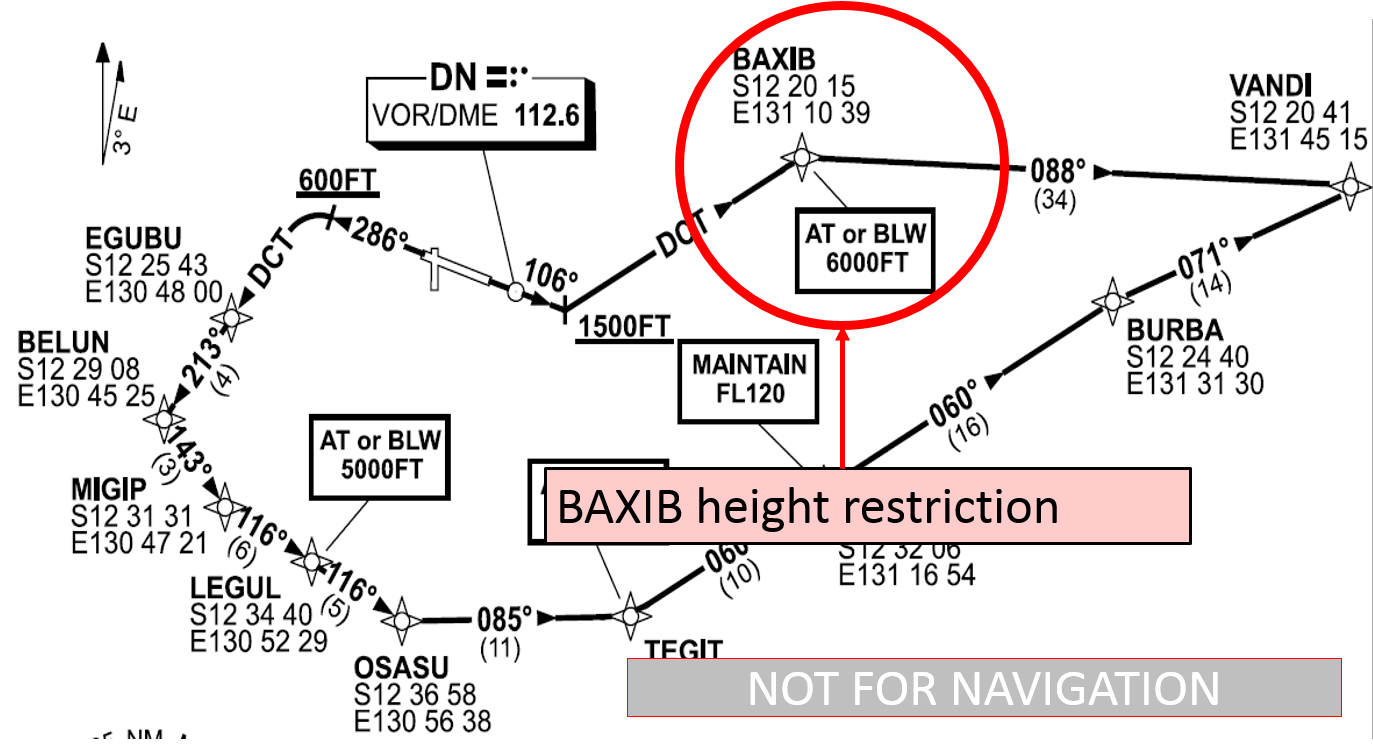
On 10 June 2015, the pilot of a Cessna 441 aircraft, registered VH-JLT (JLT), conducted pre-flight preparations for a charter flight from Darwin to Oenpelli, Northern Territory with 6 passengers. The pilot planned to track direct to Oenpelli, but on requesting an airways clearance, was advised by the clearance delivery controller that there was a requirement to plan via the VANDI ONE standard instrument departure (SID) (Figure 1). The pilot then reviewed the SID chart and noted the left turn on departure and the height limit of 6,000 ft at waypoint BAXIB. The pilot wrote ‘6,000’ on the navigation log. As part of the airways clearance issued to JLT, the pilot was initially issued a clearance to climb to 3,000 ft. The pilot entered ‘3000’ into the aircraft’s altitude alerter.
Figure 1: Extract of VANDI ONE SID
Source: Airservices Australia – annotated by the ATSB
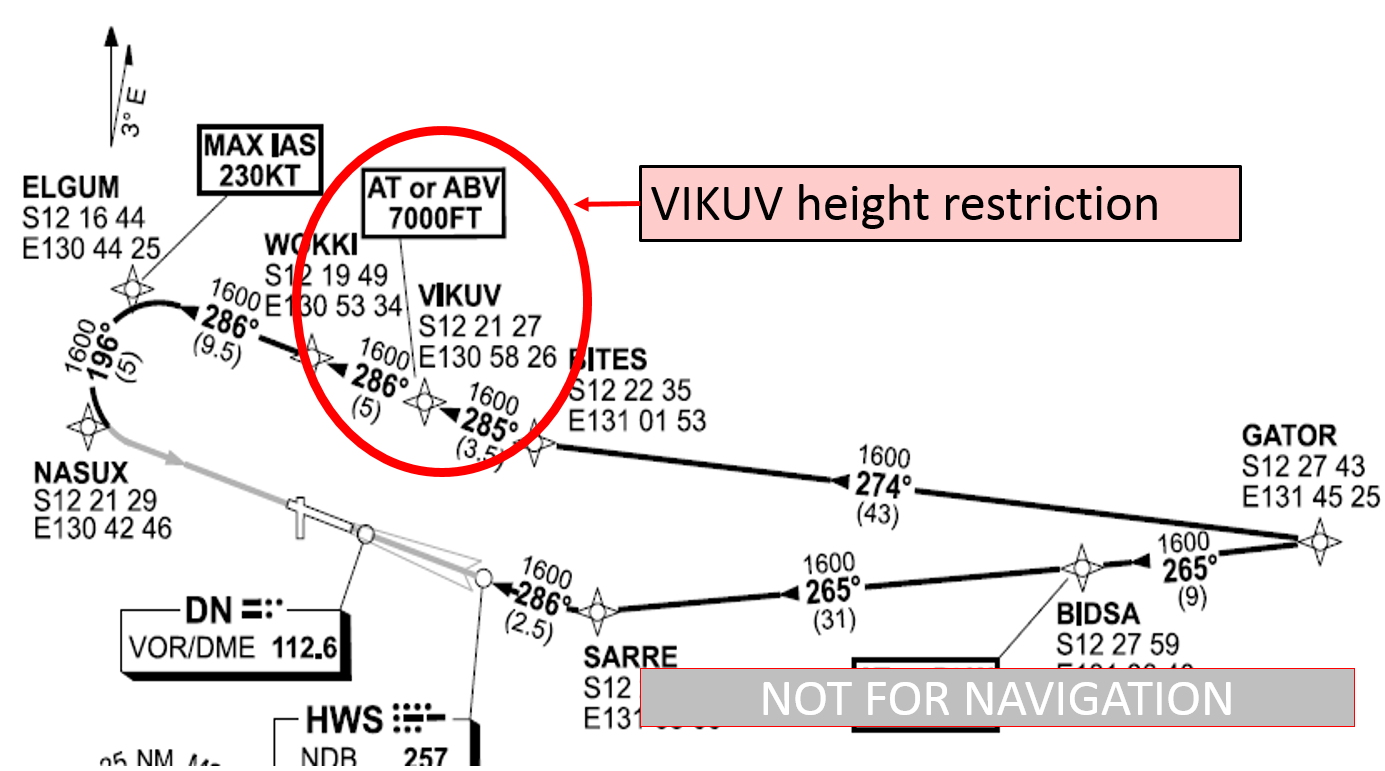
At about 0856 Central Standard Time (CST), a Raytheon B200 aircraft, registered VH-ZCJ (ZCJ), operating an aeromedical flight with a pilot, a flight nurse and four passengers on board, was approaching Darwin from Elcho Island, Northern Territory, on the GATOR THREE A standard arrival route (STAR) (Figure 2). The pilot had been advised to expect track shortening and a visual approach to runway 11. At 0856:16, the Darwin approach controller cleared ZCJ to descend to 7,000 ft.[1]
At about 0859, JLT took off. The pilot conducted a left turn as required by the SID, and the Tower controller directed the pilot to contact Approach. At 0859:52, the pilot of JLT contacted the approach controller and advised that they were conducting a VANDI SID, and passing 1,000 ft on climb to 3,000 ft. About 20 seconds later, the pilot of ZCJ reported that they were visual and were then passing about 8,400 ft on descent.
At 0900:44, the approach controller cleared JLT to climb to flight level (FL) 130.[2] The pilot then selected 13,000 in the altitude alerter. The controller did not cancel any requirements, hence JLT was still required to be at or below 6,000 ft at waypoint BAXIB in accordance with the SID. Shortly after that communication, the pilot of JLT inadvertently selected Brisbane Centre frequency (on COM1), and was no longer able to hear Darwin Approach frequency.
At 0901:00, the approach controller cleared ZCJ, which was then passing about 7,700 ft, to descend to 3,000 ft. In accordance with the STAR, that could only be complied with after passing waypoint VIKUV at or above the 7,000 ft height restriction published for that point on the STAR.
Figure 2: Extract of GATOR THREE A STAR
Source: Airservices Australia – annotated by the ATSB
About 13 seconds later, the approach controller observed ZCJ approaching 7,000 ft. The controller asked the pilot of ZCJ to confirm they were aware that the level restriction at VIKUV still applied, and to expect track shortening after VIKUV. The pilot responded ‘roger’. The radar display indicated the aircraft then descended below 7,000 ft to 6,800 ft, which was still within the specified tolerances (+/- 200 ft) of the level restriction. At 0901:41, the radar display showed the ZCJ at 6,700 ft, and the controller asked the pilot to confirm they were maintaining 7,000 ft, and the pilot responded ‘affirm’.[3] JLT was then about 11 NM away, and there was still about 3,100 ft vertical separation between the aircraft at that time.
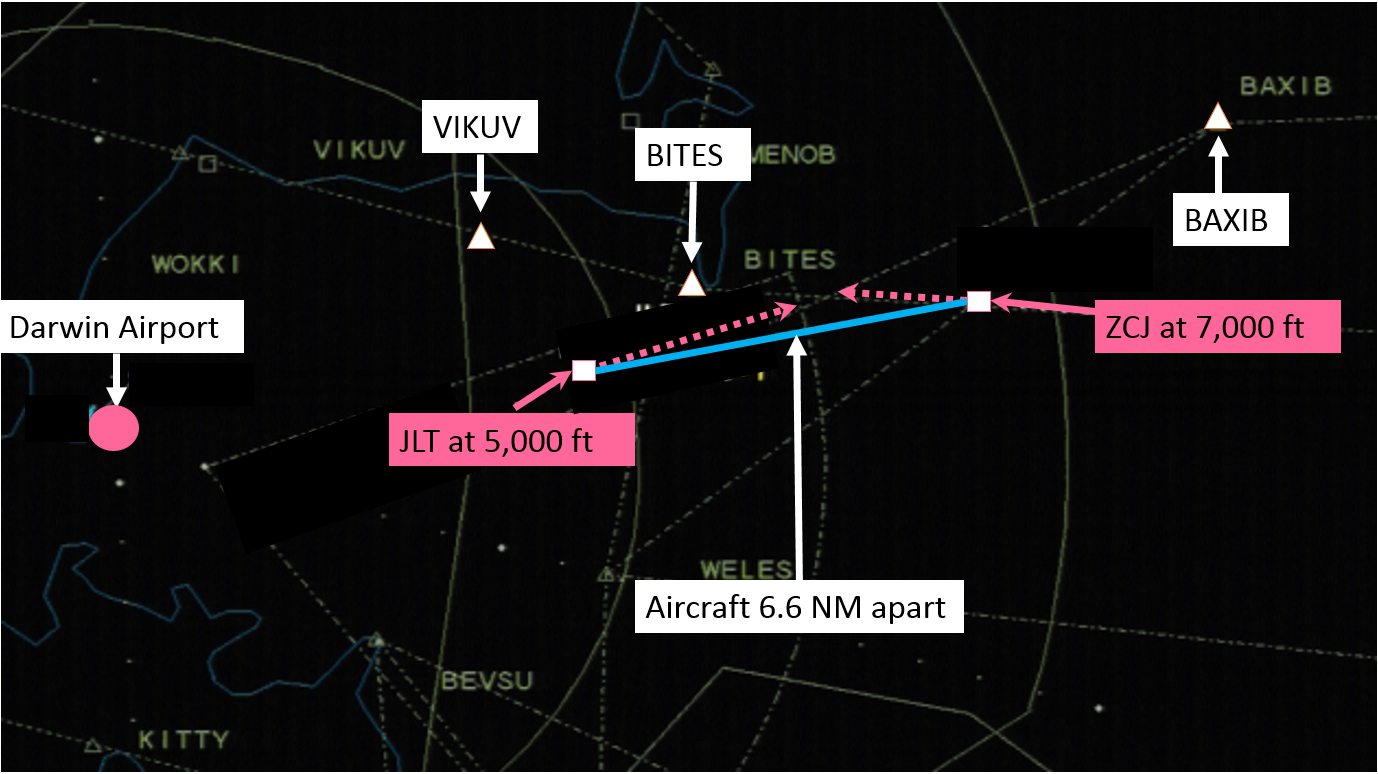
At about 0902, ZCJ was approaching waypoint BITES at 7,000 ft, JLT was at 5,000 ft and the aircraft were about 6 NM apart (Figure 3). The controller then issued JLT as traffic to the pilot of ZCJ, and advised that JLT had been assigned FL130 and had a 6,000 ft requirement at BAXIB. The pilot of ZCJ acknowledged the traffic and could see it on the aircraft’s traffic collision avoidance system (TCAS). The pilot of JLT did not hear that communication as they were not listening on the approach frequency at that time.
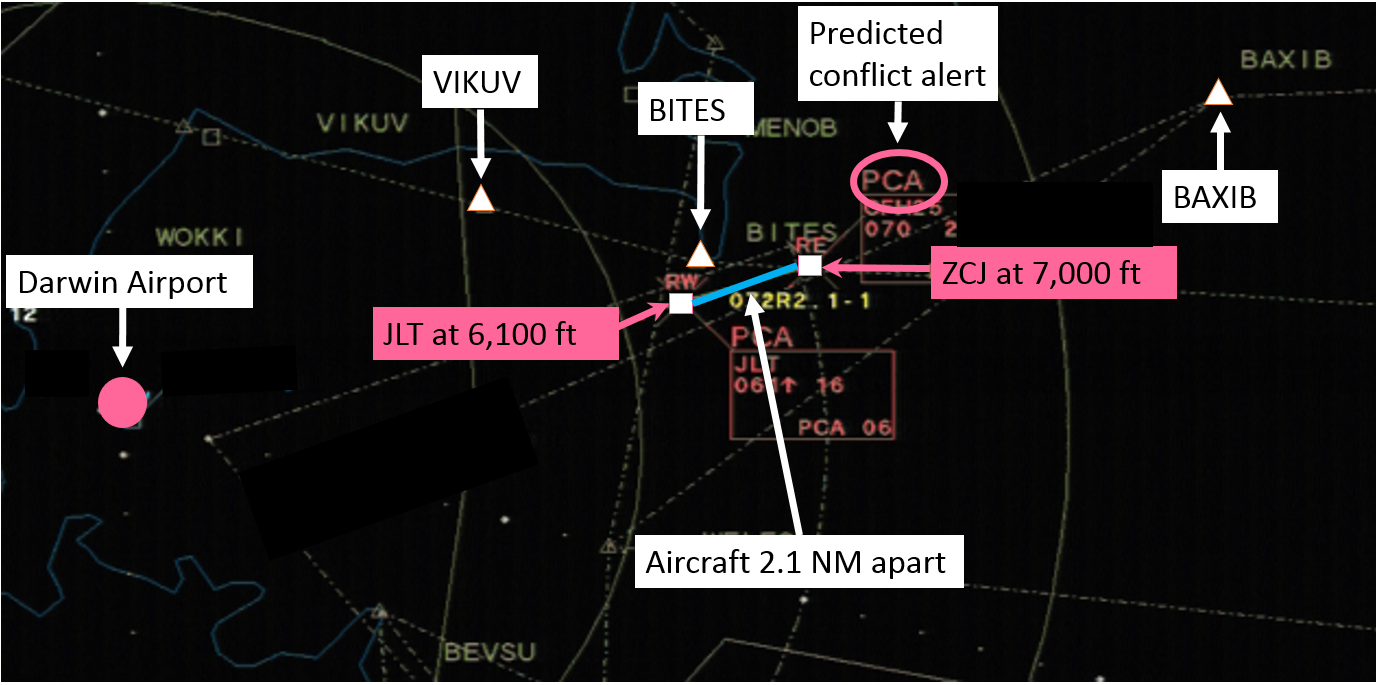
At 0902:41, as the two aircraft converged, an Australian Defence Air Traffic System (ADATS) predicted conflict alert (PCA) activated on the controller’s situational display (Figure 4). The controller advised the supervisor, as required following a PCA activation, that vertical navigation ‘strategic’ separation was in place (see right). JLT was then at 6,100 ft, above the level restriction of 6,000 ft, and ZCJ at 7,000 ft with less than 2 NM between the aircraft. At 0903:07, 1.6 NM and 800 ft existed between the aircraft, and the pilot of ZCJ reported that they had JLT in sight. The approach controller confirmed that the pilot of ZCJ was able to maintain separation with JLT. The pilot of ZCJ then received a TCAS ‘TRAFFIC TRAFFIC’ alert and disconnected the autopilot in anticipation of taking avoiding action. The approach controller quickly attempted to contact JLT, advising that ZCJ was maintaining separation with them and to confirm they were complying with the level restriction, but did not receive a reply; JLT continued to climb. The controller then advised the pilot of ZCJ that the aircraft had climbed through the 6,000 ft level restriction and issued a requirement to the pilot of ZCJ to maintain separation with that aircraft. By the time the controller had completed that transmission, the two aircraft had passed. The approach controller then cancelled ZCJ’s level restrictions, and cleared the aircraft to descend to 4,000 ft. ZCJ continued to descend in accordance with the STAR route and the pilot did not take any avoiding action.
At 0903:36, the approach controller again called JLT and received no response. At 0903:55, the approach controller received an ADATS conflict alert (CA), with the closest proximity according to the radar reducing to 400 ft vertically and 0.3 NM between the two aircraft. The pilot of ZCJ estimated the proximity between the aircraft to be about 200 ft vertically and 100-200 m horizontally. The controller stated that ‘surveillance passing’ separation standard was in place (see right).
The pilot of JLT sighted ZCJ slightly above, to their left, and closer than normal. The pilot realised the radio was selected to Brisbane Centre frequency and switched it to the Darwin Approach frequency. After two more unsuccessful attempts to contact JLT on the Darwin frequency, Brisbane Centre advised the controller that JLT was with them. The pilot of JLT, then back on Darwin Approach frequency, asked the approach controller whether they had been trying to contact them. The approach controller advised the pilot that the aircraft had climbed through a level restriction, and the pilot asked the controller to confirm they had been cleared to FL130. The controller said yes, but in accordance with the SID. The controller then handed JLT off to Brisbane Centre. ZCJ landed on runway 11 without further incident.
At 0903:36, the approach controller again called JLT and received no response. At 0903:55, the approach controller received an ADATS conflict alert (CA), with the closest proximity according to the radar reducing to 400 ft vertically and 0.3 NM between the two aircraft. The pilot of ZCJ estimated the proximity between the aircraft to be about 200 ft vertically and 100-200 m horizontally. The controller stated that ‘surveillance passing’ separation standard was in place.
Separation Standards According to the Manual of Air Traffic Services (MATS), separation is the concept of ensuring aircraft maintain a prescribed minimum from another aircraft (or object), whilst meeting the associated conditions, and requirements of the standard. A separation standard is a prescribed means to ensure separation between aircraft using longitudinal, lateral, vertical and visual standards.
Strategic Separation Strategic separation is achieved by designing flight paths that minimise conflictions between arriving and departing aircraft. Tactical separation is achieved by changing an aircraft’s speed, altitude or direction, including requiring aircraft to proceed at specific times to preserve separation.
Surveillance Passing The ‘surveillance passing’ standard applies to aircraft on reciprocal tracks (within 45° of each other’s track), when aircraft are observed by an air traffic surveillance system to have definitely passed and their position symbols are not touching.
The pilot of JLT sighted ZCJ slightly above, to their left, and closer than normal. The pilot realised the radio was selected to Brisbane Centre frequency and switched it to the Darwin Approach frequency. After two more unsuccessful attempts to contact JLT on the Darwin frequency, Brisbane Centre advised the controller that JLT was with them. The pilot of JLT, then back on Darwin Approach frequency, asked the approach controller whether they had been trying to contact them. The approach controller advised the pilot that the aircraft had climbed through a level restriction, and the pilot asked the controller to confirm they had been cleared to FL130. The controller said yes, but in accordance with the SID. The controller then handed JLT off to Brisbane Centre. ZCJ landed on runway 11 without further incident.
Figure 3: Situation display showing JLT at 5,000 ft and ZCJ at 7,000 ft
Source: Defence air traffic control – annotated by the ATSB
Figure 4: Situation display showing the predicted conflict alert, with JLT at 6,100 ft and ZCJ at 7,000 ft
Source: Defence air traffic control – annotated by the ATSB
New traffic management plan (TMP) for Darwin Airport
A new traffic management plan (TMP) for Darwin Airport came into effect on 28 May 2015. This was the result of about two years of design and development, and included consultation with industry. Traffic management planning regulates the flight profiles of arriving and departing aircraft to improve the traffic flow. The new procedures consisted of a number of vertical navigation requirements, with intermediate level restrictions. Several notices to airmen (NOTAMs) were promulgated by Airservices Australia advising of the new TMP, commencing in December 2014. Local operators were asked to provide feedback on the plan.
An Airservices Air Traffic Management (ATM) specialist reported that the new TMP was based on fulfilling a requirement from the Civil Aviation Safety Authority (CASA) to reduce controller workload. Removing the need to assign levels to each aircraft, also reduces the number of radio transmissions. The new procedures meant that the controllers would not be required to issue as much tactical separation, as the new procedures provided strategic separation. The TMP was designed to be of most benefit during busy periods, when Darwin can have up to 45 aircraft on frequency at the same time, including military jet aircraft. Controllers would then have more time to process and communicate with aircraft that are not captured in the TMP.
Since the implementation of the new plan, there had been a significant number of non-compliance events with the vertical navigation requirements. Darwin was one of the few airports in Australia with vertical navigation requirements on SIDs and STARs, and has more of them than any other airport in Australia.
Controller comments
The approach controller provided the following comments:
The duty runway was runway 11.
In accordance with the TMP, ZCJ was inbound on the GATOR THREE STAR, and JLT outbound on the VANDI ONE SID. With the vertical requirement for that STAR and SID, there was a 1,000 ft buffer between the planned routes of the two aircraft.
All communications and clearances were issued in accordance with the current Airservices Australia Aeronautical Information Package (AIP). Phraseology published in the AIP refers to cancellation of STAR level restrictions but not SID level restrictions. Consequently, the controllers had been advised to cancel the waypoint level restriction on a SID using the phrase, for example, ‘cancel BAXIB level restriction’.
The new TMP included changes to the departure and approach procedures design and charts, radiotelephony, and was a significant change to the airspace and their mode of operations. The controllers had been directed to issue full climb and descent clearances, which was consistent with Airservices operations in other locations where intermediate level restrictions existed.
The controller did not, and was not required to issue a safety alert to ZCJ, and believed that to do so would increase risk. The controller did not issue a safety alert to JLT and assigned separation responsibility to the pilot of ZCJ. The pilot of ZCJ had JLT in sight and if the controller had issued a heading or climb instruction to the pilot of ZCJ, the pilot may have looked inside at the instruments to follow the instruction, instead of keeping JLT in sight.
The controller’s initial response was to attempt to communicate with the pilot of JLT and confirm they were maintaining 6,000 ft, but the pilot did not respond. The controller wanted to issue a safety alert to the pilot of JLT as they had not been issued ZCJ as traffic. However, on receiving no response from the pilot of JLT, the controller immediately assigned safety recovery to ZCJ, and then confirmed the aircraft had passed each other.
The controller was also the senior training officer in Darwin, and because of the significant number of VNAV restrictions in the new TMP, the controller created maps and diagrams, and clearly depicted the restrictions on SIDs and STARs, and placed them on the console as a situational awareness tool for the controllers.
Prior to a controller operating under the new TMP, they had completed two simulator sessions. The scenarios included common and predicted conflictions and multiple aircraft not tracking via SIDs and STARs, and aircraft not in compliance with the TMP requirements.
Immediate actions
Following the incident, the pilots of both aircraft participated in a briefing with the controllers. They viewed the radar tapes and discussed the TMP. The aim was to educate the pilots, as local operators, and discuss the TMP with the aim to prevent further incidents from occurring.
The operator of JLT attended this briefing. They were surprised that the controllers had assumed the Cessna 441 was equipped with a traffic collision avoidance system (TCAS) and a flight management system (FMS). It was not fitted with either. The operator also stated that the same applies to most of the general aviation aircraft operating in and out of Darwin Airport.
Pilot comments
Pilot of VH-JLT
The pilot of JLT provided the following comments:
The pilot should have reviewed the en route section of the Jeppesen for the planning. The new Jeppesen charts only arrived the day before the new TMP came into effect.
The Planner advised that four other pilots had also flight planned direct to Oenpelli that morning (instead of via the VANDI ONE SID).
They had never had altitude restrictions before on the SIDs. It was the first time the pilot had ever been cleared to an altitude above a level restriction. The STARs have intermediate level restrictions, but prior to the new TMP, the pilot had only ever been cleared to an altitude lower than the restriction when also cancelling the height restriction (for example ‘descend to 4,000 cancel STAR level restriction’).
Pilot of VH-ZCJ
The pilot of ZCJ stated that the flight management system (FMS) calculated the top of descent point based on the track of the STAR. As the pilot had been advised to expect track shortening and a visual approach, they had to commence the descent earlier. The aircraft was slightly above the normal approach path and at a slightly higher rate of descent than normal, when approaching 7,000 ft. The pilot had vertical navigation (VNAV) mode selected, with VPATH in the flight mode annunciator, and ALTV armed, therefore the FMS follows the STAR profile programmed and captured the approach level restriction (of 7,000 ft).
In addition, the pilot commented that the company had sent emails and a flight operations notice to company flight crew highlighting the changes and new procedures for Darwin, prior to the commencement of the new TMP. There were NOTAMs issued months beforehand about the new SIDs and STARs to ensure the pilots were aware of the new procedures.
Operator comments – operator of VH-JLT
The operator of JLT advised that the auto-flight system of JLT was unserviceable on the incident flight. That unserviceability led to increased pilot workload, therefore reducing the pilot’s spare capacity to maintain situational awareness.
The operator believed that the change management process prior to the airspace changes was insufficient. The number of incidents that occurred immediately following the implementation of the new TMP supported that belief. The operator suggested that face-to-face briefings with the local pilots would have been more effective than just issuing NOTAMs.
The Jeppesen Charts with the new procedures were only released the day before the changes were implemented. Additionally, the associated GPS software was not available until 10 hours after the new procedures commenced at midnight.
Safety actions
Whether or not the ATSB identifies safety issues in the course of an investigation, relevant organisations may proactively initiate safety action in order to reduce their safety risk. The ATSB has been advised of the following proactive safety actions in response to this occurrence.
Aircraft operator – VH-ZCJ
As a result of this occurrence, the operator of ZCJ has advised the ATSB that they have taken the following safety actions:
Education email from Defence air traffic control (ATC)
An email from Defence ATC was sent by CASA to the operator of ZCJ, who then distributed the email to company pilots operating out of Darwin. The email advised that since the new TMP came into effect on 28 May, there had been nine occurrences of pilots failing to comply with the VNAV requirements of the SIDs and STARs. The email directed pilots to the relevant sections of the AIP. These stated that when ATC issues climb clearances to an aircraft on a SID, or descent clearances to an aircraft on a STAR, the aircraft must comply with all level restrictions or requirements published on the SID or STAR charts unless ATC explicitly cancels the restrictions or requirements.
Safety bulletin
A safety bulletin was issued to all flight crew operating out of Darwin. The bulletin advised flight crew of the recent violations of SID and STAR altitude restrictions under the new TMP. Pilots were reminded to maintain extra vigilance and situational awareness while briefing and approaching the new level restrictions. The bulletin noted that as evidenced by this incident, other aircraft may not comply with the restrictions. Flight crew were directed to engage VNAV with active vertical mode where available. In aircraft without VNAV capability, the Altitude Selector was to be set to the limiting altitude and the cleared level written down until the SID or STAR restriction had been passed.
Critical to Safety Operations notice
A ‘Critical to Safety Operations’ notice was issued to all flight crew operating out of Darwin. The notice reiterated the need to comply with level restrictions unless explicitly cancelled. The notice also provided directives regarding the use of VNAV and the FMS to conduct SIDs and STARs in Darwin.
Flight operations manual update
The Flight operations manual is being updated with further guidance on the new Darwin procedures.
Local airspace briefing
The local airspace briefing presentation for new pilots has been updated to incorporate the new Darwin TMP procedures.
Aircraft operator – VH-JLT
As a result of this occurrence, the operator of JLT has advised the ATSB that they are taking the following safety actions:
Training information for flight crew
Company flight crew have been reminded of the importance of adhering to standard operating procedures and regulatory requirements.
Traffic control facility training
The operator will participate in training sessions in the Air Traffic Control Facility with Defence ATC Darwin, to develop understanding of the issues that flight crew and air traffic control personnel identify with the airspace.
Safety newsletter
A safety newsletter will be sent to all company flight crew to remind them of the importance of understanding the SID and STAR chart requirements.
Air traffic control
New procedure implemented
With immediate effect, Darwin ATC implemented a new procedure following this incident. If a VNAV restriction is in place and one aircraft has not complied, the controller is to immediately resort to tactical separation until that confliction is cleared.
Training and awareness
Materials designed to enhance awareness of the requirements and implications of the new traffic management plan will be promulgated to local aviation operators.
Incident briefings
Defence ATC provided briefings with other local operators at the ATC Facility showing this incident, discussing the TMP and the need for compliance of VNAV on the SID's and STARs.
Safety message
For controllers, this incident highlights the need to monitor aircraft after issuing a full climb or descent, where an intermediate level restriction applies. If an aircraft appears not to be complying with a level restriction, apply tactical separation.
For pilots, this incident provides a reminder to become familiar with published standard departure and arrival procedures and charts, particularly those with intermediate level restrictions, and the associated phraseology used by air traffic controllers and pilots.
Decisions regarding whether to conduct an investigation, and the scope of an investigation, are based on many factors, including the level of safety benefit likely to be obtained from an investigation. For this occurrence, a limited-scope, fact-gathering investigation was conducted in order to produce a short summary report, and allow for greater industry awareness of potential safety issues and possible safety actions.
Publishing information
Released in accordance with section 25 of the Transport Safety Investigation Act 2003
Ownership of intellectual property rights in this publication
Unless otherwise noted, copyright (and any other intellectual property rights, if any) in this report publication is owned by the Commonwealth of Australia.
Creative Commons licence
With the exception of the Coat of Arms, ATSB logo, and photos and graphics in which a third party holds copyright, this publication is licensed under a Creative Commons Attribution 3.0 Australia licence.
Creative Commons Attribution 3.0 Australia Licence is a standard form licence agreement that allows you to copy, distribute, transmit and adapt this publication provided that you attribute the work.
The ATSB’s preference is that you attribute this publication (and any material sourced from it) using the following wording: Source: Australian Transport Safety Bureau
Copyright in material obtained from other agencies, private individuals or organisations, belongs to those agencies, individuals or organisations. Where you wish to use their material, you will need to contact them directly.
The crew of the Airbus Industrie A340 responded to a traffic alert and collision avoidance system (TCAS) resolution advisory (RA) and climbed 600 ft above the cleared level of flight level (FL)190. The conflicting traffic was a formation of military McDonnell Douglas Corporation FA-18A Hornet aircraft in transit through a military airspace corridor. Traffic information was passed to the crew of the A340 by the air traffic controller. The Hornet crews were on military control frequencies. At the time of the TCAS alert, the Hornets had climbed to FL180 from FL170 to transit civil airspace via a military airspace corridor 75km north of Sydney, known as the Hunter Corridor. Civil radar data indicated that the Hornets climbed to FL183 and military radar data indicated a climb to FL182. The crews stated that they were positive that they had levelled at FL180, and that they had the A340 in sight. Analysis of the radar data indicated that, at the time of the resolution advisory, the standard vertical separation had reduced to less than 1000ft resulting in an infringement of separation standards.
The crew had been issued a runway 34R MARUB2 SID with a requirement to maintain 5,000 ft and had confirmed this altitude on contact with Departures North. The aircraft was then observed on radar to climb above the assigned altitude. The controller confirmed the altitude requirement and passed traffic information on a crossing A320 at 6,000 ft.
The B737 crew immediately descended from 5,400 ft to 5,000 ft. Concurrently the crew of the A320 responded to a TCAS Resolution Advisory and climbed from 6,000 ft to 6,700 ft. A plot of the recorded radar data showed that the B737 had levelled at 5,400 ft and that the two aircraft had come within 600 ft of one another. The required standard was 1,000 ft and, therefore, an infringement of separation standards had occurred. The company operating the B737 conducted an investigation into the circumstances surrounding this incident and a copy of their report was duly lodged with the Bureau.
Their investigation found that a captain under training was flying the aircraft. A training captain occupied the right crew seat and performed the crew functions of the pilot not flying. The captain under training was hand-flying the aircraft at the time of the incident. Although he had correctly set the assigned altitude of 5,000 ft in the window of the Mode Control Panel, the Flight Director (FD) did not capture the 5,000 ft level-off altitude and, despite the training captain having alerted him to the approaching assigned altitude, he had allowed the aircraft to climb above the assigned 5,000 ft altitude. An intermittent fault in the altitude selection function of the FD had been detected a few days earlier but because the problem was not thought to be an aberrant operation, it was not reported. After this occurrence the problem was reported and a few days later manifested itself in a 'hard' failure.
The Mode Control Panel of the Flight Management System was subsequently replaced. The investigation concluded that the slow response of the captain under training had allowed the aircraft to exceed the assigned altitude. The company's Standard Operating Procedures were found to be adequate and, despite this event, did not require amendment. However, a recommendation was made that training captains require pilots under training to use greater levels of automation in busy flight phases in order to enhance their monitoring role.
The pilot of VH-KST, a Cessna 210M aircraft, was instructed to extend the first crosswind leg of his circuit for Runway 36 to allow the departure of VH-JSH, a DHC-8 aircraft from Runway 29. As JSH rotated for take-off, KST turned downwind and crossed in front of JSH. The crew of JSH saw KST but did not take evasive action. JSH passed approximately 1,000 m behind KST at the same altitude, about 1,000 ft AMSL. The pilot of JSH confirmed the miss-distance estimation.
The investigation revealed that the pilot of KST did not recall any ATC instructions to maintain first crosswind. The transcript of communications of the automatic voice recording (AVR) tape showed that the pilot acknowledged the crosswind instruction but did not respond to three subsequent transmission directed to his aircraft by the tower controller. The chief pilot of the company which operated KST was on the aircraft supervising the pilot in command. He said that the communications system in the aircraft had an unserviceability which resulted in the pilot operating the VHF radio with a headset and a hand microphone. The supervising pilot was not able to monitor air to air communications due to the unserviceability.
Occurrence summary
Investigation number
199900027
Occurrence date
06/01/1999
Location
Darwin Aerodrome
State
Northern Territory
Report release date
03/03/1999
Report status
Final
Investigation type
Occurrence Investigation
Investigation status
Completed
Mode of transport
Aviation
Aviation occurrence category
Loss of separation
Occurrence class
Incident
Aircraft details
Manufacturer
Cessna Aircraft Company
Model
210M
Registration
VH-KST
Sector
Piston
Departure point
Darwin NT
Destination
Darwin NT
Damage
Nil
Aircraft details
Manufacturer
De Havilland Canada/De Havilland Aircraft of Canada
VH-TJN, a Boeing 737 (B737), was en route from Melbourne to Brisbane and tracking via air route H29 at flight level (FL) 290 and was estimating overhead Mudgee at 1938 ESuT.
VH-CZK, another B737, had departed Sydney at 1914, tracking via Richmond and Nyngan to Darwin on air route T74. The crew had planned to cruise at FL310 and was instructed by Sydney Air Traffic Control (ATC) to maintain FL280 due to airspace requirements in the Sydney area. Air routes H29 and T74 intersected 113 NM north-west of Sydney.
The crew of CZK was transferred from Sydney ATC to the Melbourne Sector 16 controller (SEC16) approximately 45 NM west of Sydney. The controller asked the crew of CZK if they could meet a requirement to climb to FL310 by 100 NM from Sydney. The crew of CZK responded with "... we are showing it 90 miles to run 310". The controller instructed the crew to climb to FL310, as he understood from their reply that the aircraft would reach that level by 90 NM from Sydney. Shortly after, the crew advised the controller that they would reach FL310 about 140 NM from Sydney. The controller then instructed the crew to maintain FL290. The controller advised the crew that they could expect further climb in approximately 25 NM once they were clear of crossing traffic in their 10 o'clock position at 18 NM.
The controller then observed CZK climbing above FL280 as it was passing TJN. The controller asked the crew of CZK to confirm that they were cleared to maintain FL280. The crew advised the controller that they had been cleared to maintain FL290. As CZK had already passed TJN, the crew of CZK was instructed to climb to FL310. Subsequent investigation of the radar recording found that CZK had passed within 2 NM laterally and 500 ft vertically below TJN. The prescribed vertical separation standard was 1,000 ft, and the lateral standard was 5 NM. There had been an infringement of separation standards.
The flight progress strip for CZK had been annotated with "280" to indicate that the crew was initially instructed to maintain FL280. This annotation had two adjacent ticks. The first tick was placed on the flight progress strip after the crew had made the initial call to SEC16, advising that they were climbing to FL280. The controller wrote "310" on the flight progress strip to record the instruction to climb to FL310, and this was ticked following the correct read-back by the crew. After the crew was instructed to maintain FL290 and they had read the instruction back correctly, the controller placed a second tick next to the existing "280" on the flight progress strip. The controller did not annotate the flight progress strip with "290" following the instruction to the crew to maintain FL290.
The controller had been rostered for one familiarisation shift after having spent 5 weeks instructing in the simulator and a further 2 weeks on annual recreation leave. The controller had been operating under supervision for approximately 4 hours of the shift and his supervisor reported that he was performing satisfactorily. He was subsequently certified to operate solo on sector 16. The controller then had a rest period of approximately 1 hour prior to operating the sector 16 position for the last 2 hours of his shift. The separation infringement occurred approximately 20 minutes prior to the completion of his shift.
The crew of TJN which was fitted with a traffic alert and collision avoidance system (TCAS), was conducting training during that flight and was aware of the crossing traffic. However, they thought that CZK was on climb to maintain FL280. As CZK passed behind them, they realised that CZK had climbed above FL280. The crew did not hear SEC16 advise the crew of CZK of the crossing traffic at 18 NM. The crew of TJN advised that they "also had the traffic sighted and on TCAS".
After receiving the query for the FL310 requirement from SEC 16, the crew of CZK had ascertained from the flight management computer that the aircraft would reach FL310 in 90 track NM. The pilot in command stated that he wished to convert this to, and report it as, a distance from Sydney in accordance with the request. The co-pilot advised the controller that they would reach FL310 in 90 NM from their present position. The pilot in command was not satisfied with that response and manipulated the flight management computer to obtain the top-of-climb distance as 140 NM from Sydney. This was then advised to the controller. The crew sighted TJN after the controller had advised them of the crossing traffic. They thought that the crossing traffic was at FL310. As CZK approached the intersection of the air routes, the crew thought that the crossing traffic, TJN, was approximately 1,000 ft above them. The crew of CZK advised that they had sighted the crossing traffic. CZK was not fitted with TCAS.
ANALYSIS
The response from the crew of CZK, "... we are showing it 90 miles to run FL310", led the controller to believe that the aircraft would reach FL310 by 90 NM from Sydney. The controller then issued an instruction to climb to FL310 with the intention of monitoring the separation on radar. When the crew later advised that they would reach FL310 by 140 NM from Sydney, the controller intended to revert back to his original plan and maintain CZK at FL280. The investigation could not ascertain why the controller subsequently issued the instruction to CZK to climb to FL290. The controller thought that he had issued an instruction to climb to FL280. However, he incorrectly instructed the crew to climb to FL290 and did not appreciate the error when the crew correctly read back FL290.
By giving CZK an unconditional clearance to climb to the planned level of FL310, the controller did not apply positive separation assurance. From that point on, the prevention of an infringement of separation standards between CZK and TJN depended on the controller remembering that this potential confliction was still unresolved, and then taking timely and appropriate action to positively separate the aircraft. In the event, when the controller returned to resolve the potential conflict between CZK and TJN, an error was made.
The controller did not advise the crew of CZK of the level of the crossing traffic as he thought that the aircraft were vertically separated. The crew of CZK thought that TJN was 1,000 ft above them. The crew of TJN was discussing training issues and was probably not as vigilant in maintaining their situational awareness as if in a non-training situation. If the controller had mentioned the callsign of the crossing traffic, the crew of TJN may have realised that they were in fact the conflicting aircraft.
SIGNIFICANT FACTORS
1. The response from the crew of CZK to the level requirement was ambiguous and misled the controller into believing the aircraft would reach FL290 by 90 NM from Sydney.
2. The controller cleared the aircraft to the incorrect level and did not recognise the error when the crew read back the level.