VH-EAN was en route from Sydney to Perth, cruising at flight level (FL)350. N99SC was en route from Essendon to Sydney cruising at FL410 and requiring descent. Both aircraft were under the control of the Melbourne Air Traffic Control Centre, Sector 7. It was apparent that the two aircraft would be in lateral conflict near Yass. The controller cleared N99SC to descend to FL360.
Above FL290, for aircraft that are not laterally separated, the minimum vertical separation is 2000 feet. In this instance the controller had only provided 1000 feet. The two aircraft passed with about three and one half miles lateral separation and 1000 feet vertical separation. For aircraft not vertically separated, the minimum lateral separation in this instance was five miles.
The controller realised his error but too late to rectify the situation. Investigation revealed that prior to the incident the controller had been busy with aircraft inbound to Sydney, entering the holding pattern at Bindook. All levels assigned to other aircraft had been in the range of FL210 to FL260 where only 1000 feet vertical separation is required. He believed it was this that had led him to inadvertently apply the same standard to VH-EAN and N99SC
VH-AJJ was climbing to Flight Level (FL) 370 (37,000 feet) whilst VH-WGJ was climbing to FL350, and the aircraft were under the procedural (non-radar) control of the Perth Sector 1 air traffic service controller. The aircraft were on reciprocal tracks and a vertical separation of 2000 feet was required at least 10 minutes before the aircraft passed. The climb profiles of the aircraft meant that the required separation would not be achieved by 10 minutes prior to passing. The controller did not recognise the potential confliction.
Nine minutes prior to the aircraft passing, VH-AJJ requested an amended level of FL350 but was given FL330 because the controller assumed VH-WGJ was already at FL350.
Seven minutes prior to passing, the controller ascertained that VH-WGJ was passing FL320. He then realised a conflict existed and instructed VH-WGJ to descend to FL310. VH-WGJ started its descent back to FL310 as VH-AJJ reached FL330 on the climb. The aircraft reached the standard vertical separation requirements approximately three minutes prior to passing.
Although the controller was an experienced procedural sector controller he had not been involved in this type of control for about 12 months and had only recently been re-categorised.
At about 1125 EST (Eastern Standard Time), Rockhampton radar technicians requested approval from the Brisbane Area Approach Control Centre (AACC) Coordinator to close down the Mt Alma radar for five minutes, so that a noise emanating from the antenna turntable could be investigated.The Mount Alma radar near Rockhampton is the sensor used by Sector 3A to control traffic in the Sector 3 area of responsibility. The coordinator then alerted the Sector 3A radar controller to the request. The Sector 3A position was being operated by a trainee (unrated controller) under supervision. He then called the Sector 7 (Mackay) radar controller to advise him that the Sector 3 radar would be going off for 5 minutes and requested his assistance to monitor separation while the radar was off. Subsequently, a separation breakdown occurred when the Sector 3 controller failed to adequately separate a Boeing 767 and a Boeing 737.
Traffic Disposition
Traffic in Sector 3A area of responsibility at the time included JAL772 a Boeing 747 northbound on route Bravo 462 (B462) at Flight Level 350 (FL350), VH-OGJ a Boeing 767 northbound on the same route at FL350, 36 miles behind JAL772, and a Boeing 737 VH-TAH which was cleared to track direct from Townsville to Gladstone also at FL350. The track of VH-TAH intersected route B462 approximately 22 NM north of Rockhampton and thus there was potential confliction with VH-OGJ and JAL772.
The Sector 7 controller asked the Sector 3 controller to rectify the potential confliction with VH-TAH and to advise him when this had been done. The Sector 3 controller then turned VH-TAH right onto a heading of 190 degrees. At this time, VH-TAH was approximately 50 miles northwest of Rockhampton, JAL772 was approximately 10 miles north of Rockhampton and VH-OGJ was 32 miles South of Rockhampton. After VH-TAH and JAL772 had passed clear of each other the Sector 3 controller cleared the pilot of VH- TAH to track direct to Gladstone and to resume his own navigation. He then gave approval for the Mt Alma radar service to be turned off and made an all stations broadcast to that effect.
At about 1130 the Sector 3 controller called the Sector 7 controller, asking him to separate two other aircraft, and advising that the radar had been switched off. The Sector 7 controller then noticed on his radar display that the tracks of VH-OGJ and VH-TAH would conflict and instructed the Sector 3 controller to immediately descend VH-TAH to FL330 and to turn VH-OGJ onto a heading of 270 degrees.
The instructions were carried out but lateral and vertical separation standards between the aircraft were broken.At approximately 1132:23 VH-OGJ passed directly over VH-TAH in the opposite direction with approximately 1,500 ft vertical separation. The minimum vertical separation required is 2,000 ft.
The pilot of VH-OGJ reported that his Traffic Conflict Alert System (TCAS) had been activated when the aircraft were closing. It indicated a vertical separation of 600 ft. The crew of both aircraft visually sighted the other as the aircraft passed.
The Sector 3 controller had neglected to arrange procedural separation of VH- TAH and VH-OGJ before allowing the radar to be turned off. The traffic conflict was recognised by the Sector 7 controller when it was too late for the Sector 3 controller to achieve a separation standard. The radar was returned to service at 1136 after no fault was found.
Flight Progress Strips
Local Operating Instructions (LOI) for Sector 3A state that, in the event of radar outage 'controllers will make up additional strips as required to highlight conflicts'. In this instance, the Sector 3A controller did not consider it necessary for procedural flight progress strips to be made up as Sector 7 would be monitoring the separation of the aircraft. In the event, the conflict might not have been overlooked if procedural strips had been available.
Traffic Management
The pilot of VH-TAH had planned the route at FL370, a standard level for the particular route, and had been offered this flight level by ATC some minutes earlier. However, he said that he was content to remain at FL350, a nonstandard level for aircraft on that particular track, and one which ultimately brought the aircraft into confliction with the two northbound aircraft. (The 1992 Review of the Australian Air Traffic Services System recommended greater emphasis on traffic planning and conflict avoidance, rather than encouraging situations necessitating conflict resolution).
Systemic Issues
The occurrence raised several issues of a systemic nature which might have been relevant, such as the recently introduced teams concept, the new sectorisation of the airspace involved, the experience level and training of controllers, and standardisation. These issues were addressed in BASI Investigation Report BS/930154 - An Investigation of Systemic Factors underlying Air Safety Occurrences in the Brisbane Area Approach Control Centre.
Relevant Factors
The Sector 3A controller (supervisor) did not maintain adequate situational awareness of traffic in his area of responsibility.
The supervision of the unrated controller operating Sector 3A was inadequate.
The traffic was not procedurally separated before approval was given for the radar to be turned off.
Procedural flight strips were not prepared and placed on the flight progress board prior to the radar being turned off.
Safety Action
LOIs were amended following the incident to now require strips to be prepared and placed on the flight progress board prior to a known radar outage.
The Boeing 767 crew requested departure from Perth via a scenic flight along the Swan River. Air Traffic Control (ATC) advised the crew to expect approval for this modified departure track. Due to traffic and noise abatement requirements, the aircraft was initially cleared to maintain runway heading after take-off. The crew acknowledged the clearance.
The aircraft was seen to commence a right turn, at 1600 ft, after take-off, conflicting with traffic departing off another runway. Shortly after ATC queried the crew's actions, the aircraft was seen to return to runway heading. By the time runway heading was regained, the aircraft had reached 2500 feet and was subsequently cleared to track via the Swan River.
Although separation reduced to below the minimum required, there was no danger of collision due to the horizontal displacement, between the aircraft, and the high rate of climb of the Boeing 767.
Runways 31 (left and right) were in use at Moorabbin. VH-IBL landed on runway 31L and vacated the runway via runway 22. VH-NBE was then given a clearance to take-off. Just after the aircraft became airborne, the student pilot abandoned the take-off. VH-IBL had inadvertently re-entered runway 31L and the student pilot of VH-NBE believed that his aircraft would not clear the other aircraft. The instructor assumed control of the aircraft and manoeuvred it around VH-IBL.
The pilot of VH-IBL had only recently been issued his private pilot licence. Although he was an experienced glider pilot, he was not very experienced at Moorabbin. He said that after vacating the runway he had had to taxi around a stationary aircraft and believed he had become disoriented and re-entered runway 31L.
The instructor in VH-NBE had watched both VH-IBL and the aircraft ahead of it land and taxi. He stated that VH-IBL had not taxied around the preceeding aircraft. He said the preceeding aircraft was well ahead of VH-IBL and was not a factor in the occurrence. He also believed that it was unnecessary for his student to abandon the take-off as their aircraft would have been well clear of VH-IBL.
On 12 March 2014, at about 1211 Central Standard Time, the crew of a United States military Boeing 737 aircraft, call sign ‘Convoy 7186’, requested a clearance from the air traffic control (ATC) planner at Darwin Airport, Northern Territory, for a flight to Kadena Air Base, Japan via the ‘A461’ air route.
The planner cleared Convoy 7186 to track to the destination via the ‘OCTOB’ waypoint at 5,000 ft above mean sea level (AMSL) and for an ‘OCTOB TWO’ standard instrument departure (SID).
At about 1245, the tower controller cleared the pilot of a Cessna 206 aircraft, registered VH-RAP (RAP), for take-off from runway 29 at Darwin, then to turn right onto a heading of 320° and climb to 3,000 ft AMSL.
The crew of Convoy 7186 then contacted the tower approaching the holding point for runway 29 and requested an ‘IFR release’. The tower controller asked the crew to repeat the call. The crew stated that they wanted to verify they were ‘direct OCTOB on the go, up to 5,000’. The tower controller replied ‘Affirm’.
At about 1248, the approach controller identified RAP and requested the pilot to maintain 2,000 ft to guarantee separation assurance with the following aircraft. Shortly after, the crew of Convoy 7186 contacted the approach controller and advised they were passing 2,000 ft on climb to 5,000 ft and tracking direct to OCTOB.
The approach controller immediately issued a safety alert and advised the crew that there was a VFR aircraft at 2,000 ft about 1 NM ahead and that Convoy 7186 was cleared on an OCTOB TWO departure. The crew replied, ‘Negative, it’s direct to OCTOB on the go’ and advised that they had the VFR aircraft in sight.
This incident highlights the importance of using standard phraseology in all radio communications.
On 22 October 2013, at about 0850 Eastern Daylight-savings Time (EDT), a flight instructor and student pilot of a Schweizer 269C helicopter, registered VH-HYD (HYD), taxied to the southern helipad to conduct circuits at Moorabbin Airport, Victoria.
Runway 17 Left (17L) was the designated runway in use at the time. The helicopter circuit area was the ‘Eastern Grass’, defined as the area extending from 20 m east of, and parallel to, runway 17L to the perimeter fence.
At about 0914, the pilot of a Piper PA 31 aircraft, registered VH-IBI (IBI), requested a clearance for an IFR flight to Barnbougle Dunes, Tasmania and commenced taxiing for runway 17L. At about 0917, the pilot of an aircraft taxiing for circuits reported ready at the holding point for runway 17L.
To facilitate re-sequencing of the aircraft, the controller opted to change the departure runway for IBI from runway 17L to runway 13L. At this time, the helicopter, HYD, was on the runway 31 Right threshold at the far end of runway 13L, however the controller did not see the helicopter when conducting a scan of the runway prior to clearing IBI for take-off.
At about 0918, the controller cleared IBI for take-off from runway 13L. The pilot of IBI sighted the helicopter ahead, on the runway centreline, when about two-thirds of the way along the runway. As the aircraft had already exceeded the minimum rotate speed, the pilot continued the take-off, increased the aircraft’s angle of climb, and IBI passed about 100-200 ft above HYD.
As a result of this investigation, Airservices Australia has committed to review procedures at Moorabbin Airport.
On 20 September 2013, a loss of separation occurred about 17 km west of Adelaide, South Australia, between an Airbus A330 aircraft, registered VH-EBO (EBO) operating a scheduled passenger service from Sydney, New South Wales to Perth, Western Australia, and an Airbus A330 aircraft, registered VH-EBS (EBS), operating a scheduled passenger service from Perth to Sydney.
Both aircraft were within radar surveillance coverage at the time of the occurrence and were equipped with a traffic collision avoidance system (TCAS).
What the ATSB found
The ATSB determined the en route air traffic controller did not adequately assess the traffic for potential conflicts before issuing a climb instruction to the EBO flight crew. The air traffic control computer system subsequently alerted the controller to the conflict and they promptly commenced compromised separation recovery actions. The flight crew of EBS responded to alerts generated by the aircraft’s TCAS. The TCAS in EBO malfunctioned and did not provide the flight crew with traffic information or generate any safety alerts. The reason for the malfunction could not be determined and the equipment manufacturer considered it to be a unique event.
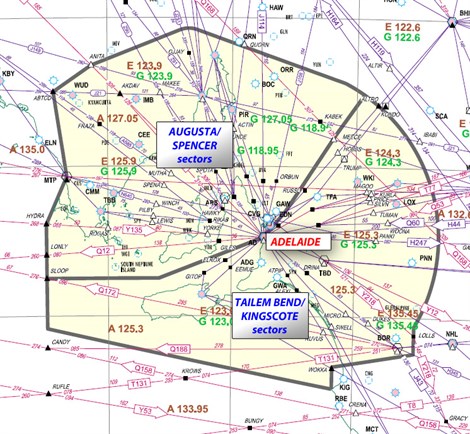
The ATSB identified a safety issue relating to the convergence of many published air routes overhead Adelaide, combined with the convergence point being positioned on the sector boundary of the Augusta and Tailem Bend sectors, which reduced the separation assurance provided by strategically separated one-way air routes and increased the potential requirement for controller intervention to assure separation.
What's been done as a result
Airservices Australia is undertaking a review of air routes and of the Australian airspace design that contributes to risk. There is also consideration to providing more flexible route structures using modern navigation technology to create traffic directional flows and remove convergence points.
In addition, Airservices undertook pro-active safety action associated with safety alerting and traffic avoidance advice by air traffic services.
Safety message
This occurrence is a reminder of the potential for skill-based errors to occur when experienced personnel are performing their tasks and highlights the importance of controllers following their normal processes to ensure traffic is assessed prior to providing control instructions.
Preliminary report
Report release date: 10/10/2013
This preliminary report details factual information established in the investigation’s early evidence collection phase and has been prepared to provide timely information to the industry and public. Preliminary reports contain no analysis or findings, which will be detailed in the investigation’s final report. The information contained in this preliminary report is released in accordance with section 25 of the Transport Safety Investigation Act 2003.
The occurrence
On 20 September 2013, a loss of separation1 occurred between an Airbus A330 aircraft, registered VH-EBO (EBO) operating a scheduled passenger service from Sydney, New South Wales to Perth, Western Australia, and an Airbus A330 aircraft, registered VH‑EBS (EBS), operating a scheduled passenger service from Perth to Sydney. Both aircraft were within radar surveillance coverage at the time of the occurrence.
At 1159:56 Eastern Standard Time2, following a handover/takeover, an air traffic controller in Airservices Australia’s Melbourne Centre accepted control jurisdiction for the Augusta and Spencer airspace sectors (Figure 1), which were permanently operated in a combined configuration. The Augusta/Spencer controller had previously been monitoring another controller who was conducting a familiarisation shift, following a period of leave, on the air traffic control (ATC) group’s other two sectors (Tailem Bend and Kingscote), which were also permanently combined. The Augusta/Spencer controller was preparing to also take over the Tailem Bend/Kingscote sectors on the same one console, as sector traffic levels and controller workloads were relatively low.
It was normal practice for all of the group’s sectors to be combined at that time of day due to low traffic levels.
Figure 1: Augusta/Spencer and Tailem Bend/Kingscote airspace sectors
Source: Airservices Australia. Image modified by the ATSB.
At the time the controller assumed control of the Augusta and Spencer sectors, EBS was within the Augusta/Spencer airspace at a position 140 NM (259 km) west of Adelaide, South Australia, eastbound on the one-way route Y135 at flight level (FL)3 390. EBO was within the adjoining eastern airspace (Tailem Bend/Kingscote), 79.6 NM (147 km) to the east of Adelaide and westbound at FL 380.
At 1210:15, EBO’s flight crew contacted the Augusta/Spencer controller as the aircraft approached the airspace boundary. The controller observed that the ATC computer system’s human machine interface prompts displayed on their screen provided a conflicting indication as to whether onwards coordination with the adjoining western sector (Forrest) controller had been completed. To assure that this coordination had been carried out, the Augusta/Spencer controller called the Forrest controller via the internal coordination line at 1211:34 and was advised that coordination had already been completed. In addition, the Forrest controller advised that they had no vertical restrictions for EBO. The Augusta/Spencer controller entered that information into the operational data line of the aircraft’s label in the ATC computer system, and then completed other tasks in preparation for assuming control of the Tailem Bend/Kingscote sectors.
At 1212:57, EBO’s flight crew requested climb from FL 380 to FL 400, which the controller immediately approved. This resulted in a loss of separation assurance4 between EBO and EBS as the vertical separation standard of 1,000 ft would not exist when the aircraft passed on their one-way routes at a point where there would be less than the required radar separation standard distance laterally of 5 NM (9.3 km).
At the time the climb request was approved, EBO was west of Adelaide and tracking in a westerly direction on the one-way air route designed Q12 (Figure 1). EBS was west of Adelaide, tracking in an easterly direction on one-way route Y135. On receipt of the level change clearance, EBO’s flight crew reported leaving FL 380 and recorded data from the aircraft showed that it commenced climbing at 1213:08.
At about 1213:32, before both the radar and vertical separation standards were infringed, the ATC system’s Short Term Conflict Alert (STCA) activated, alerting the controller to the imminent loss of separation between EBO and EBS. The controller immediately instructed EBO’s flight crew to maintain FL 380, which the crew acknowledged with advice that they were descending back to that level. Recorded data from EBO showed that the aircraft reached a maximum altitude of 38,350 ft at 1213:37.
Recorded data from EBS showed that, at 1213:27, the crew received a traffic advisory (TA)5 from their aircraft’s traffic collision avoidance system (TCAS)6 At 1213:37 the TA changed to a resolution advisory (RA),7 and at 1213:44 the EBS flight crew advised the controller that they were responding to an RA and the aircraft started to climb.
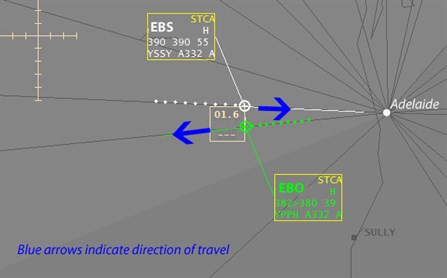
Recorded data from the two aircraft showed that the minimum vertical separation was 650 ft at 1213:37, when the two aircraft were 4.1 NM (8 km) apart laterally. The minimum lateral separation was 1.6 NM (3 km) at 1213:51, when the aircraft were 870 ft apart vertically (Figure 2). At that time both the vertical and lateral separation were increasing as the aircraft were on separate one-way routes. The vertical and radar separation standards were re-established a short time later.
Figure 2: Aircraft positions at 1213:53
Source: Airservices Australia. Image modified by the ATSB.
Note: Data in this figure is provided from the ATC system with a different level of resolution compared to the data provided from the aircraft’s recorders. The figures ‘55’ and ‘39’ refer to the ground speeds of the aircraft (divided by 10).
Air traffic control information
The Augusta/Spencer controller was initially rated as a controller in 2005. Prior to 20 September 2013, they had the previous 3 days off duty. They reported receiving a normal amount of sleep in the previous two nights, and they commenced their shift on 20 September at 0700.
Controllers reported that workload was relatively low at the time of the occurrence and that there were no operational distractions.
TCAS information
The flight crew of EBS reported that, at the time that the EBO flight crew requested clearance to climb to FL 400, they had acquired EBO visually and observed it on their TCAS display. They could see EBO was heading in the opposite direction and that it appeared to be on a diverging route. They also saw EBO climbing and diverging to the south on the TCAS display before receiving the TA and the RA.
Immediately following the occurrence, EBO’s flight crew advised the Augusta/Spencer controller that they did not receive any indications on their TCAS display of the presence of EBS. The flight crew later reported that they did not see EBS on their TCAS display, and they did not receive a TA or RA. They also reported not being able to see other aircraft on their TCAS display during the rest of their flight in situations where the other aircraft’s crews could see them, until reaching the Perth Terminal Area, where traffic returns were evident. They had been able to see other aircraft on departure from Sydney and there was no indication of a TCAS failure prior to the loss of separation event.
Examination of recorded data from EBO showed that no TA or RA was received. After the aircraft landed in Perth, a built-in test equipment (BITE) test was conducted on the TCAS with no faults indicated. A minimum equipment list (MEL)8 was applied for the unserviceable TCAS for the return flight to Sydney. A full system test was conducted in Sydney with a failure identified between ATC transponder 2 and the TCAS computer and TCAS antennas. The TCAS computer and ATC transponder 2 were replaced with spare units and a further system test carried out with nil faults detected.
Although all air transport aircraft are required to have a TCAS, on rare occasions the system can fail or lose functionality during a flight. In such situations a flight crew is usually provided with a fault message, and the flight crew are required to advise ATC. In addition, under specific conditions, aircraft are able to be dispatched for short periods of time without a serviceable TCAS.
Additional information
In high reliability systems, there are multiple risk controls in place to reduce the likelihood that safety-critical personnel will make an error. However, on rare occasions an error will still occur, and systems have additional risk controls in place to detect and recover from such errors, or mitigate the consequences of such errors. In this occurrence, one of these detection and recovery controls did not work effectively (that is, the TCAS on EBO). However, other risk controls were functioning effectively. These included the ATC STCA, EBS’s TCAS, and the use of one-way routes.
Further investigation
The investigation is continuing and will include:
further analysis of the ATC radar and audio data and the recorded data from the two aircraft
analysis of the context in which the controller’s actions occurred
examination of the TCAS computer and related components from VH-EBO
review of the reliability and availability rates of TCAS.
Purpose of safety investigations
The objective of a safety investigation is to enhance transport safety. This is done through:
identifying safety issues and facilitating safety action to address those issues
providing information about occurrences and their associated safety factors to facilitate learning within the transport industry.
It is not a function of the ATSB to apportion blame or provide a means for determining liability. At the same time, an investigation report must include factual material of sufficient weight to support the analysis and findings. At all times the ATSB endeavours to balance the use of material that could imply adverse comment with the need to properly explain what happened, and why, in a fair and unbiased manner. The ATSB does not investigate for the purpose of taking administrative, regulatory or criminal action.
Terminology
An explanation of terminology used in ATSB investigation reports is available here. This includes terms such as occurrence, contributing factor, other factor that increased risk, and safety issue.
Publishing information
Released in accordance with section 25 of the Transport Safety Investigation Act 2003
Ownership of intellectual property rights in this publication
Unless otherwise noted, copyright (and any other intellectual property rights, if any) in this report publication is owned by the Commonwealth of Australia.
Creative Commons licence
With the exception of the Coat of Arms, ATSB logo, and photos and graphics in which a third party holds copyright, this publication is licensed under a Creative Commons Attribution 3.0 Australia licence.
Creative Commons Attribution 3.0 Australia Licence is a standard form licence agreement that allows you to copy, distribute, transmit and adapt this publication provided that you attribute the work.
The ATSB’s preference is that you attribute this publication (and any material sourced from it) using the following wording: Source: Australian Transport Safety Bureau
Copyright in material obtained from other agencies, private individuals or organisations, belongs to those agencies, individuals or organisations. Where you wish to use their material, you will need to contact them directly.
_________
1 Controlled aircraft should be kept apart by at least a defined separation standard. If the relevant separation standard is infringed, this constitutes a loss of separation (LOS).
2 Eastern Standard Time (EST) was Coordinated Universal Time (UTC) + 10 hours.
3 At altitudes above 10,000 ft in Australia, an aircraft’s height above mean sea level is referred to as a flight level (FL). FL 390 equates to 39,000 ft.
4 Loss of separation assurance describes a situation where a separation standard existed but planned separation was not provided or separation was inappropriately or inadequately planned.
5 Traffic Collision Avoidance System Traffic Advisory, when a TA is issued, pilots are instructed to initiate a visual search for the traffic causing the TA.
6 Traffic collision avoidance system (TCAS) is an aircraft collision avoidance system. It monitors the airspace around an aircraft for other aircraft equipped with a corresponding active transponder and gives warning of possible collision risks.
7 Traffic Collision Avoidance System Resolution Advisory, when an RA is issued pilots are expected to respond immediately to the RA unless doing so would jeopardise the safe operation of the flight.
8 A minimum equipment list (MEL) is a list which provides the operation of aircraft, subject to specified conditions, with particular equipment inoperative.
________________
The information contained in this web update is released in accordance with section 25 of the Transport Safety Investigation Act 2003 and is derived from the initial investigation of the occurrence. Readers are cautioned that new evidence will become available as the investigation progresses that will enhance the ATSB's understanding of the accident as outlined in this web update. As such, no analysis or findings are included in this update.
In the evening of 4 July 2013 at 2040 Eastern Standard Time, a loss of separation occurred between an Airbus A320 operated by Jetstar, registered VH‑VFJ (VFJ), conducting a missed approach from a VOR approach to runway 36 at Avalon Airport, Victoria and a Bell 412, registered VH‑VAO (VAO), departing Avalon for Warrnambool, Victoria.
As the air traffic control tower at Avalon was closed, the airspace immediately above Avalon to a height of 700 ft was classified as Class G. From 700 ft to 4,500 ft the airspace was Class E, and above that was Class C. Air traffic services were being provided by a controller also responsible for Melbourne Departures. Aircraft in Class G were required to make broadcasts on the Common Traffic Advisory Frequency (CTAF). Due to the airspace configuration, pilots of IFR aircraft operating into and out of Avalon were required to monitor both the Avalon CTAF and the Avalon Approach frequency.
As a result of this occurrence, Jetstar has advised the ATSB that a technical newsletter will be sent to company flight crew highlighting the incident and emphasising the joint responsibility for maintaining separation assurance; providing guidance with regard to correct controller / flight crew interactions, specifically in relation to a clearance to leave and re-enter controlled airspace in the event of a missed approach at CTAFs with low overlying controlled airspace; and providing guidance with regard to controller expectation of the transfer of responsibility for separation from within the CTAF (on approach) to controlled airspace (in the event of a missed approach).
As a result of this occurrence, Airservices is currently undertaking a review of the risk profile associated with Avalon operations and airspace design. Of concern are the small layers of differing airspace classes with different service levels and frequency requirements. Pending the findings of the review, Airservices may request that the Civil Aviation Safety Authority (CASA) conduct an aeronautical study of the airspace surrounding Avalon Airport.
This incident demonstrates that, while expediting traffic is an important objective for a controller, safety must always be the first consideration. The incident also highlights the joint separation and communication responsibilities between flight crews and controllers in the Avalon airspace when Avalon Tower is not active.
Section 21 (2) of the Transport Safety Investigation Act 2003 (TSI Act) empowers the Australian Transport Safety Bureau (ATSB) to discontinue an investigation into a transport safety matter at any time. Section 21 (3) of the TSI Act requires the ATSB to publish a statement setting out the reasons for discontinuing an investigation.
What happened
On 29 November 2012, the ATSB commenced an investigation into a loss of separation involving two Qantas Airways Airbus A330s, registered VH-EBM (flying as QFA485) and VH-QPC (flying as QFA762). The loss of separation took place approximately 148 km east of Narrogin, Western Australia, on 28 November 2012 with the aircraft on crossing tracks.
VH-EBM was inbound to Perth maintaining flight level (FL) 380[1] and VH-QPC was outbound from Perth on climb to FL 410. A short-term conflict alert was received by the controller as VH-QPC climbed through FL 370, approximately 15 NM (about 28 km) before the aircraft passed.
In response, the controller initiated compromised separation recovery actions. During this recovery action, separation between the two aircraft reduced to 2.84 NM (5.26 km) laterally and 900 ft vertically. There were no traffic collision avoidance system[2] alerts.
In reviewing the information gathered during its investigation, the ATSB determined that there were no associated safety issues or elements of the occurrence that have not already been covered in detail in other recent air traffic-related investigations (see AO-2011-090, AO-2012-012 and AR‑2012‑034).[3] The controller in question had completed compromised separation recovery training and had 8 months consolidation on this sector following their initial rating and en route endorsement. There were no identified training, rostering, fatigue or staffing issues and sector handover/takeover was not a factor. While the controller involved had been under moderate to high workload earlier in the shift, the workload was low at the time of the occurrence and there was no evidence that distraction was a factor.
The controller was responsible for two airspace sectors at the time of the occurrence. Airservices Australia has since undertaken significant work in re-structuring the sectors in the airspace over Western Australia. Although the ATSB determined that required voice coordination between sectors was not completed by the controller in this occurrence, this did not affect the controller’s awareness of the traffic as he was already interacting with the aircraft that were involved in the occurrence.
The ATSB did not find any organisational or systemic issues that contributed to the occurrence or that might adversely affect the future safety of aviation operations. On that basis, the ATSB has decided to discontinue its investigation.
_______________________________
[1] At altitudes above 10,000 ft in Australia, an aircraft’s height above mean sea level is referred to as a flight level (FL). FL 380 equates to 38,000 ft.
[2] Traffic collision avoidance system (TCAS) is an aircraft collision avoidance system. It monitors the airspace around an aircraft for other aircraft equipped with a corresponding active transponder and gives warning of possible collision risks.