Loss of control

Loss of control involving a Bell 206L3, VH-BLV, Falls Creek, Victoria, on 20 July 2015

Final report

Report release date: 04/11/2015

What happened

On 20 July 2015, the pilot of a Bell 206L3 (Longranger) helicopter, registered VH-BLV (BLV), conducted a charter flight from Essendon Airport to Falls Creek, Victoria, with five passengers on board. The aircraft took off from Essendon close to its maximum take-off weight. Due to the weight, and therefore fuel limitations, the pilot landed and refuelled at a property near Lake Eildon. At about 1000 Eastern Standard Time (EST), the helicopter departed from the property for the 60 NM flight to Falls Creek, again close to its maximum take-off weight.

At about 1030, while 700 ft above ground level and tracking from the north-west, the pilot conducted a shallow approach towards the helipad at Falls Creek (Figure 1). As the helicopter descended to about 50 ft above ground level, the pilot found that significantly more power was required to conduct the approach than anticipated. The pilot assessed that there was insufficient power available to continue to land, and elected to abort the approach. The pilot pushed forwards on the cyclic[1] to increase the helicopter’s airspeed and conducted a left turn towards the valley.

Figure 1: Falls Creek helipad, approximate helicopter track and wind direction
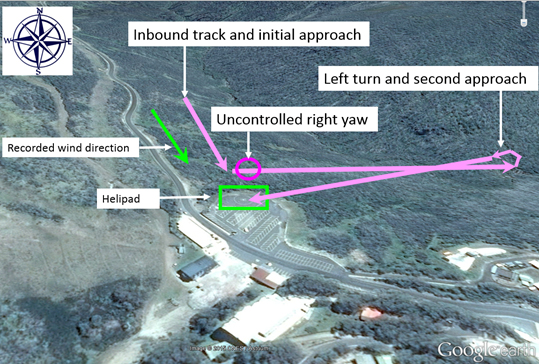
Figure 1: Falls Creek helipad, approximate helicopter track and wind direction

Source: Google earth and pilot recollection – annotated by the ATSB

As the helicopter turned left, it started to yaw[2] rapidly towards the right. The pilot applied full left pedal to counteract the yaw, but the helicopter continued to yaw. The helicopter turned through one and a half revolutions, as the pilot lowered the collective.[3] Lowering the collective reduced the power demand of the power rotor system, thereby increasing the ability of the anti-torque pedals to stop the right yaw. The combination of lowering collective and applying forward cyclic to gain forward airspeed, allowed the pilot to regain control of the helicopter. The pilot then conducted a left turn towards the helipad and made an approach to the helipad from an easterly direction. The helicopter landed following the second approach without further incident.

The pilot and passengers did not sustain any injuries and the helicopter was undamaged.

Weather

The pilot expected that the wind at Falls Creek would be variable at 2 kt, as it had been on departure from Essendon. The pilot did not see the windsock at the helipad prior to conducting the approach.

The Bureau of Meteorology provided the ATSB with a report of weather observations for Falls Creek. The automatic weather station is located south of the helipad at about 5,790 ft above mean sea level, above the village. Between 1020 and 1040, the recorded wind speed was from 17 to 20 kt, gusting to 24 kt, and wind direction was from 327° to 344° (degrees true), or 314° to 331° (degrees magnetic). The temperature was 1 °C.

Pilot comments

The pilot reported that the following combination of factors contributed to the incident:

  • Unfamiliarity with the landing site and area.
  • Inexperience operating at altitude, and unfamiliarity with the associated power requirements. The helipad at Falls Creek is at an elevation of about 5,000 ft above mean sea level.
  • Lack of experience in the aircraft type – although the pilot had about 60 hours experience in the Bell Jetranger, this was only the pilot’s second flight in the Longranger.
  • High all up weight.
  • Incorrect assessment of the wind direction – the pilot assumed that the wind would be light and variable at Falls Creek as it was had been on departure from Essendon. During the approach, the pilot assessed that the wind was from the right or a tailwind gusting to about 15 kt.

Operator comment

The operator of VH-BLV assessed that the unanticipated yaw was a result of too little pedal input, applied too late. This was most likely due to a combination of the pilot’s inexperience on the 206L3, and being surprised by the downwind approach.

Hover ceiling

Hovering requires more power than any other flight regime. Additionally, hovering at higher altitudes requires more power than to hover at lower altitudes. The ‘hover ceiling’ is the height at which the power available equals the power required to hover. An increase in power increases the main rotor torque. This additional torque needs increased tail rotor thrust, to prevent the helicopter from yawing.

The Bell 206 L3 flight manual provides a Hover ceiling – out of ground effect[4] chart. At 5,000 ft, a temperature of 0 °C, and a gross weight of about 1,814 kg (4,000 lb), the helicopter was just within the chart’s hover ceiling envelope. This indicates that adequate power should have been available to hover with those parameters. However, the wind direction and velocity also affect hovering performance.

A stronger head wind reduces the power required to hover, while a tailwind increases the power required to hover. On the initial approach to the helipad, a tailwind meant that an increase in power and tail rotor thrust was required. The increased tail rotor thrust absorbs power from the engine, which means less power is available for the main rotor to produce lift. This led to the pilot’s assessment of insufficient power available, and decision to discontinue the approach.

Unanticipated right yaw

The US Federal Aviation Administration (FAA) Helicopter flying handbook describes loss of tail rotor effectiveness (LTE) or an unanticipated yaw, as ‘an uncommanded, rapid yaw towards the advancing blade which does not subside of its own accord’. It is caused by an interaction between the main rotor and tail rotor.

At high altitudes, the lower air density reduces tail rotor thrust and efficiency. Therefore, when operating at high altitudes and high gross weights, particularly while hovering or at low airspeeds, the tail rotor thrust may not be sufficient to maintain directional control. This can result in unanticipated yaw or LTE. In these circumstances, the hover ceiling is effectively limited by the tail rotor thrust, rather than the power available.

In this incident, other factors may also have contributed to the unanticipated yaw: low and slow flight outside of ground effect, a low speed downwind turn and a large change of power at low airspeed as the pilot aborted the approach.

The US Federal Aviation Administration Advisory Circular, Unanticipated right yaw in helicopters, stated that unanticipated right yaw, or loss of tail rotor effectiveness (LTE) has been determined to be a contributing factor in a number of accidents. These mishaps have occurred at low altitude and in low-speed flight, often on final approach to landing. Unanticipated right yaw may occur during any manoeuvre in which the pilot is operating in a high-power, low-airspeed environment with a left crosswind (in aircraft with counter-clockwise blade rotation) or tailwind.

Three additional factors can significantly influence the severity of LTE:

  • gross weight and density altitude
  • low indicated airspeed
  • a rapid application of power, causing power droop.

In order to reduce the onset of LTE, when manoeuvring between hover and 30 kt, the pilot should:

  • Avoid tailwinds.
  • Avoid out of ground effect hover and high-power demand situations, such as low-speed downwind turns.
  • Be aware of wind direction and velocity. A loss of translational lift results in an unexpected high-power demand and an increased anti-torque requirement.
  • Be aware that if a considerable amount of left pedal is being maintained, a sufficient amount of left pedal may not be available to counteract an unanticipated right yaw.
  • Stay vigilant to power and wind conditions.

If a sudden unanticipated right yaw occurs, the pilot should:

  • apply full left pedal
  • simultaneously move cyclic forward to increase speed
  • if altitude permits, reduce power.

Safety message

Pilots should understand and avoid conditions that are conducive to uncontrolled yaw or loss of tail rotor effectiveness. Pilots can reduce their exposure to LTE by maintaining awareness of the wind and its effect on the helicopter. If a pilot encounters unanticipated yaw, quick application of the correct response is essential to recover control of the helicopter. The ATSB reported on an incident involving LTE in AO-2013-121.

This incident also highlights the effect of gross weight and airfield elevation on aircraft performance. Understanding controllability issues at the limits of the normal operating envelope can assist pilots in recognising the symptoms of reduced aircraft performance. Further information is available in ATSB report AO-2013-203.

Aviation Short Investigations Bulletin Issue 44

About this report

Decisions regarding whether to conduct an investigation, and the scope of an investigation, are based on many factors, including the level of safety benefit likely to be obtained from an investigation. For this occurrence, a limited-scope, fact-gathering investigation was conducted in order to produce a short summary report, and allow for greater industry awareness of potential safety issues and possible safety actions.

Publishing information 

Released in accordance with section 25 of the Transport Safety Investigation Act 2003

Published by: Australian Transport Safety Bureau

© Commonwealth of Australia 2015

image_5.png

Ownership of intellectual property rights in this publication

Unless otherwise noted, copyright (and any other intellectual property rights, if any) in this report publication is owned by the Commonwealth of Australia.

Creative Commons licence

With the exception of the Coat of Arms, ATSB logo, and photos and graphics in which a third party holds copyright, this publication is licensed under a Creative Commons Attribution 3.0 Australia licence.

Creative Commons Attribution 3.0 Australia Licence is a standard form licence agreement that allows you to copy, distribute, transmit and adapt this publication provided that you attribute the work.

The ATSB’s preference is that you attribute this publication (and any material sourced from it) using the following wording: Source: Australian Transport Safety Bureau

Copyright in material obtained from other agencies, private individuals or organisations, belongs to those agencies, individuals or organisations. Where you wish to use their material, you will need to contact them directly.

__________

  1. A primary helicopter flight control that is similar to an aircraft control column. Cyclic input tilts the main rotor disc varying the attitude of the helicopter and hence the lateral direction.
  2. Term used to describe motion of an aircraft about its vertical or normal axis.
  3. A primary helicopter flight control that simultaneously affects the pitch of all blades of a lifting rotor. Collective input is the main control for vertical velocity.
  4. Helicopters require more power to hover out of ground effect due to the absence of a cushioning effect created by the main rotor downwash striking the ground. The distance is usually defined as more than one main rotor diameter above the surface.


Occurrence summary

Investigation number AO-2015-091
Occurrence date 20/07/2015
Location Falls Creek (ALA)
State Victoria
Report release date 04/11/2015
Report status Final
Investigation level Short
Investigation type Occurrence Investigation
Investigation status Completed
Mode of transport Aviation
Aviation occurrence category Loss of control
Occurrence class Serious Incident
Highest injury level None

Aircraft details

Manufacturer Bell Helicopter Co
Model 206L-3
Registration VH-BLV
Serial number 51582
Sector Helicopter
Operation type Charter
Departure point Melbourne, Victoria
Destination Falls Creek, Victoria
Damage Nil

Collision on ground involving a Cessna A150L, VH-IEJ, Englefield, Victoria, on 14 November 1993

Summary

The pilot had planned to land the aircraft in a paddock on his father's property. During the attempted landing, the nose landing gear broke off and the aircraft overturned. Investigation revealed that the landing was attempted in a paddock covered in dense grass ranging from 500 to 700 millimetres in length. The density of the grass caused the nose gear to break off. The pilot said that he was "misinformed on strip conditions and unable to identify grass length" from the air.

Significant Factors

  • The surface condition of the landing area selected by the pilot was unsuitable for use as a landing area.
  • The pilot was unaware of the surface condition prior to attempting to land.

Occurrence summary

Investigation number 199303770
Occurrence date 14/11/1993
Location Englefield
State Victoria
Report release date 31/03/1994
Report status Final
Investigation type Occurrence Investigation
Investigation status Completed
Mode of transport Aviation
Aviation occurrence category Loss of control
Occurrence class Accident

Aircraft details

Manufacturer Cessna Aircraft Company
Model A150L
Registration VH-IEJ
Sector Piston
Operation type Private
Departure point Mount Gambier SA
Destination Englefield VIC
Damage Substantial

Collision with terrain involving a Cessna A188B/A1, VH-EYN, 40 km north-west of Ballidu, Western Australia, on 1 November 1993

Summary

Whilst returning from an aerial agriculture task, the Chief Pilot for the company elected to conduct some low flying over a lake. During this exercise, he misjudged his height, and the wheels contacted the water. The pilot lost control of the aircraft and it tipped over and came to rest inverted in the water. The pilot escaped without injury.

Occurrence summary

Investigation number 199303570
Occurrence date 01/11/1993
Location 40 km north-west of Ballidu
State Western Australia
Report release date 24/03/1994
Report status Final
Investigation type Occurrence Investigation
Investigation status Completed
Mode of transport Aviation
Aviation occurrence category Collision with terrain, Loss of control
Occurrence class Accident

Aircraft details

Manufacturer Cessna Aircraft Company
Model A188B/A1
Registration VH-EYN
Sector Piston
Operation type Aerial Work
Departure point Waterloo WA
Destination Ballidu WA
Damage Substantial

Collision with terrain involving a Piper PA-36-375, VH-AFE, 20 km south of Coleambally, New South Wales, on 22 October 1993

Summary

The aircraft was to carry out insecticide spraying operations at a rice farm. The pilot made an approach to the airstrip from the south, with a tail wind of about 3 kts. The pilot said that, shortly after touchdown, he observed cattle straying near the edge of the strip and elected to go-around. As the aircraft became airborne the right main landing gear struck an adjacent levee bank. The impact detached the gear leg which then struck the right horizontal stabilizer, detaching the elevator. The pilot said that, by remaining in ground effect, he was able to complete a right circuit and land the aircraft back on the strip. On touchdown, directional control was lost and the aircraft ground looped, colliding with large water pipes and associated equipment.

Occurrence summary

Investigation number 199303539
Occurrence date 22/10/1993
Location 20 km south of Coleambally
State New South Wales
Report release date 05/04/1994
Report status Final
Investigation type Occurrence Investigation
Investigation status Completed
Mode of transport Aviation
Aviation occurrence category Collision with terrain, Loss of control
Occurrence class Accident

Aircraft details

Manufacturer Piper Aircraft Corp
Model PA-36-375
Registration VH-AFE
Sector Piston
Operation type Aerial Work
Departure point Farm 115 Coleambally NSW
Destination Farm 598 Coleambally NSW
Damage Destroyed

Collision on ground involving a Cessna A188B/A1, VH-UWH, 10 km north-west of Esperance Airport, Western Australia, on 21 August 1993

Summary

The pilot was landing the aircraft on a strip beside a paddock of barley. The right wing tip became entangled in the barley causing the aircraft to ground loop.

Occurrence summary

Investigation number 199302624
Occurrence date 21/08/1993
Location 10 km north-west of Esperance Airport
State Western Australia
Report release date 23/08/1993
Report status Final
Investigation type Occurrence Investigation
Investigation status Completed
Mode of transport Aviation
Aviation occurrence category Ground strike, Loss of control
Occurrence class Accident

Aircraft details

Manufacturer Cessna Aircraft Company
Model A188B/A1
Registration VH-UWH
Sector Piston
Departure point 10 km NW Esperance Airport
Destination 10 km NW Esperance Airport
Damage Substantial

Runway excursion involving a Cessna T210N, VH-ZAC, Springridge 30 km north-west of Quirindi, New South Wales, on 13 June 1993

Summary

The pilot travelled to his property on a regular basis. As seven inches of rain had fallen in the previous five days, the strip on the pilot's property was unserviceable due to the surface being soft. The pilot decided to land on a nearby strip which had a gravel surface and was not rain affected. This strip was aligned north south.

On arrival overhead the strip, the pilot assessed the wind velocity as westerly at 10 knots and gusty. He positioned the aircraft to land into the north. After touchdown the aircraft was struck by a severe wind gust which caused the aircraft to become airborne, bank to the right and drift to the right off the gravel surface. The aircraft touched down on soft cultivated land and overturned.

Occurrence summary

Investigation number 199301759
Occurrence date 13/06/1993
Location Springridge 30 km north-west of Quirindi
State New South Wales
Report release date 12/08/1993
Report status Final
Investigation type Occurrence Investigation
Investigation status Completed
Mode of transport Aviation
Aviation occurrence category Loss of control, Runway excursion
Occurrence class Accident

Aircraft details

Manufacturer Cessna Aircraft Company
Model T210N
Registration VH-ZAC
Sector Piston
Operation type Private
Departure point Bankstown NSW
Destination 30km NW Qurindi NSW
Damage Substantial

Fuel contamination involving a Robinson R22 Alpha, VH-HBW, Jim Lewis Waterhole, Kurundi Station, Northern Territory, on 4 June 1993

Summary

The helicopter had been used for mustering throughout the day and had been refuelled from drums.

When the mustering was completed the last 15 litres from a partly used drum was pumped into the auxiliary fuel tank of the helicopter. Fuel samples were taken from the main tank and filter and the helicopter flown to nearby stockyards.

After a short time on the ground, the helicopter departed for the station homestead, about 37 km away. Approximately 10-15 minutes after refuelling, while cruising at 200-250 feet above ground level, the engine began to run roughly, and the rotor RPM began to decay. The pilot lowered the collective control and the engine stopped.

The helicopter was flying downwind in a 20-30 knot wind and the pilot was committed to a downwind autorotational landing. Touchdown was at 20-30 knots on rough ground made heavy by recent rains. The skids dug in and the helicopter nosed over and was substantially damaged. The pilot was uninjured and walked to the homestead for assistance.

Subsequent inspection by recovery personnel revealed water and dirt in the fuel filters.

Occurrence summary

Investigation number 199301632
Occurrence date 04/06/1993
Location Jim Lewis Waterhole, Kurundi Station
State Northern Territory
Report release date 28/03/1994
Report status Final
Investigation type Occurrence Investigation
Investigation status Completed
Mode of transport Aviation
Aviation occurrence category Fuel contamination, Loss of control
Occurrence class Accident

Aircraft details

Manufacturer Robinson Helicopter Co
Model R22 Alpha
Registration VH-HBW
Sector Helicopter
Operation type Aerial Work
Departure point Kurundi Station NT
Destination Kurundi Station NT
Damage Substantial

Loss of control involving a Hughes Helicopters 269C, VH-THY, 45 km east of Derby, Western Australia, on 2 June 1993

Summary

The aircraft was engaged in aerial mustering operations. Whilst landing to disembark the passenger the pilot experienced intermittent cyclic control problems. He then took off again and during the next 5 to 10 minutes of cattle mustering he tested the cyclic control, but response was normal. A short time later, as the helicopter approached touchdown to re-embark the passenger, all cyclic control was lost. To avoid hitting the waiting passenger the pilot applied power to go around but was unable to control the helicopter's flight path and it impacted the ground nose first.

Inspection of the wreckage revealed that the cyclic control column had fractured at the location of the electrical wiring access hole near the base of the column. The fracture was caused by fatigue crack growth. The access hole had been elongated by mechanical filing and the fatigue origins were located at these abrasion damage sites.

Safety Action

The following interim recommendation was sent to the Civil Aviation Authority on 22 June 1993:

IR930094

That the Civil Aviation Authority advise all operators of this failure and mandate an inspection of the cyclic control column electrical loom access hole to ensure control column integrity.

The CAA in response issued AD/HU-269/102 on 2 August 1993.

Subsequently, results of finite element stress analysis of the failed cyclic pitch control column indicated that material yielding, at the lower electrical loom access hole, occurs below the design limit load. Evaluation of this cyclic control column design is being considered by the Civil Aviation Authority in consultation with the Federal Aviation Administration and the aircraft manufacturer.

Occurrence summary

Investigation number 199301585
Occurrence date 02/06/1993
Location 45 km east of Derby
State Western Australia
Report release date 20/02/1996
Report status Final
Investigation type Occurrence Investigation
Investigation status Completed
Mode of transport Aviation
Aviation occurrence category Loss of control
Occurrence class Accident
Highest injury level Serious

Aircraft details

Manufacturer Hughes Helicopters
Model 269C
Registration VH-THY
Sector Helicopter
Operation type Aerial Work
Departure point Meda Station WA
Destination Meda Station WA
Damage Substantial

Loss of control involving an Extra EA 300, VH-OOE, Bankstown, New South Wales, on 4 March 1993

Summary

During the landing roll the right wheel brake failed to function. The pilot was unable to maintain directional control, resulting in a ground loop, during which slight damage to the left landing gear strut and right wingtip occurred.

Air in the right brake line rendered the right brake ineffective. It was not determined how the air was admitted to the system as no maintenance had been performed on the system since the aircraft had been delivered from the factory.

Occurrence summary

Investigation number 199300368
Occurrence date 04/03/1993
Location Bankstown
State New South Wales
Report release date 13/07/1993
Report status Final
Investigation type Occurrence Investigation
Investigation status Completed
Mode of transport Aviation
Aviation occurrence category Landing gear/indication, Loss of control
Occurrence class Accident

Aircraft details

Manufacturer Extra-Flugzeugbau GmbH
Model EA 300
Registration VH-OOE
Sector Piston
Operation type Private
Departure point Bankstown NSW
Destination Bankstown NSW
Damage Substantial

Operational event involving a Druine, Avion Roger D31, VH-PWH, Warracknabeal, Victoria, on 29 January 1993

Summary

The pilot inspected part of strip 17 and found it to be dry and firm. He took off on sealed strip 08. Later he landed on 17. Near the end of the landing roll the main wheels sank in a softer area and the aircraft overturned. This happened in an area the pilot had not checked on his inspection.

Occurrence summary

Investigation number 199300355
Occurrence date 29/01/1993
Location Warracknabeal
State Victoria
Report release date 26/05/1993
Report status Final
Investigation type Occurrence Investigation
Investigation status Completed
Mode of transport Aviation
Aviation occurrence category Loss of control
Occurrence class Incident

Aircraft details

Model Druine, Avion Roger D31
Registration VH-PWH
Sector Piston
Operation type Private
Departure point Warracknabeal VIC
Destination Warracknabeal VIC
Damage Minor