

Report release date: 27/10/2026
| Occurrence Briefs are concise reports that detail the facts surrounding a transport safety occurrence, as received in the initial notification and any follow-up enquiries. They provide an opportunity to share safety messages in the absence of an investigation. Because occurrence briefs are not investigations under the Transport Safety Investigation Act 2003, the information in them is de-identified. |
What happened
On the morning of 21 August 2026, the pilot prepared a Eurocopter AS 350 helicopter for a personal transport flight, under the day visual flight rules,1 from a private property to the Hunter Falls in the Jardine River National Park, Queensland. The pilot completed a pre‑flight inspection which included a visual check of a minor blade repair which was undertaken during a recent periodic inspection. Since the repair, the helicopter had flown about 21 hours without incident and the pilot recalled that no defects were observed with the repair during the inspection.
The flight departed at about 1200 local time with the pilot and 3 passengers on board. After arriving at Hunter Falls the pilot conducted an orbit of the easternmost falls. While manoeuvring the helicopter towards the westernmost falls they detected a mild vibration through the cyclic.2 Conscious of the recent repair, the pilot thought it prudent to conduct a precautionary landing to check the helicopter for the source of the vibration. The falls were surrounded by vegetation with limited suitable areas for a landing, however one such site was identified at the top of the westernmost falls (Figure 1).
Figure 1: Flight path
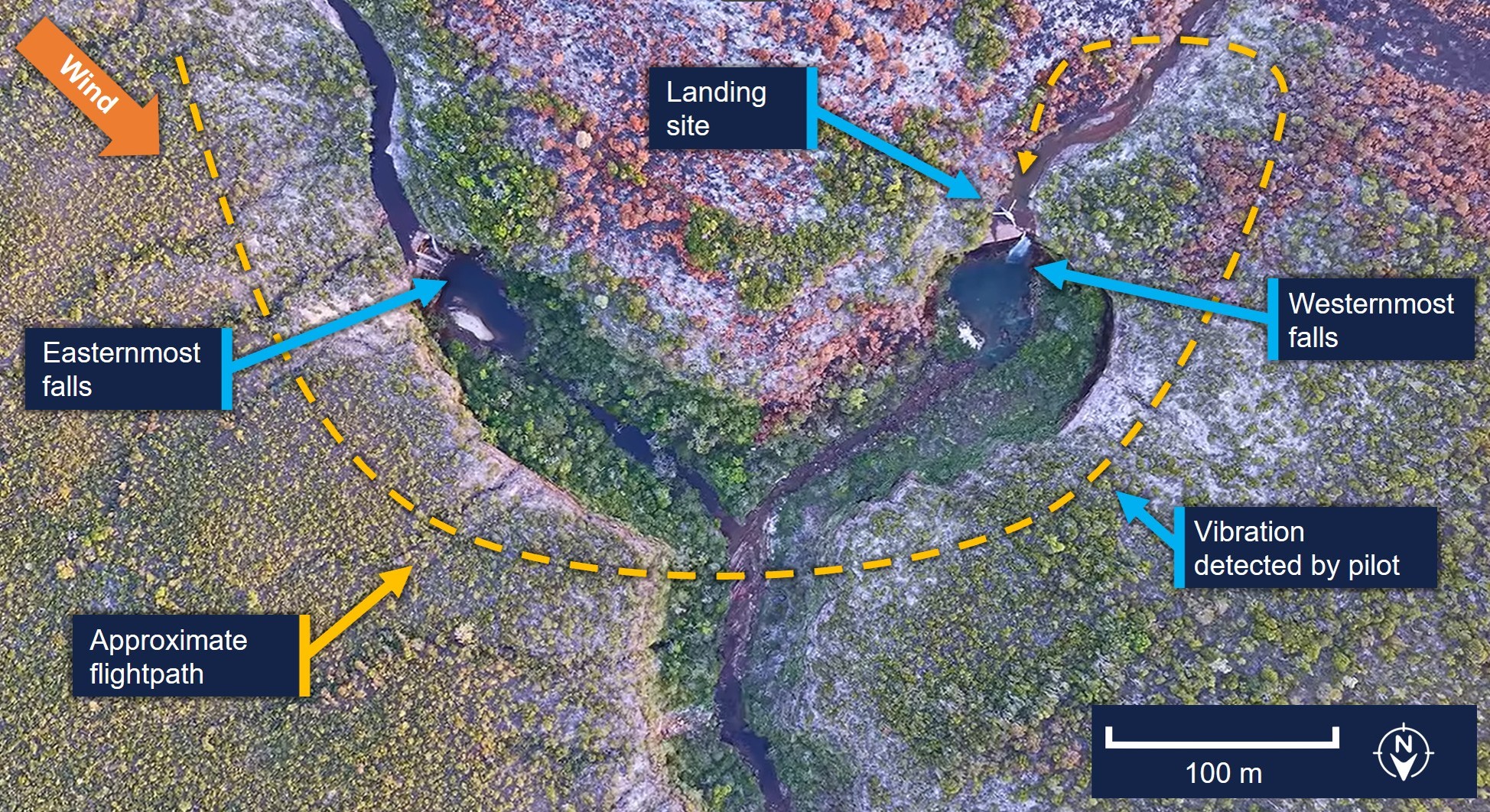
To expedite the landing, the pilot elected to conduct a downwind approach to the clear area at the top of the western falls. The pilot recalled this required additional control inputs to manage the tailwind, however they did not experience any difficulty maintaining control.
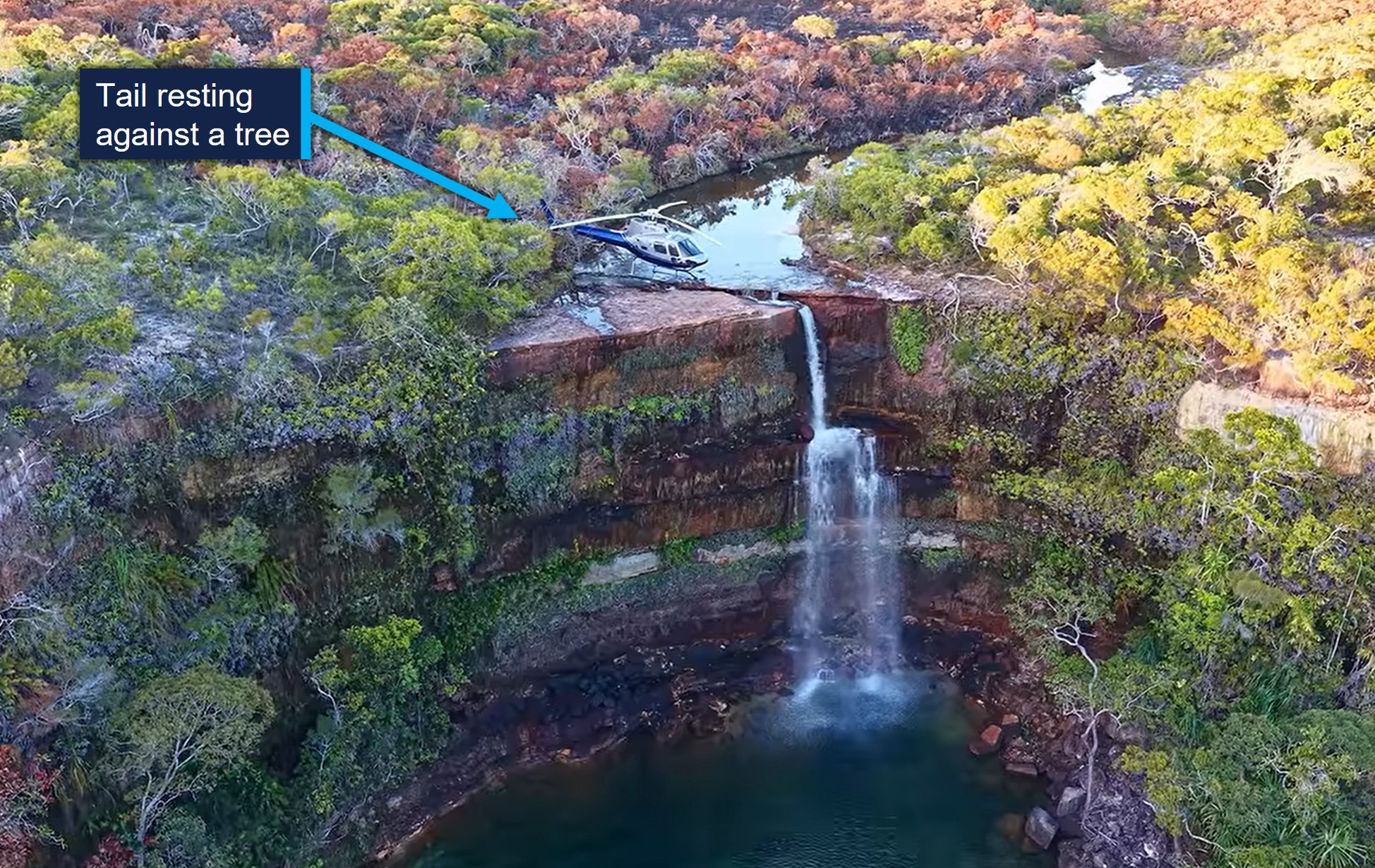
As the helicopter approached the landing site the pilot assessed there was enough room to land and that the main rotors would pass clear of the trees. However, at about 5 ft above the ground, the main rotor blades contacted a small tree and the helicopter began to buck fore and aft, and side to side, edging towards the rock ledge of the waterfall. The pilot shifted their focus to landing as soon as possible while managing the oscillating and erratic movements of the helicopter in close proximity to trees. After placing the skids on the rocky surface, the helicopter tail swung counter-clockwise coming to rest against a small tree (Figure 2). The occupants of the helicopter were uninjured. The helicopter sustained significant damage to the main rotor blades and tail rotor blades, with minor damage to the lower section of the vertical stabiliser and the right horizontal stabiliser.
Figure 2: Landing site
Safety message
Precautionary landings in response to abnormal indications often require the pilot to land as soon as possible. When flying over bushland, the first suitable location may be an unfamiliar, unprepared and confined landing site. A full assessment of the site may not always be possible, especially when managing a technical fault. While the main rotor clearance was misjudged on this occasion, the prompt decision‑making of the pilot ensured the flight was terminated before the abnormal indications could progress to a potentially more serious condition.
CASA guidance in Advisory Circular AC 91-29 Guidelines for helicopters – suitable places to take off and land provides recommended minimum standard safety margins for the selection of and operation at confined landing sites.
About this report
Decisions regarding whether to conduct an investigation, and the scope of an investigation, are based on many factors, including the level of safety benefit likely to be obtained from an investigation. For this occurrence, no investigation has been conducted and the ATSB did not verify the accuracy of the information. A brief description has been written using information supplied in the notification and any follow-up information in order to produce a short summary report, and allow for greater industry awareness of potential safety issues and possible safety actions.
- ^ Visual flight rules (VFR): a set of regulations that permit a pilot to operate an aircraft only in weather conditions generally clear enough to allow the pilot to see where the aircraft is going
^ Cyclic: a primary helicopter flight control that is similar to an aircraft control column. Cyclic input tilts the main rotor
disc, varying the attitude of the helicopter and hence the lateral direction
Occurrence summary
| Mode of transport | Aviation |
|---|---|
| Occurrence ID | AB-2026-051 |
| Occurrence date | 21/08/2026 |
| Location | 70 km south-west of Northern Peninsula Airport |
| State | Queensland |
| Occurrence class | Accident |
| Aviation occurrence category | Airframe - Other, Collision with terrain, Forced/precautionary landing, Loss of control |
| Highest injury level | None |
| Brief release date | 27/10/2026 |
Aircraft details
| Manufacturer | Eurocopter |
|---|---|
| Model | AS 350 B2 |
| Sector | Helicopter |
| Operation type | Part 91 General operating and flight rules |
| Activity | General aviation / Recreational-Sport and pleasure flying-Pleasure and personal transport |
| Departure point | Haggerstone Island, Queensland |
| Destination | Haggerstone Island, Queensland |
| Injuries | None |
| Damage | Substantial |