

Report release date: 19/10/2026
| Occurrence Briefs are concise reports that detail the facts surrounding a transport safety occurrence, as received in the initial notification and any follow-up enquiries. They provide an opportunity to share safety messages in the absence of an investigation. Because occurrence briefs are not investigations under the Transport Safety Investigation Act 2003, the information in them is de-identified. |
What happened
On the morning of 20 August 2026 a Beechcraft 1900D, operating under the instrument flight rules (IFR), with 2 flight crew and 10 passengers on board, departed Perth, Western Australia, on a non-scheduled passenger transport flight to a regional aircraft landing area (ALA).
The weather at Perth Airport at the time of the occurrence was 5 kt wind from the east, greater than 10 km visibility, and cloud cover was few1 at 3,400ft and broken at 5,600 ft.
After the departure from Perth, as the aircraft climbed and approached flight level (FL) 210, the flight crew heard a loud bang immediately followed by the rapid depressurisation of the cabin (Figure 1).
Figure 1: Flight path
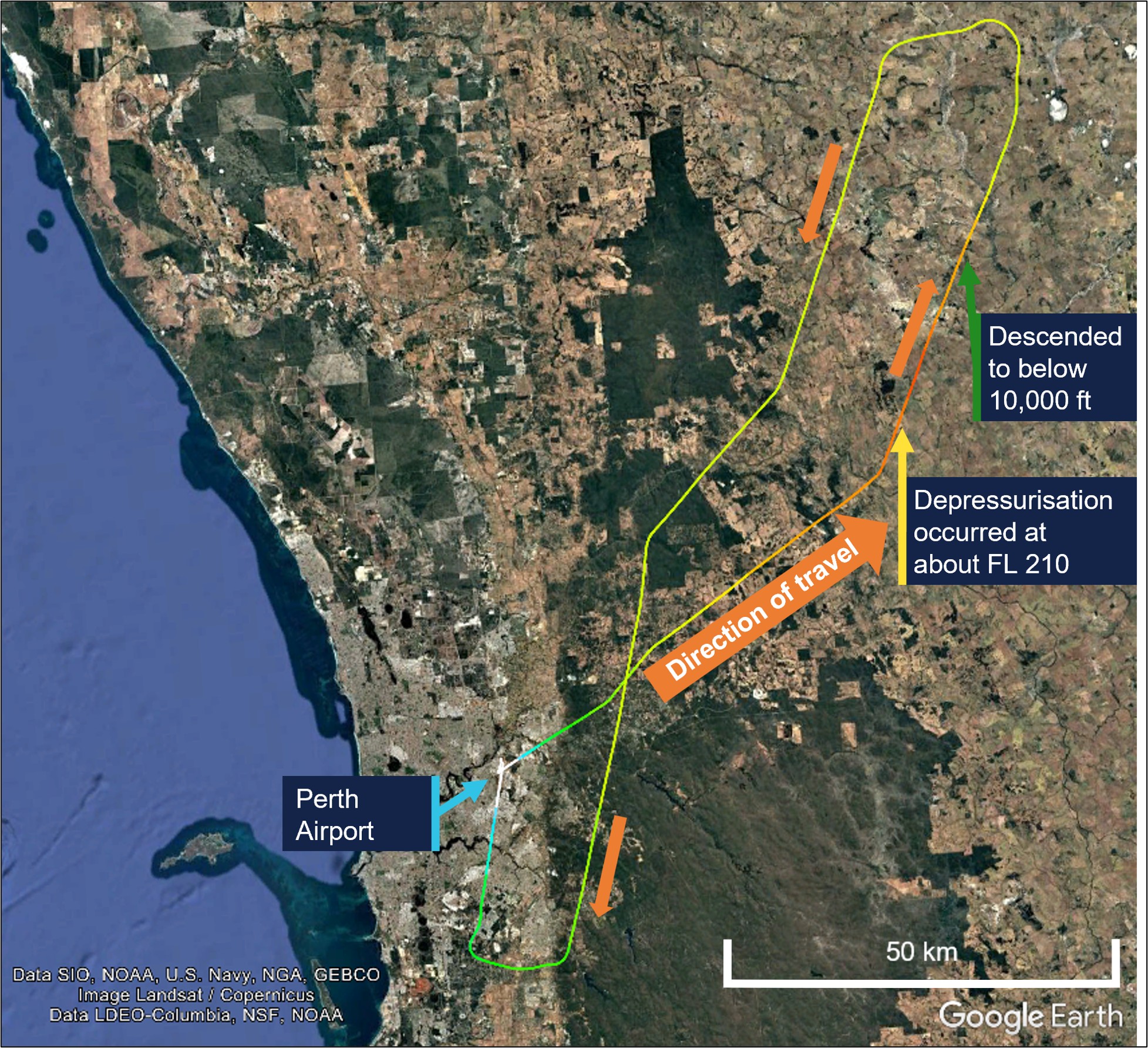
The flight crew donned oxygen masks, established communications with one another then commenced an immediate descent to FL100.2 A MAYDAY call was made to air traffic control (ATC) and the flight crew advised ATC that they had experienced a rapid depressurisation and were commencing an emergency descent. The flight crew then actioned the relevant checklists.
After levelling off at FL100, the flight crew advised ATC that they were returning to Perth Airport, at which point ATC then cleared the aircraft to descend further to 9,000 ft.
Once at 9,000 ft, the flight crew removed their oxygen masks and commenced preparation for a return to Perth, including advising passengers that it was safe to remove their oxygen masks.
During this time the flight crew also identified the reason for the depressurisation was a ruptured cabin window.
Whilst inbound to Perth the pilots downgraded the MAYDAY to a PAN-PAN3 call and advised ATC that no assistance was required on arrival. They then flew a normal arrival into Perth, followed by a safe landing. No injuries were reported by the passengers or pilots, and no medical assistance was required.
Following the occurrence the operator inspected the aircraft and established that the single-pane right-hand side window at seat 7C had failed. Seat 7C was unoccupied for this flight.
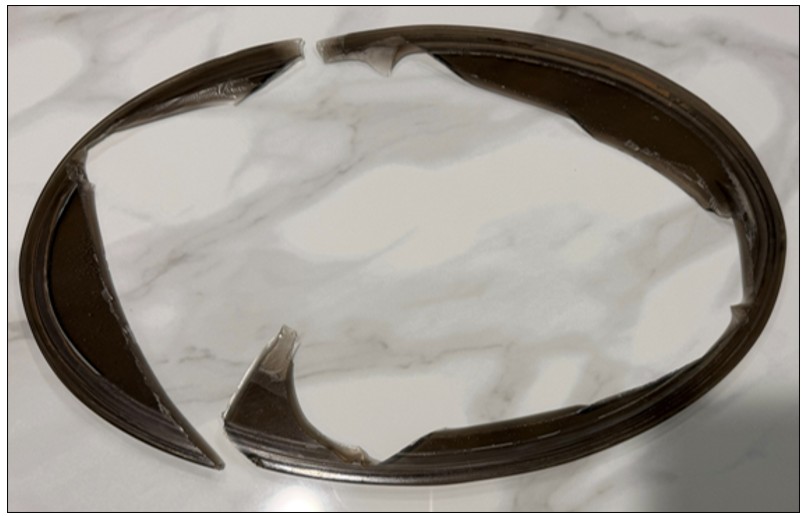
The operator suspected a crack in the window pane had resulted in it failing in‑flight. Most of the window was not recovered however its outer edge remained in place (Figure 2).
Figure 2: Remnants of the window after removal
The associated window frame that forms part of the aircraft fuselage was found to be serviceable.
The failed window was replaced, and as a precautionary measure, all remaining cabin windows on the aircraft were also replaced. The associated window frames were inspected and found to be serviceable.
During this activity, the removed window panes were inspected for defects. A crack was identified in another window on the right-hand side of the aircraft, localised to the window’s inner region. A third window was found to have a crack in its outer edge.
Safety action
The operator removed, inspected and replaced all the cabin windows in the aircraft.
Safety message
This incident provides a positive example of the importance of effective training and procedures in responding to an in-flight emergency.
In this instance, faced with a depressurisation event that required an immediate response, the flight crew responded decisively and appropriately in accordance with their training and procedures.
Additionally, although not evaluated by the ATSB for relevance to this occurrence, a similar event, involving the failure of a cabin window on the right-hand side of the fuselage occurred in South Africa on 22 October 2018. The South African Civil Aviation Authority’s investigation report into this accident made a recommendation for inspections to be carried out on all cabin windows in Beechcraft 1900D aircraft.
About this report
Decisions regarding whether to conduct an investigation, and the scope of an investigation, are based on many factors, including the level of safety benefit likely to be obtained from an investigation. For this occurrence, no investigation has been conducted and the ATSB did not verify the accuracy of the information. A brief description has been written using information supplied in the notification and any follow-up information in order to produce a short summary report, and allow for greater industry awareness of potential safety issues and possible safety actions.
- ^ Cloud cover is reported using words that denote the extent of the cover: ‘few’ indicates that up to a quarter of the sky is covered, and ‘broken’ indicates that more than half to almost all the sky is covered.
- ^ An altitude where supplementary oxygen is not required.
- ^ In the event of an in-flight emergency, pilots call ‘MAYDAY’ or ‘PAN-PAN’ to air traffic control to alert controllers to the severity of the incident. A ‘mayday’ call indicates an aircraft is in grave and imminent danger and requires immediate assistance. A ‘pan’ call is used to describe a less urgent situation but one that still requires attention from air traffic control.
Occurrence summary
| Mode of transport | Aviation |
|---|---|
| Occurrence ID | AB-2026-046 |
| Occurrence date | 20/08/2026 |
| Location | 80 km north-east of Perth Airport |
| State | Western Australia |
| Occurrence class | Serious Incident |
| Aviation occurrence category | Air/pressurisation, Depressurisation, Diversion/return, Emergency/precautionary descent, Windows |
| Highest injury level | None |
| Brief release date | 19/10/2026 |
Aircraft details
| Manufacturer | Beech Aircraft Corp |
|---|---|
| Model | 1900D |
| Sector | Turboprop |
| Operation type | Part 121 Air transport operations - larger aeroplanes |
| Activity | Commercial air transport-Non-scheduled-Passenger transport charters |
| Departure point | Aircraft Landing Area, Western Australia |
| Destination | Perth Airport, Western Australia |
| Injuries | None |
| Damage | Minor |