

Report release date: 30/07/2026
| Occurrence Briefs are concise reports that detail the facts surrounding a transport safety occurrence, as received in the initial notification and any follow-up enquiries. They provide an opportunity to share safety messages in the absence of an investigation. Because occurrence briefs are not investigations under the Transport Safety Investigation Act 2003, the information in them is de-identified. |
What happened
On the evening of 6 July 2026, about 10 minutes before last light, a Raytheon (Beechcraft) A36, with the pilot and one passenger on board, departed South Grafton Aerodrome for Bankstown Airport, New South Wales. The flight was conducted under the instrument flight rules (IFR).
Prior to departure, the pilot reviewed the graphical area forecast (GAF) and planned for a cruise altitude of 8,000 ft, thinking this was above the freezing level (FZL). However, the pilot later realised that they had mistaken the northern section (FZL above 7,000 ft) for the southern section (FZL above 9,000 ft), as the northern GAF section usually had a higher FZL.
After departure, the pilot initially climbed to 8,000 ft (Figure 1). Once established in the cruise, and clear of cloud, the pilot observed the outside air temperature was 1–2°C. Then, approximately 30 minutes after departure, the pilot requested a clearance from air traffic control (ATC) for a further climb to 10,000 ft, seeking more favourable winds.
Figure 1: Approximate flight path and sequence of events
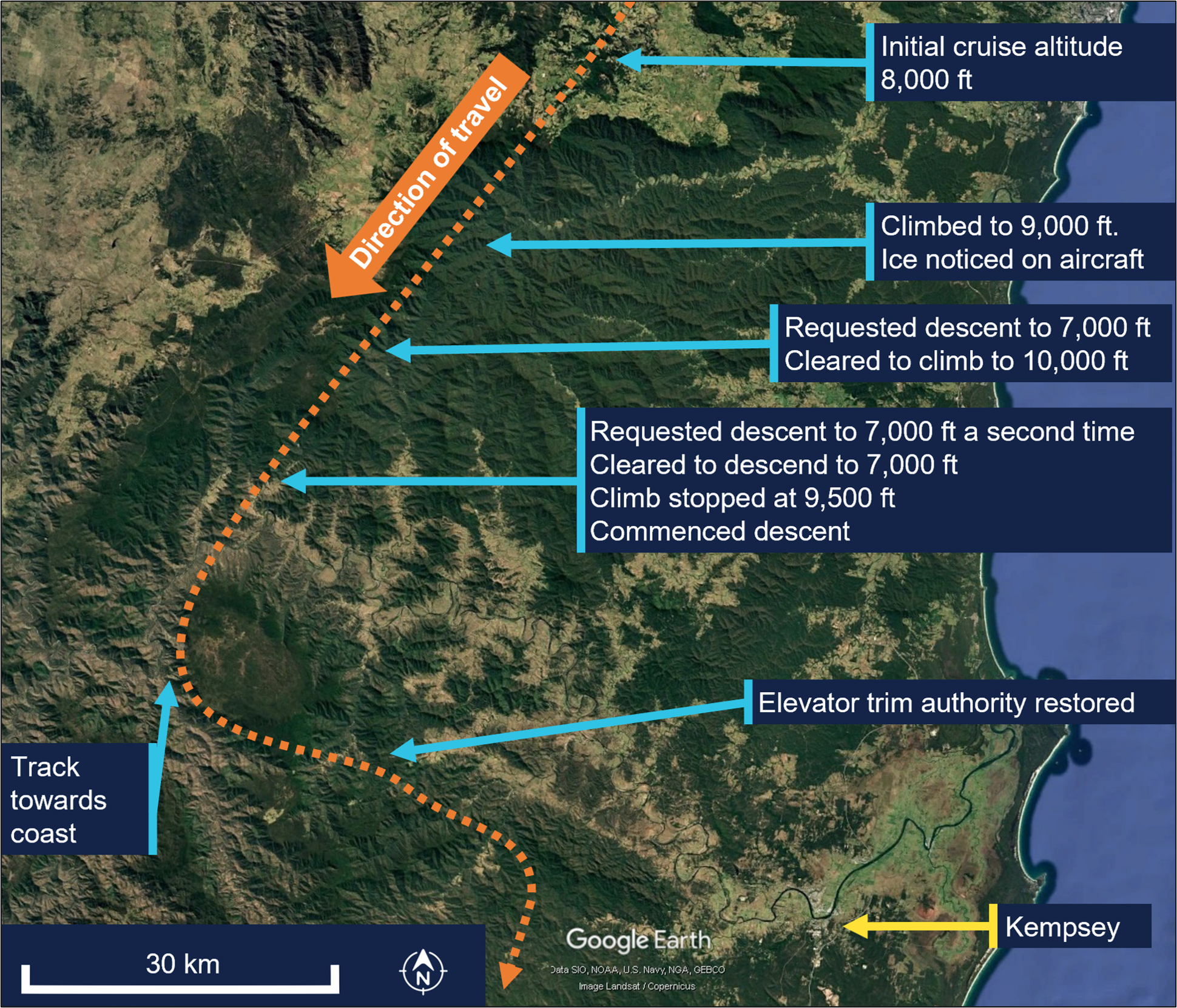
While awaiting clearance from ATC, the aircraft entered cloud. ATC cleared the pilot to climb to 9,000 ft and during the climb, the pilot noticed ice developing on the windscreen and port wing leading edge of the aircraft.
At 9,000 ft, the pilot advised ATC of the presence of ice on the aircraft and requested a descent to 7,000 ft (to warmer air).
ATC then offered the pilot a further climb to 10,000 ft (in accordance with the previous request), which the pilot accepted. During this subsequent climb, the pilot became concerned that ice was continuing to accumulate on the aircraft, prompting them to again request a descent to 7,000 ft, which ATC granted.
The pilot then stopped the climb at about 9,500 ft and commenced a descent. As the pilot attempted to re-trim the aircraft for descent, the elevator trim did not respond to the control inputs, which the pilot attributed to a likely build-up of ice on the control surface. To overcome this controllability issue and execute the descent, the pilot pushed ‘heavily’ on the control column (with both hands) and reduced the engine power. The pilot obtained further altitude clearances from ATC and, respecting the lowest safe altitude requirements, continued their descent to a final cruise altitude of 5,000 ft.
Elevator trim authority was regained at approximately 6,000 ft, while tracking east towards the coast. The pilot then continued to their destination.
Safety message
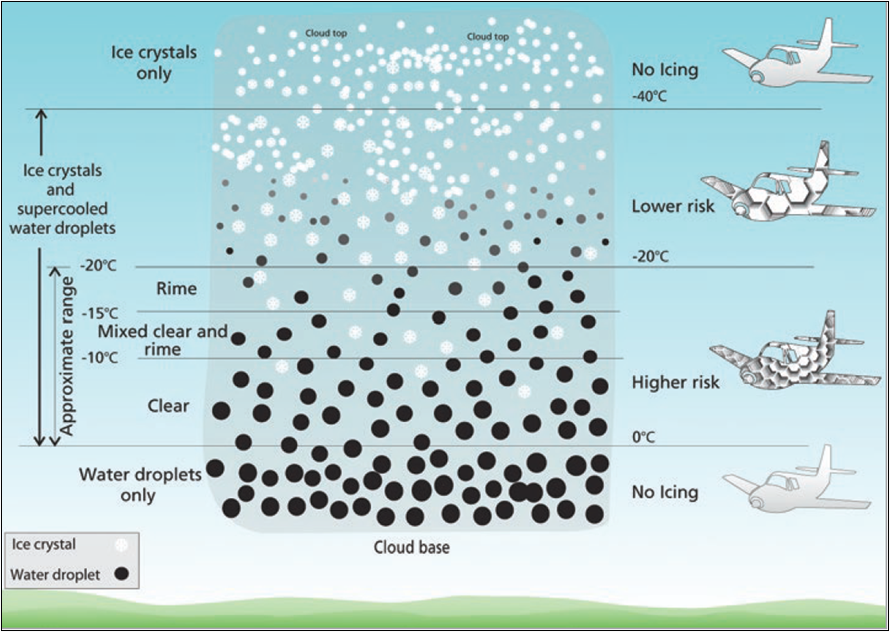
The Bureau of Meteorology has produced educational guidance on the hazards associated with airframe icing. This guidance explains that icing conditions are present when the aircraft is in visible moisture with temperatures conducive to icing. The aircraft’s susceptibility to icing can vary, and pilots need to be aware of their aircraft’s flight manual limitations.1 The highest risk of icing is identified at temperatures between 0°C and −20°C (Figure 2).
Figure 2: Icing conditions
Pilots should monitor the outside air temperature and stay alert to the possibility of icing while operating in visible moisture and low temperatures. The United States Federal Aviation Administration recommends:2
When icing is detected, a pilot should do one of two things, particularly if the aircraft is not equipped with deicing equipment: leave the area of precipitation or go to an altitude where the temperature is above freezing. This “warmer” altitude may not always be a lower altitude… If neither option is available, consider an immediate landing at the nearest suitable airport.
If a situation affects the safety of their aircraft, it is important pilots clearly advise ATC of the nature and severity of the issue, such as through an urgency notification (‘PAN‑PAN’), so that ATC can prioritise clearance to a warmer altitude or provide other support. The Airservices Safety Bulletin What happens when I declare an emergency? provides further information.
About this report
Decisions regarding whether to conduct an investigation, and the scope of an investigation, are based on many factors, including the level of safety benefit likely to be obtained from an investigation. For this occurrence, no investigation has been conducted and the ATSB did not verify the accuracy of the information. A brief description has been written using information supplied in the notification and any follow-up information in order to produce a short summary report, and allow for greater industry awareness of potential safety issues and possible safety actions.
Occurrence summary
| Mode of transport | Aviation |
|---|---|
| Occurrence ID | AB-2026-040 |
| Occurrence date | 06/07/2026 |
| Location | 56 km south-west of Armidale Airport |
| State | New South Wales |
| Occurrence class | Serious Incident |
| Aviation occurrence category | Control issues, Emergency/precautionary descent, Icing |
| Highest injury level | None |
| Brief release date | 30/07/2026 |
Aircraft details
| Manufacturer | Raytheon Aircraft Company |
|---|---|
| Model | A36 |
| Sector | Piston |
| Operation type | Part 91 General operating and flight rules |
| Activity | General aviation / Recreational-Sport and pleasure flying-Pleasure and personal transport |
| Departure point | South Grafton Aerodrome, New South Wales |
| Destination | Bankstown Airport, New South Wales |
| Injuries | None |
| Damage | Nil |