

Report release date: 03/08/2026
| Occurrence Briefs are concise reports that detail the facts surrounding a transport safety occurrence, as received in the initial notification and any follow-up enquiries. They provide an opportunity to share safety messages in the absence of an investigation. Because occurrence briefs are not investigations under the Transport Safety Investigation Act 2003, the information in them is de-identified. |
What happened
On the morning of 28 September 2025, the pilot of a Murphy Rebel light utility aircraft departed from a private airstrip in the Northern Territory for a solo local flight. Returning after about 45 minutes, the pilot reported that the approach was uneventful, however during the landing flare, the aircraft ballooned and subsequently touched down further along the airstrip than usual.
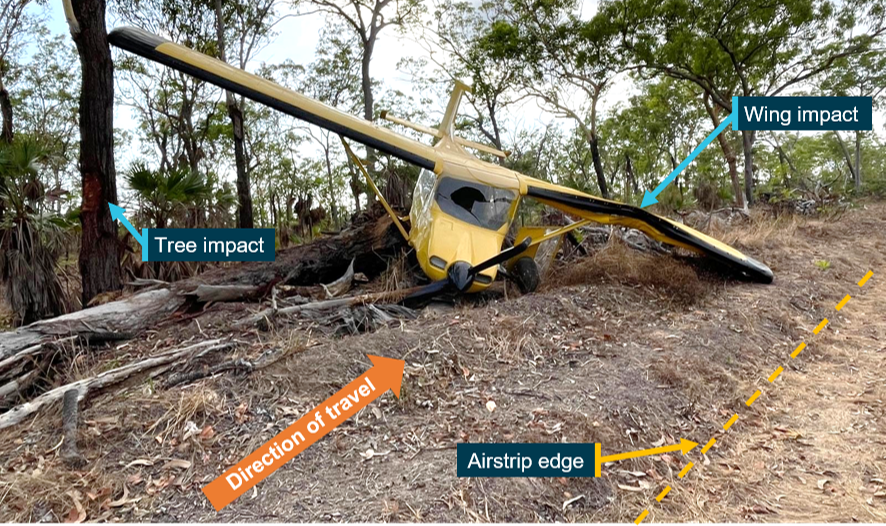
Applying firm braking to reduce the risk of a runway overrun, the pilot encountered directional control issues and the aircraft veered left, leaving the prepared airstrip and striking a tree with the left wing about mid-span. The remaining momentum subsequently spun the aircraft around and carried it into an adjacent pile of logs and tree branches (Figure 1).
The combined impacts substantially damaged the aircraft’s left wing and landing gear, with associated damage to the fuselage and propeller. The pilot was uninjured and able to safely evacuate.
Figure 1: Aircraft following the runway excursion and obstacle impacts
Safety message
The onset of directional control issues on landing can rapidly result in runway excursions and obstacle impacts if approach instabilities are allowed to continue into undesirable aircraft positioning, attitude or speed late into the landing sequence.
Attempting to control and correct for a long, misaligned or overspeed landing significantly increases the likelihood of control loss and subsequent obstacle/terrain impact – particularly in narrow, confined or rough landing areas.
Pilots must remain ready to discontinue an approach or go-around without hesitation, should any aspect of the aircraft’s state be not as expected or unfamiliar.
Similarly, flight planning must always allow a pilot to comfortably make the decision to discontinue an approach, go around, or even divert to another landing area, at any time they may judge that the prevailing conditions might not be within their (or the aircraft’s) handling limits.
About this report
Decisions regarding whether to conduct an investigation, and the scope of an investigation, are based on many factors, including the level of safety benefit likely to be obtained from an investigation. For this occurrence, no investigation has been conducted and the ATSB did not verify the accuracy of the information. A brief description has been written using information supplied in the notification and any follow-up information in order to produce a short summary report, and allow for greater industry awareness of potential safety issues and possible safety actions.
Occurrence summary
| Mode of transport | Aviation |
|---|---|
| Occurrence ID | AB-2026-038 |
| Occurrence date | 28/09/2025 |
| Location | Near Adelaide River |
| State | Northern Territory |
| Occurrence class | Accident |
| Aviation occurrence category | Collision with terrain, Runway excursion |
| Highest injury level | None |
| Brief release date | 03/08/2026 |
Aircraft details
| Manufacturer | Amateur Built Aircraft |
|---|---|
| Model | Murphy Rebel |
| Sector | Piston |
| Operation type | Part 91 General operating and flight rules |
| Activity | General aviation / Recreational - Sport and pleasure flying - Pleasure and personal transport |
| Departure point | Private airstrip, Northern Territory |
| Destination | Private airstrip, Northern Territory |
| Injuries | None |
| Damage | Substantial |