

Report release date: 31/07/2026
| Occurrence Briefs are concise reports that detail the facts surrounding a transport safety occurrence, as received in the initial notification and any follow-up enquiries. They provide an opportunity to share safety messages in the absence of an investigation. Because occurrence briefs are not investigations under the Transport Safety Investigation Act 2003, the information in them is de-identified. |
What happened
On the morning of 18 June 2026, a pilot was preparing to conduct commercial aerial agriculture spraying operations in a Bell 206B helicopter near Glenn Innes, New South Wales. This was the fourth and final day of the operation which spanned over a 690‑hectare property. The helicopter loading site was close to the property’s main structures in the north-western corner of the area.
Prior to commencing the operation, the pilot identified several overhead wire hazards in the property boundaries and reported being familiar with their locations during the operation. Of note was a single‑wire earth return (SWER) that ran in the north-south direction along the western side of the property. This wire ran through the property’s main structures and turned 45 degrees in the north‑west direction. The height of the SWER line varied due to differing pole heights (Figure 1). The pilot had observed this characteristic, verbally identifying the wire while conducting previous spray runs in its vicinity.
The spray run that ended in the accident was conducted in the east-west direction and required the pilot to cross the SWER line. At times, the helicopter passed over it with a slight roll1 to follow the curved sections of the area being sprayed. After completing a run from east to west, the pilot turned the helicopter around to complete the next run. The helicopter passed over the wire with a slight bank angle and the pilot then observed the powerline’s slight rise on the right side (Figure 1). The pilot had misjudged the proximity to the wire resulting in initial contact with the helicopter’s spray boom.2 Due to the location of the strike, the wirestrike protection system was ineffective, and the wire became stuck between the spray equipment and wire cutters.
Figure 1: Area of operation
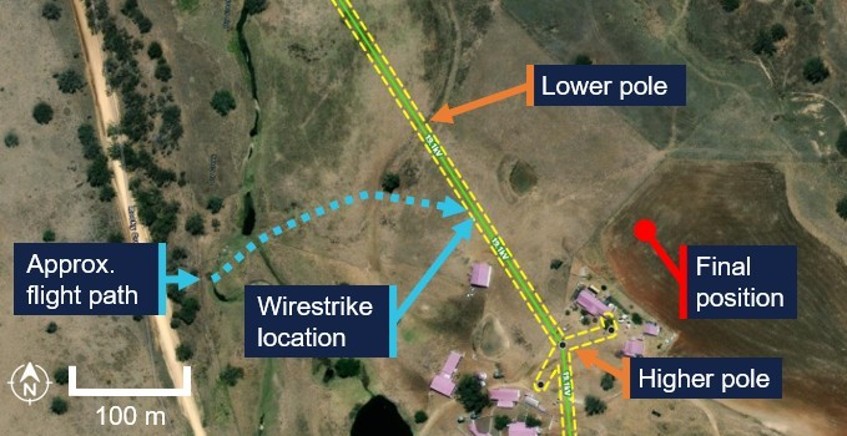
The pilot reported hearing a loud noise and immediately identified a wirestrike had occurred. The helicopter was travelling at approximately 35 knots at the time, and the pilot slowed the aircraft to a hover. As the wire had not cut on contact, the tension was preventing the pilot from freeing the helicopter. The pilot decided an attempt at landing was the best course of action and the helicopter was lowered to 3 ft above the ground. However, as a result the wire tension increased, effectively acting as a pivot point for the nose of the helicopter to roll forward in a similar manner to dynamic rollover.3 At this point in time, the pilot lost control of the helicopter as it continued to roll forward before colliding with the ground. The helicopter subsequently rolled onto its left side sustaining substantial damage to the airframe and major components (Figure 2). The impact activated the emergency locator transmitter which alerted the Joint Rescue Coordination Centre of the accident.
Figure 2: Aircraft damage
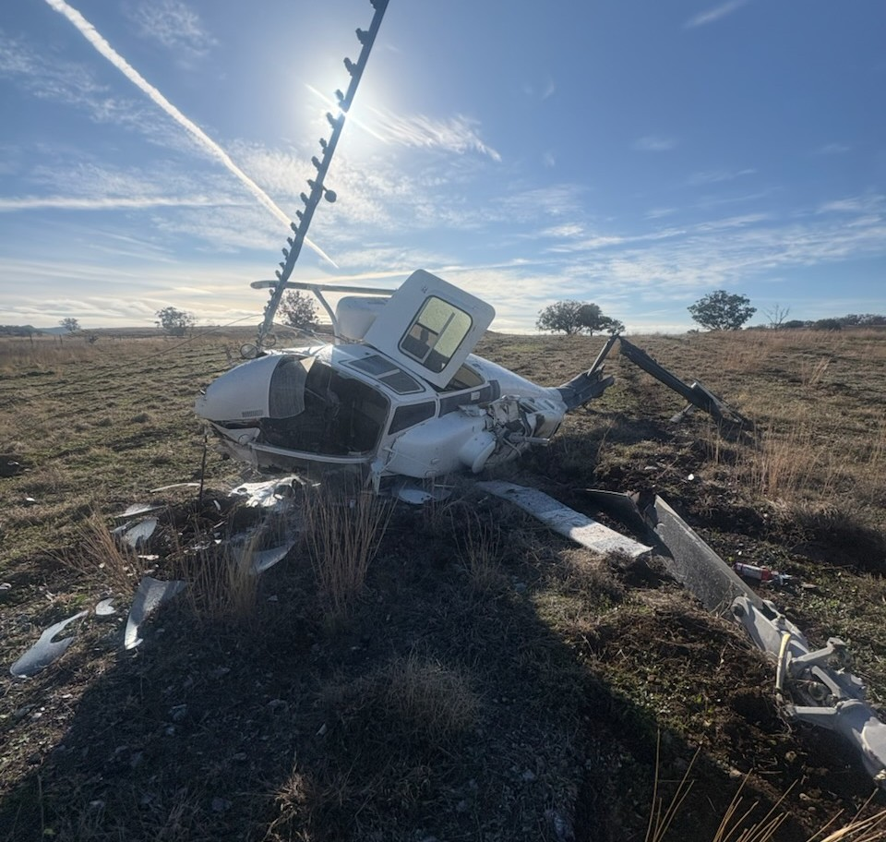
The pilot was uninjured and was wearing a flight helmet as per standard operating procedures. After cutting off fuel and power supply, the pilot quickly exited through the front windshield and reported staying alert to the possibility of the powerline still being energised.
Safety message
Powerlines and other wires are an ongoing hazard to low-level agricultural operations. As outlined in the ATSB education booklet, Wirestrikes involving known wires: A manageable aerial agricultural hazard (AR-2011-028), 63 per cent of wirestrike accidents occurred with pilots aware of the wire position. Therefore, it is essential for pilots to maintain vigilance and adequate separation when crossing in the vicinity of known wires.
This occurrence also highlights the potential threat of struck powerlines remaining energised during the post-accident actions – particularly in cases where the line becomes tangled with the aircraft. Care must be taken when evacuating an aircraft after a wirestrike as the powerline’s location to the aircraft may be difficult to determine.
About this report
Decisions regarding whether to conduct an investigation, and the scope of an investigation, are based on many factors, including the level of safety benefit likely to be obtained from an investigation. For this occurrence, no investigation has been conducted and the ATSB did not verify the accuracy of the information. A brief description has been written using information supplied in the notification and any follow-up information in order to produce a short summary report, and allow for greater industry awareness of potential safety issues and possible safety actions.
- ^ Roll: the movement of an aircraft about its longitudinal axis.
- ^ Spray boom: the tubing and nozzles arranged span-wise below the aircraft for the aerial application of chemicals.
- ^ Dynamic rollover: a rotors-running helicopter resting with one landing skid on the ground may, without appropriate pilot input, commence rolling around the skid. Under certain circumstances, this roll cannot be controlled and the helicopter will roll over.
Occurrence summary
| Mode of transport | Aviation |
|---|---|
| Occurrence ID | AB-2026-037 |
| Occurrence date | 18/06/2026 |
| Location | 46 km north-west of Glenn Innes Airport |
| State | New South Wales |
| Occurrence class | Accident |
| Aviation occurrence category | Collision with terrain, Wirestrike |
| Highest injury level | None |
| Brief release date | 31/07/2026 |
Aircraft details
| Manufacturer | Bell Helicopter Co |
|---|---|
| Model | 206B |
| Sector | Helicopter |
| Operation type | Part 138 Aerial work operations |
| Activity | General aviation/Recreational - Aerial work - Agricultural spreading/spraying |
| Departure point | Private property, New South Wales |
| Destination | Private property, New South Wales |
| Injuries | None |
| Damage | Substantial |