

Report release date: 20/07/2026
| Occurrence Briefs are concise reports that detail the facts surrounding a transport safety occurrence, as received in the initial notification and any follow-up enquiries. They provide an opportunity to share safety messages in the absence of an investigation. Because occurrence briefs are not investigations under the Transport Safety Investigation Act 2003, the information in them is de-identified. |
What happened
Sequence of events
On 14 May 2026, at about 0800 local time, the pilot of a Cessna 172 (C172) aircraft commenced a taxi from the northern hangars at Kalgoorlie-Boulder Airport, Western Australia, to depart from runway 29. The purpose of the flight was to conduct a local area scenic flight with one passenger on board.
The C172 pilot had heard a transmission on the local common traffic advisory frequency (CTAF) from an inbound passenger‑carrying Boeing 737 aircraft, which would soon land on runway 29. The C172 pilot made a transmission stating that they would taxi for a departure using runway 29.
While taxiing, at 0802, the pilot of the C172 heard a transmission from another large air transport aircraft, which was inbound from 30 NM (56 km) north of the airport. The pilot of that aircraft reported they expected to start a 5 NM (9 km) final approach to runway 29 at 0811 and to touchdown at 0813.
The pilot of the C172 had observed a light northerly wind, which meant a departure from either direction was suitable for their aircraft. To improve the scenic flight for their passenger, and as they assessed that they had the time before the arrival of the aircraft inbound from the north, they elected to change their planned departure to runway 11 (Figure 1).
The pilot of the C172 held short of runway 11/29 and observed the recently landed Boeing 737 vacate the runway for the apron. They visually checked for any other traffic in the area and at 0802:34 made a radio call to advise their intention to depart from runway 11, then entered and backtracked that runway. No other pilot acknowledged this transmission.
Meanwhile, unbeknown to the pilot of the C172, a Fokker 100 aircraft, carrying 94 passengers, was on the 10 NM (19 km) arc conducting a VOR-Z1 approach for runway 29. The captain, who was acting as the pilot monitoring,2 was also a check and training captain and was conducting a check flight for the first officer, who was the pilot flying for the sector to Kalgoorlie-Boulder.
The captain reported that they had originally briefed an arrival at Kalgoorlie-Boulder for runway 11. However, the forecast winds meant other aircraft may use runway 29 and the crew planned to change to runway 29 if the flow of traffic dictated it. After hearing the Boeing 737 use runway 29 for its arrival, the crew of the Fokker planned an arrival for runway 29 (Figure 1).
Figure 1: Kalgoorlie-Boulder Airport and planned departure for the C172 and arrival for the Fokker 100
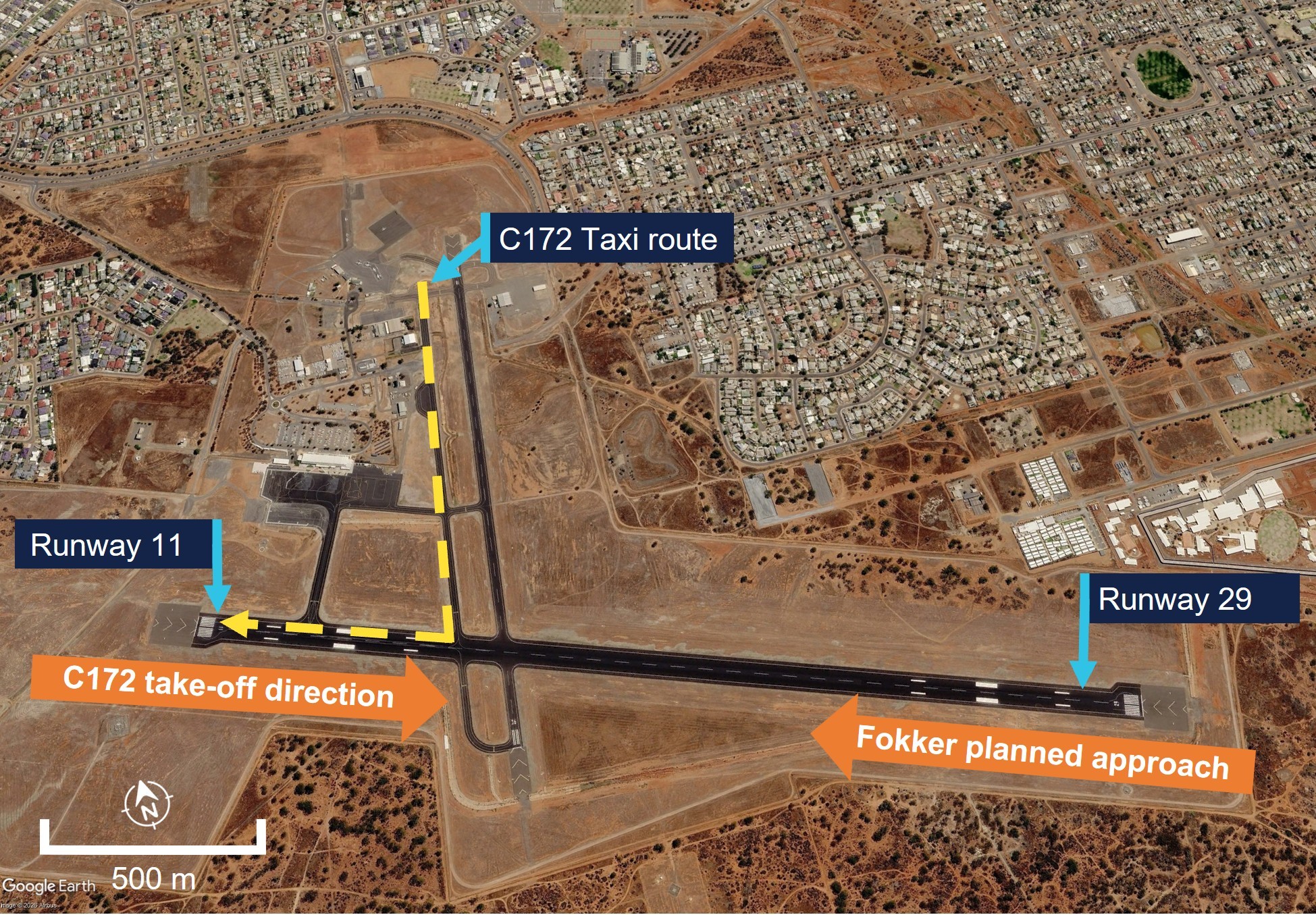
The crew of the Fokker had broadcast their intentions and expected landing times when at 25 NM (46 km) west and 9 NM (17 km) west-south-west of the airport. CTAF recordings from the airport showed that both of those calls were made before the taxi call from the C172. The captain of the Fokker stated they had received the C172 pilot’s initial radio call advising they were taxiing for runway 29. However, the captain indicated that they did not acknowledge the C172 pilot’s taxiing transmission and did not hear any subsequent calls from the pilot.
The pilot of the C172 made a radio call and commenced their take-off roll from runway 11 at 0803:54, while the Fokker was joining a 5 NM (9 km) final approach for the opposite direction runway 29.
At 0805:11, the crew of the Boeing 737, now parked on the apron, proactively alerted the crew of the Fokker that the C172 had departed towards them. The pilot of the C172 estimated that they were about 1,700 ft above mean sea level when they heard this transmission and immediately commenced a left turn away from the airport. The crew of the Fokker, who were about 5 NM (9 km) from touchdown and at about 2,800 ft, made a radio call advising their understanding and intention to go around. The crew initiated the go-around, maintained their heading and climbed to 5,000 ft (Figure 2).
Figure 2: Fokker 100 track to Kalgoorlie-Boulder and C172 estimated departure path
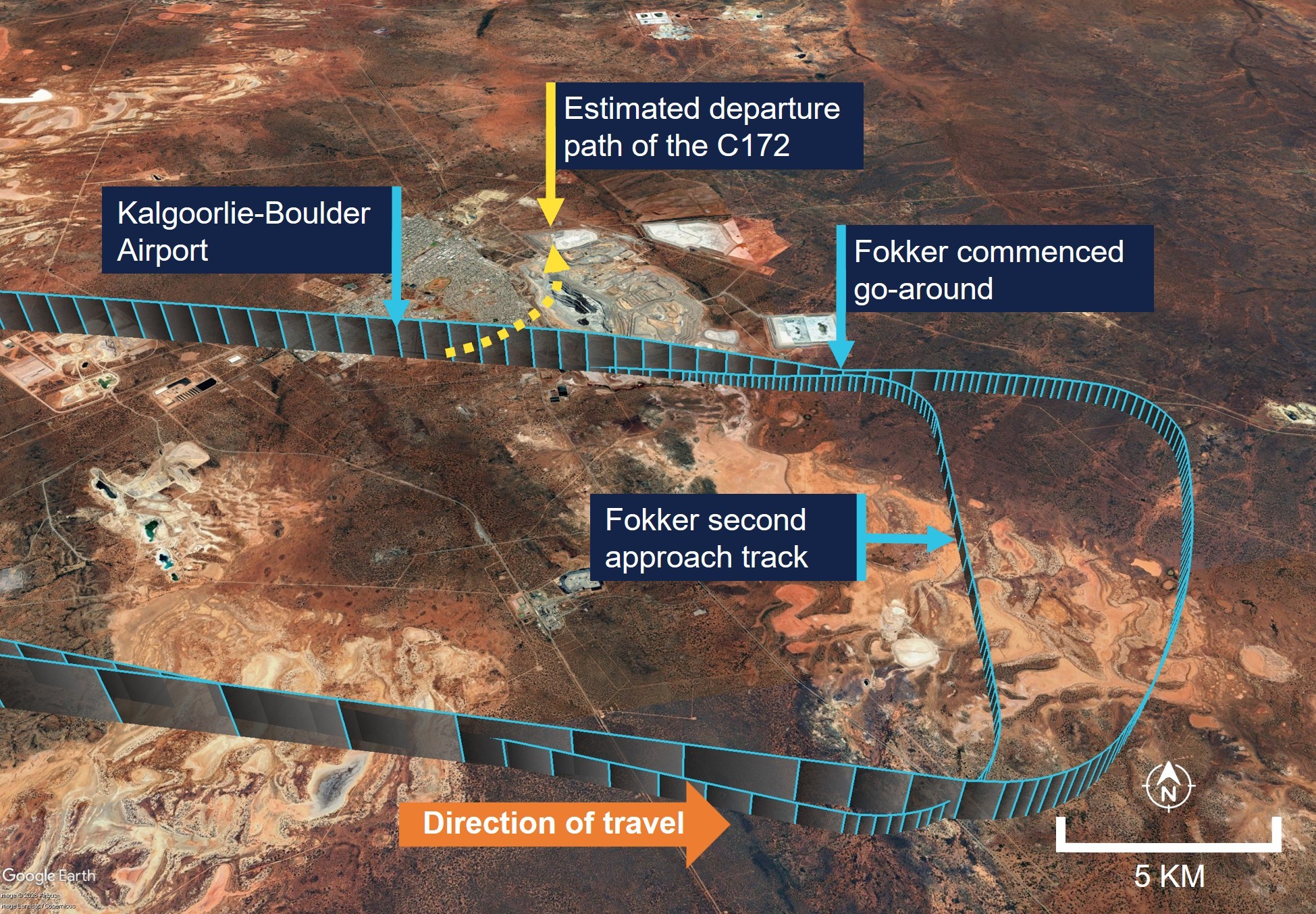
The captain of the Fokker reported they had no indication of the traffic on their traffic alert and collision avoidance system3 (TCAS). After completing the go-around, the captain established direct communication with the C172 pilot and queried the status of that aircraft’s transponder.4 Although the C172 pilot stated that their transponder was ‘ON’, the C172 was not actually fitted with a working transponder nor was it required to be for the operations conducted that day.
The Fokker returned to the airport and landed without further incident on runway 29. The C172 completed the scenic flight and also returned without incident.
Frequency congestion
The captain of the Fokker reported that the Kalgoorlie-Boulder Airport CTAF was congested around the time of the occurrence. From about 0800, 3 large passenger‑carrying air transport aircraft, the C172 and an aircraft at Kambalda aerodrome, about 25 NM (46 km) south-south-east of Kalgoorlie-Boulder, were on the same frequency. While pilots had to wait for a break in transmissions to make radio calls, all pilots were able to communicate their intentions.
From the Fokker’s initial 25 NM (46 km) inbound transmission to the crew announcing their go-around around 10 minutes later, 18 transmissions from 5 aircraft were recorded on the CTAF. This accompanied a period of high workload for the crew of the Fokker 100 who were landing and conducting a check flight.
Safety action
The operator of the C172 advised that the aircraft was subsequently flown to Perth to be fitted with a transponder equipped with ADS-B.5 The pilot of the C172 was issued with an electronic flight bag6 and trained in its use for flight planning and record keeping purposes, and to also aid in additional traffic awareness.
Safety message
Proactive action by the crew of the Boeing 737, to alert the Fokker crew to the C172’s departure, played a large part in avoiding a more serious outcome. The information the B737 crew provided updated the understanding of the pilots of both converging aircraft to what was happening and both pilots were able to respond.
Flight crews are reminded that vigilance for other traffic at busy non-controlled aerodromes is essential and although TCAS is a useful aid for traffic awareness, not all aircraft are required to have transponders fitted. Therefore, TCAS cannot be solely relied upon for traffic information.
Pilots must understand the equipment fitted to their aircraft and how that impacts conspicuity. Operators of all aircraft, and especially those operating in busy, non‑controlled aerodromes, are strongly encouraged to consider the benefits of a Mode S transponder with ADS-B in and out capability. Further information on the current rebate scheme for the installation of ADS-B is available at ADS-B rebate scheme | Civil Aviation Safety Authority.
Pilots are reminded that although accurate and timely radio calls play a critical role in ensuring collision avoidance in non-controlled airspace, they cannot assume from an absence of other radio calls that there is no conflicting traffic. This is particularly important in an environment where there is a high expectation of mixing with other aircraft of different sizes, flight rules and performance levels, operating at the same time in the same airspace.
CASA advisory circular 91-14 Pilots’ responsibility for collision avoidance section 4 details the benefits of alerted see and avoid:
As aviation developed, with increasing aircraft performance, traffic density and flight in non-visual conditions, it became apparent that unalerted see-and-avoid had significant limitations. The need to enhance a pilot’s situational awareness led to the principle of ‘alerted see-and-avoid’.
The primary tool of alerted see-and-avoid that is common across aviation—from sport and recreational to air transport—is radio communication. Radio allows for the communication of information (in this instance traffic information) to the pilot from the ground (e.g. Air Traffic Services) or from other aircraft.

The ATSB SafetyWatch highlights the broad safety concerns that come out of our investigation findings and from the occurrence data reported to us by industry. This occurrence highlights the safety concerns around reducing the collision risk around non-towered airports.
About this report
Decisions regarding whether to conduct an investigation, and the scope of an investigation, are based on many factors, including the level of safety benefit likely to be obtained from an investigation. For this occurrence, no investigation has been conducted and the ATSB did not verify the accuracy of the information. A brief description has been written using information supplied in the notification and any follow-up information in order to produce a short summary report, and allow for greater industry awareness of potential safety issues and possible safety actions.
- ^ VOR-Z: VHF Omnidirectional Radio Range-Z. The VOR approach is designed to allow an aircraft to descend on specified VOR radials to a specified minimum descent altitude.
- ^ Pilot flying (PF) and pilot monitoring (PM): procedurally assigned roles with specifically assigned duties at specific stages of a flight. The PF does most of the flying, except in defined circumstances, such as planning for descent, approach and landing. The PM carries out support duties and monitors the PF’s actions and the aircraft’s flight path.
- ^ A traffic alert and collision avoidance system is an aircraft collision avoidance system designed to reduce the incidence of mid-air collision between aircraft. It monitors the airspace around an aircraft for other aircraft equipped with a corresponding active transponder.
- ^ Transponder: A flight transponder is an automated transceiver in an aircraft that emits a coded identifying signal in response to an interrogating received signal.
- ^ Automatic dependent surveillance–broadcast is a surveillance technology in which an aircraft determines its position via satellite navigation and periodically broadcasts it, enabling it to be tracked.
- ^ Software and data-service solution to digitise logbooks charts, and other flight documents to achieve a paperless cockpit.
Occurrence summary
| Mode of transport | Aviation |
|---|---|
| Occurrence ID | AB-2026-030 |
| Occurrence date | 14/05/2026 |
| Location | 10 km east-south-east of Kalgoorlie-Boulder Airport |
| State | Western Australia |
| Occurrence class | Incident |
| Aviation occurrence category | Communications - Other, Missed approach, Separation issue |
| Highest injury level | None |
| Brief release date | 20/07/2026 |
Aircraft details
| Manufacturer | Fokker B.V. |
|---|---|
| Model | F28 MK 0100 |
| Sector | Jet |
| Operation type | Part 121 Air transport operations - larger aeroplanes |
| Activity | Commercial air transport-Scheduled-Domestic |
| Departure point | Perth Airport, Western Australia |
| Destination | Kalgoorlie-Boulder Airport, Western Australia |
| Injuries | None |
| Damage | Nil |
Aircraft details
| Manufacturer | Cessna Aircraft Company |
|---|---|
| Model | 172N |
| Sector | Piston |
| Operation type | Part 135 Air transport operations - smaller aeroplanes |
| Activity | Commercial air transport-Non-scheduled-Joyflights/sightseeing charters |
| Departure point | Kalgoorlie-Boulder Airport, Western Australia |
| Destination | Kalgoorlie-Boulder Airport, Western Australia |
| Injuries | None |
| Damage | Nil |