

What happened
On the morning of 7 June 2024, a Recreational Aviation Australia Inc. registered Aerochute powered parachute was being prepared for departure at Ingham Airport, Queensland. The pilot was conducting launch preparations with the assistance of 2 ground crew, positioned at either end of the ground‑deployed parachute. The Aerochute was intending to conduct take-off on the airport apron, away from the main runway. While the pilot was leaning over the front of the parachute, preparing radio and navigation equipment, a Robinson R44 helicopter approached from the north-west down the taxiway for landing on the apron about 40–50 m from the Aerochute (Figure 1). The helicopter downdraft caused the parachute to escape from the ground handlers and inflate suddenly. The sudden inflation of the parachute rocked the Aerochute backwards, ejecting the pilot. The pilot impacted the ground and sustained significant head, neck and rib injuries.
Figure 1: Terminal area locations of aircraft
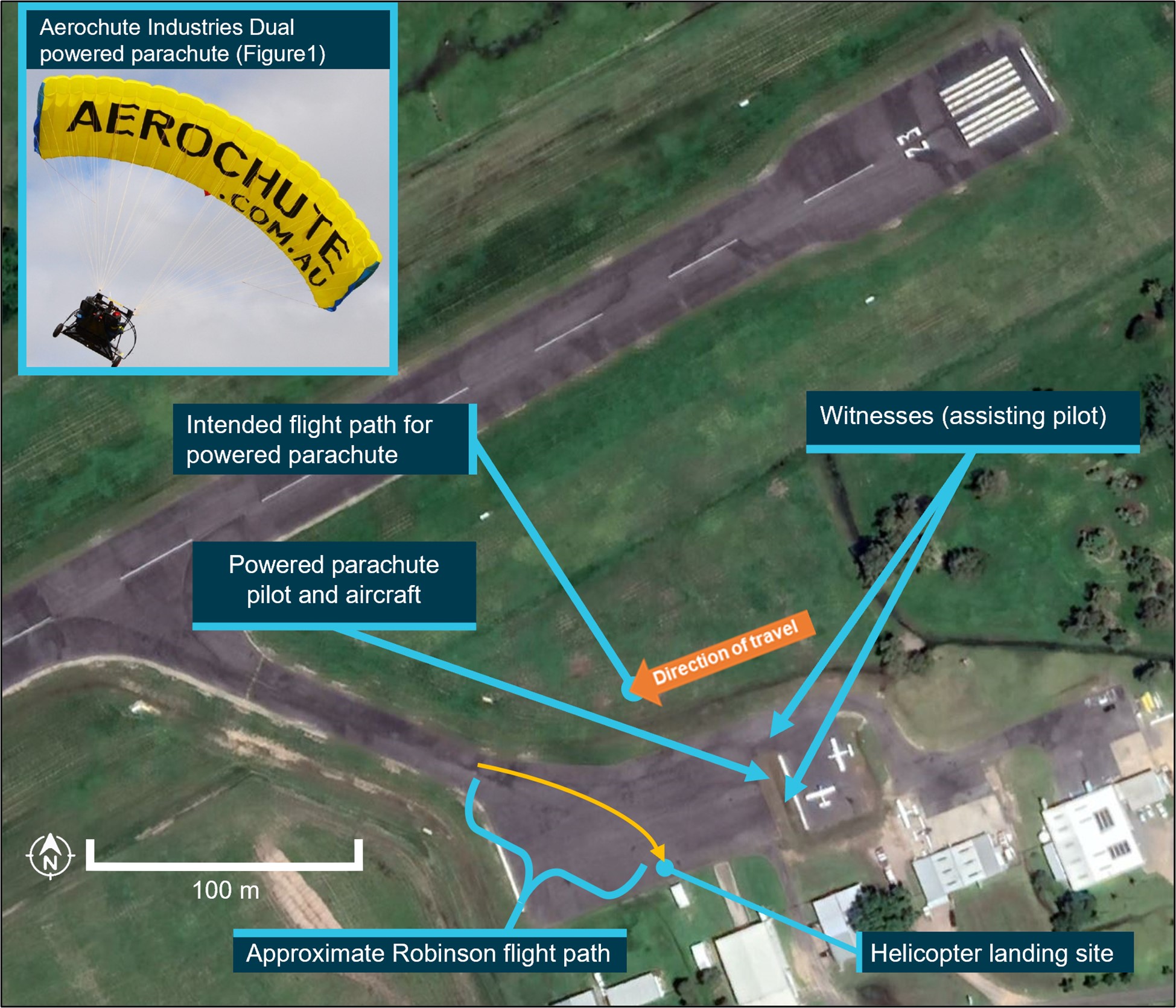
Source: Google Earth with ATSB annotations
Safety message
Helicopter pilots are reminded of the need to be cautious of their rotor wash when operating near persons and aircraft, especially when downwash (rotor wash) effects could cause unintended movement or pose a hazard. Maintaining a minimum safe distance when hovering or taxiing is crucial. CASA AC 91-29 v1.3 advises that light helicopters should observe a minimum 30 metre downwash safety distance, while medium helicopters should maintain a 50 metre distance, and heavy helicopters should keep a 65 metre distance. Being aware of downwash effects and establishing appropriate safety distances around the operating site can help mitigate hazards.
It is essential that all pilots assess the suitability of areas designated for take-off and landing. Powered parachute pilots should ensure permission to operate from areas not within the runway surface area and be familiar with local requirements, procedures, and operations.
Additionally, aerodrome operators should clearly define areas of operations for non-traditional aviation operations when granting permission to operate.
About this report
Decisions regarding whether to conduct an investigation, and the scope of an investigation, are based on many factors, including the level of safety benefit likely to be obtained from an investigation. For this occurrence, no investigation has been conducted and the ATSB did not verify the accuracy of the information. A brief description has been written using information supplied in the notification and any follow-up information in order to produce a short summary report, and allow for greater industry awareness of potential safety issues and possible safety actions.
Occurrence summary
| Mode of transport | Aviation |
|---|---|
| Occurrence ID | AB-2024-032 |
| Occurrence date | 07/06/2024 |
| Location | Ingham Airport |
| State | Queensland |
| Occurrence class | Accident |
| Aviation occurrence category | Collision with terrain |
| Highest injury level | None |
| Brief release date | 26/08/2024 |
Aircraft details
| Manufacturer | Robinson Helicopter Co |
|---|---|
| Model | R44 II |
| Sector | Helicopter |
| Operation type | Part 133 Air transport operations - rotorcraft |
| Departure point | Ingham Airport, Queensland |
| Destination | Ingham Airport, Queensland |
| Damage | Nil |
Aircraft details
| Model | Aerochute Industries Dual |
|---|---|
| Sector | Sport and recreational |
| Operation type | Part 91 General operating and flight rules |
| Departure point | Ingham Airport, Queensland |
| Destination | Ingham Airport, Queensland |
| Damage | Substantial |